Isaiah 36:13

Hebrew (Westminster Leningrad Codex) Isaiah 36:13 appears in the Hebrew Old Testament. The text above is from the Westminster Leningrad Codex. Each word links to its Strong’s number, a concise gloss, and parsing drawn from the Open Scriptures Hebrew Bible morphology. Click any word for its full Brown-Driver-Briggs (BDB) entry.
Download image
Cite this verse

Isaiah 36:13 (World English Bible). Public Domain. Lemma interlinear Bible study tool, https://lemma.gebible.app/v/isaiah/36/13.

Show BibTeX & RIS
BibTeX
RIS
English Translation
Then Rabshakeh stood, and cried with a loud voice in the Jews' language, and said, Hear you the words of the great king, the king of Assyria.
World English Bible · Public Domain
Download a study sheet

One document with this verse’s original text, its word-by-word gloss line, the meaning frame, cross-references with their text, attributed commentary, and full source and license credits — printable, and it pastes into notes with its structure intact.

This verse Autodidact and up

Study sheet (.html) Plain text (.txt)

A passage Seminary Student

Up to 50 verses in one chapter. A passage sheet keeps up to 6 commentary sources and 12 cross-references per verse, in the order this page ranks them, and says so on the sheet whenever that leaves anything out. Ask for a single verse and you get the Autodidact verse sheet above.

Everything on this page stays free to read, with no account — the sheet is a download of what is already on screen, not access to it.

Want to remove ads? Support Godless Engineer
Compare translations 3

The same verse in 3 English versions, stacked beneath the original-language interlinear above. Click any original word for its lexicon entry.

Each is an independent rendering of the whole verse — the interlinear is not word-aligned to these translations.

Highlighted words mark where these versions differ — a whole-verse word diff, not a word-by-word alignment.

  • World English Bible Public Domain
    Then Rabshakeh stood, and cried with a loud voice in the Jews' language, and said, Hear you the words of the great king, the king of Assyria.
  • King James Version Public Domain
    Then Rabshakeh stood, and cried with a loud voice in the Jews' language, and said, Hear ye the words of the great king, the king of Assyria.
  • unfoldingWord Literal Text CC BY-SA 4.0
    And the Rabshakeh stood, and he called out in a great voice Judean and said, “Hear the words of the great king, the king of Assyria.

unfoldingWord Literal Text — © unfoldingWord, licensed CC BY-SA 4.0. Word-aligned USFM3 via Door43 (git.door43.org/unfoldingWord/en_ult).

Versions to compare (up to 4)

3 of 4 selected

Show all 18 translations

Every available English version of this verse, each an independent rendering of the whole verse.

  • World English Bible Public Domain
    Then Rabshakeh stood, and cried with a loud voice in the Jews' language, and said, Hear you the words of the great king, the king of Assyria.
  • Berean Standard Bible Public Domain
    Then the Rabshakeh stood and called out loudly in Hebrew: “Hear the words of the great king, the king of Assyria!
  • Majority Standard Bible Public Domain
    Then the Rabshakeh stood and called out loudly in Hebrew: “Hear the words of the great king, the king of Assyria!
  • King James Version Public Domain
    Then Rabshakeh stood, and cried with a loud voice in the Jews' language, and said, Hear ye the words of the great king, the king of Assyria.
  • American Standard Version (1901) Public Domain
    Then Rabshakeh stood, and cried with a loud voice in the Jews' language, and said, Hear ye the words of the great king, the king of Assyria.
  • Revised Version (1885) Public Domain
    Then Rabshakeh stood, and cried with a loud voice in the Jews’ language, and said, Hear ye the words of the great king, the king of Assyria.
  • Geneva Bible (1599) Public Domain
    So Rabshakeh stood, and cryed with a loude voyce in the Iewes language, and sayd, Heare the wordes of the great King, of the King of Asshur.
  • Douay-Rheims (1899) Public Domain
    Then Rabsaces stood, and cried out with a loud voice in the Jews' language, and said: Hear the words of the great king, the king of the Assyrians.
  • Young's Literal Translation Public Domain
    And Rabshakeh standeth and calleth with a great voice `in' Jewish, and saith, `Hear ye the words of the great king, the king of Asshur:
  • Literal Standard Version CC BY-SA 4.0
    And Rabshakeh stands and calls with a great voice [in] Jewish, and says, “Hear the words of the great king, the king of Asshur—
  • Unlocked Literal Bible CC BY-SA 4.0
    Then the chief commander stood and shouted in a loud voice in the Jews' language, saying, “Listen to the words of the great king, the king of Assyria.
  • unfoldingWord Literal Text CC BY-SA 4.0
    And the Rabshakeh stood, and he called out in a great voice Judean and said, “Hear the words of the great king, the king of Assyria.
  • Darby Bible Public Domain
    And Rab-shakeh stood and cried with a loud voice in the Jewish [language], and said, Hear the words of the great king, the king of Assyria!
  • World Messianic Bible Public Domain
    Then Rabshakeh stood, and called out with a loud voice in the Jews’ language, and said, “Hear the words of the great king, the king of Assyria!
  • Webster's Bible Public Domain
    Then Rabshakeh stood, and cried with a loud voice in the Jew's language, and said, Hear ye the words of the great king, the king of Assyria.
  • Free Bible Version CC BY-SA 4.0
    Then the army general shouted out in Hebrew, “Listen to this from the great king, the king of Assyria!
  • Bible in Basic English Public Domain
    Then the Rab-shakeh got up and said with a loud voice in the Jews' language, Give ear to the words of the great king, the king of Assyria:
  • JPS Tanakh (1917) Public Domain
    Then Rab-shakeh stood, and cried with a loud voice in the Jews' language, and said: 'Hear ye the words of the great king, the king of Assyria.

Literal Standard Version (2020), Covenant Press — licensed CC BY-SA 4.0. Text via the HelloAO Bible API (eBible.org). Unlocked Literal Bible (unfoldingWord) — licensed CC BY-SA 4.0. Text via the HelloAO Bible API (eBible.org). unfoldingWord Literal Text — © unfoldingWord, licensed CC BY-SA 4.0. Word-aligned USFM3 via Door43 (git.door43.org/unfoldingWord/en_ult). Free Bible Version, Dr. Jonathan Gallagher — licensed CC BY-SA 4.0. Text via the HelloAO Bible API (eBible.org).

Word by word

More ways to search: Search by grammar → Find every occurrence → Compare this word →

Practice this passage: Drill this verse → Learn its vocabulary →

יְהוּדִ֑ית
Yᵉhûwdîyth
H3066
“Hebrew”
Noun, Gentilic, Feminine, Singular, Absolute
Part of Speech
Noun
Type
Gentilic
Gender
Feminine
Number
Singular
State
Absolute
Full BDB Definition

Origin: from H3064

TWOT: 850b

in the Jewish language, in Hebrew
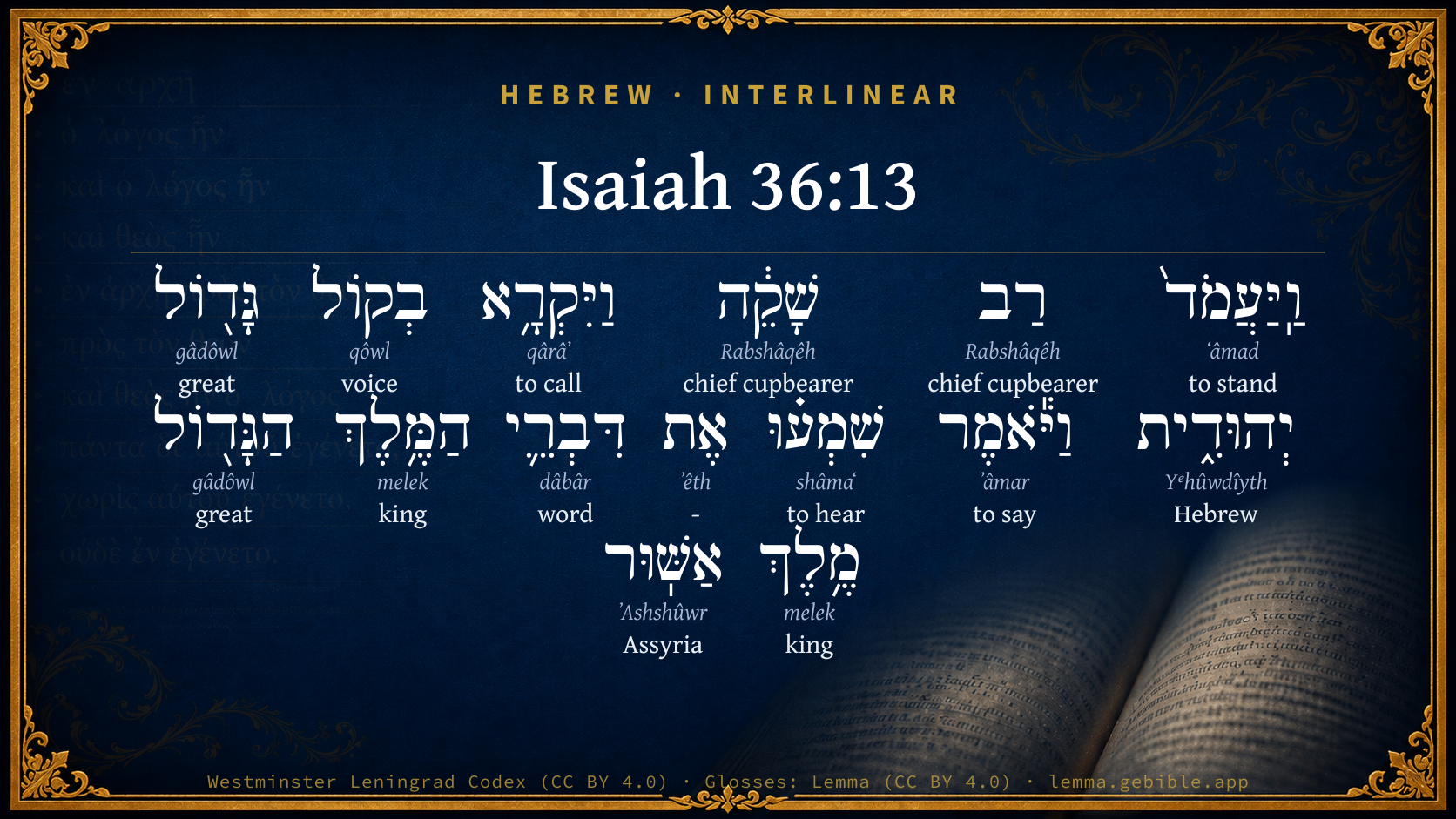
  1. וַֽיַּעֲמֹד֙ ʻâmad H5975 “and · to stand” Conjunction + Verb, Qal, Sequential Imperfect, 3rd Person, Masculine, Singular
  2. רַב Rabshâqêh H7262 “chief cupbearer” Noun, Proper
  3. שָׁקֵ֔ה Rabshâqêh H7262 “chief cupbearer” Noun, Proper
  4. וַיִּקְרָ֥א qârâʼ H7121 “and · to call” Conjunction + Verb, Qal, Sequential Imperfect, 3rd Person, Masculine, Singular
  5. בְקוֹל qôwl H6963 “in/at · voice” Preposition + Noun, Common, Masculine, Singular, Absolute
  6. גָּד֖וֹל gâdôwl H1419 “great” Adjective, Adjective, Masculine, Singular, Absolute
  7. וַיֹּ֕אמֶר ʼâmar H559 “and · to say” Conjunction + Verb, Qal, Sequential Imperfect, 3rd Person, Masculine, Singular
  8. שִׁמְע֗וּ shâmaʻ H8085 “hear” Verb, Qal, Imperative, 2nd Person, Masculine, Plural
  9. אֶת ʼêth H853 “-” Particle, Direct Object
  10. דִּבְרֵ֛י dâbâr H1697 “words of” Noun, Common, Masculine, Plural, Construct
  11. הַמֶּ֥לֶךְ melek H4428 “the · king” Particle, Definite Article + Noun, Common, Masculine, Singular, Absolute
  12. הַגָּד֖וֹל gâdôwl H1419 “the · great” Particle, Definite Article + Adjective, Adjective, Masculine, Singular, Absolute
  13. מֶ֥לֶךְ melek H4428 “king of” Noun, Common, Masculine, Singular, Construct
  14. אַשּֽׁוּר ʼAshshûwr H804 “Assyria” Noun, Proper

About this verse

These counts appear in no published source. They are computed here, from the morphology-tagged text and Lemma’s own curated glosses. What Lemma adds →

15
words
12
distinct lemmas
Prophets
section

Notable vocabulary

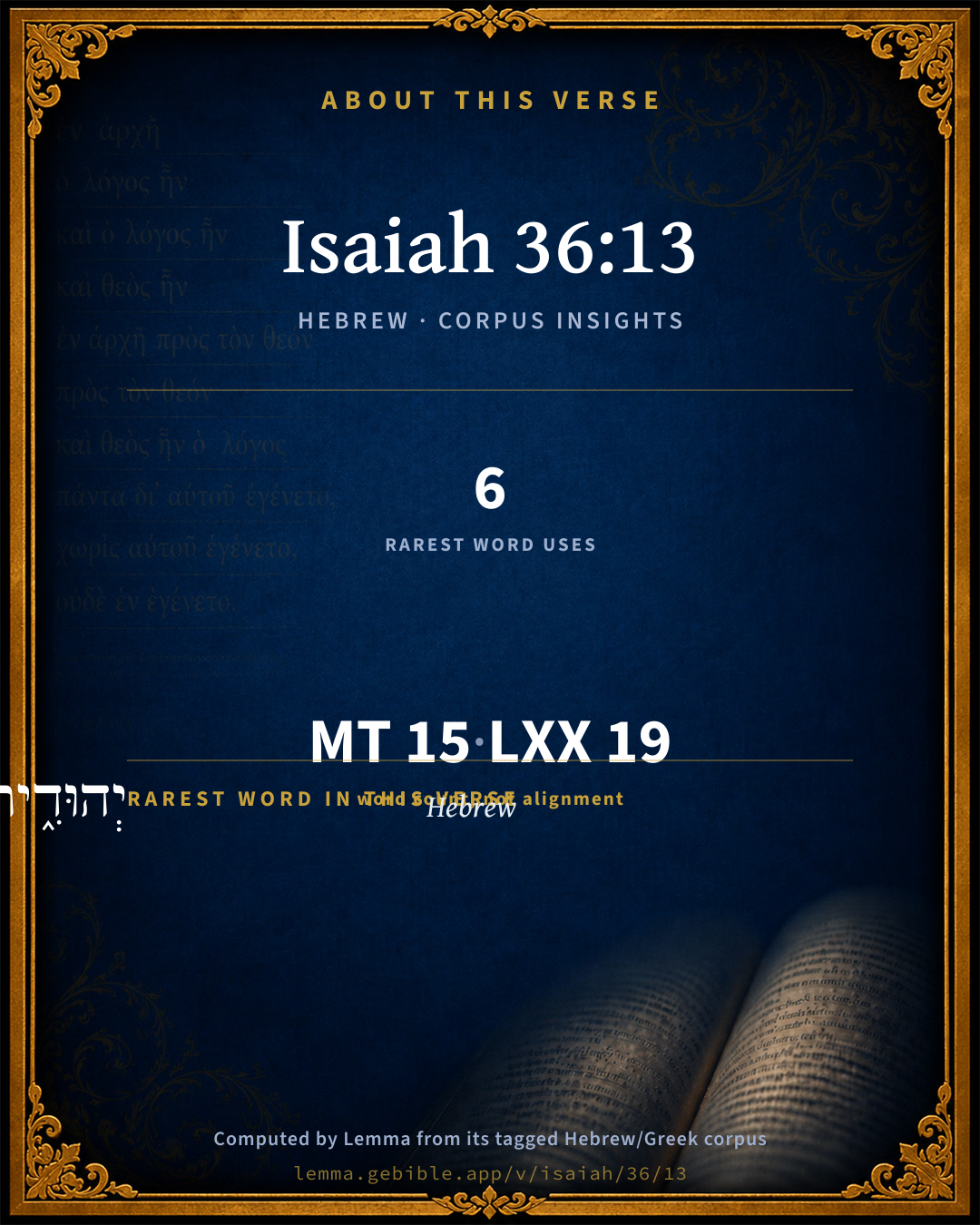
The rarest word here is יְהוּדִ֑ית Hebrew H3066 — appearing just 6 times in the whole Hebrew Bible.

Shared distinctive vocabulary

יְהוּדִ֑ית Hebrew H3066 occurs in 6 verses of the Hebrew Bible. Also found in:

Grammatical profile

  • 4 verbs
  • 8 nouns
  • 2 adjectives
  • 1 particle

Verb forms

  • וַֽיַּעֲמֹד֙ Qal · Sequential Imperfect
  • וַיִּקְרָ֥א Qal · Sequential Imperfect
  • וַיֹּ֕אמֶר Qal · Sequential Imperfect
  • שִׁמְע֗וּ Qal · Imperative

Repetition

Words recur within this verse — often emphatic in Hebrew:

  • רַב chief cupbearer H7262 ×2
  • גָּד֖וֹל great H1419 ×2
  • הַמֶּ֥לֶךְ king H4428 ×2

Hebrew & Septuagint length

In English translation the verse runs 27 words from the Hebrew and 28 from the Septuagint (LXX English) — closely comparable.

A rough comparison of the two English renderings, which tokenize alike — not a word-level alignment.

Word counts can differ between the Hebrew and the Greek without any difference in meaning — e.g. the Hebrew direct-object marker אֵת has no separate Greek word, and Greek often adds the article ὁ.

In the original languages it is 15 Hebrew tokens and 19 Greek tokens — but the two are counted differently (Hebrew bundles its prefixes and suffixes into one token; the Greek is in lemma form), so that isn’t a like-for-like length.

Cross-references

11

Topical passages linked to Isaiah 36:13 in the Treasury of Scripture Knowledge — connected by theme and wording, ordered by reader-vote popularity; previews shown in the World English Bible.

  • 2 Chronicles 32:18 They cried with a loud voice in the Jews' language to the people of Jerusalem who were on the wall, to frighten them, and to trouble them; that they might take the city.
  • 1 Samuel 17:8–11 He stood and cried to the armies of Israel, and said to them, Why are you come out to set your battle in array? am I not a Philistine, and you servants to Saul? choose you a man for you, and let him come down to me.
  • 2 Kings 18:28–32 Then Rabshakeh stood, and cried with a loud voice in the Jews' language, and spoke, saying, Hear you the word of the great king, the king of Assyria.
  • Psalms 17:10–13 They close up their callous hearts. With their mouth they speak proudly.
  • Psalms 73:8–9 They scoff and speak with malice. In arrogance, they threaten oppression.
  • Psalms 82:6–7 I said, "You are gods, All of you are sons of the Most High.
  • Isaiah 8:7 now therefore, behold, the Lord brings up on them the waters of the River, strong and many, [even] the king of Assyria and all his glory: and it shall come up over all its channels, and go over all its banks;
  • Isaiah 10:8–13 For he says, Aren't my princes all of them kings?
  • Isaiah 36:4 Rabshakeh said to them, Say you now to Hezekiah, Thus says the great king, the king of Assyria, What confidence is this in which you trust?
  • Ezekiel 31:3–10 Behold, the Assyrian was a cedar in Lebanon with beautiful branches, and with a forest-like shade, and of high stature; and its top was among the thick boughs.
  • Daniel 4:37 Now I, Nebuchadnezzar, praise and extol and honor the King of heaven; for all his works are truth, and his ways justice; and those who walk in pride he is able to abase.

Cross-references courtesy of OpenBible.info (CC BY 4.0).

Hebrew and Greek witnesses Masoretic Hebrew ↔ Greek Septuagint

The same verse in the two great witnesses to the Old Testament, shown verse-for-verse.

These are two independent witnesses, not word-aligned to each other, and the Septuagint is shown in lemma (dictionary) form.

Hebrew Isaiah 36:13 Masoretic · Westminster Leningrad Codex

וַֽיַּעֲמֹד֙ רַב שָׁקֵ֔ה וַיִּקְרָ֥א בְקוֹל גָּד֖וֹל יְהוּדִ֑ית וַיֹּ֕אמֶר שִׁמְע֗וּ אֶת דִּבְרֵ֛י הַמֶּ֥לֶךְ הַגָּד֖וֹל מֶ֥לֶךְ אַשּֽׁוּר

Then Rabshakeh stood, and cried with a loud voice in the Jews' language, and said, Hear you the words of the great king, the king of Assyria.

World English Bible · Public Domain

Greek LXX Isaiah 36:13 Septuagint · lemma form

καί ἵστημι ραψακης καί βοάω φωνή μέγας ἰουδαϊστί καί εἶπον ἀκούω ὁ λόγος ὁ βασιλεύς ὁ μέγας βασιλεύς ἀσσύριος

And Rabsaces stood and cried with a loud voice in the Jewish language, and said, Hear you⌃ the words of the great king, the king of the Assyrians:

LXX2012 (modern English Septuagint) · Public Domain

Hebrew: Westminster Leningrad Codex (CC BY 4.0). Greek: Septuagint (public domain); English from LXX2012 (modern English Septuagint) (Public Domain). How the Septuagint differs from the Hebrew →

Targum (Aramaic paraphrase)

1

The Targum is the ancient Jewish Aramaic paraphrase of the Hebrew Scriptures — an interpretive translation, not the Hebrew text itself. Onkelos (literal) and Pseudo-Jonathan (expansive) render the Torah, and Jonathan the Prophets. Coverage is partial: where no permissively-licensed English translation exists for a verse, only the Aramaic is shown. This is verse-level text, not a word-by-word alignment to the Hebrew.

  1. Targum Jonathan Prophets (Joshua–Malachi)
    וְקָם רַבְשָׁקֵה וְאַכְלֵי בְקַל רַב יְהוּדִית וַאֲמַר שְׁמָעוּ יַת פִּתְגָמָא מַלְכָּא דְרַבְּתָנָא מַלְכָּא דְאַתּוּר:

    Then Rabshakeh stood forth, and cried with a loud voice in the Jews' language, and said, Hear ye the words of our great king, the king of Assyria.

    Targum Jonathan — Aramaic: “Mikraot Gedolot” (public domain). English: “Sefaria Community Translation” (CC0 1.0 (public-domain dedication)); “London "Chaldee Paraphrase," 1871” (public domain). Text via Sefaria.

Commentary

Notes on Isaiah 36:13 from classic Christian and Jewish commentators (each source and its license shown beneath its notes). The classic Christian expositions comment on the surrounding passage and are grouped to its opening verse, so a note may address several verses; the Jewish commentaries on the Tanakh (Rashi and others) are per-verse, so they appear only where the commentator wrote on this verse.

Lemma curates 59 commentaries, every one of them public domain or Creative Commons licensed, each selected and text-cleaned for this edition rather than reprinted as found. About our sources →

The Biblical Illustrator

Joseph S. Exell

Isa_36:13-21

Hear ye the words of the great king

The bland insinuations of the enemies of Gods people

When Satan would tempt men from trusting in God and cleaving to Him, he doth it by insinuating that in yielding to him they may better their condition; but it is a false suggestion, and grossly absurd, and therefore to be rejected with the utmost abhorrence, when the world and the flesh say to us, Make an agreement with us, and come out to us, submit to our dominion and come into our interests, and you shall eat every one of his own vine, they do but deceive us, promising liberty when they would lead us into the basest captivity and slavery.

One might as good take Rabshakehs word as theirs for kind usage and fair quarter; therefore, when they speak fair, believe them not. Let them say what they will, there is no land like the land of promise, the holy land. (M. Henry.)

The Biblical Illustrator, edited by Joseph S. Exell (c. 1880s–1900s) — public domain. Text from a community e-Sword module.

Tyndale Open Study Notes

Tyndale Open Resources

36:13-20 In the Assyrian chief of staff’s second speech, he claimed that his nation’s gods were more powerful than the God of Judah (cp. 10:9-10). God’s ability to rescue his people was at stake. In the ensuing drama, the Lord shocked the Assyrian with his power (37:36-37).

Tyndale Open Study Notes — © Tyndale Open Resources, licensed CC BY-SA 4.0. Text via the HelloAO Bible API.

Jamieson, Fausset & Brown

Robert Jamieson, A. R. Fausset & David Brown

Rab-shakeh speaks louder and plainer than ever to the men on the wall.

Jamieson, Fausset & Brown — Commentary Critical and Explanatory on the Whole Bible (1871) — public domain (CC PDM 1.0). Text via the HelloAO Bible API.

The Cambridge Bible for Schools and Colleges

gen. ed. J. J. S. Perowne

13. the great king] It is to be observed that the speaker consistently withholds the title of king from Hezekiah.

13–20. The Rabshakeh’s appeal to the people.

The Cambridge Bible for Schools and Colleges (gen. ed. J. J. S. Perowne; Cambridge University Press, 1878–1918) — public domain. Text from a community e-Sword module.

John Gill's Exposition

Then Rabshakeh stood, and cried with a loud voice in the Jews' language,.... In which he spoke before; but now he raised up himself, and elevated his voice, and strained himself to the utmost, that all the people might hear, and that he might strike a terror into them, and stir them up to mutiny and rebellion, and oblige their governors to give up the city into the hands of the Assyrians; this use he made of the request of Hezekiah's ministers, perceiving hereby their fears, and the disposition of the people:

and said, hear ye the words of the great king, the king of Assyria; See Gill on Isa 36:4.

John Gill's Exposition of the Whole Bible (1746–1763) — public domain (CC PDM 1.0). Text via the HelloAO Bible API.

Albert Barnes' Notes on the Bible

Then Rabshakeh stood - Indicating the posture of a man who intends to speak to them at a distance.

And cried with a loud voice - So that those on the wall could bear.

The words of the king ... - (See the note at Isa 36:4)

Albert Barnes' Notes on the Bible (1834–1885) — public domain. Text from a community e-Sword/MySword module.

The Pulpit Commentary

Then Rabshakeh stood; i.e. "rose from a sitting or reclining posture to attract attention, and the better to make himself heard. He continued his speech in Hebrew, and at the same time purposely raised his voice to a loud pitch. The envoys would have been justified in ordering the archers to shoot him from the wall. But they seem to have been struck of a heap, as Epiphanes was by the audacity of Popillius (see the comment on the preceding verse).

The Pulpit Commentary (1880–1919), ed. H.D.M. Spence-Jones & Joseph S. Exell — public domain. Text from a community e-Sword module.

Keil & Delitzsch

C. F. Keil & F. Delitzsch

After Rabshakeh had refused the request of Hezekiah's representatives in this contemptuous manner, he turned in defiance of them to the people themselves. "Then Rabshakeh went near, and cried with a loud voice in the Jewish language (K. and spake), and said, Hear the words (K. the word) of the great king, the king of Asshur. Thus saith the king, Let not Hizkiyahu practise deception upon you (יסה, K. יסהיא)); for he cannot deliver you (K. out of his hand). And let not Hizkiyahu feed you with hope in Jehovah, saying, Jehovah will deliver, yea, deliver us: (K. and) this city will not be delivered into the hand of the king of Asshur. Hearken not to Hizkiyahu: for thus saith the king (hammelekh, K. melekh) of Asshur, Enter into a connection of mutual good wishes with me, and come out to me: and enjoy every one his vine, and every one his fig-tree, and drink every one the water of his cistern; till I come and take you away into a land like your land, a land of corn and wine, a land of bread-corn and vineyards (K. a land full of fine olive-trees and honey, and live and do not die, and hearken not to Hizkiyahu); that Hizkiyahu to not befool you (K. for he befools you), saying, Jehovah will deliver us! Have the gods of the nations delivered (K. really delivered) every one his land out of the hand of the king of Asshur? Where are the gods of Hamath and Arpad? where the gods of Sepharvayim (K. adds, Hena‛ and ‛Ivah)? and how much less (וכי, K. כּי) have they delivered that Samaria out of my hand? Who were they among all the gods of these (K. of the) lands, who delivered their land out of my hand? how much less will Jehovah deliver Jerusalem out of my hand!? The chronicler also has this continuation of Rabshakeh's address in part (Ch2 32:13-15), but he has fused into one the Assyrian self-praise uttered by Rabshakeh on his first and second mission. The encouragement of the people, by referring to the help of Jehovah (Ch2 32:6-8), is placed by him before this first account is given by Isaiah, and forms a conclusion to the preparations for the contest with Asshur as there described. Rabshakeh now draws nearer to the wall, and harangues the people. השּׁיא is construed here with a dative (to excite treacherous hopes); whereas in Ch2 32:15 it is written with an accusative. The reading מיּדו is altered from מיּדי in Isa 36:20, which is inserted still more frequently by the chronicler. The reading את־העיר with תנּתן is incorrect; it would require ינּתן (Ges. 143, 1a). To make a berâkhâh with a person was equivalent to entering into a relation of blessing, i.e., into a state of mind in which each wished all prosperity to the other. This was probably a common phrase, though we only meet with it here. יצא, when applied to the besieged, is equivalent to surrendering (e.g., Sa1 11:3). If they did that, they should remain in quiet possession and enjoyment, until the Assyrian fetched them away (after the Egyptian campaign was over), and transported them to a land which he describes to them in the most enticing terms, in order to soften down the inevitable transportation. It is a question whether the expansion of this picture in the book of Kings is original or not; since ועוּה הנע in Isa 36:19 appears to be also tacked on here from Isa 37:13 (see at this passage). On Hamath and Arpad (to the north of Haleb in northern Syria, and a different place from Arvad = Arad), see Isa 10:9. Sepharvayim (a dual form, the house of the Sepharvı̄m, Kg2 17:31) is the Sipphara of Ptol. v. 18, 7, the southernmost city of Mesopotamia, on the left bank of the Euphrates; Pliny's Hipparenum on the Narraga, i.e., the canal, nehar malkâ, the key to the irrigating or inundating works of Babylon, which were completed afterwards by Nebuchadnezzar (Plin. h. n. vi. 30); probably the same place as the sun-city, Sippara, in which Xisuthros concealed the sacred books before the great flood (see K. Mller's Fragmenta Historicorum Gr. ii. 501-2). פּן in Isa 36:18 has a warning meaning (as if it followed לכם השּׁמרו ); and both וכי and כּי in Isa 36:19, Isa 36:20, introduce an exclamatory clause when following a negative interrogatory sentence: and that they should have saved," or "that Jehovah should save," equivalent to "how much less have they saved, or will He save" (Ewald, 354, c; comp. אף־כּי, Ch2 32:15). Rabshakeh's words in Isa 36:18-20 are the same as those in Isa 10:8-11. The manner in which he defies the gods of the heathen, of Samaria, and last of all of Jerusalem, corresponds to the prophecy there. It is the prophet himself who acts as historian here, and describes the fulfilment of the prophecy, though without therefore doing violence to his character as a prophet.

Keil & Delitzsch — Biblical Commentary on the Old Testament (1861–1891) — public domain (CC PDM 1.0). Text via the HelloAO Bible API. (Old Testament only.)

J. A. Alexander on Isaiah

Joseph Addison Alexander

“And Rabshakeh stood and called with a loud voice in Jewish (i.e., Hebrew), and said, Hear the words of the great king, the king of Assyria.” In so doing he not only testified his contempt for the king’s messengers by insolently disregarding their request, but made a politic appeal to the hopes and fears of the multitude. That he stood and called, is explained by some to mean that he assumed a higher position, or came nearer to the wall; but the simplest and most natural explanation is, that he remained where he was before and merely raised his voice.

Joseph Addison Alexander, The Prophecies of Isaiah (1846–1847; New York: Scribner, 1870–1878) — public domain. Text from a community e-Sword module.

unfoldingWord translationNotes

Door43 World Missions Community

the chief commander

See how you translated this phrase in Isaiah 36:2.

this city will not be given into the hand of the king of Assyria

This can be stated in active form. AT: "Yahweh will not give Jerusalem into the hand of the king of Assyria" (See: Active or Passive)

the hand of the king

The king's "hand" refers to his "control." AT: "the control of the king" (See: Metonymy)

translationWords

voice

Jew

word

king

Assyria

Hezekiah

deceive

trust

Yahweh

unfoldingWord translationNotes — © Distant Shores Media and the Door43 World Missions Community, licensed CC BY-SA 4.0. Source: git.door43.org/Door43/en_tn.

Lesson kit

Teaching starters — assembled from the data on this page, not authored interpretation. Every prompt links to the verse data it draws on. Edit before teaching.

Isaiah, in the Prophets, opens this verse with 15 words (12 distinct Hebrew lemmas). Its most distinctive word is Yᵉhûwdîyth (“Hebrew”). A historical commentator’s framing appears above. Read the whole chapter for the surrounding context.

Discussion questions

  1. How does “Hebrew” (Yᵉhûwdîyth) shape what this verse is saying?
  2. 2 Kings 18:26 shares the word «Hebrew» with this verse. How do the two illuminate each other?
  3. “chief cupbearer” occurs 2× in this one verse. What is the effect of the repetition?
  4. These translations render this verse differently. What is at stake in choosing one wording over another?
  5. The verb «וַֽיַּעֲמֹד֙» is Qal Sequential Imperfect. How does its form color the action?
  6. Reading how The Biblical Illustrator and Tyndale Open Study Notes read this verse, where do the two commentators agree and where do they part?

Things to notice

Reading settings

Reading text

Shown beneath each verse's original-language words.

Old Testament
Old Testament edition

Read the OT as the Masoretic Hebrew (MT) or the Greek Septuagint (LXX).

English shown for the Greek Septuagint (in the Hebrew ↔ Greek comparison).

Comparing translations? Open the Compare panel on any verse page to stack up to four side by side.