
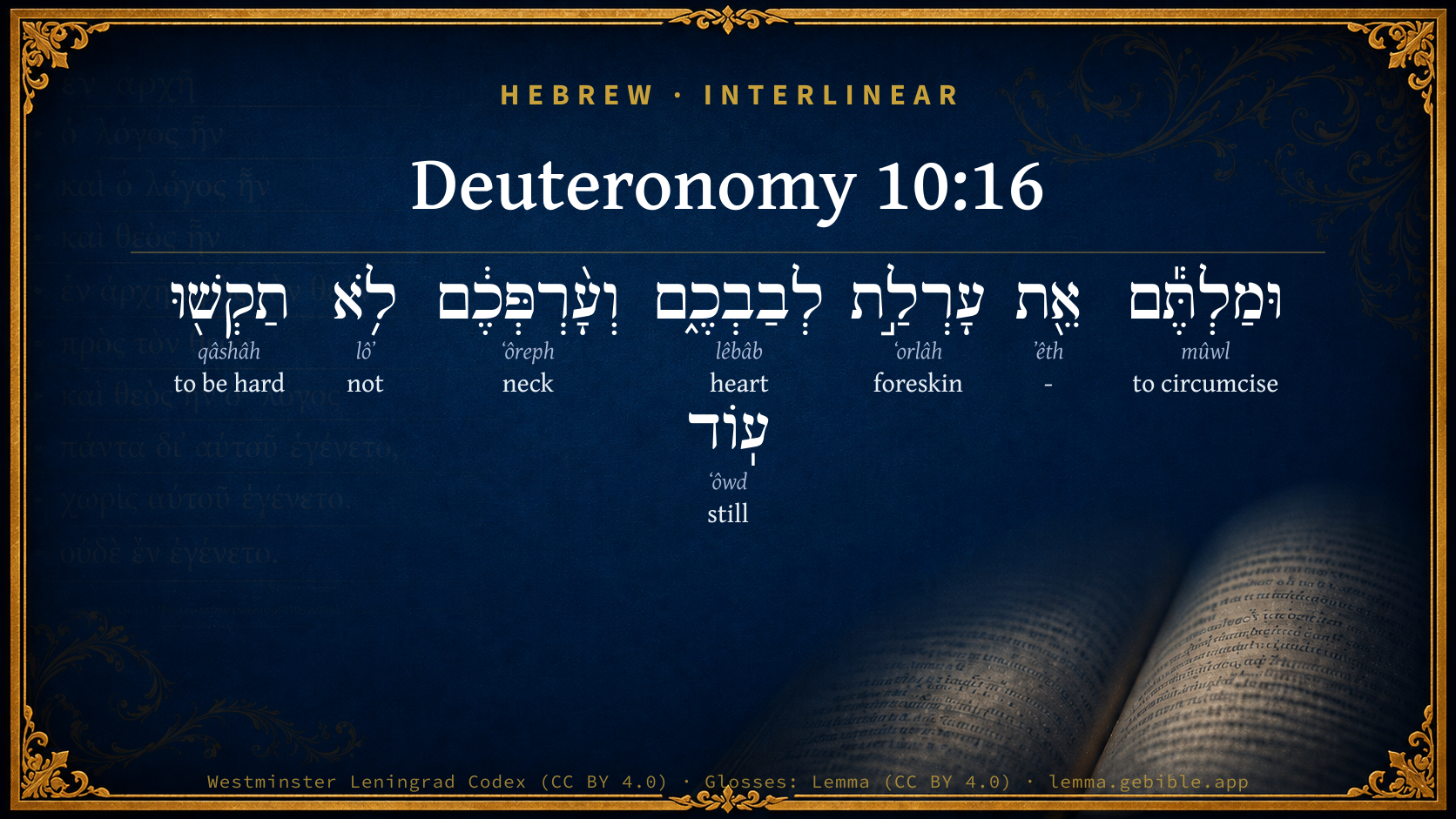
Deuteronomy 10:16

Hebrew (Westminster Leningrad Codex) Deuteronomy 10:16 appears in the Hebrew Old Testament. The text above is from the Westminster Leningrad Codex. Each word links to its Strong’s number, a concise gloss, and parsing drawn from the Open Scriptures Hebrew Bible morphology. Click any word for its full Brown-Driver-Briggs (BDB) entry.
Download image
Cite this verse

Deuteronomy 10:16 (World English Bible). Public Domain. Lemma interlinear Bible study tool, https://lemma.gebible.app/v/deuteronomy/10/16.

Show BibTeX & RIS
BibTeX
RIS
English Translation
Circumcise therefore the foreskin of your heart, and be no more stiff-necked.
World English Bible · Public Domain
Download a study sheet

One document with this verse’s original text, its word-by-word gloss line, the meaning frame, cross-references with their text, attributed commentary, and full source and license credits — printable, and it pastes into notes with its structure intact.

This verse Autodidact and up

Study sheet (.html) Plain text (.txt)

A passage Seminary Student

Up to 50 verses in one chapter. A passage sheet keeps up to 6 commentary sources and 12 cross-references per verse, in the order this page ranks them, and says so on the sheet whenever that leaves anything out. Ask for a single verse and you get the Autodidact verse sheet above.

Everything on this page stays free to read, with no account — the sheet is a download of what is already on screen, not access to it.

Want to remove ads? Support Godless Engineer
Compare translations 3

The same verse in 3 English versions, stacked beneath the original-language interlinear above. Click any original word for its lexicon entry.

Each is an independent rendering of the whole verse — the interlinear is not word-aligned to these translations.

Highlighted words mark where these versions differ — a whole-verse word diff, not a word-by-word alignment.

  • World English Bible Public Domain
    Circumcise therefore the foreskin of your heart, and be no more stiff-necked.
  • King James Version Public Domain
    Circumcise therefore the foreskin of your heart, and be no more stiffnecked.
  • unfoldingWord Literal Text CC BY-SA 4.0
    And you shall circumcise the foreskin of your hearts, and do not stiffen your necks anymore.

unfoldingWord Literal Text — © unfoldingWord, licensed CC BY-SA 4.0. Word-aligned USFM3 via Door43 (git.door43.org/unfoldingWord/en_ult).

Versions to compare (up to 4)

3 of 4 selected

Show all 18 translations

Every available English version of this verse, each an independent rendering of the whole verse.

  • World English Bible Public Domain
    Circumcise therefore the foreskin of your heart, and be no more stiff-necked.
  • Berean Standard Bible Public Domain
    Circumcise your hearts, therefore, and stiffen your necks no more.
  • Majority Standard Bible Public Domain
    Circumcise your hearts, therefore, and stiffen your necks no more.
  • King James Version Public Domain
    Circumcise therefore the foreskin of your heart, and be no more stiffnecked.
  • American Standard Version (1901) Public Domain
    Circumcise therefore the foreskin of your heart, and be no more stiffnecked.
  • Revised Version (1885) Public Domain
    Circumcise therefore the foreskin of your heart, and be no more stiffnecked.
  • Geneva Bible (1599) Public Domain
    Circumcise therefore the foreskin of your heart, and harden your neckes no more.
  • Douay-Rheims (1899) Public Domain
    Circumcise therefore the foreskin of your heart, and stiffen your neck no more.
  • Young's Literal Translation Public Domain
    and ye have circumcised the foreskin of your heart, and your neck ye do not harden any more;
  • Literal Standard Version CC BY-SA 4.0
    And you have circumcised the foreskin of your heart, and you do not harden your neck anymore.
  • Unlocked Literal Bible CC BY-SA 4.0
    Therefore circumcise the foreskin of your heart, and be stubborn no longer.
  • unfoldingWord Literal Text CC BY-SA 4.0
    And you shall circumcise the foreskin of your hearts, and do not stiffen your necks anymore.
  • Darby Bible Public Domain
    Circumcise then the foreskin of your heart, and stiffen your neck no more.
  • World Messianic Bible Public Domain
    Circumcise therefore the foreskin of your heart, and be no more stiff-necked.
  • Webster's Bible Public Domain
    Circumcise therefore the foreskin of your heart, and be no more stiff-necked.
  • Free Bible Version CC BY-SA 4.0
    Dedicate yourselves to God. Don't be stubborn and hard-hearted anymore.
  • Bible in Basic English Public Domain
    Let your circumcision be of the heart, and put away your pride.
  • JPS Tanakh (1917) Public Domain
    Circumcise therefore the foreskin of your heart, and be no more stiffnecked.

Literal Standard Version (2020), Covenant Press — licensed CC BY-SA 4.0. Text via the HelloAO Bible API (eBible.org). Unlocked Literal Bible (unfoldingWord) — licensed CC BY-SA 4.0. Text via the HelloAO Bible API (eBible.org). unfoldingWord Literal Text — © unfoldingWord, licensed CC BY-SA 4.0. Word-aligned USFM3 via Door43 (git.door43.org/unfoldingWord/en_ult). Free Bible Version, Dr. Jonathan Gallagher — licensed CC BY-SA 4.0. Text via the HelloAO Bible API (eBible.org).

Word by word

More ways to search: Search by grammar → Find every occurrence → Compare this word →

Practice this passage: Drill this verse → Learn its vocabulary →

About this verse

These counts appear in no published source. They are computed here, from the morphology-tagged text and Lemma’s own curated glosses. What Lemma adds →

8
words
8
distinct lemmas
Pentateuch
section

Notable vocabulary

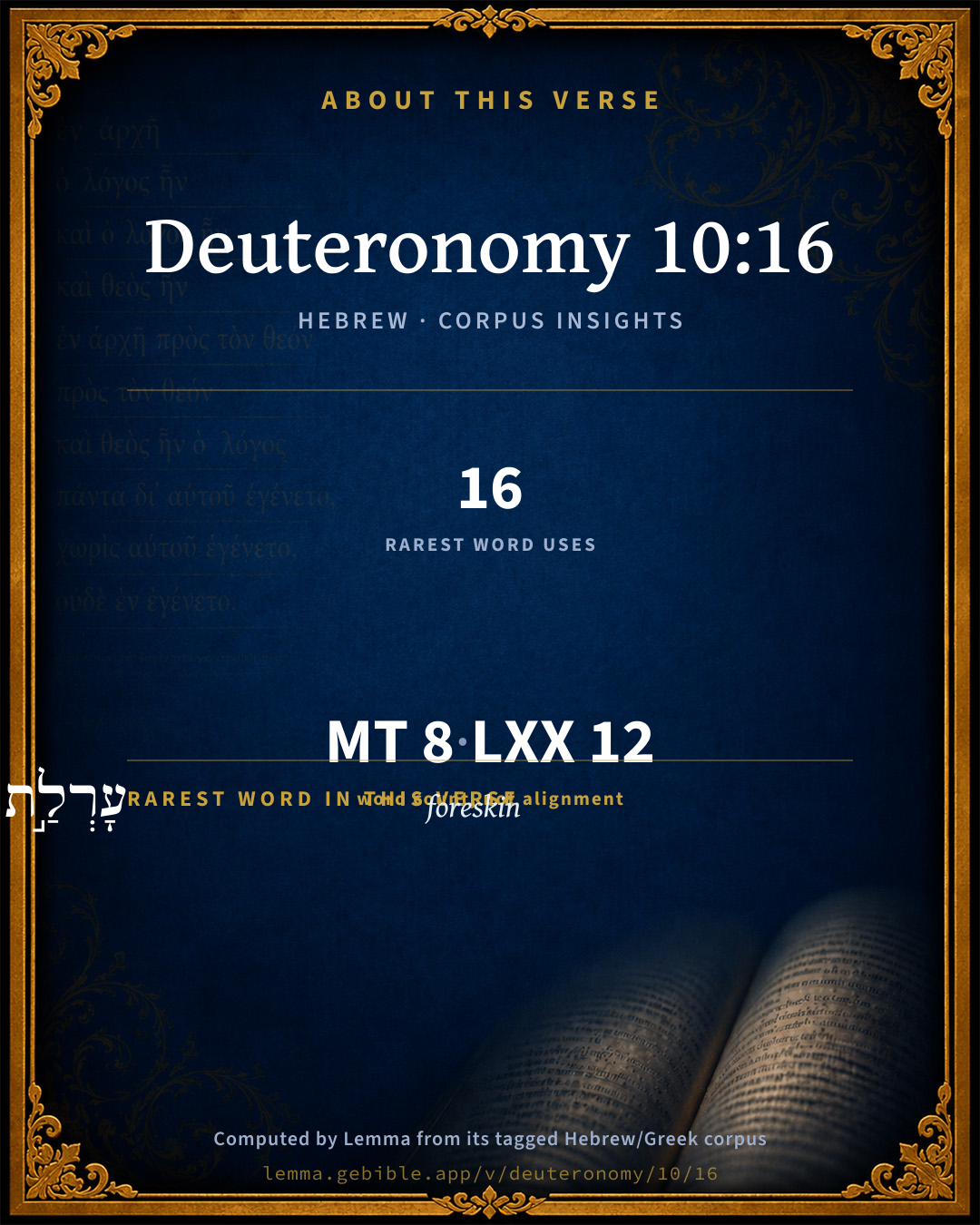
The rarest word here is עָרְלַ֣ת foreskin H6190 — appearing just 16 times in the whole Hebrew Bible.

Shared distinctive vocabulary

עָרְלַ֣ת foreskin H6190 occurs in 16 verses of the Hebrew Bible. Also found in:

Grammatical profile

  • 2 verbs
  • 3 nouns
  • 1 adverb
  • 2 particles

Verb forms

  • וּמַלְתֶּ֕ם Qal · Sequential Perfect
  • תַקְשׁ֖וּ Hiphil · Imperfect

Hebrew & Septuagint length

In English translation the verse runs 12 words from the Hebrew and 16 from the Septuagint (LXX English) — closely comparable.

A rough comparison of the two English renderings, which tokenize alike — not a word-level alignment.

Word counts can differ between the Hebrew and the Greek without any difference in meaning — e.g. the Hebrew direct-object marker אֵת has no separate Greek word, and Greek often adds the article ὁ.

In the original languages it is 8 Hebrew tokens and 12 Greek tokens — but the two are counted differently (Hebrew bundles its prefixes and suffixes into one token; the Greek is in lemma form), so that isn’t a like-for-like length.

Cross-references

10

Topical passages linked to Deuteronomy 10:16 in the Treasury of Scripture Knowledge — connected by theme and wording, ordered by reader-vote popularity; previews shown in the World English Bible.

  • Jeremiah 4:4 Circumcise yourselves to Yahweh, and take away the foreskins of your heart, you men of Judah and inhabitants of Jerusalem; lest my wrath go forth like fire, and burn so that none can quench it, because of the evil of your doings.
  • Deuteronomy 30:6 Yahweh your God will circumcise your heart, and the heart of your seed, to love Yahweh your God with all your heart, and with all your soul, that you may live.
  • Leviticus 26:41 I also walked contrary to them, and brought them into the land of their enemies: if then their uncircumcised heart is humbled, and they then accept the punishment of their iniquity;
  • Colossians 2:11 in whom you were also circumcised with a circumcision not made with hands, in the putting off of the body of the sins of the flesh, in the circumcision of Christ;
  • Romans 2:28–29 For he is not a Jew who is one outwardly, neither is that circumcision which is outward in the flesh;
  • Deuteronomy 9:6 Know therefore, that Yahweh your God doesn't give you this good land to possess it for your righteousness; for you are a stiff-necked people.
  • Jeremiah 4:14 Jerusalem, wash your heart from wickedness, that you may be saved. How long shall your evil thoughts lodge within you?
  • Deuteronomy 9:13 Furthermore Yahweh spoke to me, saying, I have seen this people, and, behold, it is a stiff-necked people:
  • Deuteronomy 31:27 For I know your rebellion, and your stiff neck: behold, while I am yet alive with you this day, you have been rebellious against Yahweh; and how much more after my death?
  • James 4:6–7 But he gives more grace. Therefore it says, "God resists the proud, but gives grace to the humble."

Cross-references courtesy of OpenBible.info (CC BY 4.0).

Hebrew and Greek witnesses Masoretic Hebrew ↔ Greek Septuagint

The same verse in the two great witnesses to the Old Testament, shown verse-for-verse.

These are two independent witnesses, not word-aligned to each other, and the Septuagint is shown in lemma (dictionary) form.

Hebrew Deuteronomy 10:16 Masoretic · Westminster Leningrad Codex

וּמַלְתֶּ֕ם אֵ֖ת עָרְלַ֣ת לְבַבְכֶ֑ם וְעָ֨רְפְּכֶ֔ם לֹ֥א תַקְשׁ֖וּ עֽוֹד

Circumcise therefore the foreskin of your heart, and be no more stiff-necked.

World English Bible · Public Domain

Greek LXX Deuteronomy 10:16 Septuagint · lemma form

καί περιτέμνω ὁ σκληροκαρδία σύ καί ὁ τράχηλος σύ οὐ σκληρύνω ἔτι

Therefore you⌃ shall circumcise the hardness of your heart, and you⌃ shall not harden your neck.

LXX2012 (modern English Septuagint) · Public Domain

Hebrew: Westminster Leningrad Codex (CC BY 4.0). Greek: Septuagint (public domain); English from LXX2012 (modern English Septuagint) (Public Domain). How the Septuagint differs from the Hebrew →

Targum (Aramaic paraphrase)

2

The Targum is the ancient Jewish Aramaic paraphrase of the Hebrew Scriptures — an interpretive translation, not the Hebrew text itself. Onkelos (literal) and Pseudo-Jonathan (expansive) render the Torah, and Jonathan the Prophets. Coverage is partial: where no permissively-licensed English translation exists for a verse, only the Aramaic is shown. This is verse-level text, not a word-by-word alignment to the Hebrew.

  1. Targum Onkelos Torah (Genesis–Deuteronomy)
    וְתֶעְדוּן יָת טַפְשׁוּת לִבְּכוֹן וּקְדָלְכוֹן לָא תַקְשׁוּן עוֹד

    (no public-domain English translation for this verse)

    Targum Onkelos — Aramaic: “Onkelos Genesis” (public domain); “Onkelos Exodus” (public domain); “Onkelos Leviticus” (public domain); “Onkelos Numbers” (public domain); “Onkelos Deuteronomy” (public domain). English: “Sefaria Community Translation” (CC0 1.0 (public-domain dedication)); “J.W. Etheridge. The Targums of Onkelos and Jonathan Ben Uzziel on the Pentateuch. London: Longmans, Green, 1862” (public domain). Text via Sefaria.

  2. Targum Pseudo-Jonathan Torah (Genesis–Deuteronomy)
    וְתַעֲדוּן יַת טִפְּשׁוּת לִבְּכוֹן וּקְדַלְכוֹן לָא תַקְשׁוּן תּוּב

    Put away folly, therefore, from your heart, and be not stiff-necked any more;

    Targum Pseudo-Jonathan — Aramaic: “Targum Jonathan on Genesis” (public domain); “Targum Jonathan on Exodus” (public domain); “Targum Jonathan on Leviticus” (public domain); “Targum Jonathan on Numbers” (public domain); “Targum Jonathan on Deuteronomy” (public domain). English: “The Targum of Jonathan ben Uzziel, trans. J. W. Etheridge, London, 1862” (public domain). Text via Sefaria.

Commentary

Notes on Deuteronomy 10:16 from classic Christian and Jewish commentators (each source and its license shown beneath its notes). The classic Christian expositions comment on the surrounding passage and are grouped to its opening verse, so a note may address several verses; the Jewish commentaries on the Tanakh (Rashi and others) are per-verse, so they appear only where the commentator wrote on this verse.

Lemma curates 59 commentaries, every one of them public domain or Creative Commons licensed, each selected and text-cleaned for this edition rather than reprinted as found. About our sources →

The Cambridge Bible for Schools and Colleges

gen. ed. J. J. S. Perowne

16. Circumcise the foreskin of your heart] The same metaphor in Jer_4:4 (cp. Deu_9:25); whether it is original to the prophet or to D is impossible to determine. In view of the style of Jeremiah’s earlier discourses, in which abrupt and unrelated metaphors are frequently conjoined, and of the secondary character of these verses before us, the presumption is that the metaphor is here derived from Jeremiah. ‘Wohl bei Jeremias ursprünglich,’ Wellh. Comp. Hex. 193. Steuernagel states the converse opinion.

stiffnecked] See Deu_9:6 Sg. and 13 Pl.

16–19. The form of address changes to Pl., and a qualification is made of the great statement just given. Though God has elected (for reasons of His own) to love Israel’s fathers and to choose their posterity after them out of all peoples to be His peculiar people, He is not one that regards persons, but as He takes the part of the helpless within Israel so He loves also the foreigner resident among them, and therefore Israel must love the foreign sojourner, having themselves been sojourners in Egypt. No doubt all this is more or less relevant to the main theme of the discourse, but it is outside it, and as its introduction is coincident with the change to the Pl. address, the passage must be considered as a later addition, or additions (for Deu_10:18-19 is still a further departure from Deu_10:16-17). The same idea, that Israel cannot count on God’s partiality for them if they continue to be stiffnecked, had been already put by Amos in a more striking form, Amo_3:2, you only have I known of all the families of the earth; therefore I will visit on you all your iniquities. Cp. Joh_8:31-45; and Act_10:34; Rom_2:11; Gal_2:6, in which the argument of this passage is developed.

The Cambridge Bible for Schools and Colleges (gen. ed. J. J. S. Perowne; Cambridge University Press, 1878–1918) — public domain. Text from a community e-Sword module.

Trapp's Complete Commentary

John Trapp

Deu 10:16 Circumcise therefore the foreskin of your heart, and be no more stiffnecked.

Ver. 16. Circumcise therefore.] Deus iubendo iuvat. Set about this work in God’s strength, and pray that the heaven may answer the earth. {Hos 2:21} For it is a work that must be done "without hands." {Col 2:11} Beg of God to thrust his holy hand into our bosom, and to pull off that filthy foreskin; urge him with his promise; {Deu 30:6} doubt not of his power: lex iubet, gratia iuvat, {a} &c.

{a} August, in Exod., quaest. 55.

John Trapp, A Commentary or Exposition upon All the Books of the Old and New Testament (1647–1656) — public domain. Text from a community e-Sword module.

Joseph Benson's Commentary

Deu 10:16. Circumcise, therefore, your heart — Rest not in your bodily circumcision, or in any mere external observances or duties; but seriously set upon that substantial and most important circumcision of the heart and of the spirit which is signified by that of the flesh, and intended to be inculcated thereby: see Rom 2:28-29. Cleanse your hearts from all filthiness and superfluity of naughtiness; fitly compared to the foreskin, which, under the Jewish law, if not cut off, made persons profane, unclean, and odious in the sight of God.

Joseph Benson's Commentary on the Old and New Testaments (1811–1818) — public domain. Text from a community e-Sword module.

Tyndale Open Study Notes

Tyndale Open Resources

10:16 change your hearts (literally circumcise the foreskin of your hearts): This figure of speech encompasses both inward and outward conformity to the covenant (Gen 17:9-14; Rom 2:28-29).

Tyndale Open Study Notes — © Tyndale Open Resources, licensed CC BY-SA 4.0. Text via the HelloAO Bible API.

Geneva Bible (1599)

Geneva Bible translators

Cut off all your evil affections, Jer 4:4.

Geneva Bible (1599) marginal notes — public domain. Text via Bolls.life.

Jamieson, Fausset & Brown

Robert Jamieson, A. R. Fausset & David Brown

Circumcise therefore the foreskin of your heart--Here he teaches them the true and spiritual meaning of that rite, as was afterwards more strongly urged by Paul (Rom 2:25, Rom 2:29), and should be applied by us to our baptism, which is "not the putting away of the filth of the flesh, but the answer of a good conscience toward God" [Pe1 3:21].

Next: Deuteronomy Chapter 11

Jamieson, Fausset & Brown — Commentary Critical and Explanatory on the Whole Bible (1871) — public domain (CC PDM 1.0). Text via the HelloAO Bible API.

Adam Clarke's Commentary

Verse 16. Circumcise - the foreskin of your heart] A plain proof from God himself that this precept pointed out spiritual things, and that it was not the cutting away a part of the flesh that was the object of the Divine commandment, but the purification of the soul, without which all forms and ceremonies are of no avail. Loving God with all the heart, soul, mind, and strength, the heart being circumcised to enable them to do it, was, from the beginning, the end, design, and fulfilment of the whole law.

Adam Clarke's Commentary on the Bible (1810–1826) — public domain. Text from a community e-Sword/MySword module.

Ellicott's Commentary for English Readers

(16) Circumcise . . . your heart.—“For circumcision is that of the heart, in the spirit, and not in the letter” (Rom_2:29). The verse literally runs thus: Circumcise the foreskin of your heart, and ye will harden your neck no more. It is the same line of thought as St. Paul’s (Gal_5:16) “Walk in the Spirit, and (then) ye will not fulfil the lust of the flesh.”

(17,18) A great God, a mighty, and a terrible . . . he doth execute the judgment of the fatherless and widow.—“Behold (says Rashi) His might! And close beside His might thou mayest find His humility.” It is not otherwise in later passages of Scripture: “He healeth the broken in heart, and bindeth up their wounds. He telleth the number of the stars, and calleth them all by their names.”

A Bible Commentary for English Readers, edited by Charles John Ellicott (1878–1897) — public domain. Text from a community e-Sword module.

John Gill's Exposition

Circumcise therefore the foreskin of your heart,.... Content not yourselves with, nor put your confidence in outward circumcision of the flesh, but be concerned for the circumcision of the heart; for removing from that whatever is disagreeable to the Lord, even all carnality, sensuality, hypocrisy, and superfluity of naughtiness, and for having that put there which is well pleasing in his sight; and which though it is the work of God, and he only can do it and has promised it, yet such an exhortation is made to bring men to a sense of their need of it, and of the importance of it, and to show how agreeable it is to the Lord, and so to stir them up to seek unto him for it; see Deu 30:6.

and be no more stiffnecked; froward, obstinate, and disobedient, as they had been hitherto; Deu 9:6.

John Gill's Exposition of the Whole Bible (1746–1763) — public domain (CC PDM 1.0). Text via the HelloAO Bible API.

Albert Barnes' Notes on the Bible

On “circumcision” see Gen 17:10. This verse points to the spiritual import of circumcision. Man is by nature “very far gone from original righteousness,” and in a state of enmity to God; by circumcision, as the sacrament of admission to the privileges of the chosen people, this opposition must be taken away ere man could enter into covenant with God. It was through the flesh that man first sinned; as it is also in the flesh, its functions, lusts, etc., that man’s rebellion against God chiefly manifests itself still. It was fitting therefore that the symbol which should denote the removal of this estrangement from God should be worked in the body. Moses then fitly follows up the command “to circumcise the heart,” with the warning “to be no more stiff-necked.” His meaning is that they should lay aside that obduracy and perverseness toward God for which he had been reproving them, which had led them into so many transgressions of the covenant and revolts from God, and which was especially the very contrary of that love and fear of God required by the first two of the Ten Commandments. The language associated with circumcision in the Bible distinguishes the use made of this rite in the Jewish religion from that found among certain pagan nations. Circumcision was practiced by some of them as a religious rite, designed (e. g.) to appease the deity of death who was supposed to delight in human suffering; but not by any, the Egyptians probably excepted, at all in the Jewish sense and meaning.

The grounds on which circumcision was imposed as essential by the Law are the same as those on which Baptism is required in the Gospel. The latter in the New Testament is strictly analogous to the former under the Old; compare Col 2:11-12.

Albert Barnes' Notes on the Bible (1834–1885) — public domain. Text from a community e-Sword/MySword module.

Haydock's Catholic Bible Commentary

Circumcise. The Hebrews esteem circumcision as a mark of their greatest glory. All who had it not were looked upon as profane. They call the ears, mind, and heart uncircumcised, when they would not hear, understand, or obey the law of God. St. Paul (Romans ii. 28) frequently inculcates this interior circumcision, to which Moses alludes in these his last exhortations, chap. xxx. 6. The people had not regularly practised circumcision in the desert. Moses takes care to raise their thoughts to something more spiritual; and declares, in clearer terms than he had hitherto done, the necessity of loving God. All must be banished from the heart which might resist this love. (Calmet) --- Vanity, blindness, luxury, must be retrenched. (Menochius)

George Leo Haydock (1774–1849), Haydock's Catholic Family Bible and Commentary, 1859 edition — public domain. Excludes Psalms (Douay-Rheims chapter numbering differs from Protestant) and Deuterocanonical books (Catholic canon only).

Matthew Poole's English Annotations

Rest not in your bodily circumcision, but seriously set upon that substantial work which is signified and designed thereby: cleanse your hearts from all filthiness and superfluity of naughtiness, which is fitly compared to the foreskin, which if not cut off, made persons profane, unclean, and odious in the sight of God. Compare Deu 30:6; Jer 4:4; 9:25; Rom 2:28,29; Col 2:11.

Matthew Poole's English Annotations on the Holy Bible (1683–1685) — public domain. Text from a community e-Sword/MySword module.

Whedon's Commentary on the Bible

Daniel D. Whedon

16. Circumcise… your heart — This verse suggests the spiritual significance of the rite of circumcision. Comp. Rom_2:29 : “Circumcision is that of the heart, in the spirit, and not in the letter.”

Daniel D. Whedon (gen. ed.), Commentary on the Old and New Testaments (1874–1909) — public domain. Text from a community e-Sword module.

The Pulpit Commentary

They were, therefore, to lay aside all insensibility of heart and all obduracy, to acknowledge God"s supremacy, to imitate his beneficence, and to fear and worship him. Circumcise therefore the foreskin of your heart. As circumcision was the symbol of purification and sign of consecration to God, so the Israelites are enjoined to realize in fact what that rite symbolized, viz. purity of heart and receptivity for the things of God. This is enforced by the consideration that Jehovah the alone God, the Almighty, is mighty and terrible without respect to persons, and at the same time is a righteous Judge, and the Protector of the helpless and destitute.

Heart circumcision.

I HEART CIRCUMCISION IN ITS IMPORT.

1. Betokens the existence of natural impurity. The rite of circumcision, as the initiatory rite of the covenant, taught that man, in his natural, unpurified state, is unfit for fellowship with God. "In us, that is, in our flesh, dwells no good thing" (Joh_3:6; Rom_7:18) It was a symbol of the putting away of "the filth of the flesh a truth now signified in baptism (Col_2:11; 1Pe_3:21)

2. Illustrates the painful nature of the renunciation of fleshly lusts. The operation was sharp, painful, bloody. It vividly set forth at once the necessity of renouncing the lusts of the flesh, and the pain attendant on the act. We are called on to mortify our members which are upon the earth. (Col_3:5) The process is described as a crucifying of the flesh, with its affections and lusts. (Gal_5:24) The deepest form which this renunciation can assume is the renunciation of the principle of self-will in its entirety, the sharp excision of evil in its root.

3. Implies the grace of the covenant. The reception of God"s grace as exhibited in the covenant is the condition of the possibility of this renunciation. We achieve it, not in our own strength, but through the impartation of a new principle of life. Paul makes it a result of faith in the risen Christ. (Col_2:12) The circumcised heart marks the accepted and restored recipient of the grace of God a child of the spiritual covenant, one born again.

II HEART CIRCUMCISION IN ITS NECESSITY.

1. As distinguished from outward circumcision. The latter was valueless without the former. Being but a symbol, its sole worth lay in that which it represented. The true Jew was he who was one inwardly, whose circumcision was that of the heart, in the spirit, and not in the letter". (Rom_2:28, Rom_2:29) The remark applies to baptism. It also is but a symbol, and without the grace which it exhibits, and the inward renewal which it betokens, it is a dead work, a valueless rite, leaving its subject as little a Christian as at first. So with all ceremonies.

2. As a positive qualification for Gods service. Pure obedience can flow only from a pure heart, a renewed will. It is not a fruit of the flesh. The flesh must he renounced, and a new and spiritual nature begotten in us before we can render it. What is needed is not reformation, but regeneration a new birth, a new creation, a new heart. J.O. (Joh_3:3; Rom_7:18-25 Rom_8:7; 2Co_5:17; Gal_5:16-25)

The Pulpit Commentary (1880–1919), ed. H.D.M. Spence-Jones & Joseph S. Exell — public domain. Text from a community e-Sword module.

John Wesley's Explanatory Notes

Circumcise - Rest not in your bodily circumcision, but seriously set upon that substantial work which is signified thereby: cleanse your hearts from all filthiness and superfluity of naughtiness, fitly compared to the foreskin, which if not cut off, made persons profane, unclean and odious in the sight of God.

John Wesley, Explanatory Notes Upon the Whole Bible (1754–1765) — public domain. Text via the GEBible commentary corpus.

Keil & Delitzsch

C. F. Keil & F. Delitzsch

Above all, therefore, they were to circumcise the foreskin of their hearts, i.e., to lay aside all insensibility of heart to impressions from the love of God (cf. Lev 26:41; and on the spiritual signification of circumcision, see Gen 17:15-21), and not stiffen their necks any more, i.e., not persist in their obstinacy, or obstinate resistance to God (cf. Deu 9:6, Deu 9:13). Without circumcision of heart, true fear of God and true love of God are both impossible. As a reason for this admonition, Moses adduces in Deu 10:17. the nature and acts of God. Jehovah as the absolute God and Lord is mighty and terrible towards all, without respect of person, and at the same time a just Judge and loving Protector of the helpless and oppressed. From this it follows that the true God will not tolerate haughtiness and stiffness of neck either towards Himself or towards other men, but will punish it without reserve. To set forth emphatically the infinite greatness and might of God, Moses describes Jehovah the God of Israel as the "God of gods," i.e., the supreme God, the essence of all that is divine, of all divine power and might (cf. Psa 136:2), - and as the "Lord of lords," i.e., the supreme, unrestricted Ruler ("the only Potentate," Ti1 6:15), above all powers in heaven and on earth, "a great King above all gods" (Psa 95:3). Compare Rev 17:14 and Rev 19:16, where these predicates are transferred to the exalted Son of God, as the Judge and Conqueror of all dominions and powers that are hostile to God. The predicates which follow describe the unfolding of the omnipotence of God in the government of the world, in which Jehovah manifests Himself as the great, mighty, and terrible God (Psa 89:8), who does not regard the person (cf. Lev 19:15), or accept presents (cf. Deu 16:19), like a human judge.

Keil & Delitzsch — Biblical Commentary on the Old Testament (1861–1891) — public domain (CC PDM 1.0). Text via the HelloAO Bible API. (Old Testament only.)

unfoldingWord translationNotes

Door43 World Missions Community

Therefore

"Because of this"

circumcise the foreskin of your heart

The word "foreskin" refers to the fold of skin on a man's private parts that is removed during circumcision. Here Moses is referring to a spiritual circumcision. This means the people must remove the sin from their lives. (See: Metaphor)

God of gods

"the supreme God" or "the only true God"

Lord of masters

"the supreme Lord" or "the greatest Lord"

the fearsome one

"the one who causes people to fear"

translationWords

circumcise

heart

stiff-necked

Yahweh

God

false god

lord

might

favor

bribe

unfoldingWord translationNotes — © Distant Shores Media and the Door43 World Missions Community, licensed CC BY-SA 4.0. Source: git.door43.org/Door43/en_tn.

Rashi

Rabbi Shlomo Yitzchaki (Rashi)

ערלת לבבכם [YE SHALL CIRCUMCISE] THE FORESKIN OF YOUR HEART — This means: ye shall remove the closure and cover that is on your hearts, [which prevent My words gaining entrance to them] (cf. Rashi on Exodus 6:12 and Leviticus 19:23).

Rashi on the Tanakh — English translations: “The Judaica Press complete Tanach with Rashi, translated by A. J. Rosenberg” (CC BY 4.0); “Pentateuch with Rashi's commentary by M. Rosenbaum and A.M. Silbermann, 1929-1934” (public domain); “The Metsudah Tanach series, Lakewood, N.J” (CC BY 4.0); and “The Book of Joshua, Metsudah Publications, 1997” (CC BY 4.0). Text via Sefaria.

Ramban (Nachmanides)

Rabbi Moshe ben Nachman (Ramban / Nachmanides)

CIRCUMCISE THEREFORE THE FORESKIN OF YOUR HEART — that your heart be open to know the truth, not as you have done to this day, for the Eternal hath not given you a heart to know, and eyes to see, and ears to hear [unto this day].

AND BE NO MORE STIFFNECKED — that you be not as your fathers, a stubborn and rebellious generation, because they dwelled with the Egyptians and learned their works, 106:35. and were obdurate about discarding their ways as [shown by the fact] they made the [golden] calf, and He called them there it is a stiffnecked people, meaning that they will not disavow the mistake that had entered their hearts to think that there is some benefit in worshipping the angels or the host of heaven. But you are to know, to be wise and to believe For the Eternal your G-d, He is G-d of gods, and Lord of lords. G-d of ‘gods’ is a reference to the angels above, and the Lord of ‘lords’ is an allusion to all the host of heaven to whom dominion over the lower creatures belongs, for He is the Lord Who established their authority on earth, and His is the greatness and the power, and He is to be feared in the beauty of His strength, Who regarded not any one of the angels or the lords to protect their worshippers, nor taketh bribery from the hand of a person. Now on this matter of bribery [to G-d] they have explained its meaning to be that even if a perfectly pious person should commit a sin, He will not accept from him any of his meritious deeds, as a bribe in atonement for him. And Onkelos translated: “[He is the great G-d] before Whom there is no regard for persons, nor the acceptance of a bribe.” Onkelos thus meant to explain that the verse is in praise of negative attributes of the Creator, blessed be He. The verse is thus stating that G-d is not of the category [of beings] that regards persons, for men shall not see Him and live, and everything is as nothing before Him; they are accounted by Him as things of nought, and vanity; nor is He of the category of beings that take a bribe or reward from man like kings and judges of a land.The correct interpretation in my opinion is that he is stating that G-d is not partial to powerful persons in their quarrel with their inferiors, nor does He take a bribe from the rich when they strive with the poor, for He doth execute justice for the fatherless and widow from the powerful, and despoileth life of those that despoil them. And He loveth the stranger in giving him food and raiment, these being all the essential needs of man. Thus He supports the poor who have no friend and companion.

Ramban (Nachmanides) on the Tanakh — English translation: “Commentary on the Torah by Ramban (Nachmanides). Translated and annotated by Charles B. Chavel. New York, Shilo Pub. House, 1971-1976” (CC BY 4.0). Text via Sefaria.

Lesson kit

Teaching starters — assembled from the data on this page, not authored interpretation. Every prompt links to the verse data it draws on. Edit before teaching.

Deuteronomy, in the Pentateuch, opens this verse with 8 words (8 distinct Hebrew lemmas). Its most distinctive word is ʻorlâh (“foreskin”). A historical commentator’s framing appears above. Read the whole chapter for the surrounding context.

Discussion questions

  1. How does “foreskin” (ʻorlâh) shape what this verse is saying?
  2. How does Genesis 17:11, which shares the word «foreskin», read alongside this verse?
  3. These translations render this verse differently. What is at stake in choosing one wording over another?
  4. «וּמַלְתֶּ֕ם» is a Qal Sequential Perfect verb. How does that grammatical form shape the action described?
  5. Compare how The Cambridge Bible for Schools and Colleges and Trapp's Complete Commentary read this verse. Where do they agree or differ?

Things to notice

Reading settings

Reading text

Shown beneath each verse's original-language words.

Old Testament
Old Testament edition

Read the OT as the Masoretic Hebrew (MT) or the Greek Septuagint (LXX).

English shown for the Greek Septuagint (in the Hebrew ↔ Greek comparison).

Comparing translations? Open the Compare panel on any verse page to stack up to four side by side.