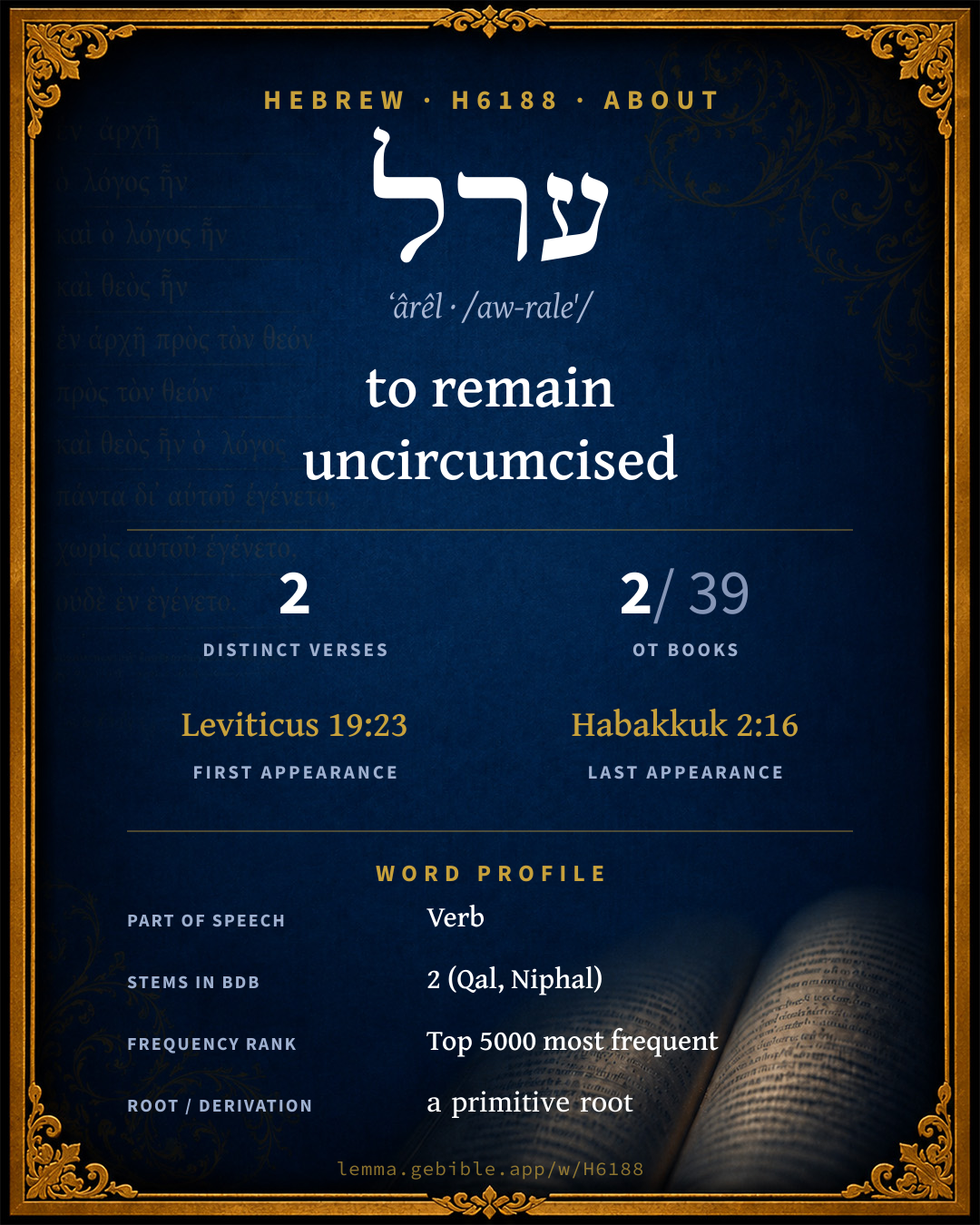
עָרַל
to remain uncircumcised
also: count uncircumcised, count as foreskin fuller range ↓
Full lexicon entry — Brown-Driver-Briggs (BDB)
From Brown-Driver-Briggs (BDB)
Where this word appears
See every Niphal verb in the Hebrew Bible →
Grammar key — what these labels mean
Stem
- Niphal
- Usually the simple passive or reflexive of the Qal (“he was written”).
- Qal
- The basic, simple active stem — the plain form of the verb (“he wrote”).
Form
- Imperative
- A direct command (“write!”).
- Sequential Perfect
- A perfect with prefixed waw continuing a preceding imperfect or command (waw-consecutive perfect).
Person
- 2nd Person
- The one addressed (“you”).
Gender
- Masculine
- Grammatically masculine.
Number
- Singular
- One.
- Plural
- More than one (in Hebrew, generally three or more).
Grammatical forms
- Verb, Niphal, Imperative, 2nd Person, Masculine, Singular 1 time (50%)
- Verb, Qal, Sequential Perfect, 2nd Person, Masculine, Plural 1 time (50%)
Parsed forms decoded from the imported morphology (morphhb / Westminster Leningrad Codex — WLC text public domain, morphhb tagging CC BY 4.0), counted across 2 parsed occurrences — not distinct verses.
Every verse where H6188 appears — 2 distinct verses across 2 books. Click any verse to open its interlinear word-by-word view. Verse text shown in the World English Bible for context — . Each verse’s Hebrew form is shown with its reference; the English is not keyword-highlighted, since the data carries no word-level English alignment. Use “Compare translations” on any verse to read it across multiple English versions. This concordance covers the Hebrew Bible; Septuagint (Greek Old Testament) occurrences are not indexed here.
Leviticus 1 verse
Habakkuk 1 verse
About this entry
At a glance — auto-summarized from this page’s data, not written by a person. Every figure links to its source below. This summary describes the numbers; it doesn’t interpret them.
The Hebrew verb ערל centers on the idea of “to remain uncircumcised.” A scarce word — 2 verses in all of the Hebrew Bible. The word gravitates to Leviticus (50%), then Habakkuk. Its earliest occurrence is Leviticus 19:23. Read the stem: it spans 2 stems, including Qal and Niphal. For the data behind this summary, explore the sense tree and the renderings breakdown below.
Gloss history
Strong's 1890 vs modern scholarship
About this word
Strong's H6188 catalogs a Hebrew word from the Hebrew Old Testament.
These counts are not copied from any lexicon or concordance. They are computed here, from the morphology-tagged Hebrew Old Testament. What Lemma adds →
- 2
- distinct verses
- The word appears in 2 distinct verses.
- 2 / 39
- OT books
- The word appears in 2 of 39 Old Testament books.
- #4,807
- by frequency
- Top 5000 most frequent Hebrew words (rank 4,807 of 8,640 Hebrew words by occurrence).
View all 2 occurrences in the concordance →
By traditional corpus
Conventional, traditional groupings — biblical authorship is debated, so this is a traditional corpus grouping, not an authorship claim. Each share is this word’s portion of its verses in that division of the Hebrew canon. Each figure is a share of the word’s 2 distinct verses.
- Torah (Pentateuch) 1 verse · 50%
- Prophets (Nevi'im) 1 verse · 50%
How translations render this word
Counts come from each version’s own published word-to-Strong’s tagging or interlinear alignment — an approximate guide to how each version renders this word, not a word-level alignment the data otherwise carries. Because each total is that version’s own tagged count, the per-version totals vary from one another and need not match the appearance or distinct-verse counts above. These counts may also differ from a printed concordance because Lemma counts each distinctly tagged rendering and does not collapse phrase taggings into a single head-word total. This is a fixed set of word-tagged versions (KJV, ASV, BSB, ULT) and does not change with the reading translation you choose elsewhere. Each version’s license is shown beside its name below (and on Sources).
- King James Version: Thereof as uncircumcised 1×, Thou also and let thy foreskin be uncovered 1×, Ye shall count 1×
- American Standard Version: Thereof as their uncircumcision 1×, Thou also 1×, Ye shall count 1×
- Berean Standard Bible: Expose your uncircumcision 1×, You shall regard 1×
- unfoldingWord Literal Text: As 1×, Be uncircumcised 1×, You shall leave uncircumcised 1×
King James Version Public Domain
Renders H6188 across 3 tagged occurrences — most commonly:
American Standard Version Public Domain
Renders H6188 across 3 tagged occurrences — most commonly:
Berean Standard Bible Public Domain
Renders H6188 across 2 tagged occurrences — most commonly:
unfoldingWord Literal Text CC BY-SA 4.0
Renders H6188 across 3 tagged occurrences — most commonly:
Senses in the full BDB
Hebrew verbs can shift meaning by stem (binyan): Qal is the basic action, Niphal is often passive or reflexive, Piel often intensifies or makes it factitive, and Hiphil is typically causative. The senses below are grouped under the stem BDB assigns to each.
What do BDB’s symbols mean?
BDB uses these scholarly abbreviations:
| Symbol | Meaning |
|---|---|
| 𝔊 | the Septuagint (the ancient Greek translation, LXX) |
| 𝔙 | the Vulgate (the Latin translation) |
| 𝔖 | the Syriac version (the Peshitta) |
| 𝔗 | the Targum (the Aramaic translation) |
| ψ | the Psalms |
| √ | root (the underlying root or stem) |
| ‖ | parallel passage (a synonymous or contrasted parallel) |
| † | the dagger: every passage where the word occurs is cited |
The 2 senses and sub-senses the full Brown-Driver-Briggs lexicon distinguishes for this word, in lexicon order (not ranked by frequency), with BDB’s own verbatim wording and sub-sense lettering. Shown in Hebrew script with BDB’s own scholarly abbreviations. The condensed entry is in the Lexicon Entry tab. See also the Forms in the corpus table below.
Qal
- Pf. 2 mpl., c. acc. cogn. וַעֲרַלְתֶּם עָרְלָתוֹ Lv 19:23 ye shall regard its fruit as uncircumcised, and not eat it (for three years) (> SS remove its foreskin (its fruit), as 𝔙, cf. 𝔊 περικαθαριεῖτε τὴν ἀκαθαρσίαν αὐτοῦ). e.g. Leviticus 19:23
Niphal
- Imv. הֵעָרֵל Hb 2:16 be counted uncircumcised, i.e. be object of mockery; but dub., read probably הֵרָעֵל reel (𝔊 𝔖 We Now BuhlLex). e.g. Habakkuk 2:16
Senses from the full Brown-Driver-Briggs lexicon (Brown, Driver, Briggs; Oxford 1906 — public domain), digitized via Sefaria, supplemented by the OpenScriptures HebrewLexicon (CC BY 4.0). Full attribution on Sources.
Word origin
vb. denom. count as foreskin, i.e. as uncircumcised;—
— Brown-Driver-Briggs (Oxford 1906, public domain), digitized via Sefaria, supplemented by the OpenScriptures HebrewLexicon (CC BY 4.0). See Sources.
Origin: a primitive root
Jastrow Dictionary
A second Hebrew/Aramaic lexicon for comparison, covering Aramaic and post-biblical (Talmudic, Targumic, Midrashic) usage that the biblical-Hebrew BDB does not. Matched by lemma rather than by Strong’s number, so a lemma may carry more than one Jastrow headword (shown separately below), and the entries cover usage well beyond the Bible.
עָרַל
- (denom. of עָרְלָה) to sheathe, cover. Y. Orl. III, beg. 62ᵈ (ref. to Lev. XIX, 23) אית תניי תני בעוֹרֵל את פריו one Tannai explains that it refers to that which covers the fruit (peel, shell &c.); דבר שהוא עורל את פריו ופריו עוֹרְלוֹ that which covers the fruit (peel), and that which the fruit covers (kernel); Y. Maasr. IV, end, 51ᶜ דבר שעורל את פריו.—[In b. h. עָרַל to treat as ‘Orlah, to remove.] e.g. Leviticus 19:23
עָרֵל
- v. עָרְלָה) [covered,] uncircumcised; gentile. Mekh. Bo s. 15 (ref. to Ex. XII, 43) אבל ישראל ע׳ שומע וכ׳ I might deduce from this that an uncircumcised Israelite may pertake of the Passover lamb; Pes. 96ᵃ אבל ע׳ דלבו לשמים but an uncircumcised Israelite whose heart is directed towards heaven (and who remained uncircumcised, because his older brothers had died from circumcision). Yeb. VIII, 1 הע׳ וכל וכ׳ an uncircumcised priest, and all unclean persons must not eat T’rumah. Tosef. Ḥull. I, 1 אפי׳ ע׳ even an uncircumcised Israelite; Ḥull. 5ᵃ האי ע׳ היכי וכ׳ what is meant by this ʿarel? Do you mean an Israelite whose brothers died from circumcision? Pes. 92ᵃ ע׳ נכרי an uncircumcised gentile (a proselyte that was circumcised on the eve of Passover); ע׳ ישראל an Israelite that was circumcised on the eve of Passover; a. fr.—[Y. Shebi. VII, end, 37ᶜ חוץ מן הערל, read: העֲדָל.]—Pl. עֲרֵלִים. Mekh. l. c. עבדים ע׳ (not וע׳) uncircumcised slaves. Ned. III, 11 קונם … לע׳ מותר בעַרְלֵי ישראל he who vows that he will not receive any benefits from uncircumcised persons, is permitted benefits from uncircumcised Israelites, and forbidden benefits from circumcised gentiles (the word ʿărelim being meant only for non-Jews; v. עָרְלָה); a. fr. e.g. Exodus 12:43
עָרֵל ²
- Targ. Deut. XXVIII, 43 (h. text הגר). Targ. Ex. XII, 48 (Y. עַרְלָאֵי, read: עַרְלַאי); a. fr.—Pl. עֲרֵלִין, עַרְלִין, עַרְלַיָּא, עַרְלָאִין. Targ. Josh. V, 7 (ed. Lag. עֲרילִ׳). Targ. Jer. IX, 24, sq. Targ. Esth. I, 5; a. e.
A Dictionary of the Targumim, the Talmud Babli and Yerushalmi, and the Midrashic Literature (Marcus Jastrow; London, Luzac, 1903) — Public Domain. Digitized via Sefaria. Digitized via Sefaria. Full attribution on Sources.
Forms in the corpus
The 2 distinct written forms H6188 takes in the Hebrew Bible, most frequent first — each parse links to that stem’s occurrences in the concordance. Hebrew forms include their vowel points and cantillation, so a single lemma takes many written forms.
| Form | Parsing | Example | Uses |
|---|---|---|---|
| וְ/הֵֽעָרֵ֑ל | Verb, Niphal, Imperative, 2nd Person, Masculine, Singular | Habakkuk 2:16 | 1 |
| וַ/עֲרַלְתֶּ֥ם | Verb, Qal, Sequential Perfect, 2nd Person, Masculine, Plural | Leviticus 19:23 | 1 |
Same root — word family
Other BDB entries built from the same root as H6188, grouped by Strong’s listed origin. These share a root / origin per the lexicon — not necessarily a shared meaning. Each links to that word’s own entry.
Derived from this word
Compare all same-root words → They share a root, not necessarily a meaning.
Septuagint verse parallels
This word appears in 2 verses that also exist in the Greek Old Testament (Septuagint), out of the 2 Hebrew verses it occurs in. You can read those verses in Greek by switching the Old Testament edition to the Septuagint.
Read these verses in the Septuagint
This is a verse-level parallel only — the same verses exist in both the Hebrew and Greek Old Testaments. No word-level Hebrew↔Greek correspondence is claimed: the data carries no such alignment, so no Greek word is shown as this Hebrew word’s translation. Coverage is not total — the Septuagint omits the deuterocanon and renumbers the Psalms, so some Hebrew verses have no direct Greek parallel.