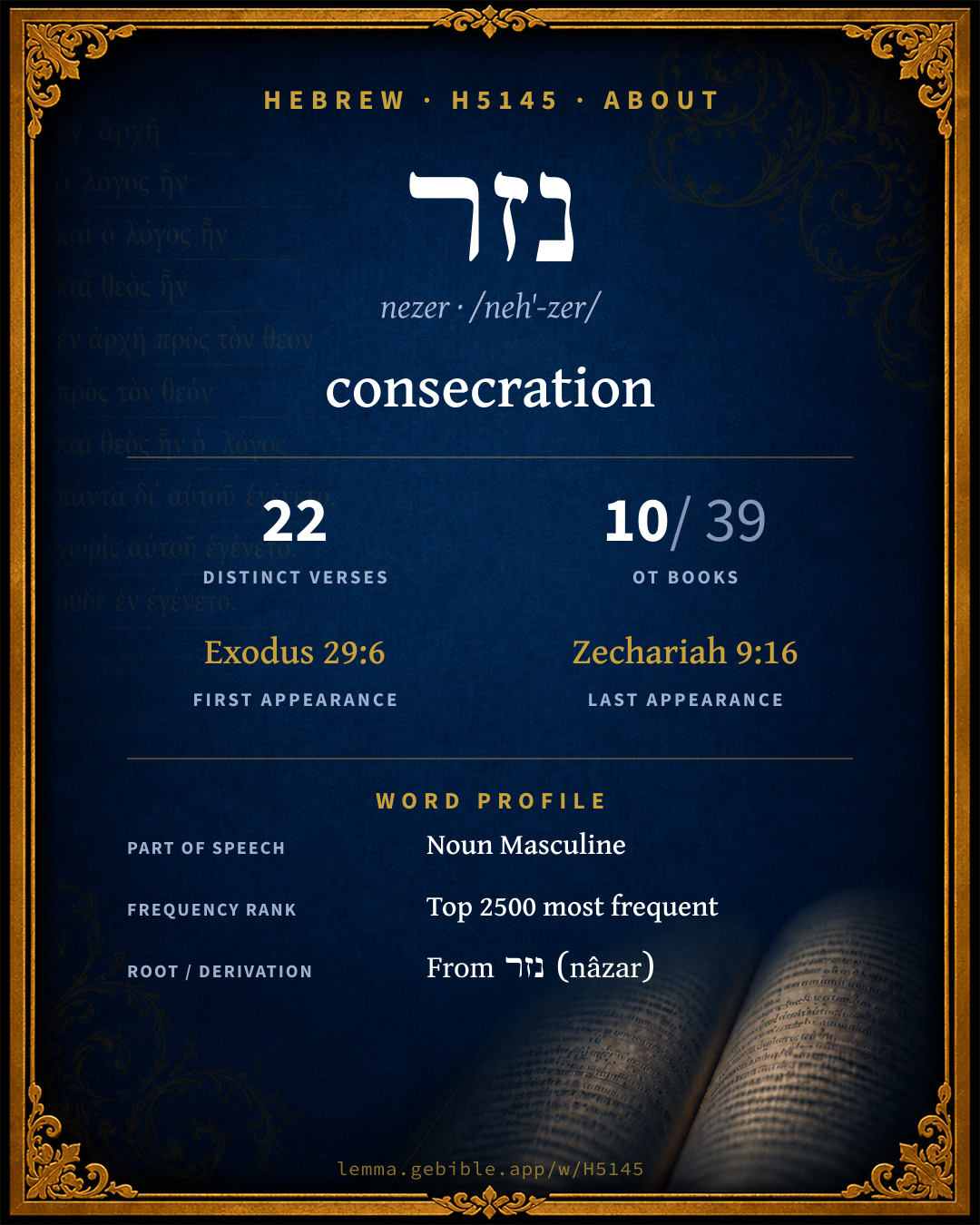
נֵ֫זֶר
consecration
also: crown, separation, Nazariteship fuller range ↓
Full lexicon entry — Brown-Driver-Briggs (BDB)
From Brown-Driver-Briggs (BDB)
Where this word appears
See every Construct-state word in the Hebrew Bible →
Grammar key — what these labels mean
Part of speech
- Noun
- A naming word — a person, place, thing, or idea.
Noun type
- Common
- A common noun — a general class of person, place, or thing (“king,” “city,” “water”), not a specific name.
State
- Construct
- A noun bound to a following noun in a possessive / “of” relationship (the construct chain).
- Absolute
- The independent form of a noun, not bound to a following word.
Gender
- Masculine
- Grammatically masculine.
Number
- Singular
- One.
Grammatical forms
- Noun, Common, Masculine, Singular, Construct 20 times (80%)
- Noun, Common, Masculine, Singular, Absolute 5 times (20%)
Parsed forms decoded from the imported morphology (morphhb / Westminster Leningrad Codex — WLC text public domain, morphhb tagging CC BY 4.0), counted across 25 parsed occurrences — not distinct verses.
Every verse where H5145 appears — 22 distinct verses across 10 books. Click any verse to open its interlinear word-by-word view. Verse text shown in the World English Bible for context — . Each verse’s Hebrew form is shown with its reference; the English is not keyword-highlighted, since the data carries no word-level English alignment. Use “Compare translations” on any verse to read it across multiple English versions. This concordance covers the Hebrew Bible; Septuagint (Greek Old Testament) occurrences are not indexed here.
Exodus 2 verses
Leviticus 2 verses
- Leviticus 8:9 נֵ֣זֶר n c ms cs He set the turban on his head; and on the turban, in front, he set the golden plate, the holy crown; as Yahweh commanded Moses.
- Leviticus 21:12 נֵ֠זֶר n c ms cs neither shall he go out of the sanctuary, nor profane the sanctuary of his God; for the crown of the anointing oil of his God is upon him. I am Yahweh.
Numbers 10 verses
- Numbers 6:4 נִזְר֑/וֹ n c ms cs + sfx pers 3ms All the days of his separation he shall eat nothing that is made of the grapevine, from the seeds even to the skins.
- Numbers 6:5 נִזְר֔/וֹ n c ms cs + sfx pers 3ms "All the days of his vow of separation there shall no razor come on his head, until the days are fulfilled, in which he separates himself to Yahweh. He shall be holy. He shall let the locks of the hair of his head grow long.
- Numbers 6:7 נֵ֥זֶר n c ms cs He shall not make himself unclean for his father, or for his mother, for his brother, or for his sister, when they die; because his separation to God is on his head.
- Numbers 6:8 נִזְר֑/וֹ n c ms cs + sfx pers 3ms All the days of his separation he is holy to Yahweh.
- Numbers 6:9 נִזְר֑/וֹ n c ms cs + sfx pers 3ms "If any man dies very suddenly beside him, and he defiles the head of his separation; then he shall shave his head in the day of his cleansing. On the seventh day he shall shave it.
- Numbers 6:12 נִזְר֔/וֹ נִזְרֽ/וֹ n c ms cs + sfx pers 3ms n c ms cs + sfx pers 3ms He shall separate to Yahweh the days of his separation, and shall bring a male lamb a year old for a trespass offering; but the former days shall be void, because his separation was defiled.
- Numbers 6:13 נִזְר֔/וֹ n c ms cs + sfx pers 3ms "This is the law of the Nazirite: when the days of his separation are fulfilled, he shall be brought to the door of the Tent of Meeting,
- Numbers 6:18 נִזְר֑/וֹ נִזְר֔/וֹ n c ms cs + sfx pers 3ms n c ms cs + sfx pers 3ms The Nazirite shall shave the head of his separation at the door of the Tent of Meeting, and shall take the hair of the head of his separation, and put it on the fire which is under the sacrifice of peace offerings.
- Numbers 6:19 נִזְרֽ/וֹ n c ms cs + sfx pers 3ms The priest shall take the boiled shoulder of the ram, and one unleavened cake out of the basket, and one unleavened wafer, and shall put them on the hands of the Nazirite, after he has shaved the head of his separation;
- Numbers 6:21 נִזְר֔/וֹ נִזְרֽ/וֹ n c ms cs + sfx pers 3ms n c ms cs + sfx pers 3ms "This is the law of the Nazirite who vows, and of his offering to Yahweh for his separation, besides that which he is able to get. According to his vow which he vows, so he must do after the law of his separation."
2 Samuel 1 verse
2 Kings 1 verse
2 Chronicles 1 verse
Psalms 2 verses
Proverbs 1 verse
Jeremiah 1 verse
Zechariah 1 verse
About this entry
At a glance — auto-summarized from this page’s data, not written by a person. Every figure links to its source below. This summary describes the numbers; it doesn’t interpret them.
The Hebrew noun נזר centers on the idea of “consecration.” Alongside “consecration” the lexicon also lists “crown”, “separation”, and “Nazariteship” — part of its full sense range. It appears 22 verses across 10 books of the Hebrew Bible, among its uncommon vocabulary. The word gravitates to Numbers (45%), then Exodus and Leviticus. Debuting at Exodus 29:6, it then recurs through the corpus. Dig into 22-verse concordance and the renderings breakdown below.
Gloss history
Strong's 1890 vs modern scholarship
About this word
Strong's H5145 catalogs a Hebrew word from the Hebrew Old Testament.
These counts are not copied from any lexicon or concordance. They are computed here, from the morphology-tagged Hebrew Old Testament. What Lemma adds →
- 22
- distinct verses
- The word appears in 22 distinct verses.
- 10 / 39
- OT books
- The word appears in 10 of 39 Old Testament books.
- #1,282
- by frequency
- Top 2500 most frequent Hebrew words (rank 1,282 of 8,640 Hebrew words by occurrence).
View all 22 occurrences in the concordance →
By section of the Old Testament
By traditional corpus
Conventional, traditional groupings — biblical authorship is debated, so this is a traditional corpus grouping, not an authorship claim. Each share is this word’s portion of its verses in that division of the Hebrew canon. Each figure is a share of the word’s 22 distinct verses.
- Torah (Pentateuch) 14 verses · 64%
- Prophets (Nevi'im) 4 verses · 18%
- Writings (Ketuvim) 4 verses · 18%
How translations render this word
Counts come from each version’s own published word-to-Strong’s tagging or interlinear alignment — an approximate guide to how each version renders this word, not a word-level alignment the data otherwise carries. Because each total is that version’s own tagged count, the per-version totals vary from one another and need not match the appearance or distinct-verse counts above. These counts may also differ from a printed concordance because Lemma counts each distinctly tagged rendering and does not collapse phrase taggings into a single head-word total. This is a fixed set of word-tagged versions (KJV, ASV, BSB, ULT) and does not change with the reading translation you choose elsewhere. Each version’s license is shown beside its name below (and on Sources).
- King James Version: Separation 10×, Crown 9×, Consecration 2×
- American Standard Version: Separation 12×, Crown 9×
- Berean Standard Bible: Crown 8×, Separation 8×, Consecration 2×
- unfoldingWord Literal Text: Separation 12×, Crown 7×, Crown of 4×
King James Version Public Domain
Renders H5145 across 25 tagged occurrences — most commonly:
Plus 4 renderings that appear only once — usually multi-word phrases or single function words the recovered tagging swept in, not distinct renderings.
American Standard Version Public Domain
Renders H5145 across 25 tagged occurrences — most commonly:
Plus 4 renderings that appear only once — usually multi-word phrases or single function words the recovered tagging swept in, not distinct renderings.
Berean Standard Bible Public Domain
Renders H5145 across 24 tagged occurrences — most commonly:
Plus 2 renderings that appear only once — usually multi-word phrases or single function words the recovered tagging swept in, not distinct renderings. Not rendered by a distinct English word in 1 further occurrence.
unfoldingWord Literal Text CC BY-SA 4.0
Renders H5145 across 27 tagged occurrences — most commonly:
Plus 4 renderings that appear only once — usually multi-word phrases or single function words the recovered tagging swept in, not distinct renderings.
7 senses and sub-senses in the full BDB
What do BDB’s symbols mean?
BDB uses these scholarly abbreviations:
| Symbol | Meaning |
|---|---|
| 𝔊 | the Septuagint (the ancient Greek translation, LXX) |
| 𝔙 | the Vulgate (the Latin translation) |
| 𝔖 | the Syriac version (the Peshitta) |
| 𝔗 | the Targum (the Aramaic translation) |
| ψ | the Psalms |
| √ | root (the underlying root or stem) |
| ‖ | parallel passage (a synonymous or contrasted parallel) |
| † | the dagger: every passage where the word occurs is cited |
The 7 senses and sub-senses the full Brown-Driver-Briggs lexicon distinguishes for this word, in lexicon order (not ranked by frequency), with BDB’s own verbatim wording and sub-sense lettering. Shown in Hebrew script with BDB’s own scholarly abbreviations. The condensed entry is in the Lexicon Entry tab. See also the Forms in the corpus table below.
- 1. crown (sign of consecration; WeSkizzen iii. 118 cp. Syriac קדשא [ܩܕܳܫܳܐ], earring; v. also GeiJüd. Zeitschr. x. 45. ff. on נֶוֶם):
- a. of kg. 2 S 1:10 2 K 11:12 = 2 Ch 23:11; symbol of royal power ψ 89:40; 132:18; cf. Pr 27:24; אַבְנֵי נ׳ Zc 9:16 stones of a crown, diadem (prob.; > We Now—who del., cf. GASm—stones of charming, from use of precious stones as charms. e.g. 2 Samuel 1:10
- b. of high priest, נ׳ הַקֹּדֶשׁ Ex 29:6, made of gold 39:30 Lv 8:9 (all P). e.g. Exodus 29:6
- 2. woman’s hair (orig. prob. of long hair as sign of consecration, as in Nazirite vow, cf. Nu 6:19 infr., and נָזִיר, also WeSkizzen iii. 117, 167; Arab. Heidenthum 2, p. 143 RSSem i. 464, 2d ed. 483), Je 7:29 (of personif. Jerus.). e.g. Numbers 6:19
- 3. consecration
- a. of h. p. נ׳ שֶׁמֶן מִשְׁחַת א׳ עליו Lv 21:12 (P) the consecration of the oil of anointing of his God is upon him. e.g. Leviticus 21:12
- b. in Nu 6 (P), specif. of Nazirite consecration (cf. נָזִיר): נ׳ אֱלֹהָיו עָלָיו Nu 6:7, נֶדֶר נִזְרוֹ v 5, טָמֵא נ׳ v 12, רֹאֹשׁ נ׳ (because of unshorn hair) v 9, 18(×2), יְמֵי נ׳ (כָּל־) v 4, 8, 12, 13, תּוֹרַת נ׳ v 21 b cf. עַל־נ׳ v 21 a; in v 19 נ׳ = the hair of his consecration (cf. Je 7:29 supr.). e.g. Numbers 6:7
Senses from the full Brown-Driver-Briggs lexicon (Brown, Driver, Briggs; Oxford 1906 — public domain), digitized via Sefaria, supplemented by the OpenScriptures HebrewLexicon (CC BY 4.0). Full attribution on Sources.
Word origin
n.m. ψ 132:18 consecration, crown, Naziriteship;—נ׳ abs. 2 S 1:10 +; cstr. Ex 29:6 +; sf. נִזְרוֹ ψ 89:40 +, נִזְרֵךְ Je 7:29;—
— Brown-Driver-Briggs (Oxford 1906, public domain), digitized via Sefaria, supplemented by the OpenScriptures HebrewLexicon (CC BY 4.0). See Sources.
Derived from נזר (nâzar) (H5144) — to consecrate.
Jastrow Dictionary
A second Hebrew/Aramaic lexicon for comparison, covering Aramaic and post-biblical (Talmudic, Targumic, Midrashic) usage that the biblical-Hebrew BDB does not. Matched by lemma rather than by Strong’s number, so a lemma may carry more than one Jastrow headword (shown separately below), and the entries cover usage well beyond the Bible.
זָרַר
- v. זוּר a.
- 1. to press, stamp;
- 2. to scatter.
- to be scattered. Pesik. Vayhi, p. 64ᵇ היתה נדקת … ונִזֶּרֶת was crushed, ground, and scattered; Pesik. R. s. 17; Yalk. Ex. 186; Mekh. Bo s. 13 וכִזָּרוֹת … (pl.).
- to be smashed. Part. מוּזָר, fem. מוּזֶרֶת, pl. מוּזָרוֹת. ביצה מ׳ an egg smashed in the nest, rotten (cmp. מָאַס). Snh. 82ᵇ; Tanḥ. Pinḥ. 2; a. e., v. זָמַר III.—Nidd. 35ᵇ. Ḥull. XII, 3.
נָזַר
- 1. to surround; to keep off; to set apart. V. נָזִיר, נֵזֶר.
- 2. (denom. of נָזִיר) to vow to be a Nazarite;to dedicate one’s self to nazariteship. Naz. III, 2 שנ׳ שתי וכ׳ who vows to be a Nazarite for two terms. Ib. 5 מי שנ׳ והוא וכ׳ if one makes the vow while in a burial ground. Ib. 17ᵃ לא תִינְזוֹר thou must not vow (while in a burial ground). Ib. I, 5 אחת גדולה נָזַרְתִּי I meant by my vow one nazaritic term which I consider a long one. Ned. 3ᵇ נימא קרא לִיזּוֹר the text (Num. VI, 2) ought to read lizzor (instead of l’hazzir). Y. Naz. I, beg. 51ᵃ במתכוין לִיזּוֹר when he intended to vow nazariteship; a. fr. e.g. Numbers 6:2
- 1. (sub. (sub. נפשו) to abstain. Ned. 4ᵃ עד שיַזִּיר מכולן (Naz. 3ᵇ שיִדּוֹר) unless he vows abstinence from all of them (mentioned Num. VI, 3). e.g. Numbers 6:3
- 2. to impose the vow of abstinence. Sifré Num. 22 להַזִּיר אף את אחרים l’hazzir (Num. VI, 2) includes also the imposition of nazariteship on others (one’s son &c.). Ib. את עצמו מַזִּיר וכ׳ himself he may obligate, but he cannot obligate others; Num. R. s. 10; a. e. e.g. Numbers 6:2
- 3. to be a Nazarite. Naz. 19ᵃ אע"פ שלא הביא ה׳ even if he did not bring the due sacrifice, he must resume his nazariteship. Ib. אימתי ה׳ וכ׳ when can he resume &c.? After he brought the sacrifice (Num. VI, 12). e.g. Numbers 6:12
- 1. (with (with ל) to dedicate one’s self to. Sifré l. c. המצוה להִנָּזֵר לשם the merit of nazariteship consists in the dedication of one’s self to the Lord (in the sacred motive).
- 2. (with מ) to abstain from; to renounce. Ib. 131 הִנָּזֵר מתורתו … והוא נִזּוֹר renounce the law of Moses, and he did renounce; Y. Snh. X, 28ᵈ הִינָּזֵר.
נְזַר
- , to abstain; to vow, observe nazariteship. Targ. O. Num. VI, 3 יִזַּר (ed. Berl. יַזַּר Af.; Y. II יִתְנְזַר Ithpe.). Targ. O. ib. 5 דִּנְזִיר ed. Berl. (Var. דִּנְזַר, דְּיַנְזַר, v. Berl. Targ. O. II, p. 40).
- , אַנְזַר same. Ib. 12; v. supra.
- to abstain, v. supra.
נֵזֶר
- preced.)
- 1. crown, esp. the Nazarite’s hair. Num. R. s. 10 (ref. to Num. VI, 7) קראו הכתוב עטרה לראשו the text calls it (his long hair which defaces him) a crown on his head. Ib. נִזְרוֹ כקרבן his hair is as sacred as the sacrifice; a. fr. e.g. Numbers 6:7
- 2. = נְזִירוּת, the Nazarite’s vow. Num. R. l. c.; Tosef. Naz. II, 6 (ref. to Num. VI, 21) ולא נ׳ על קרבנו but not the vow to follow the dedication of his sacrifice; Y. ib. II, 52ᵇ top שיקדום נזרו וכ׳ his vow must precede the dedication of his sacrifice &c. Ib. V, 54ᵃ גילגל בנזרו he turned around (trifled with) his vow. Ned. 90ᵃ נשאל על נזרו, v. שָׁאַל; a. fr. e.g. Numbers 6:21
A Dictionary of the Targumim, the Talmud Babli and Yerushalmi, and the Midrashic Literature (Marcus Jastrow; London, Luzac, 1903) — Public Domain. Digitized via Sefaria. Digitized via Sefaria. Full attribution on Sources.
Forms in the corpus
The 12 distinct written forms H5145 takes in the Hebrew Bible, most frequent first — each parse links to that state’s occurrences in the concordance. Hebrew forms include their vowel points and cantillation, so a single lemma takes many written forms.
| Form | Parsing | Example | Uses |
|---|---|---|---|
| נִזְר֔/וֹ | Noun, Common, Masculine, Singular, Construct | Numbers 6:5 | 5 |
| נִזְרֽ/וֹ | Noun, Common, Masculine, Singular, Construct | Numbers 6:12 | 5 |
| נִזְר֑/וֹ | Noun, Common, Masculine, Singular, Construct | Numbers 6:4 | 4 |
| הַ/נֵּ֨זֶר֙ | Noun, Common, Masculine, Singular, Absolute | 2 Chronicles 23:11 | 2 |
| נֵ֥זֶר | Noun, Common, Masculine, Singular, Construct | Exodus 29:6 | 2 |
| הַ/נֵּ֣זֶר | Noun, Common, Masculine, Singular, Absolute | 2 Samuel 1:10 | 1 |
| נִזְרֵ/ךְ֙ | Noun, Common, Masculine, Singular, Construct | Jeremiah 7:29 | 1 |
| נֵ֔זֶר | Noun, Common, Masculine, Singular, Absolute | Zechariah 9:16 | 1 |
| נֵ֝֗זֶר | Noun, Common, Masculine, Singular, Absolute | Proverbs 27:24 | 1 |
| נֵ֠זֶר | Noun, Common, Masculine, Singular, Construct | Leviticus 21:12 | 1 |
| נֵ֣זֶר | Noun, Common, Masculine, Singular, Construct | Leviticus 8:9 | 1 |
| נֵֽזֶר | Noun, Common, Masculine, Singular, Construct | Exodus 39:30 | 1 |
Same root — word family
Other BDB entries built from the same root as H5145, grouped by Strong’s listed origin. These share a root / origin per the lexicon — not necessarily a shared meaning. Each links to that word’s own entry.
Derives from
Shares the same root
Proper names from this root
People and places named from this root — a name, not an additional meaning of the word.
Compare all same-root words → Showing 4 of 5 — not the complete family. 1 of the same-root words is a proper name (a person or place). They share a root, not necessarily a meaning.
Septuagint verse parallels
This word appears in 19 verses that also exist in the Greek Old Testament (Septuagint), out of the 22 Hebrew verses it occurs in. You can read those verses in Greek by switching the Old Testament edition to the Septuagint.
Read these verses in the Septuagint
- Exodus 29:6
- Leviticus 8:9
- Numbers 6:4
- 2 Samuel 1:10
- 2 Kings 11:12
- 2 Chronicles 23:11
- Proverbs 27:24
- Jeremiah 7:29
- Zechariah 9:16
This is a verse-level parallel only — the same verses exist in both the Hebrew and Greek Old Testaments. No word-level Hebrew↔Greek correspondence is claimed: the data carries no such alignment, so no Greek word is shown as this Hebrew word’s translation. Coverage is not total — the Septuagint omits the deuterocanon and renumbers the Psalms, so some Hebrew verses have no direct Greek parallel.