Ezekiel 21:6

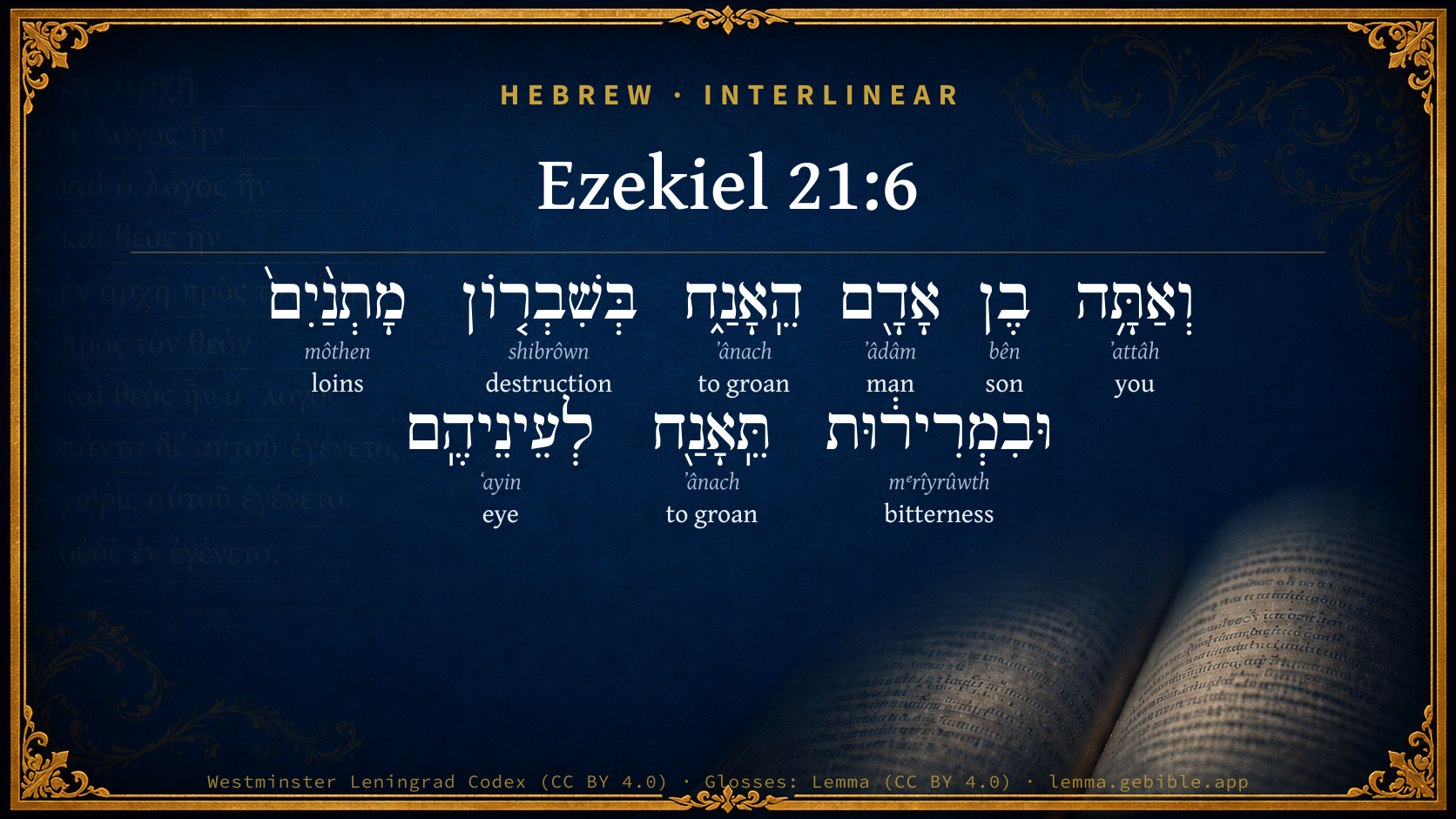
Hebrew (Westminster Leningrad Codex) Ezekiel 21:6 appears in the Hebrew Old Testament. The text above is from the Westminster Leningrad Codex. Each word links to its Strong’s number, a concise gloss, and parsing drawn from the Open Scriptures Hebrew Bible morphology. Click any word for its full Brown-Driver-Briggs (BDB) entry.
Download image
Cite this verse

Ezekiel 21:6 (World English Bible). Public Domain. Lemma interlinear Bible study tool, https://lemma.gebible.app/v/ezekiel/21/6.

Show BibTeX & RIS
BibTeX
RIS
English Translation
Sigh therefore, you son of man; with the breaking of your loins and with bitterness shall you sigh before their eyes.
World English Bible · Public Domain
Highlights
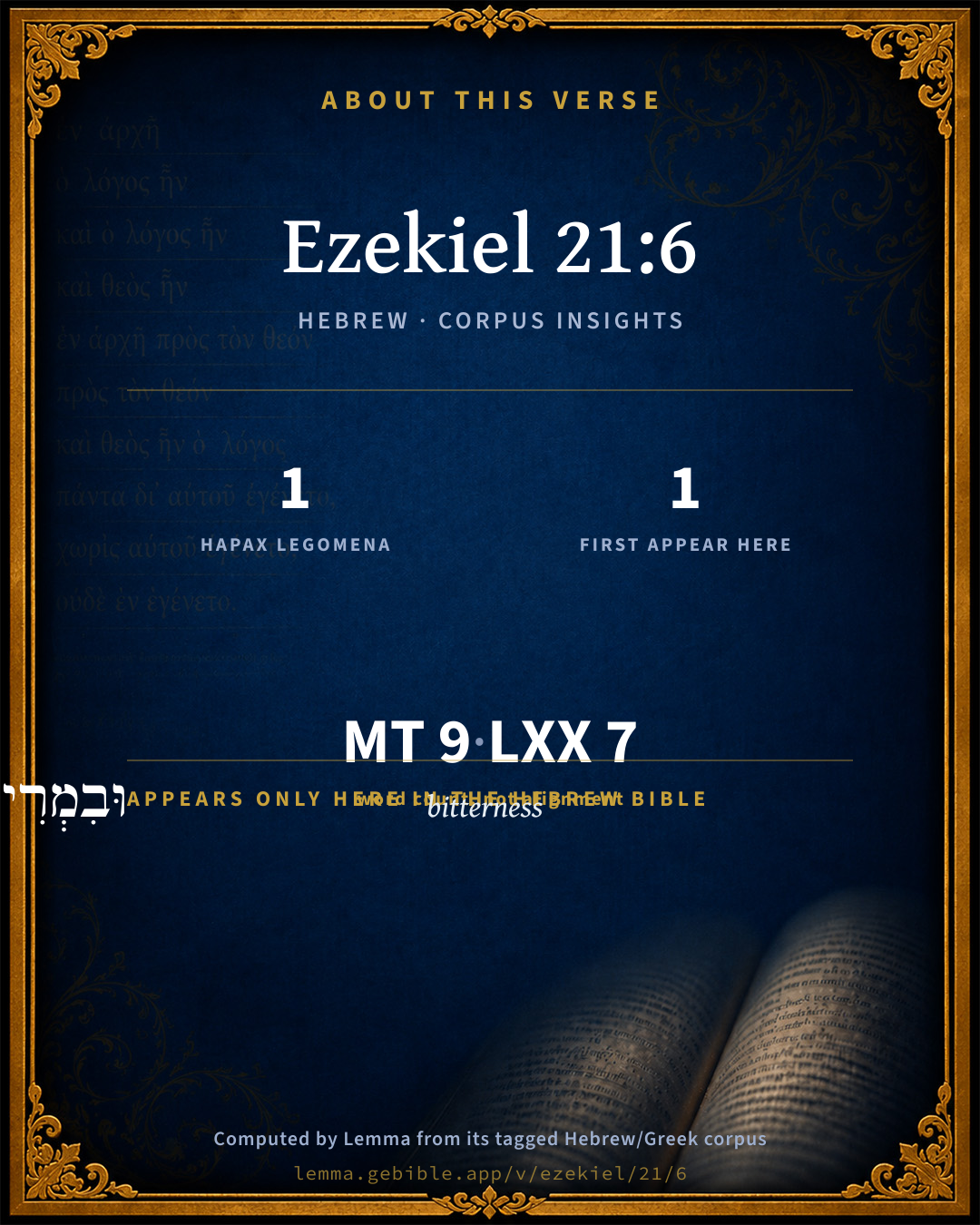
  • 1 hapax legomenon — only here in the Hebrew Bible
  • 1 first appearance in the Hebrew Bible
Full analysis ↓
Download a study sheet

One document with this verse’s original text, its word-by-word gloss line, the meaning frame, cross-references with their text, attributed commentary, and full source and license credits — printable, and it pastes into notes with its structure intact.

This verse Autodidact and up

Study sheet (.html) Plain text (.txt)

A passage Seminary Student

Up to 50 verses in one chapter. A passage sheet keeps up to 6 commentary sources and 12 cross-references per verse, in the order this page ranks them, and says so on the sheet whenever that leaves anything out. Ask for a single verse and you get the Autodidact verse sheet above.

Everything on this page stays free to read, with no account — the sheet is a download of what is already on screen, not access to it.

Want to remove ads? Support Godless Engineer
Compare translations 3

The same verse in 3 English versions, stacked beneath the original-language interlinear above. Click any original word for its lexicon entry.

Each is an independent rendering of the whole verse — the interlinear is not word-aligned to these translations.

Highlighted words mark where these versions differ — a whole-verse word diff, not a word-by-word alignment.

  • World English Bible Public Domain
    Sigh therefore, you son of man; with the breaking of your loins and with bitterness shall you sigh before their eyes.
  • King James Version Public Domain
    Sigh therefore, thou son of man, with the breaking of thy loins; and with bitterness sigh before their eyes.
  • unfoldingWord Literal Text CC BY-SA 4.0
    As for you, son of man, groan as your loins break! In bitterness groan before their eyes!

unfoldingWord Literal Text — © unfoldingWord, licensed CC BY-SA 4.0. Word-aligned USFM3 via Door43 (git.door43.org/unfoldingWord/en_ult).

Versions to compare (up to 4)

3 of 4 selected

Show all 18 translations

Every available English version of this verse, each an independent rendering of the whole verse.

  • World English Bible Public Domain
    Sigh therefore, you son of man; with the breaking of your loins and with bitterness shall you sigh before their eyes.
  • Berean Standard Bible Public Domain
    But you, son of man, groan! Groan before their eyes with a broken heart and bitter grief.
  • Majority Standard Bible Public Domain
    But you, son of man, groan! Groan before their eyes with a broken heart and bitter grief.
  • King James Version Public Domain
    Sigh therefore, thou son of man, with the breaking of thy loins; and with bitterness sigh before their eyes.
  • American Standard Version (1901) Public Domain
    Sigh therefore, thou son of man; with the breaking of thy loins and with bitterness shalt thou sigh before their eyes.
  • Revised Version (1885) Public Domain
    Sigh therefore, thou son of man; with the breaking of thy loins and with bitterness shalt thou sigh before their eyes.
  • Geneva Bible (1599) Public Domain
    Mourne therefore, thou sonne of man, as in the paine of thy reines, and mourne bitterly before them.
  • Douay-Rheims (1899) Public Domain
    And thou, son of man, mourn with the breaking of thy loins, and with bitterness sigh before them.
  • Young's Literal Translation Public Domain
    And thou, son of man, sigh with breaking of loins, yea, with bitterness thou dost sigh before their eyes,
  • Literal Standard Version CC BY-SA 4.0
    And you, son of man, sigh with breaking of loins, indeed, sigh before their eyes with bitterness,
  • Unlocked Literal Bible CC BY-SA 4.0
    As for you, son of man, groan as your loins break! In bitterness groan before their eyes!
  • unfoldingWord Literal Text CC BY-SA 4.0
    As for you, son of man, groan as your loins break! In bitterness groan before their eyes!
  • Darby Bible Public Domain
    Sigh then, thou son of man; with breaking of the loins, and with bitterness sigh before their eyes.
  • World Messianic Bible Public Domain
    “Therefore sigh, you son of man. You shall sigh before their eyes with a broken heart and with bitterness.
  • Webster's Bible Public Domain
    Sigh therefore, thou son of man, with the breaking of thy loins; and with bitterness sigh before their eyes.
  • Free Bible Version CC BY-SA 4.0
    You, son of man, you are to groan. Groan as if you're broken up inside, showing terrible sadness while they watch you.
  • Bible in Basic English Public Domain
    Make sounds of grief, son of man; with body bent and a bitter heart make sounds of grief before their eyes.
  • JPS Tanakh (1917) Public Domain
    (21-11) Sigh therefore, thou son of man; with the breaking of thy loins and with bitterness shalt thou sigh before their eyes.

Literal Standard Version (2020), Covenant Press — licensed CC BY-SA 4.0. Text via the HelloAO Bible API (eBible.org). Unlocked Literal Bible (unfoldingWord) — licensed CC BY-SA 4.0. Text via the HelloAO Bible API (eBible.org). unfoldingWord Literal Text — © unfoldingWord, licensed CC BY-SA 4.0. Word-aligned USFM3 via Door43 (git.door43.org/unfoldingWord/en_ult). Free Bible Version, Dr. Jonathan Gallagher — licensed CC BY-SA 4.0. Text via the HelloAO Bible API (eBible.org).

Word by word

More ways to search: Search by grammar → Find every occurrence → Compare this word →

Practice this passage: Drill this verse → Learn its vocabulary →

וּבִמְרִיר֔וּת
mᵉrîyrûwth
H4814
“and · in/at · bitterness”
Conjunction + Preposition + Noun, Common, Feminine, Singular, Absolute
Part of Speech
Conjunction + Preposition + Noun
Type
Common
Gender
Feminine
Number
Singular
State
Absolute
Full BDB Definition

Origin: from H4843

TWOT: 1248i

bitterness
  1. וְאַתָּ֥ה ʼattâh H859 “and · you” Conjunction + Pronoun, Personal, 2nd Person, Masculine, Singular
  2. בֶן bên H1121 “son of” Noun, Common, Masculine, Singular, Construct
  3. אָדָ֖ם ʼâdâm H120 “man” Noun, Common, Masculine, Singular, Absolute
  4. הֵֽאָנַ֑ח ʼânach H584 “groan” Verb, Niphal, Imperative, 2nd Person, Masculine, Singular
  5. בְּשִׁבְר֤וֹן shibrôwn H7670 “in/at · destruction of” Preposition + Noun, Common, Masculine, Singular, Construct
  6. מָתְנַ֨יִם֙ môthen H4975 “loins” Noun, Common, Masculine, Dual, Absolute
  7. תֵּֽאָנַ֖ח ʼânach H584 “to groan” Verb, Niphal, Imperfect, 2nd Person, Masculine, Singular
  8. לְעֵינֵיהֶֽם ʻayin H5869 “to/for · eyes · their” Preposition + Noun, Common, Both, Dual, Construct + Suffix, Personal, 3rd Person, Masculine, Plural

About this verse

These counts appear in no published source. They are computed here, from the morphology-tagged text and Lemma’s own curated glosses. What Lemma adds →

9
words
8
distinct lemmas
Prophets
section

Notable vocabulary

1 hapax legomenon — a word that appears only here in the entire Hebrew Bible:

  • וּבִמְרִיר֔וּת bitterness H4814

First appearance in Scripture

This word makes its first canonical appearance in the Hebrew Bible here:

  • וּבִמְרִיר֔וּת bitterness H4814

Shared distinctive vocabulary

בְּשִׁבְר֤וֹן destruction H7670 occurs in 2 verses of the Hebrew Bible. Also found in:

Grammatical profile

  • 2 verbs
  • 6 nouns
  • 1 pronoun

Verb forms

  • הֵֽאָנַ֑ח Niphal · Imperative
  • תֵּֽאָנַ֖ח Niphal · Imperfect

Repetition

A word recurs within this verse — often emphatic in Hebrew:

  • הֵֽאָנַ֑ח to groan H584 ×2

Hebrew & Septuagint length

In English translation the verse runs 21 words from the Hebrew and 20 from the Septuagint (LXX English) — closely comparable.

A rough comparison of the two English renderings, which tokenize alike — not a word-level alignment.

Word counts can differ between the Hebrew and the Greek without any difference in meaning — e.g. the Hebrew direct-object marker אֵת has no separate Greek word, and Greek often adds the article ὁ.

In the original languages it is 9 Hebrew tokens and 7 Greek tokens — but the two are counted differently (Hebrew bundles its prefixes and suffixes into one token; the Greek is in lemma form), so that isn’t a like-for-like length.

Cross-references

18

Topical passages linked to Ezekiel 21:6 in the Treasury of Scripture Knowledge — connected by theme and wording, ordered by reader-vote popularity; previews shown in the World English Bible.

  • Isaiah 22:4 Therefore said I, Look away from me, I will weep bitterly; don't labor to comfort me for the destruction of the daughter of my people.
  • Ezekiel 6:11 Thus says the Lord Yahweh: Smite with your hand, and stamp with your foot, and say, Alas! because of all the evil abominations of the house of Israel; for they shall fall by the sword, by the famine, and by the pestilence.
  • Isaiah 16:11 Why my heart sounds like a harp for Moab, and my inward parts for Kir Heres.
  • Isaiah 21:3 Therefore are my loins filled with anguish; pangs have taken hold on me, as the pangs of a woman in travail: I am pained so that I can't hear; I am dismayed so that I can't see.
  • Jeremiah 4:19 My anguish, my anguish! I am pained at my very heart; my heart is disquieted in me; I can't hold my peace; because you have heard, O my soul, the sound of the trumpet, the alarm of war.
  • Jeremiah 9:17–21 Thus says Yahweh of Hosts, Consider you, and call for the mourning women, that they may come; and send for the skillful women, that they may come:
  • Jeremiah 19:10 Then shall you break the bottle in the sight of the men who go with you,
  • Jeremiah 30:6 Ask now, and see whether a man does travail with child: why do I see every man with his hands on his loins, as a woman in travail, and all faces are turned into paleness?
  • Ezekiel 4:12 You shall eat it as barley cakes, and you shall bake it in their sight with dung that comes out of man.
  • Ezekiel 9:4 Yahweh said to him, Go through the midst of the city, through the midst of Jerusalem, and set a mark on the foreheads of the men that sigh and that cry over all the abominations that are done in the midst of it.
  • Ezekiel 12:3–5 Therefore, you son of man, prepare you stuff for removing, and remove by day in their sight; and you shall remove from your place to another place in their sight: it may be they will consider, though they are a rebellious house.
  • Ezekiel 21:12 Cry and wail, son of man; for it is on my people, it is on all the princes of Israel: they are delivered over to the sword with my people; strike therefore on your thigh.
  • Ezekiel 37:20 The sticks whereon you write shall be in your hand before their eyes.
  • Daniel 5:6 Then the king's face was changed in him, and his thoughts troubled him; and the joints of his loins were loosened, and his knees struck one against another.
  • Daniel 8:27 I, Daniel, fainted, and was sick certain days; then I rose up, and did the king's business: and I wondered at the vision, but none understood it.
  • Nahum 2:10 She is empty, void, and waste. The heart melts, the knees knock together, their bodies and faces have grown pale.
  • Habakkuk 3:16 I heard, and my body trembled. My lips quivered at the voice. Rottenness enters into my bones, and I tremble in my place, Because I must wait quietly for the day of trouble, For the coming up of the people who invade us.
  • John 11:33–35 When Jesus therefore saw her weeping, and the Jews weeping who came with her, he groaned in the spirit, and was troubled,

Cross-references courtesy of OpenBible.info (CC BY 4.0).

Hebrew and Greek witnesses Masoretic Hebrew ↔ Greek Septuagint

The same verse in the two great witnesses to the Old Testament, shown verse-for-verse.

These are two independent witnesses, not word-aligned to each other, and the Septuagint is shown in lemma (dictionary) form.

Hebrew Ezekiel 21:6 Masoretic · Westminster Leningrad Codex

וְאַתָּ֥ה בֶן אָדָ֖ם הֵֽאָנַ֑ח בְּשִׁבְר֤וֹן מָתְנַ֨יִם֙ וּבִמְרִיר֔וּת תֵּֽאָנַ֖ח לְעֵינֵיהֶֽם

Sigh therefore, you son of man; with the breaking of your loins and with bitterness shall you sigh before their eyes.

World English Bible · Public Domain

Greek LXX Ezekiel 21:6 Septuagint · lemma form

καί γίγνομαι λόγος κύριος πρός ἐγώ λέγω

And you, son of man, groan with the breaking of your loins; you shall even groan heavily in their sight.

LXX2012 (modern English Septuagint) · Public Domain

On this verse, Haydock's Catholic Bible Commentary discusses the Septuagint’s reading. Read the note in Commentary ↓

Hebrew: Westminster Leningrad Codex (CC BY 4.0). Greek: Septuagint (public domain); English from LXX2012 (modern English Septuagint) (Public Domain). How the Septuagint differs from the Hebrew →

Targum (Aramaic paraphrase)

1

The Targum is the ancient Jewish Aramaic paraphrase of the Hebrew Scriptures — an interpretive translation, not the Hebrew text itself. Onkelos (literal) and Pseudo-Jonathan (expansive) render the Torah, and Jonathan the Prophets. Coverage is partial: where no permissively-licensed English translation exists for a verse, only the Aramaic is shown. This is verse-level text, not a word-by-word alignment to the Hebrew.

  1. Targum Jonathan Prophets (Joshua–Malachi)
    וַהֲוָה פִּתְגַם נְבוּאָה מִן קֳדָם יְיָ עִמִי לְמֵימָר:

    (no public-domain English translation for this verse)

    Targum Jonathan — Aramaic: “Mikraot Gedolot” (public domain). English: “Sefaria Community Translation” (CC0 1.0 (public-domain dedication)); “London "Chaldee Paraphrase," 1871” (public domain). Text via Sefaria.

Commentary

Notes on Ezekiel 21:6 from classic Christian and Jewish commentators (each source and its license shown beneath its notes). The classic Christian expositions comment on the surrounding passage and are grouped to its opening verse, so a note may address several verses; the Jewish commentaries on the Tanakh (Rashi and others) are per-verse, so they appear only where the commentator wrote on this verse.

Lemma curates 59 commentaries, every one of them public domain or Creative Commons licensed, each selected and text-cleaned for this edition rather than reprinted as found. About our sources →

Trapp's Complete Commentary

John Trapp

Eze 21:6 Sigh therefore, thou son of man, with the breaking of [thy] loins; and with bitterness sigh before their eyes.

Ver. 6. Sigh therefore, with the breaking of thy loins.] Gemituque et gestu dolorem referas; show greatest grief, such as is deep and downright; sigh till thy buttons fly; or as a travailing woman. Non ut praeficae in funeribus solent.

John Trapp, A Commentary or Exposition upon All the Books of the Old and New Testament (1647–1656) — public domain. Text from a community e-Sword module.

The Biblical Illustrator

Joseph S. Exell

Eze_21:6-7

Wherefore sighest thou?

. . .For the tidings.

Sighing because of sorrowful tidings

The tidings were, in the first place, of dishonour done to God, and, in the second place, of ruin which the transgressors were bringing upon themselves; and we think to show you that the tidings were such as might well justify the prophet as he looked upon his nation in sighing with bitterness before their eyes.

1. If you know anything of the relationship subsisting between the Creator and the creature, you must know that we lie absolutely at the disposal of God, depending for every thing upon His bounty, and bound to live wholly to His glory. Gods laws are binding without exception and without limitation; and if He only issue an announcement of His will, it should be received with the deepest reverence and obeyed with unhesitating compliance throughout every department of His unbounded empire. And if this obedience be withheld, who can fail to see that the very greatest insult is at once offered by the finite to the Infinite? Now, consider what effect this insult will have--or at least ought to have--upon a man who loves God, and whose prime effort it is to obey His every word. If a man of warm loyalty were living amongst traitors, it would wound him to the quick to hear the king whom he honoured continually reviled. If a man of warm friendship were with the enemies of his love, it would sorely grieve him to observe how his friend was hated and despised. And what are such feelings in comparison of those which should rise in the man of real piety, when he beholds on all sides dishonour done to his God? Oh! as such a man thinks on the unlimited right which God has to the services of His creatures, and yet more as he thinks how God draws those creatures to Himself by every motive of interest and attraction, supplying their wants, offering them happiness, bearing with their perverseness; and then, when there come to him tidings of the return which God receives--His authority defied, His promises despised, His threatenings laughed to scorn, so that it almost seems the universal object to expel Him from His own world, and set up some usurper in His stead--as the man, we say, of real piety observes all this, and meditates on all this, would there be any cause of wonder were he to exclaim, For the tidings! for the tidings when asked to explain a manifestation of grief which should be similar to that of the prophet--Sigh, therefore, thou son of man, with the breaking of thy loins, and with bitterness sigh before their eyes?

2. But let us go on to consider the ruin which transgressors are bringing on themselves; for here at least we shall find tidings which, in the judgment of you all, might vindicate Ezekiels mighty manifestation of anguish. It is not the moment of absolute shipwreck; but it cometh--it cometh. The tidings make him as certain of the shipwreck of thousands as though already were the sea strewed with the fragments of the stranded navy. It is with him no matter of conjecture or speculation whether a life of wickedness will terminate in an eternity of misery; he so surely anticipates the future that he is as though he beheld the casting of the wicked into a lake of fire, and could not be more assured of their terrible doom if the last day were come, and the dead were raised, and the books were opened. And who are these victims of Divine justice? Are they not his fellow men--his brethren after the flesh--those for whom he would bitterly sorrow, if he knew them exposed to some temporal calamity? Shall he--can he--be unmoved by their everlasting wretchedness? (H. Melvill, B. D.)

The Biblical Illustrator, edited by Joseph S. Exell (c. 1880s–1900s) — public domain. Text from a community e-Sword module.

Joseph Benson's Commentary

Eze 21:6-7. Sigh, therefore, with the breaking of thy loins, &c. — Show all the tokens of grief and concern; sigh and groan deeply; let the sense of these impending judgments so greatly affect thee, as to make thee stoop like one quite borne down under the weight of them. God’s judgments, as they were represented to the minds of the prophets, very often affected them with dreadful apprehensions, especially when they concerned their own people: see the margin. With bitterness sigh before their eyes — Before the eyes of the elders of Israel, mentioned Eze 20:1, or of the Jewish captives, who could not but be touched with a tender sense of the calamities ready to befall their brethren in Judea. Every heart shall melt, &c. — Men’s hearts and strength shall fail them for fear.

Joseph Benson's Commentary on the Old and New Testaments (1811–1818) — public domain. Text from a community e-Sword module.

Tyndale Open Study Notes

Tyndale Open Resources

21:6-7 Ezekiel’s groaning showed that in the coming judgment, the boldest heart would melt and the strong knees would become . . . weak. The judgment that had previously been announced had now become a bitter reality (cp. 7:1-4).

Tyndale Open Study Notes — © Tyndale Open Resources, licensed CC BY-SA 4.0. Text via the HelloAO Bible API.

Geneva Bible (1599)

Geneva Bible translators

As though thou were in extreme anguish.

Geneva Bible (1599) marginal notes — public domain. Text via Bolls.life.

Jamieson, Fausset & Brown

Robert Jamieson, A. R. Fausset & David Brown

with the breaking of thy loins--as one afflicted with pleurisy; or as a woman, in labor-throes, clasps her loins in pain, and heaves and sighs till the girdle of the loins is broken by the violent action of the body (Jer 30:6).

Jamieson, Fausset & Brown — Commentary Critical and Explanatory on the Whole Bible (1871) — public domain (CC PDM 1.0). Text via the HelloAO Bible API.

Adam Clarke's Commentary

Verse 6. Sigh - with the breaking of thy loins] Let thy mourning for this sore calamity be like that of a woman in the pains of travail.

Adam Clarke's Commentary on the Bible (1810–1826) — public domain. Text from a community e-Sword/MySword module.

Ellicott's Commentary for English Readers

(6) With the breaking of thy loins.—The loins were regarded as the seat of strength (Job_40:16); and the breaking of these, therefore, expresses entire prostration. Comp. Psa_66:11; Psa_69:23; Isa_21:3; Nah_2:10. The prophet was to do this “before their eyes,” i.e., was in some way to express before them a sense of extreme dejection and prostration, such as should call forth the question and reply of the following verse. With the expression “Every heart shall melt” comp. Luk_21:26.

A Bible Commentary for English Readers, edited by Charles John Ellicott (1878–1897) — public domain. Text from a community e-Sword module.

The Cambridge Bible for Schools and Colleges

gen. ed. J. J. S. Perowne

6, 7. Agitation of the prophet at the tidings of the coming calamity. This agitation of his is only a symbol of the dismay and paralysis that shall overtake all when the calamity comes. On the figures in Eze_21:7 cf. Eze_7:17.

The Cambridge Bible for Schools and Colleges (gen. ed. J. J. S. Perowne; Cambridge University Press, 1878–1918) — public domain. Text from a community e-Sword module.

John Gill's Exposition

And it shall be, when they say unto thee, wherefore sighest thou?.... Which he was to do that purpose, that they might be put upon asking him the reason of it; whether it was on his own personal amount, or on account of his family or particular friends; or whether on a public account, either because of what should befall the captives there, or their countrymen in Judea and Jerusalem:

that thou shalt answer, for the tidings, or, the "report" (p),

because it cometh; the report of the Chaldean army approaching and invading Judea, and besieging Jerusalem, which he had from the Lord; and the thing itself was just at hand, and would shortly and certainly be; and that was the thing that affected him, and caused such sorrow and sighing:

and every heart shall melt; like wax, for fear of the enemy; even such who then disbelieved the report, and laughed at it as an idle story:

and all hands shall be feeble; and not able to hold a sword, or strike a stroke:

and every spirit shall faint; yea, such who had the greatest spirits, and were the most bold and undaunted, shall be quite dispirited, no heart nor courage to defend themselves or their country:

and all knees shall be weak as water; they shall not be able to stand upon their legs, and fight like men in their own defence; nor even be able to flee away, and make their escape: or,

shall flow with water (q); either with sweat, or with urine, through fear of the enemy:

behold, it cometh, and shall be brought pass, saith the Lord God; let no man therefore put this evil day far from him, or treat this report as an idle tale, or a thing at a distance, and which may never come to pass; for it is now a coming, and in a very little time will be accomplished; for the Lord has said it, who cannot lie, whose counsel shall stand, and will do all his pleasure.

(p) , , Sept.; "propter rumorem", Vatablus, Cocceius; "propter vel ad auditum", Paginus, Montanus. (q) "fluent aquis", Munster, Tigurine version, so Ben Melech; "manabunt ut aqua" Cocceius.

John Gill's Exposition of the Whole Bible (1746–1763) — public domain (CC PDM 1.0). Text via the HelloAO Bible API.

Albert Barnes' Notes on the Bible

The prophet was directed to let the people see him sighing and prostrate, as a sign of the sorrow and weakness about to come upon the people.

The breaking of thy loins - The prostration of strength; the loins being the seat of strength.

Albert Barnes' Notes on the Bible (1834–1885) — public domain. Text from a community e-Sword/MySword module.

Haydock's Catholic Bible Commentary

Bitterness. Septuagint, "pains," like those of child-bearing, Isaias xxi. 3.

George Leo Haydock (1774–1849), Haydock's Catholic Family Bible and Commentary, 1859 edition — public domain. Excludes Psalms (Douay-Rheims chapter numbering differs from Protestant) and Deuterocanonical books (Catholic canon only).

Matthew Poole's English Annotations

Sigh; thereby express to them deepest sorrows for what is present, and most piercing fears of what is to come.

With the breaking of thy loins; like a woman in travail, or as one whose griefs are ready to break his heart, Isa 21:3.

With bitterness; with all sorts of the most bitter cries and tears.

Before their eyes who were now with him in Babylon, and who, as they easily could, so surely would, send word to them in Jerusalem and Judea.

Matthew Poole's English Annotations on the Holy Bible (1683–1685) — public domain. Text from a community e-Sword/MySword module.

Whedon's Commentary on the Bible

Daniel D. Whedon

6. Sigh… with the breaking of thy loins — This expression of speechless grief, which seems as if it will tear the body asunder, is the picture prophecy of the anguish which all shall feel when the news of the downfall of the holy city — which Ezekiel has so long been prophesying — shall be brought to the captives at Tel-abib.

Daniel D. Whedon (gen. ed.), Commentary on the Old and New Testaments (1874–1909) — public domain. Text from a community e-Sword module.

The Pulpit Commentary

Sigh therefore, etc. As in other instances, (Eze_4:4 Eze_5:1-4) the prophet dramatizes the coming calamity. He is to act the part of a mourner, whose sighs are so deep that they seem to "break his loins". (compare, for the gesture, Nah_2:1, Nah_2:10; Isa_21:3; Jer_30:6) The strange action was meant to lead to questions. What did it mean? And then he is to answer that he does it "for the tidings" which are to him as certain as if they had already come. He is but doing what all would do, when the messenger brought word, as in Eze_33:21, five years later, that the city was at last smitten.

Vers. 6, 7. The sign of sighing.

In the case of Ezekiel, perhaps more than in any other of the prophets, actions were adopted as prophetic signs, more effective than words. The tidings conveyed to the prophet, and through him to his fellow countrymen, were of so mournful an import that such indications of mental distress as sighing and weeping were natural expressions of the feelings which he could not but experience. It was appointed for him in this way to excite the curiosity of his people, and, in response to their inquiries, to inform them of coming evils.

I THE CAUSE OF THE PROPHET"S SIGHING.

1. The trouble which was about to come upon the inhabitants of Jerusalemand of the whole land of Israel, in the invasion of the country, the siege of the metropolis, and the violent death of many of the inhabitants.

2. The sinful rebelliousness of the people, by which they were bringingupon themselves these calamities and disasters.

3. Ezekiel"s deep and sincere sympathy with sufferers, and his sorrow for their evil ways, so that he felt for his fellow countrymen as he would have felt for himself.

II THE SEVERITY OF THE PROPHET"S SIGHING. It was "with bitterness," "with the breaking of the loins," i.e. sighing shaking the whole bodily frame, and evincing the pungent distress afflicting his spirit.

III THE SIGNIFICANCE OF THE PROPHET"S SIGHING.

1. It was an evidence of patriotism; for Ezekiel himself was far from thescene of approaching retribution, and it did not affect him personally, but through his patriotic identification of himself with all that concerned his people.

2. It was an evidence of his faith in Divine assurances. There is no reasonto suppose that mere political foresight enabled the prophet to anticipate the coming, evil; yet he realized its certain approach with such intensity as to call forth the manifestation of feeling here described.

3. It was a warning to the careless and insensible. There were many forwhom Ezekiel sighed who sighed not for themselves; yet theirs was the sin, and theirs the punishment now imminent.

4. It was a summons to repentance. If the prophet cried and sighed for theabominations wrought among the people, how much more did it become those who by their sins had provoked the anger of the righteous God to consider their ways, to weep because of their guilty ingratitude and persistent disobedience, and to flee from the wrath to come! how much more did it behove them to call upon the Lord that he might have mercy upon them, and upon their God who could abundantly pardon! T.

The Pulpit Commentary (1880–1919), ed. H.D.M. Spence-Jones & Joseph S. Exell — public domain. Text from a community e-Sword module.

John Wesley's Explanatory Notes

Sigh therefore - Thereby express deep sorrow. Breaking of thy loins - Like a woman in travail.

John Wesley, Explanatory Notes Upon the Whole Bible (1754–1765) — public domain. Text via the GEBible commentary corpus.

unfoldingWord translationNotes

Door43 World Missions Community

General Information:

Yahweh is speaking to Ezekiel.

groan as your loins break

Yahweh tells Ezekiel to groan as a sign to accompany his message. He tells him to groan deeply as if his abdomen was in great pain. "groan deeply as if your loins were in great pain" or "groan deeply with great sorrow" (See: Idiom)

In bitterness groan

"With great grief" or "With great sorrow"

before their eyes

Here the Israelites are referred to by their "eyes" to emphasize what they see. AT: "before them" or "before the Israelite people" (See: Synecdoche)

the news that is coming

This speaks of the "news" as if it were a person that was soon coming to them. AT: "the news that they will soon hear" (See: Personification)

for every heart will faint away

This speaks of people becoming afraid, as if their hearts were fainting. Also, this speaks of the people fainting as a result of fear. AT: "for everyone will become fearful" (See: Synecdoche and Metaphor)

will falter

"will be weak"

Every spirit will grow faint

This speaks of people becoming fearful in their spirits as if their spirits were about to faint. AT: "Everyone will be fearful in their inner being" (See: Metaphor)

every knee will flow like water

"every knee will be as weak as water." This is a euphemism for people being so afraid that they lose their bladder control and urinate on themselves. AT: "every leg will be wet with urine" or "everyone will lose control of their urine" (See: Euphemism)

this is the Lord Yahweh's declaration

Yahweh speaks of himself by name to express the certainty of what he is declaring. See how you translated this in Ezekiel 5:11. AT: "this is what the Lord Yahweh has declared" or "this is what I, the Lord Yahweh, have declared" (See: First, Second, or Third Person)

translationWords

loins

heart

spirit

Lord Yahweh

declare

unfoldingWord translationNotes — © Distant Shores Media and the Door43 World Missions Community, licensed CC BY-SA 4.0. Source: git.door43.org/Door43/en_tn.

Rashi

Rabbi Shlomo Yitzchaki (Rashi)

Then the word of the Lord came to me, saying Prophesy to them a clear prophecy. What I said to you, “Set your face southward,” I explain to you: “Set your face toward Jerusalem.”

Rashi on the Tanakh — English translations: “The Judaica Press complete Tanach with Rashi, translated by A. J. Rosenberg” (CC BY 4.0); “Pentateuch with Rashi's commentary by M. Rosenbaum and A.M. Silbermann, 1929-1934” (public domain); “The Metsudah Tanach series, Lakewood, N.J” (CC BY 4.0); and “The Book of Joshua, Metsudah Publications, 1997” (CC BY 4.0). Text via Sefaria.

Lesson kit

Teaching starters — assembled from the data on this page, not authored interpretation. Every prompt links to the verse data it draws on. Edit before teaching.

Ezekiel, in the Prophets, opens this verse with 9 words (8 distinct Hebrew lemmas). Its most distinctive word is mᵉrîyrûwth (“bitterness”). A historical commentator’s framing appears above. Read the whole chapter for the surrounding context.

Discussion questions

  1. How does “bitterness” (mᵉrîyrûwth) shape what this verse is saying?
  2. This verse holds 1 word here found nowhere else in the Hebrew Bible. What might the rare word draw attention to?
  3. The word “bitterness” first appears here in Scripture. What is being introduced at this debut?
  4. Jeremiah 17:18 shares the word «destruction» with this verse. How do the two illuminate each other?
  5. “to groan” occurs 2× in this one verse. What is the effect of the repetition?
  6. The translations on this page render this verse differently — a whole-verse word diff, not a word-by-word alignment. What might account for the different wordings?
  7. The verb «הֵֽאָנַ֑ח» is Niphal Imperative. How does its form color the action?
  8. Reading how Trapp's Complete Commentary and The Biblical Illustrator read this verse, where do the two commentators agree and where do they part?

Things to notice

  • 1 word in this verse appears nowhere else in the Hebrew Bible.
  • 1 word makes its first canonical appearance in Scripture here.
  • This verse counts 9 Hebrew ↔ 7 Greek words.
  • These translations choose different wording for 7 words in this verse.
  • “to groan” occurs 2× in this single verse.

Reading settings

Reading text

Shown beneath each verse's original-language words.

Old Testament
Old Testament edition

Read the OT as the Masoretic Hebrew (MT) or the Greek Septuagint (LXX).

English shown for the Greek Septuagint (in the Hebrew ↔ Greek comparison).

Comparing translations? Open the Compare panel on any verse page to stack up to four side by side.