1 Peter 5:7

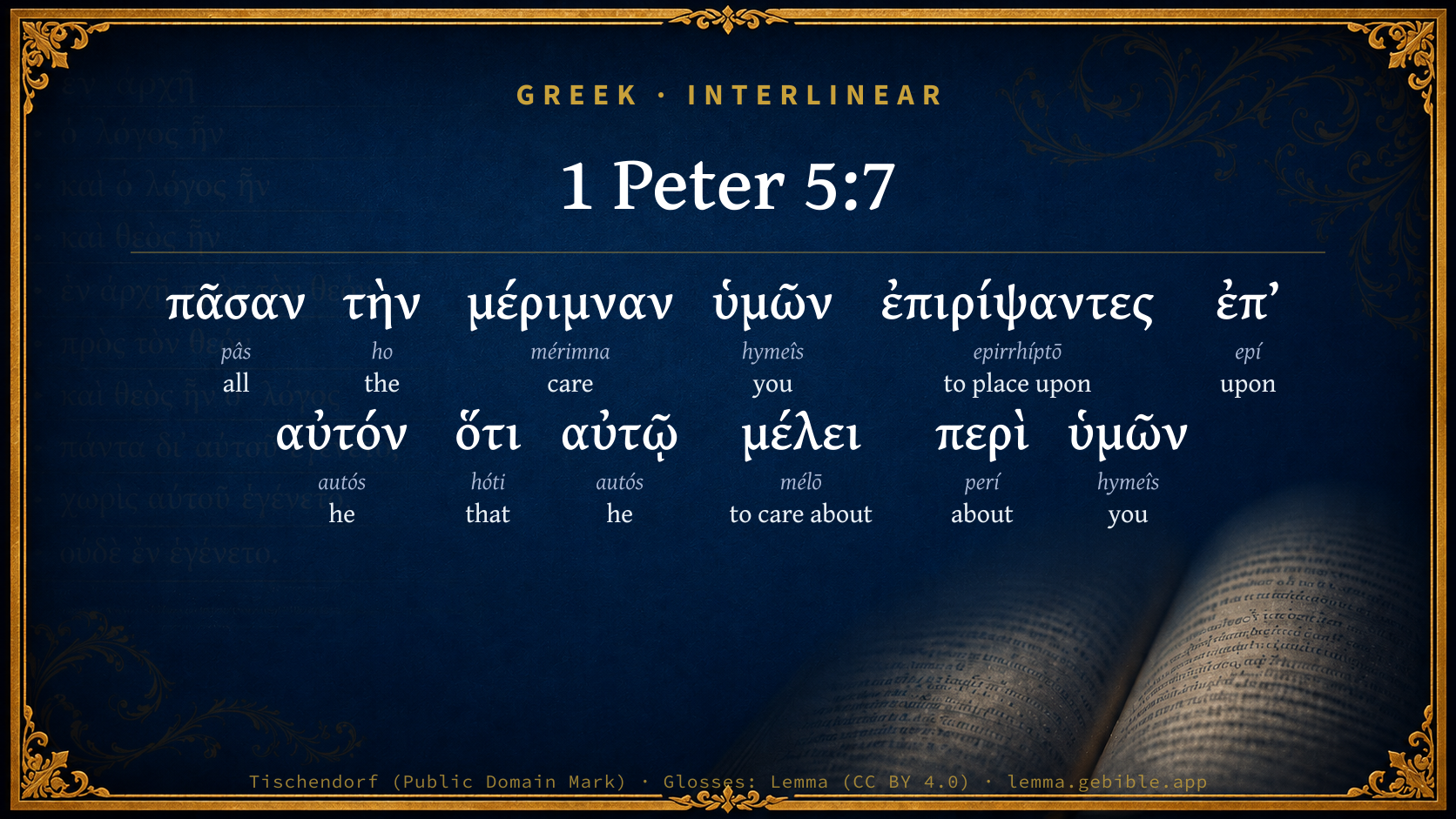
Greek (Tischendorf 8th ed.) 1 Peter 5:7 appears in the Greek New Testament. The text above is from the Tischendorf 8th edition. Each word links to its Strong’s number and a concise gloss. Click any word for its full Thayer’s Greek Lexicon entry.
Download image
Cite this verse

1 Peter 5:7 (World English Bible). Public Domain. Lemma interlinear Bible study tool, https://lemma.gebible.app/v/1-peter/5/7.

Show BibTeX & RIS
BibTeX
RIS
English Translation
casting all your worries on him, because he cares for you.
World English Bible · Public Domain
Download a study sheet

One document with this verse’s original text, its word-by-word gloss line, the meaning frame, cross-references with their text, attributed commentary, and full source and license credits — printable, and it pastes into notes with its structure intact.

This verse Autodidact and up

Study sheet (.html) Plain text (.txt)

A passage Seminary Student

Up to 50 verses in one chapter. A passage sheet keeps up to 6 commentary sources and 12 cross-references per verse, in the order this page ranks them, and says so on the sheet whenever that leaves anything out. Ask for a single verse and you get the Autodidact verse sheet above.

Everything on this page stays free to read, with no account — the sheet is a download of what is already on screen, not access to it.

Want to remove ads? Support Godless Engineer
Compare translations 3

The same verse in 3 English versions, stacked beneath the original-language interlinear above. Click any original word for its lexicon entry.

Each is an independent rendering of the whole verse — the interlinear is not word-aligned to these translations.

Highlighted words mark where these versions differ — a whole-verse word diff, not a word-by-word alignment.

  • World English Bible Public Domain
    casting all your worries on him, because he cares for you.
  • King James Version Public Domain
    Casting all your care upon him; for he careth for you.
  • unfoldingWord Literal Text CC BY-SA 4.0
    having cast all your anxiety on him, because he cares for you.

unfoldingWord Literal Text — © unfoldingWord, licensed CC BY-SA 4.0. Word-aligned USFM3 via Door43 (git.door43.org/unfoldingWord/en_ult).

Versions to compare (up to 4)

3 of 4 selected

Show all 19 translations

Every available English version of this verse, each an independent rendering of the whole verse.

  • World English Bible Public Domain
    casting all your worries on him, because he cares for you.
  • Berean Standard Bible Public Domain
    Cast all your anxiety on Him, because He cares for you.
  • Majority Standard Bible Public Domain
    Cast all your anxiety on Him, because He cares for you.
  • King James Version Public Domain
    Casting all your care upon him; for he careth for you.
  • American Standard Version (1901) Public Domain
    casting all your anxiety upon him, because he careth for you.
  • Revised Version (1885) Public Domain
    casting all your anxiety upon him, because he careth for you.
  • Geneva Bible (1599) Public Domain
    Cast all your care on him: for he careth for you.
  • Douay-Rheims (1899) Public Domain
    Casting all your care upon him, for he hath care of you.
  • Young's Literal Translation Public Domain
    all your care having cast upon Him, because He careth for you.
  • Literal Standard Version CC BY-SA 4.0
    having cast all your care on Him, because He cares for you.
  • Unlocked Literal Bible CC BY-SA 4.0
    Cast all your anxiety on him, because he cares for you.
  • unfoldingWord Literal Text CC BY-SA 4.0
    having cast all your anxiety on him, because he cares for you.
  • Darby Bible Public Domain
    having cast all your care upon him, for he cares about you.
  • World Messianic Bible Public Domain
    casting all your worries on him, because he cares for you.
  • Webster's Bible Public Domain
    Casting all your care upon him; for he careth for you.
  • Free Bible Version CC BY-SA 4.0
    Surrender all your worries to him, because he cares for you.
  • Bible in Basic English Public Domain
    Putting all your troubles on him, for he takes care of you.
  • Text-Critical English NT CC BY 4.0
    casting all your anxiety on him, because he cares for you.
  • Tyndale New Testament (1534) Public Domain
    Cast all youre care to him: for he careth for you.

Literal Standard Version (2020), Covenant Press — licensed CC BY-SA 4.0. Text via the HelloAO Bible API (eBible.org). Unlocked Literal Bible (unfoldingWord) — licensed CC BY-SA 4.0. Text via the HelloAO Bible API (eBible.org). unfoldingWord Literal Text — © unfoldingWord, licensed CC BY-SA 4.0. Word-aligned USFM3 via Door43 (git.door43.org/unfoldingWord/en_ult). Free Bible Version, Dr. Jonathan Gallagher — licensed CC BY-SA 4.0. Text via the HelloAO Bible API (eBible.org).

Word by word

More ways to search: Search by grammar → Find every occurrence → Compare this word →

Practice this passage: Drill this verse → Learn its vocabulary →

About this verse

These counts appear in no published source. They are computed here, from the morphology-tagged text and Lemma’s own curated glosses. What Lemma adds →

12
words
10
distinct lemmas
General Epistles
section

Notable vocabulary

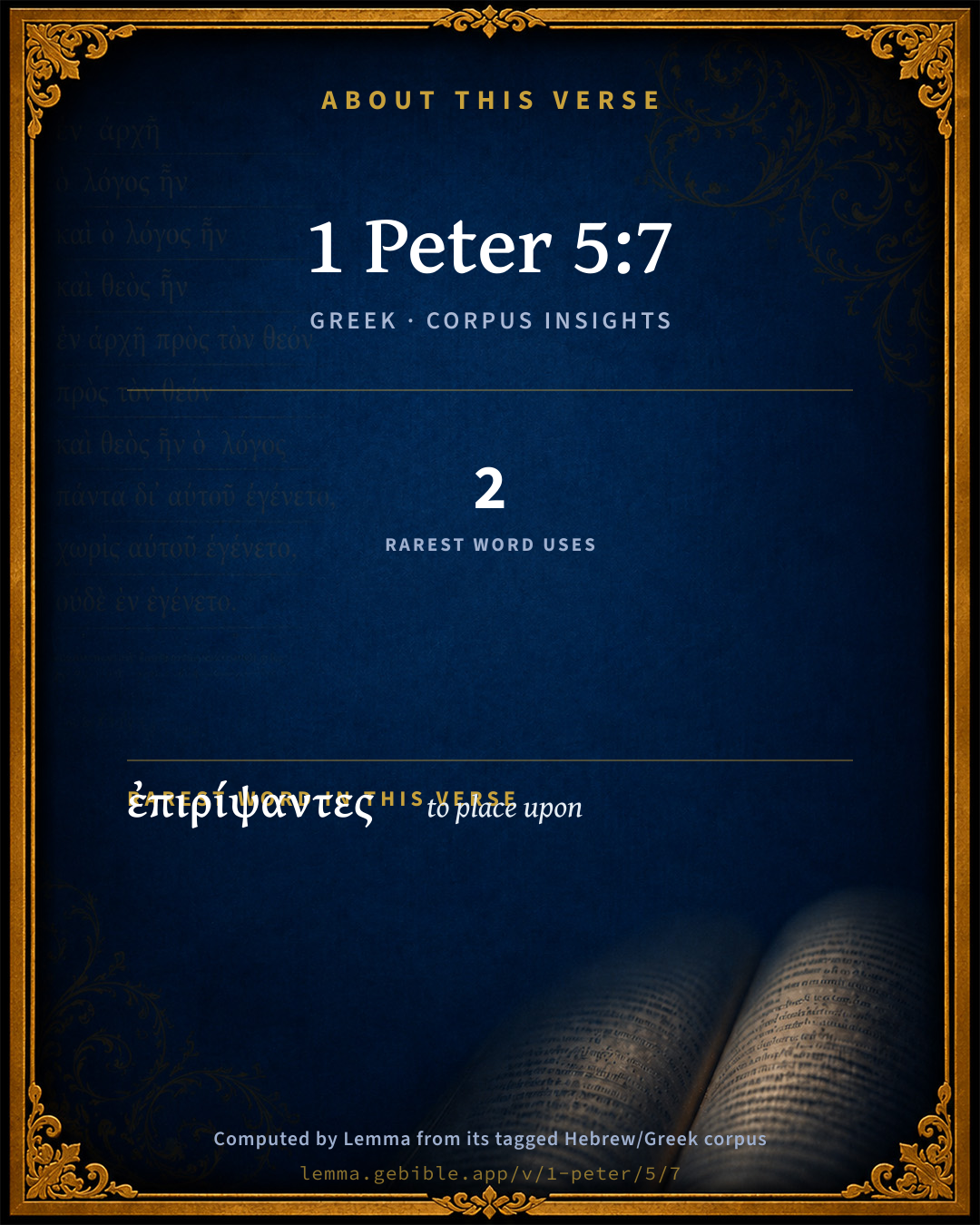
The rarest word here is ἐπιρίψαντες to place upon G1977 — appearing just 2 times in the whole Greek New Testament.

Shared distinctive vocabulary

ἐπιρίψαντες to place upon G1977 occurs in 2 verses of the Greek New Testament. Also found in:

Repetition

Words recur within this verse:

  • ὑμῶν you G5210 ×2
  • αὐτόν he G846 ×2

Cross-references

17

Topical passages linked to 1 Peter 5:7 in the Treasury of Scripture Knowledge — connected by theme and wording, ordered by reader-vote popularity; previews shown in the World English Bible.

  • Psalms 55:22 Cast your burden on Yahweh, and he will sustain you. He will never allow the righteous to be moved.
  • Philippians 4:6 In nothing be anxious, but in everything, by prayer and petition with thanksgiving, let your requests be made known to God.
  • Psalms 37:5 Commit your way to Yahweh. Trust also in him, and he will do this:
  • Psalms 56:3–4 When I am afraid, I will put my trust in you.
  • Matthew 6:25–26 Therefore, I tell you, don't be anxious for your life: what you will eat, or what you will drink; nor yet for your body, what you will wear. Isn't life more than food, and the body more than clothing?
  • Matthew 6:33–34 But seek first God's Kingdom, and his righteousness; and all these things will be given to you as well.
  • Hebrews 13:5–6 Be free from the love of money, content with such things as you have, for he has said, "I will in no way leave you, neither will I in any way forsake you."
  • Psalms 34:15 Yahweh's eyes are toward the righteous. His ears listen to their cry.
  • Luke 12:22 He said to his disciples, "Therefore I tell you, don't be anxious for your life, what you will eat, nor yet for your body, what you will wear.
  • Psalms 27:13–14 I am still confident of this: I will see the goodness of Yahweh in the land of the living.
  • 1 Samuel 30:6 David was greatly distressed; for the people spoke of stoning him, because the soul of all the people was grieved, every man for his sons and for his daughters: but David strengthened himself in Yahweh his God.
  • Luke 12:30–32 For the nations of the world seek after all of these things, but your Father knows that you need these things.
  • Psalms 142:4–5 Look on my right, and see; For there is no one who is concerned for me. Refuge has fled from me. No one cares for my soul.
  • Luke 12:11–12 When they bring you before the synagogues, the rulers, and the authorities, don't be anxious how or what you will answer, or what you will say;
  • Mark 4:38 He himself was in the stern, asleep on the cushion, and they woke him up, and told him, "Teacher, don't you care that we are dying?"
  • 1 Samuel 1:10–18 She was in bitterness of soul, and prayed to Yahweh, and wept sore.
  • John 10:13 The hired hand flees because he is a hired hand, and doesn't care for the sheep.

Cross-references courtesy of OpenBible.info (CC BY 4.0).

Commentary

Notes on 1 Peter 5:7 from classic Christian and Jewish commentators (each source and its license shown beneath its notes). The classic Christian expositions comment on the surrounding passage and are grouped to its opening verse, so a note may address several verses; the Jewish commentaries on the Tanakh (Rashi and others) are per-verse, so they appear only where the commentator wrote on this verse.

Lemma curates 59 commentaries, every one of them public domain or Creative Commons licensed, each selected and text-cleaned for this edition rather than reprinted as found. About our sources →

Bengel's Gnomon

Johann Albrecht Bengel

1Pe 5:7. Πᾶσον τὴν μέριμναν, all your anxiety) If the world depresses you, or if many things are wanting to you.—ἐπιῤῥίψαντες, casting) boldly. [Exemption from anxieties is pre-eminently accordant with humility.—V. g.] Psa 55:22, Septuagint, ἐπίῤῥιψον ἐπὶ Κύριον τὴν μέριμνάν σου, καὶ αὐτός σε διαθρέψει, Cast thine anxiety upon the Lord, and He shall sustain thee. Casting, watch. There is a close agreement between these two duties, Luk 12:22; Luk 12:37; and Peter adds to each its own because. God provides: therefore do not be anxious. The devil seeks: therefore watch.—μέλει, there is a care) Not so strong a word as μέριμνα, anxiety.

Bengel's Gnomon of the New Testament — English translation (T&T Clark, Edinburgh, 1860) — public domain. Text from a community e-Sword module.

Meyer's Critical & Exegetical Commentary

Heinrich August Wilhelm Meyer

1Pe_5:7 is closely connected with 1Pe_5:6; hence the participle. The idea and expression are taken from Ps. 54:23, LXX. (ἐπίῤῥιψον ἐπὶ κύριον τὴν μέριμνάν σου καὶ αὐτός σε διαθρέψει), although somewhat altered; πᾶσαν τὴν μέριμναν ὑμῶν:[275] your whole care; the singular unites all individual cares together into one uniform whole. Hofmann, without reason, assumes that in this passage μέριμνα does not mean care itself, but the object which causes care. The context shows that the care specially meant here is that which is occasioned by the sufferings; cf. Mat_6:25; Php_4:6.

ὅτι αὐτῷ κ.τ.λ.] for He careth for you; the same construction of the verb with περί occurs frequently in the N. T., e.g. Joh_10:13; ἐπʼ αὐτὸν, ὅτι αὐτῷ, are intentionally brought together (Wiesinger).

[275] Gerhard: μέριμνα significat curam sollicitam et dubiam, quae mentem in partes divisas velut dividit, a μερίζειν τὸν νοῦν.

Meyer — Critical and Exegetical Commentary on the New Testament — English translation by Peter Christie, edited by Frederick Crombie (T&T Clark, 1880) — public domain. Text from a community e-Sword module.

Expositor's Greek Testament

ed. W. Robertson Nicoll

1Pe 5:7 . τὴν μέριμναν … αὐτὸν comes from Psa 55:12 , ἐπίριψον ἐπὶ Κύριον τὴν μέριμνάν σου , which is the source of part of the Sermon on the Mount (Mat 6:25 ff.). ὅτι … ὑμῶν substituted for καὶ αὐτός σε διαθρέψει of Ps. l.c. in accordance with Jesus’ amplification and application of the metaphor. God cares for His flock as the hireling shepherd does not ( οὐ μέλει αὐτῷ περὶ τῶν προβάτων , Joh 10:13 ).

The Expositor's Greek Testament, edited by W. Robertson Nicoll (1897–1910) — public domain. Text from a community e-Sword module.

Jamieson, Fausset & Brown

Robert Jamieson, A. R. Fausset & David Brown

Casting--once for all: so the Greek aorist.

care--"anxiety? The advantage flowing from humbling ourselves under God's hand (Pe1 5:6) is confident reliance on His goodness. Exemption from care goes along with humble submission to God.

careth for you--literally "respecting you." Care is a burden which faith casts off the man on his God. Compare Psa 22:10; Psa 37:5; Psa 55:22, to which Peter alludes; Luk 12:22, Luk 12:37; Phi 4:6.

careth--not so strong a Greek word as the previous Greek "anxiety."

Jamieson, Fausset & Brown — Commentary Critical and Explanatory on the Whole Bible (1871) — public domain (CC PDM 1.0). Text via the HelloAO Bible API.

Adam Clarke's Commentary

Verse 7. Casting all your care] τηνμεριμναν. Your anxiety, your distracting care, on him, for he careth for you, οτιαυτω μελειπεριυμων, for he meddles or concerns himself, with the things that interest you. Whatever things concern a follower of God, whether they be spiritual or temporal, or whether in themselves great or small, God concerns himself with them; what affects them affects him; in all their afflictions he is afflicted. He who knows that God cares for him, need have no anxious cares about himself. This is a plain reference to Ps 55:22: Cast thy burden upon the Lord, and he will sustain thee. He will bear both thee and thy burden.

Adam Clarke's Commentary on the Bible (1810–1826) — public domain. Text from a community e-Sword/MySword module.

John Calvin's Commentaries

7 Casting all our care He more fully sets forth here the providence of God. For whence are these proverbial sayings, “We shall have to howl among wolves,” and, “They are foolish who are like sheep, exposing themselves to wolves to be devoured,” except that we think that by our humility we set loose the reins to the audacity of the ungodly, so that they insult us more wantonly? But this fear arises from our ignorance of divine providence. Now, on the other hand, as soon as we are convinced that God cares for us, our minds are easily led to patience and humility. Lest, then, the wickedness of men should tempt us to a fierceness of mind, the Apostle prescribes to us a remedy, and also David does in the thirty-seventh Psalm, so that having cast our care on God, we may calmly rest. For all those who recumb not on God’s providence must necessarily be in constant turmoil and violently assail others. We ought the more to dwell on this thought, that God cares for us, in order, first, that we may have peace within; and, secondly, that we may be humble and meek towards men.

But we are not thus bidden to cast all our care on God, as though God wished us to have strong hearts, and to be void of all feeling; but lest fear or anxiety should drive us to impatience. In like manner, the knowledge of divine providence does not free men from every care, that they may securely indulge themselves; for it ought not to encourage the torpidity of the flesh, but to bring rest to faith.

John Calvin's Commentaries (1540-1563) — public domain. Text from the Calvin Translation Society English edition (1840s-50s) via the Christian Classics Ethereal Library (ccel.org). Calvin's coverage is partial (roughly two-thirds of the Bible); uncommented books and verses are honest gaps, never fabricated. The 19th-century editor's footnotes and remarks are omitted so the notes are faithfully Calvin's own voice.

Ellicott's Commentary for English Readers

(7) Casting all your care upon him.—An adaptation of Psa_55:22, according to the LXX. Anxiety implies not only some distrust of God’s providence, but also some kind of belief that we may be able to manage better for ourselves; therefore here, as in the Sermon on the Mount, we are exhorted, especially in time of danger, simply to do what we know we ought to do, and to be unheeding about the rest.

“Lord, it belongs not to my care

Whether I die or live.”

The confidence cannot be misplaced, for God is not forgetful of us. The play of words in the English does not represent anything in the original, where the two words for “care” are quite different.

A Bible Commentary for English Readers, edited by Charles John Ellicott (1878–1897) — public domain. Text from a community e-Sword module.

The Cambridge Bible for Schools and Colleges

gen. ed. J. J. S. Perowne

7. casting all your care upon him; for he careth for you] The English version effaces a distinction in the Greek, the first word for “care” implying “distracting anxiety,” as in Mat_13:22; Mar_4:19; Luk_8:14; Luk_21:34, the latter conveying the idea simply of the care that foresees and provides, as in Mar_4:38; Joh_10:13; Joh_12:6. The thought expressed is accordingly that our anxiety is to be swallowed up in our trust in the loving Providence of the Father. Here again we have a quotation somewhat altered from the LXX. version (Psa_55:22), “Cast thy care upon the Lord and he shall nourish thee,” and in the warning against anxiety we may find an echo of the precepts against “taking thought” (where the Greek verb is formed from the same noun) in Mat_6:25-34.

The Cambridge Bible for Schools and Colleges (gen. ed. J. J. S. Perowne; Cambridge University Press, 1878–1918) — public domain. Text from a community e-Sword module.

John Gill's Exposition

Casting all your care upon him,.... "Upon God": as the Syriac and Ethiopic versions read. The words are taken out of, or at least refer to Psa 55:22, where, instead of "cast thy burden upon the Lord", the Septuagint have it, "cast thy care upon the Lord"; the care of the body, and of all the affairs of life, concerning which saints should not be anxiously thoughtful, but depend upon the providence of God, though in the diligent use of means, which is not forbidden, nor discouraged by this, or any such like exhortation; as also the care of the soul, and the spiritual and eternal welfare of it, which should be committed into the hands of Christ, on whom help is laid, and who is become the author of eternal salvation; nor should this slacken and make persons negligent in the use of means, for the good, comfort, and advantage of their souls:

for he careth for you; for the bodies of his people, and their outward concerns of life, for food and raiment for them, and for the preservation of them, who will not suffer them to want, nor withhold any good thing from them, or ever leave them and forsake them; and for their souls, for which he has made provision in his Son, and in the covenant of his grace has laid help upon a mighty Saviour; and who has obtained an eternal redemption for them, bestows his grace upon them, and gives every needful supply of it to them, and keeps them by his power through faith unto salvation.

John Gill's Exposition of the Whole Bible (1746–1763) — public domain (CC PDM 1.0). Text via the HelloAO Bible API.

Trapp's Complete Commentary

John Trapp

7 Casting all your care upon him; for he careth for you.

Ver. 7. Casting all your care] Your carking care, your care of diffidence. I will now with you sing away care, said John Careless, martyr, in a letter to Mr Philpot, for now my soul is turned to her old rest again, and hath taken a sweet nap in Christ’s lap. I have cast my care upon the Lord which careth for me, and will be careless, according to my name. It is our work, saith another, to cast care; it is God’s work to take care. Let us not, by our soul dividing thoughts, take his work out of his hand.

John Trapp, A Commentary or Exposition upon All the Books of the Old and New Testament (1647–1656) — public domain. Text from a community e-Sword module.

Albert Barnes' Notes on the Bible

Casting all your care upon him - Compare Psa 55:22, from whence this passage was probably taken. “Cast thy burden upon the Lord, and he shall sustain thee; he shall never suffer the righteous to be moved.” Compare, for a similar sentiment, Mat 6:25-30. The meaning is, that we are to commit our whole cause to him. If we suffer heavy trials; if we lose our friends, health, or property; if we have arduous and responsible duties to perform; if we feel that we have no strength, and are in danger of being crushed by what is laid upon us, we may go and cast all upon the Lord; that is, we may look to him for grace and strength, and feel assured that he will enable us to sustain all that is laid upon us. The relief in the case will be as real, and as full of consolation, as if he took the burden and bore it himself. He will enable us to bear with ease what we supposed we could never have done; and the burden which he lays upon us will be light, Mat 11:30. Compare the notes at Phi 4:6-7.

For he careth for you - See the notes at Mat 10:29-31. He is not like the gods worshipped by many of the pagan, who were supposed to be so exalted, and so distant, that they did not interest themselves in human affairs; but He condescends to regard the needs of the meanest of his creatures. It is one of the glorious attributes of the true God, that he can and will thus notice the needs of the mean as well as the mighty; and one of the richest of all consolations when we are afflicted, and are despised by the world, is the thought that we are not forgotten by our heavenly Father. He who remembers the falling sparrow, and who hears the young ravens when they cry, will not be unmindful of us. “Yet the Lord thinketh on me,” was the consolation of David, when he felt that he was “poor and needy,” Psa 40:17. “When my father and my mother forsake me, then the Lord will take me up,” Psa 27:10.

Compare Isa 49:15. What more can one wish than to be permitted to feel that the great and merciful Yahweh thinks on him? What are we - what have we done, that should be worthy of such condescension? Remember, poor, despised, afflicted child of God, that you will never be forgotten. Friends on earth, the great, the frivilous, the noble, the rich, may forget you; God never will. Remember that you will never be entirely neglected. Father, mother, neighbor, friend, those whom you have loved, and those to whom you have done good, may neglect you, but God never will. You may become poor, and they may pass by you; you may lose your office, and flatterers may no longer throng your path; your beauty may fade, and your admirers may leave you; you may grow old, and be infirm, and appear to be useless in the world, and no one may seem to care for you; but it is not thus with the God whom you serve. When he loves, he always loves; if he regarded you with favor when you were rich, he will not forget you when you are poor; he who watched over you with a parent’s care in the bloom of youth, will not cast you off when you are “old and grey-headed,” Psa 71:18. If we are what we should be, we shall never be without a friend as long as there is a God.

Albert Barnes' Notes on the Bible (1834–1885) — public domain. Text from a community e-Sword/MySword module.

Matthew Poole's English Annotations

Casting, as a burden, all your care upon him; your care for all sorts of things, even which concern this life, that care which will otherwise cut and divide your hearts, (as the Greek word in Matthew imports), and be grievous and tormenting to you.

For he careth for you; God concerns himself in the affairs of his servants, and in whatsoever befalls them, and takes diligent care that no good thing be wanting to them, Psa 84:11; Phi 4:6.

Matthew Poole's English Annotations on the Holy Bible (1683–1685) — public domain. Text from a community e-Sword/MySword module.

Whedon's Commentary on the Bible

Daniel D. Whedon

7. Casting—Aorist: Casting off upon, once for all: casting off from yourselves the whole of your care and anxiety, and reposing it upon him. This does not mean every care as it arises, but it goes further back, to the laying of ourselves, with all that pertains to us, in God’s hands, in the fulness of a surrendering faith. If then some new subject of care arises, faith at once recognises it as belonging not to us but to him. So does most blessed, heavenly peace, reign within, under the knowledge that God careth for us, which is the reason for our not bearing the burden ourselves.

Daniel D. Whedon (gen. ed.), Commentary on the Old and New Testaments (1874–1909) — public domain. Text from a community e-Sword module.

The Pulpit Commentary

Casting all your care upon him; rather, all your anxiety merimna. St. Peter is quoting, with slight alterations, the Septuagint Version of, Psa_55:22. We cast our anxiety upon God when we fulfill the Lord"s commandment, "Take no thought (rather, "be not anxious saying, What shall we eat? or, What shall we drink? or, Wherewithal shall we be clothed? For your heavenly Fat. her knoweth that ye have need of all these things." God cares for us; therefore we must not be over-anxious, but trust in him. The participle is aorist, as if implying that we are to cast the whole burden of all our anxieties pasan thrimnan uJmwn by one act of faith upon the Lord. For he careth for you . The Greek word is melei, quite different from the merimna of the foregoing clause. The care which is forbidden is that anxiety about worldly things which harasses a man and distracts his mind, so that he cannot compose himself to prayer and holy meditation. God"s care for us is calm, holy, thoughtful providence. He "knoweth that we have need of all these things;" and he maketh all things work together for good to his chosen, to them that love him.

The cure of care.

The Christian religion is not simply a body of doctrine, it is a provision of grace. Its practical helpfulness has been proved by all who have accepted its guidance and put themselves under its authority. It is intended not merely to brighten this life, when dark, by the prospect of a better life to come, but to supply motives to service and to endurance, even when toil is hard and thankless and trials are many and oppressive.

I THE ILL THAT CALLS FOR REMEDY. This is anxiety; and from the beginning human life has abounded in occasions of anxiety. No doubt the measure of this evil varies with the character and temperament of individuals, and with their needs and circumstances. The anxieties of some are personal; those of others are relative. Many are anxious because health is broken, or circumstances are narrow, or a vocation is uncongenial. Some are anxious concerning the prospects of their children, others concerning the state of their Church or their country. The anxieties of not a few arise from their spiritual state their temptations, doubts, and fears. These anxieties are distractions, and have a tendency to depress the spirits, to mar happiness, to cripple in the discharge of duty.

II THE REMEDY PROPOSED FOR THIS ILL. It is, in the simple language of St. Peter language prompted, there can be no doubt, by his own personal experience to cast anxiety upon God. But how is this to be done? It is to be done by confession, i.e. where there is a consciousness of sin, where there has been distrust or murmuring. By prayer; in which deliverance is to be sought. "Roll thy burden," said the psalmist, "upon the Lord." By faith; in which the anxious Christian, convinced of God"s all-sufficiency, is content to leave all that concerns him in the wise and merciful hands of his Father and Savior. Whether the cause for anxiety be temporal or spiritual, great or small, personal or relative, the remedy is the same, and is equally efficacious.

III THE ENCOURAGEMENT TO APPLY THE REMEDY TO THE ILL WITH A VIEW TO RELIEF AND CURE. The apostle assures us that God "careth for us." By this we understand that he observes, being minded otherwise than the fabled Epicurean deities, who were deaf to human cries and indifferent to human affairs. And he takes a deep and sympathetic interest in the condition and the sorrows of his children upon earth. Nor is this all. There are ways in which God gives expression to his interest and care for his own. By his providence he guides and governs all human affairs for their good. And by his Spirit he brings their hearts into harmony with his will, and thus causes all things to work together for their good. J.R.T.

The Pulpit Commentary (1880–1919), ed. H.D.M. Spence-Jones & Joseph S. Exell — public domain. Text from a community e-Sword module.

John Wesley's Explanatory Notes

Casting all your care upon him - In every want or pressure.

John Wesley, Explanatory Notes Upon the Whole Bible (1754–1765) — public domain. Text via the GEBible commentary corpus.

Burkitt's Expository Notes on the New Testament

William Burkitt

Observe here, 1. The nature of the duty enjoined, to cast our care upon God; it is not a providential and prudential care, but an anxious and vexatious care, that the scripture forbids; and the duty here required is this, that after we have used all prudent care and diligence in subserviency to the providence of God, we should not be over-solicitous about the issue and event of things; which, when we have done all we can, will be out of our power.

Casting our care upon God implies, that we should refer the issue and event of things to his wise providence, which is continually watching over us, and knows how to dispose of all things for the best advantage to us; entirely confiding in his wisdom and goodness, that he will order all things for the best, and in that confidence resting satisfied with the disposals of his providence, whatever they be. This is to cast all our care upon God.

Observe here, 2. The argument here made use of to persuade us to this duty: God careth for us.

This implies also two things:

1. In general, that the providence of God governs the world, and concerns itself in the affairs of men, and disposeth of all events that happen to us.

2. More particularly, that this providence is more peculiarly concerned for good men, and that he takes a special care of them, and of their concerns; and the care that God takes of them is a special care, a tender care, a promised and engaged care, a care mysteriously exercised; he then takes most care of them when they think he takes none at all.

Cast we then all our care upon him who careth for us; for anxious care is a painful evil, an unprofitable evil, a sinful evil.

William Burkitt's Expository Notes on the New Testament (1700–1703) — public domain. Text from a community e-Sword module.

The People's New Testament

B. W. Johnson

7. Casting. Simply submitting, doing the Lord's will, and casting all care on him.

B. W. Johnson's The People's New Testament with Notes (1889–1891) — public domain. Electronic text from the Christian Classics Ethereal Library (CCEL) ThML edition.

Cambridge Greek Testament for Schools and Colleges

7. ἐπιρίψαντες. The words are borrowed from Psa 55:22 ἐπίριψον ἐπὶ Κύριον τὴν μέριμυάν σου καὶ αὐτός σε διαθρέψει. In times of danger the Christian is to cast all the burden of his anxiety or alarm (μέριμνα) upon God with confident trust in His loving care (μέλει). The A.V. casting all your care upon Him for He careth for you misses the distinction between the two words.

Cambridge Greek Testament for Schools and Colleges (Cambridge University Press, 1896; 21 vols, various authors incl. Carr, Maclear, Plummer, Farrar, Lumby, Moule, M. R. James, Simcox) — public domain. Text from a community e-Sword module.

Alford’s Greek Testament

Henry Alford

7.] casting (aor., once for all, by an act which includes the life) all your anxiety (πᾶσαν τήν, ‘the whole of;’ not, every anxiety as it arises: for none will arise if this transference has been effectually made. This again is an O. T. citation (ref. Ps.), ἐπίῤῥιψον ἐπὶ κύριον τὴν μέριμνάν σου. The art. also shews that the μέριμνα was not a possible, but a present one; that the exhortation is addressed to men under sufferings. As to the connexion, we may remark, that this participial clause is explanatory of the former imperative one, inasmuch as all anxiety is a contradiction of true humility: μέριμνα, by which the spirit μερίζεται, part for God, part for unbelief, is in fact an exalting self against Him) upon Him, because (seeing that: the justifying reason for the ἐπιῤῥίψαι) He careth (αὐτῷ prefixed for emphasis, to take up the ἐπʼ αὐτόν) for (about: the distinction between περί and ὑπέρ after verbs of caring is thus given by Weber, Demosth. p. 130 (see Winer, § 47. l): “περί solam mentis circumspectionem vel respectum rei, ὑπέρ simul animi propensionem significat.” But perhaps it must not be too much pressed) you.

8,

Henry Alford, The Greek Testament (1849–1861) — public domain. Text from a community e-Sword module.

Vincent's Word Studies in the New Testament

Marvin R. Vincent

Casting [επιρριψαντες] . The aorist participle denoting an act once for all; throwing the whole life with its care on him.

All your care [πασαν την μεριμναν] . The whole of your care. "Not every anxiety as it arises, for none will arise if this transference has been effectually made." Care. See on Mt 6:25, take no thought. Rev., rightly, anxiety.

He careth [μελει] . Meaning the watchful care of interest and affection. The sixth and seventh verses should be taken together : Humble yourselves and cast all your anxiety. Pride is at the root of most of our anxiety. To human pride it is humiliating to cast everything upon another and be cared for. See Jas 4:6, 7.

Marvin R. Vincent, Word Studies in the New Testament (1887–1900) — public domain. Text from a community e-Sword/MySword module.

Lesson kit

Teaching starters — assembled from the data on this page, not authored interpretation. Every prompt links to the verse data it draws on. Edit before teaching.

1 Peter, in the General Epistles, opens this verse with 12 words (10 distinct Greek lemmas). Its most distinctive word is epirrhíptō (“to place upon”). A historical commentator’s framing appears above. Read the whole chapter for the surrounding context.

Discussion questions

  1. What does “to place upon” (epirrhíptō) contribute to the verse as a whole?
  2. How does Luke 19:35, which shares the word «to place upon», read alongside this verse?
  3. What does the repetition of “you” (2× in this one verse) do in this verse?
  4. These translations render this verse differently. What is at stake in choosing one wording over another?
  5. Compare how Bengel's Gnomon and Meyer's Critical & Exegetical Commentary read this verse. Where do they agree or differ?

Things to notice

Reading settings

Reading text

Shown beneath each verse's original-language words.

Old Testament
Old Testament edition

Read the OT as the Masoretic Hebrew (MT) or the Greek Septuagint (LXX).

English shown for the Greek Septuagint (in the Hebrew ↔ Greek comparison).

Comparing translations? Open the Compare panel on any verse page to stack up to four side by side.