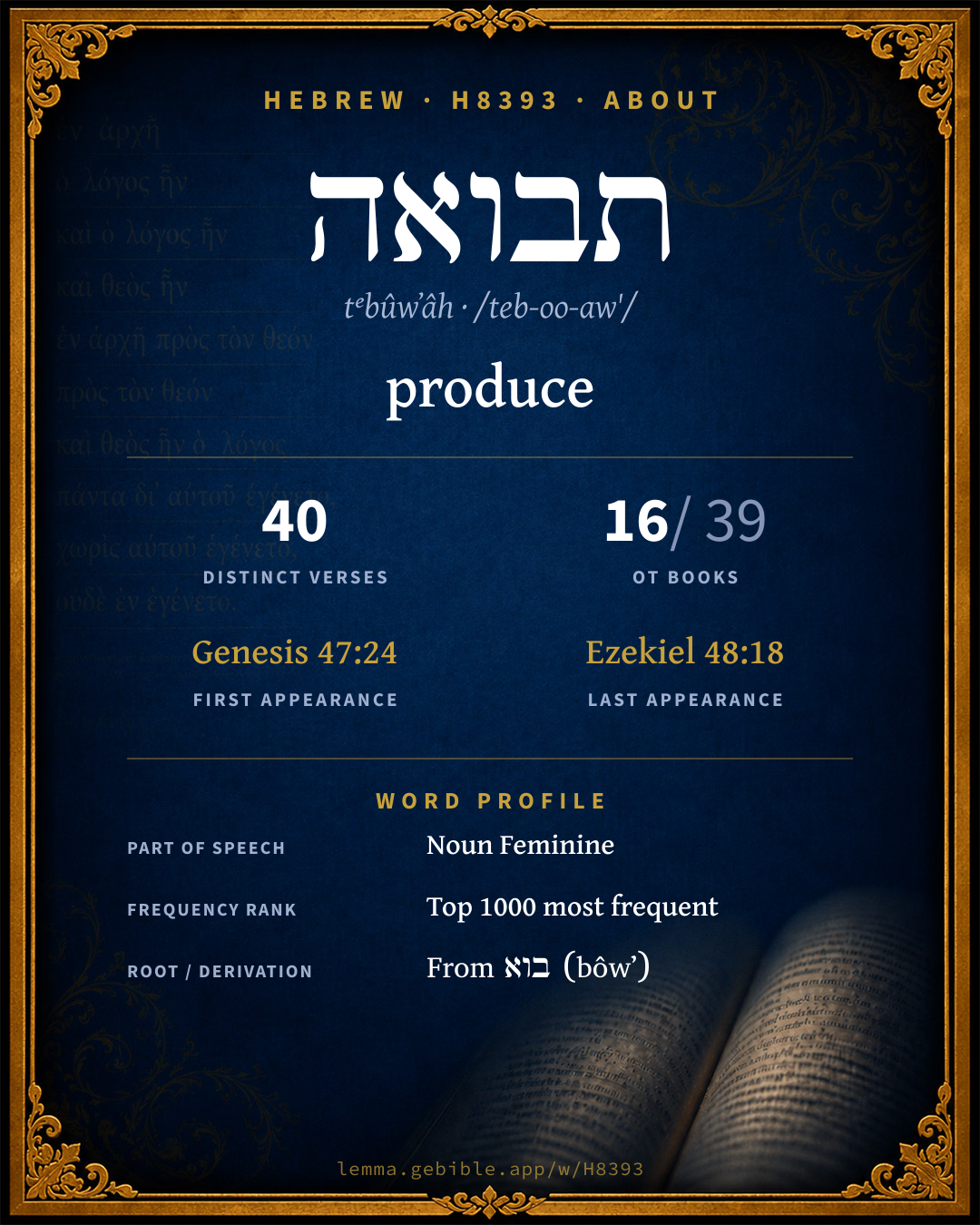
תְּבוּאָה
produce
also: product, revenue fuller range ↓
Full lexicon entry — Brown-Driver-Briggs (BDB)
From Brown-Driver-Briggs (BDB)
Where this word appears
See every Construct-state word in the Hebrew Bible →
Grammar key — what these labels mean
Part of speech
- Noun
- A naming word — a person, place, thing, or idea.
Noun type
- Common
- A common noun — a general class of person, place, or thing (“king,” “city,” “water”), not a specific name.
State
- Construct
- A noun bound to a following noun in a possessive / “of” relationship (the construct chain).
- Absolute
- The independent form of a noun, not bound to a following word.
Gender
- Feminine
- Grammatically feminine.
Number
- Singular
- One.
- Plural
- More than one (in Hebrew, generally three or more).
32 distinct verses where H8393 appears in the Construct state, across 13 books. Filtered view — show all forms. Click any verse to open its interlinear word-by-word view. Verse text shown in the World English Bible for context — . Each verse’s Hebrew form is shown with its reference; the English is not keyword-highlighted, since the data carries no word-level English alignment. Use “Compare translations” on any verse to read it across multiple English versions. This concordance covers the Hebrew Bible; Septuagint (Greek Old Testament) occurrences are not indexed here.
Exodus 1 verse
Leviticus 7 verses
- Leviticus 19:25 תְּבוּאָת֑/וֹ n c fs cs + sfx pers 3ms In the fifth year you shall eat its fruit, that it may yield its increase to you. I am Yahweh your God.
- Leviticus 23:39 תְּבוּאַ֣ת n c fs cs "'So on the fifteenth day of the seventh month, when you have gathered in the fruits of the land, you shall keep the feast of Yahweh seven days: on the first day shall be a solemn rest, and on the eighth day shall be a solemn rest.
- Leviticus 25:3 תְּבוּאָתָֽ/הּ n c fs cs + sfx pers 3fs Six years you shall sow your field, and six years you shall prune your vineyard, and gather in its fruits;
- Leviticus 25:7 תְּבוּאָתָ֖/הּ n c fs cs + sfx pers 3fs For your cattle also, and for the animals that are in your land, shall all the increase of it be for food.
- Leviticus 25:12 תְּבוּאָתָֽ/הּ n c fs cs + sfx pers 3fs For it is a jubilee; it shall be holy to you. You shall eat of its increase out of the field.
- Leviticus 25:20 תְּבוּאָתֵֽ/נוּ n c fs cs + sfx pers 1cp If you said, "What shall we eat the seventh year? Behold, we shall not sow, nor gather in our increase;"
- Leviticus 25:22 הַ/תְּבוּאָ֣ה תְּב֣וּאָתָ֔/הּ ptcl def.art + n c fs n c fs cs + sfx pers 3fs You shall sow the eighth year, and eat of the fruits, the old store; until the ninth year, until its fruits come in, you shall eat the old store.
Numbers 1 verse
Deuteronomy 6 verses
- Deuteronomy 14:22 תְּבוּאַ֣ת n c fs cs You shall surely tithe all the increase of your seed, that which comes forth from the field year by year.
- Deuteronomy 14:28 תְּבוּאָ֣תְ/ךָ֔ n c fs cs + sfx pers 2ms At the end of every three years you shall bring forth all the tithe of your increase in the same year, and shall lay it up within your gates:
- Deuteronomy 16:15 תְּבוּאָֽתְ/ךָ֙ n c fs cs + sfx pers 2ms Seven days shall you keep a feast to Yahweh your God in the place which Yahweh shall choose; because Yahweh your God will bless you in all your increase, and in all the work of your hands, and you shall be altogether joyful.
- Deuteronomy 22:9 וּ/תְבוּאַ֖ת conj + n c fs cs You shall not sow your vineyard with two kinds of seed, lest the whole fruit be forfeited, the seed which you have sown, and the increase of the vineyard.
- Deuteronomy 26:12 תְּבוּאָתְ/ךָ֛ n c fs cs + sfx pers 2ms When you have made an end of tithing all the tithe of your increase in the third year, which is the year of tithing, then you shall give it to the Levite, to the foreigner, to the fatherless, and to the widow, that they may eat within your gates, and be filled.
- Deuteronomy 33:14 תְּבוּאֹ֣ת n c fp cs For the precious things of the fruits of the sun, For the precious things of the growth of the moons,
Joshua 1 verse
2 Kings 1 verse
2 Chronicles 2 verses
- 2 Chronicles 31:5 תְּבוּאַ֣ת n c fs cs As soon as the commandment came abroad, the children of Israel gave in abundance the first fruits of grain, new wine, and oil, and honey, and of all the increase of the field; and the tithe of all things brought they in abundantly.
- 2 Chronicles 32:28 לִ/תְבוּאַ֥ת prep + n c fs cs store-houses also for the increase of grain and new wine and oil; and stalls for all manner of animals, and flocks in folds.
Nehemiah 1 verse
Job 1 verse
Proverbs 6 verses
- Proverbs 3:9 תְּבוּאָתֶֽ/ךָ n c fs cs + sfx pers 2ms Honor Yahweh with your substance, With the first fruits of all your increase:
- Proverbs 3:14 תְּבוּאָתָֽ/הּ n c fs cs + sfx pers 3fs For her good profit is better than getting silver, And her return is better than fine gold.
- Proverbs 8:19 וּ֝/תְבוּאָתִ֗/י conj + n c fs cs + sfx pers 1cs My fruit is better than gold, yes, than fine gold; My yield than choice silver.
- Proverbs 10:16 תְּבוּאַ֖ת n c fs cs The labor of the righteous leads to life. The increase of the wicked leads to sin.
- Proverbs 15:6 וּ/בִ/תְבוּאַ֖ת conj + prep + n c fs cs In the house of the righteous is much treasure, But the income of the wicked brings trouble.
- Proverbs 18:20 תְּבוּאַ֖ת n c fs cs A man's stomach is filled with the fruit of his mouth. With the harvest of his lips he is satisfied.
Isaiah 2 verses
- Isaiah 23:3 תְּבֽוּאָתָ֑/הּ n c fs cs + sfx pers 3fs On great waters the seed of the Shihor, the harvest of the Nile, was her revenue; and she was the market of nations.
- Isaiah 30:23 תְּבוּאַ֣ת n c fs cs He will give the rain for your seed, with which you shall sow the ground; and bread of the increase of the ground, and it shall be fat and plenteous. In that day shall your cattle feed in large pastures;
Jeremiah 2 verses
- Jeremiah 2:3 תְּבוּאָתֹ֑/ה n c fs cs + sfx pers 3ms Israel [was] holiness to Yahweh, the first fruits of his increase: all who devour him shall be held guilty; evil shall come on them, says Yahweh.
- Jeremiah 12:13 מִ/תְּבוּאֹ֣תֵי/כֶ֔ם prep + n c fp cs + sfx pers 2mp They have sown wheat, and have reaped thorns; they have put themselves to pain, and profit nothing: and you shall be ashamed of your fruits, because of the fierce anger of Yahweh.
Ezekiel 1 verse
About this entry
At a glance — auto-summarized from this page’s data, not written by a person. Every figure links to its source below. This summary describes the numbers; it doesn’t interpret them.
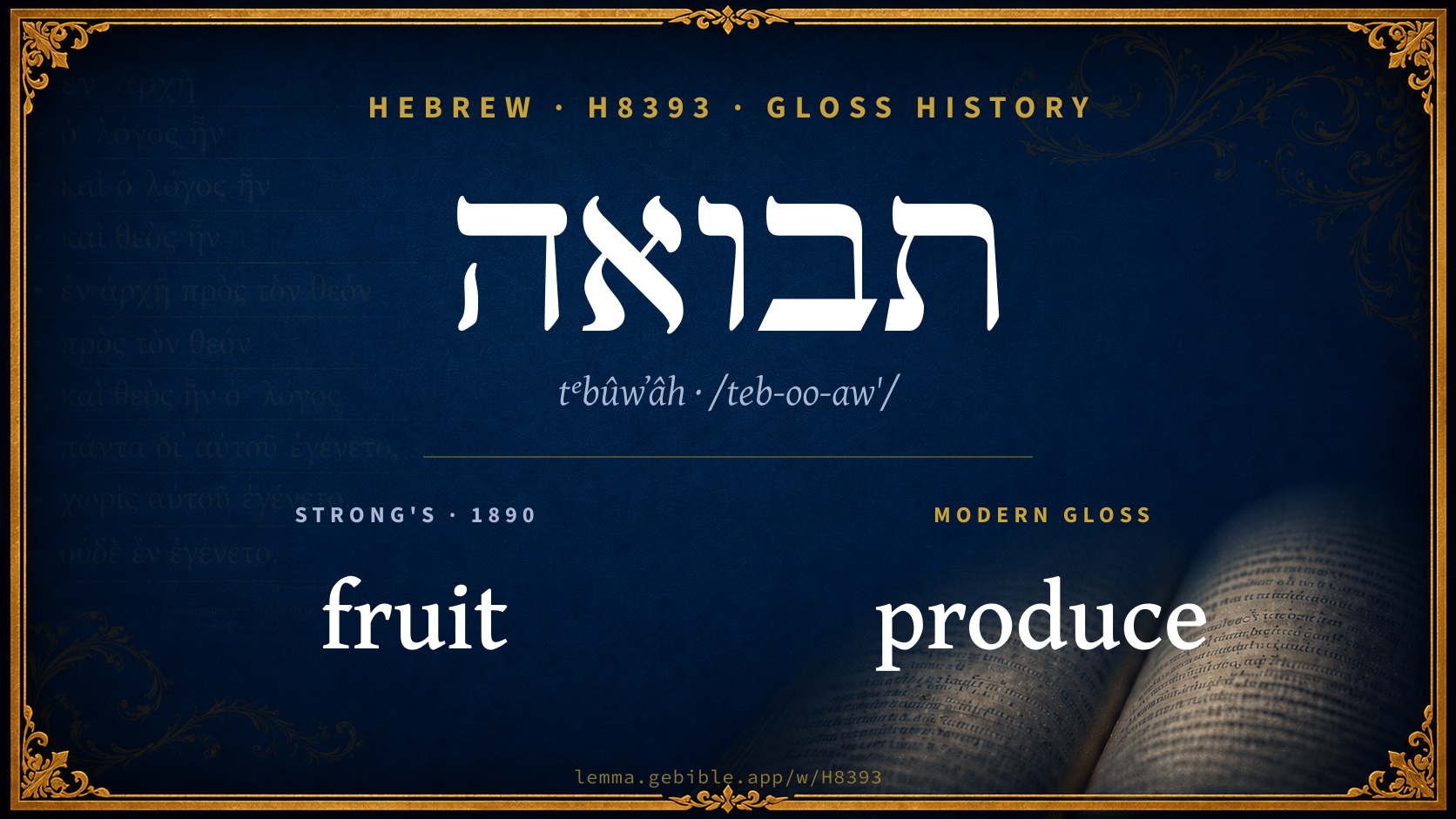
The Hebrew noun תבואה centers on the idea of “produce.” Older and newer Bibles part ways — “increase” in the King James Version, “harvest” (Berean Standard Bible) and “produce” (unfoldingWord Literal Text) in modern versions. See the renderings breakdown. It appears 40 verses across 16 books of the Hebrew Bible, among its moderately common vocabulary. The word gravitates to Leviticus (25%), then Proverbs and Deuteronomy. Beyond “produce” it also covers “product” and “revenue” — see its full sense range. Dig into 40-verse concordance and the renderings breakdown below.
Gloss history
Strong's 1890 vs modern scholarship
About this word
Strong's H8393 catalogs a Hebrew word from the Hebrew Old Testament.
These counts are not copied from any lexicon or concordance. They are computed here, from the morphology-tagged Hebrew Old Testament. What Lemma adds →
- 40
- distinct verses
- The word appears in 40 distinct verses.
- 16 / 39
- OT books
- The word appears in 16 of 39 Old Testament books.
- #837
- by frequency
- Top 1000 most frequent Hebrew words (rank 837 of 8,640 Hebrew words by occurrence).
View all 40 occurrences in the concordance →
Most concentrated in
- Leviticus 10 verses 25%
- Proverbs 8 verses 20%
- Deuteronomy 6 verses 15%
By section of the Old Testament
By traditional corpus
Conventional, traditional groupings — biblical authorship is debated, so this is a traditional corpus grouping, not an authorship claim. Each share is this word’s portion of its verses in that division of the Hebrew canon. Each figure is a share of the word’s 40 distinct verses.
- Torah (Pentateuch) 19 verses · 48%
- Writings (Ketuvim) 14 verses · 35%
- Prophets (Nevi'im) 7 verses · 18%
How translations render this word
Counts come from each version’s own published word-to-Strong’s tagging or interlinear alignment — an approximate guide to how each version renders this word, not a word-level alignment the data otherwise carries. Because each total is that version’s own tagged count, the per-version totals vary from one another and need not match the appearance or distinct-verse counts above. These counts may also differ from a printed concordance because Lemma counts each distinctly tagged rendering and does not collapse phrase taggings into a single head-word total. This is a fixed set of word-tagged versions (KJV, ASV, BSB, ULT) and does not change with the reading translation you choose elsewhere. Each version’s license is shown beside its name below (and on Sources).
- King James Version: Increase 14×, Fruit 7×, Fruits 3×
- American Standard Version: Increase 16×, All the increase 2×, Fruits 2×
- Berean Standard Bible: Harvest 13×, Produce 10×, Crops 3×
- unfoldingWord Literal Text: Produce 16×, Produce of 7×, Harvest 5×
King James Version Public Domain
Renders H8393 across 42 tagged occurrences — most commonly:
Plus 13 renderings that appear only once — usually multi-word phrases or single function words the recovered tagging swept in, not distinct renderings.
American Standard Version Public Domain
Renders H8393 across 42 tagged occurrences — most commonly:
Plus 20 renderings that appear only once — usually multi-word phrases or single function words the recovered tagging swept in, not distinct renderings.
Berean Standard Bible Public Domain
Renders H8393 across 41 tagged occurrences — most commonly:
Plus 10 renderings that appear only once — usually multi-word phrases or single function words the recovered tagging swept in, not distinct renderings.
unfoldingWord Literal Text CC BY-SA 4.0
Renders H8393 across 44 tagged occurrences — most commonly:
Plus 8 renderings that appear only once — usually multi-word phrases or single function words the recovered tagging swept in, not distinct renderings.
Senses in the full BDB
What do BDB’s symbols mean?
BDB uses these scholarly abbreviations:
| Symbol | Meaning |
|---|---|
| 𝔊 | the Septuagint (the ancient Greek translation, LXX) |
| 𝔙 | the Vulgate (the Latin translation) |
| 𝔖 | the Syriac version (the Peshitta) |
| 𝔗 | the Targum (the Aramaic translation) |
| ψ | the Psalms |
| √ | root (the underlying root or stem) |
| ‖ | parallel passage (a synonymous or contrasted parallel) |
| † | the dagger: every passage where the word occurs is cited |
The 3 senses and sub-senses the full Brown-Driver-Briggs lexicon distinguishes for this word, in lexicon order (not ranked by frequency), with BDB’s own verbatim wording and sub-sense lettering. Shown in Hebrew script with BDB’s own scholarly abbreviations. The condensed entry is in the Lexicon Entry tab. See also the Forms in the corpus table below.
- 1. product, yield, usually of earth (= crops, etc.) תּ׳ הָאָרֶץ Ex 23:10 Lv 19:25; 23:39; 25:3, 7 (used as food for man & beast, cf. v 22) Jos 5:12, cf. Ne 9:37 Lv 25:15, 16, also Ez 48:18; in Gn 47:24 בַּתּ׳ must = of the crops (בּ partitive, cf. בְּ I. 2. b.; 𝔊 del. בְּ); תּ׳ שָׂדֶה 2 K 8:6 2 Ch 31:5; תּ׳ כֶּרֶם Dt 22:9 cf. ψ 107:37; לֶחֶם תּ׳ הָאֲדָמָה Is 30:23; תּ׳ גֹּרֶן & תּ׳ יָ֑קֶב Nu 18:30; תּ׳ זֶרַע Dt 14:22; תּ׳ דָּגָן 2 Ch 32:28; as property of husbandmen, or people Lv 25:20 Dt 14:28; 16:15; 26:12 Pr 3:9; crops as determined by season, תּ׳ שָׁ֑מֶשׁ Dt 33:14 (‖ גֶּרֶשׁ יְרָחִים); yield of a year שָׁנָה Lv 25:12, 22; cf. v 21 עָשָׂה תּ׳, subj. שָׁנָה. e.g. Exodus 23:10
- 2.
- a. income, revenue, in general Jb 31:12 (almost = possessions) Pr 10:16; 14:4; 15:6; 16:8 Ec 5:9 cf. Is 23:3 (revenue of Tyre from trade with Egypt in bread stuffs). e.g. Job 31:12
- b. fig. gain of wisdom תּ׳ תָכְמָה Pr 13:14; 8:19; product of lips (תּ׳ שְׂפָתָיו) Pr 18:20, i.e. results of his speech (‖ פְּרִי פִי־אִישׁ); of Isr. as Yahweh’s product Je 2:3; of Israel’s wickedness Je 12:13. e.g. Proverbs 13:14
Senses from the full Brown-Driver-Briggs lexicon (Brown, Driver, Briggs; Oxford 1906 — public domain), digitized via Sefaria, supplemented by the OpenScriptures HebrewLexicon (CC BY 4.0). Full attribution on Sources.
Word origin
n.f. proventus, product, revenue—תּ׳ abs. ψ 107:37 + 3 times; cstr. תְּבוּאַת Lv 23:39 + 11 times; sf. תְּבוּאָתִי Jb 31:12 Pr 8:19; תְּבוּאָתְךָ Dt 14:28 + 2 times; תְּבוּאָתֶ֑ךָ Pr 3:9; תְּבוּאָתוֹ Lv 19:25 + Ez 48:18 Qr (Kt תבואתה), תְּבוּאָתֹה Je 2:3; תְּבוּאָתָהּ Ex 23:10 + 7 times + Ez 48:18 Kt (so Co); תְּבוּאָתֵנוּ Lv 25:20; pl. תְּבוּאֹת Lv 25:15 + 4 times; תְּבוּאוֹת Pr 14:4; 16:8; תְּבוּאֹתֵיכֶם Je 12:13;—
— Brown-Driver-Briggs (Oxford 1906, public domain), digitized via Sefaria, supplemented by the OpenScriptures HebrewLexicon (CC BY 4.0). See Sources.
Derived from בוא (bôwʼ) (H935) — to enter.
Jastrow Dictionary
A second Hebrew/Aramaic lexicon for comparison, covering Aramaic and post-biblical (Talmudic, Targumic, Midrashic) usage that the biblical-Hebrew BDB does not. Matched by lemma rather than by Strong’s number, so a lemma may carry more than one Jastrow headword (shown separately below), and the entries cover usage well beyond the Bible.
תְּבוּאָה
- [that which is brought in,] grain, provision. Ned. 55ᵃ, v. עֲלַל II. Ib. תבואה לחוד ותְבוּאַת וכ׳ t’buah is one thing (refers only to the five kinds of grain), and t’buath sadeh is another thing (refers to all in-gatherings of the field). Peah VI, 9 סאה ת׳ עקורה וכ׳ a S’ah of plucked grain (forgotten in the field), and one of unplucked (standing) grain. Ib. 10 ת׳ שנתנה לשחת grain cut for fodder (v. שַׁחַת II). B. Mets. 59ᵃ לעולם … בת׳ וכ׳ a man should always take care to have grain in his house, שאין מריבה … על עסקי ת׳ for no strife is more frequent in the house than that about grain. Men. 103ᵇ הלוקח ת׳ משנה וכ׳ he who buys grain from year to year; (Y. Sabb. VIII, 11ᵃ bot. חטים). Tem. 16ᵃ אשה כיון שאין לה ת׳ וכ׳ when a woman has no provision in the house, she clamors at once; a. fr.
A Dictionary of the Targumim, the Talmud Babli and Yerushalmi, and the Midrashic Literature (Marcus Jastrow; London, Luzac, 1903) — Public Domain. Digitized via Sefaria. Digitized via Sefaria. Full attribution on Sources.
Forms in the corpus
The 34 distinct written forms H8393 takes in the Hebrew Bible, most frequent first — each parse links to that state’s occurrences in the concordance. Hebrew forms include their vowel points and cantillation, so a single lemma takes many written forms.
Same root — word family
Other BDB entries built from the same root as H8393, grouped by Strong’s listed origin. These share a root / origin per the lexicon — not necessarily a shared meaning. Each links to that word’s own entry.
Derives from
Shares the same root
Compare all same-root words → They share a root, not necessarily a meaning.
Septuagint verse parallels
This word appears in 38 verses that also exist in the Greek Old Testament (Septuagint), out of the 40 Hebrew verses it occurs in. You can read those verses in Greek by switching the Old Testament edition to the Septuagint.
Read these verses in the Septuagint
- Genesis 47:24
- Exodus 23:10
- Leviticus 19:25
- Numbers 18:30
- Deuteronomy 14:22
- Joshua 5:12
- 2 Kings 8:6
- 2 Chronicles 31:5
- Job 31:12
- Proverbs 3:9
- Ecclesiastes 5:10
- Isaiah 23:3
This is a verse-level parallel only — the same verses exist in both the Hebrew and Greek Old Testaments. No word-level Hebrew↔Greek correspondence is claimed: the data carries no such alignment, so no Greek word is shown as this Hebrew word’s translation. Coverage is not total — the Septuagint omits the deuterocanon and renumbers the Psalms, so some Hebrew verses have no direct Greek parallel.