
Proverbs 3:14

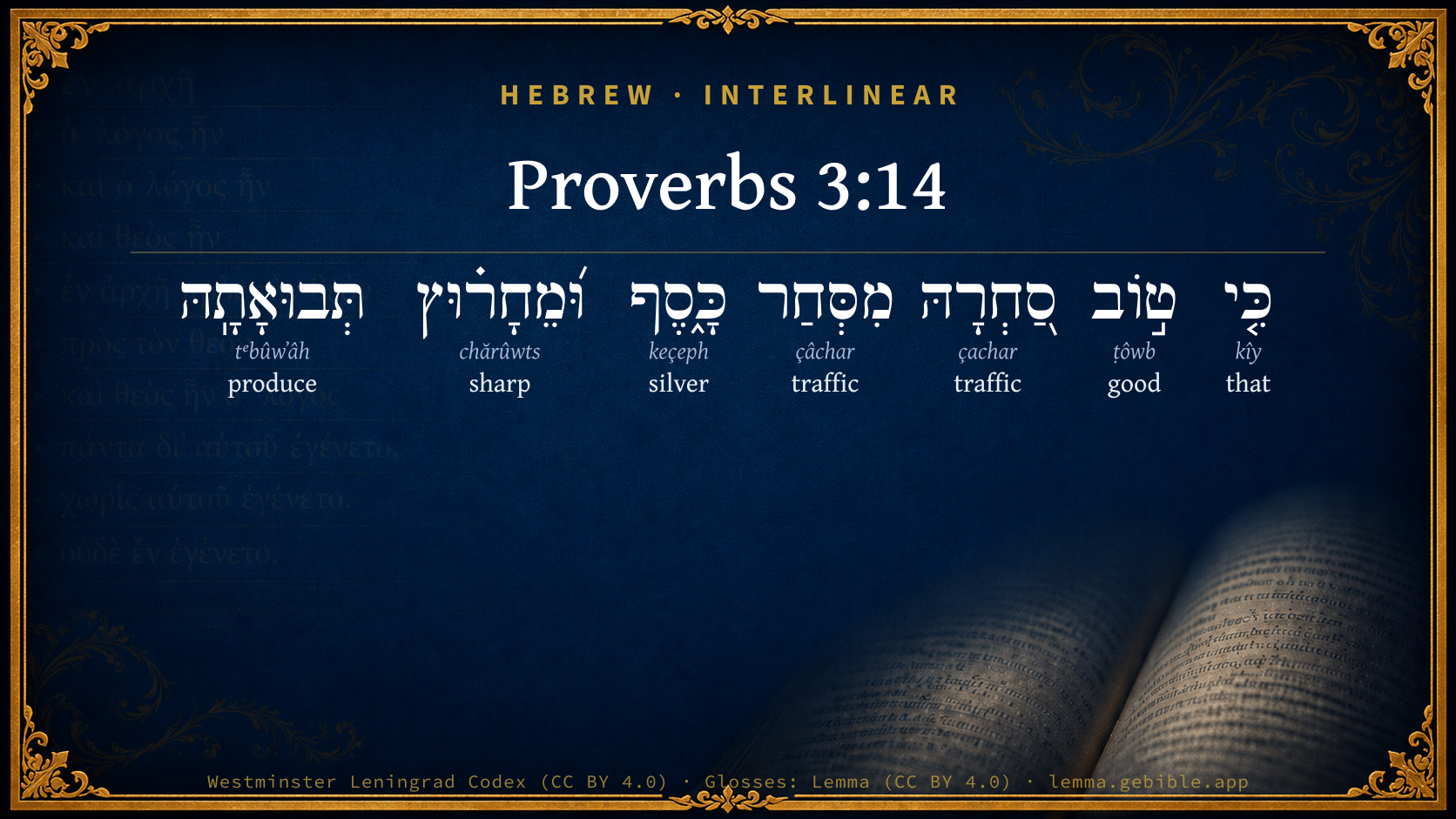
Hebrew (Westminster Leningrad Codex) Proverbs 3:14 appears in the Hebrew Old Testament. The text above is from the Westminster Leningrad Codex. Each word links to its Strong’s number, a concise gloss, and parsing drawn from the Open Scriptures Hebrew Bible morphology. Click any word for its full Brown-Driver-Briggs (BDB) entry.
Download image
Cite this verse

Proverbs 3:14 (World English Bible). Public Domain. Lemma interlinear Bible study tool, https://lemma.gebible.app/v/proverbs/3/14.

Show BibTeX & RIS
BibTeX
RIS
English Translation
For her good profit is better than getting silver, And her return is better than fine gold.
World English Bible · Public Domain
Highlights
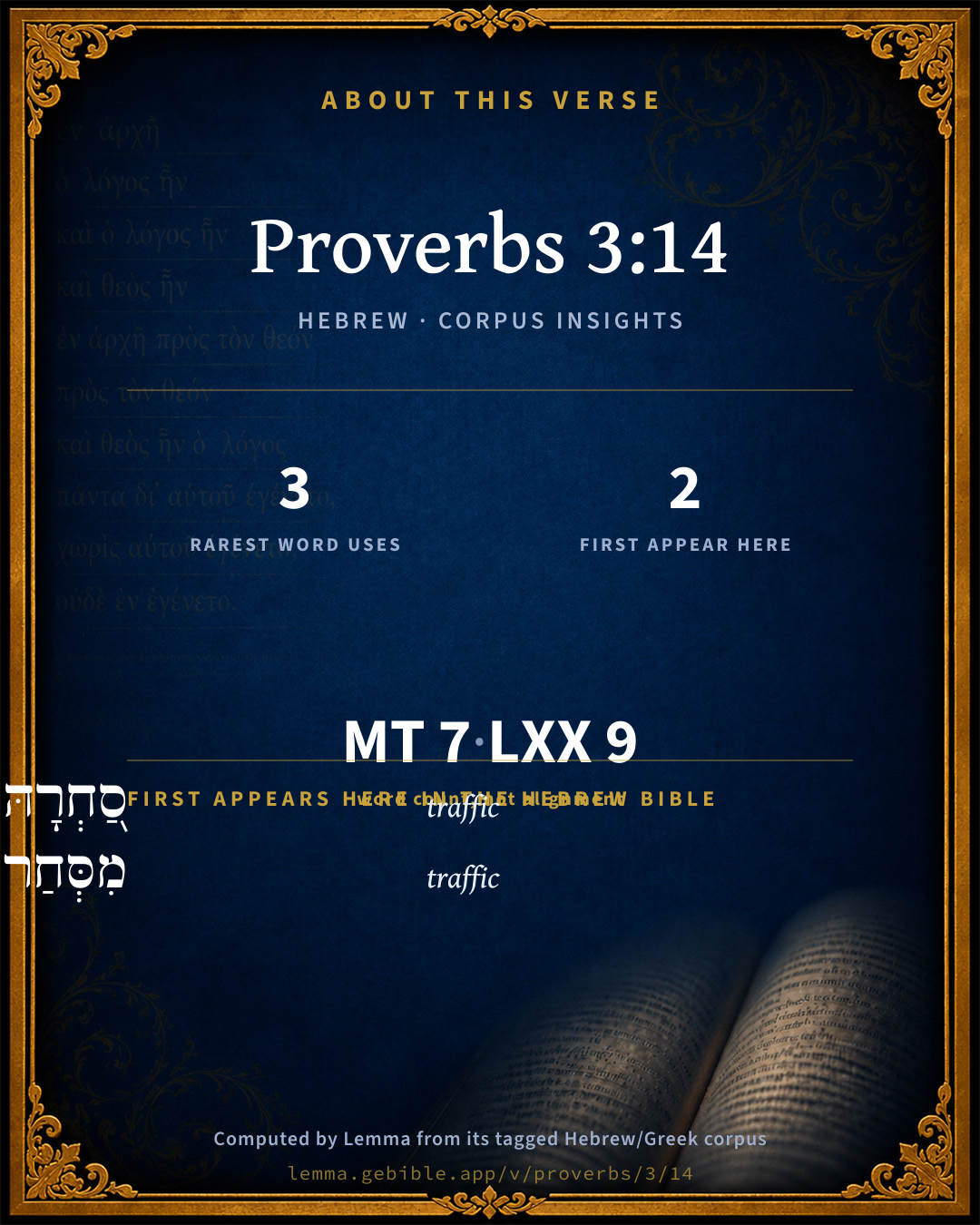
  • 2 first appearances in the Hebrew Bible
Full analysis ↓
Download a study sheet

One document with this verse’s original text, its word-by-word gloss line, the meaning frame, cross-references with their text, attributed commentary, and full source and license credits — printable, and it pastes into notes with its structure intact.

This verse Autodidact and up

Study sheet (.html) Plain text (.txt)

A passage Seminary Student

Up to 50 verses in one chapter. A passage sheet keeps up to 6 commentary sources and 12 cross-references per verse, in the order this page ranks them, and says so on the sheet whenever that leaves anything out. Ask for a single verse and you get the Autodidact verse sheet above.

Everything on this page stays free to read, with no account — the sheet is a download of what is already on screen, not access to it.

Want to remove ads? Support Godless Engineer
Compare translations 3

The same verse in 3 English versions, stacked beneath the original-language interlinear above. Click any original word for its lexicon entry.

Each is an independent rendering of the whole verse — the interlinear is not word-aligned to these translations.

Highlighted words mark where these versions differ — a whole-verse word diff, not a word-by-word alignment.

  • World English Bible Public Domain
    For her good profit is better than getting silver, And her return is better than fine gold.
  • King James Version Public Domain
    For the merchandise of it is better than the merchandise of silver, and the gain thereof than fine gold.
  • unfoldingWord Literal Text CC BY-SA 4.0
    For better its profit than the profit of silver, and than gold, its produce.

unfoldingWord Literal Text — © unfoldingWord, licensed CC BY-SA 4.0. Word-aligned USFM3 via Door43 (git.door43.org/unfoldingWord/en_ult).

Versions to compare (up to 4)

3 of 4 selected

Show all 18 translations

Every available English version of this verse, each an independent rendering of the whole verse.

  • World English Bible Public Domain
    For her good profit is better than getting silver, And her return is better than fine gold.
  • Berean Standard Bible Public Domain
    for she is more profitable than silver, and her gain is better than fine gold.
  • Majority Standard Bible Public Domain
    for she is more profitable than silver, and her gain is better than fine gold.
  • King James Version Public Domain
    For the merchandise of it is better than the merchandise of silver, and the gain thereof than fine gold.
  • American Standard Version (1901) Public Domain
    For the gaining of it is better than the gaining of silver, And the profit thereof than fine gold.
  • Revised Version (1885) Public Domain
    For the merchandise of it is better than the merchandise of silver, and the gain thereof than fine gold.
  • Geneva Bible (1599) Public Domain
    For the marchandise thereof is better then the marchandise of siluer, and the gaine thereof is better then golde.
  • Douay-Rheims (1899) Public Domain
    The purchasing thereof is better than the merchandise of silver, and her fruit than the chiefest and purest gold:
  • Young's Literal Translation Public Domain
    For better `is' her merchandise Than the merchandise of silver, And than gold -- her increase.
  • Literal Standard Version CC BY-SA 4.0
    For better [is] her merchandise || Than the merchandise of silver, || And than gold—her increase.
  • Unlocked Literal Bible CC BY-SA 4.0
    What you gain from wisdom is better than what silver will give in return and its profit is better than gold.
  • unfoldingWord Literal Text CC BY-SA 4.0
    For better its profit than the profit of silver, and than gold, its produce.
  • Darby Bible Public Domain
    For the gain thereof is better than the gain of silver, and her revenue than fine gold.
  • World Messianic Bible Public Domain
    For her good profit is better than getting silver, and her return is better than fine gold.
  • Webster's Bible Public Domain
    For the merchandise of it is better than the merchandise of silver, and the gain of it than fine gold.
  • Free Bible Version CC BY-SA 4.0
    for wisdom is worth more than silver, and pays better than gold.
  • Bible in Basic English Public Domain
    For trading in it is better than trading in silver, and its profit greater than bright gold.
  • JPS Tanakh (1917) Public Domain
    For the merchandise of it is better than the merchandise of silver, and the gain thereof than fine gold.

Literal Standard Version (2020), Covenant Press — licensed CC BY-SA 4.0. Text via the HelloAO Bible API (eBible.org). Unlocked Literal Bible (unfoldingWord) — licensed CC BY-SA 4.0. Text via the HelloAO Bible API (eBible.org). unfoldingWord Literal Text — © unfoldingWord, licensed CC BY-SA 4.0. Word-aligned USFM3 via Door43 (git.door43.org/unfoldingWord/en_ult). Free Bible Version, Dr. Jonathan Gallagher — licensed CC BY-SA 4.0. Text via the HelloAO Bible API (eBible.org).

Word by word

More ways to search: Search by grammar → Find every occurrence → Compare this word →

Practice this passage: Drill this verse → Learn its vocabulary →

About this verse

These counts appear in no published source. They are computed here, from the morphology-tagged text and Lemma’s own curated glosses. What Lemma adds →

7
words
7
distinct lemmas
Wisdom
section

Notable vocabulary

The rarest word here is מִסְּחַר traffic H5505 — appearing just 3 times in the whole Hebrew Bible.

First appearance in Scripture

These words make their first canonical appearance in the Hebrew Bible here:

  • סַ֭חְרָהּ traffic H5504
  • מִסְּחַר traffic H5505

Shared distinctive vocabulary

מִסְּחַר traffic H5505 occurs in 3 verses of the Hebrew Bible. Also found in:

Grammatical profile

  • 5 nouns
  • 1 adjective
  • 1 conjunction

Hebrew & Septuagint length

In English translation the verse runs 17 words from the Hebrew and 15 from the Septuagint (LXX English) — closely comparable.

A rough comparison of the two English renderings, which tokenize alike — not a word-level alignment.

Word counts can differ between the Hebrew and the Greek without any difference in meaning — e.g. the Hebrew direct-object marker אֵת has no separate Greek word, and Greek often adds the article ὁ.

In the original languages it is 7 Hebrew tokens and 9 Greek tokens — but the two are counted differently (Hebrew bundles its prefixes and suffixes into one token; the Greek is in lemma form), so that isn’t a like-for-like length.

Cross-references

12

Topical passages linked to Proverbs 3:14 in the Treasury of Scripture Knowledge — connected by theme and wording, ordered by reader-vote popularity; previews shown in the World English Bible.

  • Proverbs 16:16 How much better it is to get wisdom than gold! Yes, to get understanding is to be chosen rather than silver.
  • Proverbs 8:19 My fruit is better than gold, yes, than fine gold; My yield than choice silver.
  • Job 28:13–19 Man doesn't know its price; Neither is it found in the land of the living.
  • Revelation 3:18 I counsel you to buy from me gold refined by fire, that you may become rich; and white garments, that you may clothe yourself, and that the shame of your nakedness may not be revealed; and eye salve to anoint your eyes, that you may see.
  • 2 Chronicles 1:11–12 God said to Solomon, Because this was in your heart, and you have not asked riches, wealth, or honor, nor the life of those who hate you, neither yet have asked long life; but have asked wisdom and knowledge for yourself, that you may judge my people, over whom I have made you king:
  • Psalms 119:111 I have taken your testimonies as a heritage forever, For they are the joy of my heart.
  • Psalms 119:162 I rejoice at your word, As one who finds great spoil.
  • Proverbs 2:4 If you seek her as silver, And search for her as for hidden treasures:
  • Proverbs 8:10–11 Receive my instruction rather than silver; Knowledge rather than choice gold.
  • Matthew 16:26 For what will it profit a man, if he gains the whole world, and forfeits his life? Or what will a man give in exchange for his life?
  • Psalms 119:72 The law of your mouth is better to me than thousands of pieces of gold and silver.
  • Philippians 3:8–9 Yes most assuredly, and I count all things to be loss for the excellency of the knowledge of Christ Jesus, my Lord, for whom I suffered the loss of all things, and count them nothing but refuse, that I may gain Christ

Cross-references courtesy of OpenBible.info (CC BY 4.0).

Hebrew and Greek witnesses Masoretic Hebrew ↔ Greek Septuagint

The same verse in the two great witnesses to the Old Testament, shown verse-for-verse.

These are two independent witnesses, not word-aligned to each other, and the Septuagint is shown in lemma (dictionary) form.

Hebrew Proverbs 3:14 Masoretic · Westminster Leningrad Codex

כִּ֤י ט֣וֹב סַ֭חְרָהּ מִסְּחַר כָּ֑סֶף וּ֝מֵחָר֗וּץ תְּבוּאָתָֽהּ

For her good profit is better than getting silver, And her return is better than fine gold.

World English Bible · Public Domain

Greek LXX Proverbs 3:14 Septuagint · lemma form

κρείσσων γάρ αὐτός ἐνπορεύομαι ἤ χρυσίον καί ἀργύριον θησαυρός

For it is better to traffic for her, than for treasures of gold and silver.

LXX2012 (modern English Septuagint) · Public Domain

On this verse, The Pulpit Commentary discusses the Septuagint’s reading. Read the note in Commentary ↓

Hebrew: Westminster Leningrad Codex (CC BY 4.0). Greek: Septuagint (public domain); English from LXX2012 (modern English Septuagint) (Public Domain). How the Septuagint differs from the Hebrew →

Commentary

Notes on Proverbs 3:14 from classic Christian and Jewish commentators (each source and its license shown beneath its notes). The classic Christian expositions comment on the surrounding passage and are grouped to its opening verse, so a note may address several verses; the Jewish commentaries on the Tanakh (Rashi and others) are per-verse, so they appear only where the commentator wrote on this verse.

Lemma curates 59 commentaries, every one of them public domain or Creative Commons licensed, each selected and text-cleaned for this edition rather than reprinted as found. About our sources →

Trapp's Complete Commentary

John Trapp

Pro 3:14 For the merchandise of it [is] better than the merchandise of silver, and the gain thereof than fine gold.

Ver. 14. For the merchandise of.] That is, The profit that is gotten by making use of it. Kερδανοντες ου κοπιωμεν, saith a father. Seldom is any man weary of making money. Sing a song of utile, and men will lend their ears to it. The Jassians in Strabo, delighted with the music of an excellent harper, ran all away, as soon as the market bell rang, save a deaf old man, and he too, as soon as he heard of it. Now "godliness is profitable to all things," as having the promises of both lives; and the promises are "exceeding great and precious" things, {2Pe 1:4} even "the unsearchable riches of Christ," {Eph 3:8} who brings "gold tried in the fire," and that which is better. {Rev 3:18} For one grain of grace is far beyond all the gold of Ophir, and one hour’s enjoyment of God to be much preferred before all the king of Spain’s annual tribute. What is gold and silver, but the guts and garbage of the earth? And what is all the pomp and glory of the world, but dung and dogs’ meat? {Php 3:7-8} I esteem them no better (surely) that I may win Christ, said St Paul, that great trader both by land and sea. {2Co 11:23; 2Co 11:25-26} Let me be put to any pain, to any loss, tantundem ut Iesum nanciscar, so I may get my Jesus, said Ignatius. This gold we cannot buy too dear, whatever we pay for it. The wise merchant sells all to purchase it. {Mat 13:44; Mat 13:46} Every true son of Jacob will be content to part with his broth for the birthright, to purchase spiritual favours with earthly. "The Lord that made heaven and earth, bless thee out of Sion"; {Psa 134:3} which is to say, the blessings that come out of Sion are choice, peculiar, precious, even above any that come out of heaven and earth. When God is shaking all nations, {Hag 2:7} the saints shall come with their desirable things (so some read the words). Colligent omnes thesauros suos, saith Calvin, They shall gather up all their treasures.

John Trapp, A Commentary or Exposition upon All the Books of the Old and New Testament (1647–1656) — public domain. Text from a community e-Sword module.

The Biblical Illustrator

Joseph S. Exell

Pro_3:14

For the merchandise of it is better than the merchandise of silver, and the gain thereof than fine gold.

The honour, profit, and pleasure of religion

It is an unquestionable truth, that to walk in the paths which God has enjoined, is to secure to ourselves the most perfect felicity which our present state will admit; and that our misery and unhappiness arise in proportion to our deviation from that peaceful and pleasant path. If you are wise enough to lay hold of and retain this excellent wisdom--

1. Honour shall be yours.

2. Profit shall be yours. Who can doubt of the advantages which will accompany our sincere profession of religion? Advantages in time and in eternity.

3. Pleasure shall be yours. Religion affords the mind the most complete and substantial satisfaction. (W. Dodd, LL. D.)

A gainful merchandise

Wisdom is compared and contrasted with other possessions. It is merchandise. There is a most pleasant excitement in the prosecution of mercantile enterprise. It gives full play to all the faculties. Those who prosecute have their wits more sharpened than other sections of the community. The plans are contrived, and the calculations made . . . What of the merchandise for a more distant country than that to which his goods are going--what of the traffic for eternity? Are there no careful calculations, no instructive longings, no vivid imaginings, as to its condition and progress? This merchandise is better and more gainful than any other. The world contains not any such promising field for speculation. It opens up a richer and surer market than any port of Time. It is a treasure that cannot be taken away. (W. Arnot, D.D.)

The treasures of wisdom

Man is the only trading animal; commerce is his prerogative. The blazon of his trade, or exchange, is his patent of nobility. There is no distinction more honourable. There is no earthly title nobler than a merchant; and as such they are the controlling class in society--the chieftains and nobles of the later civilisation. Without them, there could be no division of labour, and consequently no accumulation of capital, and therefore no education, no literature, no science, no fine art, no true civilisation. The term merchant is altogether honourable and honoured, and therefore, and as such, is aptly metaphorical of a true Christian. Consider some points of resemblance.

I. The true merchant is a man of strong faith. Indeed, in regard of temporal things, he above all other men may be said to walk by faith. His barks are on the sea, and the sea is treacherous. His goods are consigned to men who may be plotting to defraud him. His ability to meet obligations depends on media of exchange, which some financial panic may paralyse in a moment. Yea, his walk by faith goes far beyond this. His business extends practically to the very ends of the earth, to lands he has never seen, and with races of men with whom he has never mingled. And thus in this walk by faith he is a fit emblem of a Christian.

II. The true merchant is a man of great earnestness and activity. His faith is not an indolent trust, but an energising principle.

III. The true merchant is a man practically and pre-eminently useful. His wares are of real value--his labours sincere benefactions. Traced carefully back to their origin, to mercantile enterprise under God, must be ascribed all real human progress, from the hut and hunting spear of the earlier barbarism to the palaces and emporiums of the last civilisation. It is the merchant who has bridged the oceans and united continents; covered the seas with sails and the land with machinery.

IV. Especially in these particulars must every Christian be like unto a merchantman, for--

1. He must be a man of strong faith. This is essentially and every way the foundation of his character. He must rely confidently for his salvation on another, and live ever in reference to the far-away and invisible.

2. A. Christian must be an active and earnest man. That indolent reliance on Christ, which some men call faith, is a fearful delusion of the great adversary. While we can do nothing to merit salvation, yet we must do very much to work out our salvation. The high calling of God in Christ Jesus is not a lullaby over a cradle, but a great voice out of heaven saying, Come up hither.

3. A Christian must be a useful man. The law of his life is that of his Master, not to be ministered unto, but to minister.

4. But we are not to forget that while thus beneficent to other men, a Christian, like a merchant, is above all, and ineffably, benefiting himself. This, indeed, is the main truth set forth in the emblem. Mark the language, The merchandise of it is better than the merchandise of silver. It is implied here that this trading of the merchant in earthly products is good because profitable. But the Christians exchanging of temporal for eternal things is affirmed to be obviously better, because ineffably more profitable.

(1) Because of the security of the transaction. All material commerce is manifestly with a hazard. But not so the spiritual. The Christians trust is in nothing finite, but in the living God. His bark cannot founder, for Christ sails with him. Thieves cannot steal his treasure, for it is laid up in heaven.

(2) Because the treasure it secures is infinitely more valuable. This, indeed, is the great truth of the whole passage. We have here a most beautiful climax of all earths rarest and richest things. Silver, gold, rubies, all in their rarest purity and richest abundance, are declared to be of inferior value. Yea, the inspired penman affirms that all things the human heart can desire are not to be compared with his. And if you will remember that this is the testimony, not of some poor, unsuccessful man, but of Solomon--of Solomon, too, at a period of his experience when he had tested, as no other man ever did, the worth of all earthly things--not the utterance of one who, disappointed in his struggle for riches, pleasure, honour, turns in melancholy misanthropy away, to rail at the world and call it hard names, and scold from a hermits cell, or a priests pulpit; but of a crowned king in a palace, on a throne, around whom the world delighted to gather all the prizes of lifes mightiest triumphs, then you will take his testimony as demonstrated, that the treasure secured by Christian life is letter than all the results of an earthly commerce. (C. Wadsworth, D.D.)

Wisdom for the children

This Book of Proverbs is a manual of conduct. It is not intended to make its readers learned men, but to make them wise men. We begin to be wise when we fear God, and to fear Him is always the chief part of wisdom. Some parts of the book are specially intended for the young. Its authors saw clearly that character is largely formed in childhood and youth. Hence strong emphasis is placed on the importance of the firm and wise discipline of children and young people; and there are grave and repeated warnings against the sins to which the young are specially tempted. If we are to achieve any great and enduring reformation in the condition of this country, and of the world, there must be an intelligent, a serious, a persistent endeavour to give to children and young people true conceptions of the possible dignity of human life, the gracious sternness of duty, the freedom and blessedness which are to be found in the service of God. Children are the salvation of the race. There is a new world created every thirty or forty years. There lies our hope. What ought we to teach the children?

I. Wisdom. What they need to know for the conduct of life: how to live. Our first duty is to make God known to them. And the Christian method of doing that is to bring home to them constantly the great truth that having seen Christ we have seen the Father. All that Christ was, all that He said, must be accepted as containing disclosures of the life of the Father. The Christian conception of life is founded on the Christian gospel. Wisdom consists in a clear and just estimate of what are the true ends of life, and in the power to determine how life should be ordered so as to secure those ends, but for this we must know what Gods relations to us are. The great Christian truths have a direct relation to life; they determine the laws of life; they are the forces which enable us to fulfil those laws.

II. Understanding. This denotes the power of accurate discrimination between things which may seem to be alike; in this sense, understanding is one of the aids and instruments by which wisdom is able to direct conduct. In most men the perception of duty is often dim and uncertain. Men who mean to do right do wrong because they cannot clearly see the line by which right and wrong are separated. Therefore the plain duties of human life and relationship should be taught to children. The duties of industry, truthfulness, equal justice, temperance, patience, fortitude, good temper, courtesy, and modesty. Much more in the way of direct moral instruction, for securing a proper understanding of life and relations, could be done both in the school and in the family. (R. W. Dale, LL.D.)

The value of mental cultivation

Even in the sense of mere mental cultivation this is true. A well-informed, well-stored mind is an acquirement greatly superior in real excellence to aught that is merely external--to wealth, or to all the outward distinction that wealth can procure. It is a source of more rational and richer enjoyment to the persons self, and a far worthier ground of respectability and honour. There are few objects really more pitiable than an ignorant, senseless rich man--a man whose mind, in its unfurnished poverty and emptiness, presents a perpetual contrast with his outward pomp and plenitude. (R. Wardlaw, D.D.)

The best merchandise

Why is the merchandise of wisdom better than the merchandise of silver?

1. Because it is a business you can begin sooner than you can any other.

2. Because it is easier to trade in. It requires less money and less labour to carry it on.

3. Because you can have better partners here than in any other pursuits.

4. Because it yields more profit than any other.

5. Because there is more room for engaging in it than in any other. We are all fitted for it, and invited to engage in it. (R. Newton, D.D.)

The Biblical Illustrator, edited by Joseph S. Exell (c. 1880s–1900s) — public domain. Text from a community e-Sword module.

Tyndale Open Study Notes

Tyndale Open Resources

3:14-15 Wisdom is worth more than precious metals and jewels. It leads to relationship with God, the ultimate joy-giver (see 2:1-8).

Tyndale Open Study Notes — © Tyndale Open Resources, licensed CC BY-SA 4.0. Text via the HelloAO Bible API.

Jamieson, Fausset & Brown

Robert Jamieson, A. R. Fausset & David Brown

The figure of Pro 3:13 carried out.

it--that is, wisdom.

merchandise of silver--acquisition by trading.

fine gold--dug gold, solid as a nugget.

Jamieson, Fausset & Brown — Commentary Critical and Explanatory on the Whole Bible (1871) — public domain (CC PDM 1.0). Text via the HelloAO Bible API.

Adam Clarke's Commentary

Verse 14. For the merchandise] סחר sachar, the traffic, the trade that is carried on by going through countries and provinces with such articles as they could carry on the backs of camels, c. from סחר sachar, to go about, traverse. Chaffarynge; Old MS. Bible.

And the gain thereof] תבואתה tebuathah, its produce; what is gained by the articles after all expenses are paid. The slaves, as we have already seen, got their liberty if they were so lucky as to find a diamond of so many carats' weight; he who finds wisdom-the knowledge and salvation of God - gets a greater prize; for he obtains the liberty of the Gospel, is adopted into the family of God, and made an heir according to the hope of an eternal life.

Adam Clarke's Commentary on the Bible (1810–1826) — public domain. Text from a community e-Sword/MySword module.

The Cambridge Bible for Schools and Colleges

gen. ed. J. J. S. Perowne

14. the merchandise of it] Comp. Mat_13:45-46, where this proverb is expanded into a parable. The same idea of trading in the moral and spiritual sphere occurs in Pro_11:19, Pro_23:23; Job_28:15-19.

The Cambridge Bible for Schools and Colleges (gen. ed. J. J. S. Perowne; Cambridge University Press, 1878–1918) — public domain. Text from a community e-Sword module.

John Gill's Exposition

For the merchandise of it is better than the merchandise of silver,.... The believer is a spiritual merchant; faith is a trading with and for Christ, and for spiritual and heavenly things by him; and because there is a parting with something for Christ, as a man's sinful lusts and pleasures, his own righteousness, his friends and relations, when set in opposition to or competition with him, and even life itself, when called for; and because he runs a risk of suffering reproach, afflictions, and death itself; therefore this concern with him, and enjoyment of him, is called a "merchandise", which is "better than that of silver", or than silver which is got by merchandise: for Christ, and the things of Christ, are more valuable than silver, and to be preferred unto it; more useful and profitable than silver is, which a man may have a large abundance of, and lose his soul, whereas by Christ is the salvation of it; more satisfying than silver is, with which a man is never satisfied, whereas he that has Christ has enough, having all things; more pleasant in obtaining, and more safe in enjoying; a great deal of anxiety and vexation attend the one, and inexpressible pleasure the other; and more durable and lasting than that, the enjoyment of Christ is for ever;

and the gain thereof than fine gold; the doctrines and ordinances of Christ are more to be desired than gold, yea, than fine gold; the blessings of grace by Christ, such as redemption, pardon of sin, &c. are not obtained by corruptible things, as silver and gold, but are more precious than they; and even the graces of Christ in the hearts of his people, as faith, hope, and love, are more precious than gold that perisheth; and much more preferable must he himself be, and the gain that accrues to a believer by him, which is cent per cent an hundred fold, even in this world, and in the world to come everlasting life: it is all clear gain a believer gets by Christ and trading with him; he has him, and all with him, without money and without price; he has that which is more worth than the gain of the whole world, even the salvation of his immortal soul; the riches he has by Christ are immense and unsearchable, the riches of grace and glory; it cannot be said how great this gain is.

John Gill's Exposition of the Whole Bible (1746–1763) — public domain (CC PDM 1.0). Text via the HelloAO Bible API.

Albert Barnes' Notes on the Bible

Compare Pro 2:4. “Fine gold” is apparently a technical word of that commerce, the native gold in the nugget or the dust.

Albert Barnes' Notes on the Bible (1834–1885) — public domain. Text from a community e-Sword/MySword module.

Matthew Poole's English Annotations

It is more necessary and advantageous, because it is so, not only for this short life, but also to the future and everlasting life, in which gold and silver bear no price.

Matthew Poole's English Annotations on the Holy Bible (1683–1685) — public domain. Text from a community e-Sword/MySword module.

The Pulpit Commentary

The merchandise (sakh"rah); Vulgate, acquisitio; LXX, emporeuesyai . The gain arising from trading in wisdom is better than that which arises from trading in silver. Sakh"rah is the gain or profit arising from merchandise, i.e. from trading. It denotes the act itself of gaining. The root sakrah, like the Greek emporeuesyai , signifies "to go about for the sake of traffic," i.e. to trade. There may be an allusion here, as in Pro_2:4, to the new commerce (Plumptre). The gain thereof (t"vuathah); i.e. the gain existing in, and going along with, Wisdom herself; gain, therefore, in a different sense from that indicated in sakh"rah. Gesenius takes it as "gain resulting from Wisdom," as in Pro_8:19 and Isa_23:3. The word is used of the produce of the earth, the idea apparently embodied in the Vulgate fructus. In this case there may be a reference to ver. 18, where Wisdom is said to be a "tree of life." The LXX omits the latter clause of this verse. The sense is, "The possession of Wisdom herself is better than fine gold." Fine gold (karuts); Vulgate, aurum purum; Syriac, aurum purissimum. Kharuts is the poetic word for gold, so called, either

(1) from its brilliancy, and then akin to the Greek crusov (Curtius); or

(2) from its being dug up, from the root kharats, "to cut into or dig up, to sharpen." It evidently means the finest and purest gold, and is here contrasted with silver (keseph). The word is translated "choice gold" in Pro_8:10; "gold" simply in Pro_16:16; "yellow gold" in Psa_68:13; and "fine gold" in Zec_9:3. In the Version Junii et Tremellii it appears as effosum aurum, "gold dug up," i.e. gold in its native, unalloyed state. The Targum Jonathan understands it of "molten gold" (aurum conflatum).

Rubies (Khetib, p"niyim; Keri, p"ninim). No unanimous opinion has been arrived at as to the real signification of the word here translated "rubies." The majority of the rabbins (among them Rashi), and Bochart, Hartman, Bohlen, Lee on Job_38:18, and Zockler, render it "pearls." Its meaning seems to lie between this and "corals," the rendering adopted by Michaelis, Gesenius, and Delitzsch (following Fleischer), who says that the Hebrew p"ninim corresponds with the Arabia word whose root idea is "shooting forth," and means "a branch." The peculiar branching form in which corm is found favours this opinion, which is strengthened by the passage in Lam_4:7, where we get additional information as to color, "They the Nazarites were more ruddy in body than rubies," a description of which would apply to "coral," but is scarcely applicable to "pearls." The various versions suggest the further idea that p"ninim was a descriptive word used to denote precious stones in general. The LXX renders, "She is more precious than precious stones (liywn polutelwn )." So the Targum Jonathan, Syriac, and Arabic. The Vulgate renders. "She is more precious than all riches ( cunctis opibus)." The word p"ninim only occurs here (Keri) and in Pro_8:11 Pro_20:15 Pro_31:10; and in Job and Lamentations as above. This passage, as well as Pro_8:11, which is an almost literal repetition of it, are imitations cf. Job_28:18. The identification of p"ninim with "pearls" may have suggested our Lord"s parable of the pearl of great price. (Mat_13:45, Mat_13:46) All the things thou canst desire (kal-khaphatseyka); literally, all thy desires. Here everything in which you have pleasure, or all your precious things; LXX, pan timon ; Vulgate, omnia, quae desiderantur. The comparison, which has risen from the less to the more valuable, culminates in this comprehensive expression. There is nothing, neither silver, gold, precious stones, nor anything precious, which is an equivalent (shavah) to Wisdom in value. How it shows, when everything is put before us to choose from, that, like Solomon at Gibeon, we should prefer wisdom! (1Ki_3:11-13) In the second half of this verse the LXX substitutes, "No evil thing competes with her; she is well known to all that approach her."

The Pulpit Commentary (1880–1919), ed. H.D.M. Spence-Jones & Joseph S. Exell — public domain. Text from a community e-Sword module.

Rashi

Rabbi Shlomo Yitzchaki (Rashi)

for its commerce is better than the commerce of silver In any exchange, when a person exchanges [something] for merchandise, this one takes this, and that one takes that; but if one says to his friend, “Teach me your chapter, and I will teach you my chapter,” [then] both chapters are found in the hand of each of them.

than fine gold Heb. מחרוץ. That is a type of gold.

Rashi on the Tanakh — English translations: “The Judaica Press complete Tanach with Rashi, translated by A. J. Rosenberg” (CC BY 4.0); “Pentateuch with Rashi's commentary by M. Rosenbaum and A.M. Silbermann, 1929-1934” (public domain); “The Metsudah Tanach series, Lakewood, N.J” (CC BY 4.0); and “The Book of Joshua, Metsudah Publications, 1997” (CC BY 4.0). Text via Sefaria.

Lesson kit

Teaching starters — assembled from the data on this page, not authored interpretation. Every prompt links to the verse data it draws on. Edit before teaching.

Proverbs, in the Wisdom, opens this verse with 7 words (7 distinct Hebrew lemmas). Its most distinctive word is çâchar (“traffic”). A historical commentator’s framing appears above. Read the whole chapter for the surrounding context.

Discussion questions

  1. How does “traffic” (çâchar) shape what this verse is saying?
  2. 2 words make their first appearance in Scripture here. What does this debut establish?
  3. How does Isaiah 23:3, which shares the word «traffic», read alongside this verse?
  4. These translations render this verse differently. What is at stake in choosing one wording over another?
  5. Compare how Trapp's Complete Commentary and The Biblical Illustrator read this verse. Where do they agree or differ?

Things to notice

Reading settings

Reading text

Shown beneath each verse's original-language words.

Old Testament
Old Testament edition

Read the OT as the Masoretic Hebrew (MT) or the Greek Septuagint (LXX).

English shown for the Greek Septuagint (in the Hebrew ↔ Greek comparison).

Comparing translations? Open the Compare panel on any verse page to stack up to four side by side.