Isaiah 23:3

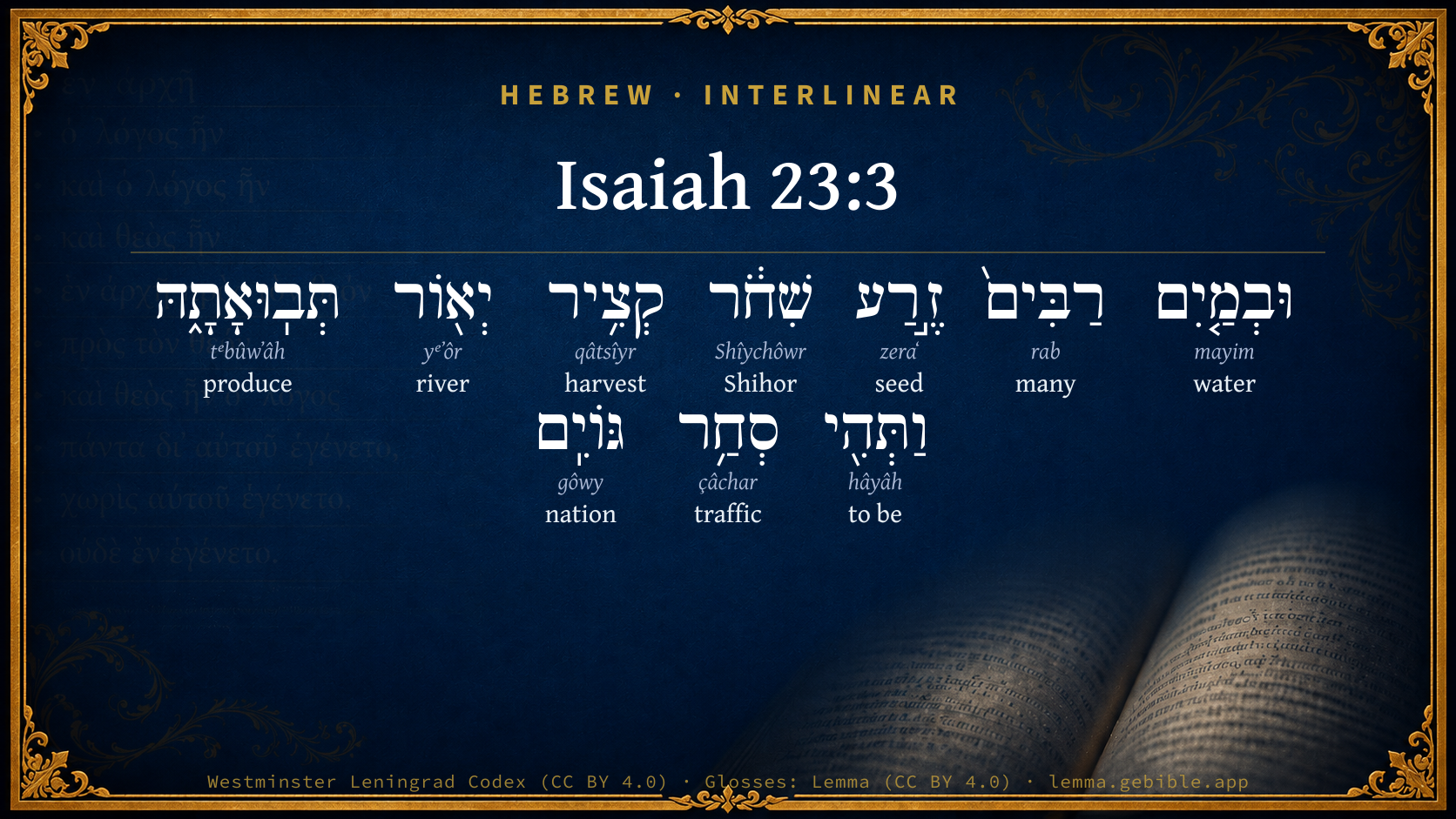
Hebrew (Westminster Leningrad Codex) Isaiah 23:3 appears in the Hebrew Old Testament. The text above is from the Westminster Leningrad Codex. Each word links to its Strong’s number, a concise gloss, and parsing drawn from the Open Scriptures Hebrew Bible morphology. Click any word for its full Brown-Driver-Briggs (BDB) entry.
Download image
Cite this verse

Isaiah 23:3 (World English Bible). Public Domain. Lemma interlinear Bible study tool, https://lemma.gebible.app/v/isaiah/23/3.

Show BibTeX & RIS
BibTeX
RIS
English Translation
On great waters the seed of the Shihor, the harvest of the Nile, was her revenue; and she was the market of nations.
World English Bible · Public Domain
Download a study sheet

One document with this verse’s original text, its word-by-word gloss line, the meaning frame, cross-references with their text, attributed commentary, and full source and license credits — printable, and it pastes into notes with its structure intact.

This verse Autodidact and up

Study sheet (.html) Plain text (.txt)

A passage Seminary Student

Up to 50 verses in one chapter. A passage sheet keeps up to 6 commentary sources and 12 cross-references per verse, in the order this page ranks them, and says so on the sheet whenever that leaves anything out. Ask for a single verse and you get the Autodidact verse sheet above.

Everything on this page stays free to read, with no account — the sheet is a download of what is already on screen, not access to it.

Want to remove ads? Support Godless Engineer
Compare translations 3

The same verse in 3 English versions, stacked beneath the original-language interlinear above. Click any original word for its lexicon entry.

Each is an independent rendering of the whole verse — the interlinear is not word-aligned to these translations.

Highlighted words mark where these versions differ — a whole-verse word diff, not a word-by-word alignment.

  • World English Bible Public Domain
    On great waters the seed of the Shihor, the harvest of the Nile, was her revenue; and she was the market of nations.
  • King James Version Public Domain
    And by great waters the seed of Sihor, the harvest of the river, is her revenue; and she is a mart of nations.
  • unfoldingWord Literal Text CC BY-SA 4.0
    For the seed of Shihor on many waters; the harvest of the Nile its revenue, and it became a marketplace of the nations.

unfoldingWord Literal Text — © unfoldingWord, licensed CC BY-SA 4.0. Word-aligned USFM3 via Door43 (git.door43.org/unfoldingWord/en_ult).

Versions to compare (up to 4)

3 of 4 selected

Show all 18 translations

Every available English version of this verse, each an independent rendering of the whole verse.

  • World English Bible Public Domain
    On great waters the seed of the Shihor, the harvest of the Nile, was her revenue; and she was the market of nations.
  • Berean Standard Bible Public Domain
    On the great waters came the grain of Shihor; the harvest of the Nile was the revenue of Tyre; she was the merchant of the nations.
  • Majority Standard Bible Public Domain
    On the great waters came the grain of Shihor; the harvest of the Nile was the revenue of Tyre; she was the merchant of the nations.
  • King James Version Public Domain
    And by great waters the seed of Sihor, the harvest of the river, is her revenue; and she is a mart of nations.
  • American Standard Version (1901) Public Domain
    And on great waters the seed of the Shihor, the harvest of the Nile, was her revenue; and she was the mart of nations.
  • Revised Version (1885) Public Domain
    And on great waters the seed of Shihor, the harvest of the Nile, was her revenue; and she was the mart of nations.
  • Geneva Bible (1599) Public Domain
    The seede of Nilus growing by the abundance of waters, and the haruest of the riuer was her reuenues, and she was a marte of the nations.
  • Douay-Rheims (1899) Public Domain
    The seed of the Nile in many waters, the harvest of the river is her revenue: and she is become the mart of the nations.
  • Young's Literal Translation Public Domain
    And in many waters `is' the seed of Sihor, The harvest of the brook `is' her increase, And she is a mart of nations.
  • Literal Standard Version CC BY-SA 4.0
    And the seed of Sihor [is] in many waters, || Her increase [is] the harvest of the brook, || And she is a market of nations.
  • Unlocked Literal Bible CC BY-SA 4.0
    Upon the great waters was the grain of Shihor, the harvest of the Nile was her produce; and it became the commerce of the nations.
  • unfoldingWord Literal Text CC BY-SA 4.0
    For the seed of Shihor on many waters; the harvest of the Nile its revenue, and it became a marketplace of the nations.
  • Darby Bible Public Domain
    And on great waters, the seed of Shihor, the harvest of the Nile, was her revenue; and she was the market of the nations.
  • World Messianic Bible Public Domain
    On great waters, the seed of the Shihor, the harvest of the Nile, was her revenue. She was the market of nations.
  • Webster's Bible Public Domain
    And by great waters the seed of Sihor, the harvest of the river, is her revenue; and she is a mart of nations.
  • Free Bible Version CC BY-SA 4.0
    Egyptian grain came across the wide oceans. The Nile's harvest was what made Tyre money; she was the merchant to the nations.
  • Bible in Basic English Public Domain
    Who get in the seed of Shihor, whose wealth is the trade of the nations.
  • JPS Tanakh (1917) Public Domain
    And on great waters the seed of Shihor, the harvest of the Nile, was her revenue; and she was the mart of nations.

Literal Standard Version (2020), Covenant Press — licensed CC BY-SA 4.0. Text via the HelloAO Bible API (eBible.org). Unlocked Literal Bible (unfoldingWord) — licensed CC BY-SA 4.0. Text via the HelloAO Bible API (eBible.org). unfoldingWord Literal Text — © unfoldingWord, licensed CC BY-SA 4.0. Word-aligned USFM3 via Door43 (git.door43.org/unfoldingWord/en_ult). Free Bible Version, Dr. Jonathan Gallagher — licensed CC BY-SA 4.0. Text via the HelloAO Bible API (eBible.org).

Word by word

More ways to search: Search by grammar → Find every occurrence → Compare this word →

Practice this passage: Drill this verse → Learn its vocabulary →

About this verse

These counts appear in no published source. They are computed here, from the morphology-tagged text and Lemma’s own curated glosses. What Lemma adds →

10
words
10
distinct lemmas
Prophets
section

Notable vocabulary

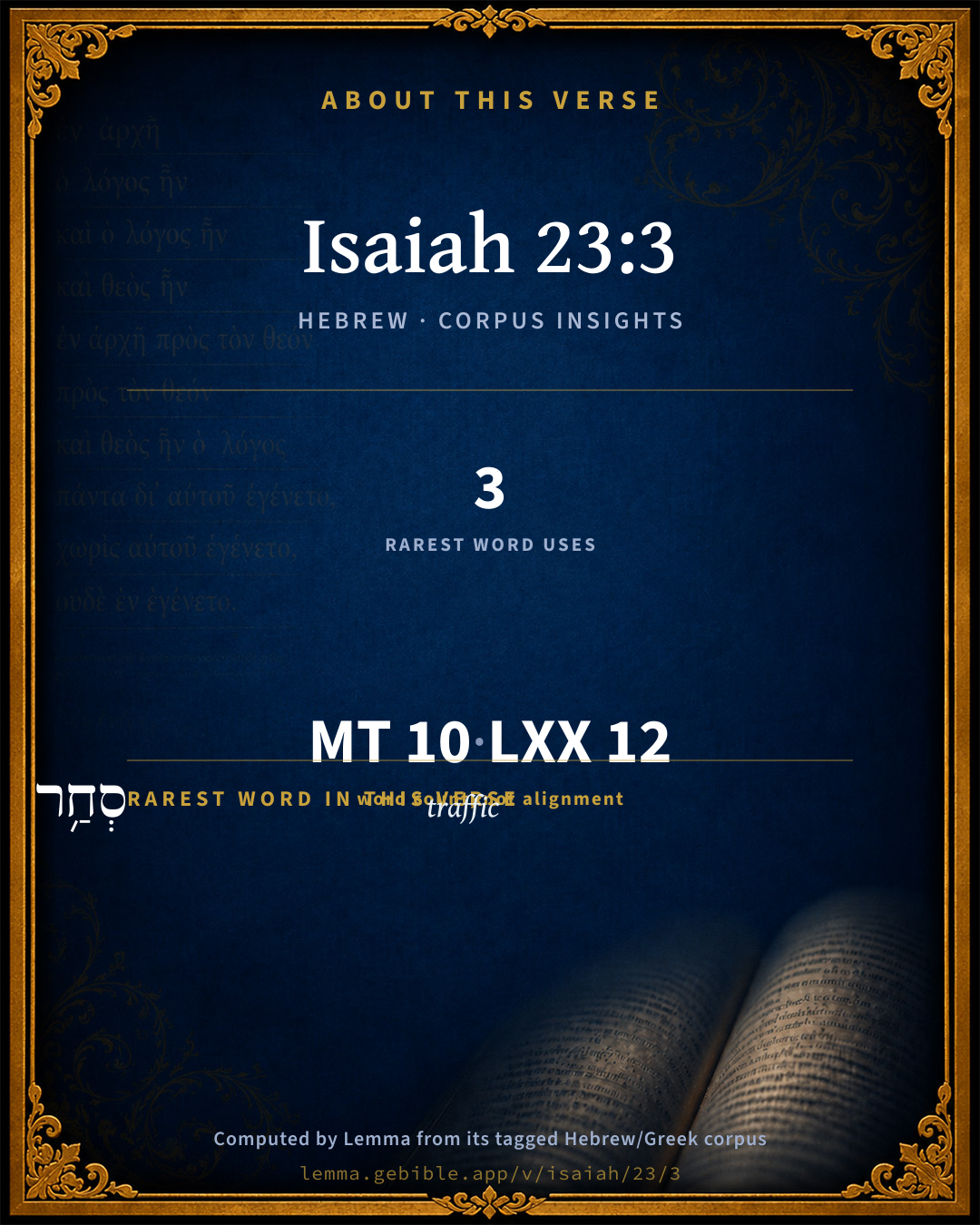
The rarest word here is סְחַ֥ר traffic H5505 — appearing just 3 times in the whole Hebrew Bible.

Shared distinctive vocabulary

סְחַ֥ר traffic H5505 occurs in 3 verses of the Hebrew Bible. Also found in:

Grammatical profile

  • 1 verb
  • 8 nouns
  • 1 adjective

Verb forms

  • וַתְּהִ֖י Qal · Sequential Imperfect

Hebrew & Septuagint length

In English translation the verse runs 23 words from the Hebrew and 21 from the Septuagint (LXX English) — closely comparable.

A rough comparison of the two English renderings, which tokenize alike — not a word-level alignment.

Word counts can differ between the Hebrew and the Greek without any difference in meaning — e.g. the Hebrew direct-object marker אֵת has no separate Greek word, and Greek often adds the article ὁ.

In the original languages it is 10 Hebrew tokens and 12 Greek tokens — but the two are counted differently (Hebrew bundles its prefixes and suffixes into one token; the Greek is in lemma form), so that isn’t a like-for-like length.

Cross-references

11

Topical passages linked to Isaiah 23:3 in the Treasury of Scripture Knowledge — connected by theme and wording, ordered by reader-vote popularity; previews shown in the World English Bible.

  • 1 Chronicles 13:5 So David assembled all Israel together, from the Shihor [the brook] of Egypt even to the entrance of Hamath, to bring the ark of God from Kiriath Jearim.
  • Jeremiah 2:18 Now what have you to do in the way to Egypt, to drink the waters of the Shihor? or what have you to do in the way to Assyria, to drink the waters of the River?
  • Deuteronomy 11:10 For the land, where you go in to possess it, isn't as the land of Egypt, from whence you came out, where you sowed your seed, and watered it with your foot, as a garden of herbs;
  • Isaiah 19:7 The meadows by the Nile, by the brink of the Nile, and all the sown fields of the Nile, shall become dry, be driven away, and be no more.
  • Isaiah 23:8 Who has purposed this against Tyre, the giver of crowns, whose merchants are princes, whose traffickers are the honorable of the earth?
  • Isaiah 32:20 Blessed are you who sow beside all waters, who send forth the feet of the ox and the donkey.
  • Ezekiel 27:3–23 and tell Tyre, you who dwell at the entry of the sea, who are the merchant of the peoples to many isles, thus says the Lord Yahweh: You, Tyre, have said, I am perfect in beauty.
  • Ezekiel 27:33 When your wares went forth out of the seas, you filled many peoples; you did enrich the kings of the earth with the multitude of your riches and of your merchandise.
  • Ezekiel 28:4 by your wisdom and by your understanding you have gotten you riches, and have gotten gold and silver into your treasures;
  • Joel 3:5 Because you have taken my silver and my gold, And have carried my finest treasures into your temples,
  • Revelation 18:11–13 The merchants of the earth weep and mourn over her, for no one buys their merchandise any more;

Cross-references courtesy of OpenBible.info (CC BY 4.0).

Hebrew and Greek witnesses Masoretic Hebrew ↔ Greek Septuagint

The same verse in the two great witnesses to the Old Testament, shown verse-for-verse.

These are two independent witnesses, not word-aligned to each other, and the Septuagint is shown in lemma (dictionary) form.

Hebrew Isaiah 23:3 Masoretic · Westminster Leningrad Codex

וּבְמַ֤יִם רַבִּים֙ זֶ֣רַע שִׁחֹ֔ר קְצִ֥יר יְא֖וֹר תְּבֽוּאָתָ֑הּ וַתְּהִ֖י סְחַ֥ר גּוֹיִֽם

On great waters the seed of the Shihor, the harvest of the Nile, was her revenue; and she was the market of nations.

World English Bible · Public Domain

Greek LXX Isaiah 23:3 Septuagint · lemma form

ἐν ὕδωρ πολύς σπέρμα μεταβολή ὡς ἀμητός εἰςφέρω ὁ μεταβόλος ὁ ἔθνος

in great waters, a generation of merchants? as when the harvest is gathered in, so are these traders with the nations.

LXX2012 (modern English Septuagint) · Public Domain

Hebrew: Westminster Leningrad Codex (CC BY 4.0). Greek: Septuagint (public domain); English from LXX2012 (modern English Septuagint) (Public Domain). How the Septuagint differs from the Hebrew →

Targum (Aramaic paraphrase)

1

The Targum is the ancient Jewish Aramaic paraphrase of the Hebrew Scriptures — an interpretive translation, not the Hebrew text itself. Onkelos (literal) and Pseudo-Jonathan (expansive) render the Torah, and Jonathan the Prophets. Coverage is partial: where no permissively-licensed English translation exists for a verse, only the Aramaic is shown. This is verse-level text, not a word-by-word alignment to the Hebrew.

  1. Targum Jonathan Prophets (Joshua–Malachi)
    דַהֲוַת מְסַפְּקָא סְחוֹרָא לְעַמְמִין סַגִיאִין דְבַחֲצַד כְּנִישַׁת נַהֲרָא עֲלַלְתָּהּ נַהֲרָא סְחוֹרָא לְעַמְמַיָא:

    She was the plentiful mart for many nations; the harvest of the increase of the river was her revenue, and she became the mart of the nations.

    Targum Jonathan — Aramaic: “Mikraot Gedolot” (public domain). English: “Sefaria Community Translation” (CC0 1.0 (public-domain dedication)); “London "Chaldee Paraphrase," 1871” (public domain). Text via Sefaria.

Commentary

Notes on Isaiah 23:3 from classic Christian and Jewish commentators (each source and its license shown beneath its notes). The classic Christian expositions comment on the surrounding passage and are grouped to its opening verse, so a note may address several verses; the Jewish commentaries on the Tanakh (Rashi and others) are per-verse, so they appear only where the commentator wrote on this verse.

Lemma curates 59 commentaries, every one of them public domain or Creative Commons licensed, each selected and text-cleaned for this edition rather than reprinted as found. About our sources →

Trapp's Complete Commentary

John Trapp

Isa 23:3 And by great waters the seed of Sihor, the harvest of the river, [is] her revenue; and she is a mart of nations.

Ver. 3. And by great waters the seed of Sihor,] i.e., Of Nile, by the overflowing whereof Egypt is made exceeding fertile, being styled the "granary of the world." Tyre was much enriched by its store thereto transported through the midland sea, called here great waters.

John Trapp, A Commentary or Exposition upon All the Books of the Old and New Testament (1647–1656) — public domain. Text from a community e-Sword module.

The Biblical Illustrator

Joseph S. Exell

Isa_23:3

The harvest of the river

The harvest of the river

The valley of the Nile was the field for sowing and reaping.

The ships of Tyre trafficked far and wide, and by purchase or by barter the corn supplies of Egypt were fetched in to fill the barns and granaries of the merchant city, and were thence resold with profit to many nations. The harvest of the Nile most accurately describes and stands for all the resources and the wealth of Egypt, which depend entirely upon the Nile. This river brings down from the mountains of Abyssinia a great quantity of decayed vegetable matter and rich alluvial deposit, which in flood time it spreads over the land. A failure in the rise of the Nile means famine in Egypt, and it was lately computed that one foot difference in the height of the annual flood makes a difference of £2,000,000 to the income of the country. So little in this respect have things changed since the days of Isaiah. (P. T. Bainbrigge, M. A.)

The harvest of the river

We need not, however, restrict the term to the importation of corn. The harvest of the river was the merchandise of the world, which the ships of Tarshish conveyed to the city of the isle--Tyre. The harvest of the river, then, is the commerce of the city built upon its banks. God is equally the God of the harvest of the river as He is the God of the harvest of the field, and though He made the country He ordained that men should form themselves into communities and dwell together in cities, and He has laid down laws for their guidance as members of a great society which must be followed, that order may be maintained and prosperity achieved. The merchant is as much engaged in doing Gods work as the farmer is. There may not be so much romance and poetry about his occupation. But God may be glorified in the fires as well as in the green fields and the pleasant woods. It is He who assigns to every man his proper place--implants within him a desire to do his duty in his appointed sphere of action, and so contrives that while a man does his duty and provides for his own interest and welfare, he by so doing contributes at the same time to the happiness and well-being of all. (W. Rogers, M. A.)

God the great World-Provider

When the Shah of Persia some few years ago visited this country, he was taken through the docks down the river, and while contemplating the great harvest reposing on its bosom, and witnessing the crowds of people eager to see the Eastern potentate and to do him honour, he asked a pertinent question of the nobleman who accompanied him. It was this: How are these vast multitudes fed? It is a question which showed the thoughtful intelligence of the barbarian, but it is one which few pause to ask, and which few are able to answer, because few look beyond the surface and attempt to unravel the great mystery by which we are enshrouded, and recognise the agency of the invisible One in all the affairs of men. (W. Rogers, M. A.)

The Biblical Illustrator, edited by Joseph S. Exell (c. 1880s–1900s) — public domain. Text from a community e-Sword module.

Tyndale Open Study Notes

Tyndale Open Resources

23:3 Fish, agricultural produce, flax, and linen were all harvests from along the Nile (see ch 19). • Tyre was known as the marketplace of the world, comparable to modern cities like New York, Hong Kong, or London.

Tyndale Open Study Notes — © Tyndale Open Resources, licensed CC BY-SA 4.0. Text via the HelloAO Bible API.

Geneva Bible (1599)

Geneva Bible translators

Meaning, the corn of Egypt, which was fed by the overflowing of the Nile.

Geneva Bible (1599) marginal notes — public domain. Text via Bolls.life.

Jamieson, Fausset & Brown

Robert Jamieson, A. R. Fausset & David Brown

great waters--the wide waters of the sea.

seed--"grain," or crop, as in Sa1 8:15; Job 39:12.

Sihor--literally, "dark-colored"; applied to the Nile, as the Egyptian Jeor, and the Greek Melas, to express the "dark, turbid" colors given to its waters by the fertilizing soil which it deposits at its yearly overflow (Jer 2:18).

harvest of the river--the growth of the Delta; the produce due to the overflow of the Nile: Egypt was the great granary of corn in the ancient world (Gen. 41:1-57; Gen. 42:1-38; Gen. 43:1-34).

her revenue--Tyrian vessels carried Egyptian produce obtained in exchange for wine, oil, glass, &c., into various lands, and so made large profits.

mart-- (Eze 27:3). No city was more favorably situated for commerce.

Jamieson, Fausset & Brown — Commentary Critical and Explanatory on the Whole Bible (1871) — public domain (CC PDM 1.0). Text via the HelloAO Bible API.

Adam Clarke's Commentary

Verse 3. The seed of Sihor - "The seed of the Nile"] The Nile is called here Shichor, as it is Jer 2:18, and 1Ch 13:5. It had this name from the blackness of its waters, charged with the mud which it brings down from Ethiopia when it overflows, Et viridem AEgyptum nigra fecundat arena; as it was called by the Greeks Melas, and by the Latins Melo, for the same reason. See Servius on the above line of Virgil, Georg. iv. 291. It was called Siris by the Ethiopians, by some supposed to be the same with Shichor. Egypt by its extraordinary fertility, caused by the overflowing of the Nile supplied the neighbouring nations with corn, by which branch of trade the Tyrians gained great wealth.

Adam Clarke's Commentary on the Bible (1810–1826) — public domain. Text from a community e-Sword/MySword module.

Ellicott's Commentary for English Readers

(3) By great waters the seed of Sihor . . .—Sihor (“the dark river”) is as in Jer_2:18, a Hebrew name for the Nile. The corn-trade with Egypt (Eze_27:7, adds the linen-trade) was naturally a chief branch of Tyrian commerce. Practically, indeed, as the Egyptians had no timber to build ships, and, for the most part, hated the sea, their navy consisted of Phœnicians. Tyre practically reaped the harvest that sprang from the inundation of the Nile. For “mart,” read gain. The “great waters” are those of the great sea, i.e., of the Mediterranean.

A Bible Commentary for English Readers, edited by Charles John Ellicott (1878–1897) — public domain. Text from a community e-Sword module.

The Cambridge Bible for Schools and Colleges

gen. ed. J. J. S. Perowne

3. The easiest translation would be: and on great waters the seed of Shihor, the harvest of the Nile, (was) her revenue, and it (i.e. her revenue) was the gain of the nations. Shihor might be a name for the Nile, as in Jer_2:18; and the meaning would be that the revenue of Tyre (or Phœnicia) was derived from the sea-traffic in Egyptian grain. This was no doubt the case to some extent; but to suppose that the corn trade with Egypt was a principal source of wealth to Tyre is contrary to all the information we possess. The expression of the thought, moreover, is involved and enigmatic, and even if we call to our aid the subtle suggestion that Tyre, with no agriculture of her own, nevertheless reaped a rich harvest by her command of the sea, the idea is still unworthy of Isaiah, and of the rest of this poem.

The translation mart in E.V., instead of “gain” or “merchandise” is hardly justifiable.

The Cambridge Bible for Schools and Colleges (gen. ed. J. J. S. Perowne; Cambridge University Press, 1878–1918) — public domain. Text from a community e-Sword module.

John Gill's Exposition

And by great waters the seed of Sihor,.... Sihor is the river Nile in Egypt; it had its name from the black colour of its waters, as in Jer 2:18 hence called by the Greeks Melas, and by the Latins Melo: the "seed" of it intends what was sown and grew upon the banks of it, or was nourished by the overflow of this river throughout the land, and includes corn, flax, paper, &c. with which Egypt abounded; and when this is said to be "by great waters", the meaning either is, that it grew by great waters, the waters of the Nile, and through the influence of them; or that it came by great waters to Tyre; that is, by the waters of the sea, the Mediterranean Sea:

the harvest of the river is her revenue; this clause is the same with the former, and serves to explain it; the river is the river Nile, the harvest is the seed that was sown and grew by it, and which at the proper season, when ripe, was gathered from it, and carried in ships to Tyre, with which that city was supplied and enriched, as if it had been its own produce:

and she is a mart of nations; Tyre was a city to which all nations traded, it was a mart for them all, and where they brought their wares to sell, and always found a market for them, here they had vent. The twenty seventh chapter of Ezekiel Eze 27:1 is a proper commentary on this clause.

John Gill's Exposition of the Whole Bible (1746–1763) — public domain (CC PDM 1.0). Text via the HelloAO Bible API.

Albert Barnes' Notes on the Bible

And by great waters - That is, by the abundant-waters, or the overflowing of the Nile. Tyre was the mart to which the superabundant productions of Egypt were borne (see Ezek. 27)

The seed of Sihor - There can be no doubt that by ‘Sihor’ here is meant the river Nile in Egypt (see Jos 13:3; 1Ch 13:5; Jer 2:18). The word שׁחר shichor is derived from שׁחר shachar, “to be black” Job 30:30, and is given to the Nile from its color when it brings down the slime or mud by which Egypt is rendered so fertile. The Greeks gave to the river the name Μέλας Melas (“black”), and the Latins call it “Melo” - (Serv. ad Virg. “Geor.” iv. 291. It was called “Siris” by the Ethiopians; perhaps the same as Sihor. The upper branches of the Nile in Abyssinia all receive their names from the “color” of the water, and are called the White River, the Blue River, etc.

The harvest of the river - The productions caused by the overflowing of the river. Egypt was celebrated for producing grain, and Rome and Greece derived no small part of their supplies from that fertile country. It is also evident that the inhabitants of Palestine were early accustomed to go to Egypt in time of scarcity for supplies of grain (see Gen 37:25, Gen 37:28, and the history of Joseph, Gen. 41–43) That the “Tyrians” traded with Egypt is also well known. Herodotus (ii. 112) mentions one entire quarter of the city of Memphis that was inhabited by the Tyrians.

Is her revenue - Her resources are brought from thence.

She is a mart of nations - How true this was, see Ezek. 27. No place was more favorably situated for commerce; and she had engrossed the trade nearly of all the world.

Albert Barnes' Notes on the Bible (1834–1885) — public domain. Text from a community e-Sword/MySword module.

Haydock's Catholic Bible Commentary

Nile. Hebrew Shichor, or "muddy water," designates that river, Josue xiii. 3. --- River. The overflowing of the Nile gave fertility to Egypt, insomuch that Tyre and other nations were supplied by it with corn.

George Leo Haydock (1774–1849), Haydock's Catholic Family Bible and Commentary, 1859 edition — public domain. Excludes Psalms (Douay-Rheims chapter numbering differs from Protestant) and Deuterocanonical books (Catholic canon only).

Matthew Poole's English Annotations

By great waters; by the sea, which is very fitly called the great waters, Psa 107:23; understand, cometh, or is brought to her.

The seed of Sihor; the corn of Egypt, wherewith Egypt abounded, and furnished divers other parts of the world, whence it was called the granary of the Roman empire; which also was easily conveyed by sea from Egypt to Tyre, and thence to divers other countries. This is called seed, here, as also Hag 1:10, and elsewhere, by a usual metonymy; and the seed of Sihor, because it grew up the more abundantly because of the overflow of the river, as all sorts of authors have noted. For Sihor is nothing else but Nilus, as appears from Jer 2:18, which is called Sihor, as by the Greeks it was called Melas, from its black colour. And this and no other river seems to be that Sihor, which is so oft mentioned as one of the bounds of the land of Canaan, as Num 34:5, &c., because that land, at least in that extent which God allotted and gave it to the Israelites, though they through neglect or cowardice might not actually possess it, did reach to one of the branches of that river. And indeed, if Sihor be not Nilus, that great and neighbouring river is not named in all the Scripture, which seems very improbable.

The harvest of the river: this clause explains the former; that plentiful harvest of corn which comes from the influence and inundation of Nilus, which is emphatically called the river, as here, so also Exo 1:22; Isa 19:5; Eze 29:3,9, as Euphrates is in other texts of Scripture.

Is her revenue; is as easily procured and plentifully enjoyed by her, as if it grew in her own territories.

A mart of nations; a place to which all nations resort for traffic.

Matthew Poole's English Annotations on the Holy Bible (1683–1685) — public domain. Text from a community e-Sword/MySword module.

Whedon's Commentary on the Bible

Daniel D. Whedon

3. By great waters — Across the sea to Egypt. The grain of the Nile land (called here Sihor, black, the black deposits of yearly fertile mud) is Tyre’s revenue. Egypt was the great emporium of the nations.

Daniel D. Whedon (gen. ed.), Commentary on the Old and New Testaments (1874–1909) — public domain. Text from a community e-Sword module.

The Pulpit Commentary

By great waters; rather, on great waters; i.e. on the waters of the Mediterranean. (cf. Psa_107:23 Eze_27:26) The Egyptian vessels conveyed the corn intended for exportation to the ports at the mouths of the Nile, where it was transhipped aboard Phoenician craft, which carried it on the open sea to the countries needing it. We never hear of the Egyptians disputing the trade of the Mediterranean with the Phoenicians and the Greeks, though they certainly had trading-vessels at times on the waters of the Red Sea. The seed of Sihor; i.e. the corn of the Nile valley. "Si-her," or rather "Shihor," is the only proper name by which the Nile is designated in the Hebrew Scriptures. It means "the dark," "the turbid," and may be compared with the modern Bahr-el-azrak," used of the Eastern or Abyssinian Nile, and with the term" Nilus" itself, if that signifies "the dark blue stream." It occurs, as the name of the Nile, only in Jos_13:3 1Ch_13:5 Jer_2:18; and the present place. Is her revenue; i.e. "produces a portion of her annual income." And she is a man of nations (so Gesenius and Ewald). Delitzsch and Mr. Cheyne translate, "It is the gain of the nations," referring "it" to the corn which the Tyrians exported.

HOMILIES BY W.M. STATHAM Ver. 3. "The harvest of the river.

Egypt was the first of nations, and the masts of the vessels stood hike tall river-reeds by her banks. How expressive the words are! There is life where the river comes, life along the emerald banks to which the cattle come, and on the fields where the waters overflow.

I ALL LANDS HAVE THEIR RIVERS. Think of the Tiber, the Tigris, the Thames, the Rhone, the Rhine, the Nile, the Niger. Cities rise on their banks which are, like Tyre, populous and prosperous. The harvest is vast indeed. Ships which are freighted with necessaries and luxuries, with the works of art, the spoils of the sea, and the produce of far-away lauds, all come up the river. What wonder that the river should become a type of the blessings of the gospel that the prophet should tell us "living waters shall flow out of Jerusalem!

II THE HARVESTS ARE MANIFOLD. We are so accustomed to think of the golden sheaves of the corn-fields when we mention the rivers, that we are liable to forget how indebted we are to the broad estuaries which bear on their bosom the wealth of many nations. How manifold, too, are our harvests under the gospel! Where that comes philanthropy lives, and social purity flows, and justice is sacred in its rivers of righteousness, and salvation comes, delivering us from sensuality and sin. Harvests? Surely the Christian should notice how wide and vast the gospel waters are.

III THEIR DRYING UP IS DEATH. We cannot live without rain and rivers. Cattle perish. Verdure withers. Man himself dies. No wealth can purchase what God gives so plentifully. "Hath the rain a Father?" Oh yes. Not a mere Creator, but a Father; for it is rich in evidences of his universal care and love. God gives "the former and the latter rain," and all through the ages the rivers flow into the sea. So God"s truth remains! The living water flows, and the voice is still heard, "He, every one that thirsteth, come ye to the waters. W.M.S.

The Pulpit Commentary (1880–1919), ed. H.D.M. Spence-Jones & Joseph S. Exell — public domain. Text from a community e-Sword module.

J. A. Alexander on Isaiah

Joseph Addison Alexander

“And in great waters (was) the seed of the Nile; the harvest of the river (was) her revenue; and she was a mart of nations.” The Hebrew and Egyptian names of the Nile are here combined. The first, according to its etymology, means black, and corresponds to Melo, the Latin name of the same river, all derived from the color of the water or the mud which it deposits. Of the whole verse there are three interpretations. The first supposes an allusion to the fact that the grain of Egypt was exported in Phoenician vessels on the great waters (i.e., over the sea). The objection that Phenicia is described by Ezekiel as trading not with Egypt but with Palestine in grain, though entitled to some weight, is not conclusive. A stronger objection may be drawn from the apparent incongruity of naming this one branch of commerce as a proof that Tyre was a mart of nations. A second interpretation understands what is said of Egypt figuratively, or as a comparison; as if he had said that the wealth which Egypt derived from the Nile, Phoenicia derived from the great waters (i.e., by her maritime trade). The third differs from this only by supposing a distinct allusion to the insular situation of Tyre, which, though planted on a rock and girt by mighty waters, reaped as rich a harvest as the fertile land of Egypt. This last interpretation is much more poetical than either of the others, and at least in that respect entitled to the preference.

Joseph Addison Alexander, The Prophecies of Isaiah (1846–1847; New York: Scribner, 1870–1878) — public domain. Text from a community e-Sword module.

Rashi

Rabbi Shlomo Yitzchaki (Rashi)

And on great waters the seed would come from Egypt, that is situated on the river Shihor, to Tyre.

the harvest of the Nile Egypt was the revenue of Tyre.

Shihor This is the Nile, as it is said (Jos. 13: 3): “From the Shihor, which is before Egypt.” And they would bring the produce to Tyre in Egyptian ships.

and she became (I.e.,) Tyre.

the mart of the nations from the multitude of people that were therein. All the nations brought merchandise to her. ([Some editions read:] All the strangers.)

Rashi on the Tanakh — English translations: “The Judaica Press complete Tanach with Rashi, translated by A. J. Rosenberg” (CC BY 4.0); “Pentateuch with Rashi's commentary by M. Rosenbaum and A.M. Silbermann, 1929-1934” (public domain); “The Metsudah Tanach series, Lakewood, N.J” (CC BY 4.0); and “The Book of Joshua, Metsudah Publications, 1997” (CC BY 4.0). Text via Sefaria.

Ibn Ezra

Rabbi Abraham ibn Ezra

And by great waters, etc. The merchants brought to Tyre the seed of the Sihor, and her increase was the harvest of the Nile.

סחר A mart. סחר is a noun and means merchandise; but we have here to supply בעלת; And she was the mistress of the merchandise (that is, the mart) of the nations. Comp. ובעל חסרון ═ וחסרון That which is wanting (Eccl. 1:15)

Ibn Ezra on the Tanakh — English translations: “Sefaria Community Translation” (CC0 1.0 (public-domain dedication)); “Yalkut, Sifsei Chachomim Chumash, Metsudah Publications, 2009” (CC BY 4.0); and “Commentary of Ibn Ezra on Isaiah - trans. by M. Friedlander, 1873” (public domain). Text via Sefaria.

Lesson kit

Teaching starters — assembled from the data on this page, not authored interpretation. Every prompt links to the verse data it draws on. Edit before teaching.

Isaiah, in the Prophets, opens this verse with 10 words (10 distinct Hebrew lemmas). Its most distinctive word is çâchar (“traffic”). A historical commentator’s framing appears above. Read the whole chapter for the surrounding context.

Discussion questions

  1. The word çâchar carries the sense “traffic.” How does it shape the verse?
  2. How does Proverbs 3:14, which shares the word «traffic», read alongside this verse?
  3. The translations on this page render this verse differently — a whole-verse word diff, not a word-by-word alignment. What might account for the different wordings?
  4. «וַתְּהִ֖י» is a Qal Sequential Imperfect verb. How does that grammatical form shape the action described?
  5. Compare how Trapp's Complete Commentary and The Biblical Illustrator read this verse. Where do they agree or differ?

Things to notice

Reading settings

Reading text

Shown beneath each verse's original-language words.

Old Testament
Old Testament edition

Read the OT as the Masoretic Hebrew (MT) or the Greek Septuagint (LXX).

English shown for the Greek Septuagint (in the Hebrew ↔ Greek comparison).

Comparing translations? Open the Compare panel on any verse page to stack up to four side by side.