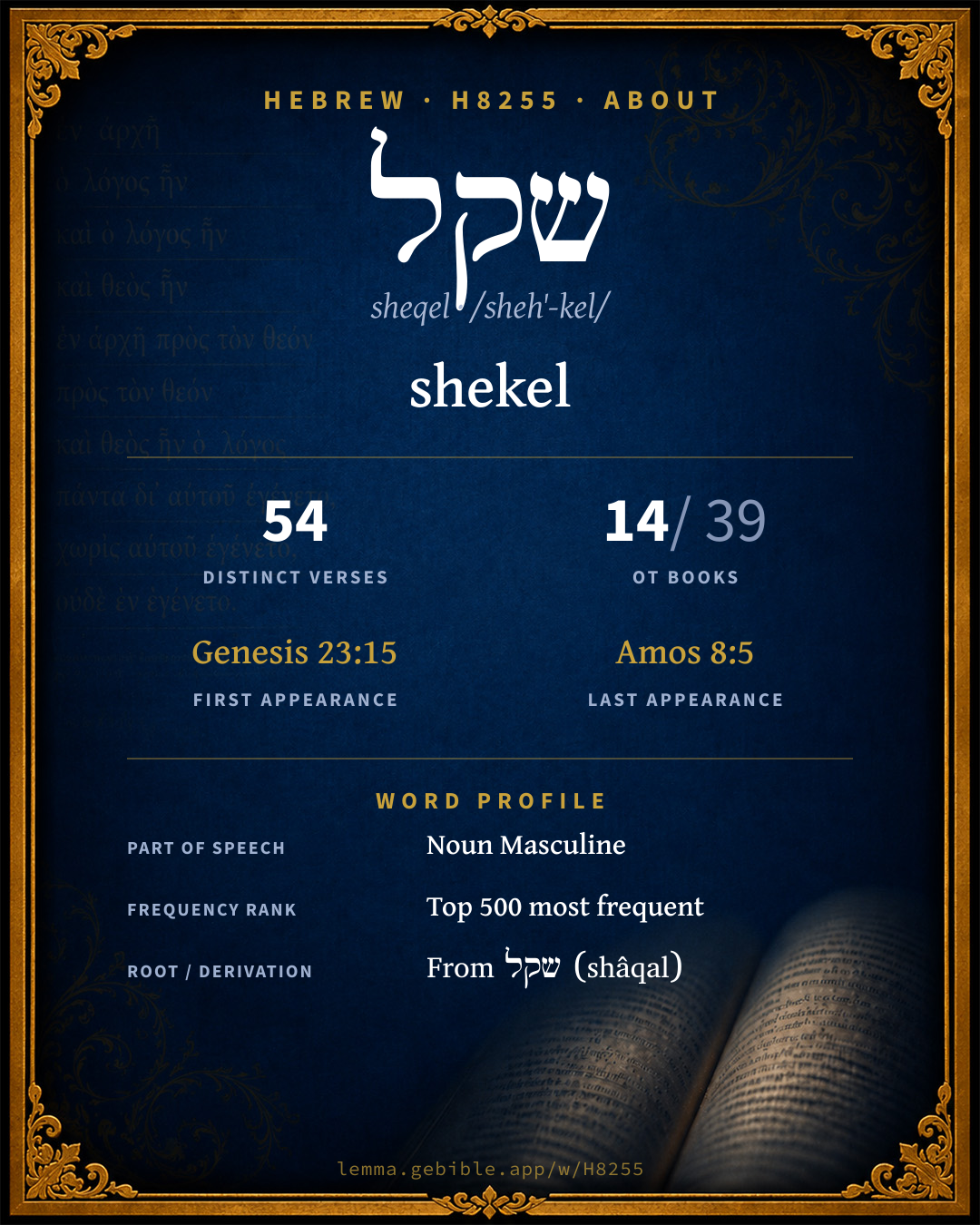
שֶׁ֫קֶל
shekel
‘shekel’ is one of 2 main senses fuller range ↓
Full lexicon entry — Brown-Driver-Briggs (BDB)
From Brown-Driver-Briggs (BDB)
Where this word appears
See every Absolute-state word in the Hebrew Bible →
Grammar key — what these labels mean
Part of speech
- Noun
- A naming word — a person, place, thing, or idea.
Noun type
- Common
- A common noun — a general class of person, place, or thing (“king,” “city,” “water”), not a specific name.
State
- Construct
- A noun bound to a following noun in a possessive / “of” relationship (the construct chain).
- Absolute
- The independent form of a noun, not bound to a following word.
Gender
- Masculine
- Grammatically masculine.
Number
- Singular
- One.
- Plural
- More than one (in Hebrew, generally three or more).
Grammatical forms
- Noun, Common, Masculine, Singular, Absolute 37 times (42%)
- Noun, Common, Masculine, Singular, Construct 29 times (33%)
- Noun, Common, Masculine, Plural, Absolute 21 times (24%)
- Noun, Common, Masculine, Plural, Construct 1 time (1%)
Parsed forms decoded from the imported morphology (morphhb / Westminster Leningrad Codex — WLC text public domain, morphhb tagging CC BY 4.0), counted across 88 parsed occurrences — not distinct verses.
Every verse where H8255 appears — 54 distinct verses across 14 books. Click any verse to open its interlinear word-by-word view. Verse text shown in the World English Bible for context — . Each verse’s Hebrew form is shown with its reference; the English is not keyword-highlighted, since the data carries no word-level English alignment. Use “Compare translations” on any verse to read it across multiple English versions. This concordance covers the Hebrew Bible; Septuagint (Greek Old Testament) occurrences are not indexed here.
Genesis 2 verses
- Genesis 23:15 שֶֽׁקֶל n c ms cs "My lord, listen to me. What is a piece of land worth four hundred shekels of silver between me and you? Therefore bury your dead."
- Genesis 23:16 שֶׁ֣קֶל n c ms cs Abraham listened to Ephron. Abraham weighed to Ephron the silver which he had named in the audience of the children of Heth, four hundred shekels of silver, according to the current merchants' standard.
Exodus 8 verses
- Exodus 21:32 שְׁקָלִ֗ים n c mp If the bull gores a man-servant or a maid-servant, thirty shekels of silver shall be given to their master, and the ox shall be stoned.
- Exodus 30:13 הַ/שֶּׁ֖קֶל בְּ/שֶׁ֣קֶל הַ/שֶּׁ֔קֶל הַ/שֶּׁ֔קֶל ptcl def.art + n c ms prep + n c ms cs ptcl def.art + n c ms ptcl def.art + n c ms They shall give this, everyone who passes over to those who are numbered, half a shekel after the shekel of the sanctuary; (the shekel is twenty gerahs;) half a shekel for an offering to Yahweh.
- Exodus 30:15 הַ/שָּׁ֑קֶל ptcl def.art + n c ms The rich shall not give more, and the poor shall not give less, than the half shekel, when they give the offering of Yahweh, to make atonement for your souls.
- Exodus 30:24 בְּ/שֶׁ֣קֶל prep + n c ms cs and of cassia five hundred, after the shekel of the sanctuary; and a hin of olive oil.
- Exodus 38:24 שֶׁ֖קֶל בְּ/שֶׁ֥קֶל n c ms prep + n c ms cs All the gold that was used for the work in all the work of the sanctuary, even the gold of the offering, was twenty-nine talents, and seven hundred thirty shekels, after the shekel of the sanctuary.
- Exodus 38:25 שֶׁ֖קֶל בְּ/שֶׁ֥קֶל n c ms prep + n c ms cs The silver of those who were numbered of the congregation was one hundred talents, and one thousand seven hundred seventy-five shekels, after the shekel of the sanctuary:
- Exodus 38:26 הַ/שֶּׁ֖קֶל בְּ/שֶׁ֣קֶל ptcl def.art + n c ms prep + n c ms cs a beka a head, that is, half a shekel, after the shekel of the sanctuary, for everyone who passed over to those who were numbered, from twenty years old and upward, for six hundred three thousand five hundred fifty men.
- Exodus 38:29 שָֽׁקֶל n c ms The brass of the offering was seventy talents, and two thousand four hundred shekels.
Leviticus 8 verses
- Leviticus 5:15 שְׁקָלִ֥ים בְּ/שֶֽׁקֶל n c mp prep + n c ms cs "If anyone commits a trespass, and sins unwittingly, in the holy things of Yahweh; then he shall bring his trespass offering to Yahweh, a ram without blemish from the flock, according to your estimation in silver by shekels, after the shekel of the sanctuary, for a trespass offering.
- Leviticus 27:3 שֶׁ֥קֶל בְּ/שֶׁ֥קֶל n c ms prep + n c ms cs Your valuation shall be of a male from twenty years old even to sixty years old, even your valuation shall be fifty shekels of silver, after the shekel of the sanctuary.
- Leviticus 27:4 שָֽׁקֶל n c ms If it is a female, then your valuation shall be thirty shekels.
- Leviticus 27:5 שְׁקָלִ֑ים שְׁקָלִֽים n c mp n c mp If the person is from five years old even to twenty years old, then your valuation shall be for a male twenty shekels, and for a female ten shekels.
- Leviticus 27:6 שְׁקָלִ֖ים שְׁקָלִ֖ים n c mp n c mp If the person is from a month old even to five years old, then your valuation shall be for a male five shekels of silver, and for a female your valuation shall be three shekels of silver.
- Leviticus 27:7 שָׁ֑קֶל שְׁקָלִֽים n c ms n c mp If the person is from sixty years old and upward; if it is a male, then your valuation shall be fifteen shekels, and for a female ten shekels.
- Leviticus 27:16 שֶׁ֥קֶל n c ms cs "'If a man dedicates to Yahweh part of the field of his possession, then your valuation shall be according to the seed for it: the sowing of a homer of barley shall be valued at fifty shekels of silver.
- Leviticus 27:25 בְּ/שֶׁ֣קֶל הַ/שָּֽׁקֶל prep + n c ms cs ptcl def.art + n c ms All your valuations shall be according to the shekel of the sanctuary: twenty gerahs to the shekel.
Numbers 18 verses
- Numbers 3:47 שְׁקָלִ֖ים בְּ/שֶׁ֤קֶל הַ/שָּֽׁקֶל n c mp prep + n c ms cs ptcl def.art + n c ms you shall take five shekels apiece for each one; after the shekel of the sanctuary you shall take them (the shekel is twenty gerahs):
- Numbers 3:50 בְּ/שֶׁ֥קֶל prep + n c ms cs from the firstborn of the children of Israel he took the money, one thousand three hundred sixty-five shekels, after the shekel of the sanctuary:
- Numbers 7:13 שֶׁ֖קֶל בְּ/שֶׁ֣קֶל n c ms prep + n c ms cs and his offering was: one silver platter, the weight of which was one hundred thirty shekels, one silver bowl of seventy shekels, after the shekel of the sanctuary; both of them full of fine flour mixed with oil for a meal offering;
- Numbers 7:19 שֶׁ֖קֶל בְּ/שֶׁ֣קֶל n c ms prep + n c ms cs He offered for his offering: one silver platter, the weight of which was one hundred thirty shekels, one silver bowl of seventy shekels, after the shekel of the sanctuary; both of them full of fine flour mixed with oil for a meal offering;
- Numbers 7:25 שֶׁ֖קֶל בְּ/שֶׁ֣קֶל n c ms prep + n c ms cs gave his offering: one silver platter, the weight of which was a hundred and thirty shekels, one silver bowl of seventy shekels, after the shekel of the sanctuary; both of them full of fine flour mixed with oil for a meal offering;
- Numbers 7:31 שֶׁ֖קֶל בְּ/שֶׁ֣קֶל n c ms prep + n c ms cs gave his offering: one silver platter, the weight of which was one hundred thirty shekels, one silver bowl of seventy shekels, after the shekel of the sanctuary; both of them full of fine flour mixed with oil for a meal offering;
- Numbers 7:37 שֶׁ֖קֶל בְּ/שֶׁ֣קֶל n c ms prep + n c ms cs gave his offering: one silver platter, the weight of which was one hundred thirty shekels, one silver bowl of seventy shekels, after the shekel of the sanctuary; both of them full of fine flour mixed with oil for a meal offering;
- Numbers 7:43 שֶׁ֖קֶל בְּ/שֶׁ֣קֶל n c ms prep + n c ms cs gave his offering: one silver platter, the weight of which was one hundred thirty shekels, one silver bowl of seventy shekels, after the shekel of the sanctuary; both of them full of fine flour mixed with oil for a meal offering;
- Numbers 7:49 שֶׁ֖קֶל בְּ/שֶׁ֣קֶל n c ms prep + n c ms cs gave his offering: one silver platter, the weight of which was one hundred thirty shekels, one silver bowl of seventy shekels, after the shekel of the sanctuary; both of them full of fine flour mixed with oil for a meal offering;
- Numbers 7:55 שֶׁ֖קֶל בְּ/שֶׁ֣קֶל n c ms prep + n c ms cs gave his offering: one silver platter, the weight of which was one hundred thirty shekels, one silver bowl of seventy shekels, after the shekel of the sanctuary; both of them full of fine flour mixed with oil for a meal offering;
- Numbers 7:61 שֶׁ֖קֶל בְּ/שֶׁ֣קֶל n c ms prep + n c ms cs gave his offering: one silver platter, the weight of which was one hundred thirty shekels, one silver bowl of seventy shekels, after the shekel of the sanctuary; both of them full of fine flour mixed with oil for a meal offering;
- Numbers 7:67 שֶׁ֖קֶל בְּ/שֶׁ֣קֶל n c ms prep + n c ms cs gave his offering: one silver platter, the weight of which was one hundred thirty shekels, one silver bowl of seventy shekels, after the shekel of the sanctuary; both of them full of fine flour mixed with oil for a meal offering;
- Numbers 7:73 שֶׁ֖קֶל בְּ/שֶׁ֣קֶל n c ms prep + n c ms cs gave his offering: one silver platter, the weight of which was one hundred thirty shekels, one silver bowl of seventy shekels, after the shekel of the sanctuary; both of them full of fine flour mixed with oil for a meal offering;
- Numbers 7:79 שֶׁ֖קֶל בְּ/שֶׁ֣קֶל n c ms prep + n c ms cs gave his offering: one silver platter, the weight of which was one hundred thirty shekels, one silver bowl of seventy shekels, after the shekel of the sanctuary; both of them full of fine flour mixed with oil for a meal offering;
- Numbers 7:85 בְּ/שֶׁ֥קֶל prep + n c ms cs each silver platter weighing one hundred thirty shekels, and each bowl seventy; all the silver of the vessels two thousand four hundred shekels, after the shekel of the sanctuary;
- Numbers 7:86 בְּ/שֶׁ֣קֶל prep + n c ms cs the twelve golden ladles, full of incense, weighing ten shekels apiece, after the shekel of the sanctuary; all the gold of the ladles weighed one hundred twenty shekels;
- Numbers 18:16 שְׁקָלִ֖ים בְּ/שֶׁ֣קֶל n c mp prep + n c ms cs Those who are to be redeemed of them from a month old shall you redeem, according to your estimation, for the money of five shekels, after the shekel of the sanctuary (the same is twenty gerahs).
- Numbers 31:52 שָׁ֑קֶל n c ms All the gold of the heave-offering that they offered up to Yahweh, of the captains of thousands, and of the captains of hundreds, was sixteen thousand seven hundred fifty shekels.
Joshua 1 verse
1 Samuel 3 verses
- 1 Samuel 9:8 שֶׁ֣קֶל n c ms cs The servant answered Saul again, and said, Behold, I have in my hand the fourth part of a shekel of silver: that will I give to the man of God, to tell us our way.
- 1 Samuel 17:5 שְׁקָלִ֖ים n c mp He had a helmet of brass on his head, and he was clad with a coat of mail; and the weight of the coat was five thousand shekels of brass.
- 1 Samuel 17:7 שְׁקָלִ֖ים n c mp The staff of his spear was like a weaver's beam; and his spear's head [weighed] six hundred shekels of iron: and his shield-bearer went before him.
2 Samuel 2 verses
- 2 Samuel 14:26 שְׁקָלִ֖ים n c mp When he cut the hair of his head (now it was at every year's end that he cut it; because it was heavy on him, therefore he cut it); he weighed the hair of his head at two hundred shekels, after the king's weight.
- 2 Samuel 24:24 שְׁקָלִ֥ים n c mp The king said to Araunah, No; but I will most assuredly buy it of you at a price. Neither will I offer burnt-offerings to Yahweh my God which cost me nothing. So David bought the threshing floor and the oxen for fifty shekels of silver.
2 Kings 4 verses
- 2 Kings 7:1 בְּ/שֶׁ֗קֶל בְּ/שֶׁ֖קֶל prep + n c ms prep + n c ms Elisha said, Hear you the word of Yahweh: thus says Yahweh, Tomorrow about this time shall a measure of fine flour be [sold] for a shekel, and two measures of barley for a shekel, in the gate of Samaria.
- 2 Kings 7:16 בְּ/שֶׁ֗קֶל בְּ/שֶׁ֖קֶל prep + n c ms prep + n c ms The people went out, and plundered the camp of the Syrians. So a measure of fine flour was [sold] for a shekel, and two measures of barley for a shekel, according to the word of Yahweh.
- 2 Kings 7:18 בְּ/שֶׁ֗קֶל בְּ/שֶׁ֔קֶל prep + n c ms prep + n c ms It happened, as the man of God had spoken to the king, saying, Two measures of barley for a shekel, and a measure of fine flour for a shekel, shall be tomorrow about this time in the gate of Samaria;
- 2 Kings 15:20 שְׁקָלִ֛ים n c mp Menahem exacted the money of Israel, even of all the mighty men of wealth, of each man fifty shekels of silver, to give to the king of Assyria. So the king of Assyria turned back, and didn't stay there in the land.
1 Chronicles 1 verse
2 Chronicles 1 verse
Nehemiah 2 verses
- Nehemiah 5:15 שְׁקָלִ֣ים n c mp But the former governors who were before me were chargeable to the people, and took of them bread and wine, besides forty shekels of silver; yes, even their servants bore rule over the people: but I didn't do so, because of the fear of God.
- Nehemiah 10:32 הַ/שֶּׁ֖קֶל ptcl def.art + n c ms Also we made ordinances for us, to charge ourselves yearly with the third part of a shekel for the service of the house of our God;
Jeremiah 1 verse
Ezekiel 2 verses
- Ezekiel 4:10 שֶׁ֖קֶל n c ms Your food which you shall eat shall be by weight, twenty shekels a day: from time to time shall you eat it.
- Ezekiel 45:12 וְ/הַ/שֶּׁ֖קֶל שְׁקָלִ֜ים שְׁקָלִ֗ים שֶׁ֔קֶל conj + ptcl def.art + n c ms n c mp n c mp n c ms The shekel shall be twenty gerahs. Twenty shekels plus twenty-five shekels plus fifteen shekels shall be your mina.
Amos 1 verse
About this entry
At a glance — auto-summarized from this page’s data, not written by a person. Every figure links to its source below. This summary describes the numbers; it doesn’t interpret them.
שקל — transliterated sheqel — is a Hebrew noun carrying the sense “shekel.” Its earliest occurrence is Genesis 23:15. Spanning 54 verses in 14 books, it ranks among the moderately common words of the Hebrew Bible. Its uses concentrate in Numbers (33% of all occurrences). BDB distinguishes 2 senses for it. Each statement above links to its evidence; the full detail follows below.
Gloss history
Strong's 1890 vs modern scholarship
About this word
Strong's H8255 catalogs a Hebrew word from the Hebrew Old Testament.
These counts are not copied from any lexicon or concordance. They are computed here, from the morphology-tagged Hebrew Old Testament. What Lemma adds →
- 54
- distinct verses
- The word appears in 54 distinct verses.
- 14 / 39
- OT books
- The word appears in 14 of 39 Old Testament books.
- #467
- by frequency
- Top 500 most frequent Hebrew words (rank 467 of 8,640 Hebrew words by occurrence).
View all 54 occurrences in the concordance →
By section of the Old Testament
By traditional corpus
Conventional, traditional groupings — biblical authorship is debated, so this is a traditional corpus grouping, not an authorship claim. Each share is this word’s portion of its verses in that division of the Hebrew canon. Each figure is a share of the word’s 54 distinct verses.
- Torah (Pentateuch) 36 verses · 67%
- Prophets (Nevi'im) 14 verses · 26%
- Writings (Ketuvim) 4 verses · 7%
How translations render this word
Counts come from each version’s own published word-to-Strong’s tagging or interlinear alignment — an approximate guide to how each version renders this word, not a word-level alignment the data otherwise carries. Because each total is that version’s own tagged count, the per-version totals vary from one another and need not match the appearance or distinct-verse counts above. These counts may also differ from a printed concordance because Lemma counts each distinctly tagged rendering and does not collapse phrase taggings into a single head-word total. This is a fixed set of word-tagged versions (KJV, ASV, BSB, ULT) and does not change with the reading translation you choose elsewhere. Each version’s license is shown beside its name below (and on Sources).
- King James Version: Shekels 46×, After the shekel 21×, Shekel 14×
- American Standard Version: Shekels 48×, After the shekel 22×, Shekel 12×
- Berean Standard Bible: Shekels 47×, Shekel 37×, Will sell for a shekel 2×
- unfoldingWord Literal Text: Shekels 33×, Shekel of 19×, Shekel 14×
King James Version Public Domain
Renders H8255 across 88 tagged occurrences — most commonly:
Plus 4 renderings that appear only once — usually multi-word phrases or single function words the recovered tagging swept in, not distinct renderings.
American Standard Version Public Domain
Renders H8255 across 88 tagged occurrences — most commonly:
Plus 6 renderings that appear only once — usually multi-word phrases or single function words the recovered tagging swept in, not distinct renderings.
Berean Standard Bible Public Domain
Renders H8255 across 86 tagged occurrences — most commonly:
Not rendered by a distinct English word in 2 further occurrences.
unfoldingWord Literal Text CC BY-SA 4.0
Renders H8255 across 93 tagged occurrences — most commonly:
Plus 7 renderings that appear only once — usually multi-word phrases or single function words the recovered tagging swept in, not distinct renderings.
Senses in BDB
The 2 senses BDB distinguishes for this word, in lexicon order (not ranked by frequency or importance). The full entry — with sub-senses — is in the Lexicon Entry tab.
- shekel
- the chief unit of weight or measure
Word origin
n.m. Lv 27:6 a weight, shekel (orig. = weight; late Heb. = coin GACooke Inscr.356);—abs. שׁ׳ Am 8:5 +, שָׁ֑קֶל Ex 38:29 +; pl. שְׁקָלִים Jos 7:21 +; cstr. שִׁקְלֵי 1 Ch 21:25;—shekel, as standard weight Am 8:5; of weight of bronze armour 1 S 17:5, iron spear-head v 7, + 2 S 21:16b (v. מִשְׁקָל), hair 2 S 14:26, food Ez 4:10; implying value, of wedge of gold Jos 7:21 (JE); of nails in temple (gold) 2 Ch 3:9; usually a definite weight of silver (used in payment or valuation) Ex 21:32 (E), Jos 7:21 (JE), 1 S 9:8; 2 S 24:24; 2 K 7:1(×2), 16(×2), 18(×2); 15:20; Je 32:9; Ez 45:12(×2) (v. infra), and (= coin, from time of Darius I) Ne 5:15; 10:33; Lv 5:15; 27:3, 4, 5(×2) (all P), + 53 times P; also מַחֲצִית הַשּׁ׳ Ex 30:13(×2), 15; 38:26 (= בֶּקַע), all half-shekel, atonement-money; cf. שְׁלִישִׁית הַשּׁ׳ Ne 10:33 one-third; also רֶבַע שׁ׳ 1 S 9:8 one-fourth of shekel; שׁ׳ = 20 גֵּרָה (ג׳ otherwise unknown) Ez 45:12; Ex 30:13; Lv 27:25; Nu 3:47; 50 שׁ׳ = one maneh Ez 45:12 (read וַחֲמִשִּׁים for וחמשׁה [and עֶשְׂרֵה for עֲשָׂרָה preceding], 𝔊A Boeckh Hi-Sm Co Toy Da Krae Berthol); שׁ׳ הַקֹּדֶשׁ Ex 30:13, 24; Lv 5:15; Nu 3:47, 50; 7:13 + 21 times P; land estimated in שׁ׳ of gold 1 Ch 21:25; שׂ׳ also often om. after num.—שׁ׳ was of two standards, one one-half the other; actual weights (and values) varied, but most persistent were: (1) gold, 252 2/3 gr. Troy (or 126 1/3), mod. equiv. c. £2 1 s., or $10; (2) silver, 224 1/2 gr. (nearly 1/2 oz.) = שׁ׳ הַקֹּדֶשׁ (v. supra), or 112 1/4, mod. equiv. c. 2 s. 9d., or 67 c.; שׁ׳ בְּאֶבֶן הַמֶּלֶךְ 2 S 14:26 is dub.; if late (Bu HPS Löhr Now) it prob. ref. to a Bab. or Pers. scale (cf. S-CPap באבני מלבא often); 60 (or 50) שׁ׳ = 1 mina, 60 minas = 1 talent (v. מָנֶה, כִּכָּר). Vid. especially ARSKennedyHast. DB weights and measures, and money.
— Brown-Driver-Briggs (Oxford 1906, public domain), digitized via Sefaria, supplemented by the OpenScriptures HebrewLexicon (CC BY 4.0). See Sources.
Derived from שקל (shâqal) (H8254) — to weigh.
Jastrow Dictionary
A second Hebrew/Aramaic lexicon for comparison, covering Aramaic and post-biblical (Talmudic, Targumic, Midrashic) usage that the biblical-Hebrew BDB does not. Matched by lemma rather than by Strong’s number, so a lemma may carry more than one Jastrow headword (shown separately below), and the entries cover usage well beyond the Bible.
שָׁקַל
- 1. [to swing,] to weigh, balance. Gen. R. s. 4 הכנס ורחוץ ושְׁקוֹל וכ׳ go in and bathe, and weigh thyself before and after &c.; כיון שיצא וש׳ וכ׳ when he came out and weighed himself, he had lost nothing. B. Bath. V, 11 היה שׁוֹקֵל לוֹ עין בעין if he gave him exact weight, v. עַיִן. Ib. 89ᵃ לא יאמר לו שקול … אלא שוקל ליטרא וכ׳ he cannot say to him, weigh me three single fourths of a litra, but he weighs (puts in the balance) one litra, and puts one-fourth of a litra with the meat; a. fr.—Trnsf. to weigh, consider, account. Koh. R. to XII, 14 עבד שרבו שוקל וכ׳ a slave to whom his master accounts errors as wilful offenses; Ḥag. 5ᵃ. Ib. (ref. to Mal. III, 5) אוי לני שש׳ … קלות וכ׳ woe unto us to whom the Scripture accounts light offenses alike with severe crimes; Yalk. Mal. 589. Mekh. Yithro, s. 8 חביב … שש׳ כבודן וכ׳ the honoring of father and mother is precious before God, for he put their honor and the fear of them on a level with his own honor &c.; (Kidd. 30ᵇ השוה); a. e. e.g. Malachi 3:5
- 2. (denom. of שֶׁקֶל) to offer the head-tax (half a Shekel). Shek. I, 4 כל כהן ששוקל וכ׳ a priest that pays the head-tax. Ib. 6 השוקל על ידי וכ׳ if one pays the head-tax for a priest, a woman, or a minor, he is exempt (from paying agio). Ned. IV, 2 (33ᵃ) את שקלו (לו)שוקל may pay the head-tax for him; a. fr.—In gen. to pay taxes. Tosef. Dem. VI, 3; 4; Y. ib. VI, end, 26ᵃ, v. אוֹצָר.—Part. pass. שָׁקוּל; f. שְׁקוּלָה; pl. שְׁקוּלִים, שְׁקוּלִין; שְׁקוּלוֹת even-balanced, of equal importance. Snh. 3ᵇ, a. fr. אין בית דין ש׳ a court must never be even-balanced, i.e. not be of even numbers, opp. נוטה; v. בַּיִת. Num. R. s. 188 (ref. to Ps. XCIX, 6) שמואל שש׳ כנגד וכ׳ Samuel who is balanced against Moses and Aaron together; Ber. 31ᵇ (ref. to I Sam. I, 11, זרע אנשים) זרע שש׳ כנגד שני אנשים וכ׳ a seed (son) that will hold the balance against two men &c. Ib. 33ᵃ מזכירין … שש׳ כתחיית וכ׳ we insert ‘the power of rain’ (v. גְּבוּרָה) in the section about resurrection, because it is equal to resurrection. B. Kam. 3ᵃ ש׳ הן וכ׳ they (the two kinds of damages) are even-balanced (you cannot decide between the two), let both be included; Zeb. 4ᵇ; Naz. 58ᵇ ש׳ הוא the balance is even; Arakh. 4ᵇ. Sifra Vayikra, N’dab., ch. XVII, Par. 14; Yalk. Lev. 462 (ref. to Lev. III, 4) הדבר ש׳ יטול וכ׳ it may be understood either way, he should take that part of the midriff which is by the liver, or a portion of the liver with the midriff &c.; a. fr. e.g. Psalms 99:6
- to weigh, ponder, estimate. Gen. R. s. 59 (ref. to Hos. XII, 8) that is Eliezer, שהיה יושב ומַשְׁקִיל את בתו וכ׳ for he sat and pondered on his daughter: is she or is she not worthy?; Yalk. Hos. 528 ומְשַׁקֵּל (Pi.). e.g. Hosea 12:8
שְׁקַל
- (cmp. נטל)
- 1. to take, take away. Targ. Prov. XVII, 8. Ib. XXV, 20. Targ. II Esth. I, 16; a. fr.—[Targ. Ex. XXIII, 5 מלמשקל ed. Berl., oth. ed. למשבק, מלמשבק.]—ש׳ וטרא, v. טְרָא.—B. Mets. 40ᵃ ושָׁקְלִין וכ׳, v. שׁוּפְטָנָא. Ib. 60ᵇ דקא שָׁקֵיל מיניה וכ׳ (not שקלי) for he takes from him &c., v. נְכַת. Kidd. 12ᵇ שְׁקַלְתָּהּ ואישתיקא (not שקלתא) she accepted it and kept silence; ib. 13ᵃ שְׁקַלְתֵּיה. Ib. אין שַׁקְלִי ודידי שקלי yes, I received it, but it was mine I received. Shebu. 32ᵇ הוה משתבענא ושְׁקִילְנָא I should have been assigned an oath, and the money would have been decreed to me. Yeb. 105ᵃ; Snh. 21ᵃ, v. מִטַּרְפְּסָא. Ber. 60ᵃ ש׳ בדקא וכ׳ a freshet carried away part of his field (Ms. F. אישתקל וכ׳ a freshet was carried into his field); B. Bath. 41ᵃ, v. בִּדְקָא; a. fr.—Ber. l. c. הוה שָׁקֵיל ואזיל בתריה וכ׳ took up (his cloak) and walked behind &c.—Part. pass. שָׁקִיל; f. שְׁקִילָא; pl. שְׁקִילִין, שְׁקִילֵי; שְׁקִילָן. Sabb. 63ᵇ שקילי … שקילין וכ׳ (Ms. M. שקילין … ושקילן), v. נִיבָא I. Ib. שקילא טיבותיך (not שקולא; better: שְׁקוֹלִי וכ׳ take thy goodness), v. חִיזְרָא I; a. e.
- 2. to carry. Men. 85ᵃ; Ex. R. s. 9 ירקא שְׁקוֹל, v. מָתָא; Yalk. ib. 182 שְׁקִיל.
- , Af. אַשְׁקֵל to cause to take, to give. Pes. 57ᵇ דאַשְׁקְלֵיה וכ׳ (Ms. M. דשַׁקְּלֵיה); Yalk. Lev. 469, v. מִטַּרְפְּסָא.
- to be taken away. Targ. I Chr. V, 2 אִשְׁתְּקִילַת (Var. אִשְׁתַּקְלַת). Ib. 1 (ed. Beck אסתלקת).—Ber. 60ᵃ, v. supra.
שֶׁקֶל
- [weight,] Shekel, a coin; ש׳ הקדש the sacred Sh., twenty Gerah or M’ʿah, twice the weight of the common Shekel (v. סֶלַע). Bekh. VIII, 7 (49ᵇ) כולם בש׳ הק׳ all these definitions refer to the sacred Sh. Ib. 50ᵃ. B. Bath. 9ᵃ שלישית הש׳ one-third of a Sh. (Neh. X, 33); a. fr.—Esp. (מחצית הש׳, Ex. XXX, 13) the head-tax for the Temple. Ned. IV, 2 שִׁקְלוֹ, v. שָׁקַל. Shek. II, 3 הרי אלו לשִׁקְלִי these coins are designated for my contribution as head-tax; שאביא מהן לשקלי that I will offer my head-tax out of them; a. fr.—Pl. שְׁקָלִים. Ib. I, 1, v. שָׁמַע. Ib. II, 1, v. דַּרְכּוֹן. Meg. 13ᵇ גלוי … לשקול ש׳ … הקדים שִׁקְלֵיהֶן לשְׁקָלָיו וכ׳ it was known before God that Haman would, at some future day, pay Shekels for the destruction of Israel, therefore He made their Shekels (contributions to the sanctuary) to precede his Shekels, this is why we are told (Shek. I, 1), ‘on the first of Adar &c.’; a. fr.—Sh’ḳalim (Shek.), name of a treatise, of the Order of Moʿed, of Mishnah, Tosefta, and Talmud Y’rushalmi. e.g. Nehemiah 10:33
A Dictionary of the Targumim, the Talmud Babli and Yerushalmi, and the Midrashic Literature (Marcus Jastrow; London, Luzac, 1903) — Public Domain. Digitized via Sefaria. Digitized via Sefaria. Full attribution on Sources.
Forms in the corpus
The 30 distinct written forms H8255 takes in the Hebrew Bible, most frequent first — each parse links to that state’s occurrences in the concordance. Hebrew forms include their vowel points and cantillation, so a single lemma takes many written forms.
Same root — word family
Other BDB entries built from the same root as H8255, grouped by Strong’s listed origin. These share a root / origin per the lexicon — not necessarily a shared meaning. Each links to that word’s own entry.
Derives from
Shares the same root
Proper names from this root
People and places named from this root — a name, not an additional meaning of the word.
Compare all same-root words → Showing 4 of 6 — not the complete family. 1 of the same-root words is a proper name (a person or place). They share a root, not necessarily a meaning.
Septuagint verse parallels
This word appears in 51 verses that also exist in the Greek Old Testament (Septuagint), out of the 54 Hebrew verses it occurs in. You can read those verses in Greek by switching the Old Testament edition to the Septuagint.
Read these verses in the Septuagint
- Genesis 23:15
- Exodus 21:32
- Leviticus 5:15
- Numbers 3:47
- Joshua 7:21
- 1 Samuel 9:8
- 2 Samuel 14:26
- 2 Kings 7:1
- 1 Chronicles 21:25
- 2 Chronicles 3:9
- Jeremiah 32:9
- Ezekiel 4:10
This is a verse-level parallel only — the same verses exist in both the Hebrew and Greek Old Testaments. No word-level Hebrew↔Greek correspondence is claimed: the data carries no such alignment, so no Greek word is shown as this Hebrew word’s translation. Coverage is not total — the Septuagint omits the deuterocanon and renumbers the Psalms, so some Hebrew verses have no direct Greek parallel.