
2 Kings 7:16

Hebrew (Westminster Leningrad Codex) 2 Kings 7:16 appears in the Hebrew Old Testament. The text above is from the Westminster Leningrad Codex. Each word links to its Strong’s number, a concise gloss, and parsing drawn from the Open Scriptures Hebrew Bible morphology. Click any word for its full Brown-Driver-Briggs (BDB) entry.
Download image
Cite this verse

2 Kings 7:16 (World English Bible). Public Domain. Lemma interlinear Bible study tool, https://lemma.gebible.app/v/2-kings/7/16.

Show BibTeX & RIS
BibTeX
RIS
English Translation
The people went out, and plundered the camp of the Syrians. So a measure of fine flour was [sold] for a shekel, and two measures of barley for a shekel, according to the word of Yahweh.
World English Bible · Public Domain
Download a study sheet

One document with this verse’s original text, its word-by-word gloss line, the meaning frame, cross-references with their text, attributed commentary, and full source and license credits — printable, and it pastes into notes with its structure intact.

This verse Autodidact and up

Study sheet (.html) Plain text (.txt)

A passage Seminary Student

Up to 50 verses in one chapter. A passage sheet keeps up to 6 commentary sources and 12 cross-references per verse, in the order this page ranks them, and says so on the sheet whenever that leaves anything out. Ask for a single verse and you get the Autodidact verse sheet above.

Everything on this page stays free to read, with no account — the sheet is a download of what is already on screen, not access to it.

Want to remove ads? Support Godless Engineer
Compare translations 3

The same verse in 3 English versions, stacked beneath the original-language interlinear above. Click any original word for its lexicon entry.

Each is an independent rendering of the whole verse — the interlinear is not word-aligned to these translations.

Highlighted words mark where these versions differ — a whole-verse word diff, not a word-by-word alignment.

  • World English Bible Public Domain
    The people went out, and plundered the camp of the Syrians. So a measure of fine flour was [sold] for a shekel, and two measures of barley for a shekel, according to the word of Yahweh.
  • King James Version Public Domain
    And the people went out, and spoiled the tents of the Syrians. So a measure of fine flour was sold for a shekel, and two measures of barley for a shekel, according to the word of the LORD.
  • unfoldingWord Literal Text CC BY-SA 4.0
    And the people went out, and they plundered the camp of Aram. And it happened, a seah of fine flour at a shekel, and two seahs of barley at a shekel, according to the word of Yahweh.

unfoldingWord Literal Text — © unfoldingWord, licensed CC BY-SA 4.0. Word-aligned USFM3 via Door43 (git.door43.org/unfoldingWord/en_ult).

Versions to compare (up to 4)

3 of 4 selected

Show all 18 translations

Every available English version of this verse, each an independent rendering of the whole verse.

  • World English Bible Public Domain
    The people went out, and plundered the camp of the Syrians. So a measure of fine flour was [sold] for a shekel, and two measures of barley for a shekel, according to the word of Yahweh.
  • Berean Standard Bible Public Domain
    Then the people went out and plundered the camp of the Arameans. It was then that a seah of fine flour sold for a shekel, and two seahs of barley sold for a shekel, according to the word of the LORD.
  • Majority Standard Bible Public Domain
    Then the people went out and plundered the camp of the Arameans. It was then that a seah of fine flour sold for a shekel, and two seahs of barley sold for a shekel, according to the word of the LORD.
  • King James Version Public Domain
    And the people went out, and spoiled the tents of the Syrians. So a measure of fine flour was sold for a shekel, and two measures of barley for a shekel, according to the word of the LORD.
  • American Standard Version (1901) Public Domain
    And the people went out, and plundered the camp of the Syrians. So a measure of fine flour was `sold' for a shekel, and two measures of barley for a shekel, according to the word of Jehovah.
  • Revised Version (1885) Public Domain
    And the people went out, and spoiled the camp of the Syrians. So a measure of fine flour was sold for a shekel, and two measures of barley for a shekel, according to the word of the LORD.
  • Geneva Bible (1599) Public Domain
    Then the people went out and spoyled the campe of the Aramites: so a measure of fine floure was at a shekel, and two measures of barley at a shekel according to the word of the Lord.
  • Douay-Rheims (1899) Public Domain
    And the people going out pillaged the camp of the Syrians: and a bushel of fine flour was sold for a stater, and two bushels of barley for a stater, according to the word of the Lord.
  • Young's Literal Translation Public Domain
    And the people go out and spoil the camp of Aram, and there is a measure of fine flour at a shekel, and two measures of barley at a shekel, according to the word of Jehovah.
  • Literal Standard Version CC BY-SA 4.0
    And the people go out and spoil the camp of Aram, and there is a measure of fine flour at a shekel, and two measures of barley at a shekel, according to the word of YHWH.
  • Unlocked Literal Bible CC BY-SA 4.0
    The people went out and plundered the camp of the Arameans. So a measure of fine flour was sold for a shekel, and two measures of barley for a shekel, just as the word of Yahweh had said.
  • unfoldingWord Literal Text CC BY-SA 4.0
    And the people went out, and they plundered the camp of Aram. And it happened, a seah of fine flour at a shekel, and two seahs of barley at a shekel, according to the word of Yahweh.
  • Darby Bible Public Domain
    And the people went out and plundered the camp of the Syrians; and the measure of fine flour was at a shekel, and two measures of barley at a shekel, according to the word of Jehovah.
  • World Messianic Bible Public Domain
    The people went out and plundered the camp of the Syrians. So a seah of fine flour was sold for a shekel, and two measures of barley for a shekel, according to the LORD’s word.
  • Webster's Bible Public Domain
    And the people went out, and plundered the tents of the Syrians. So a measure of fine flour was sold for a shekel, and two measures of barley for a shekel, according to the word of the LORD.
  • Free Bible Version CC BY-SA 4.0
    Then the people went out and looted the camp of the Arameans. So a seah of the best flour sold for a shekel, and two seahs of barley sold for a shekel, just as the Lord had predicted.
  • Bible in Basic English Public Domain
    Then the people went out and took the goods from the tents of the Aramaeans. So a measure of good meal was to be had for the price of a shekel, and two measures of barley for a shekel, as the Lord had said.
  • JPS Tanakh (1917) Public Domain
    And the people went out, and spoiled the camp of the Arameans. So a measure of fine flour was sold for a shekel, and two measures of barley for a shekel, according to the word of the LORD.

Literal Standard Version (2020), Covenant Press — licensed CC BY-SA 4.0. Text via the HelloAO Bible API (eBible.org). Unlocked Literal Bible (unfoldingWord) — licensed CC BY-SA 4.0. Text via the HelloAO Bible API (eBible.org). unfoldingWord Literal Text — © unfoldingWord, licensed CC BY-SA 4.0. Word-aligned USFM3 via Door43 (git.door43.org/unfoldingWord/en_ult). Free Bible Version, Dr. Jonathan Gallagher — licensed CC BY-SA 4.0. Text via the HelloAO Bible API (eBible.org).

Word by word

More ways to search: Search by grammar → Find every occurrence → Compare this word →

Practice this passage: Drill this verse → Learn its vocabulary →

סְאָה
çᵉʼâh
H5429
“seah”
Noun, Common, Feminine, Singular, Absolute
Part of Speech
Noun
Type
Common
Gender
Feminine
Number
Singular
State
Absolute
Full BDB Definition

Origin: from an unused root meaning to define

TWOT: 1452

seah, a measure of flour or grain - probably equal to 1/3 ephah
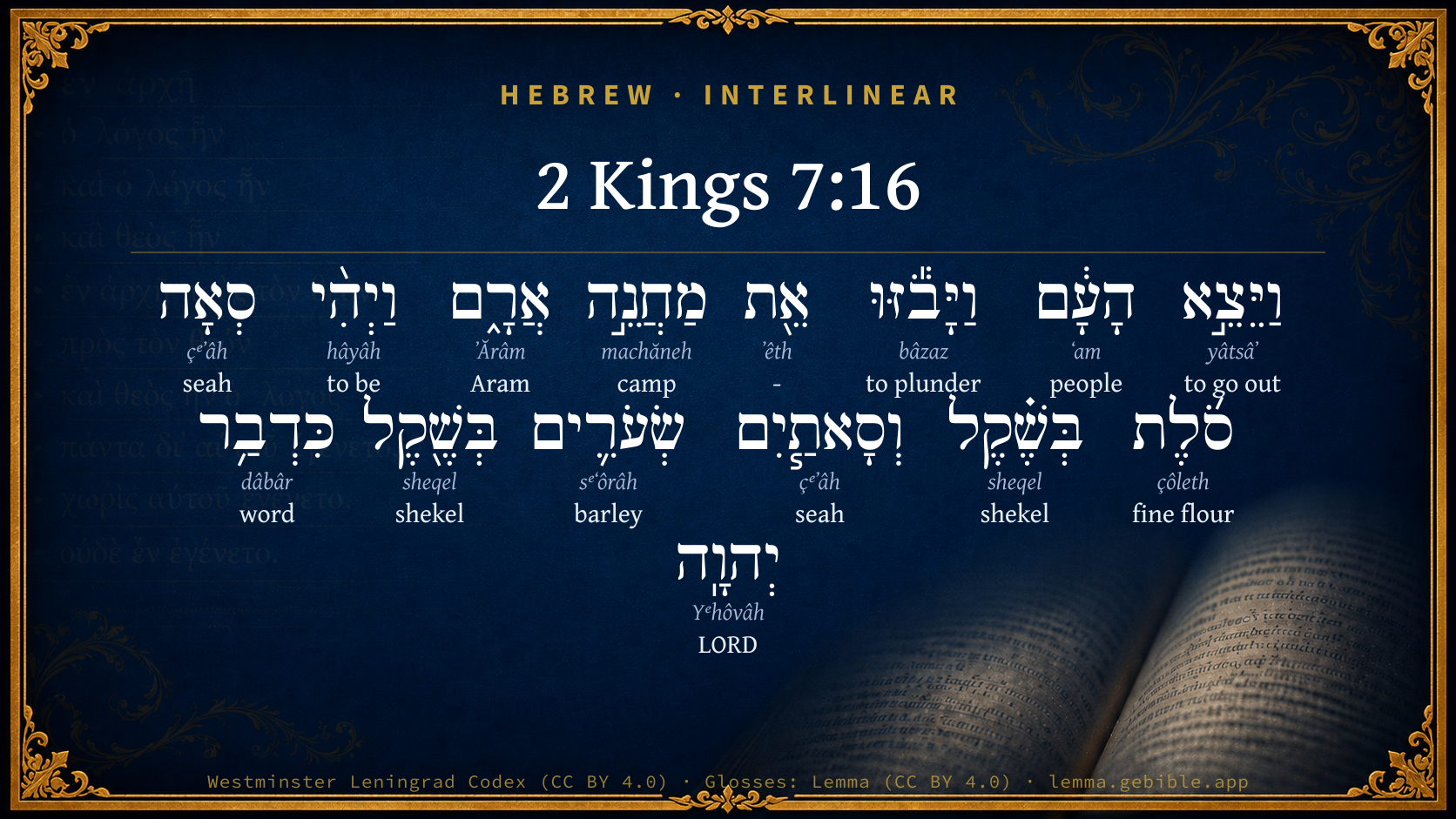
  1. וַיֵּצֵ֣א yâtsâʼ H3318 “and · to go out” Conjunction + Verb, Qal, Sequential Imperfect, 3rd Person, Masculine, Singular
  2. הָעָ֔ם ʻam H5971 “the · people” Particle, Definite Article + Noun, Common, Masculine, Singular, Absolute
  3. וַיָּבֹ֕זּוּ bâzaz H962 “and · to plunder” Conjunction + Verb, Qal, Sequential Imperfect, 3rd Person, Masculine, Plural
  4. אֵ֖ת ʼêth H853 “-” Particle, Direct Object
  5. מַחֲנֵ֣ה machăneh H4264 “camp of” Noun, Common, Both, Singular, Construct
  6. אֲרָ֑ם ʼĂrâm H758 “Aram” Noun, Proper
  7. וַיְהִ֨י hâyâh H1961 “and · to be” Conjunction + Verb, Qal, Sequential Imperfect, 3rd Person, Masculine, Singular
  8. סֹ֜לֶת çôleth H5560 “fine flour” Noun, Common, Feminine, Singular, Absolute
  9. בְּשֶׁ֗קֶל sheqel H8255 “in/at · shekel” Preposition + Noun, Common, Masculine, Singular, Absolute
  10. וְסָאתַ֧יִם çᵉʼâh H5429 “and · seahs” Conjunction + Noun, Common, Feminine, Dual, Absolute
  11. שְׂעֹרִ֛ים sᵉʻôrâh H8184 “barley” Noun, Common, Feminine, Plural, Absolute
  12. בְּשֶׁ֖קֶל sheqel H8255 “in/at · shekel” Preposition + Noun, Common, Masculine, Singular, Absolute
  13. כִּדְבַ֥ר dâbâr H1697 “like/as · word of” Preposition + Noun, Common, Masculine, Singular, Construct
  14. יְהוָֽה Yᵉhôvâh H3068 “LORD” Noun, Proper

About this verse

These counts appear in no published source. They are computed here, from the morphology-tagged text and Lemma’s own curated glosses. What Lemma adds →

15
words
13
distinct lemmas
Historical
section

Notable vocabulary

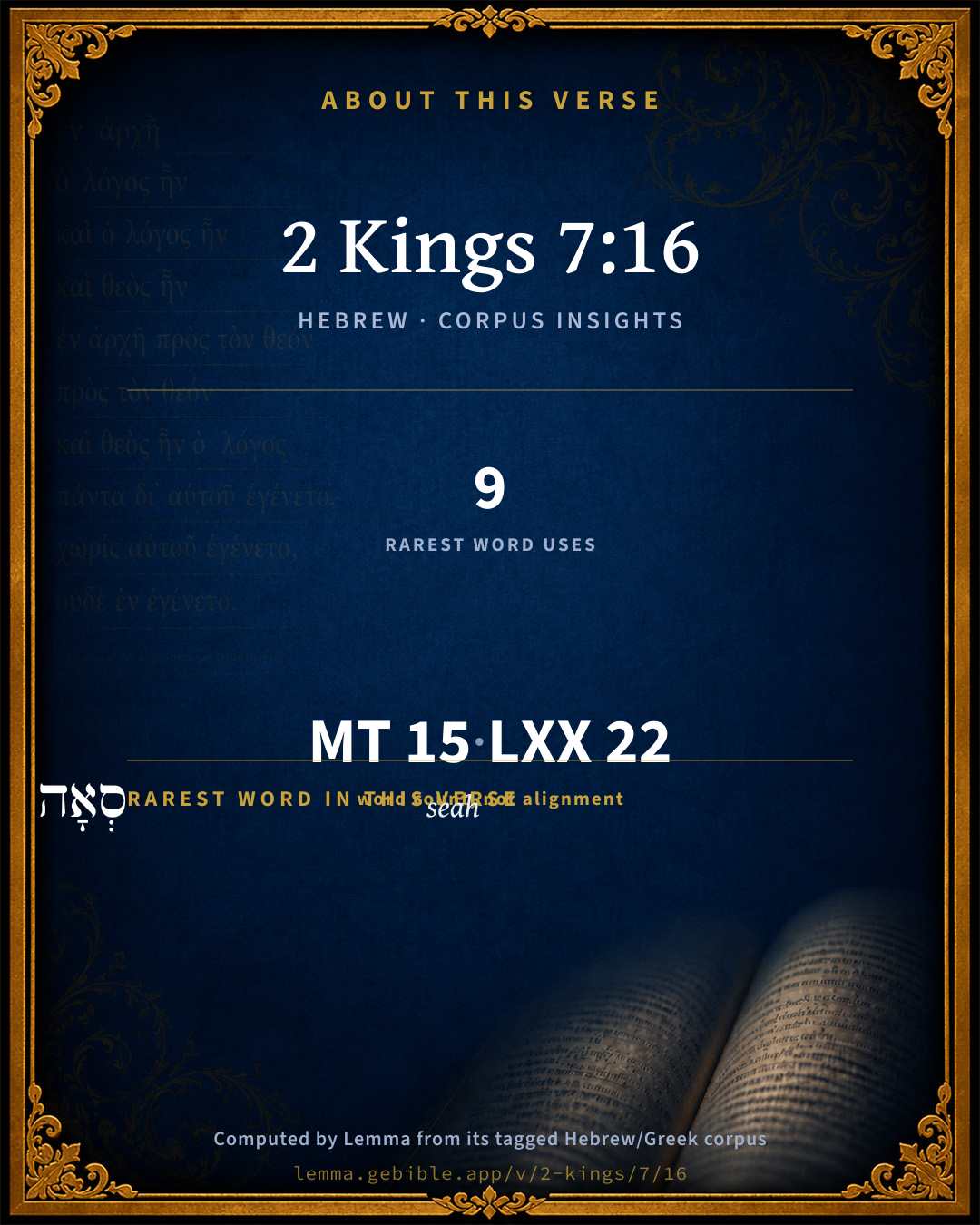
The rarest word here is סְאָה seah H5429 — appearing just 9 times in the whole Hebrew Bible.

Shared distinctive vocabulary

סְאָה seah H5429 occurs in 6 verses of the Hebrew Bible. Also found in:

Grammatical profile

  • 3 verbs
  • 11 nouns
  • 1 particle

Verb forms

  • וַיֵּצֵ֣א Qal · Sequential Imperfect
  • וַיָּבֹ֕זּוּ Qal · Sequential Imperfect
  • וַיְהִ֨י Qal · Sequential Imperfect

Repetition

Words recur within this verse — often emphatic in Hebrew:

  • סְאָה seah H5429 ×2
  • בְּשֶׁ֗קֶל shekel H8255 ×2

Hebrew & Septuagint length

In English translation the verse runs 36 words from the Hebrew and 37 from the Septuagint (LXX English) — closely comparable.

A rough comparison of the two English renderings, which tokenize alike — not a word-level alignment.

Word counts can differ between the Hebrew and the Greek without any difference in meaning — e.g. the Hebrew direct-object marker אֵת has no separate Greek word, and Greek often adds the article ὁ.

In the original languages it is 15 Hebrew tokens and 22 Greek tokens — but the two are counted differently (Hebrew bundles its prefixes and suffixes into one token; the Greek is in lemma form), so that isn’t a like-for-like length.

Cross-references

12

Topical passages linked to 2 Kings 7:16 in the Treasury of Scripture Knowledge — connected by theme and wording, ordered by reader-vote popularity; previews shown in the World English Bible.

  • 2 Kings 7:1 Elisha said, Hear you the word of Yahweh: thus says Yahweh, Tomorrow about this time shall a measure of fine flour be [sold] for a shekel, and two measures of barley for a shekel, in the gate of Samaria.
  • Isaiah 33:4 Your spoil shall be gathered as the caterpillar gathers: as locusts leap shall men leap on it.
  • Isaiah 33:23 Your rigging is untied; they could not strengthen the foot of their mast, they could not spread the sail: then was the prey of a great spoil divided; the lame took the prey.
  • Numbers 23:19 God is not a man, that he should lie, Neither the son of man, that he should repent: Has he said, and will he not do it? Or has he spoken, and will he not make it good?
  • 1 Samuel 17:53 The children of Israel returned from chasing after the Philistines, and they plundered their camp.
  • 2 Chronicles 14:12–15 So Yahweh struck the Ethiopians before Asa, and before Judah; and the Ethiopians fled.
  • 2 Chronicles 20:25 When Jehoshaphat and his people came to take the spoil of them, they found among them in abundance both riches and dead bodies, and precious jewels, which they stripped off for themselves, more than they could carry away: and they were three days in taking the spoil, it was so much.
  • Job 27:16–17 Though he heap up silver as the dust, And prepare clothing as the clay;
  • Psalms 68:12 "Kings of armies flee! They flee!" She who waits at home divides the spoil,
  • Isaiah 33:1 Woe to you who destroy, and you weren't destroyed; and deal treacherously, and they didn't deal treacherously with you! When you have ceased to destroy, you shall be destroyed; and when you have made an end of dealing treacherously, they shall deal treacherously with you.
  • Isaiah 44:26 who confirms the word of his servant, and performs the counsel of his messengers; who says of Jerusalem, She shall be inhabited; and of the cities of Judah, They shall be built, and I will raise up the waste places of it;
  • Matthew 24:35 Heaven and earth will pass away, but my words will not pass away.

Cross-references courtesy of OpenBible.info (CC BY 4.0).

Hebrew and Greek witnesses Masoretic Hebrew ↔ Greek Septuagint

The same verse in the two great witnesses to the Old Testament, shown verse-for-verse.

These are two independent witnesses, not word-aligned to each other, and the Septuagint is shown in lemma (dictionary) form.

Hebrew 2 Kings 7:16 Masoretic · Westminster Leningrad Codex

וַיֵּצֵ֣א הָעָ֔ם וַיָּבֹ֕זּוּ אֵ֖ת מַחֲנֵ֣ה אֲרָ֑ם וַיְהִ֨י סְאָה סֹ֜לֶת בְּשֶׁ֗קֶל וְסָאתַ֧יִם שְׂעֹרִ֛ים בְּשֶׁ֖קֶל כִּדְבַ֥ר יְהוָֽה

The people went out, and plundered the camp of the Syrians. So a measure of fine flour was [sold] for a shekel, and two measures of barley for a shekel, according to the word of Yahweh.

World English Bible · Public Domain

Greek LXX 2 Kings 7:16 Septuagint · lemma form

καί ἐκἔρχομαι ὁ λαός καί διαἁρπάζω ὁ παρεμβολή συρία καί γίγνομαι μέτρον σεμίδαλις σίκλος καί δίμετρος κριθή σίκλος κατά ὁ ῥῆμα κύριος

And the people went out, and plundered the camp of Syria: and a measure of fine flour was sold for a shekel, according to the word of the Lord, and two measures of barley for a shekel.

LXX2012 (modern English Septuagint) · Public Domain

Hebrew: Westminster Leningrad Codex (CC BY 4.0). Greek: Septuagint (public domain); English from LXX2012 (modern English Septuagint) (Public Domain). How the Septuagint differs from the Hebrew →

Targum (Aramaic paraphrase)

1

The Targum is the ancient Jewish Aramaic paraphrase of the Hebrew Scriptures — an interpretive translation, not the Hebrew text itself. Onkelos (literal) and Pseudo-Jonathan (expansive) render the Torah, and Jonathan the Prophets. Coverage is partial: where no permissively-licensed English translation exists for a verse, only the Aramaic is shown. This is verse-level text, not a word-by-word alignment to the Hebrew.

  1. Targum Jonathan Prophets (Joshua–Malachi)
    וּנְפַק עַמָא וּבְזוֹ יַת מַשִׁרְיַת אֲרָם וַהֲוָה סְאָה סוּלְתָּא בְּסִלְעָא וְסָאתָן סְעוֹרִין בְּסִלְעָא כְּפִתְגָמָא דַיָי:

    (no public-domain English translation for this verse)

    Targum Jonathan — Aramaic: “Mikraot Gedolot” (public domain). English: “Sefaria Community Translation” (CC0 1.0 (public-domain dedication)); “London "Chaldee Paraphrase," 1871” (public domain). Text via Sefaria.

Commentary

Notes on 2 Kings 7:16 from classic Christian and Jewish commentators (each source and its license shown beneath its notes). The classic Christian expositions comment on the surrounding passage and are grouped to its opening verse, so a note may address several verses; the Jewish commentaries on the Tanakh (Rashi and others) are per-verse, so they appear only where the commentator wrote on this verse.

Lemma curates 59 commentaries, every one of them public domain or Creative Commons licensed, each selected and text-cleaned for this edition rather than reprinted as found. About our sources →

Trapp's Complete Commentary

John Trapp

2Ki 7:16 And the people went out, and spoiled the tents of the Syrians. So a measure of fine flour was [sold] for a shekel, and two measures of barley for a shekel, according to the word of the LORD.

Ver. 16. So a measure.] See on 2Ki 7:1.

John Trapp, A Commentary or Exposition upon All the Books of the Old and New Testament (1647–1656) — public domain. Text from a community e-Sword module.

Geneva Bible (1599)

Geneva Bible translators

Which he spake by the mouth of Elisha, verse 1.

Geneva Bible (1599) marginal notes — public domain. Text via Bolls.life.

Ellicott's Commentary for English Readers

(16) The tents.—Rather, the camp.

So—And it came to pass.

A Bible Commentary for English Readers, edited by Charles John Ellicott (1878–1897) — public domain. Text from a community e-Sword module.

The Cambridge Bible for Schools and Colleges

gen. ed. J. J. S. Perowne

16. the people went out] When the camp had been found empty, word was at once sent back into Samaria, while a portion of the exploring party advanced on the road to the Jordan. The whole population were encouraged by the news, and went out, as they were likely to do after being so long pent up, in full numbers. There was food to be had, and beside that, rich plunder.

according to the word of the Lord] See above in verse 1 where Elisha describes the announcement he makes as ‘the word of the Lord’.

The Cambridge Bible for Schools and Colleges (gen. ed. J. J. S. Perowne; Cambridge University Press, 1878–1918) — public domain. Text from a community e-Sword module.

John Gill's Exposition

And the people went out and spoiled the tents of the Syrians,.... Of their riches, and of their provisions; of which there was such a plenty, not only for present use, but for sale:

so that a measure of fine flour was sold for a shekel, &c.

according to the word of the Lord; by Elisha, Kg2 7:1.

John Gill's Exposition of the Whole Bible (1746–1763) — public domain (CC PDM 1.0). Text via the HelloAO Bible API.

The Pulpit Commentary

And the people went out, and spoiled the tents of the Syrians. The whole population of Samaria, with one accord, quitted the town, and flung themselves upon the spoil the rich garments, the gold and silver vessels, the horses and asses, of which mention had been made previously (vers. 8-10). At the same time, no doubt, they feasted on the abundant dainties which they found in the tents. Having satisfied their immediate wants, they proceeded to lay in a store of corn for future use, and crowded tumultuously into the gate, where the corn found in the camp was being sold. So a measure of fine flour; rather, and a measure, etc. was sold for a shekel, and two measures of barley for a shekel, according to the word of the Lord (see ver. 1).

The Pulpit Commentary (1880–1919), ed. H.D.M. Spence-Jones & Joseph S. Exell — public domain. Text from a community e-Sword module.

Keil & Delitzsch

C. F. Keil & F. Delitzsch

When the returning messengers reported this, the people went out and plundered the camp of the Syrians, and this was followed by the consequent cheapness of provisions predicted by Elisha. As the people streamed out, the unbelieving aide-de-camp, whom the king had ordered to take the oversight at the gate (הפקיד, to deliver the oversight) for the purpose of preserving order in the crowding of the starving multitude, was trodden down by the people, so that he died, whereby this prediction of Elisha was fulfilled. The exact fulfilment of this prediction appeared so memorable to the historian, that he repeats this prophecy in Kg2 7:18-20 along with the event which occasioned it, and refers again to its fulfilment.

Keil & Delitzsch — Biblical Commentary on the Old Testament (1861–1891) — public domain (CC PDM 1.0). Text via the HelloAO Bible API. (Old Testament only.)

unfoldingWord translationNotes

Door43 World Missions Community

plundered the camp

This refers to taking items from a defeated army.

So a measure of fine flour was sold for a shekel, and two measures of barley for a shekel

This can be stated in active form. AT: "So people sold a measure of fine flour for a shekel and two measures of barley for a shekel" (See: Active or Passive)

a measure of fine flour ... two measures of barley

Here the word "measure" translates the word "seah," which is a unit of dry measurement equal to about 7 liters. AT: "7 liters of fine flour ... 14 liters of barley" (See: Biblical Volume)

a shekel

A shekel is a unit of weight equal to about 11 grams. AT: "about 11 grams of silver" or "one silver coin"(See: Biblical Money)

just as the word of Yahweh had said

Here "word" represents Yahweh. AT: "just as Yahweh had said" (See: Metonymy)

the captain on whose hand he had leaned

A high ranking captain who was the king's personal assistant is spoken of as if he were a person on whom the king leaned his hand. See how you translated this in 2 Kings 7:2. AT: "the captain who was close to the king" or "the captain who was the king's personal assistant" (See: Metaphor)

trampled him down

The crowd of people were in such a rush to get to the food in the camp that they knocked over the man and trampled him to death.

translationWords

Aram

word of God

king

gate

unfoldingWord translationNotes — © Distant Shores Media and the Door43 World Missions Community, licensed CC BY-SA 4.0. Source: git.door43.org/Door43/en_tn.

Lesson kit

Teaching starters — assembled from the data on this page, not authored interpretation. Every prompt links to the verse data it draws on. Edit before teaching.

2 Kings, in the Historical, opens this verse with 15 words (13 distinct Hebrew lemmas). Its most distinctive word is çᵉʼâh (“seah”). A historical commentator’s framing appears above. Read the whole chapter for the surrounding context.

Discussion questions

  1. What does “seah” (çᵉʼâh) contribute to the verse as a whole?
  2. Genesis 18:6 shares the word «seah» with this verse. How do the two illuminate each other?
  3. “seah” occurs 2× in this one verse. What is the effect of the repetition?
  4. The translations on this page render this verse differently — a whole-verse word diff, not a word-by-word alignment. What might account for the different wordings?
  5. The verb «וַיֵּצֵ֣א» is Qal Sequential Imperfect. How does its form color the action?
  6. Reading how Trapp's Complete Commentary and Geneva Bible (1599) read this verse, where do the two commentators agree and where do they part?

Things to notice

Reading settings

Reading text

Shown beneath each verse's original-language words.

Old Testament
Old Testament edition

Read the OT as the Masoretic Hebrew (MT) or the Greek Septuagint (LXX).

English shown for the Greek Septuagint (in the Hebrew ↔ Greek comparison).

Comparing translations? Open the Compare panel on any verse page to stack up to four side by side.