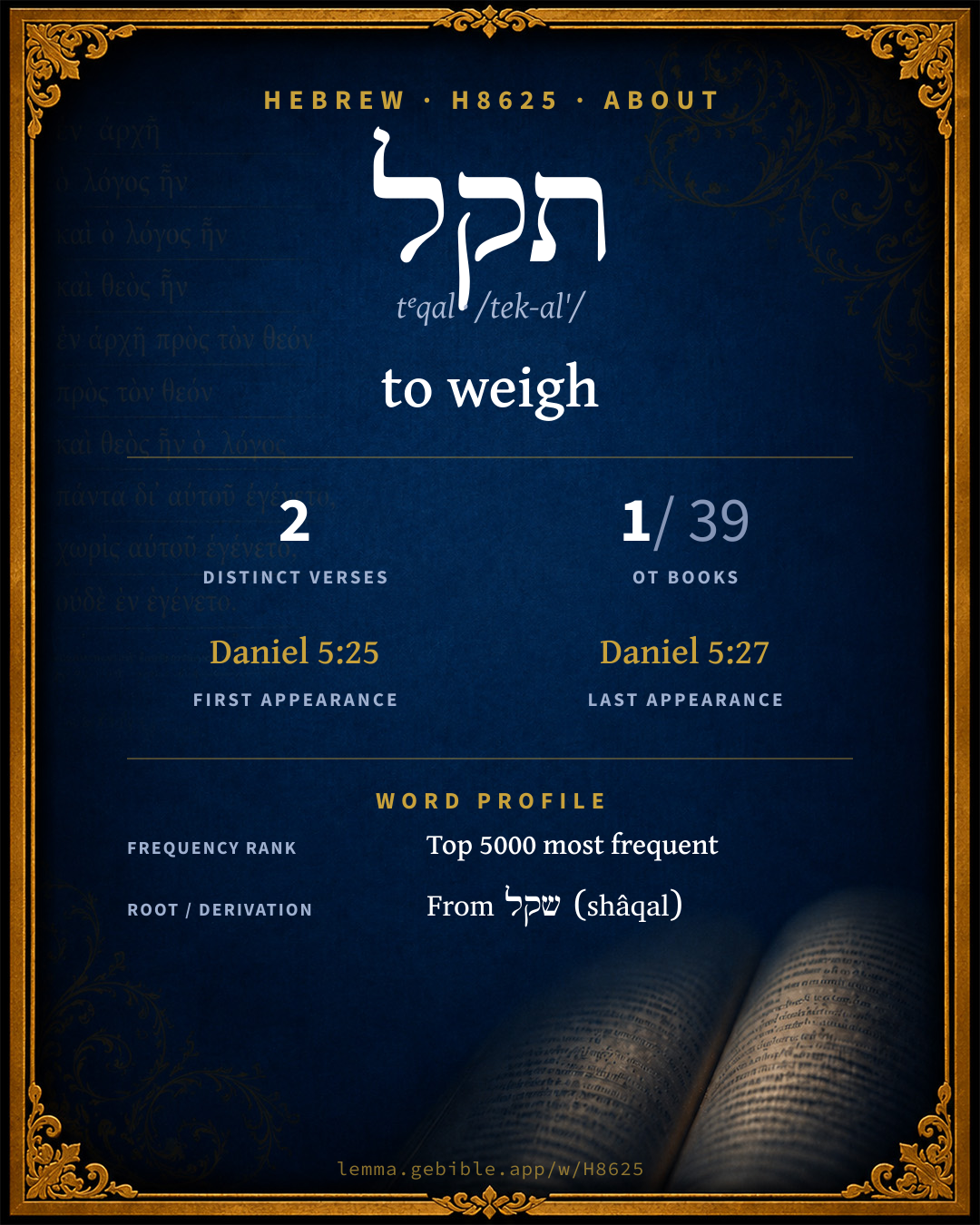
תקל
to weigh
‘to weigh’ is one of 2 main senses fuller range ↓
Full lexicon entry — Brown-Driver-Briggs (BDB)
From Brown-Driver-Briggs (BDB)
Where this word appears
Grammar key — what these labels mean
Part of speech
- Noun
- A naming word — a person, place, thing, or idea.
- Verb
- An action or state-of-being word.
Stem
- Qal Passive
- An archaic passive of the Qal, preserved in a few forms.
Form
- Imperfect
- An incomplete, ongoing, or future action (“he will / would write”).
State
- Absolute
- The independent form of a noun, not bound to a following word.
Person
- 2nd Person
- The one addressed (“you”).
Gender
- Masculine
- Grammatically masculine.
Number
- Singular
- One.
Grammatical forms
- Noun, x, Absolute 2 times (67%)
- Verb, Qal Passive, Imperfect, 2nd Person, Masculine, Singular 1 time (33%)
Parsed forms decoded from the imported morphology (morphhb / Westminster Leningrad Codex — WLC text public domain, morphhb tagging CC BY 4.0), counted across 3 parsed occurrences — not distinct verses.
Every verse where H8625 appears — 2 distinct verses across 1 book. Click any verse to open its interlinear word-by-word view. Verse text shown in the World English Bible for context — . Each verse’s Hebrew form is shown with its reference; the English is not keyword-highlighted, since the data carries no word-level English alignment. Use “Compare translations” on any verse to read it across multiple English versions. This concordance covers the Hebrew Bible; Septuagint (Greek Old Testament) occurrences are not indexed here.
Daniel 2 verses
About this entry
At a glance — auto-summarized from this page’s data, not written by a person. Every figure links to its source below. This summary describes the numbers; it doesn’t interpret them.
“to weigh” is the headline sense of the Hebrew word תקל (tᵉqal). The Hebrew Bible uses it only 2 verses. More than three-quarters of its appearances fall in Daniel. Its earliest occurrence is Daniel 5:25. Lexicons map it across 2 senses. The sections below give every sense, occurrence, and version rendering.
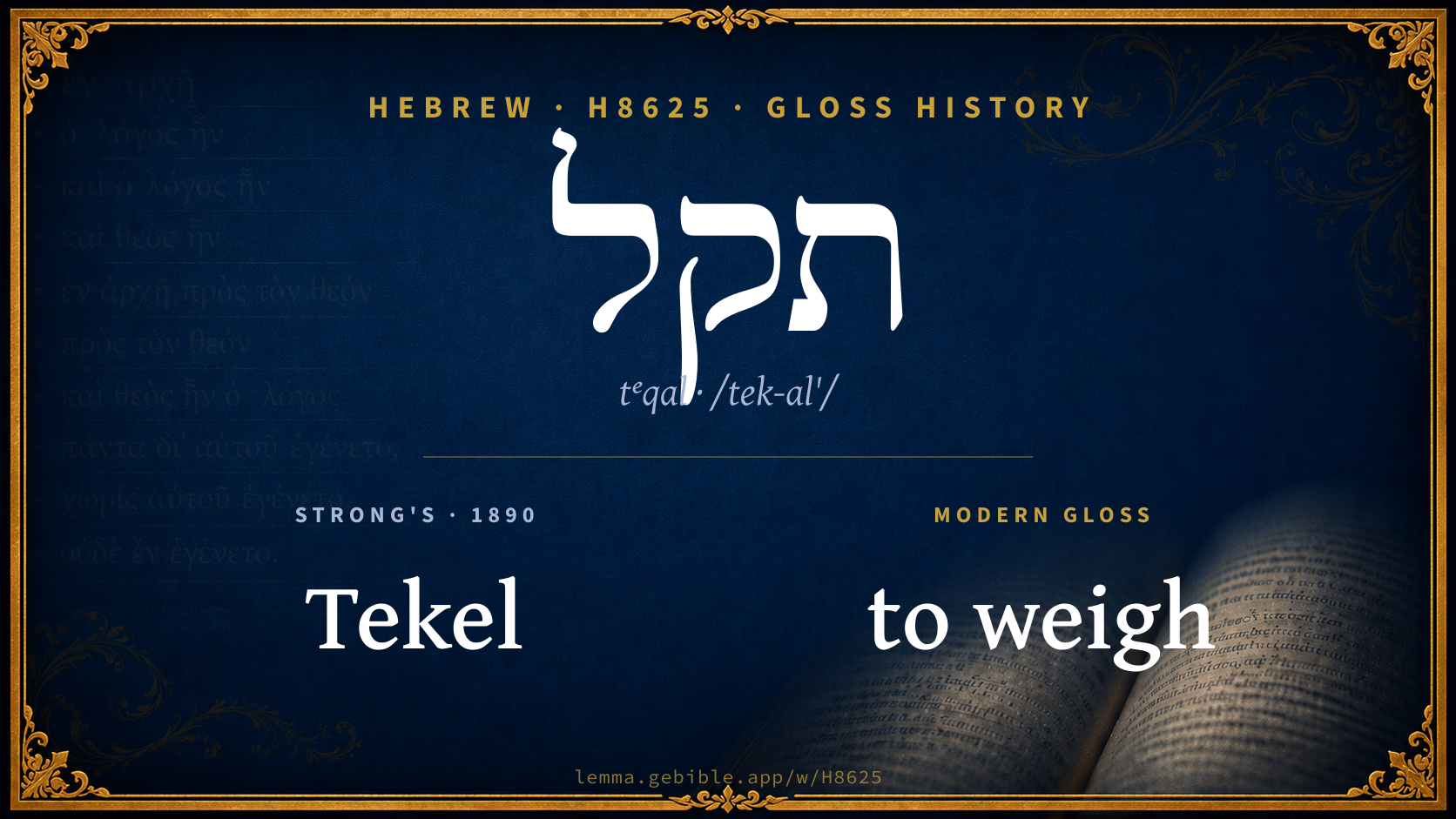
Gloss history
Strong's 1890 vs modern scholarship
About this word
Strong's H8625 catalogs a Hebrew word from the Hebrew Old Testament.
These counts are not copied from any lexicon or concordance. They are computed here, from the morphology-tagged Hebrew Old Testament. What Lemma adds →
- 2
- distinct verses
- The word appears in 2 distinct verses.
- 1 / 39
- OT books
- The word appears in 1 of 39 Old Testament books.
- #4,179
- by frequency
- Top 5000 most frequent Hebrew words (rank 4,179 of 8,640 Hebrew words by occurrence).
View all 2 occurrences in the concordance →
Most concentrated in
- Daniel 2 verses 100%
By section of the Old Testament
By traditional corpus
Conventional, traditional groupings — biblical authorship is debated, so this is a traditional corpus grouping, not an authorship claim. Each share is this word’s portion of its verses in that division of the Hebrew canon. Each figure is a share of the word’s 2 distinct verses.
- Writings (Ketuvim) 2 verses · 100%
How translations render this word
Counts come from each version’s own published word-to-Strong’s tagging or interlinear alignment — an approximate guide to how each version renders this word, not a word-level alignment the data otherwise carries. Because each total is that version’s own tagged count, the per-version totals vary from one another and need not match the appearance or distinct-verse counts above. These counts may also differ from a printed concordance because Lemma counts each distinctly tagged rendering and does not collapse phrase taggings into a single head-word total. This is a fixed set of word-tagged versions (KJV, ASV, BSB, ULT) and does not change with the reading translation you choose elsewhere. Each version’s license is shown beside its name below (and on Sources).
BDB lists this Strong’s number as 2 distinct words (homographs). Each count above pools all of them and is not split by sense — see the Senses section below. A low-frequency rendering may belong to a different one of those words, not the primary meaning.
- King James Version†: Tekel 2×
- American Standard Version†: Tekel 2×
- Berean Standard Bible†: Tekel 2×
- unfoldingWord Literal Text†: Tekel 2×
King James Version Public Domain
Renders H8625 across 3† tagged occurrences — most commonly:
Plus 1 rendering that appears only once — usually multi-word phrases or single function words the recovered tagging swept in, not distinct renderings.
American Standard Version Public Domain
Renders H8625 across 3† tagged occurrences — most commonly:
Plus 1 rendering that appears only once — usually multi-word phrases or single function words the recovered tagging swept in, not distinct renderings.
Berean Standard Bible Public Domain
Renders H8625 across 3† tagged occurrences — most commonly:
Plus 1 rendering that appears only once — usually multi-word phrases or single function words the recovered tagging swept in, not distinct renderings.
unfoldingWord Literal Text CC BY-SA 4.0
Renders H8625 across 3† tagged occurrences — most commonly:
Plus 1 rendering that appears only once — usually multi-word phrases or single function words the recovered tagging swept in, not distinct renderings.
Senses in the full BDB
What do BDB’s symbols mean?
BDB uses these scholarly abbreviations:
| Symbol | Meaning |
|---|---|
| 𝔊 | the Septuagint (the ancient Greek translation, LXX) |
| 𝔙 | the Vulgate (the Latin translation) |
| 𝔖 | the Syriac version (the Peshitta) |
| 𝔗 | the Targum (the Aramaic translation) |
| ψ | the Psalms |
| √ | root (the underlying root or stem) |
| ‖ | parallel passage (a synonymous or contrasted parallel) |
| † | the dagger: every passage where the word occurs is cited |
The 0 senses and sub-senses the full Brown-Driver-Briggs lexicon distinguishes for this word, in lexicon order (not ranked by frequency), with BDB’s own verbatim wording and sub-sense lettering. Shown in Hebrew script with BDB’s own scholarly abbreviations. The condensed entry is in the Lexicon Entry tab. See also the Forms in the corpus table below.
תקל I weigh
תקל II shekel
Senses from the full Brown-Driver-Briggs lexicon (Brown, Driver, Briggs; Oxford 1906 — public domain), digitized via Sefaria, supplemented by the OpenScriptures HebrewLexicon (CC BY 4.0). Full attribution on Sources.
Word origin
[ תְּקַל ] vb. weigh;— Pe‛îl Dn 5:27
— Brown-Driver-Briggs (Oxford 1906, public domain), digitized via Sefaria, supplemented by the OpenScriptures HebrewLexicon (CC BY 4.0). See Sources.
Derived from שקל (shâqal) (H8254) — to weigh.
Jastrow Dictionary
A second Hebrew/Aramaic lexicon for comparison, covering Aramaic and post-biblical (Talmudic, Targumic, Midrashic) usage that the biblical-Hebrew BDB does not. Matched by lemma rather than by Strong’s number, so a lemma may carry more than one Jastrow headword (shown separately below), and the entries cover usage well beyond the Bible.
תְּקַל I
- = h. שָׁקַל, to weigh. Targ. Gen. XXIII, 16. Targ. Is. XLVI, 6; a. fr.—[Targ. Job VI, 2, V. Ithpe.]—Part. pass. תָּקִיל; pl. תְּקִילִין. Targ. Is. XL, 12 מִתְקַל תְּקִילִין (ed. Wil. מַתְקַל תַּקִילִין, corr. acc.); a. e.—B. Kam. 119ᵃ רב חסדא … דהוה תָקֵיל ויהיב תקיל ושקיל Rab Ḥ. had a tenant who weighed and gave, weighed and took (i.e. who was very close in settling; oth. opin. who took one-half of the produces, instead of the customary one-third). B. Mets. 44ᵇ טבין ותקילין in good and full-weight Denars.
- same.—[Targ. Is. XL, 12, v. supra.]—Y. Shebi. IV, end, 35ᶜ מַתְקל גושיא weighed the clods (of the holy land); v. כֶּיפָא I.
- (אִתְקַל) to be weighed. Targ. Job VI, 2. Ib. XXVIII, 15; a. e.
תָּקַל
- (cmp. תָּקַע) to strike, knock.
- to strike against, stumble (cmp. כָּשַׁל). Yalk. Num. 764 כשתראה שנִתְקְלוּ בדבר וכ׳ when thou seest that they (Israel) have stumbled in anything, leap thou against (attack) them. B. Kam. III, 1 המניח … ונ׳ בה ושברה if one left his pitcher on public ground, and another man came and struck against it, and broke it. Ib. 4 ונ׳ הראשון ונפל ונ׳ וכ׳ and the first man stumbled and fell, and the second man stumbled over the first. Ib. 28ᵇ נ׳ באבן ונשוף וכ׳ if he struck against a stone, and the vessel was smashed by the stone; נ׳ בקרקע וכ׳ if he struck against soft ground, and the vessel was smashed through falling on the stone. Ib. 29ᵇ נ׳ פושע הוא he that does damage by stumbling is legally considered like one criminally negligent; a. fr.
- same. Pesik. R. s. 44 הושע … אלא מַתְקֶלֶת Hosea declared her (Israel) nothing more than a stumbler (ref. to כשלת, Hos. XIV, 2). e.g. Hosea 14:2
תְּקַל II
- , to stumble, fail (corresp. to h. כָּשַׁל). Targ. Is. VIII, 15. Ib. XXXI, 3. Targ. Ps. XXXI, 11; a. fr.
- 1. same. Ib. LVI, 14 (misplaced in ed. Lag. a. oth. under LVII, 3).—2) same.
- to clear, v. infra.
- ; Ithpe. אִתְּקַל, אִתְּקִיל (אִתְקַל) same; also: to be caught, ensnared. Targ. Ps. IX, 17 (h. text נוקש). Ib. CV, 37 למִיתַּקָּלָא Ms. (ed. למַתְקְלָא, corr. acc.). Targ. O. Deut. XII, 30 (Y. תִּיתוֹקְלוּן). Targ. Hos. XIV, 2. Targ. Koh. IX, 12 מִיתַּקְּלִין (ed. Vien. מוּתְקָלִין Hebraism); a. fr.—B. Kam. 29ᵃ ואִיתְּקִילָא וכ׳ (איהו) איתקיל Ms. M. (ed. דאתקול ואתקילה, read with Rashi דאתקיל) when he stumbled, and the camel stumbled over him.
- 1. to cause to stumble; to weaken. Targ. Mal. II, 8. Targ. Lam. I, 14. Targ. Ps. V, 11; a. e.
- 2. to remove obstacles, clear. B. Bath. 54ᵃ האי מאן דא׳ תיקלא וכ׳ (Ms. M. דתַקֵיל Pa.) if one clears a field for the sake of the field (to sow) &c.; M. Kat. 10ᵇ דמַתְקֵיל ארעא.
A Dictionary of the Targumim, the Talmud Babli and Yerushalmi, and the Midrashic Literature (Marcus Jastrow; London, Luzac, 1903) — Public Domain. Digitized via Sefaria. Digitized via Sefaria. Full attribution on Sources.
Forms in the corpus
The 3 distinct written forms H8625 takes in the Hebrew Bible, most frequent first — each parse links to that state’s occurrences in the concordance. Hebrew forms include their vowel points and cantillation, so a single lemma takes many written forms.
| Form | Parsing | Example | Uses |
|---|---|---|---|
| תְּקִ֥ילְתָּה | Verb, Qal Passive, Imperfect, 2nd Person, Masculine, Singular | Daniel 5:27 | 1 |
| תְּקֵ֑ל | Noun, x, Absolute | Daniel 5:27 | 1 |
| תְּקֵ֥ל | Noun, x, Absolute | Daniel 5:25 | 1 |
Same root — word family
Other BDB entries built from the same root as H8625, grouped by Strong’s listed origin. These share a root / origin per the lexicon — not necessarily a shared meaning. Each links to that word’s own entry.
Derives from
Shares the same root
Proper names from this root
People and places named from this root — a name, not an additional meaning of the word.
Compare all same-root words → Showing 4 of 6 — not the complete family. 1 of the same-root words is a proper name (a person or place). They share a root, not necessarily a meaning.