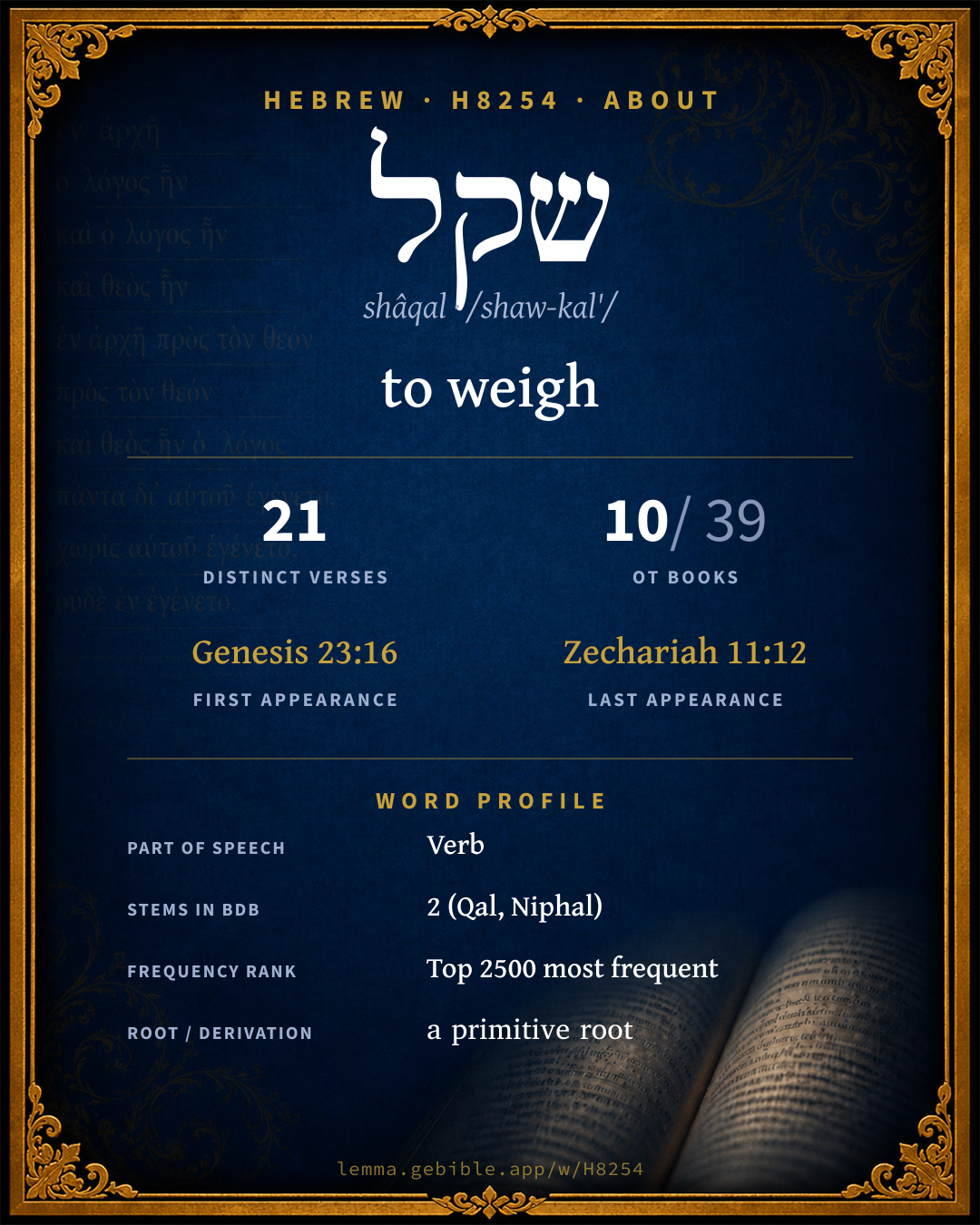
שָׁקַל
to weigh
also: weigh out, pay out fuller range ↓
Full lexicon entry — Brown-Driver-Briggs (BDB)
From Brown-Driver-Briggs (BDB)
Where this word appears
See every Qal verb in the Hebrew Bible →
Grammar key — what these labels mean
Part of speech
- Verb
- An action or state-of-being word.
Stem
- Qal
- The basic, simple active stem — the plain form of the verb (“he wrote”). Here: ‘weigh’
- Niphal
- Usually the simple passive or reflexive of the Qal (“he was written”). Here: ‘be weighed’
Form
- Sequential Imperfect
- An imperfect with prefixed waw — the standard past-narrative form (waw-consecutive imperfect).
- Sequential Perfect
- A perfect with prefixed waw continuing a preceding imperfect or command (waw-consecutive perfect).
- Imperfect
- An incomplete, ongoing, or future action (“he will / would write”).
- Participle Active
- A verbal adjective expressing ongoing or characteristic action (“writing / one who writes”).
- Infinitive Construct
- A bound verbal noun, frequently with prepositions (“to write / in writing”).
- Perfect
- A completed action or state — Hebrew marks aspect (completeness) more than strict tense (“he wrote”).
- Infinitive Absolute
- An unbound verbal noun, often intensifying or standing in for a finite verb.
State
- Absolute
- The independent form of a noun, not bound to a following word.
Person
- 1st Person
- The speaker (“I / we”).
- 3rd Person
- The one spoken about (“he / she / it / they”).
- 2nd Person
- The one addressed (“you”).
Gender
- Common
- Either gender — not distinguished for this form.
- Masculine
- Grammatically masculine.
Number
- Singular
- One.
- Plural
- More than one (in Hebrew, generally three or more).
Grammatical forms 14 distinct
- Verb, Qal, Sequential Imperfect, 1st Person, Common, Singular 5 times (22%)
- Verb, Qal, Sequential Perfect, 3rd Person, Masculine, Singular 2 times (9%)
- Verb, Niphal, Imperfect, 3rd Person, Masculine, Singular 2 times (9%)
- Verb, Qal, Imperfect, 2nd Person, Masculine, Plural 2 times (9%)
- Verb, Qal, Participle Active, Masculine, Singular, Absolute 2 times (9%)
- Verb, Qal, Imperfect, 3rd Person, Masculine, Singular 2 times (9%)
- Verb, Qal, Sequential Imperfect, 3rd Person, Masculine, Plural 1 time (4%)
- Verb, Qal, Sequential Imperfect, 3rd Person, Masculine, Singular 1 time (4%)
+6 more forms (6 occurrences)
Parsed forms decoded from the imported morphology (morphhb / Westminster Leningrad Codex — WLC text public domain, morphhb tagging CC BY 4.0), counted across 23 parsed occurrences — not distinct verses.
Every verse where H8254 appears — 21 distinct verses across 10 books. Click any verse to open its interlinear word-by-word view. Verse text shown in the World English Bible for context — . Each verse’s Hebrew form is shown with its reference; the English is not keyword-highlighted, since the data carries no word-level English alignment. Use “Compare translations” on any verse to read it across multiple English versions. This concordance covers the Hebrew Bible; Septuagint (Greek Old Testament) occurrences are not indexed here.
Genesis 1 verse
Exodus 1 verse
2 Samuel 2 verses
- 2 Samuel 14:26 וְ/שָׁקַל֙ conj + Qal wpf 3ms When he cut the hair of his head (now it was at every year's end that he cut it; because it was heavy on him, therefore he cut it); he weighed the hair of his head at two hundred shekels, after the king's weight.
- 2 Samuel 18:12 שֹׁקֵ֤ל Qal ptcp.act ms The man said to Joab, Though I should receive a thousand [pieces of] silver in my hand, I still wouldn't put forth my hand against the king's son; for in our hearing the king charged you and Abishai and Ittai, saying, Beware that none touch the young man Absalom.
1 Kings 1 verse
Ezra 4 verses
- Ezra 8:25 ו/אשקול/ה וָ/אֶשְׁקֳלָ֣/ה conj + Qal wimpf 1cs + sfx h conj + Qal wimpf 1cs + sfx h and weighed to them the silver, and the gold, and the vessels, even the offering for the house of our God, which the king, and his counselors, and his princes, and all Israel there present, had offered:
- Ezra 8:26 וָ/אֶשְׁקֲלָ֨/ה conj + Qal wimpf 1cs + sfx h I weighed into their hand six hundred fifty talents of silver, and silver vessels one hundred talents; of gold one hundred talents;
- Ezra 8:29 תִּשְׁקְל֡וּ Qal impf 2mp Watch you, and keep them, until you weigh them before the chiefs of the priests and the Levites, and the princes of the fathers' [houses] of Israel, at Jerusalem, in the chambers of the house of Yahweh.
- Ezra 8:33 נִשְׁקַ֣ל Niphal pf 3ms On the fourth day the silver and the gold and the vessels were weighed in the house of our God into the hand of Meremoth the son of Uriah the priest; and with him was Eleazar the son of Phinehas; and with them was Jozabad the son of Jeshua, and Noadiah the son of Binnui, the Levite;
Esther 2 verses
- Esther 3:9 אֶשְׁקוֹל֙ Qal impf 1cs If it please the king, let it be written that they be destroyed: and I will pay ten thousand talents of silver into the hands of those who have the charge of the [king's] business, to bring it into the king's treasuries.
- Esther 4:7 לִ֠/שְׁקוֹל prep + Qal inf.cs Mordecai told him of all that had happened to him, and the exact sum of the money that Haman had promised to pay to the king's treasuries for the Jews, to destroy them.
Job 3 verses
- Job 6:2 שָׁק֣וֹל יִשָּׁקֵ֣ל Qal inf.abs Niphal impf 3ms "Oh that my anguish were weighed, And all my calamity laid in the balances!
- Job 28:15 יִ֝שָּׁקֵ֗ל Niphal impf 3ms It can't be gotten for gold, Neither shall silver be weighed for its price.
- Job 31:6 יִשְׁקְלֵ֥/נִי Qal impf 3ms + sfx pers 1cs (Let me be weighed in an even balance, That God may know my integrity);
Isaiah 4 verses
- Isaiah 33:18 שֹׁקֵ֔ל Qal ptcp.act ms Your heart shall muse on the terror: Where is he who counted, where is he who weighed [the tribute]? where is he who counted the towers?
- Isaiah 40:12 וְ/שָׁקַ֤ל conj + Qal wpf 3ms Who has measured the waters in the hollow of his hand, and meted out the sky with the span, and comprehended the dust of the earth in a measure, and weighed the mountains in scales, and the hills in a balance?
- Isaiah 46:6 יִשְׁקֹ֑לוּ Qal impf 3mp Some pour out gold from the bag, and weigh silver in the balance. They hire a goldsmith, and he makes it a god. They fall down--yes, they worship.
- Isaiah 55:2 תִשְׁקְלוּ Qal impf 2mp Why do you spend money for that which is not bread? and your labor for that which doesn't satisfy? listen diligently to me, and eat you that which is good, and let your soul delight itself in fatness.
Jeremiah 2 verses
- Jeremiah 32:9 וָֽ/אֶשְׁקֲלָ/ה conj + Qal wimpf 1cs + sfx h I bought the field that was in Anathoth of Hanamel my uncle's son, and weighed him the money, even seventeen shekels of silver.
- Jeremiah 32:10 וָ/אֶשְׁקֹ֥ל conj + Qal wimpf 1cs I subscribed the deed, and sealed it, and called witnesses, and weighed him the money in the balances.
Zechariah 1 verse
About this entry
At a glance — auto-summarized from this page’s data, not written by a person. Every figure links to its source below. This summary describes the numbers; it doesn’t interpret them.
שקל (shâqal) is a Hebrew verb most often rendered “to weigh.” Scripture first uses it in Genesis 23:16. It turns up in 21 verses across 10 books, an uncommon footprint. The verb spans 2 stems, from Qal to Niphal. It clusters with משקול, משקל and שקל under a shared root. For the data behind this summary, explore the sense tree and the renderings breakdown below.
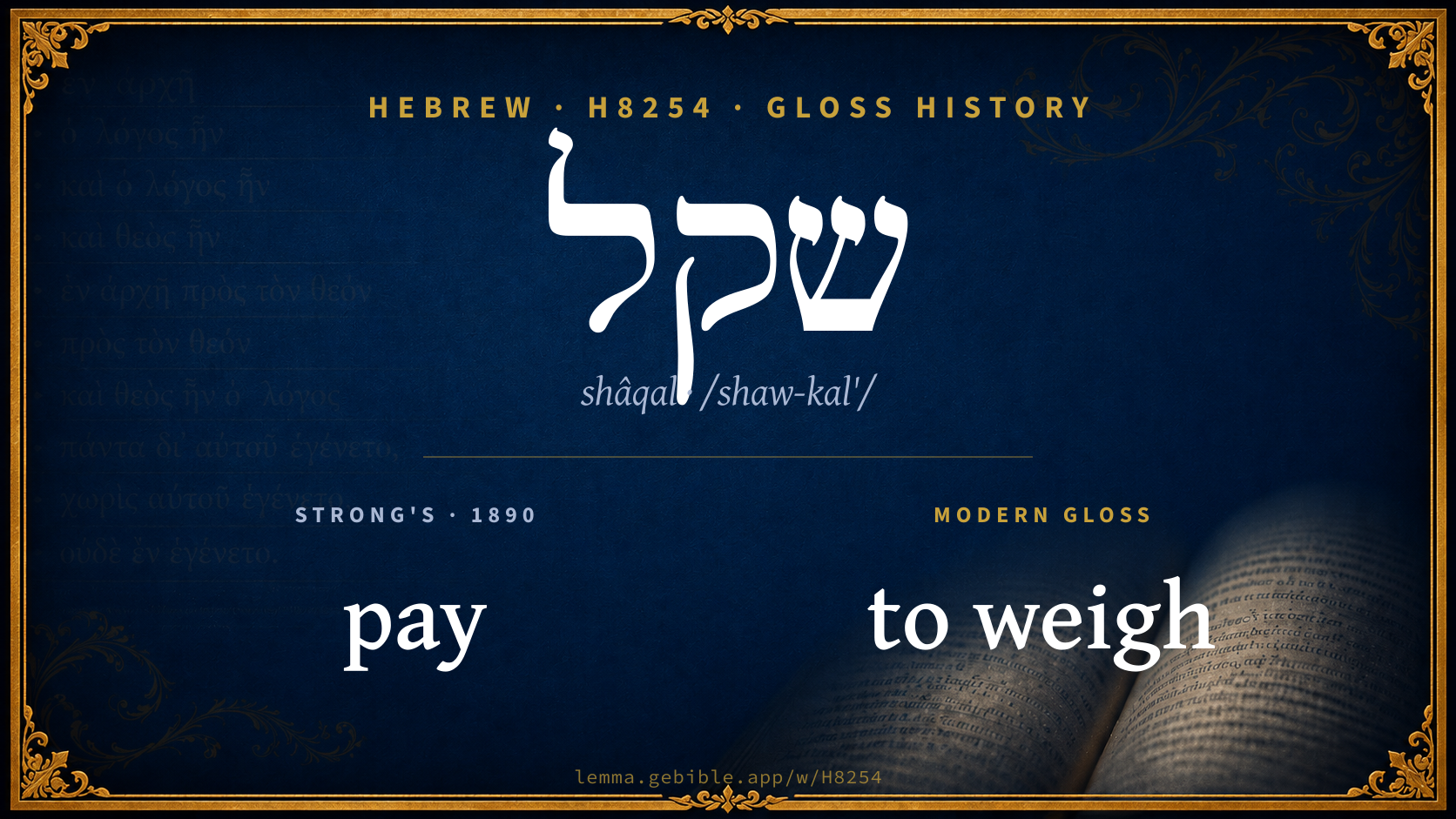
Gloss history
Strong's 1890 vs modern scholarship
About this word
Strong's H8254 catalogs a Hebrew word from the Hebrew Old Testament.
These counts are not copied from any lexicon or concordance. They are computed here, from the morphology-tagged Hebrew Old Testament. What Lemma adds →
- 21
- distinct verses
- The word appears in 21 distinct verses.
- 10 / 39
- OT books
- The word appears in 10 of 39 Old Testament books.
- #1,368
- by frequency
- Top 2500 most frequent Hebrew words (rank 1,368 of 8,640 Hebrew words by occurrence).
View all 21 occurrences in the concordance →
By section of the Old Testament
By traditional corpus
Conventional, traditional groupings — biblical authorship is debated, so this is a traditional corpus grouping, not an authorship claim. Each share is this word’s portion of its verses in that division of the Hebrew canon. Each figure is a share of the word’s 21 distinct verses.
- Prophets (Nevi'im) 10 verses · 48%
- Writings (Ketuvim) 9 verses · 43%
- Torah (Pentateuch) 2 verses · 10%
How translations render this word
Counts come from each version’s own published word-to-Strong’s tagging or interlinear alignment — an approximate guide to how each version renders this word, not a word-level alignment the data otherwise carries. Because each total is that version’s own tagged count, the per-version totals vary from one another and need not match the appearance or distinct-verse counts above. These counts may also differ from a printed concordance because Lemma counts each distinctly tagged rendering and does not collapse phrase taggings into a single head-word total. This is a fixed set of word-tagged versions (KJV, ASV, BSB, ULT) and does not change with the reading translation you choose elsewhere. Each version’s license is shown beside its name below (and on Sources).
- King James Version: Weighed 7×
- American Standard Version: Weighed 6×
- Berean Standard Bible: I weighed out 3×, Pay 2×, Weighed out 2×
- unfoldingWord Literal Text: I weighed out 2×
King James Version Public Domain
Renders H8254 across 22 tagged occurrences — most commonly:
Plus 15 renderings that appear only once — usually multi-word phrases or single function words the recovered tagging swept in, not distinct renderings.
American Standard Version Public Domain
Renders H8254 across 22 tagged occurrences — most commonly:
Plus 16 renderings that appear only once — usually multi-word phrases or single function words the recovered tagging swept in, not distinct renderings.
Berean Standard Bible Public Domain
Renders H8254 across 21 tagged occurrences — most commonly:
Plus 14 renderings that appear only once — usually multi-word phrases or single function words the recovered tagging swept in, not distinct renderings. Not rendered by a distinct English word in 1 further occurrence.
unfoldingWord Literal Text CC BY-SA 4.0
Renders H8254 across 22 tagged occurrences — most commonly:
Plus 20 renderings that appear only once — usually multi-word phrases or single function words the recovered tagging swept in, not distinct renderings.
Senses in the full BDB
Hebrew verbs can shift meaning by stem (binyan): Qal is the basic action, Niphal is often passive or reflexive, Piel often intensifies or makes it factitive, and Hiphil is typically causative. The senses below are grouped under the stem BDB assigns to each.
What do BDB’s symbols mean?
BDB uses these scholarly abbreviations:
| Symbol | Meaning |
|---|---|
| 𝔊 | the Septuagint (the ancient Greek translation, LXX) |
| 𝔙 | the Vulgate (the Latin translation) |
| 𝔖 | the Syriac version (the Peshitta) |
| 𝔗 | the Targum (the Aramaic translation) |
| ψ | the Psalms |
| √ | root (the underlying root or stem) |
| ‖ | parallel passage (a synonymous or contrasted parallel) |
| † | the dagger: every passage where the word occurs is cited |
The 6 senses and sub-senses the full Brown-Driver-Briggs lexicon distinguishes for this word, in lexicon order (not ranked by frequency), with BDB’s own verbatim wording and sub-sense lettering. Shown in Hebrew script with BDB’s own scholarly abbreviations. The condensed entry is in the Lexicon Entry tab. See also the Forms in the corpus table below.
Qal
- Pf. 3 ms. שׁ׳ 2 S 14:26; Is 40:12; Impf. 3 ms. יִשְׁקֹל Ex 22:16, sf. יִשְׁקְלֵ֫נִי Jb 31:6, etc.; Inf. abs. שָׁקוֹל Jb 6:2; cstr. לִשְׁקוֹל Est 4:7; Pt. act. שֹׁקֵל Is 33:18; 2 S 18:12 read perhaps שָׁקֻל, v. infr.; e.g. 2 Samuel 14:26
- 1. weigh, human subj. Is 33:18, acc. rei 2 S 14:26; Is 46:6 (ב of scale); fig., י׳ subj. Is 40:12, also (acc. pers.) Jb 31:6 (both c. ב of scale); cf. Inf. abs. sub Niph.; weigh precious metals intrusted to one, ל pers. Ezr 8:25, עַל־יָדָם v 26, acc. rei om. v 29 (לִפְנֵי of superior). e.g. Isaiah 33:18
- 2. weigh out a price (i.e. pay): acc. of silver Ex 22:16 (E), 1 K 20:39 Zc 11:12 Je 32:10 (ב of scale), Is 55:2 (c. ב, in exchange for); + ל pers. Je 32:9; Gn 23:16 (P); + עַל־כַּפַּי 2 S 18:12 (read perhaps שָׁקֻל, so We KitKau Bu Buhl), עַל־יְדֵי פ׳ Est 3:9, עַל־גִּנְזֵי הַמֶּלֶךְ 4:7. e.g. Exodus 22:16
Niphal
- be weighed:
- 1. Pf. 3 ms. נִשְׁקַל, subj. rei Ezr 8:33 (pass. of Qal v 25f.); Impf. 3 ms. fig. (+ Qal Inf. abs.), לוּ שָׁקוֹל יִשָּׁקֵל כַּעְשִׂי Jb 6:2. e.g. Ezra 8:33
- 2. be weighed out, as price, 28:15. e.g. Job 28:15
Senses from the full Brown-Driver-Briggs lexicon (Brown, Driver, Briggs; Oxford 1906 — public domain), digitized via Sefaria, supplemented by the OpenScriptures HebrewLexicon (CC BY 4.0). Full attribution on Sources.
Word origin
vb. weigh (NH id.; Arabic ثَقُلَ be heavy, ثِقَلٌ heaviness, weight, ثَقَلٌ load, Old Aramaic תקל weigh, Aramaic תְּקַל, ܬܩܰܠ (weigh), pay, תִּקְלָא shekel, but also (Old Aramaic Zinj.) שקל, שקלן Lzb382; ܫܩܰܠ lift up; Assyrian šaḳâlu, weigh, šiḳlu (appar.) = שֶׁקֶל; Ethiopic ሰቀለ: hang up, weigh; Ph. משקל weight; cf. Frä202, also Gk. σίγλος (𝔊 σίκλος), LagM ii.357 LewyFremdw.118f.;—on connex. of meanings cf. weigh trans. and intrans. = Germ. wägen, wiegen, also heave, heavy, heft (= weight, obs. or colloq.));—
— Brown-Driver-Briggs (Oxford 1906, public domain), digitized via Sefaria, supplemented by the OpenScriptures HebrewLexicon (CC BY 4.0). See Sources.
Origin: a primitive root
Jastrow Dictionary
A second Hebrew/Aramaic lexicon for comparison, covering Aramaic and post-biblical (Talmudic, Targumic, Midrashic) usage that the biblical-Hebrew BDB does not. Matched by lemma rather than by Strong’s number, so a lemma may carry more than one Jastrow headword (shown separately below), and the entries cover usage well beyond the Bible.
שָׁקַל
- 1. [to swing,] to weigh, balance. Gen. R. s. 4 הכנס ורחוץ ושְׁקוֹל וכ׳ go in and bathe, and weigh thyself before and after &c.; כיון שיצא וש׳ וכ׳ when he came out and weighed himself, he had lost nothing. B. Bath. V, 11 היה שׁוֹקֵל לוֹ עין בעין if he gave him exact weight, v. עַיִן. Ib. 89ᵃ לא יאמר לו שקול … אלא שוקל ליטרא וכ׳ he cannot say to him, weigh me three single fourths of a litra, but he weighs (puts in the balance) one litra, and puts one-fourth of a litra with the meat; a. fr.—Trnsf. to weigh, consider, account. Koh. R. to XII, 14 עבד שרבו שוקל וכ׳ a slave to whom his master accounts errors as wilful offenses; Ḥag. 5ᵃ. Ib. (ref. to Mal. III, 5) אוי לני שש׳ … קלות וכ׳ woe unto us to whom the Scripture accounts light offenses alike with severe crimes; Yalk. Mal. 589. Mekh. Yithro, s. 8 חביב … שש׳ כבודן וכ׳ the honoring of father and mother is precious before God, for he put their honor and the fear of them on a level with his own honor &c.; (Kidd. 30ᵇ השוה); a. e. e.g. Malachi 3:5
- 2. (denom. of שֶׁקֶל) to offer the head-tax (half a Shekel). Shek. I, 4 כל כהן ששוקל וכ׳ a priest that pays the head-tax. Ib. 6 השוקל על ידי וכ׳ if one pays the head-tax for a priest, a woman, or a minor, he is exempt (from paying agio). Ned. IV, 2 (33ᵃ) את שקלו (לו)שוקל may pay the head-tax for him; a. fr.—In gen. to pay taxes. Tosef. Dem. VI, 3; 4; Y. ib. VI, end, 26ᵃ, v. אוֹצָר.—Part. pass. שָׁקוּל; f. שְׁקוּלָה; pl. שְׁקוּלִים, שְׁקוּלִין; שְׁקוּלוֹת even-balanced, of equal importance. Snh. 3ᵇ, a. fr. אין בית דין ש׳ a court must never be even-balanced, i.e. not be of even numbers, opp. נוטה; v. בַּיִת. Num. R. s. 188 (ref. to Ps. XCIX, 6) שמואל שש׳ כנגד וכ׳ Samuel who is balanced against Moses and Aaron together; Ber. 31ᵇ (ref. to I Sam. I, 11, זרע אנשים) זרע שש׳ כנגד שני אנשים וכ׳ a seed (son) that will hold the balance against two men &c. Ib. 33ᵃ מזכירין … שש׳ כתחיית וכ׳ we insert ‘the power of rain’ (v. גְּבוּרָה) in the section about resurrection, because it is equal to resurrection. B. Kam. 3ᵃ ש׳ הן וכ׳ they (the two kinds of damages) are even-balanced (you cannot decide between the two), let both be included; Zeb. 4ᵇ; Naz. 58ᵇ ש׳ הוא the balance is even; Arakh. 4ᵇ. Sifra Vayikra, N’dab., ch. XVII, Par. 14; Yalk. Lev. 462 (ref. to Lev. III, 4) הדבר ש׳ יטול וכ׳ it may be understood either way, he should take that part of the midriff which is by the liver, or a portion of the liver with the midriff &c.; a. fr. e.g. Psalms 99:6
- to weigh, ponder, estimate. Gen. R. s. 59 (ref. to Hos. XII, 8) that is Eliezer, שהיה יושב ומַשְׁקִיל את בתו וכ׳ for he sat and pondered on his daughter: is she or is she not worthy?; Yalk. Hos. 528 ומְשַׁקֵּל (Pi.). e.g. Hosea 12:8
שְׁקַל
- (cmp. נטל)
- 1. to take, take away. Targ. Prov. XVII, 8. Ib. XXV, 20. Targ. II Esth. I, 16; a. fr.—[Targ. Ex. XXIII, 5 מלמשקל ed. Berl., oth. ed. למשבק, מלמשבק.]—ש׳ וטרא, v. טְרָא.—B. Mets. 40ᵃ ושָׁקְלִין וכ׳, v. שׁוּפְטָנָא. Ib. 60ᵇ דקא שָׁקֵיל מיניה וכ׳ (not שקלי) for he takes from him &c., v. נְכַת. Kidd. 12ᵇ שְׁקַלְתָּהּ ואישתיקא (not שקלתא) she accepted it and kept silence; ib. 13ᵃ שְׁקַלְתֵּיה. Ib. אין שַׁקְלִי ודידי שקלי yes, I received it, but it was mine I received. Shebu. 32ᵇ הוה משתבענא ושְׁקִילְנָא I should have been assigned an oath, and the money would have been decreed to me. Yeb. 105ᵃ; Snh. 21ᵃ, v. מִטַּרְפְּסָא. Ber. 60ᵃ ש׳ בדקא וכ׳ a freshet carried away part of his field (Ms. F. אישתקל וכ׳ a freshet was carried into his field); B. Bath. 41ᵃ, v. בִּדְקָא; a. fr.—Ber. l. c. הוה שָׁקֵיל ואזיל בתריה וכ׳ took up (his cloak) and walked behind &c.—Part. pass. שָׁקִיל; f. שְׁקִילָא; pl. שְׁקִילִין, שְׁקִילֵי; שְׁקִילָן. Sabb. 63ᵇ שקילי … שקילין וכ׳ (Ms. M. שקילין … ושקילן), v. נִיבָא I. Ib. שקילא טיבותיך (not שקולא; better: שְׁקוֹלִי וכ׳ take thy goodness), v. חִיזְרָא I; a. e.
- 2. to carry. Men. 85ᵃ; Ex. R. s. 9 ירקא שְׁקוֹל, v. מָתָא; Yalk. ib. 182 שְׁקִיל.
- , Af. אַשְׁקֵל to cause to take, to give. Pes. 57ᵇ דאַשְׁקְלֵיה וכ׳ (Ms. M. דשַׁקְּלֵיה); Yalk. Lev. 469, v. מִטַּרְפְּסָא.
- to be taken away. Targ. I Chr. V, 2 אִשְׁתְּקִילַת (Var. אִשְׁתַּקְלַת). Ib. 1 (ed. Beck אסתלקת).—Ber. 60ᵃ, v. supra.
שֶׁקֶל
- [weight,] Shekel, a coin; ש׳ הקדש the sacred Sh., twenty Gerah or M’ʿah, twice the weight of the common Shekel (v. סֶלַע). Bekh. VIII, 7 (49ᵇ) כולם בש׳ הק׳ all these definitions refer to the sacred Sh. Ib. 50ᵃ. B. Bath. 9ᵃ שלישית הש׳ one-third of a Sh. (Neh. X, 33); a. fr.—Esp. (מחצית הש׳, Ex. XXX, 13) the head-tax for the Temple. Ned. IV, 2 שִׁקְלוֹ, v. שָׁקַל. Shek. II, 3 הרי אלו לשִׁקְלִי these coins are designated for my contribution as head-tax; שאביא מהן לשקלי that I will offer my head-tax out of them; a. fr.—Pl. שְׁקָלִים. Ib. I, 1, v. שָׁמַע. Ib. II, 1, v. דַּרְכּוֹן. Meg. 13ᵇ גלוי … לשקול ש׳ … הקדים שִׁקְלֵיהֶן לשְׁקָלָיו וכ׳ it was known before God that Haman would, at some future day, pay Shekels for the destruction of Israel, therefore He made their Shekels (contributions to the sanctuary) to precede his Shekels, this is why we are told (Shek. I, 1), ‘on the first of Adar &c.’; a. fr.—Sh’ḳalim (Shek.), name of a treatise, of the Order of Moʿed, of Mishnah, Tosefta, and Talmud Y’rushalmi. e.g. Nehemiah 10:33
A Dictionary of the Targumim, the Talmud Babli and Yerushalmi, and the Midrashic Literature (Marcus Jastrow; London, Luzac, 1903) — Public Domain. Digitized via Sefaria. Digitized via Sefaria. Full attribution on Sources.
Forms in the corpus
The 23 distinct written forms H8254 takes in the Hebrew Bible, most frequent first — each parse links to that stem’s occurrences in the concordance. Hebrew forms include their vowel points and cantillation, so a single lemma takes many written forms.
Same root — word family
Other BDB entries built from the same root as H8254, grouped by Strong’s listed origin. These share a root / origin per the lexicon — not necessarily a shared meaning. Each links to that word’s own entry.
Derived from this word
- משקול mishqôwl H4946 weight
- משקל mishqâl H4948 weight
- שקל sheqel H8255 shekel
- תקל tᵉqal H8625 to weigh
Proper names from this root
People and places named from this root — a name, not an additional meaning of the word.
Compare all same-root words → Showing 4 of 6 — not the complete family. 1 of the same-root words is a proper name (a person or place). They share a root, not necessarily a meaning.
Septuagint verse parallels
This word appears in 20 verses that also exist in the Greek Old Testament (Septuagint), out of the 21 Hebrew verses it occurs in. You can read those verses in Greek by switching the Old Testament edition to the Septuagint.
Read these verses in the Septuagint
- Genesis 23:16
- Exodus 22:17
- 2 Samuel 14:26
- Ezra 8:25
- Esther 3:9
- Job 6:2
- Isaiah 33:18
- Jeremiah 32:9
- Zechariah 11:12
This is a verse-level parallel only — the same verses exist in both the Hebrew and Greek Old Testaments. No word-level Hebrew↔Greek correspondence is claimed: the data carries no such alignment, so no Greek word is shown as this Hebrew word’s translation. Coverage is not total — the Septuagint omits the deuterocanon and renumbers the Psalms, so some Hebrew verses have no direct Greek parallel.