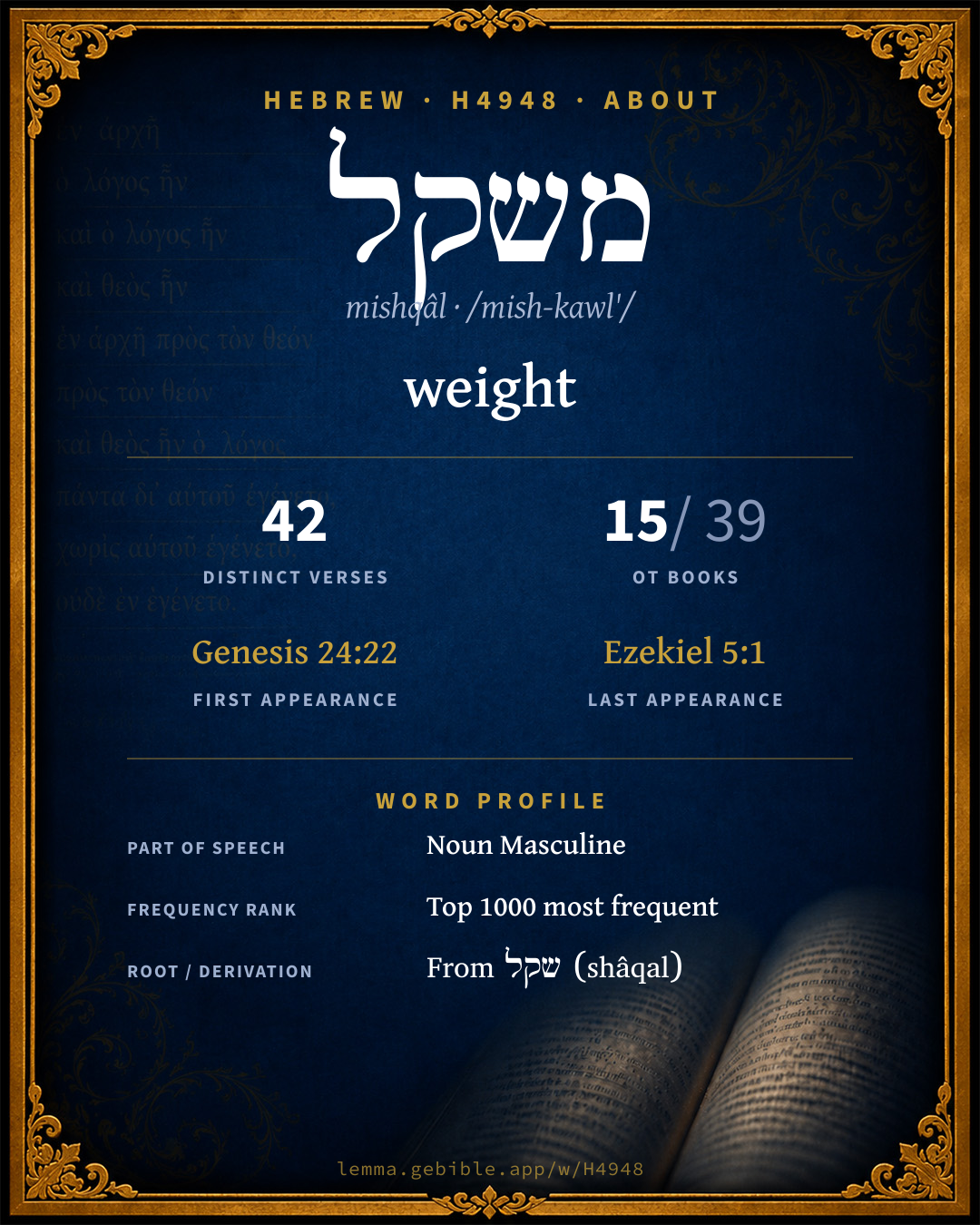
מִשְׁקָל
weight
Full lexicon entry — Brown-Driver-Briggs (BDB)
From Brown-Driver-Briggs (BDB)
Where this word appears
See every Construct-state word in the Hebrew Bible →
Grammar key — what these labels mean
Part of speech
- Noun
- A naming word — a person, place, thing, or idea.
Noun type
- Common
- A common noun — a general class of person, place, or thing (“king,” “city,” “water”), not a specific name.
State
- Construct
- A noun bound to a following noun in a possessive / “of” relationship (the construct chain).
- Absolute
- The independent form of a noun, not bound to a following word.
Gender
- Masculine
- Grammatically masculine.
Number
- Singular
- One.
Grammatical forms
- Noun, Common, Masculine, Singular, Construct 28 times (57%)
- Noun, Common, Masculine, Singular, Absolute 21 times (43%)
Parsed forms decoded from the imported morphology (morphhb / Westminster Leningrad Codex — WLC text public domain, morphhb tagging CC BY 4.0), counted across 49 parsed occurrences — not distinct verses.
Every verse where H4948 appears — 42 distinct verses across 15 books. Click any verse to open its interlinear word-by-word view. Verse text shown in the World English Bible for context — . Each verse’s Hebrew form is shown with its reference; the English is not keyword-highlighted, since the data carries no word-level English alignment. Use “Compare translations” on any verse to read it across multiple English versions. This concordance covers the Hebrew Bible; Septuagint (Greek Old Testament) occurrences are not indexed here.
Genesis 2 verses
- Genesis 24:22 מִשְׁקָל֑/וֹ מִשְׁקָלָֽ/ם n c ms cs + sfx pers 3ms n c ms cs + sfx pers 3mp It happened, as the camels had done drinking, that the man took a golden ring of half a shekel weight, and two bracelets for her hands of ten shekels weight of gold,
- Genesis 43:21 בְּ/מִשְׁקָל֑/וֹ prep + n c ms cs + sfx pers 3ms and it happened, when we came to the lodging-place, that we opened our sacks, and, behold, every man's money was in the mouth of his sack, our money in full weight. We have brought it again in our hand.
Leviticus 2 verses
- Leviticus 19:35 בַּ/מִּשְׁקָ֖ל prep det + n c ms "'You shall do no unrighteousness in judgment, in measures of length, of weight, or of quantity.
- Leviticus 26:26 בַּ/מִּשְׁקָ֑ל prep det + n c ms When I break your staff of bread, ten women shall bake your bread in one oven, and they shall deliver your bread again by weight: and you shall eat, and not be satisfied.
Numbers 12 verses
- Numbers 7:13 מִשְׁקָלָ/הּ֒ n c ms cs + sfx pers 3fs and his offering was: one silver platter, the weight of which was one hundred thirty shekels, one silver bowl of seventy shekels, after the shekel of the sanctuary; both of them full of fine flour mixed with oil for a meal offering;
- Numbers 7:19 מִשְׁקָלָ/הּ֒ n c ms cs + sfx pers 3fs He offered for his offering: one silver platter, the weight of which was one hundred thirty shekels, one silver bowl of seventy shekels, after the shekel of the sanctuary; both of them full of fine flour mixed with oil for a meal offering;
- Numbers 7:25 מִשְׁקָלָ/הּ֒ n c ms cs + sfx pers 3fs gave his offering: one silver platter, the weight of which was a hundred and thirty shekels, one silver bowl of seventy shekels, after the shekel of the sanctuary; both of them full of fine flour mixed with oil for a meal offering;
- Numbers 7:31 מִשְׁקָלָ/הּ֒ n c ms cs + sfx pers 3fs gave his offering: one silver platter, the weight of which was one hundred thirty shekels, one silver bowl of seventy shekels, after the shekel of the sanctuary; both of them full of fine flour mixed with oil for a meal offering;
- Numbers 7:37 מִשְׁקָלָ/הּ֒ n c ms cs + sfx pers 3fs gave his offering: one silver platter, the weight of which was one hundred thirty shekels, one silver bowl of seventy shekels, after the shekel of the sanctuary; both of them full of fine flour mixed with oil for a meal offering;
- Numbers 7:43 מִשְׁקָלָ/הּ֒ n c ms cs + sfx pers 3fs gave his offering: one silver platter, the weight of which was one hundred thirty shekels, one silver bowl of seventy shekels, after the shekel of the sanctuary; both of them full of fine flour mixed with oil for a meal offering;
- Numbers 7:49 מִשְׁקָלָ/הּ֒ n c ms cs + sfx pers 3fs gave his offering: one silver platter, the weight of which was one hundred thirty shekels, one silver bowl of seventy shekels, after the shekel of the sanctuary; both of them full of fine flour mixed with oil for a meal offering;
- Numbers 7:55 מִשְׁקָלָ/הּ֒ n c ms cs + sfx pers 3fs gave his offering: one silver platter, the weight of which was one hundred thirty shekels, one silver bowl of seventy shekels, after the shekel of the sanctuary; both of them full of fine flour mixed with oil for a meal offering;
- Numbers 7:61 מִשְׁקָלָ/הּ֒ n c ms cs + sfx pers 3fs gave his offering: one silver platter, the weight of which was one hundred thirty shekels, one silver bowl of seventy shekels, after the shekel of the sanctuary; both of them full of fine flour mixed with oil for a meal offering;
- Numbers 7:67 מִשְׁקָלָ/הּ֒ n c ms cs + sfx pers 3fs gave his offering: one silver platter, the weight of which was one hundred thirty shekels, one silver bowl of seventy shekels, after the shekel of the sanctuary; both of them full of fine flour mixed with oil for a meal offering;
- Numbers 7:73 מִשְׁקָלָ/הּ֒ n c ms cs + sfx pers 3fs gave his offering: one silver platter, the weight of which was one hundred thirty shekels, one silver bowl of seventy shekels, after the shekel of the sanctuary; both of them full of fine flour mixed with oil for a meal offering;
- Numbers 7:79 מִשְׁקָלָ/הּ֒ n c ms cs + sfx pers 3fs gave his offering: one silver platter, the weight of which was one hundred thirty shekels, one silver bowl of seventy shekels, after the shekel of the sanctuary; both of them full of fine flour mixed with oil for a meal offering;
Joshua 1 verse
Judges 1 verse
1 Samuel 1 verse
2 Samuel 2 verses
- 2 Samuel 12:30 וּ/מִשְׁקָלָ֨/הּ conj + n c ms cs + sfx pers 3fs He took the crown of their king from off his head; and the weight of it was a talent of gold, and [in it were] precious stones; and it was set on David's head. He brought forth the spoil of the city, exceeding much.
- 2 Samuel 21:16 וּ/מִשְׁקַ֤ל מִשְׁקַ֣ל conj + n c ms cs n c ms cs and Ishbibenob, who was of the sons of the giant, the weight of whose spear was three hundred [shekels] of brass in weight, he being girded with a new [sword], thought to have slain David.
1 Kings 2 verses
2 Kings 1 verse
1 Chronicles 9 verses
- 1 Chronicles 20:2 מִשְׁקַ֣ל n c ms cs David took the crown of their king from off his head, and found it to weigh a talent of gold, and there were precious stones in it; and it was set on David's head: and he brought forth the spoil of the city, exceeding much.
- 1 Chronicles 21:25 מִשְׁקָ֖ל n c ms So David gave to Ornan for the place six hundred shekels of gold by weight.
- 1 Chronicles 22:3 מִשְׁקָֽל n c ms David prepared iron in abundance for the nails for the doors of the gates, and for the couplings; and brass in abundance without weight;
- 1 Chronicles 22:14 מִשְׁקָ֔ל n c ms Now, behold, in my affliction I have prepared for the house of Yahweh one hundred thousand talents of gold, and one thousand thousand talents of silver, and of brass and iron without weight; for it is in abundance: timber also and stone have I prepared; and you may add to them.
- 1 Chronicles 28:14 בַּ/מִּשְׁקָל֙ בְּ/מִשְׁקָ֔ל prep det + n c ms prep + n c ms of gold by weight for the [vessels of] gold, for all vessels of every kind of service; [of silver] for all the vessels of silver by weight, for all vessels of every kind of service;
- 1 Chronicles 28:15 וּ/מִשְׁקָ֞ל בְּ/מִשְׁקַל בְּ/מִשְׁקָל֙ conj + n c ms prep + n c ms cs prep + n c ms by weight also for the lampstands of gold, and for the lamps of it, of gold, by weight for every lampstand and for the lamps of it; and for the lampstands of silver, [silver] by weight for [every] lampstand and for the lamps of it, according to the use of every lampstand;
- 1 Chronicles 28:16 מִשְׁקָ֛ל n c ms and the gold by weight for the tables of show bread, for every table; and silver for the tables of silver;
- 1 Chronicles 28:17 בְּ/מִשְׁקָל֙ בְּ/מִשְׁקָ֖ל prep + n c ms prep + n c ms and the flesh-hooks, and the basins, and the cups, of pure gold; and for the golden bowls by weight for every bowl; and for the silver bowls by weight for every bowl;
- 1 Chronicles 28:18 בַּ/מִּשְׁקָ֑ל prep det + n c ms and for the altar of incense refined gold by weight; and gold for the pattern of the chariot, [even] the cherubim, that spread out [their wings], and covered the ark of the covenant of Yahweh.
2 Chronicles 3 verses
- 2 Chronicles 3:9 וּ/מִשְׁקָ֛ל conj + n c ms The weight of the nails was fifty shekels of gold. He overlaid the upper chambers with gold.
- 2 Chronicles 4:18 מִשְׁקַ֥ל n c ms cs Thus Solomon made all these vessels in great abundance: for the weight of the brass could not be found out.
- 2 Chronicles 9:13 מִשְׁקַ֣ל n c ms cs Now the weight of gold that came to Solomon in one year was six hundred and sixty-six talents of gold,
Ezra 2 verses
- Ezra 8:30 מִשְׁקַ֛ל n c ms cs So the priests and the Levites received the weight of the silver and the gold, and the vessels, to bring them to Jerusalem to the house of our God.
- Ezra 8:34 בְּ/מִשְׁקָ֖ל הַ/מִּשְׁקָ֖ל prep + n c ms ptcl def.art + n c ms the whole by number and by weight: and all the weight was written at that time.
Job 1 verse
Jeremiah 1 verse
Ezekiel 2 verses
- Ezekiel 4:16 בְּ/מִשְׁקָ֖ל prep + n c ms Moreover he said to me, Son of man, behold, I will break the staff of bread in Jerusalem: and they shall eat bread by weight, and with fearfulness; and they shall drink water by measure, and in dismay:
- Ezekiel 5:1 מִשְׁקָ֖ל n c ms You, son of man, take a sharp sword; [as] a barber's razor shall you take it to you, and shall cause it to pass on your head and on your beard: then take balances to weigh, and divide the hair.
About this entry
At a glance — auto-summarized from this page’s data, not written by a person. Every figure links to its source below. This summary describes the numbers; it doesn’t interpret them.
משקל — transliterated mishqâl — is a Hebrew noun carrying the sense “weight.” It first appears in Genesis 24:22. With 42 verses in 15 books, it is a moderately common word in the Hebrew Bible. Its uses concentrate in Numbers (29% of all occurrences). From the same root come שקל, משקול and שקל. Each statement above links to its evidence; the full detail follows below.
Gloss history
Strong's 1890 vs modern scholarship
About this word
Strong's H4948 catalogs a Hebrew word from the Hebrew Old Testament.
These counts are not copied from any lexicon or concordance. They are computed here, from the morphology-tagged Hebrew Old Testament. What Lemma adds →
- 42
- distinct verses
- The word appears in 42 distinct verses.
- 15 / 39
- OT books
- The word appears in 15 of 39 Old Testament books.
- #752
- by frequency
- Top 1000 most frequent Hebrew words (rank 752 of 8,640 Hebrew words by occurrence).
View all 42 occurrences in the concordance →
Most concentrated in
- Numbers 12 verses 29%
- 1 Chronicles 9 verses 21%
- 2 Chronicles 3 verses 7%
By section of the Old Testament
By traditional corpus
Conventional, traditional groupings — biblical authorship is debated, so this is a traditional corpus grouping, not an authorship claim. Each share is this word’s portion of its verses in that division of the Hebrew canon. Each figure is a share of the word’s 42 distinct verses.
- Torah (Pentateuch) 16 verses · 38%
- Writings (Ketuvim) 15 verses · 36%
- Prophets (Nevi'im) 11 verses · 26%
How translations render this word
Counts come from each version’s own published word-to-Strong’s tagging or interlinear alignment — an approximate guide to how each version renders this word, not a word-level alignment the data otherwise carries. Because each total is that version’s own tagged count, the per-version totals vary from one another and need not match the appearance or distinct-verse counts above. These counts may also differ from a printed concordance because Lemma counts each distinctly tagged rendering and does not collapse phrase taggings into a single head-word total. This is a fixed set of word-tagged versions (KJV, ASV, BSB, ULT) and does not change with the reading translation you choose elsewhere. Each version’s license is shown beside its name below (and on Sources).
- King James Version: Weight 36×, Now the weight 2×, Weigh 2×
- American Standard Version: Weight 35×, Now the weight 2×, Weigh 2×
- Berean Standard Bible: Weight 20×, Weighing 16×, Weighed 2×
- unfoldingWord Literal Text: Weight 34×, Weight of 8×, Weighing 2×
King James Version Public Domain
Renders H4948 across 49 tagged occurrences — most commonly:
Plus 7 renderings that appear only once — usually multi-word phrases or single function words the recovered tagging swept in, not distinct renderings.
American Standard Version Public Domain
Renders H4948 across 49 tagged occurrences — most commonly:
Plus 8 renderings that appear only once — usually multi-word phrases or single function words the recovered tagging swept in, not distinct renderings.
Berean Standard Bible Public Domain
Renders H4948 across 46 tagged occurrences — most commonly:
Plus 8 renderings that appear only once — usually multi-word phrases or single function words the recovered tagging swept in, not distinct renderings. Not rendered by a distinct English word in 3 further occurrences.
unfoldingWord Literal Text CC BY-SA 4.0
Renders H4948 across 49 tagged occurrences — most commonly:
Plus 5 renderings that appear only once — usually multi-word phrases or single function words the recovered tagging swept in, not distinct renderings.
Senses in BDB
The 1 sense BDB distinguishes for this word, in lexicon order (not ranked by frequency or importance). The full entry — with sub-senses — is in the Lexicon Entry tab.
- heaviness, weight
Word origin
n.m. id.;—abs. מ׳ 1 K 25:16 +; cstr. מִשְׁקַל Ju 8:26 +; sf. מִשְׁקָלוֹ Gn 24:22 +, etc.;—weight Gn 24:22(×2) (J), Jos 7:21 (JE), Ju 8:26; 1 S 17:5; 2 S 12:30; 21:16a (v 16b read שֶׁקֶל with 𝔊 [v. especially 𝔊L] We Dr and mod.), 1 K 7:47; 10:14; Nu 7:13 + 11 times Nu 7 (P), 7 times Chr; of wind Jb 28:25; בְּמִשְׁקָלוֹ Gn 43:21 (J) in its (full) weight, cf. מא̇זְנֵי מ׳ Ez 5:1; בַּמּ׳ by weight Lv 26:26; 1 Ch 28:14a, 18; בְּמ׳ id. Ez 4:16 (of bread), Ezr 8:34; 1 Ch 28:14b, 15(×2), 17(×2); בַּמּ׳ Lv 19:35 in respect to weight, cf. מ׳ 1 Ch 28:16 as to weight, in weight; לֹא־הָיָה מ׳ (i.e. there was too much to be weighed) 2 K 25:16 = Je 52:20, אֵין מ׳ 1 Ch 22:3, 14.
— Brown-Driver-Briggs (Oxford 1906, public domain), digitized via Sefaria, supplemented by the OpenScriptures HebrewLexicon (CC BY 4.0). See Sources.
Derived from שקל (shâqal) (H8254) — to weigh.
Jastrow Dictionary
A second Hebrew/Aramaic lexicon for comparison, covering Aramaic and post-biblical (Talmudic, Targumic, Midrashic) usage that the biblical-Hebrew BDB does not. Matched by lemma rather than by Strong’s number, so a lemma may carry more than one Jastrow headword (shown separately below), and the entries cover usage well beyond the Bible.
מִשְׁקָל
- weighing, weight. Tosef. Ḥull. IX, 9 לקח הימנו במ׳ if he bought of him by the weight. B. Bath. V, 10 על כל מ׳ ומ׳ as often as he uses the weights; Sifra K’dosh. Par. 3, ch. VIII על כל מ׳ מ׳ (corr. acc.). Ib. (ref. to Lev. XIX, 35), v. טוּרְטִינִי. Ker. 5ᵃ לא יניח מ׳ במ׳ וכ׳ he must not use one weighed species as a weight for the other; a. fr.—Pl. מִשְׁקָלוֹת. Sifra. l. c.; B. Bath. l. c.; v. מָחָה. Tunḥ. Balak 12 מְעַוֵּל ומשקר במ׳ (not מעולה) committing wrong and fraud in weights; ib. משקר במ׳ using false weights; Yalk. Num. 765; a. fr. e.g. Leviticus 19:35
A Dictionary of the Targumim, the Talmud Babli and Yerushalmi, and the Midrashic Literature (Marcus Jastrow; London, Luzac, 1903) — Public Domain. Digitized via Sefaria. Digitized via Sefaria. Full attribution on Sources.
Forms in the corpus
The 27 distinct written forms H4948 takes in the Hebrew Bible, most frequent first — each parse links to that state’s occurrences in the concordance. Hebrew forms include their vowel points and cantillation, so a single lemma takes many written forms.
Same root — word family
Other BDB entries built from the same root as H4948, grouped by Strong’s listed origin. These share a root / origin per the lexicon — not necessarily a shared meaning. Each links to that word’s own entry.
Derives from
Shares the same root
Derived from this word
Proper names from this root
People and places named from this root — a name, not an additional meaning of the word.
Compare all same-root words → Showing 4 of 7 — not the complete family. 1 of the same-root words is a proper name (a person or place). They share a root, not necessarily a meaning.
Septuagint verse parallels
This word appears in 42 verses that also exist in the Greek Old Testament (Septuagint), out of the 42 Hebrew verses it occurs in. You can read those verses in Greek by switching the Old Testament edition to the Septuagint.
Read these verses in the Septuagint
- Genesis 24:22
- Leviticus 19:35
- Numbers 7:13
- Joshua 7:21
- Judges 8:26
- 1 Samuel 17:5
- 2 Samuel 12:30
- 1 Kings 7:47
- 2 Kings 25:16
- 1 Chronicles 20:2
- 2 Chronicles 3:9
- Ezra 8:30
This is a verse-level parallel only — the same verses exist in both the Hebrew and Greek Old Testaments. No word-level Hebrew↔Greek correspondence is claimed: the data carries no such alignment, so no Greek word is shown as this Hebrew word’s translation. Coverage is not total — the Septuagint omits the deuterocanon and renumbers the Psalms, so some Hebrew verses have no direct Greek parallel.