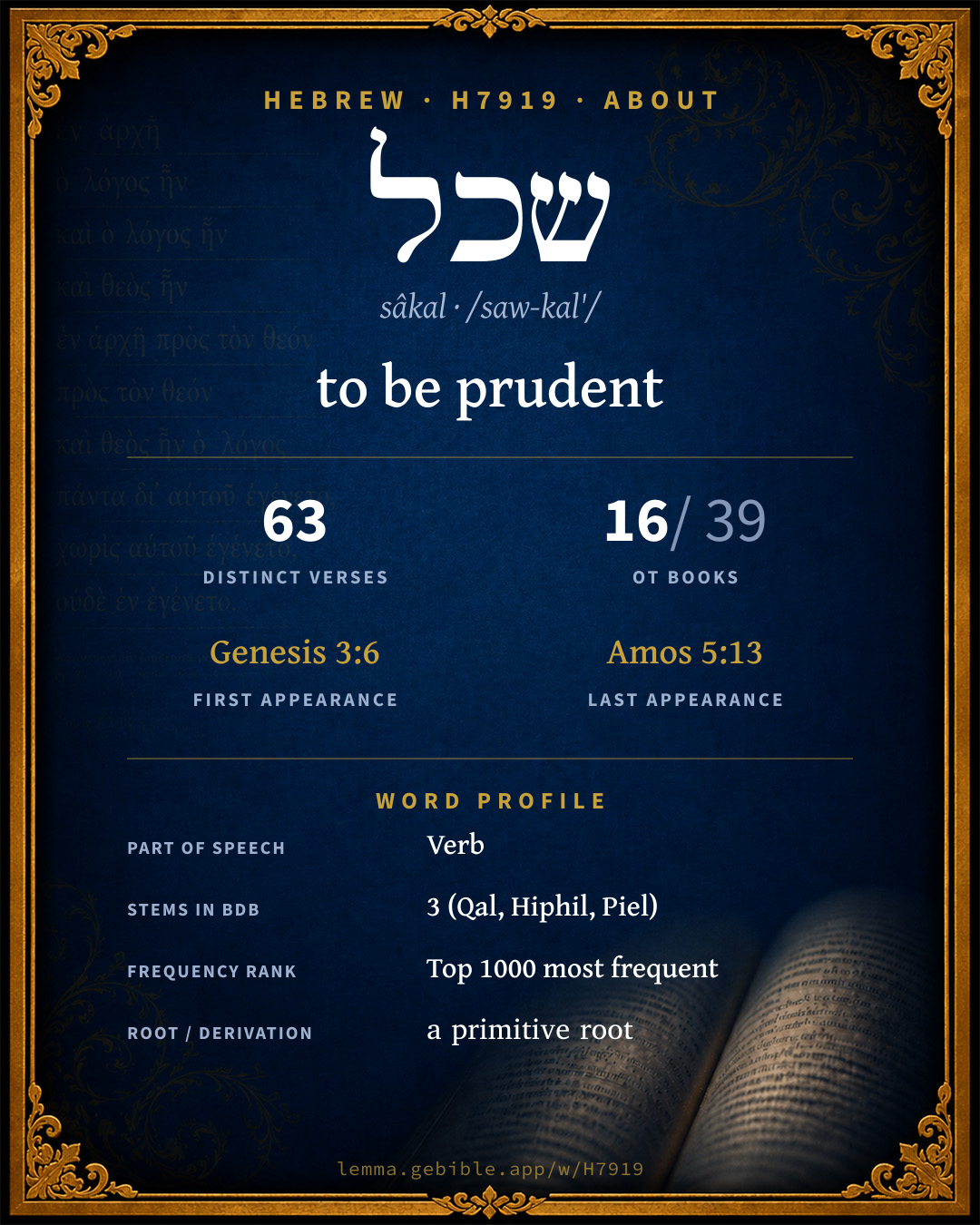
שָׂכַל
to be prudent
also: be circumspect, wisely understand, prosper fuller range ↓
Full lexicon entry — Brown-Driver-Briggs (BDB)
From Brown-Driver-Briggs (BDB)
Where this word appears
Grammar key — what these labels mean
Part of speech
- Verb
- An action or state-of-being word.
- Noun
- A naming word — a person, place, thing, or idea.
Noun type
- Common
- A common noun — a general class of person, place, or thing (“king,” “city,” “water”), not a specific name.
Stem
- Hiphil
- The causative active stem (“he caused / brought about”). Here: ‘look at’
- Piel
- An intensive or resultative active stem. Here: ‘lay crosswise’
- Qal
- The basic, simple active stem — the plain form of the verb (“he wrote”).
Form
- Participle Active
- A verbal adjective expressing ongoing or characteristic action (“writing / one who writes”).
- Imperfect
- An incomplete, ongoing, or future action (“he will / would write”).
- Perfect
- A completed action or state — Hebrew marks aspect (completeness) more than strict tense (“he wrote”).
- Infinitive Construct
- A bound verbal noun, frequently with prepositions (“to write / in writing”).
- Infinitive Absolute
- An unbound verbal noun, often intensifying or standing in for a finite verb.
- Sequential Perfect
- A perfect with prefixed waw continuing a preceding imperfect or command (waw-consecutive perfect).
- Cohortative
- A first-person volitional form expressing wish or resolve (“let me / let us write”).
- Imperative
- A direct command (“write!”).
State
- Absolute
- The independent form of a noun, not bound to a following word.
- Construct
- A noun bound to a following noun in a possessive / “of” relationship (the construct chain).
Person
- 3rd Person
- The one spoken about (“he / she / it / they”).
- 2nd Person
- The one addressed (“you”).
- 1st Person
- The speaker (“I / we”).
Gender
- Masculine
- Grammatically masculine.
- Common
- Either gender — not distinguished for this form.
- Feminine
- Grammatically feminine.
Number
- Singular
- One.
- Plural
- More than one (in Hebrew, generally three or more).
Every verse where H7919 appears in the Book of Deuteronomy — 2 distinct verses. Click any verse to open its interlinear word-by-word view. Verse text shown in the World English Bible for context — . Each verse’s Hebrew form is shown with its reference; the English is not keyword-highlighted, since the data carries no word-level English alignment. Use “Compare translations” on any verse to read it across multiple English versions. This concordance covers the Hebrew Bible; Septuagint (Greek Old Testament) occurrences are not indexed here.
Deuteronomy
About this entry
At a glance — auto-summarized from this page’s data, not written by a person. Every figure links to its source below. This summary describes the numbers; it doesn’t interpret them.
At its core, שכל (sâkal) means “to be prudent.” It first appears in Genesis 3:6. Spanning 63 verses in 16 books, it ranks among the moderately common words of the Hebrew Bible. As a verb its force shifts by stem, across 3 stems (Qal, Hiphil, and more). Sharing its root, it stands alongside משכיל, שכל and שכל. Each statement above links to its evidence; the full detail follows below.
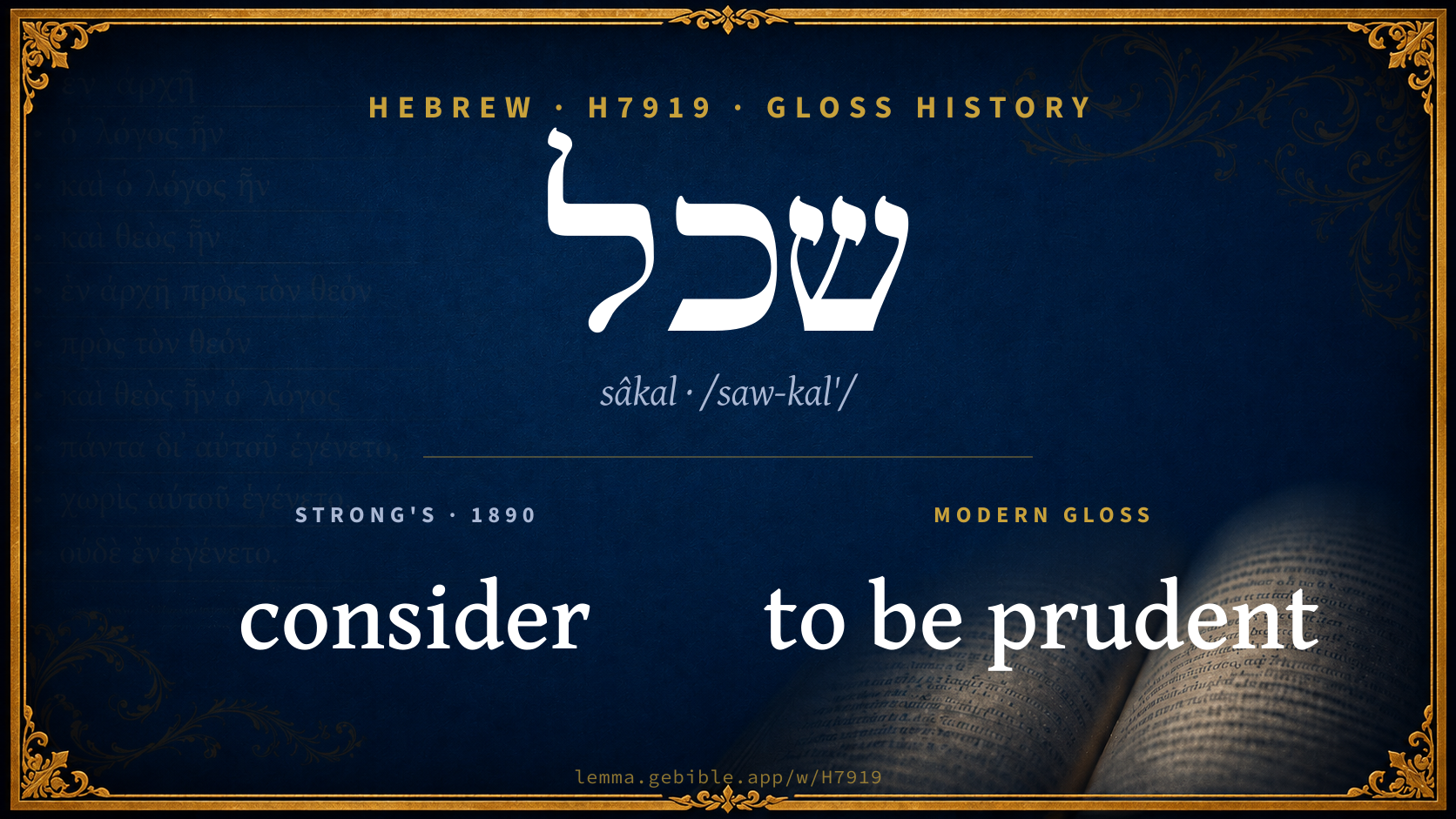
Gloss history
Strong's 1890 vs modern scholarship
About this word
Strong's H7919 catalogs a Hebrew word from the Hebrew Old Testament.
These counts are not copied from any lexicon or concordance. They are computed here, from the morphology-tagged Hebrew Old Testament. What Lemma adds →
- 63
- distinct verses
- The word appears in 63 distinct verses.
- 16 / 39
- OT books
- The word appears in 16 of 39 Old Testament books.
- #611
- by frequency
- Top 1000 most frequent Hebrew words (rank 611 of 8,640 Hebrew words by occurrence).
View all 63 occurrences in the concordance →
By section of the Old Testament
By traditional corpus
Conventional, traditional groupings — biblical authorship is debated, so this is a traditional corpus grouping, not an authorship claim. Each share is this word’s portion of its verses in that division of the Hebrew canon. Each figure is a share of the word’s 63 distinct verses.
- Writings (Ketuvim) 41 verses · 65%
- Prophets (Nevi'im) 18 verses · 29%
- Torah (Pentateuch) 4 verses · 6%
How translations render this word
Counts come from each version’s own published word-to-Strong’s tagging or interlinear alignment — an approximate guide to how each version renders this word, not a word-level alignment the data otherwise carries. Because each total is that version’s own tagged count, the per-version totals vary from one another and need not match the appearance or distinct-verse counts above. These counts may also differ from a printed concordance because Lemma counts each distinctly tagged rendering and does not collapse phrase taggings into a single head-word total. This is a fixed set of word-tagged versions (KJV, ASV, BSB, ULT) and does not change with the reading translation you choose elsewhere. Each version’s license is shown beside its name below (and on Sources).
BDB lists this Strong’s number as 2 distinct words (homographs). Each count above pools all of them and is not split by sense — see the Senses section below. A low-frequency rendering may belong to a different one of those words, not the primary meaning.
- King James Version†: Understand 3×, Understanding 3×, Wise 3×
- American Standard Version†: They that are wise 3×, Understanding 3×, Dealeth wisely 2×
- Berean Standard Bible†: Wise 7×, Understand 3×, Understanding 3×
- unfoldingWord Literal Text†: Have insight 4×, Insight 4×, Consider 3×
King James Version Public Domain
Renders H7919 across 65† tagged occurrences — most commonly:
Plus 48 renderings that appear only once — usually multi-word phrases or single function words the recovered tagging swept in, not distinct renderings.
American Standard Version Public Domain
Renders H7919 across 65† tagged occurrences — most commonly:
Plus 55 renderings that appear only once — usually multi-word phrases or single function words the recovered tagging swept in, not distinct renderings.
Berean Standard Bible Public Domain
Renders H7919 across 61† tagged occurrences — most commonly:
Plus 37 renderings that appear only once — usually multi-word phrases or single function words the recovered tagging swept in, not distinct renderings. Not rendered by a distinct English word in 1 further occurrence.
unfoldingWord Literal Text CC BY-SA 4.0
Renders H7919 across 70† tagged occurrences — most commonly:
Plus 39 renderings that appear only once — usually multi-word phrases or single function words the recovered tagging swept in, not distinct renderings.
10 senses and sub-senses in the full BDB
Hebrew verbs can shift meaning by stem (binyan): Qal is the basic action, Niphal is often passive or reflexive, Piel often intensifies or makes it factitive, and Hiphil is typically causative. The senses below are grouped under the stem BDB assigns to each.
What do BDB’s symbols mean?
BDB uses these scholarly abbreviations:
| Symbol | Meaning |
|---|---|
| 𝔊 | the Septuagint (the ancient Greek translation, LXX) |
| 𝔙 | the Vulgate (the Latin translation) |
| 𝔖 | the Syriac version (the Peshitta) |
| 𝔗 | the Targum (the Aramaic translation) |
| ψ | the Psalms |
| √ | root (the underlying root or stem) |
| ‖ | parallel passage (a synonymous or contrasted parallel) |
| † | the dagger: every passage where the word occurs is cited |
The 10 senses and sub-senses the full Brown-Driver-Briggs lexicon distinguishes for this word, in lexicon order (not ranked by frequency), with BDB’s own verbatim wording and sub-sense lettering. Shown in Hebrew script with BDB’s own scholarly abbreviations. The condensed entry is in the Lexicon Entry tab. See also the Forms in the corpus table below.
שכל I be prudent (Gerber47 denom. from שֶׂכֶל, but vb. early
Qal
- Pf. 3 ms. שׂ׳ 1 S 18:30 be prudent, circumspect (SS HPS); Kit Buhl Gerber al. prosper. e.g. 1 Samuel 18:30
Hiphil
- Pf. 3 ms. הִשְׂכִּיל Je 23:5; 1 Ch 28:19; 1 s. הִשְׂכַּלְתִּי ψ 119:99; 3 mpl. הִשְׂכִּילוּ Jb 34:27 +; Impf. יַשְׂכִּיל 1 S 18:5 +; 2 ms. juss. תַּשְׂכֵּל Dn 9:25, etc.; Imv. mpl. הַשְׂכִּילוּ ψ 2:10; Inf. abs. הַשְׂכֵּל Je 9:23 +; הַשְׂכֵּיל (Ges§ 53 k) Je 3:15; Jb 34:35; cstr. הַשְׂכִּיל Gn 3:6 +, etc.; Pt. מַשְׂכִּיל 1 S 18:14 +, f. מַשְׂכָּ֑לֶת Pr 19:14; pl. מַשְׂכִּילִים Dn 11:35 +, etc.; meanings hard to classify: scholars differ greatly;— e.g. Jeremiah 23:5
- 1. look at: נֶחְמָד הָעֵץ לְהַשְׂכִּיל Gn 3:6 (J) was desirable to look upon (so 𝔊 Ges De; AV, RV to make one wise; Ew Di Buhl SS Dr al. sub 3). e.g. Genesis 3:6
- 2. give attention to, consider, ponder: Is 41:20; 44:18; Dt 32:29 ψ 64:10; 106:7; Jb 34:27; c. לְ Pr 21:12; c. אֶל ψ 41:2; Ne 8:13; c. עַל Pr 16:20; c. ב ψ 101:2; Dn 9:13. e.g. Isaiah 41:20
- 3. have insight, comprehension: Je 9:23 (‖ יָדַע י׳), ψ 94:8 (‖ בִּין), 119:99; Dn 1:4; 9:25 (‖ יָדַע); הַשְׂכֵּ(י)ל as subst. = insight, understanding: as י׳’s gift to ruler and teacher, ‖ דֵּעָה Je 3:15; ‖ דַּ֫עַת Jb 34:35; ‖ מַדָּע Dn 1:17; מוּסַר הַשׂ׳ Pr 1:3; דֶּרֶךְ הַשׂ׳ 21:16. e.g. Jeremiah 9:23
- 4. cause to consider, give insight, teach: י׳ subj., acc. rei, 1 Ch 28:19, acc. pers. ψ 32:8; Ne 9:20; Gabriel subj., 2 acc. Dn 9:22; לֵב חָכָם subj., acc. rei Pr 16:23; c. לְ, Pr 21:11; הַמַּשְׂכִּילִים שֵׂכֶל טוֹב לי׳ 2 Ch 30:22 (but Be Ke Benz etc. who shewed good skill, sc. in music, v 21b); (הַ)מַשְׂכִּילִים Dn 11:33, 35; 12:3, 10 the teachers (so Ew Hi Bev; Thes Ke Behrm al. the wise). e.g. 1 Chronicles 28:19
- 5. act circumspectly, prudently: abs. Am 5:13 ψ 2:10; 36:4; מַשְׂכִּיל as subst. ψ 14:2 = 53:3, Pr 10:5, 19; 14:35; 15:24; 17:2; Jb 22:2; אִשָּׁה מַשְׂכָּ֑לֶת Pr 19:14.—Je 50:9 has גִּבּוֹר מַשְׁכִּיל according to Mas. (van d. H. Baer Gi), cf. 𝔙, i.e. a child-slaying warrior; but שׁ׳ Hiph. elsewhere only Ho 9:14, of miscarriage; 𝔊 𝔖 Ew and most mod. (Gf Gie Rothst) read מַשְׂכִּיל, either skilful or fortunate. e.g. Amos 5:13
- 6. prosper, have success (cf. Dr 1 S 18:5): abs. 1 S 18:15; Is 52:13; Je 10:21; 20:11; 23:5; Jos 1:8 (D); c. ב, v 7 (D) 1 S 18:5, 14 (read בְּכָל־ for לְכָל־ Vrss Th HPS al.), cf. 2 K 18:7; c. אֶל, Pr 17:8. e.g. 1 Samuel 18:5
- 7. cause to prosper: Dt 29:8; 1 K 2:3 (D). e.g. Deuteronomy 29:8
שכל II
Piel
- lay crosswise (so, and not √ I. שׂ׳, 𝔊 𝔖 𝔙 𝔗 Jon and mod., cf. Arabic شَكَلَ bind legs of beast, plait locks of hair);—Pf. 3 ms. שִׂכֵּל אֶת־יָדָיו Gn 48:14 (J); Thes Dr, however, prudentes fecit, from √ I. שׂ׳. e.g. Genesis 48:14
Senses from the full Brown-Driver-Briggs lexicon (Brown, Driver, Briggs; Oxford 1906 — public domain), digitized via Sefaria, supplemented by the OpenScriptures HebrewLexicon (CC BY 4.0). Full attribution on Sources.
Word origin
vb. be prudent (Gerber47 denom. from שֶׂכֶל, but vb. early; NH סָכַל, Hithp. shew oneself attentive (to), look; Aramaic סְכַל (rare) understand, Ithpa. look (at), consider, Aph. instruct; שְׂכַל only Aph. (for Heb. הִשְׂכִּיל), understand, make wise; ܣܟܰܠ Pa. teach, Ethpa. understand, etc.; Sam. ࠎࠊࠋ Ithpa. look (for Heb. הִבִּיט); Assyrian šiklu, clever, šiklûtu, cleverness, MeissnSuppl. 93);—
— Brown-Driver-Briggs (Oxford 1906, public domain), digitized via Sefaria, supplemented by the OpenScriptures HebrewLexicon (CC BY 4.0). See Sources.
Origin: a primitive root
Jastrow Dictionary
A second Hebrew/Aramaic lexicon for comparison, covering Aramaic and post-biblical (Talmudic, Targumic, Midrashic) usage that the biblical-Hebrew BDB does not. Matched by lemma rather than by Strong’s number, so a lemma may carry more than one Jastrow headword (shown separately below), and the entries cover usage well beyond the Bible.
כֹּל
- , constr. כָּל (b. h.; כָּלַל) all, every one. Sot. 5ᵃ הקב"ה הניח כל הרים וכ׳ the Lord passed over all mountains and hills and caused his Presence to rest on Sinai. Ib. (ref. to ככל Job XXIV, 24) כאברהם … בַּכֹּל מִכֹּל כֹּל like Abraham, Isaac and Jacob of whom is written ‘with everything’ &c. (Gen. XXIV, 1; XXVII, 33; XXXIII, 11).—Ḥull. I, 1 הַכֹּל שוחטין וכ׳ all persons are competent to slaughter &c.; וכוּלָּן וכ׳ but all those (mentioned as unfit), if they &c. Ib. 2 ובַכֹּל שוחטין וכ׳ and you may slaughter with any cutting tool except &c. Tem. I, 1; a. v. fr.—דברי הכל the words of all, (it is) the unanimous opinion, all agree. Bets. 9ᵃ ד׳ ה׳ מותר all agree that it is permitted; a. fr.—אין … כל עיקר not at all. Y. Dem. I, 21ᵈ אינו מפריש כל עיקר he does not set aside at all; a. fr.—Y. Shebi. VIII, beg. 37ᵈ, a. e. לא הכל ממנו it is not in his power to do so, v. הֵימ־.—כָּל העולם כּוּלּוֹ the whole world. Ber. 17ᵇ; a. fr.—כל ה־, כל ש־ whosoever, whatsoever. Gitt. 11ᵇ כל האומר תנו וכ׳ whoever says, ‘Give you’ (a letter of emancipation &c.), is considered as having said, Take possession (in behalf of the person concerned). Kidd. 43ᵇ כל שאין יכולה וכ׳ whatever woman is incapable of guarding her letter of divorce, is incapable of being divorced. Ḥag. 4ᵇ, v. יֵשׁ; a. v. fr.—כָּל שֶׁהוּא whatever it be, i.e. the smallest quantity. Macc. 17ᵃ, a. e. כ׳ ש׳ למכות for punishment with lashes, the partaking of any quantity is sufficient, opp. כזית, v. זַיִת. Shebu. III, 1 ואכל כ׳ ש׳ and ate the least thing; a. v. fr.—כָּל שֶׁכֵּן (abbr. כ"ש) there is every reason that it is even so, i.e. so much the more, a matter of course. Sabb. 63ᵃ … אורך וכ"ש וכ׳ there is length of life promised and, as a matter of course, wealth and honor; a. fr.—לא כ"ש, v. הַשְׁתָּא. e.g. Job 24:24
כָּל
- ch., v. כּוֹל
שָׂכַל I
- v. סָכַל I) to be bright.
- 1. to be wise, understand; to consider, deliberate. Midr. Prov. to I, 3 כיון … צריך להַשְׂכִּיל היאך וכ׳ when a man is appointed judge, he must deliberate how to acquit the innocent &c.; צריך להשכיל ולדקדק וכ׳ he must study and investigate the law, that he may not sin or lead to sin; Yalk. ib. 929 צריך להשכיל היאך לדקדק וכ׳ he must deliberate how to carry out the law exactly &c. Midr. Till. to Ps. XXXII (ref. to I Sam. XVIII, 14, sq.) ומפני שהיה מַשְׂכִּיל היה כסוי חטאה and because he was wise, his sin was covered; a. fr. e.g. 1 Samuel 18:14
- 2. to look towards, face; (cmp. סָכַם, a. כּוּן) to be directed. Num. R. s. 145; Pesik. R. s. 3 (ref. to שִׂכֵּל את ידיו, Gen. XLVIII, 14) הִשְׂכִּילוּ ידיו … לרוח הקדש Jacob’s hands were directed towards (pointed to) the holy spirit. e.g. Genesis 48:14
שָׂכַל II
- to entangle, cross.
- same, trnsf. to cause confusion. Pesik. R. s. 3 (ref. to Gen. XLVIII, 14) [read:] מהו ש׳ אמר ר׳ יהודה ש׳ ידיו … בבכורתו וכ׳ (אמר רבי ש׳, a dittography) he (God) made Jacob’s hands bring confusion into Menasseh’s birthright. e.g. Genesis 48:14
שָׁכַל
- [to finish, consume,] to bereave (of everything), make childless; שָׁכֹל to be childless. Part. pass. שָׁכוּל; f. שְׁכוּלָה; pl. f. שְׁכוּלוֹת. Pirké d’R. El. ch. XLIX (v. I Sam. XV, 33) כשם ששִׁכְּלָה … וישבו נשיהם ש׳ ואלמנות כן תִּשְׁכַּל וכ׳ as the sword of Amalek, thy (Haman’s) grandfather, consumed the young men …, and their women remained childless and widowed, so shall thy mother be childless among women; ובתפלת … ש׳ וכ׳ and through the prayer of Esther and her maids all males of Amalek were killed, and their women remained childless &c. e.g. 1 Samuel 15:33
- to destroy, consume. Ib., v. supra. Num. R. s. 1624 בראתי אותך שתהא מְשַׁכֵּל באומות וכ׳ I have created thee (the angel of death) to work destruction among the nations, except &c. Gen. R. s. 86 דוב שהיתה מְשַׁכֶּלֶת בבני אדוניה a bear that worked destruction among the children of her owner; a. e.—Part. pass. מְשׁוּכָּל. Yalk. Cant. 988 (ref. to שכלה, Cant. IV, 2) כל מי שלומד מהם אינו מש׳ whoever learns from them (the scholars), shall not be bereft (injured). e.g. Song of Solomon 4:2
שְׁכַל
- , Ithpa. אִשְׁתַּכֵּל, v. שׁכְלֵל.
A Dictionary of the Targumim, the Talmud Babli and Yerushalmi, and the Midrashic Literature (Marcus Jastrow; London, Luzac, 1903) — Public Domain. Digitized via Sefaria. Digitized via Sefaria. Full attribution on Sources.
Forms in the corpus
The 50 distinct written forms H7919 takes in the Hebrew Bible, most frequent first — each parse links to that stem’s occurrences in the concordance. Hebrew forms include their vowel points and cantillation, so a single lemma takes many written forms.
Same root — word family
Other BDB entries built from the same root as H7919, grouped by Strong’s listed origin. These share a root / origin per the lexicon — not necessarily a shared meaning. Each links to that word’s own entry.
Derived from this word
Compare all same-root words → They share a root, not necessarily a meaning.
Septuagint verse parallels
This word appears in 59 verses that also exist in the Greek Old Testament (Septuagint), out of the 63 Hebrew verses it occurs in. You can read those verses in Greek by switching the Old Testament edition to the Septuagint.
Read these verses in the Septuagint
- Genesis 3:6
- Deuteronomy 29:9
- Joshua 1:7
- 1 Samuel 18:5
- 1 Kings 2:3
- 2 Kings 18:7
- 1 Chronicles 28:19
- 2 Chronicles 30:22
- Job 22:2
- Psalms 2:10
- Proverbs 1:3
- Isaiah 41:20
This is a verse-level parallel only — the same verses exist in both the Hebrew and Greek Old Testaments. No word-level Hebrew↔Greek correspondence is claimed: the data carries no such alignment, so no Greek word is shown as this Hebrew word’s translation. Coverage is not total — the Septuagint omits the deuterocanon and renumbers the Psalms, so some Hebrew verses have no direct Greek parallel.