Song of Solomon 4:2

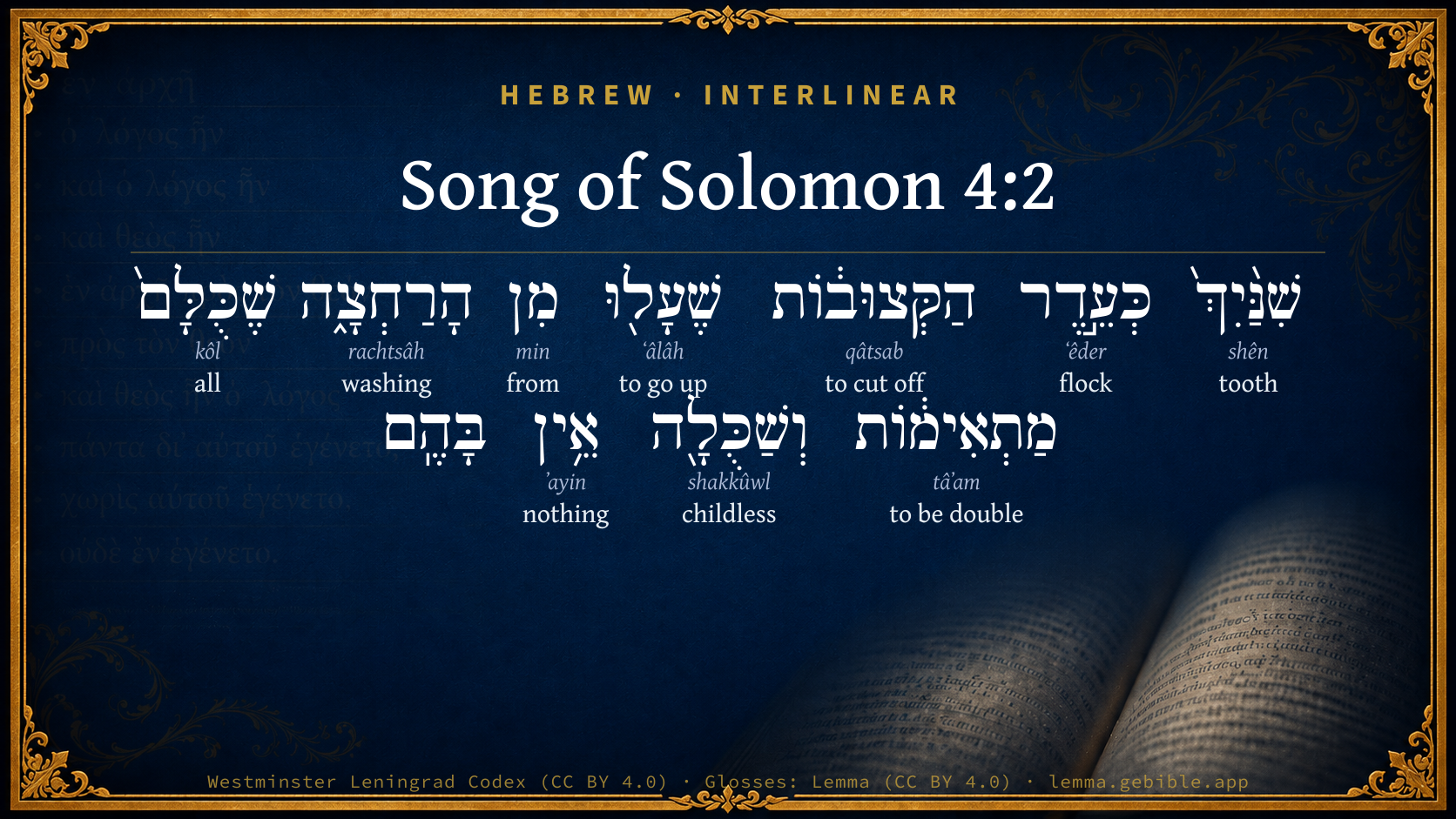
Hebrew (Westminster Leningrad Codex) Song of Solomon 4:2 appears in the Hebrew Old Testament. The text above is from the Westminster Leningrad Codex. Each word links to its Strong’s number, a concise gloss, and parsing drawn from the Open Scriptures Hebrew Bible morphology. Click any word for its full Brown-Driver-Briggs (BDB) entry.
Download image
Cite this verse

Song of Solomon 4:2 (World English Bible). Public Domain. Lemma interlinear Bible study tool, https://lemma.gebible.app/v/song-of-solomon/4/2.

Show BibTeX & RIS
BibTeX
RIS
English Translation
Your teeth are like a newly shorn flock, Which have come up from the washing, Where every one of them has twins. None is bereaved among them.
World English Bible · Public Domain
Highlights
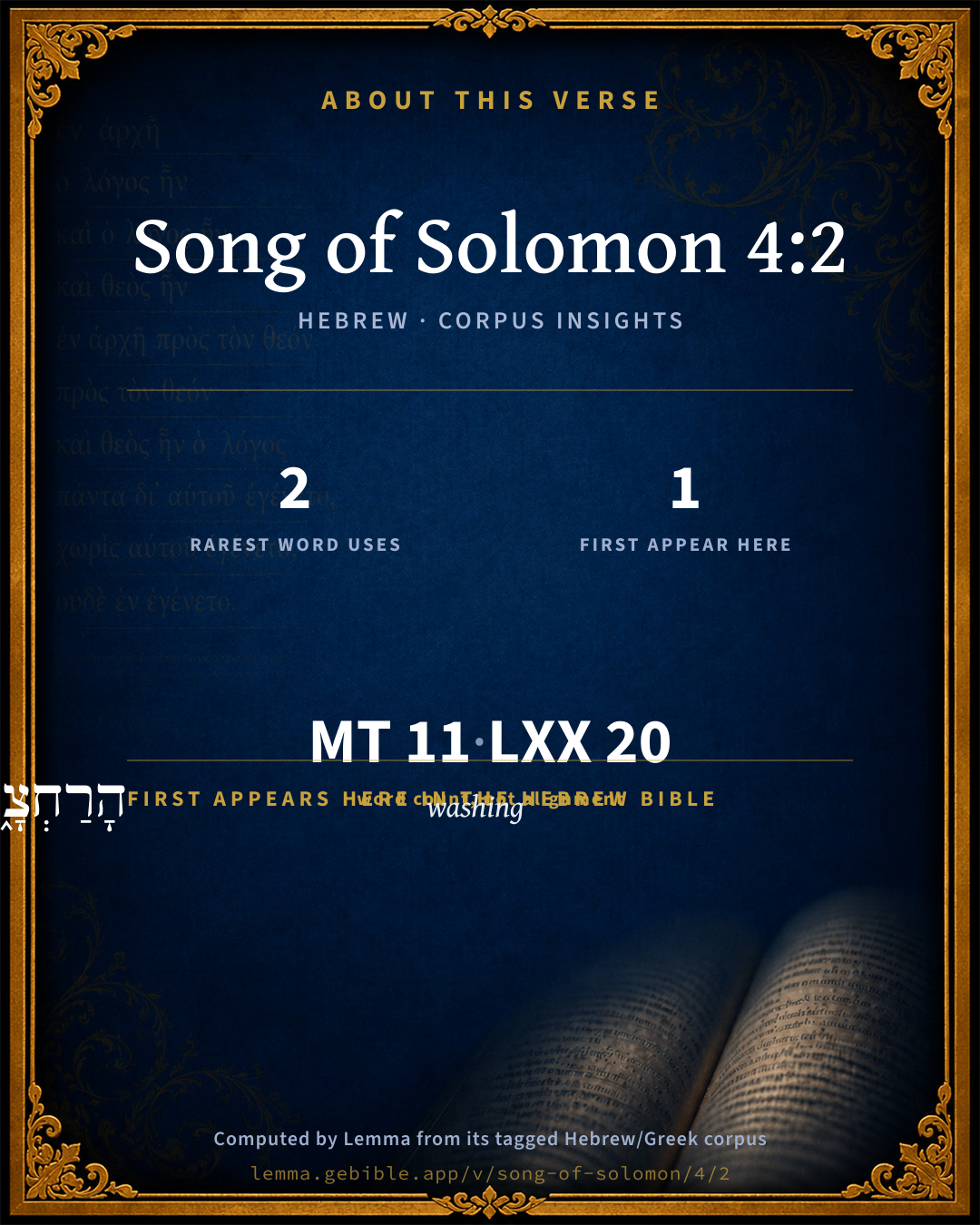
  • 1 first appearance in the Hebrew Bible
Full analysis ↓
Download a study sheet

One document with this verse’s original text, its word-by-word gloss line, the meaning frame, cross-references with their text, attributed commentary, and full source and license credits — printable, and it pastes into notes with its structure intact.

This verse Autodidact and up

Study sheet (.html) Plain text (.txt)

A passage Seminary Student

Up to 50 verses in one chapter. A passage sheet keeps up to 6 commentary sources and 12 cross-references per verse, in the order this page ranks them, and says so on the sheet whenever that leaves anything out. Ask for a single verse and you get the Autodidact verse sheet above.

Everything on this page stays free to read, with no account — the sheet is a download of what is already on screen, not access to it.

Want to remove ads? Support Godless Engineer
Compare translations 3

The same verse in 3 English versions, stacked beneath the original-language interlinear above. Click any original word for its lexicon entry.

Each is an independent rendering of the whole verse — the interlinear is not word-aligned to these translations.

Highlighted words mark where these versions differ — a whole-verse word diff, not a word-by-word alignment.

  • World English Bible Public Domain
    Your teeth are like a newly shorn flock, Which have come up from the washing, Where every one of them has twins. None is bereaved among them.
  • King James Version Public Domain
    Thy teeth are like a flock of sheep that are even shorn, which came up from the washing; whereof every one bear twins, and none is barren among them.
  • unfoldingWord Literal Text CC BY-SA 4.0
    Your teeth like a flock of shorn that have come up from the washing, all of which bear twins, and there is not among them one which is bereaved.

unfoldingWord Literal Text — © unfoldingWord, licensed CC BY-SA 4.0. Word-aligned USFM3 via Door43 (git.door43.org/unfoldingWord/en_ult).

Versions to compare (up to 4)

3 of 4 selected

Show all 18 translations

Every available English version of this verse, each an independent rendering of the whole verse.

  • World English Bible Public Domain
    Your teeth are like a newly shorn flock, Which have come up from the washing, Where every one of them has twins. None is bereaved among them.
  • Berean Standard Bible Public Domain
    Your teeth are like a flock of newly shorn sheep coming up from the washing; each has its twin, and not one of them is lost.
  • Majority Standard Bible Public Domain
    Your teeth are like a flock of newly shorn sheep coming up from the washing; each has its twin, and not one of them is lost.
  • King James Version Public Domain
    Thy teeth are like a flock of sheep that are even shorn, which came up from the washing; whereof every one bear twins, and none is barren among them.
  • American Standard Version (1901) Public Domain
    Thy teeth are like a flock `of ewes' that are `newly' shorn, Which are come up from the washing, Whereof every one hath twins, And none is bereaved among them.
  • Revised Version (1885) Public Domain
    Thy teeth are like a flock of ewes that are newly shorn, which are come up from the washing; whereof every one hath twins, and none is bereaved among them.
  • Geneva Bible (1599) Public Domain
    Thy teeth are like a flocke of sheepe in good order, which go vp from the washing: which euery one bring out twinnes, and none is barren among them.
  • Douay-Rheims (1899) Public Domain
    Thy teeth as flocks of sheep, that are shorn which come up from the washing, all with twins, and there is none barren among them.
  • Young's Literal Translation Public Domain
    Thy teeth as a row of the shorn ones That have come up from the washing, For all of them are forming twins, And a bereaved one is not among them.
  • Literal Standard Version CC BY-SA 4.0
    Your teeth as a row of the shorn ones that have come up from the washing, || For all of them are forming twins, || And a bereaved one is not among them.
  • Unlocked Literal Bible CC BY-SA 4.0
    Your teeth are like a flock of newly shorn ewes, coming up from the washing place. Each one has a twin, and none among them is bereaved.
  • unfoldingWord Literal Text CC BY-SA 4.0
    Your teeth like a flock of shorn that have come up from the washing, all of which bear twins, and there is not among them one which is bereaved.
  • Darby Bible Public Domain
    Thy teeth are like a flock of shorn sheep, Which go up from the washing; Which have all borne twins, And none is barren among them.
  • World Messianic Bible Public Domain
    Your teeth are like a newly shorn flock, which have come up from the washing, where every one of them has twins. None is bereaved among them.
  • Webster's Bible Public Domain
    Thy teeth are like a flock of sheep that are even shorn, which came up from the washing; all of which bear twins, and none is barren among them.
  • Free Bible Version CC BY-SA 4.0
    Your teeth are as white as a flock of sheep that are just shorn and washed. None of them are missing—they are all perfectly matched.
  • Bible in Basic English Public Domain
    Your teeth are like a flock of sheep whose wool is newly cut, which come up from the washing; every one has two lambs, and there is not one without young.
  • JPS Tanakh (1917) Public Domain
    Thy teeth are like a flock of ewes all shaped alike, which are come up from the washing; whereof all are paired, and none faileth among them.

Literal Standard Version (2020), Covenant Press — licensed CC BY-SA 4.0. Text via the HelloAO Bible API (eBible.org). Unlocked Literal Bible (unfoldingWord) — licensed CC BY-SA 4.0. Text via the HelloAO Bible API (eBible.org). unfoldingWord Literal Text — © unfoldingWord, licensed CC BY-SA 4.0. Word-aligned USFM3 via Door43 (git.door43.org/unfoldingWord/en_ult). Free Bible Version, Dr. Jonathan Gallagher — licensed CC BY-SA 4.0. Text via the HelloAO Bible API (eBible.org).

Word by word

More ways to search: Search by grammar → Find every occurrence → Compare this word →

Practice this passage: Drill this verse → Learn its vocabulary →

הַקְּצוּב֔וֹת
qâtsab
H7094
“the · cut off”
Particle, Definite Article + Verb, Qal, Participle Passive, Feminine, Plural, Absolute
Part of Speech
Particle + Verb
Stem
Qal
Form
Participle Passive
Gender
Feminine
Number
Plural
State
Absolute
Full BDB Definition

Origin: a primitive root

TWOT: 2052

(Qal) to cut off, shear
  1. שִׁנַּ֨יִךְ֙ shên H8127 “teeth · your” Noun, Common, Both, Dual, Construct + Suffix, Personal, 2nd Person, Feminine, Singular
  2. כְּעֵ֣דֶר ʻêder H5739 “like/as · flock of” Preposition + Noun, Common, Masculine, Singular, Construct
  3. שֶׁעָל֖וּ ʻâlâh H5927 “who/which · to go up” Particle, Relative + Verb, Qal, Perfect, 3rd Person, Common, Plural
  4. מִן min H4480 “from” Preposition
  5. הָרַחְצָ֑ה rachtsâh H7367 “the · washing” Particle, Definite Article + Noun, Common, Feminine, Singular, Absolute
  6. שֶׁכֻּלָּם֙ kôl H3605 “who/which · all · their” Particle, Relative + Noun, Common, Masculine, Singular, Construct + Suffix, Personal, 3rd Person, Masculine, Plural
  7. מַתְאִימ֔וֹת tâʼam H8382 “being double” Verb, Hiphil, Participle Active, Feminine, Plural, Absolute
  8. וְשַׁכֻּלָ֖ה shakkûwl H7909 “and · childless” Conjunction + Adjective, Adjective, Feminine, Singular, Absolute
  9. אֵ֥ין ʼayin H369 “nothing” Particle, Negative

About this verse

These counts appear in no published source. They are computed here, from the morphology-tagged text and Lemma’s own curated glosses. What Lemma adds →

11
words
10
distinct lemmas
Wisdom
section

Notable vocabulary

The rarest word here is הַקְּצוּב֔וֹת to cut off H7094 — appearing just 2 times in the whole Hebrew Bible.

First appearance in Scripture

This word makes its first canonical appearance in the Hebrew Bible here:

  • הָרַחְצָ֑ה washing H7367

Shared distinctive vocabulary

הַקְּצוּב֔וֹת to cut off H7094 occurs in 2 verses of the Hebrew Bible. Also found in:

Grammatical profile

  • 3 verbs
  • 4 nouns
  • 1 adjective
  • 2 prepositions
  • 1 particle

Verb forms

  • הַקְּצוּב֔וֹת Qal · Participle Passive
  • שֶׁעָל֖וּ Qal · Perfect
  • מַתְאִימ֔וֹת Hiphil · Participle Active

Hebrew & Septuagint length

In English translation the verse runs 27 words from the Hebrew and 29 from the Septuagint (LXX English) — closely comparable.

A rough comparison of the two English renderings, which tokenize alike — not a word-level alignment.

Word counts can differ between the Hebrew and the Greek without any difference in meaning — e.g. the Hebrew direct-object marker אֵת has no separate Greek word, and Greek often adds the article ὁ.

In the original languages it is 11 Hebrew tokens and 20 Greek tokens — but the two are counted differently (Hebrew bundles its prefixes and suffixes into one token; the Greek is in lemma form), so that isn’t a like-for-like length.

Cross-references

8

Topical passages linked to Song of Solomon 4:2 in the Treasury of Scripture Knowledge — connected by theme and wording, ordered by reader-vote popularity; previews shown in the World English Bible.

  • Song of Solomon 6:6 Your teeth are like a flock of ewes, Which have come up from the washing; Of which every one has twins; None is bereaved among them.
  • Exodus 23:26 No one will miscarry or be barren in your land. I will fulfill the number of your days.
  • Deuteronomy 7:13–14 and he will love you, and bless you, and multiply you; he will also bless the fruit of your body and the fruit of your ground, your grain and your new wine and your oil, the increase of your cattle and the young of your flock, in the land which he swore to your fathers to give you.
  • Jeremiah 15:16 Your words were found, and I ate them; and your words were to me a joy and the rejoicing of my heart: for I am called by your name, Yahweh, God of hosts.
  • John 15:7 If you remain in me, and my words remain in you, you will ask whatever you desire, and it will be done for you.
  • Colossians 1:4–6 having heard of your faith in Christ Jesus, and of the love which you have toward all the saints,
  • 1 Thessalonians 2:13 For this cause we also thank God without ceasing, that, when you received from us the word of the message of God, you accepted it not as the word of men, but, as it is in truth, the word of God, which also works in you who believe.
  • 2 Peter 1:5–8 Yes, and for this very cause adding on your part all diligence, in your faith supply moral excellence; and in moral excellence, knowledge;

Cross-references courtesy of OpenBible.info (CC BY 4.0).

Hebrew and Greek witnesses Masoretic Hebrew ↔ Greek Septuagint

The same verse in the two great witnesses to the Old Testament, shown verse-for-verse.

These are two independent witnesses, not word-aligned to each other, and the Septuagint is shown in lemma (dictionary) form.

Hebrew Song of Solomon 4:2 Masoretic · Westminster Leningrad Codex

שִׁנַּ֨יִךְ֙ כְּעֵ֣דֶר הַקְּצוּב֔וֹת שֶׁעָל֖וּ מִן הָרַחְצָ֑ה שֶׁכֻּלָּם֙ מַתְאִימ֔וֹת וְשַׁכֻּלָ֖ה אֵ֥ין בָּהֶֽם

Your teeth are like a newly shorn flock, Which have come up from the washing, Where every one of them has twins. None is bereaved among them.

World English Bible · Public Domain

Greek LXX Song of Solomon 4:2 Septuagint · lemma form

ὀδούς σύ ὡς ἀγέλη ὁ κείρω ὅς ἀναβαίνω ἀπό ὁ λουτρόν ὁ πᾶς διδυμεύω καί ἀτεκνόω οὐ εἰμί ἐν αὐτός

Your teeth are as flocks of shorn sheep, that have gone up from the washing; all of them bearing twins, and there is not a barren one among them.

LXX2012 (modern English Septuagint) · Public Domain

Hebrew: Westminster Leningrad Codex (CC BY 4.0). Greek: Septuagint (public domain); English from LXX2012 (modern English Septuagint) (Public Domain). How the Septuagint differs from the Hebrew →

Commentary

Notes on Song of Solomon 4:2 from classic Christian and Jewish commentators (each source and its license shown beneath its notes). The classic Christian expositions comment on the surrounding passage and are grouped to its opening verse, so a note may address several verses; the Jewish commentaries on the Tanakh (Rashi and others) are per-verse, so they appear only where the commentator wrote on this verse.

Lemma curates 59 commentaries, every one of them public domain or Creative Commons licensed, each selected and text-cleaned for this edition rather than reprinted as found. About our sources →

Trapp's Complete Commentary

John Trapp

Son 4:2 Thy teeth [are] like a flock [of sheep that are even] shorn, which came up from the washing; whereof every one bear twins, and none [is] barren among them.

Ver. 2. Thy teeth are like a flock of sheep, &c.] Handsome teeth set forth a woman very well, and they are then held handsome when they are (1.) Even and well matched; (2.) Fair and white; (3.) Thick and full. All this we have here daintily set forth in an allegory. And by teeth the Chaldee paraphrast will have meant (and I dissent not) the priests and Levites of the law, the pastors and preachers, think I, of the Church; who, as they must be "eyes" to see, so they nmst be "teeth" in another regard - viz. (1.) To chew; (2.) To bite. First, They must champ and chew the children’s meat for them, as good nurses, such as Paul was, {1Th 2:7} and before him Isaiah. {Isa 28:9} Whom shall he teach knowledge, and whom shall he make to understand? Not the wise and prudent, not conceited persons, that make divinity only a matter of discourse, or come to hear only to exercise their critics, and to sit as judges on their ministers’ gifts. But such as are "weaned from the milk, and drawn from the breasts." And how will he do to deal with such, and to "divide the word aright" {ορθοτομειν, 2Ti 2:25} to them? He will praemansum cibum in os indere, mollify their harder meat for them, that it hurt not the tender toothless gums of these weanlings, weaklings "Precept," saith he, "shall be upon precept, precept upon precept, line upon line, line upon line, here a little, and there a little." They shall have it as they can take it, neither will he put that upon them that is not fit for them. They shall have milk, and not strong meat; or if they have, it shall be ready chewed for them. Our Saviour spake "as the people could hear," {Mar 4:33} and not as he could have spoken. "If we have spoken to you," saith he, "of earthly things" (that is, of spiritual matters under earthly similitudes borrowed from wind, water, &c.) "and ye believe not, how shall ye believe if I tell you of heavenly things?" {Joh 3:12} that is, of more sublime matters and mysteries of eternal life. Ministers must stoop to their hearers’ capacities, and not be up in their altitudes, or deliver their discourses in a high language, in a Roman English, &c. For what is that but to "beat the air," to lose their labour, and to be "as barbarians to their hearers?" &c. Non oratorum filii sumus, sed piscatorum; nec verborum πευροχη, sed Spiritus επιδειξει, said that great divine to Libanius the rhetorician. We are not orators, but preachers; neither come we with "excellence of words," but with "evidence of the Spirit and of power," and "by manifestation of the truth, commending ourselves to every man’s conscience in the sight of God." {1Co 2:4 2Co 4:2} This is preaching; the art whereof plus operis habet quam ostentationis, as Quintillian saith of the art of grammar, is not a matter of show, but of service. And to the ears of that which St Peter calls "the hidden man of the heart," the plain song always makes the best music.

But, secondly, As ministers must masticate the children’s meat, and make it fit for eating, so they are bound to bite - that is, to "rebuke sharply" {a} those that are unsound in their faith, or enormous in their practice; {Tit 1:13} to gore their very souls with smarting pain, and to sting their consciences to the quick, with the forked arrows of biting reproofs and unquestionable convictions. "Thine arrows are sharp in the hearts of the king’s enemies, whereby the people fall under thee." {Psa 45:5} Ministers must not only whet their teeth against the wicked (as boars do their tusks when provoked), but set their teeth in the sides of those boars that root up the vineyard, and those foxes that destroy the grapes. Thus the ancient prophets pricked and pierced the hearts of their hearers; so did the holy apostles, St Peter for instance. He so handled the matter that they were punctually "pricked at heart" {b} {Act 2:37} they felt the nails wherewith they had crucified Christ sticking fast in their own spirits, and driven home to the head by that "Master of the assembly." {Ecc 12:11} Penitence and pain are words of one derivation, and are very near of kin. Hardly will men be made to repent till touched to the quick, till the Preacher do mordaci radere vero, {c} deal plainly and roundly with them, stab them to the heart with the menaces of the law, and lay them for dead at Christ’s feet, that he may revive them, as the pelican doth her young ones with her blood. It is said of Chrysostom, that he took the same liberty to cry down sin that men did to commit it. {d} Of Mr Bradford, that as he did earnestly persuade to a godly life, and sweetly preach Christ crucified, so he did sharply reprove sin, and zealously impugn errors. Of Mr Perkins, that he came so close in his applications, that he was able almost to make his hearers’ hearts fall down, and their hairs to stand upright. This was preaching indeed, preaching in the life of it. I know well that most men are sick of a Noli me tangere, and are apt to hate him that reproveth in the gate. As loath they are to be searched as Rachel, when she sat upon the idols; to have their lusts mortified, as David was to have Absalom executed. "Handle him gently, for my sake," &c. Cannot preachers meddle only with toothless truths, say they, as Balak bade Balaam neither curse nor bless at all. But why hath Christ given his ministers teeth, but to bite and be bitter against sin and wickedness? personal invectives, indeed, proceeding from private grudge, he allows not. Spiritus Christi nec mendax, nec mordax. The Spirit of Christ is neither deceitful nor caustic. The rule here is,

“ Parcere nominibus, dicere de vitiis. ”

“To space by names, is to say concerning the crimes.”

Of Erasmus it is said that he was Mente et dente potens, sharp with discretion. Every minister should be so; and his doctrine should distil as honey, as the property whereof is to purge wounds, but to bite ulcers; {e} it causeth pain to exulcerate parts, though of itself sweet and medicinable.

That are even shorn.] The commendations of a set of teeth, whereof before. (1.) Even they must be and well matched; so should ministers be "likeminded, having the same love; being of one accord, and of one mind," {Php 2:2} serving the Lord with one shoulder, {Zep 3:9} not shouldering one another, and striving for precedence, but content with a parity, and in giving honour, going one before another. The six branches in the golden candlestick joined all in one, and the cherubims in the temple looked one toward another, which some think signified the agreement and oneness that should be between the ministers of the gospel.

Which came up from the washing.] (2.) Fair and white, washed in the king’s bath of Christ’s blood, famous and eximious for their extraordinary and exemplary holiness. It is their office to be fullones animarum, to make and keep white the fleeces of their flocks, the people’s souls. And therefore themselves had need be as Jerusalem’s Nazarites were, Lam 4:7, "Purer than snow, whiter than milk," &c.

Whereof every one bears twins.] Gemelliparae. It must be ministers’ care to bring many to God, whom they may one day present with, Here am I, and the children whom thou hast given me. Aaron’s sons, by generation, are said to be Moses’ sons by institution and instruction. {Num 3:1} See Gal 4:19 1Co 4:15. "Happy is the man that hath his quiver full of them."

{a} αποτομως, cuttingly.

{b} Kατενυγησαν τη καρδια.

{c} Horat.

{d} Osiand. Hist. Eccles., cent. 5, lib. i. c. 6.

{e} τοις ελκεσι δριμυ. - Alex. Aphrod. Probl.

John Trapp, A Commentary or Exposition upon All the Books of the Old and New Testament (1647–1656) — public domain. Text from a community e-Sword module.

Joseph Benson's Commentary

Son 4:2-3. Thy teeth are like a flock of sheep — Numerous, and placed in due order: that are even and shorn — Smooth and even, as also clean and white. Whereof every one bears twins — Which seems to denote the two rows of teeth: and none is barren among them — Not one tooth is lacking. Thy speech is comely — Which is added as another ingredient of an amiable person; and to explain the foregoing metaphor. The discourse of believers is edifying and comfortable, and acceptable to God, and to serious men. Thy temples — Under which he comprehends the cheeks; are like a piece of pomegranate — In which there is a lovely mixture of red and white.

Joseph Benson's Commentary on the Old and New Testaments (1811–1818) — public domain. Text from a community e-Sword module.

Tyndale Open Study Notes

Tyndale Open Resources

4:2 Your smile is flawless, each tooth matched with its twin: Her teeth are matched on both sides, with none missing. In an age when dental care was not what it is today, a woman with all her teeth was quite a prize!

Tyndale Open Study Notes — © Tyndale Open Resources, licensed CC BY-SA 4.0. Text via the HelloAO Bible API.

Adam Clarke's Commentary

Verse 2. Thy teeth are like a flock] This comparison appears to be founded on the evenness, neatness, and whiteness of the newly shorn and newly washed sheep.

Adam Clarke's Commentary on the Bible (1810–1826) — public domain. Text from a community e-Sword/MySword module.

Ellicott's Commentary for English Readers

(2) Thy teeth . . . —i.e., white as newly washed sheep. The word translated shorn is only used as a synonym for sheep, as we see by comparison with Son_6:6. The only other place where it is found is 2Ki_6:6, where it is used of cutting wood.

Bear twins.—The Hebrew word means “to make double.” But this may either be “to produce twins,” as in the text, or “to make pairs,” or “to occur in pairs,” a rendering which gives far better sense. The perfect and regular rows of teeth are exactly paired, upper to lower, like the sheep coming two and two from the washing, not one being bereaved of its fellow.

A Bible Commentary for English Readers, edited by Charles John Ellicott (1878–1897) — public domain. Text from a community e-Sword module.

The Cambridge Bible for Schools and Colleges

gen. ed. J. J. S. Perowne

2. The A.V. has supplied a great deal in the first clause, and has diverted the comparison thereby from the whiteness to the evenness of the teeth. The comparison is really this, Thy teeth are like a flock of shorn sheep which have come up from the washing, i.e. they are white as a flock of sheep in their most spotlessly white condition. The smoothness of the teeth may also be referred to in the simile.

whereof every one beareth twins, and none is barren among them] There is a play on words here such as Orientals love. ‘All of whom’ is shekkullâm, and ‘a barren,’ or rather, ‘a childless one,’ is shakkûlâh. In the R.V. margin the clause is translated, which are all of them in pairs, and undoubtedly that is the idea meant to be conveyed. The teeth run accurately in pairs, the upper corresponding to the lower, and none of them is wanting. But the Hiph. participle math’îmôth can hardly mean anything, according to O.T. usage, but ‘producing twins.’ Cp. the word for ‘producing a firstborn’ in Jer_4:31. Consequently the leading commentators retain this meaning. It would also seem to be demanded by the use of the word shakkûlâh, ‘bereaved,’ for that too implies that the individual teeth are compared to mothers. The only thing in favour of the R.V. margin is that in the Talmud this same Hiph. is used in the meaning ‘to be twins.’ (Cp. Levy, Neuhebr. Wörterb. IV. 622.) As the language of the Song has in some respects affinities with late Heb., the word may have the same signification here. Certainly, if that view be not taken, the last clause of the verse can be only a rhetorical expansion of the simile, to indicate that the sheep to which the teeth are compared are in full health.

The Cambridge Bible for Schools and Colleges (gen. ed. J. J. S. Perowne; Cambridge University Press, 1878–1918) — public domain. Text from a community e-Sword module.

Albert Barnes' Notes on the Bible

Whereof ... - Or, “all of them are equal pairs, and none is bereft among them,” i. e., none has lost her mate. The points of comparison in this simile are of course brilliant whiteness, regularity, and completeness of number.

Albert Barnes' Notes on the Bible (1834–1885) — public domain. Text from a community e-Sword/MySword module.

Haydock's Catholic Bible Commentary

Them. Those who lay aside the old man, and receive baptism, are filled with grace, to bring forth the fruits of virtue. (St. Augustine, Doct. ii. 6.) --- Pastors in particular, must lay aside worldly cares, and attend to their flocks. (Menochius)

George Leo Haydock (1774–1849), Haydock's Catholic Family Bible and Commentary, 1859 edition — public domain. Excludes Psalms (Douay-Rheims chapter numbering differs from Protestant) and Deuterocanonical books (Catholic canon only).

Matthew Poole's English Annotations

Thy teeth are like a flock, numerous, and placed in due order, of sheep; which is here fitly supplied out of Son 6:6, where it is expressed.

Even shorn; smooth and even, as also clean and white, whereas unshorn sheep retain much filth in their wool, even after their washing.

Every one bear twins; which seems to note the two rows of teeth, like twins, one directly answering to the other; which is a great part of the beauty or comeliness belonging to the teeth. Nor let any wonder to hear of sheep bearing. twins; for that there were many such in the Eastern countries is apparent, not only from Holy Scripture, but also from the express testimony of Aristotle, and other ancient writers.

None is barren among them; not one tooth is lacking. By the teeth some understand the teachers, which may be compared to teeth, because they prepare, and as it were chew, spiritual food for the people, and to such teeth as are here described for their great number and excellent order, and for that purity and fruitfulness which is required of them. Others understand some gracious qualification or action of the faithful, either their faith, which is compared to eating, Joh 6:41, &c., and elsewhere; which also purifies the heart and life, and produceth good works in abundance; or their meditation or study of God, and of his word, whereby, like the clean beasts under the law, they chew the cud; which also much promotes their purity and fertility. But, as I said on the first verse, there is no need of a distinct application of every particular, as it is in parables, where many things are added for decency, which belong not to the main scope, and therefore are neglected in the interpretation of them. The scope of this place is only to set forth the church’s perfection and beauty by the resemblance of a beautiful woman, and one part of beauty consists in the colour and order of the teeth.

Matthew Poole's English Annotations on the Holy Bible (1683–1685) — public domain. Text from a community e-Sword/MySword module.

Whedon's Commentary on the Bible

Daniel D. Whedon

2. Thy teeth, etc. — This verse should read, Thy teeth are like a fleecy flock which have come up from the washing, all of which are paired, and not one among them solitary.

Shorn — Should be, accustomed to be shorn, that is, fleece-bearing. Paired, means, each having its fellow in the opposite row. Wool, in Scripture, is associated with snow for whiteness. The teeth, full, white, and sound, are always reckoned a beauty and a blessing.

Daniel D. Whedon (gen. ed.), Commentary on the Old and New Testaments (1874–1909) — public domain. Text from a community e-Sword module.

The Pulpit Commentary

Thy teeth are like a flock of ewes that are newly shorn, which are come up from the washing; whereof every one hath twins, and none is bereaved among them. The simile is very apt and beautiful Thy teeth are perfectly smooth, regular, and white; the upper set corresponding exactly to the lower set, like twin births in which there is no break. (cf. Son_6:6) The moisture of the saliva dentium, heightening the glance of the teeth, is frequently mentioned in love songs. The whiteness of wool is often used as a comparison. (see Isa_1:18 Dan_7:9 Rev_1:14; Book of Enoch 46:1) Some think that twObWxq should not be rendered "newly shorn," but "periodically shorn" (see Ginsburg) a poetical epithet for The newly shorn would be washed first, "to be double,....to be pairs," in the hiph. is "to make double," "to make pairs," "to appear paired." Perhaps the reference is to the sheep being washed in pairs, and going up side by side from the water. This would seem almost more exact than the idea of twin lambs, because the difference in size between the ewe and the lamb would suggest irregularity. The word tLKuv, "deprived," "bereaved", (Jer_18:21) may point merely to the loneliness of the single sheep going up by itself, suggesting one tooth without its fellow. Ginsburg says, "all of which are paired." Each keeps to its mate as they come up from the pool. This is a decided improvement on the Authorized Version. But the figure is clear with either rendering, and is very striking and suggestive of the pleasant country life to which the bride was accustomed.

The Pulpit Commentary (1880–1919), ed. H.D.M. Spence-Jones & Joseph S. Exell — public domain. Text from a community e-Sword module.

John Wesley's Explanatory Notes

A flock - Numerous, and placed in due order. Even - Smooth and even, as also clean and white. Twins - Which seems to denote the two rows of teeth. Barren - Not one tooth is lacking.

John Wesley, Explanatory Notes Upon the Whole Bible (1754–1765) — public domain. Text via the GEBible commentary corpus.

unfoldingWord translationNotes

Door43 World Missions Community

Your teeth are like a flock of newly shorn ewes

After sheep have their wool cut off, they are washed and their skin looks very white. The woman's teeth are white. (See: Simile)

a flock of newly shorn ewes

This can be translated in active form. AT: "a flock of ewes whose wool people have cut off" (See: Active or Passive)

coming up from the washing place

The ewes are coming up out of the water. AT: "that are coming up out of the water after people have washed them" (See: Assumed Knowledge and Implicit Information)

Each one has a twin

Sheep usually give birth to two lambs at one time. These twin lambs usually look like one another. Each of the woman's teeth has a matching tooth on the other side of her mouth. (See: Metaphor)

none among them is bereaved

Each of the woman's teeth has a matching tooth on the other side of her mouth. She has not lost any of her teeth.

bereaved

lost a loved one who has died

translationWords

like

flocks

ewe

unfoldingWord translationNotes — © Distant Shores Media and the Door43 World Missions Community, licensed CC BY-SA 4.0. Source: git.door43.org/Door43/en_tn.

Rashi

Rabbi Shlomo Yitzchaki (Rashi)

Your teeth are like a flock of uniformly shaped [ewes] This praise too is in terms of a woman’s beauty.

Your teeth are thin and white and arranged like wool and the order of a flock of ewes, selected from the rest of the flocks by count and number, delivered to a clever and worthy shepherd to be careful with their wool, for they make them into fine woolen garments, and they watch them from the time of their birth, that the wool should not become soiled, and they wash them from day to day.

all of whom are perfect Heb. מַתְאִימוֹת, an expression of perfection, (Ps. 38:4): “There is no soundness (מְתֹם),” i.e., perfect, enterins in Old French, whole, perfect, sound.

bereavement There is neither bereavement nor blemish among them. This example is given as symbolic of the mighty men of Israel, who cut down and devour their enemies surrounding them with their teeth, and yet they distance themselves from stealing from Israelites and from immoral acts, so that they should not become sullied with sin. Now this praise was given concerning the twelve thousand men who mobilized against Midian with count and number, of whom not one was suspected of committing immoral acts, as it is written (Num. 31:49): “and not a single man among us is missing.” And they even brought atonements for erotic thoughts, and they were not suspected of theft, for Scripture attests for them, (ibid. verses 11f.): “And they took all the booty and they brought it to Moses and to Eleazar the priest, etc.,” and not one of them concealed even one cow or one donkey.

Rashi on the Tanakh — English translations: “The Judaica Press complete Tanach with Rashi, translated by A. J. Rosenberg” (CC BY 4.0); “Pentateuch with Rashi's commentary by M. Rosenbaum and A.M. Silbermann, 1929-1934” (public domain); “The Metsudah Tanach series, Lakewood, N.J” (CC BY 4.0); and “The Book of Joshua, Metsudah Publications, 1997” (CC BY 4.0). Text via Sefaria.

Lesson kit

Teaching starters — assembled from the data on this page, not authored interpretation. Every prompt links to the verse data it draws on. Edit before teaching.

Song of Solomon, in the Wisdom, opens this verse with 11 words (10 distinct Hebrew lemmas). Its most distinctive word is qâtsab (“to cut off”). A historical commentator’s framing appears above. Read the whole chapter for the surrounding context.

Discussion questions

  1. How does “to cut off” (qâtsab) shape what this verse is saying?
  2. This is the first place “washing” appears in Scripture (first appears here). What does its debut here establish?
  3. How does 2 Kings 6:6, which shares the word «to cut off», read alongside this verse?
  4. These translations render this verse differently. What is at stake in choosing one wording over another?
  5. «הַקְּצוּב֔וֹת» is a Qal Participle Passive verb. How does that grammatical form shape the action described?
  6. Compare how Trapp's Complete Commentary and Joseph Benson's Commentary read this verse. Where do they agree or differ?

Things to notice

Reading settings

Reading text

Shown beneath each verse's original-language words.

Old Testament
Old Testament edition

Read the OT as the Masoretic Hebrew (MT) or the Greek Septuagint (LXX).

English shown for the Greek Septuagint (in the Hebrew ↔ Greek comparison).

Comparing translations? Open the Compare panel on any verse page to stack up to four side by side.