
Proverbs 19:14

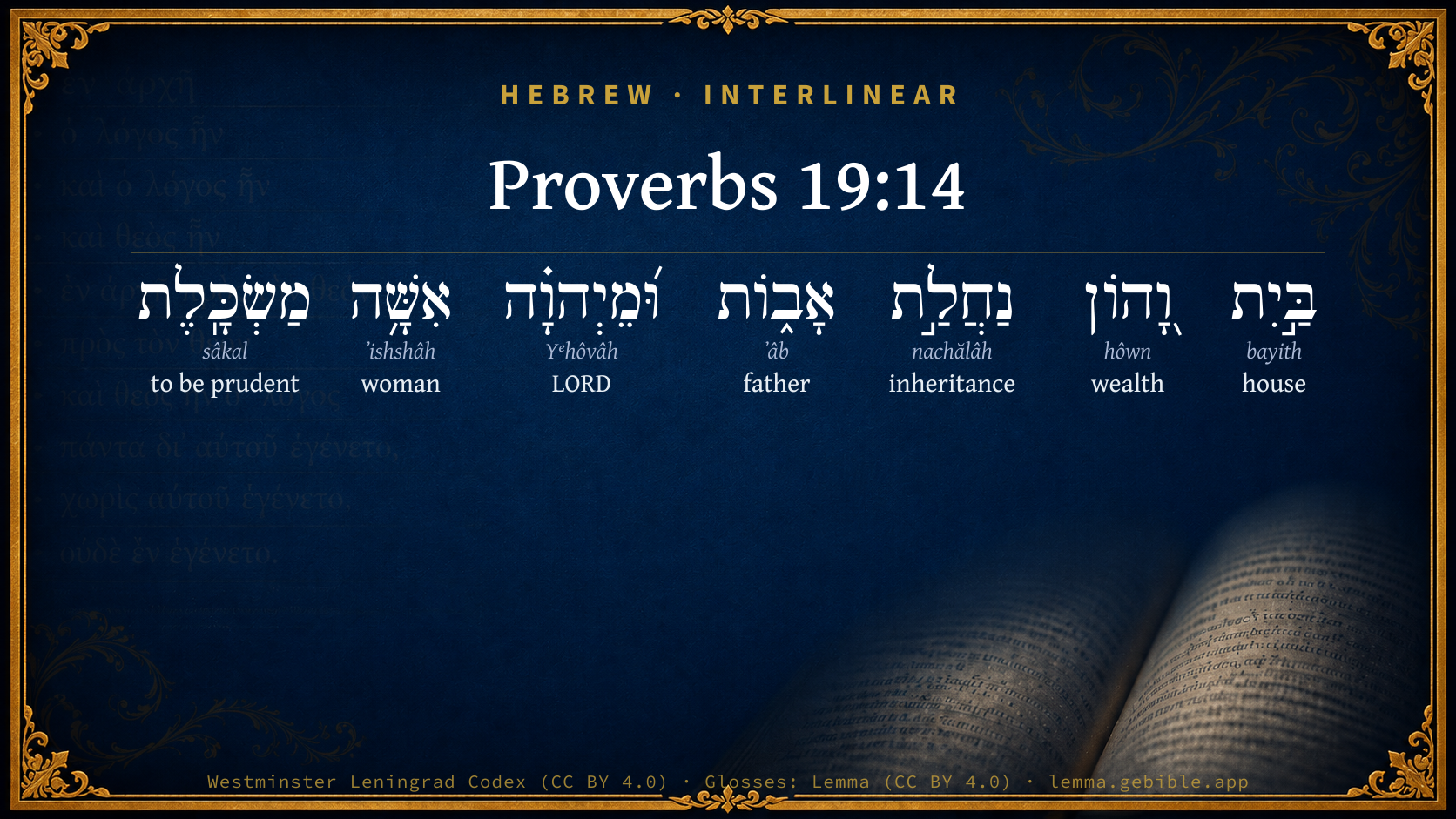
Hebrew (Westminster Leningrad Codex) Proverbs 19:14 appears in the Hebrew Old Testament. The text above is from the Westminster Leningrad Codex. Each word links to its Strong’s number, a concise gloss, and parsing drawn from the Open Scriptures Hebrew Bible morphology. Click any word for its full Brown-Driver-Briggs (BDB) entry.
Download image
Cite this verse

Proverbs 19:14 (World English Bible). Public Domain. Lemma interlinear Bible study tool, https://lemma.gebible.app/v/proverbs/19/14.

Show BibTeX & RIS
BibTeX
RIS
English Translation
House and riches are an inheritance from fathers, But a prudent wife is from Yahweh.
World English Bible · Public Domain
Download a study sheet

One document with this verse’s original text, its word-by-word gloss line, the meaning frame, cross-references with their text, attributed commentary, and full source and license credits — printable, and it pastes into notes with its structure intact.

This verse Autodidact and up

Study sheet (.html) Plain text (.txt)

A passage Seminary Student

Up to 50 verses in one chapter. A passage sheet keeps up to 6 commentary sources and 12 cross-references per verse, in the order this page ranks them, and says so on the sheet whenever that leaves anything out. Ask for a single verse and you get the Autodidact verse sheet above.

Everything on this page stays free to read, with no account — the sheet is a download of what is already on screen, not access to it.

Want to remove ads? Support Godless Engineer
Compare translations 3

The same verse in 3 English versions, stacked beneath the original-language interlinear above. Click any original word for its lexicon entry.

Each is an independent rendering of the whole verse — the interlinear is not word-aligned to these translations.

Highlighted words mark where these versions differ — a whole-verse word diff, not a word-by-word alignment.

  • World English Bible Public Domain
    House and riches are an inheritance from fathers, But a prudent wife is from Yahweh.
  • King James Version Public Domain
    House and riches are the inheritance of fathers: and a prudent wife is from the LORD.
  • unfoldingWord Literal Text CC BY-SA 4.0
    A house and wealth the inheritance of fathers, but from Yahweh a wife who has insight.

unfoldingWord Literal Text — © unfoldingWord, licensed CC BY-SA 4.0. Word-aligned USFM3 via Door43 (git.door43.org/unfoldingWord/en_ult).

Versions to compare (up to 4)

3 of 4 selected

Show all 18 translations

Every available English version of this verse, each an independent rendering of the whole verse.

  • World English Bible Public Domain
    House and riches are an inheritance from fathers, But a prudent wife is from Yahweh.
  • Berean Standard Bible Public Domain
    Houses and wealth are inherited from fathers, but a prudent wife is from the LORD.
  • Majority Standard Bible Public Domain
    Houses and wealth are inherited from fathers, but a prudent wife is from the LORD.
  • King James Version Public Domain
    House and riches are the inheritance of fathers: and a prudent wife is from the LORD.
  • American Standard Version (1901) Public Domain
    House and riches are an inheritance from fathers; But a prudent wife is from Jehovah.
  • Revised Version (1885) Public Domain
    House and riches are an inheritance from fathers: but a prudent wife is from the LORD.
  • Geneva Bible (1599) Public Domain
    House and riches are the inheritance of the fathers: but a prudent wife commeth of the Lord.
  • Douay-Rheims (1899) Public Domain
    House and riches are given by parents: but a prudent wife is properly from the Lord.
  • Young's Literal Translation Public Domain
    House and wealth `are' the inheritance of fathers, And from Jehovah `is' an understanding wife.
  • Literal Standard Version CC BY-SA 4.0
    House and wealth [are] the inheritance of fathers, || And an understanding wife [is] from YHWH.
  • Unlocked Literal Bible CC BY-SA 4.0
    A house and wealth are inherited from parents, but a prudent wife is from Yahweh.
  • unfoldingWord Literal Text CC BY-SA 4.0
    A house and wealth the inheritance of fathers, but from Yahweh a wife who has insight.
  • Darby Bible Public Domain
    House and wealth are an inheritance from fathers; but a prudent wife is from Jehovah.
  • World Messianic Bible Public Domain
    House and riches are an inheritance from fathers, but a prudent wife is from the LORD.
  • Webster's Bible Public Domain
    House and riches are the inheritance of fathers: and a prudent wife is from the LORD.
  • Free Bible Version CC BY-SA 4.0
    You inherit a house and wealth from your father, but a sensible wife is a gift from the Lord.
  • Bible in Basic English Public Domain
    House and wealth are a heritage from fathers, but a wife with good sense is from the Lord.
  • JPS Tanakh (1917) Public Domain
    House and riches are the inheritance of fathers; but a prudent wife is from the LORD.

Literal Standard Version (2020), Covenant Press — licensed CC BY-SA 4.0. Text via the HelloAO Bible API (eBible.org). Unlocked Literal Bible (unfoldingWord) — licensed CC BY-SA 4.0. Text via the HelloAO Bible API (eBible.org). unfoldingWord Literal Text — © unfoldingWord, licensed CC BY-SA 4.0. Word-aligned USFM3 via Door43 (git.door43.org/unfoldingWord/en_ult). Free Bible Version, Dr. Jonathan Gallagher — licensed CC BY-SA 4.0. Text via the HelloAO Bible API (eBible.org).

Word by word

More ways to search: Search by grammar → Find every occurrence → Compare this word →

Practice this passage: Drill this verse → Learn its vocabulary →

About this verse

These counts appear in no published source. They are computed here, from the morphology-tagged text and Lemma’s own curated glosses. What Lemma adds →

7
words
7
distinct lemmas
Wisdom
section

Shared distinctive vocabulary

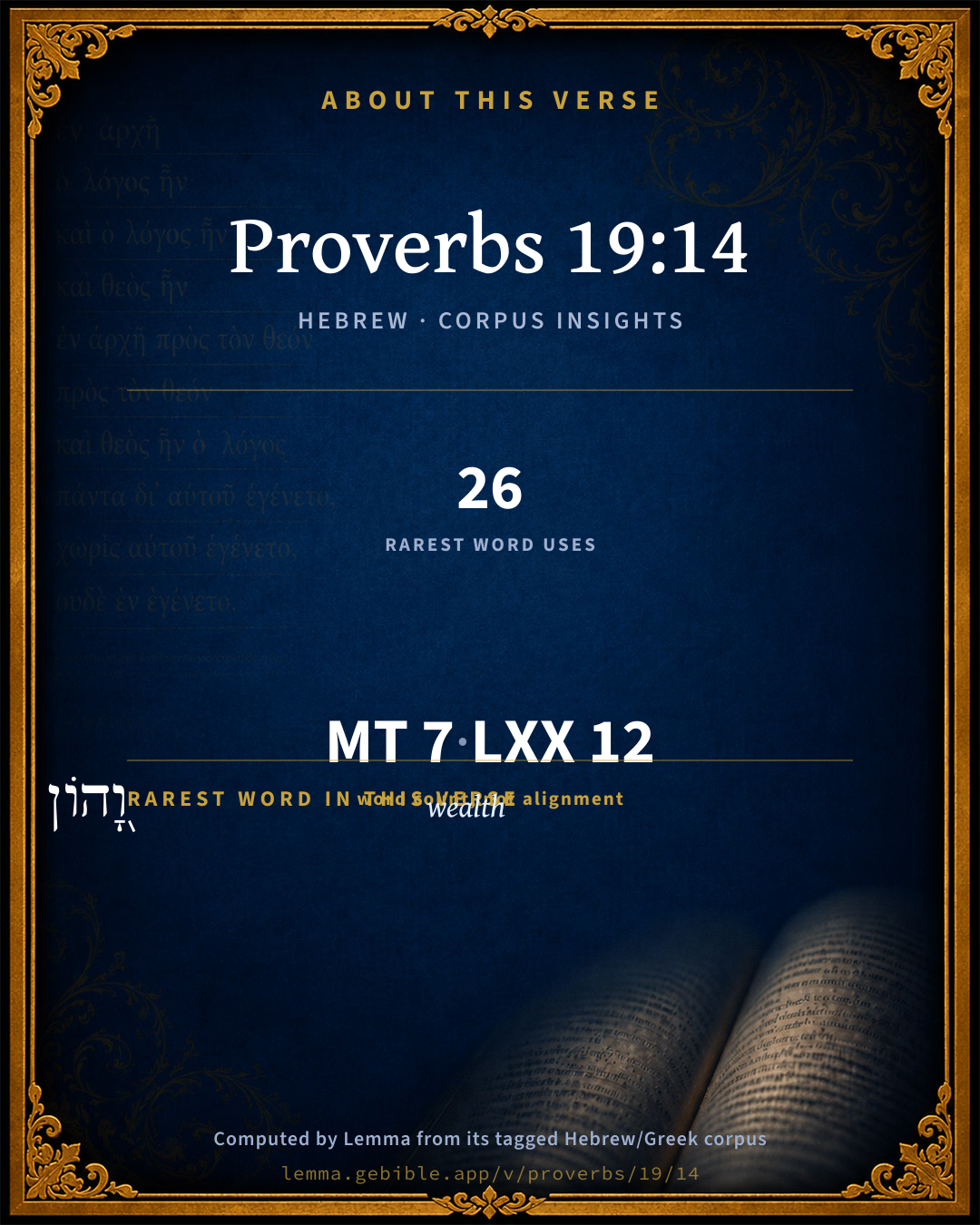
וָ֭הוֹן wealth H1952 occurs in 26 verses of the Hebrew Bible. Also found in:

Grammatical profile

  • 1 verb
  • 6 nouns

Verb forms

  • מַשְׂכָּֽלֶת Hiphil · Participle Active

Hebrew & Septuagint length

In English translation the verse runs 15 words from the Hebrew and 19 from the Septuagint (LXX English) — closely comparable.

A rough comparison of the two English renderings, which tokenize alike — not a word-level alignment.

Word counts can differ between the Hebrew and the Greek without any difference in meaning — e.g. the Hebrew direct-object marker אֵת has no separate Greek word, and Greek often adds the article ὁ.

In the original languages it is 7 Hebrew tokens and 12 Greek tokens — but the two are counted differently (Hebrew bundles its prefixes and suffixes into one token; the Greek is in lemma form), so that isn’t a like-for-like length.

Cross-references

10

Topical passages linked to Proverbs 19:14 in the Treasury of Scripture Knowledge — connected by theme and wording, ordered by reader-vote popularity; previews shown in the World English Bible.

  • Proverbs 18:22 Whoever finds a wife finds a good thing, And obtains favor of Yahweh.
  • Proverbs 31:10–31 Who can find a worthy woman? For her price is far above rubies.
  • Proverbs 13:22 A good man leaves an inheritance to his children's children, But the wealth of the sinner is stored for the righteous.
  • Proverbs 3:6 In all your ways acknowledge him, And he will direct your paths.
  • James 1:17 Every good gift and every perfect gift is from above, coming down from the Father of lights, with whom can be no variation, nor turning shadow.
  • Genesis 28:1–4 Isaac called Jacob, blessed him, and commanded him, "You shall not take a wife of the daughters of Canaan.
  • 2 Corinthians 12:14 Behold, this is the third time I am ready to come to you, and I will not be a burden to you; for I seek not your possessions, but you. For the children ought not to save up for the parents, but the parents for the children.
  • Deuteronomy 21:16 then it shall be, in the day that he causes his sons to inherit that which he has, that he may not make the son of the beloved the firstborn before the son of the hated, who is the firstborn:
  • Genesis 24:7 Yahweh, the God of heaven, who took me from my father's house, and from the land of my birth, who spoke to me, and who swore to me, saying, 'I will give this land to your seed.' He will send his angel before you, and you shall take a wife for my son from there.
  • Joshua 11:23 So Joshua took the whole land, according to all that Yahweh spoke to Moses; and Joshua gave it for an inheritance to Israel according to their divisions by their tribes. The land had rest from war.

Cross-references courtesy of OpenBible.info (CC BY 4.0).

Hebrew and Greek witnesses Masoretic Hebrew ↔ Greek Septuagint

The same verse in the two great witnesses to the Old Testament, shown verse-for-verse.

These are two independent witnesses, not word-aligned to each other, and the Septuagint is shown in lemma (dictionary) form.

Hebrew Proverbs 19:14 Masoretic · Westminster Leningrad Codex

בַּ֣יִת וָ֭הוֹן נַחֲלַ֣ת אָב֑וֹת וּ֝מֵיְהוָ֗ה אִשָּׁ֥ה מַשְׂכָּֽלֶת

House and riches are an inheritance from fathers, But a prudent wife is from Yahweh.

World English Bible · Public Domain

Greek LXX Proverbs 19:14 Septuagint · lemma form

οἶκος καί ὕπαρξις μερίζω πατήρ παῖς παρά δέ θεός ἁρμόζω γυνή ἀνήρ

Fathers divide house and substance to their children: but a wife is suited to a man by the Lord.

LXX2012 (modern English Septuagint) · Public Domain

On this verse, The Cambridge Bible for Schools and Colleges discusses the Septuagint’s reading. Read the note in Commentary ↓

Hebrew: Westminster Leningrad Codex (CC BY 4.0). Greek: Septuagint (public domain); English from LXX2012 (modern English Septuagint) (Public Domain). How the Septuagint differs from the Hebrew →

Commentary

Notes on Proverbs 19:14 from classic Christian and Jewish commentators (each source and its license shown beneath its notes). The classic Christian expositions comment on the surrounding passage and are grouped to its opening verse, so a note may address several verses; the Jewish commentaries on the Tanakh (Rashi and others) are per-verse, so they appear only where the commentator wrote on this verse.

Lemma curates 59 commentaries, every one of them public domain or Creative Commons licensed, each selected and text-cleaned for this edition rather than reprinted as found. About our sources →

Trapp's Complete Commentary

John Trapp

Pro 19:14 House and riches [are] the inheritance of fathers: and a prudent wife [is] from the LORD.

Ver. 14. House and riches are the inheritance of the fathers.] Viz., More immediately. God gives them to the parents, and they leave them to their children, being moved thereto by God. Though a carnal heart looks no higher than parents, cares not, so he may have it, whence he hath it. It is dos non Deus that maketh marriages with them - good enough, if goods enough. Money is the greatest meddler, and drives the bargain and business to an upshot. Mostly such matches prove unhappy and uncomfortable. How can it be otherwise, since Hic Deus nihil fecit? God indeed had a hand in it, but for their just punishment that so followed after lying vanities, and so forsook their own mercies.

But a prudent wife is of the Lord.] Nature makes a woman, election a wife; but to be prudent, wise, and virtuous is of the Lord. A good wife was one of the first real and royal gifts bestowed on Adam. God set all the creatures before him ere he gave him a wife, that, seeing no other fit help, he might prize such a gift; not a gift of industry, but of destiny, as one saith; for "marriages are made in heaven," as the common sort can say, and as very heathens acknowledge. The governor of Eskichisar, hearing Othoman the great Turk’s relation of a fair lady whom he was in love with, and had highly commended for her virtues, seemed greatly to like his choice, saying that she was by the divine providence appointed only for him to have. {a}

{a} Turkish Hist., fol. 136.

John Trapp, A Commentary or Exposition upon All the Books of the Old and New Testament (1647–1656) — public domain. Text from a community e-Sword module.

The Biblical Illustrator

Joseph S. Exell

Pro_19:14

And a prudent wife is from the Lord.

Divine direction needed in the choice of a wife

In the choice of a wife, first of all seek Divine direction. About thirty-five years ago, when Martin Farquhar Tupper urged men to prayer before they decided upon matrimonial association, people laughed. And some of them have lived to laugh on the other side of their mouths. The need of Divine direction I argue from the fact that so many men, and some of them strong and wise, have wrecked their lives at this juncture. Witness Samson and the woman of Timnath. Witness Socrates, pecked of the historical Xantippe. Witness Ananias, a liar, who might perhaps have been cured by a truthful spouse, yet marrying as great a liar as himself--Sapphira. Witness John Wesley, one of the best men that ever lived, united to one of the most miserable women, who sat in City Road Chapel making mouths at him while he preached. Witness the once connubial wretchedness of John Ruskin, the great art essayist, and Frederick W. Robertson the great preacher. On this sea of matrimony, where so many have been wrecked, am I not right in advising Divine pilotage? Especially is devout supplication needed because of the fact that society is so full of artificialities that men are deceived as to whom they are marrying, and no one but the Lord knows. After the dressmaker, and the milliner, and the jeweller, and the hair-adjuster, and the dancing-master, and the cosmetic art have completed their work, how is an unsophisticated man to decipher the physiological hieroglyphics, and make accurate judgment of who it is to whom he offers hand and heart? That is what makes so many recreant husbands. They make an honourable marriage contract, but the goods delivered are so different from the sample by which they bargained. They were simply swindled. They mistook Jezebel for Longfellows Evangeline, and Lucretia Borgia for Martha Washington. (T. De Witt Talmage.)

The Biblical Illustrator, edited by Joseph S. Exell (c. 1880s–1900s) — public domain. Text from a community e-Sword module.

Joseph Benson's Commentary

Pro 19:14. House and riches are the inheritance of fathers, &c. — Parents may bestow on their children houses, and lands, and riches; but a prudent wife is from the Lord — Is vouchsafed to a man by the singular providence of God, who is the only searcher and ruler of hearts, exactly discerning who are prudent or pious, (with regard to which the judgments even of wise men are frequently mistaken,) and inclining the hearts of persons one toward another. So that when such a wife falls to the lot of any one, he should look upon it as a singular favour of God to him, for which he ought to be very thankful.

Joseph Benson's Commentary on the Old and New Testaments (1811–1818) — public domain. Text from a community e-Sword module.

Matthew Henry's Commentary

Note, 1. A discreet and virtuous wife is a choice gift of God's providence to a man - a wife that is prudent, in opposition to one that is contentious, Pro 19:13. For, though a wife that is continually finding fault may think it is her wit and wisdom to be so, it is really her folly; a prudent wife is meek and quiet, and makes the best of every thing. If a man has such a wife, let him not ascribe it to the wisdom of his own choice or his own management (for the wisest have been deceived both in and by a woman), but let him ascribe it to the goodness of God, who made him a help meet for him, and perhaps by some hits and turns of providence that seemed casual brought her to him. Every creature is what he makes it. Happy marriages, we are sure, are made in heaven; Abraham's servant prayed in the belief of this, Gen 24:12. 2. It is a more valuable gift than house and riches, contributes more to the comfort and credit of a man's life and the welfare of his family, is a greater token of God's favour, and about which the divine providence is in a more especial manner conversant. A good estate may be the inheritance of fathers, which, by the common direction of Providence, comes in course to a man; but no man has a good wife by descent or entail. Parents that are worldly, in disposing of their children, look no further than to match them to house and riches, but, if withal it be to a prudent wife, let God have the glory.

Matthew Henry's Commentary on the Whole Bible (1708–1710) — public domain (CC PDM 1.0). Text via the HelloAO Bible API.

Jamieson, Fausset & Brown

Robert Jamieson, A. R. Fausset & David Brown

A contrast of men's gifts and God's, who, though author of both blessings, confers the latter by His more special providence.

and--or, "but," implying that the evils of Pro 19:13 are only avoided by His care.

Jamieson, Fausset & Brown — Commentary Critical and Explanatory on the Whole Bible (1871) — public domain (CC PDM 1.0). Text via the HelloAO Bible API.

Adam Clarke's Commentary

Verse 14. A prudent wife is from the Lord.] One who has a good understanding, אשה משכלת ishshah mascaleth; who avoids complaining, though she may often have cause for it.

Adam Clarke's Commentary on the Bible (1810–1826) — public domain. Text from a community e-Sword/MySword module.

The Cambridge Bible for Schools and Colleges

gen. ed. J. J. S. Perowne

14. the inheritance of] Rather, an inheritance from (R.V.); i.e. derived from.

And] Rather, But.

οἶκον καὶ ὕπαρξιν μερίζουσι πατέρες παισὶ, παρὰ δὲ κυρίου ἁρμόζεται γυνὴ ἀνδρί, LXX. Domus et divitiæ dantur a parentibus; a Domino autem proprie uxor prudens, Vulg. Comp. Pro_18:22; Gen_24:12-14.

The Cambridge Bible for Schools and Colleges (gen. ed. J. J. S. Perowne; Cambridge University Press, 1878–1918) — public domain. Text from a community e-Sword module.

John Gill's Exposition

Houses and riches are the inheritance of fathers,.... Which they are careful to provide and leave to their children. This they may and often do, build or purchase houses, and procure great riches, and put their children into the possession of them;

and, or but,

a prudent wife is from the Lord; one that behaves well to her husband, massages the affairs of her house with wisdom, and brings up her children in all orderly manner: such a wife no man has from the care and provision of his parents; nor so much from his own good choice and industry as from the kind providence of God, to which he should ascribe it; his parents may give him houses and lands, but it is God that gives him a wise and discreet woman to be an helpmeet to him; see Pro 18:22.

John Gill's Exposition of the Whole Bible (1746–1763) — public domain (CC PDM 1.0). Text via the HelloAO Bible API.

Haydock's Catholic Bible Commentary

Properly. Septuagint, "fitted by." (Haydock) --- Hence the Fathers dissuade marrying with infidels. (St. Ambrose in Luke xvi.) --- All good comes from God.

George Leo Haydock (1774–1849), Haydock's Catholic Family Bible and Commentary, 1859 edition — public domain. Excludes Psalms (Douay-Rheims chapter numbering differs from Protestant) and Deuterocanonical books (Catholic canon only).

Matthew Poole's English Annotations

Is vouchsafed to a man by the singular providence of God, who is the only searcher and ruler of hearts, exactly discerning who are prudent or pious, in which even wise men’s judgments are commonly mistaken, and inclining the minds and hearts of persons one towards another.

Matthew Poole's English Annotations on the Holy Bible (1683–1685) — public domain. Text from a community e-Sword/MySword module.

Whedon's Commentary on the Bible

Daniel D. Whedon

14. Inheritance of fathers — That is, such as may be inherited.

A prudent wife — The greatest of earthly blessings is a special boon from Jehovah. Compare Pro_18:22.

Daniel D. Whedon (gen. ed.), Commentary on the Old and New Testaments (1874–1909) — public domain. Text from a community e-Sword module.

The Pulpit Commentary

House and riches are an inheritance of (from) fathers. Any man, worthy or not, may inherit property from progenitors; any man may bargain for a wife, or give a dowry to his son to further his matrimonial prospects. But a prudent wife is from the Lord. She is a special gift of God, a proof of his gracious care for his servants. (see on Pro_18:22) Septuagint, Para de Kuriou armozetai gunh andri , "It is by the Lord that a man is matched with a woman." There is a special providence that watches over wedlock; as we say, "Marriages are made in heaven." But marriages of convenience, marriages made in consideration of worldly means, are a mere earthly arrangement, and claim no particular grace.

The Pulpit Commentary (1880–1919), ed. H.D.M. Spence-Jones & Joseph S. Exell — public domain. Text from a community e-Sword module.

Keil & Delitzsch

C. F. Keil & F. Delitzsch

14 House and riches are a paternal inheritance,

But from Jahve cometh a prudent wife.

House and riches (opulentia), which in themselves do not make men happy, one may receive according to the law of inheritance; but a prudent wife is God's gracious gift, Pro 18:22. There is not a more suitable word than משׂכּלת (fem. of משׂכּיל) to characterize a wife as a divine gift, making her husband happy. שׂכל (השׂכּל) is the property which says: "I am named modesty, which wears the crown of all virtues."

(Note: The lxx translates: παρὰ δὲ ἁρμόζεται γυνὴ ἀνδοί. Here as often (vid., my Jesurun) The Arab. usus loquendi makes itself felt in the idiom of the lxx, for shâkl means ἁρμόζειν.)

Keil & Delitzsch — Biblical Commentary on the Old Testament (1861–1891) — public domain (CC PDM 1.0). Text via the HelloAO Bible API. (Old Testament only.)

Bridges on Proverbs

Charles Bridges

"Every good gift is from the Lord" (Jas 1:17 ); only, some in the ordinary course; others more directly from him. Houses and riches, though his gifts, come by descent. They are the inheritance of fathers.†1 The heir is known, and in the course of events he takes possession of his estate. But the prudent wife is wholly unconnected with the man. There has been no previous bond of relation.†2 She is often brought from a distance.†3 "The LORD brought her to the man"†4 by his special Providence, and therefore as his special gift. The history of Ruth beautifully illustrates the train of matrimonial Providence. The Moabitess married, contrary to all human probability, a man of Israel, that she might be brought into Naomi’s family, return with her to her own land, and in course of filial duty be brought under the eye, and drawn to the heart of Boaz, her appointed husband. (Rth 1:1-4 ; Rth 4:13 .) Often do the wheels of the LORD’s working in this interesting matter constrain the admiration of men not well exercised in spiritual observation. (Gen 24:50 .) And how much more endearing and secure is a special gift of God! The bread coming down from heaven was more valued, than if it had been the fruit of labour. Thus is the prudent wife honoured, as ’a special blessing of God’s immediate choosing, and therefore to be obtained by our prayers at the hand of the giver.’†5 The prudence, however, here described, implies not only her wise governing of her household,†6 but that godly consideration connected with Divine wisdom,†7 by which she becomes the joy and confidence of her husband:†8 as the contentious wife is his trouble and disgrace.

But is not the husband, no less than the wife, from the LORD? Let each prospectively seek the blessing of God’s ordinance; never trusting to his own judgment and affections, without primary reference to his guidance. (Pro 3:6 .) Let us realize the responsibility, as well as the indulgent comfort, of the union; ever counting it a talent for God, for his service and glory; and not doubting for ourselves, that ’all things shall turn to our commodity and comfort, if we draw the yoke in one concord of heart and mind.’†9

Footnotes:

†1 Pro 13:22. Num 27:7 . Deu 21:16 . 1Ki 21:3-4 . 2Co 12:14 .

†2 1Sa 25:39-42 .

†3 Gen 24:4-5.

†4 Gen 2:22.

†5 Bishop Hall.

†6 Pro 31:27.

†7 Pro 8:12.

†8 Pro 18:22; Pro 31:11, Pro 31:23, Pro 31:28 .

†9 Homily on Matrimony.

Charles Bridges, An Exposition of the Book of Proverbs (1846) — public domain. Text from a community e-Sword module.

Kretzmann's Popular Commentary

Paul E. Kretzmann

v. 14. House and riches are the inheritance of fathers, it is possible to get into possession of them by the fact of one’s being an heir; and a prudent wife is from the Lord, a special gift of His kindness.

Paul E. Kretzmann, Popular Commentary of the Bible (1921–1924) — public domain. Text from a community e-Sword module.

Lesson kit

Teaching starters — assembled from the data on this page, not authored interpretation. Every prompt links to the verse data it draws on. Edit before teaching.

Proverbs, in the Wisdom, opens this verse with 7 words (7 distinct Hebrew lemmas). Its most distinctive word is hôwn (“wealth”). A historical commentator’s framing appears above. Read the whole chapter for the surrounding context.

Discussion questions

  1. How does “wealth” (hôwn) shape what this verse is saying?
  2. Psalms 44:12 shares the word «wealth» with this verse. How do the two illuminate each other?
  3. These translations render this verse differently; the difference is in the English rendering, not the original. What questions does that raise?
  4. The verb «מַשְׂכָּֽלֶת» is Hiphil Participle Active. How does its form color the action?
  5. Reading how Trapp's Complete Commentary and The Biblical Illustrator read this verse, where do the two commentators agree and where do they part?

Things to notice

Reading settings

Reading text

Shown beneath each verse's original-language words.

Old Testament
Old Testament edition

Read the OT as the Masoretic Hebrew (MT) or the Greek Septuagint (LXX).

English shown for the Greek Septuagint (in the Hebrew ↔ Greek comparison).

Comparing translations? Open the Compare panel on any verse page to stack up to four side by side.