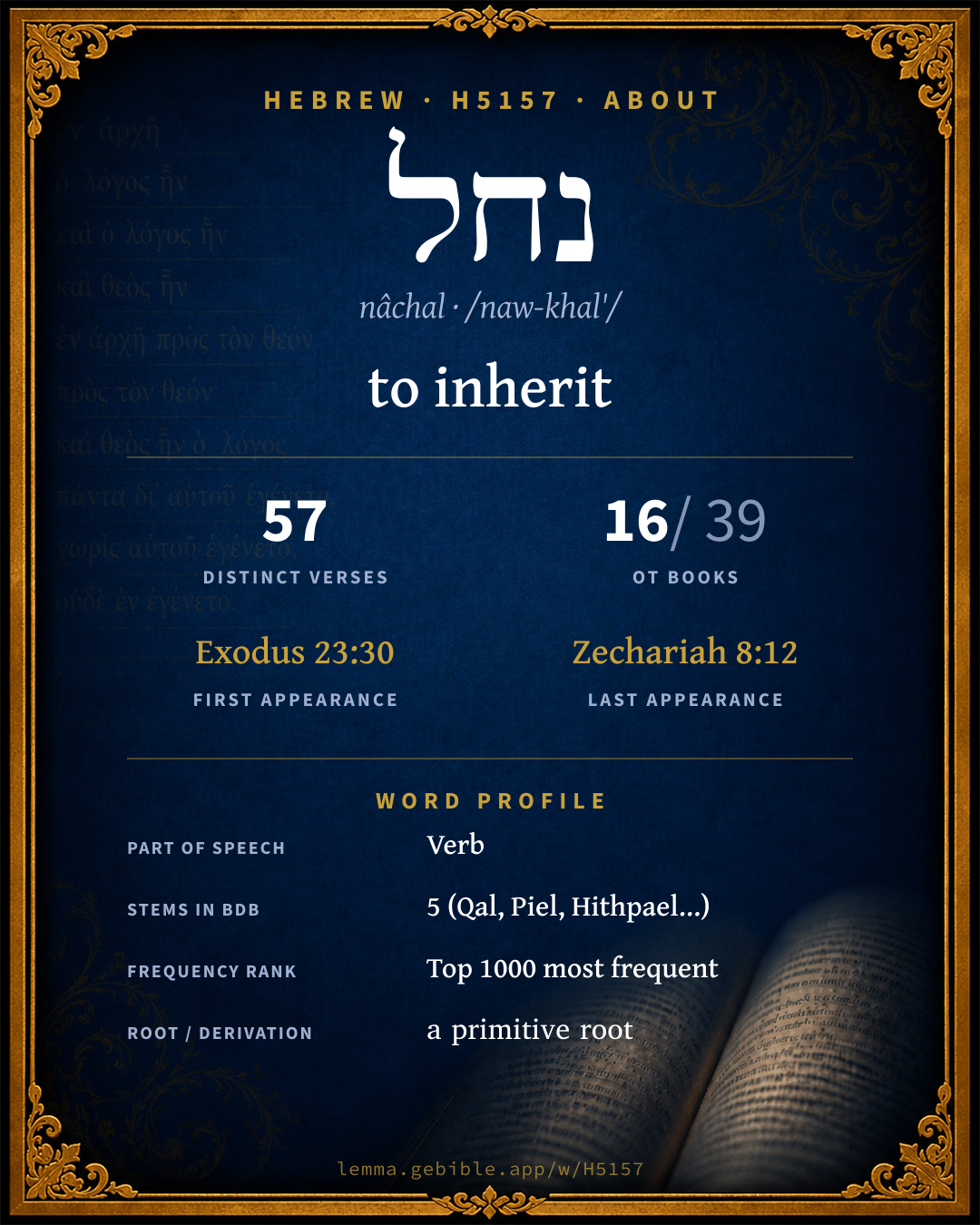
נָחַל
to inherit
‘to inherit’ is one of 4 main senses fuller range ↓
Full lexicon entry — Brown-Driver-Briggs (BDB)
From Brown-Driver-Briggs (BDB)
Where this word appears
See every Hiphil verb in the Hebrew Bible →
Grammar key — what these labels mean
Part of speech
- Verb
- An action or state-of-being word.
Stem
- Qal
- The basic, simple active stem — the plain form of the verb (“he wrote”). Here: ‘take possession’
- Hiphil
- The causative active stem (“he caused / brought about”). Here: ‘give as a possession’
- Hithpael
- The reflexive or reciprocal stem (the subject acts on itself).
- Piel
- An intensive or resultative active stem. Here: ‘divide for a possession’
- Hophal
- The passive counterpart of the Hiphil (“he was caused to…”).
Form
- Imperfect
- An incomplete, ongoing, or future action (“he will / would write”).
- Perfect
- A completed action or state — Hebrew marks aspect (completeness) more than strict tense (“he wrote”).
- Infinitive Construct
- A bound verbal noun, frequently with prepositions (“to write / in writing”).
- Sequential Imperfect
- An imperfect with prefixed waw — the standard past-narrative form (waw-consecutive imperfect).
- Sequential Perfect
- A perfect with prefixed waw continuing a preceding imperfect or command (waw-consecutive perfect).
- Participle Active
- A verbal adjective expressing ongoing or characteristic action (“writing / one who writes”).
State
- Absolute
- The independent form of a noun, not bound to a following word.
Person
- 3rd Person
- The one spoken about (“he / she / it / they”).
- 2nd Person
- The one addressed (“you”).
- 1st Person
- The speaker (“I / we”).
Gender
- Masculine
- Grammatically masculine.
- Common
- Either gender — not distinguished for this form.
Number
- Plural
- More than one (in Hebrew, generally three or more).
- Singular
- One.
1 verse where H5157 appears in the Qal stem in the Book of Deuteronomy. Filtered view — show all forms. Click any verse to open its interlinear word-by-word view. Verse text shown in the World English Bible for context — . Each verse’s Hebrew form is shown with its reference; the English is not keyword-highlighted, since the data carries no word-level English alignment. Use “Compare translations” on any verse to read it across multiple English versions. This concordance covers the Hebrew Bible; Septuagint (Greek Old Testament) occurrences are not indexed here.
Deuteronomy
About this entry
At a glance — auto-summarized from this page’s data, not written by a person. Every figure links to its source below. This summary describes the numbers; it doesn’t interpret them.
נחל (nâchal) is a Hebrew verb most often rendered “to inherit.” Different stems carry different senses — BDB groups them under 5 stems, among them Qal and Piel. The Hebrew Bible uses it across 57 verses — moderately common. Debuting at Exodus 23:30, it then recurs through the corpus. Related forms include נחל and נחלה. For the data behind this summary, explore the sense tree and the renderings breakdown below.
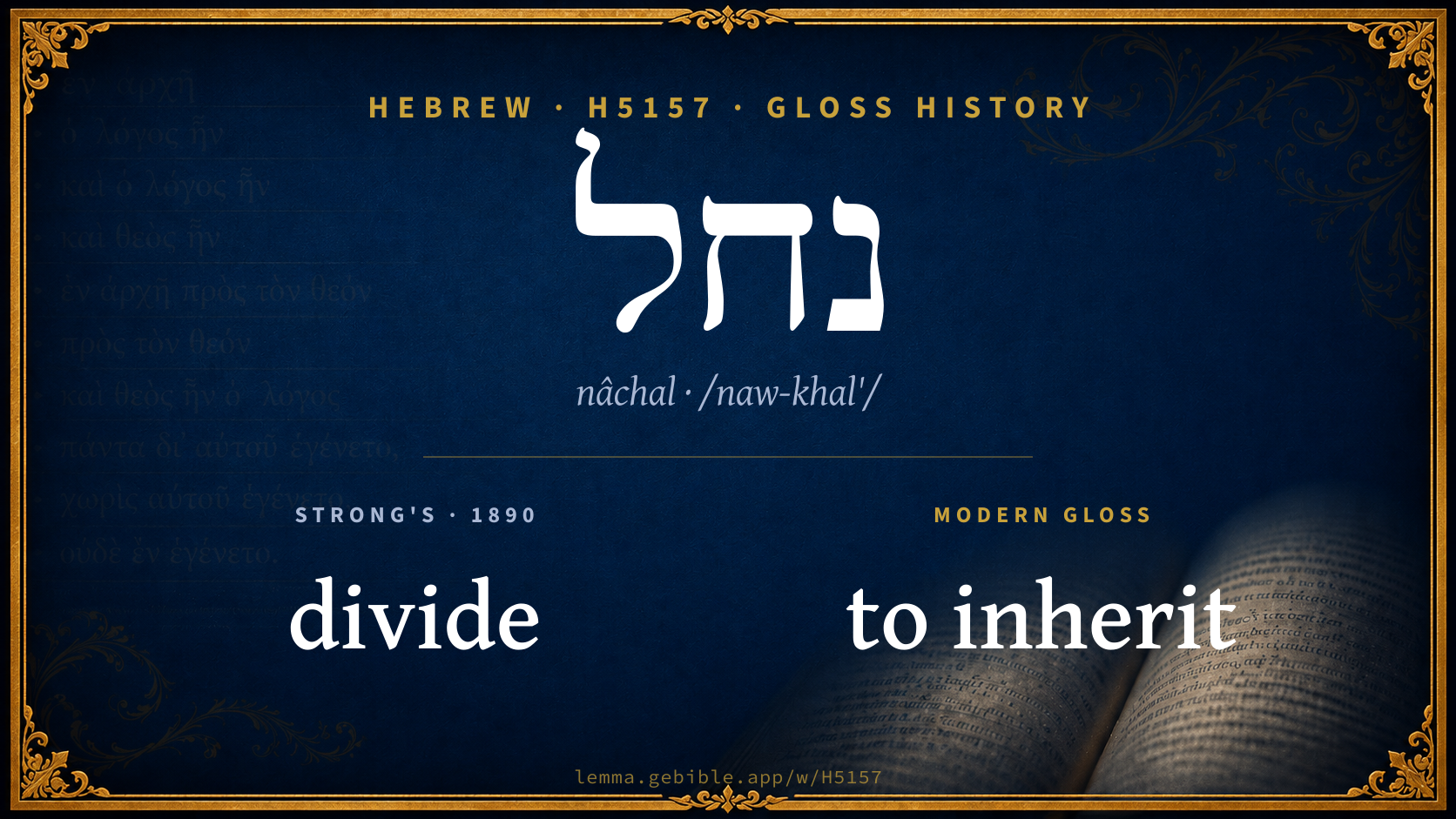
Gloss history
Strong's 1890 vs modern scholarship
About this word
Strong's H5157 catalogs a Hebrew word from the Hebrew Old Testament.
These counts are not copied from any lexicon or concordance. They are computed here, from the morphology-tagged Hebrew Old Testament. What Lemma adds →
- 57
- distinct verses
- The word appears in 57 distinct verses.
- 16 / 39
- OT books
- The word appears in 16 of 39 Old Testament books.
- #647
- by frequency
- Top 1000 most frequent Hebrew words (rank 647 of 8,640 Hebrew words by occurrence).
View all 57 occurrences in the concordance →
Most concentrated in
- Numbers 12 verses 21%
- Deuteronomy 8 verses 14%
- Joshua 8 verses 14%
By section of the Old Testament
By traditional corpus
Conventional, traditional groupings — biblical authorship is debated, so this is a traditional corpus grouping, not an authorship claim. Each share is this word’s portion of its verses in that division of the Hebrew canon. Each figure is a share of the word’s 57 distinct verses.
- Torah (Pentateuch) 24 verses · 42%
- Prophets (Nevi'im) 22 verses · 39%
- Writings (Ketuvim) 11 verses · 19%
How translations render this word
Counts come from each version’s own published word-to-Strong’s tagging or interlinear alignment — an approximate guide to how each version renders this word, not a word-level alignment the data otherwise carries. Because each total is that version’s own tagged count, the per-version totals vary from one another and need not match the appearance or distinct-verse counts above. These counts may also differ from a printed concordance because Lemma counts each distinctly tagged rendering and does not collapse phrase taggings into a single head-word total. This is a fixed set of word-tagged versions (KJV, ASV, BSB, ULT) and does not change with the reading translation you choose elsewhere. Each version’s license is shown beside its name below (and on Sources).
BDB lists this Strong’s number as 2 distinct words (homographs). Each count above pools all of them and is not split by sense — see the Senses section below. A low-frequency rendering may belong to a different one of those words, not the primary meaning.
- King James Version†: Inherit 6×, Inheritance 5×, Shall inherit 4×
- American Standard Version†: Inherit 6×, Inheritance 5×, Shall inherit 5×
- Berean Standard Bible†: Inheritance 9×, Will inherit 4×, Distributed 2×
- unfoldingWord Literal Text†: Inherit 18×, Will inherit 6×, Inherited 4×
King James Version Public Domain
Renders H5157 across 62† tagged occurrences — most commonly:
Plus 35 renderings that appear only once — usually multi-word phrases or single function words the recovered tagging swept in, not distinct renderings. Not rendered by a distinct English word in 2 further occurrences.
American Standard Version Public Domain
Renders H5157 across 62† tagged occurrences — most commonly:
Plus 33 renderings that appear only once — usually multi-word phrases or single function words the recovered tagging swept in, not distinct renderings.
Berean Standard Bible Public Domain
Renders H5157 across 58† tagged occurrences — most commonly:
Plus 33 renderings that appear only once — usually multi-word phrases or single function words the recovered tagging swept in, not distinct renderings. Not rendered by a distinct English word in 1 further occurrence.
unfoldingWord Literal Text CC BY-SA 4.0
Renders H5157 across 87† tagged occurrences — most commonly:
Plus 44 renderings that appear only once — usually multi-word phrases or single function words the recovered tagging swept in, not distinct renderings.
16 senses and sub-senses in the full BDB
Hebrew verbs can shift meaning by stem (binyan): Qal is the basic action, Niphal is often passive or reflexive, Piel often intensifies or makes it factitive, and Hiphil is typically causative. The senses below are grouped under the stem BDB assigns to each. This entry also uses Hithpael (reflexive or reciprocal) and Hophal (the passive of Hiphil).
What do BDB’s symbols mean?
BDB uses these scholarly abbreviations:
| Symbol | Meaning |
|---|---|
| 𝔊 | the Septuagint (the ancient Greek translation, LXX) |
| 𝔙 | the Vulgate (the Latin translation) |
| 𝔖 | the Syriac version (the Peshitta) |
| 𝔗 | the Targum (the Aramaic translation) |
| ψ | the Psalms |
| √ | root (the underlying root or stem) |
| ‖ | parallel passage (a synonymous or contrasted parallel) |
| † | the dagger: every passage where the word occurs is cited |
The 16 senses and sub-senses the full Brown-Driver-Briggs lexicon distinguishes for this word, in lexicon order (not ranked by frequency), with BDB’s own verbatim wording and sub-sense lettering. Shown in Hebrew script with BDB’s own scholarly abbreviations. The condensed entry is in the Lexicon Entry tab. See also the Forms in the corpus table below.
נחל I denom. get or take as a possession (cf. Gerber 236 ff.
Qal
- Pf. נ׳ Zc, 2:16; 2 ms. נָמַלְתָּ Ex 23:30 + 8 times Pf.; Impf. 3 ms. יִנְחַל Is 57:13; 3 mpl. יִנְחֲלוּ Nu 18:23 + 5 times; יִנְחָ֑לוּ 26:55 + 2 times; + 8 times Impf.; Inf. נִחֹל Nu 34:18 Jos 19:49;— e.g. Zechariah 2:16
- 1. take possession, inherit:
- a. land of Canaan, Ex 23:30 (E), 32:13 (J), Is 57:13 Ez 47:14; Zion and Judah ψ 69:37. e.g. Exodus 23:30
- b. special sections in the land, of tribes and individuals, נחל נחלה Jos 17:6 (J); נחלה אשׁר נ׳ Dt 19:14 (D), Nu 35:8 (P), cf. Jos 14:1 (P); without acc., have or get a (landed) property, Nu 18:20, 23, 24; 26:55; 32:19 Jos 16:4; 19:9 (all P), Ju 11:2. e.g. Joshua 17:6
- c. land of Moab and Ammon by conquest Zp 2:9; landed property בכל הגוים ψ 82:8. e.g. Zephaniah 2:9
- d. God takes possession of Israel as his private property Ex 34:9 (J); Judah Zc 2:16. e.g. Exodus 34:9
- 2. fig. have or get as a possession, property: testimonies ψ 119:111, glory Pr 3:35, good things 28:10, lies Je 16:19, wind Pr 11:29, simplicity 14:18. e.g. Psalms 119:111
- 3. divide the land for a possession, Nu 34:17, 18 Jos 19:49 (all P; incorrect pointing for Piel, so SS). e.g. Numbers 34:17
Piel
- divide for a possession: Pf. 3 ms. נִחַל Jos 13:32; 3 pl. נִחֲלוּ Jos 14:1; 19:51; Inf. נַחֵל Nu 34:29 (all P); also Nu 34:17, 18 Jos 19:49 (v. Qal 3). e.g. Joshua 13:32
Hithpael
- Pf. 3 pl. sf. הִתְנַחֲלוּם Is 14:2; 2 mpl. הִתְנַחַלְתֶּם Lv 25:46 Nu 33:54; Impf. תִּתְנַחֲלוּ Nu 34:13 Ez 47:13; תִּתְנֶתָ֑לוּ Nu 33:54; Inf. הִתְנַחֵל Nu 32:18; possess oneself of land (acc.) Nu 33:54; 34:13 (P) Ez 47:13; נחלה Nu 32:18 (P); slaves Lv 25:46 (P) Is 14:2; abs., ref. to land Nu 33:54 (P); all c. לְ pers. (for whose benefit), except Nu 32:18; 34:13 Is 14:2. e.g. Isaiah 14:2
Hiphil
- Pf. 1 s. הִנְחַ֫לְתִּי Je 3:18 + 3 times Pf.; Impf. 3 ms. יַנְחִיל Dt 3:28; יַנְחִל Ez 46:18; 2 ms. sf. תַּנְחִילָנָּה Dt 31:7 + 5 times Impf.; Inf. cstr. הַנְחִיל Is 49:8 Pr 8:21; בְּהַנְחֵל Dt 32:8 (on form cf. Ew§ 238 d Köi 315 Ges§ 53 k; read בְּהַנְחִל?); sf. הַנְחִילוֹ Dt 21:16; Pt. מַנְחִיל Dt 12:10;— e.g. Jeremiah 3:18
- 1. give as a possession:
- a. land of Canaan (given by י׳ or his servants), acc. pers. et rei, Dt 1:38; 3:28; 12:10; 19:3; 31:7 Jos 1:6 (all D), Je 3:18; 12:14. e.g. Deuteronomy 1:38
- b. various things, acc. pers. et rei, especially blessings, Zc 8:12 1 S 2:8 Pr 8:21; acc. rei Is 49:8; acc. pers. Dt 32:8. e.g. Zechariah 8:12
- 2. cause to inherit, give as an inheritance, c. acc. pers. et rei, Dt 21:16; acc. pers. + מן rei, Ez 46:18; acc. pers. Pr 13:22 ל pers. 1 Ch 28:8. e.g. Deuteronomy 21:16
Hophal
- Pf. 1 s. הָנְחַלְתּי Jb 7:3 made to possess, c. acc. rei, e.g. months of vanity. e.g. Job 7:3
נחל II (√ of foll.
Senses from the full Brown-Driver-Briggs lexicon (Brown, Driver, Briggs; Oxford 1906 — public domain), digitized via Sefaria, supplemented by the OpenScriptures HebrewLexicon (CC BY 4.0). Full attribution on Sources.
Word origin
I. vb. denom. get or take as a possession (cf. Gerber 236 ff.; Ecclus נחל 45:22 b +; NH id. (rare));—
II. (√ of foll.; meaning unknown).
— Brown-Driver-Briggs (Oxford 1906, public domain), digitized via Sefaria, supplemented by the OpenScriptures HebrewLexicon (CC BY 4.0). See Sources.
Origin: a primitive root
Jastrow Dictionary
A second Hebrew/Aramaic lexicon for comparison, covering Aramaic and post-biblical (Talmudic, Targumic, Midrashic) usage that the biblical-Hebrew BDB does not. Matched by lemma rather than by Strong’s number, so a lemma may carry more than one Jastrow headword (shown separately below), and the entries cover usage well beyond the Bible.
נַחַל
- wady, river-bed, ravine, stream. Sabb. 56ᵇ (ref. to I Sam. XV, 5) על עסקי נ׳ (he was discussing) the subject of naḥal (Deut. XXI, 4), i.e. the regard due to human lives. Cant. R. to I, 2 עד שנעשה כנ׳ נובע until he (through his erudition) becomes like a bubbling stream; a. e.—Pl. נְחָלִים, נְחָלִין. Ib. מה מים … ונעשין נ׳ נ׳ as waters come down in drops and grow to be torrents; Midr. Till. to Ps. I. Ber. 1Ber. 16ᵃ (ref. to Num. XXIV, 6) מה נ׳ … אף אהלים וכ׳ as the waters of streams raise man from uncleanness to cleanness, so do the tents (of learning) &c.; a. fr. e.g. 1 Samuel 15:5
נַחַל ²
- Targ. Gen. XXVI, 19. Targ. Num. XIII, 24. Targ. Ps. LXXIV, 15; a. fr.—[Targ. Is. XXXVIII, 12 נְחַל, v. נְוַול III.]—Pl. נַחֲלִין, נַחֲלַיָּא, נַחֲלֵי. Targ. Deut. VIII, 7. Targ. Koh. I, 7. Targ. Prov. VIII, 26 (h. text חוצות); a. e.
נָחַל
- , q. v.) to inherit. B. Bath. VIII, 1 יש נוֹחֲלִין ומַנְחִילִין there are such relations as inherit from and eventually transmit to one another (e. g. father and son); ויש נוחלין ולא מנחילין and some inherit, but (when they die) do not transmit their estate to those whose natural heirs they would have been (e. g. son and mother). Kidd. I, 10 ונוֹחֵל את הארץ and shall inherit the land (of life everlasting). Sifré Num. 133 יודע … שהבנות נוֹחֲלוֹת Moses knew that daughters (in the absence of sons) are legal heirs. Midr. Till. to Ps. V, beg. (ref. to Num. XXI, 19) משנָחֲלוּ ע"ז בא עליהם וכ׳ when they adopted idolatry, the angel of death came upon them. Ib. נחלו להק"בה לאלוה והוא נ׳ וכ׳ they adopted the Lord as God, and he adopted them as a people; ib. ממתנה נָחַלְתִּי לאל through the gift (of the well in the desert) I adopted God; מתוך שנתן לי הקב"ה הבאר נחלתי אותו (ed. Bub.) because the Lord gave me the well as a gift, I adopted him; Erub. 54ᵃ וכיון שניתנה לו במתנה נְחָלוֹ אל and since it (the Law) is given him as a gift, the Lord claims him as his own; a. fr. e.g. Numbers 21:19
- to transmit by legal succession; to give in possession. B. Bath. l. c., v. supra. Tosef. B. Mets. XI, 32, a. fr. שעל מנת כן ה׳ וכ׳ for Joshua gave possession of the land with such provisions (restricting the rights of ownership). Ukts. III, 12 עתיד הקב"ה להַנְחִיל וכ׳ (Snh. 100ᵃ ליתן) the Lord will in the hereafter give every righteous man possession of &c. B. Bath. 114ᵇ אין הבן יורש את אמו בקבר להנחיל וכ׳ a son in the grave does not succeed his mother so as to transmit his estate to his paternal brothers; a. fr.
A Dictionary of the Targumim, the Talmud Babli and Yerushalmi, and the Midrashic Literature (Marcus Jastrow; London, Luzac, 1903) — Public Domain. Digitized via Sefaria. Digitized via Sefaria. Full attribution on Sources.
Forms in the corpus
The 53 distinct written forms H5157 takes in the Hebrew Bible, most frequent first — each parse links to that stem’s occurrences in the concordance. Hebrew forms include their vowel points and cantillation, so a single lemma takes many written forms.
Same root — word family
Other BDB entries built from the same root as H5157, grouped by Strong’s listed origin. These share a root / origin per the lexicon — not necessarily a shared meaning. Each links to that word’s own entry.
Derived from this word
Compare all same-root words → They share a root, not necessarily a meaning.
Septuagint verse parallels
This word appears in 55 verses that also exist in the Greek Old Testament (Septuagint), out of the 57 Hebrew verses it occurs in. You can read those verses in Greek by switching the Old Testament edition to the Septuagint.
Read these verses in the Septuagint
- Exodus 23:30
- Leviticus 25:46
- Numbers 18:20
- Deuteronomy 1:38
- Joshua 1:6
- Judges 11:2
- 1 Samuel 2:8
- 1 Chronicles 28:8
- Job 7:3
- Psalms 82:8
- Proverbs 3:35
- Isaiah 14:2
This is a verse-level parallel only — the same verses exist in both the Hebrew and Greek Old Testaments. No word-level Hebrew↔Greek correspondence is claimed: the data carries no such alignment, so no Greek word is shown as this Hebrew word’s translation. Coverage is not total — the Septuagint omits the deuterocanon and renumbers the Psalms, so some Hebrew verses have no direct Greek parallel.