
Zechariah 2:12

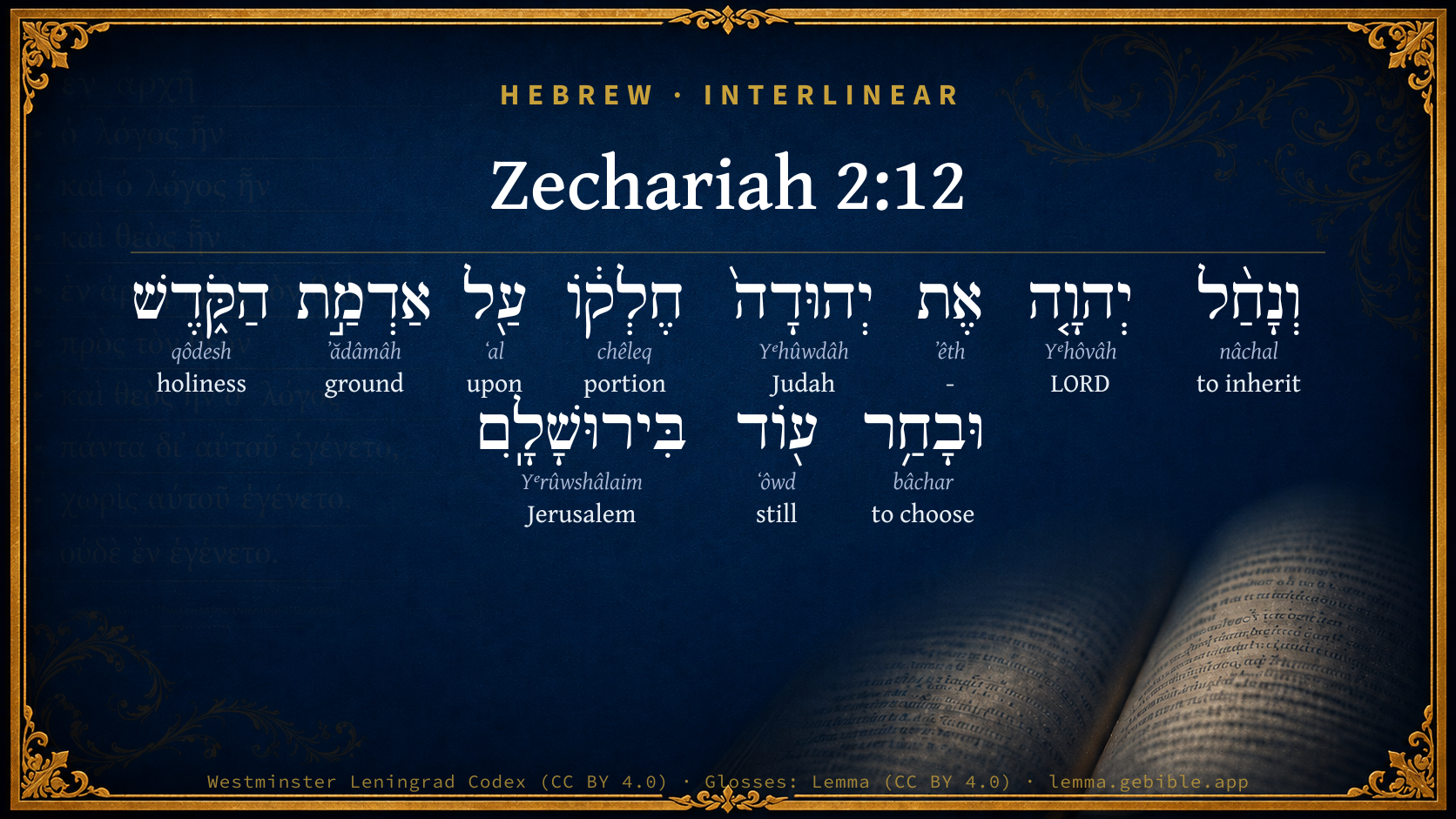
Hebrew (Westminster Leningrad Codex) Zechariah 2:12 appears in the Hebrew Old Testament. The text above is from the Westminster Leningrad Codex. Each word links to its Strong’s number, a concise gloss, and parsing drawn from the Open Scriptures Hebrew Bible morphology. Click any word for its full Brown-Driver-Briggs (BDB) entry.
Download image
Cite this verse

Zechariah 2:12 (World English Bible). Public Domain. Lemma interlinear Bible study tool, https://lemma.gebible.app/v/zechariah/2/12.

Show BibTeX & RIS
BibTeX
RIS
English Translation
Yahweh will inherit Judah as his portion in the holy land, and will again choose Jerusalem.
World English Bible · Public Domain
Download a study sheet

One document with this verse’s original text, its word-by-word gloss line, the meaning frame, cross-references with their text, attributed commentary, and full source and license credits — printable, and it pastes into notes with its structure intact.

This verse Autodidact and up

Study sheet (.html) Plain text (.txt)

A passage Seminary Student

Up to 50 verses in one chapter. A passage sheet keeps up to 6 commentary sources and 12 cross-references per verse, in the order this page ranks them, and says so on the sheet whenever that leaves anything out. Ask for a single verse and you get the Autodidact verse sheet above.

Everything on this page stays free to read, with no account — the sheet is a download of what is already on screen, not access to it.

Want to remove ads? Support Godless Engineer
Compare translations 3

The same verse in 3 English versions, stacked beneath the original-language interlinear above. Click any original word for its lexicon entry.

Each is an independent rendering of the whole verse — the interlinear is not word-aligned to these translations.

Highlighted words mark where these versions differ — a whole-verse word diff, not a word-by-word alignment.

  • World English Bible Public Domain
    Yahweh will inherit Judah as his portion in the holy land, and will again choose Jerusalem.
  • King James Version Public Domain
    And the LORD shall inherit Judah his portion in the holy land, and shall choose Jerusalem again.
  • unfoldingWord Literal Text CC BY-SA 4.0
    And Yahweh will inherit Judah his portion on the land of holiness, and he will again choose Jerusalem.

unfoldingWord Literal Text — © unfoldingWord, licensed CC BY-SA 4.0. Word-aligned USFM3 via Door43 (git.door43.org/unfoldingWord/en_ult).

Versions to compare (up to 4)

3 of 4 selected

Show all 18 translations

Every available English version of this verse, each an independent rendering of the whole verse.

  • World English Bible Public Domain
    Yahweh will inherit Judah as his portion in the holy land, and will again choose Jerusalem.
  • Berean Standard Bible Public Domain
    And the LORD will take possession of Judah as His portion in the Holy Land, and He will once again choose Jerusalem.
  • Majority Standard Bible Public Domain
    And the LORD will take possession of Judah as His portion in the Holy Land, and He will once again choose Jerusalem.
  • King James Version Public Domain
    And the LORD shall inherit Judah his portion in the holy land, and shall choose Jerusalem again.
  • American Standard Version (1901) Public Domain
    And Jehovah shall inherit Judah as his portion in the holy land, and shall yet choose Jerusalem.
  • Revised Version (1885) Public Domain
    And the LORD shall inherit Judah as his portion in the holy land, and shall yet choose Jerusalem.
  • Geneva Bible (1599) Public Domain
    And the Lord shall inherite Iudah his portion in the holy lande, and shall chuse Ierusalem againe.
  • Douay-Rheims (1899) Public Domain
    And the Lord shall possess Juda his portion in the sanctified land: and he shall yet choose Jerusalem.
  • Young's Literal Translation Public Domain
    And Jehovah hath inherited Judah, His portion on the holy ground, And He hath fixed again on Jerusalem.
  • Literal Standard Version CC BY-SA 4.0
    And YHWH has inherited Judah, || His portion on the holy ground, || And He has fixed again on Jerusalem.
  • Unlocked Literal Bible CC BY-SA 4.0
    For Yahweh will inherit Judah as his rightful possession in the holy land and will once again choose Jerusalem for himself.
  • unfoldingWord Literal Text CC BY-SA 4.0
    And Yahweh will inherit Judah his portion on the land of holiness, and he will again choose Jerusalem.
  • Darby Bible Public Domain
    And Jehovah shall inherit Judah [as] his portion in the holy land, and shall yet choose Jerusalem.
  • World Messianic Bible Public Domain
    The LORD will inherit Judah as his portion in the holy land, and will again choose Jerusalem.
  • Webster's Bible Public Domain
    \\2:8\\For thus saith the LORD of hosts; After the glory hath he sent me to the nations which wasted you: for he that toucheth you, toucheth the apple of his eye.
  • Free Bible Version CC BY-SA 4.0
    The people of Judah will be the Lord's special people in the holy land, and he will once again choose Jerusalem as his special city.
  • Bible in Basic English Public Domain
    For this is what the Lord of armies has said: In the way of glory he has sent me to the nations which have taken your goods: for anyone touching you is touching what is most dear to him.
  • JPS Tanakh (1917) Public Domain
    (2-16) And the LORD shall inherit Judah as His portion in the holy land, and shall choose Jerusalem again.

Literal Standard Version (2020), Covenant Press — licensed CC BY-SA 4.0. Text via the HelloAO Bible API (eBible.org). Unlocked Literal Bible (unfoldingWord) — licensed CC BY-SA 4.0. Text via the HelloAO Bible API (eBible.org). unfoldingWord Literal Text — © unfoldingWord, licensed CC BY-SA 4.0. Word-aligned USFM3 via Door43 (git.door43.org/unfoldingWord/en_ult). Free Bible Version, Dr. Jonathan Gallagher — licensed CC BY-SA 4.0. Text via the HelloAO Bible API (eBible.org).

Word by word

More ways to search: Search by grammar → Find every occurrence → Compare this word →

Practice this passage: Drill this verse → Learn its vocabulary →

וְנָחַ֨ל
nâchal
H5157
“and · to inherit”
Conjunction + Verb, Qal, Sequential Perfect, 3rd Person, Masculine, Singular
Part of Speech
Conjunction + Verb
Stem
Qal
Form
Sequential Perfect
Person
3rd Person
Gender
Masculine
Number
Singular
Full BDB Definition

Origin: a primitive root

TWOT: 1342

to get as a possession, acquire, inherit, possess - (Qal) - to take possession, inherit - to have or get as a possession or property (figuratively) - to divide the land for a possession - to acquire (testimonies) (figuratively) - (Piel) to divide for a possession - (Hithpael) to possess oneself of - (Hiphil) - to give as a possession - to cause to inherit, give as an inheritance - (Hophal) to be allotted, be made to possess
  1. יְהוָ֤ה Yᵉhôvâh H3068 “LORD” Noun, Proper
  2. אֶת ʼêth H853 “-” Particle, Direct Object
  3. יְהוּדָה֙ Yᵉhûwdâh H3063 “Judah” Noun, Proper
  4. חֶלְק֔וֹ chêleq H2506 “portion · his” Noun, Common, Masculine, Singular, Construct + Suffix, Personal, 3rd Person, Masculine, Singular
  5. עַ֖ל ʻal H5921 “upon” Preposition
  6. אַדְמַ֣ת ʼădâmâh H127 “ground of” Noun, Common, Feminine, Singular, Construct
  7. הַקֹּ֑דֶשׁ qôdesh H6944 “the · holiness” Particle, Definite Article + Noun, Common, Masculine, Singular, Absolute
  8. וּבָחַ֥ר bâchar H977 “and · to choose” Conjunction + Verb, Qal, Sequential Perfect, 3rd Person, Masculine, Singular
  9. ע֖וֹד ʻôwd H5750 “still” Adverb
  10. בִּירוּשָׁלִָֽם Yᵉrûwshâlaim H3389 “in/at · Jerusalem” Preposition + Noun, Proper

About this verse

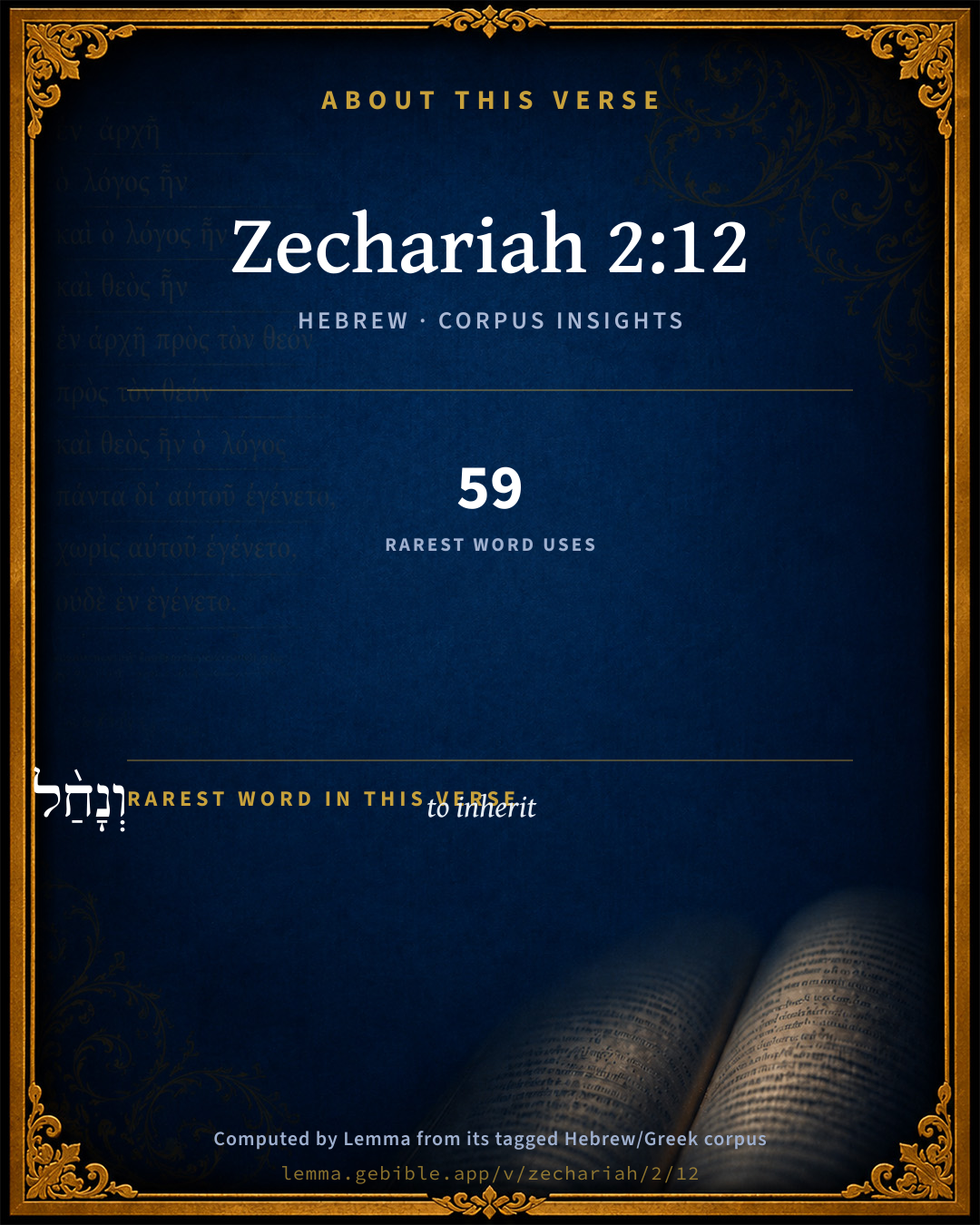
These counts appear in no published source. They are computed here, from the morphology-tagged text and Lemma’s own curated glosses. What Lemma adds →

11
words
11
distinct lemmas
Prophets
section

Shared distinctive vocabulary

וְנָחַ֨ל to inherit H5157 occurs in 57 verses of the Hebrew Bible. Also found in:

Grammatical profile

  • 2 verbs
  • 6 nouns
  • 1 preposition
  • 1 adverb
  • 1 particle

Verb forms

  • וְנָחַ֨ל Qal · Sequential Perfect
  • וּבָחַ֥ר Qal · Sequential Perfect

Hebrew & Septuagint length

In English translation the verse runs 16 words from the Hebrew and 18 from the Septuagint (LXX English) — closely comparable.

A rough comparison of the two English renderings, which tokenize alike — not a word-level alignment.

Word counts can differ between the Hebrew and the Greek without any difference in meaning — e.g. the Hebrew direct-object marker אֵת has no separate Greek word, and Greek often adds the article ὁ.

Cross-references

9

Topical passages linked to Zechariah 2:12 in the Treasury of Scripture Knowledge — connected by theme and wording, ordered by reader-vote popularity; previews shown in the World English Bible.

  • Zechariah 1:17 "Proclaim further, saying, 'Thus says Yahweh of Hosts: "My cities will again overflow with prosperity, and Yahweh will again comfort Zion, and will again choose Jerusalem."'"
  • Deuteronomy 32:9 For Yahweh's portion is his people; Jacob is the lot of his inheritance.
  • Jeremiah 10:16 The portion of Jacob is not like these; for he is the former of all things; and Israel is the tribe of his inheritance: Yahweh of Hosts is his name.
  • Psalms 33:12 Blessed is the nation whose God is Yahweh, The people whom he has chosen for his own inheritance.
  • Exodus 19:5–6 Now therefore, if you will indeed obey my voice, and keep my covenant, then you shall be my own possession from among all peoples; for all the earth is mine;
  • Psalms 82:8 Arise, God, judge the earth, For you inherit all of the nations.
  • Psalms 135:4 For Yah has chosen Jacob for himself; Israel for his own possession.
  • Isaiah 41:9 you whom I have taken hold of from the ends of the earth, and called from the corners of it, and said to you, You are my servant, I have chosen you and not cast you away;
  • Jeremiah 51:19 The portion of Jacob is not like these; for he is the former of all things; and [Israel] is the tribe of his inheritance: Yahweh of Hosts is his name.

Cross-references courtesy of OpenBible.info (CC BY 4.0).

Hebrew and Greek witnesses Masoretic Hebrew ↔ Greek Septuagint

The same verse in the two great witnesses to the Old Testament, shown verse-for-verse.

These are two independent witnesses, not word-aligned to each other, and the Septuagint is shown in lemma (dictionary) form.

Hebrew Zechariah 2:12 Masoretic · Westminster Leningrad Codex

וְנָחַ֨ל יְהוָ֤ה אֶת יְהוּדָה֙ חֶלְק֔וֹ עַ֖ל אַדְמַ֣ת הַקֹּ֑דֶשׁ וּבָחַ֥ר ע֖וֹד בִּירוּשָׁלִָֽם

Yahweh will inherit Judah as his portion in the holy land, and will again choose Jerusalem.

World English Bible · Public Domain

Greek LXX Zechariah 2:12 Septuagint · lemma form

διότι ὅδε λέγω κύριος παντοκράτωρ ὀπίσω δόξα ἀποστέλλω ἐγώ ἐπί ὁ ἔθνος ὁ σκυλεύω σύ διότι ὁ ἅπτομαι σύ ὡς ἅπτομαι ὁ κόρη ὁ ὀφθαλμός αὐτός

And the Lord shall inherit Juda his portion in the holy land, and he will yet choose Jerusalem.

LXX2012 (modern English Septuagint) · Public Domain

Hebrew: Westminster Leningrad Codex (CC BY 4.0). Greek: Septuagint (public domain); English from LXX2012 (modern English Septuagint) (Public Domain). How the Septuagint differs from the Hebrew →

Targum (Aramaic paraphrase)

1

The Targum is the ancient Jewish Aramaic paraphrase of the Hebrew Scriptures — an interpretive translation, not the Hebrew text itself. Onkelos (literal) and Pseudo-Jonathan (expansive) render the Torah, and Jonathan the Prophets. Coverage is partial: where no permissively-licensed English translation exists for a verse, only the Aramaic is shown. This is verse-level text, not a word-by-word alignment to the Hebrew.

  1. Targum Jonathan Prophets (Joshua–Malachi)
    אֲרֵי כִּדְנַן אֲמַר יְיָ צְבָאוֹת בָּתַר יְקָרָא דַאֲמִיר לְאַיְתָאָה עֲלֵיכוֹן שַׁלְחַנִי עַל עַמְמַיָא דְבָזְזִין יַתְכוֹן אֲרֵי דִמְנַזֵיק בְּכוֹן כַּד מוֹשִׁיט יְדֵיהּ לְמִקְרַב בְּגַלְגְלֵי עֵינוֹהִי:

    (no public-domain English translation for this verse)

    Targum Jonathan — Aramaic: “Mikraot Gedolot” (public domain). English: “Sefaria Community Translation” (CC0 1.0 (public-domain dedication)); “London "Chaldee Paraphrase," 1871” (public domain). Text via Sefaria.

Commentary

Notes on Zechariah 2:12 from classic Christian and Jewish commentators (each source and its license shown beneath its notes). The classic Christian expositions comment on the surrounding passage and are grouped to its opening verse, so a note may address several verses; the Jewish commentaries on the Tanakh (Rashi and others) are per-verse, so they appear only where the commentator wrote on this verse.

Lemma curates 59 commentaries, every one of them public domain or Creative Commons licensed, each selected and text-cleaned for this edition rather than reprinted as found. About our sources →

Trapp's Complete Commentary

John Trapp

Zec 2:12 And the LORD shall inherit Judah his portion in the holy land, and shall choose Jerusalem again.

Ver. 12. And the Lord shall inherit Judah his portion] Or his enclosure, his several, divided from the rest of the world by a wonderful separation, as the Hebrew word signifieth, Exo 33:16. And though there were some interruption in showing favour for a time; yet was there no intercession and utter breach of covenant; nor is to this time, as the apostle showeth, Rom 11:28-29. About the time when the Turkish tyranny shall have lasted 350 years (saith my former author out of Dan 7:25; Dan 12:7; Dan 12:11 Rev 9:15), the Jews shall repair toward their own country, Isa 11:15-16; Isa 51:10-11 Jer 3:18 Hos 1:11, where they shall have a great conflict with the Turk, Eze 38:1-23, and be in great distress for a time, Dan 12:1, but at length prevail, to the utter ruin of the Grand Seignior himself, and the overthrow of his army; perhaps not far from the sea of Gennesaret, otherwise called the lake of Tiberias, Eze 39:11. After which they shall dwell in their own country, Jer 3:18; Jer 23:8 Eze 37:21-22 Amo 9:14-15. They shall inhabit all the parts of the land as before, Oba 1:15; Oba 1:19-20 Jer 31:38-40 Isa 27:12; Isa 65:10. The land shall be more fertile than ever it was, Eze 36:8-15 Hos 2:21-22 Joe 3:18 Amo 9:13 Zec 14:10. The country more populous than before, Isa 49:19-21 Eze 34:31; Eze 36:37-38. There shall be no separation of the ten tribes from the other two; but all make one entire kingdom, Eze 37:22; Eze 37:24 Hos 1:11, and a most flourishing commonwealth, Dan 7:27, together with a Church most glorious, both for outward beauty, Zec 14:6-7 Isa 60:20; Isa 62:1-3, and inward purity in doctrine, Eze 37:23 Zec 13:2-3; in discipline, all profane purged out, Joe 3:17 Zec 14:8, abundance of spiritual graces, Isa 25:6-8, safety, Zec 10:12; Zec 14:11, prosperity, Isa 25:8; Isa 51:13, and stability, Isa 26:1; Isa 33:16 Jer 30:20, &c., perpetuity, Isa 60:21 Joe 3:20.

John Trapp, A Commentary or Exposition upon All the Books of the Old and New Testament (1647–1656) — public domain. Text from a community e-Sword module.

The Biblical Illustrator

Joseph S. Exell

Zec_2:12

The Holy Land

Those holy fields

There is no place on the face of the globe so attractive as Palestine.

There is no abatement of the interest which the peoples of the world have always taken in it.

I. What makes it attractive? How comes it that this land has such a hold upon the hearts of men of varying religions and different races? Is it because of the excellence of its government? Is it because of the might and power of its arms? Is it because of its size, its colossal proportions?

II. Its connection with Jesus Christ. The Holy Land is endeared to the hearts of men because the Son of God walked its streets, and made it forever sacred by His holy life and sacrificial death. There the Lord Jesus Christ, the Son of God, made known to perishing man the love of God for a lost world.

III. The holy land is striking and interesting in many of its aspects. Its climate is the most remarkable in the world. Its position is not less striking. In ancient days it was believed to be the very centre of the earth. And so it is higher and better sense. It was there the great mystery of the Incarnation was enacted. Mount Calvary is the central point of the worlds religious life and thought. If ever that universal brotherhood of man, for which the world longs, is to be realised, it will come in proportion as men climb Mount Calvary, and meet in love at the Cross of Christ. (Charles Leech, D. D.)

The Biblical Illustrator, edited by Joseph S. Exell (c. 1880s–1900s) — public domain. Text from a community e-Sword module.

Keil & Delitzsch

C. F. Keil & F. Delitzsch

"And Jehovah will take possession of Judah as His portion in the holy land, and will yet choose Jerusalem. Zac 2:13. Be still, all flesh, before Jehovah; for He has risen up out of His holy habitation." The first hemistich of Zac 2:12 rests upon Deu 32:9, where Israel, as the chosen nation, is called the chēleq and nachălâh of Jehovah. This appointment of Israel to be the possession of Jehovah will become perfect truth and reality in the future, through the coming of the Lord. Yehūdâh is Judah as delivered, i.e., the remnant of the whole of the covenant nation. This remnant, after being gathered out of Babel, will dwell upon holy ground, or in a holy land, as the possession of the Lord. The holy land is the land of Jehovah (Hos 9:3); but this is not to be set down without reserve as identical with Palestine. On the contrary, every place where Jehovah may be is holy ground (cf. Exo 3:5); so that even Palestine is only holy when the Lord dwells there. And we must not limit the idea of the holy land in this passage to Palestine, because the idea of the people of God will be so expanded by the addition of nation nations, that it will not have room enough within the limits of Palestine; and according to Deu 32:4, even Jerusalem will no longer be a city with limited boundaries. The holy land reaches just as far as the nations, which have become the people of Jehovah by attaching themselves to Judah, spread themselves out over the surface of the earth. The words "choose Jerusalem again" round off the promise, just as in Zac 1:17; but in Zac 2:13 the admonition is added, to wait in reverential silence for the coming of the Lord to judgment, after Hab 2:20; and the reason assigned is, that the judgment will soon begin. נעור, niphal of עוּר (compare Ewald, 140, a; Ges. 72, Anm. 9), to wake up, or rise up from His rest (cf. Psa 44:24). מעון קדשׁו, the holy habitation of God, is heaven, as in Deu 26:15; Jer 25:30. The judgment upon the heathen world-power began to burst in a very short time. When Babylon revolted against the king of Persia, under the reign of Darius, a great massacre took place within the city after its re-capture, and its walls were destroyed, so that the city could not rise again to its ancient grandeur and importance. Compare with this the remark made in the comm. on Haggai, concerning the overthrow of the Persian empire and those which followed it. We have already shown, what a groundless hypothesis the opinion is, that the fulfilment was interrupted in consequence of Israel's guilt; and that as the result of this, the completion of it has been deferred for centuries, or even thousands of years.

Keil & Delitzsch — Biblical Commentary on the Old Testament (1861–1891) — public domain (CC PDM 1.0). Text via the HelloAO Bible API. (Old Testament only.)

Tyndale Open Study Notes

Tyndale Open Resources

2:12 Israel is the Lord’s inheritance or special possession—the people of Israel belonged to the Lord (Deut 32:9-10). • The land was holy because of God’s glorious presence in the Jerusalem Temple (see Pss 11:4; 15:1).

Tyndale Open Study Notes — © Tyndale Open Resources, licensed CC BY-SA 4.0. Text via the HelloAO Bible API.

Jamieson, Fausset & Brown

Robert Jamieson, A. R. Fausset & David Brown

Judah his portion in the holy land--Lest the joining of the Gentile "nations to Jehovah" (Zac 2:11) should lead the Jews to fear that their peculiar relation to Him (Deu 4:20; Deu 9:29; Deu 32:9) as "His inheritance" should cease, this verse is added to assure them of His making them so hereafter "again."

choose Jerusalem again--The course of God's grace was interrupted for a time, but His covenant was not set aside (Rom 11:28-29); the election was once for all, and therefore shall hold good for ever.

Jamieson, Fausset & Brown — Commentary Critical and Explanatory on the Whole Bible (1871) — public domain (CC PDM 1.0). Text via the HelloAO Bible API.

Adam Clarke's Commentary

Verse 12. The Lord shall inherit Judah his portion in the holy land] This is a promise of the final restoration of the Jews, and that they should be God's portion in their own land.

Adam Clarke's Commentary on the Bible (1810–1826) — public domain. Text from a community e-Sword/MySword module.

John Calvin's Commentaries

The Prophet confirms the former doctrine, but removes offenses, which might have occurred to the Jews and prevented them from believing this prophecy: for they had been for a time rejected, so that there was no difference between them and other nations. The land of Canaan had been given them as a pledge of their heirship; but they had been thence expelled, and there had been no temple, no public worship, no kingdom. The Jews then might have concluded from all these reasons, that they were rejected by God. Hence the Prophet here promises that they were to be restored again to their former state and to their own place. Jehovah, he says, will take Judah as his hereditary portion; that is, God will really show that he has not forgotten the election by which he had separated the Jews for himself; for he intended them to be to him a peculiar people. They were now mixed with the nations; their dispersion seemed an evidence of repudiation; but it was to be at length manifest that God was mindful of that adoption, by which he once purposed to gather the Jews to himself, that their condition might be different from that of other nations. When therefore he says, that Judah would be to God for an heritage or for an hereditary portion, he brings forward nothing new, but only reminds them that the covenant by which God chose Judah as his people would not be void, for it would be made evident in its time.

And the following clause is to the same purpose, And he will again choose Jerusalem; for it was not then for the first time that Jerusalem became the city of God when restoration took place, but the election, which existed before, was now in a manner renewed conspicuously in the sight of men. It is then the same as though the Prophet had said, “The course of God’s favor has indeed been interrupted, yet he will again show that you have not been in vain chosen as his people, and that Jerusalem, which was his sanctuary, has not been chosen without purpose.” The renovation of the Church, then, is what the Prophet means by these words.

What we have said elsewhere ought at the same time to be noticed, that the word choose is not to be taken here in its strict sense; for God does not repeatedly choose those whom he regards as his Church. God’s election is one single act, for it is eternal and immutable. But as Jerusalem had been apparently rejected, the word choose imports here that God would make it evident, that the first elections had ever been unchangeable, however hidden it may have been to the eyes of men. He then adds —

John Calvin's Commentaries (1540-1563) — public domain. Text from the Calvin Translation Society English edition (1840s-50s) via the Christian Classics Ethereal Library (ccel.org). Calvin's coverage is partial (roughly two-thirds of the Bible); uncommented books and verses are honest gaps, never fabricated. The 19th-century editor's footnotes and remarks are omitted so the notes are faithfully Calvin's own voice.

Ellicott's Commentary for English Readers

(12) The holy land.—This is the only passage in which this term is used. This promise has not been literally fulfilled, for, so far from God’s then inheriting “Judah or the Holy Land,” and choosing “again Jerusalem,” the coming of Christ was but the beginning of the rejection of His people, and the destruction of Jerusalem. But such discrepancies between promise and fulfilment (see Note on Zec_2:10-13) do not case any suspicion on the prophet’s trustworthiness, or in the least invalidate our Christian interpretation of the passage; they simply afford an illustration of the fact that the prophets, as well as others, saw only “through a mirror in enigma” (1Co_13:12), and that the truth was never revealed to any one prophet in its entirety, but to all the prophets “in many portions, and in diverse manners” (Hebrews 1). We may believe, on the authority of St. Paul, that God hath not cast off His own people, and that a time will come when all Israel shall be saved.

A Bible Commentary for English Readers, edited by Charles John Ellicott (1878–1897) — public domain. Text from a community e-Sword module.

The Cambridge Bible for Schools and Colleges

gen. ed. J. J. S. Perowne

12. the holy land] made so by God dwelling there. Comp. Exo_3:5. again] shall yet choose Jerusalem. R. V.

The Cambridge Bible for Schools and Colleges (gen. ed. J. J. S. Perowne; Cambridge University Press, 1878–1918) — public domain. Text from a community e-Sword module.

John Gill's Exposition

And the Lord shall inherit Judah his portion in the holy land,.... The Lord's people is his portion, and the lot of his inheritance; whom he has chosen, and calls as such, whether they be Jews or Gentiles; but here it seems to mean the believing Jews; who, it is very likely, upon their conversion, will be returned to their own land, here called "the holy land"; because formerly here the Lord's holy people dwelt, his holy sanctuary was, and his holy worship and ordinances were attended on; and where now he will possess and enjoy his people, and favour them with communion with himself:

and shall choose Jerusalem again; after long trodden down of the Gentiles; as it formerly was a place of divine worship, so it shall be again; and which will be performed in it in a more spiritual and evangelical manner than ever; or it may respect the people of the Jews, who, being called by grace, this will be a kind of a renovation of their election, and an evidence of it; see Rom 11:26.

John Gill's Exposition of the Whole Bible (1746–1763) — public domain (CC PDM 1.0). Text via the HelloAO Bible API.

Albert Barnes' Notes on the Bible

And the Lord shall inherit Judah His portion - The inheritance of the Lord is the title which God commonly gave to Israel (Deu 4:20; Deu 9:26, Deu 9:29; 1Sa 26:19; 2Sa 14:16; 2Sa 20:19; 2Sa 21:3; 1Ki 8:51; Psa 28:9; Psa 33:12; Psa 68:10; Psa 78:62, Psa 78:71; Psa 119:1; Psa 106:40, Joe 2:17; Joe 3:2, (Hebrew) Isa 19:25; Isa 47:6; Jer 12:7-9; Jer 50:11). God is said to be the portion of Israel Jer 10:16; Jer 51:19; of the pious Psa 16:5; Psa 73:26; Psa 119:57; Psa 142:6; Lam 3:24; once only beside, is Israel said to be the portion of God Deu 32:9; once only is God said to inherit Israel, “Pardon our iniquity and our sin, and take us for thine inheritance” Exo 34:9. Zechariah unites the two rare idioms.

In the holy land - The land is again made holy by God, and sanctified by His Presence. So He calls the place where He revealed Himself to Moses, “holy ground” Exo 3:5. So it is said, “the holy place” Lev 10:17; Lev 14:13, “the holy house” 1Ch 29:3, “the holy ark” 2Ch 35:3, “the holy city” Neh 11:1, Neh 11:18; Isa 48:2; Isa 52:1, “the holy mountain” Isa 27:13; Jer 31:23; Zec 8:3, “the holy people” Isa 62:12, “the holy chambers” (Eze 42:13 all), or, with reference to their relation to God who consecrates them, “My holy mountain” Psa 2:6; Isa 11:9; Isa 56:7; Isa 57:13; Isa 65:11, Isa 65:25; Isa 66:20; Eze 20:40; Joe 2:1; Joe 3:17; Oba 1:16. Zep 3:11, “Thy holy habitation” Exo 15:13, “Thy holy dwelling-place” (Deu 26:15. “His holy hab.” Psa 68:6; Jer 25:30; Zec 2:1-13 :17) “thy holy temple” (Psa 5:8; Psa 79:1; Psa 138:2; Jon 2:5, Jon 2:8, “His holy temple,” Mic 1:2; Hab 2:20), “Thy holy mountain” (Psa 15:1; Psa 43:3; Dan 9:16. “His holy hill,” Psa 3:5; Psa 48:2; Psa 99:9), “Thy holy oracle” Psa 28:2, “Thy holy city” Dan 9:24, “cities” Isa 64:9, “His holy place” Psa 24:1-10 :, “His holy border.” Psa 78:54. It is not one technical expression, as people now by a sort of effort speak of “the holy land.” Everything which has reference to God is holy. The land is holy, not for any merits of theirs, but because God was worshiped there, was specially present there. It was an anticipation and type of “Thy holy Church throughout all the world doth acknowledge Thee.” This land their fathers had “polluted with blood” Psa 106:38; God says, “they defiled My land” Jer 2:7; Jer 3:9; Jer 16:18; Ezekiel called her eminently, “the land that is not cleansed” Eze 22:24. Now God said, “I will remove the iniquity of the land” Zec 3:9, and she was again a holy land, as hallowed by Him.

It is not a mere conversion of the pagan, But, as Isaiah Isa 2:3 and Micah Mic 4:2 foretold; a conversion, of which Jerusalem should be the center, as our Lord explained to the Apostles after His Resurrection, “that repentance and remission of sins should be preached in His name among all nations, beginning at Jerusalem” Luk 24:47.

Albert Barnes' Notes on the Bible (1834–1885) — public domain. Text from a community e-Sword/MySword module.

Matthew Poole's English Annotations

The Lord; Jehovah, the God of Abraham and of his seed, who had cast off Judah, and seemed to quit his claim in his ancient inheritance, by a disseisin of seventy years.

Shall inherit; claim, recover, possess, and delight in, as a man doth in his paternal inheritance.

Judah; all his Israel; this tribe mentioned, but all the rest included.

His portion; his treasure and peculiar people, his lot and part.

In the holy land, Heb. upon; holy, not by any inherent holiness, but holy and selected, and set apart for a holy people consecrated to God.

Shall choose Jerusalem again; the Lord will, as of old, choose Jerusalem for his seat.

Matthew Poole's English Annotations on the Holy Bible (1683–1685) — public domain. Text from a community e-Sword/MySword module.

The Pulpit Commentary

Shall inherit Judah. The Lord, though it is true that many other nations shall be converted, shall take Judah (i.e. the whole Jewish nation) as his portion, in accordance with Deu_32:9. In the holy land. This expression is not found elsewhere applied to Judaea, nor is it to be confined to that nation here. Every land is holy where the Lord dwells. The conversion of the heathen should emanate from Judaea, (Luk_24:47) and spread through all the world, and thus the earth should be holy ground. Shah choose Jerusalem again; Revised Version, "shall yet choose Jerusalem". (comp. Zec_1:17) This points to Christ as King of the spiritual Zion.

The Pulpit Commentary (1880–1919), ed. H.D.M. Spence-Jones & Joseph S. Exell — public domain. Text from a community e-Sword module.

John Wesley's Explanatory Notes

Shall inherit - Claim, recover, possess, and delight in, as a man doth in his paternal inheritance.

John Wesley, Explanatory Notes Upon the Whole Bible (1754–1765) — public domain. Text via the GEBible commentary corpus.

unfoldingWord translationNotes

Door43 World Missions Community

Yahweh will inherit Judah as his rightful possession

Zechariah speaks of Yahweh claiming Judah as his own land as if Judah were something that Yahweh inherits as a permanent possession. AT: "Yahweh will claim Judah as his rightful possession" (See: Metaphor)

all flesh

Here the word "flesh" represents all humanity. AT: "all people" (See: Synecdoche)

he has been roused

Zechariah speaks of Yahweh beginning to act as if someone had roused Yahweh from inactivity. It is implied that this action refers to his returning to Jerusalem. AT: "he is coming" (See: Metaphor and Assumed Knowledge and Implicit Information)

from out of his holy place

Here "his holy place" refers to heaven, and not to the temple in Jerusalem. AT: "from his holy place in heaven" (See: Assumed Knowledge and Implicit Information)

translationWords

Yahweh

inherit

kingdom of Judah

possess

holy

Jerusalem

flesh

unfoldingWord translationNotes — © Distant Shores Media and the Door43 World Missions Community, licensed CC BY-SA 4.0. Source: git.door43.org/Door43/en_tn.

Rashi

Rabbi Shlomo Yitzchaki (Rashi)

After glory After your glory I am sent, to magnify your glory. And the Midrash Aggadah (Addendum to Tan. Buber, Devarim 4) states: After the honor - After I pay Esau for the honor that he bestowed upon his father.

Rashi on the Tanakh — English translations: “The Judaica Press complete Tanach with Rashi, translated by A. J. Rosenberg” (CC BY 4.0); “Pentateuch with Rashi's commentary by M. Rosenbaum and A.M. Silbermann, 1929-1934” (public domain); “The Metsudah Tanach series, Lakewood, N.J” (CC BY 4.0); and “The Book of Joshua, Metsudah Publications, 1997” (CC BY 4.0). Text via Sefaria.

Lesson kit

Teaching starters — assembled from the data on this page, not authored interpretation. Every prompt links to the verse data it draws on. Edit before teaching.

Zechariah, in the Prophets, opens this verse with 11 words (11 distinct Hebrew lemmas). Its most distinctive word is nâchal (“to inherit”). A historical commentator’s framing appears above. Read the whole chapter for the surrounding context.

Discussion questions

  1. The word nâchal carries the sense “to inherit.” How does it shape the verse?
  2. Exodus 23:30 shares the word «to inherit» with this verse. How do the two illuminate each other?
  3. These translations render this verse differently. What is at stake in choosing one wording over another?
  4. The verb «וְנָחַ֨ל» is Qal Sequential Perfect. How does its form color the action?
  5. Reading how Trapp's Complete Commentary and The Biblical Illustrator read this verse, where do the two commentators agree and where do they part?

Things to notice

Reading settings

Reading text

Shown beneath each verse's original-language words.

Old Testament
Old Testament edition

Read the OT as the Masoretic Hebrew (MT) or the Greek Septuagint (LXX).

English shown for the Greek Septuagint (in the Hebrew ↔ Greek comparison).

Comparing translations? Open the Compare panel on any verse page to stack up to four side by side.