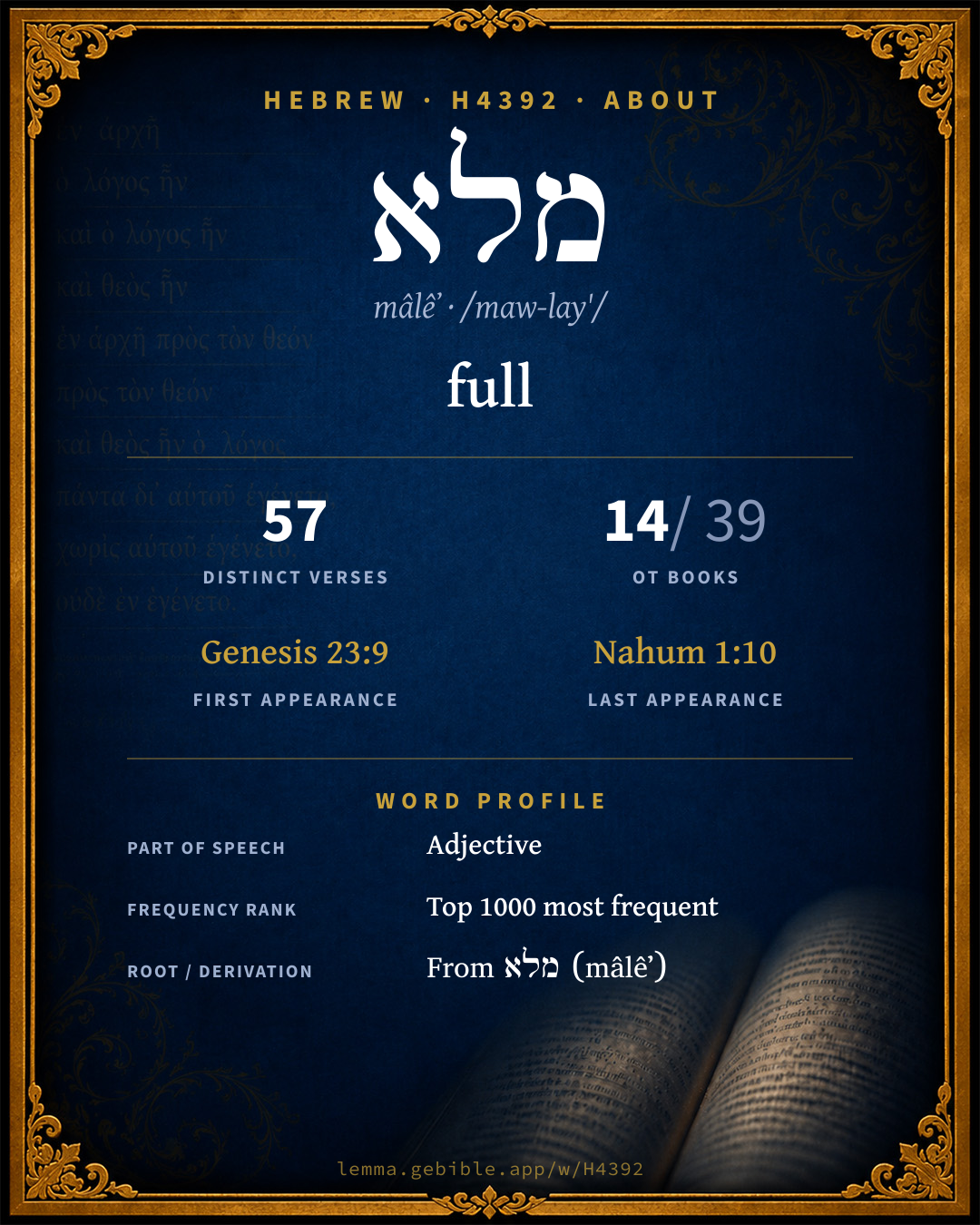
מָלֵא
full
also: fulness, that which fills fuller range ↓
Full lexicon entry — Brown-Driver-Briggs (BDB)
From Brown-Driver-Briggs (BDB)
Where this word appears
Grammar key — what these labels mean
Part of speech
- Adjective
- A word that describes or qualifies a noun.
- Verb
- An action or state-of-being word.
Stem
- Qal
- The basic, simple active stem — the plain form of the verb (“he wrote”). Here: ‘be full’
Form
- Perfect
- A completed action or state — Hebrew marks aspect (completeness) more than strict tense (“he wrote”).
State
- Absolute
- The independent form of a noun, not bound to a following word.
Person
- 1st Person
- The speaker (“I / we”).
Gender
- Masculine
- Grammatically masculine.
- Feminine
- Grammatically feminine.
- Common
- Either gender — not distinguished for this form.
Number
- Plural
- More than one (in Hebrew, generally three or more).
- Singular
- One.
Every verse where H4392 appears in the Book of Ezekiel — 6 distinct verses. Click any verse to open its interlinear word-by-word view. Verse text shown in the World English Bible for context — . Each verse’s Hebrew form is shown with its reference; the English is not keyword-highlighted, since the data carries no word-level English alignment. Use “Compare translations” on any verse to read it across multiple English versions. This concordance covers the Hebrew Bible; Septuagint (Greek Old Testament) occurrences are not indexed here.
Ezekiel
- Ezekiel 1:18 מְלֵאֹ֥ת adj Adjective fp As for their rims, they were high and dreadful; and they four had their rims full of eyes round about.
- Ezekiel 10:12 מְלֵאִ֤ים adj Adjective mp Their whole body, and their backs, and their hands, and their wings, and the wheels, were full of eyes round about, [even] the wheels that they four had.
- Ezekiel 17:3 מָלֵא֙ adj Adjective ms and say, Thus says the Lord Yahweh: A great eagle with great wings and long feathers, full of feathers, which had various colors, came to Lebanon, and took the top of the cedar:
- Ezekiel 28:12 מָלֵ֥א adj Adjective ms Son of man, take up a lamentation over the king of Tyre, and tell him, Thus says the Lord Yahweh: You seal up the sum, full of wisdom, and perfect in beauty.
- Ezekiel 36:38 מְלֵא֖וֹת adj Adjective fp As the flock for sacrifice, as the flock of Jerusalem in her appointed feasts, so shall the waste cities be filled with flocks of men; and they shall know that I am Yahweh.
- Ezekiel 37:1 מְלֵאָ֥ה adj Adjective fs The hand of Yahweh was on me, and he brought me out in the Spirit of Yahweh, and set me down in the midst of the valley; and it was full of bones.
About this entry
At a glance — auto-summarized from this page’s data, not written by a person. Every figure links to its source below. This summary describes the numbers; it doesn’t interpret them.
“full” is the headline sense of the Hebrew adjective מלא (mâlêʼ). The King James Version usually renders it “full,” while modern versions prefer “filled with” (Berean Standard Bible) and “full of” (unfoldingWord Literal Text) — see the renderings breakdown. With 57 verses in 14 books, it is a moderately common word in the Hebrew Bible. It concentrates in Numbers, which alone accounts for 44% of its uses. Not a single-sense word: its full sense range also takes in “fulness” and “that which fills”. The sections below give every sense, occurrence, and version rendering.
Gloss history
Strong's 1890 vs modern scholarship
About this word
Strong's H4392 catalogs a Hebrew word from the Hebrew Old Testament.
These counts are not copied from any lexicon or concordance. They are computed here, from the morphology-tagged Hebrew Old Testament. What Lemma adds →
- 57
- distinct verses
- The word appears in 57 distinct verses.
- 14 / 39
- OT books
- The word appears in 14 of 39 Old Testament books.
- #658
- by frequency
- Top 1000 most frequent Hebrew words (rank 658 of 8,640 Hebrew words by occurrence).
View all 57 occurrences in the concordance →
By section of the Old Testament
By traditional corpus
Conventional, traditional groupings — biblical authorship is debated, so this is a traditional corpus grouping, not an authorship claim. Each share is this word’s portion of its verses in that division of the Hebrew canon. Each figure is a share of the word’s 57 distinct verses.
- Torah (Pentateuch) 31 verses · 54%
- Prophets (Nevi'im) 15 verses · 26%
- Writings (Ketuvim) 11 verses · 19%
How translations render this word
Counts come from each version’s own published word-to-Strong’s tagging or interlinear alignment — an approximate guide to how each version renders this word, not a word-level alignment the data otherwise carries. Because each total is that version’s own tagged count, the per-version totals vary from one another and need not match the appearance or distinct-verse counts above. These counts may also differ from a printed concordance because Lemma counts each distinctly tagged rendering and does not collapse phrase taggings into a single head-word total. This is a fixed set of word-tagged versions (KJV, ASV, BSB, ULT) and does not change with the reading translation you choose elsewhere. Each version’s license is shown beside its name below (and on Sources).
BDB lists this Strong’s number as 2 distinct words (homographs). Each count above pools all of them and is not split by sense — see the Senses section below. A low-frequency rendering may belong to a different one of those words, not the primary meaning.
- King James Version†: Full 30×, Shekels full 11×, Is full 4×
- American Standard Version†: Full 31×, Shekels 12×, Is full 4×
- Berean Standard Bible†: Filled with 25×, Full 10×, Full of 9×
- unfoldingWord Literal Text†: Full of 29×, Full 15×, Fully 2×
King James Version Public Domain
Renders H4392 across 66† tagged occurrences — most commonly:
Plus 14 renderings that appear only once — usually multi-word phrases or single function words the recovered tagging swept in, not distinct renderings.
American Standard Version Public Domain
Renders H4392 across 66† tagged occurrences — most commonly:
Plus 17 renderings that appear only once — usually multi-word phrases or single function words the recovered tagging swept in, not distinct renderings.
Berean Standard Bible Public Domain
Renders H4392 across 64† tagged occurrences — most commonly:
Plus 16 renderings that appear only once — usually multi-word phrases or single function words the recovered tagging swept in, not distinct renderings. Not rendered by a distinct English word in 2 further occurrences.
unfoldingWord Literal Text CC BY-SA 4.0
Renders H4392 across 63† tagged occurrences — most commonly:
Plus 15 renderings that appear only once — usually multi-word phrases or single function words the recovered tagging swept in, not distinct renderings.
15 senses and sub-senses in the full BDB
Hebrew verbs can shift meaning by stem (binyan): Qal is the basic action, Niphal is often passive or reflexive, Piel often intensifies or makes it factitive, and Hiphil is typically causative. The senses below are grouped under the stem BDB assigns to each. This entry also uses Pual (the passive of Piel) and Hithpael (reflexive or reciprocal).
What do BDB’s symbols mean?
BDB uses these scholarly abbreviations:
| Symbol | Meaning |
|---|---|
| 𝔊 | the Septuagint (the ancient Greek translation, LXX) |
| 𝔙 | the Vulgate (the Latin translation) |
| 𝔖 | the Syriac version (the Peshitta) |
| 𝔗 | the Targum (the Aramaic translation) |
| ψ | the Psalms |
| √ | root (the underlying root or stem) |
| ‖ | parallel passage (a synonymous or contrasted parallel) |
| † | the dagger: every passage where the word occurs is cited |
The 15 senses and sub-senses the full Brown-Driver-Briggs lexicon distinguishes for this word, in lexicon order (not ranked by frequency), with BDB’s own verbatim wording and sub-sense lettering. Shown in Hebrew script with BDB’s own scholarly abbreviations. The condensed entry is in the Lexicon Entry tab. See also the Forms in the corpus table below.
מלא I be full, fill (NH id. (Pi. trans.)
Qal
- Pf. מ׳ Ex 40:34 +; sf. מְלָאוֹ Est 7:5; מָלֵאתָ Jb 36:17; מָלֵאתִי Mi 3:8 Je 6:11; מָלֵ֫תִי Jb 32:18; מָֽלְאוּ Gn 29:21 +; מָלוּ Ez 28:16 (מָלֵאתָ 𝔊 𝔖 Co); מָלֵ֑אוּ Is 1:15, etc.; Impf. 3 fs. sf. תִּמְלָאֵ֣מוֹ Ex 15:9; יִמְלְאוּ Gn 50:3 + 2 times; וַיִּמְלְאוּ Gn 25:24; 50:3; Imv. מִלְאוּ Gn 1:22 + 5 times; Inf. cstr. מְלאֹת (מְלֹאות) Lv 8:33 + 12 times; Pt. מָלֵא Je 23:24; מְלֵאִים Is 6:1; (cf. also sub מָלֵא adj.);— e.g. Exodus 40:34
- 1. be full, usually c. acc. material:
- a. lit. subj. houses Ex 8:17; 10:6 (both J) Ju 16:27 Is 13:21 2 Ch 5:13, cf. Ez 10:4 (del. Co); winepress Jo 4:13; threshing-floor Jo 2:24; vessel 2 K 4:6 Jb 21:24, etc.; Jb 20:22 מְלֹאות (cf. מְלֹא), i.e. fulness, abundance. e.g. Exodus 8:17
- b. fig., earth full of violence Gn 6:13, cf. Lv 19:29 (both P), Mi 6:12 Is 1:15 Je 23:10; 51:5 ψ 26:10 Ez 7:23(×2) Ec 9:3, etc.; earth full of glory, mercy, goodness, knowledge, of י׳ ψ 33:5; 119:64 Is 11:9 Hb 3:3; cf. also ψ 48:11; 104:24, etc.; subj. נֶפֶשׁ = desire be satisfied (full) c. sf. Ex 15:9; וְדִין רָשָׁע מ׳ Jb 36:17 and of judgment on the wicked art thou full (hast thou thy fill), cf. Di Du; מָלֵא לֵב לַעֲשׂוֹת רָ֑ע Ec 8:11; especially of days, years, be full, accomplished, ended, Gn 25:24; 29:21; 50:3(×2) (JE); Lv 8:33; 12:4, 6; 25:30 Nu 6:5, 13 (P); 1 S 18:26 2 S 7:12; Je 25:12; 29:10 La 4:18 Ez 5:2 1 Ch 17:11 Est 1:5; 2:12 Dn 10:3; cf. also with other subj. (lit.) Je 25:34 Is 40:2. e.g. Genesis 6:13
- 2. trans. fill, of populating sea and earth Gn 1:22, 28; 9:1 (all P); consecrate מִלְאוּ יֶדְכֶם ליהוה; (lit. fill the hand) Ex 32:29 (cf. infr.); especially of glory of י׳ filling tabern. and temple; Ex 40:34, 35 (P) 1 K 8:10, 11, cf. Is 6:1; v. also Je 23:24, especially lit. Ez 10:3; 43:5; 44:4 2 Ch 5:14; 7:1, 2; sq. 2 acc. fill jars (with) water 1 K 18:34; abs. overflow מ׳ עַל־כָּל־גְּדוֹתָיו Jos 3:15 (cf. 1 Ch 12:16 Pi.); fig. fill land with sin Je 16:18, cf. 19:4 Ez 8:17; 28:16, cf. 30:11; מְלָאוֹ לִבּוֹ לֵעֲשׂוֹת־כֵּן Est 7:5 (cf. Ec 8:11 supr.); מִלְאוּ הַשְּׁלָטִים Je 51:11 meaning obscure, v. [שֶׁלֶט]; Gie proposes מִדְטוּ הַשּׁ׳ polish. e.g. Genesis 1:22
Niphal
- Pf. נִמְלָא־ Ct 5:2; Impf. יִמָּלֵא 2 S 23:7 + 9 times; וַיִּמָּלֵא Ex 7:25 + 5 times; יִמָּֽלְא֫וּ Pr 3:10 + 2 times; יִמָּֽלֵא֑וּ Pr 24:4; יִמָּֽלְאוּן Ez 32:6;— e.g. Song of Solomon 5:2
- 1. be filled, usually c. acc. mat. (c. מִן of source Ec 1:8, cf. Ez 32:6; c. לְ Hb 2:14); land, with people Ex 1:7; cf. 2 K 3:17, 20 Is 2:7(×2), 8; house with smoke Is 6:4, cf. Ez 10:4; v. also Pr 3:10; 24:4 Je 13:12(×2) Zc 8:5 Ct 5:2 Ec 11:3 2 K 10:21 Ez 32:6; = be armed 2 S 23:7 (lit. be filled or full himself, i.e. his hand, with weapon, cf. Pi. 2); be satisfied, subj. נֶפֶשׁ = appetite Ec 6:7; subj. אֹזֶן Ec 1:8; fig. earth filled with violence (cf. Qal) Gn 6:11, cf. Ez 9:9; 23:33; with glory and knowledge of י׳ Nu 14:21 Hb 2:14 ψ 72:19; v. also 1 K 7:14 ψ 71:8; 126:2 Est 3:5; 5:9 Pr 20:17; abs. Ez 26:2 (but Co sub מָלֵא adj., so 𝔊 𝔗) 27:25. e.g. Ecclesiastes 1:8
- 2. be accomplished, ended, subj. days Ex 7:25; of an exchange, requital, Jb 15:32. e.g. Exodus 7:25
Piel
- Pf. מִלֵּא Ex 35:35 +; מִלָּא Je 51:34; מִלֵּאתָ Dt 6:11 +; מִלְאוּ Nu 32:11 +, etc.; Impf. יְמַלֵּא Lv 8:33 +; יְמַלֵּה Jb 8:21; וַיְמַלְאוּ Gn 42:25 Ex 39:10; יְמַלֵּ֑אוּ Ez 7:19, etc.; Imv. מַלֵּא Gn 29:27 + 5 times; מַלְאוּ Je 4:5 Ez 9:7; Inf. cstr. מַלֵּא Ex 29:29 + 5 times; מַלְּאוֹת (-אֹת) Ex 31:5 + 5 times; sf. מַלְּאָם Je 33:5; Pt. מְמַלֵּא Je 13:13 1 Ch 12:15; pl. מְמַלְאִים Is 65:11 + 2 times;— e.g. Exodus 35:35
- 1. fill (often c. 2 acc.; lit., c. בְּ 2 K 9:24 Ezr 9:11 Jb 40:31; c. מִן Je 51:34 ψ 127:5): Gn 21:19; 24:16; 26:15; 42:25; 44:1 Ex 2:16 Dt 6:11 Jos 9:13 1 K 18:35; 20:27 2 K 3:25; 23:14 Is 23:2 Jb 3:15; 22:18 Je 41:9 Ez 3:3; 7:19; 9:7; 10:2; 24:4 Na 2:13 Hg 2:7 ψ 129:7 2 Ch 16:14, etc. (indef. subj.); fill (cup) with drink for libation Is 65:11; fig. fill with spirit Ex 28:3; 31:3; 35:31 cf. v 35, ψ 107:9 Is 33:5 Je 15:17; fill (with blood) 2 K 21:16; with abominations Ezr 9:11 (c. בְּ). e.g. 2 Kings 9:24
- 2. special uses are: satisfy appetite Jb 38:39 ψ 17:14 Pr 6:30 Jb 20:23 Je 51:14 (fig.); take a handful of מ׳ כַּפּוֹ מִן Lv 9:17; grasp מ׳ יָדוֹ בְּ 2 K 9:24, cf. (of laying arrow on bow) fig. מ׳ קֶשֶׁת … אֶפְרַיִם Zc 9:13; overflow מְמַלֵּא עַל־כָּל־גְּד֯יֹתָיו 1 Ch 12:16 (cf. Jos 3:15 Qal); give in full וַיְמַלְאוּם לַמֶּלֶךְ 1 S 18:27 (read וַיְמַלְּאֵם A 𝔊L 𝔙 We Dr Kit Bu); מִלֵּא יַד פּ׳ fig. for institute to a priestly office, consecrate Ex 28:41; 29:9, 29, 33, 35; 32:29 Lv 8:33; 16:32; 21:10 Nu 3:3 Ju 17:5, 12 1 K 13:33 Ez 43:26 (altar), 1 Ch 29:5; 2 Ch 13:9; 29:31 (cf. Assyrian qāta … mullû, confer upon, DlHWB 409); מ׳ אַהֲרֵי wholly follow י׳ Nu 14:24; 32:11, 12 Dt 1:36 Jos 14:8, 9, 14 1 K 11:6; fill in, i.e. set precious stones Ex 28:17 (מ׳ בּוֹ מִלֻּאַת אֶבֶן) cf. 31:5; 35:33; 39:10 (all P); etc. e.g. Job 38:39
- 3. fulfil, accomplish, complete, obj. week, year, day, Gn 29:27, 28 Ex 23:26 Is 65:20 Jb 39:2 2 Ch 36:21 Dn 9:2; obj. word, promise, etc.; subj. י׳ 1 K 8:15, 24 2 Ch 6:4, 15 ψ 20:5, 6; subj. men 1 K 2:27 Je 44:25 2 Ch 36:21. e.g. Genesis 29:27
- 4. confirm words 1 K 1:14. e.g. 1 Kings 1:14
Pual
- Pt. filled, i.e. set with jewels מְמֻלָּאִים בַּתַּרְשִׁישׁ Ct 5:14. e.g. Song of Solomon 5:14
Hithpael
- Impf. עָלַי יִתְמַלָּא֑וּן Jb 16:10, mass themselves against me; perhaps denom. from מְלֹא 2. e.g. Job 16:10
מלא II full
Senses from the full Brown-Driver-Briggs lexicon (Brown, Driver, Briggs; Oxford 1906 — public domain), digitized via Sefaria, supplemented by the OpenScriptures HebrewLexicon (CC BY 4.0). Full attribution on Sources.
Word origin
I. vb. be full, fill (NH id. (Pi. trans.); Zinj. מלא (Pi. trans.) DHMSendsch. 60; Assyrian malû (trans. and intrans.) DlHWB 409; Arabic مَلَأَ (trans.) مَلُؤَ, مَلِىَٔ (intrans.); Ethiopic መልአ: (trans. and intrans.); Aramaic ܡܠܴܐ (trans.), מְלָא (intrans. and trans.), Palm. n.pr. מלא = plenitude, VogPalm. 7, 2 al.; Sab. מלא Os 14 Levy-OsZMG xix. 1865, 211 f. DHMZMG xxix, 1875, 595);—
II. adj. full;—מ׳ Gn 23:9 + 15 times; cstr. מְלֵא Je 6:11; f. מְלֵאָה Nu 7:14 + 20 times; cstr. מְלֵאֲתִי Is 1:21 cf. Ges§ 90, 3 a.; pl. מְלֵאִים Nu 7:13 + 18 times; f. מְלֵאוֹת (-אֹת) Gn 41:7 + 4 times;—full, abs. of ears of corn Gn 41:7, 22; of value, price, Gn 23:9 1 Ch 21:22, 24; of wind (= strong) Je 4:12 sq. acc. mat., bowls of fine flour (סֹלָת) Nu 7:13, 19, 25, 31, 37, 43, 49, 55, 61, 67, 73, 79; spoons of incense Nu 7:14, 20, 26, 32, 38, 44, 50, 56, 62, 68, 74, 80, 86; bowls of wine Je 35:5, cf. fig. ψ 75:9; houses, of contents Dt 6:11 Ne 9:25 cf. Pr 17:1; cage, of birds Je 5:27 (in sim., v. infr.); cart, of sheaves Am 2:13 (in sim.) 1 Ch 11:13 2 K 7:15; Ez 1:18; 10:12; 17:3; 36:38; 37:1; as pred., of storehouses ψ 144;13; cf. fig. of Naomi Ru 1:21; of sea Ec 1:7; with art., of full vessel 2 K 4:4; מְלֵאָה pregnant woman Ec 11:5; fig. full of blessing Dt 33:23; wisdom 34:9; justice Is 1:21; commotion 22:2; fury 51:20; lies, etc. Na 3:1; wisdom Ez 28:12 (del. A BCo); only twice in cstr. before that with which a thing is filled Is 1:21 מ׳ מִשְׁפָּט; Je 6:11 מְלֵא יָמִים (as subst.); as subst. in genit. (Ges§ 128 n) ψ 73:10 מֵי מָלֵא; as adv. = fully Na 1:10 Je 12:6 (loudly, cf. 4:5).
— Brown-Driver-Briggs (Oxford 1906, public domain), digitized via Sefaria, supplemented by the OpenScriptures HebrewLexicon (CC BY 4.0). See Sources.
Derived from מלא (mâlêʼ) (H4390) — to fill.
Jastrow Dictionary
A second Hebrew/Aramaic lexicon for comparison, covering Aramaic and post-biblical (Talmudic, Targumic, Midrashic) usage that the biblical-Hebrew BDB does not. Matched by lemma rather than by Strong’s number, so a lemma may carry more than one Jastrow headword (shown separately below), and the entries cover usage well beyond the Bible.
מִלָּא
- , v. מִלְּתָא a. מִלָּה.
מָלֵא I
- (b. h.) to be full, v. מָלֵא II.—Tosef. Dem. V, 24 היאך מְלָאֲךָ ליבך how could thy heart be so full of thyself, i.e. how daredst thou?
- to fill, to draw (water). Erub. VIII, 6 אין מְמַלְּאִין וכ׳ (Y. ed. מְמַלִּין) you must not draw water out of it on the Sabbath. B. Bath. 162ᵇ מִילְּאֵהוּ בקרובים if he filled the vacant space on the document with the signatures of relatives; Gitt. 87ᵇ. Hor. 11ᵇ ממלא מקום אבותיו הוה he was filling his ancestors’ place, was a direct successor; a. fr.
- to be filled. Ber. 3ᵇ; 59ᵃ אין הבור מִתְמַלֵּא וכ׳, v. חוּלְיָא I. Y. Succ. III, end, 54ᵃ עד שיִתְמַלֵּא זקנו until he has a full beard. Y. Ber. IX, 13ᵈ bot. הִתְמַלְּאִי דינרי זהב be full of gold denars; והיתה מתְמַלְּאָה and it became filled with &c. Gen. R. s. 33 הִתְסַלְּאוּ רחמים אלו על אלו be merciful to one another. Ib. ראיתי … והִתְמַלֵּאתִי עליה רחמים I saw her in distress and was filled with pity for her; a. fr.
מְלָא
- v. מְלֵי
מָלֵא II
- (b. h.) full. Ab. IV, 20 יש … מ׳ ישן many a new vessel is full of old wine (many a young man is full of wisdom). Meg. 6ᵃ (ref. to Ez. XXVI, 2) אם מ׳ זו חרבה זו when one (of the two cities, Jerusalem and Caesarea) is full, the other is waste; a. fr.—Esp. a full month, of thirty days. Bekh. 58ᵃ זימנין מ׳ וכ׳ at times (in some years) it is full, at times defective, v. חָסֵר; a. fr.—Pl. מְלֵאִים, מְלֵאִין, מְלֵי׳; f. מְלֵאוֹת, מְלֵי׳. Ber. 57ᵃ; Erub. 19ᵃ, a. e. מ׳ מצות כרמון are full of good deeds as a pomegranate (is full of seeds); a. fr.—[מְלֵאָה as a noun, v. מְלֵיאָה.] e.g. Ezekiel 26:2
מְלֹא
- ch., v. מְלוֹא
מְלוֹא
- fulness, contents. Mikv. III, 1, sq. עד שיצא ממנו מְלוֹאוֹ ועוד until a quantity equal to its original contents and something besides have run off. Y. Succ. I, 51ᵈ top אכסדרה שנפרצה במְלוֹאָהּ וכ׳ an exedra which is (on one side) entirely open towards the public road. Ib. bot. כמְלוֹאוֹ של דלי as far as the bucket is let down into the water (for filling it). Ḥull. II, 3 אם יש בסכין מְלֹא צואר if the slaughtering knife has the length of the width of the neck. Kidd. 33ᵃ מ׳ עיניו as far as his eye can reach. Sabb. 30ᵃ, a. e. כמ׳ נימא as much as a hair’s breadth. Sifré Num. 160 (expl. אבן יד, Num. XXXV, 17) מ׳ יד as large as the grasp of the hand; a. fr.—[Tosef. Ohol. XVII, 3 מ׳ טימיא, v. לָטוֹמְיָא.] e.g. Numbers 35:17
מְלוֹא ²
- Targ. Y. Num. XXXV, 17. Targ. O. Deut. XXXIII, 16 (Y. ומַלְיָהּ, v. מַלְיָא II); a. e.—Ab. Zar. 29ᵃ מ׳ חמש אצבעתיה as much as one can pinch with five fingers; מ׳ אצבעיה … ומ׳ וכ׳ as much as one can pinch with thumb and little finger; a. e.
מְלֵי
- 1. to be full. Targ. Josh. III, 15; a. fr.; v. next art. Ab. Zar. 28ᵃ דלא מָלוּ תִילתא, v. תִּילְתָּא; a. e.
- 2. to fill. Targ. Gen. I, 22. Targ. Deut. VI, 11 (O. ed. Vienna מַלֵּ׳ Pa.); a. fr.—Part. מָלֵי; f. מַלְּיָא; pl. מָלָן; מַלְיָאתָא, מַלְיָיתָא. Ib. O. XXIX, 10. Targ. Josh. IX, 21 (ed. Wil. מְלָן). Targ. Gen. XXIV, 11; a. fr.
- 1. to fill. Targ. Jer. XIII, 13; a. fr.—Lev. R. s. 21 מַלּוֹי קולתיך fill thy vessel; Pesik. Aḥăré, p. 176ᵇ; Yalk. Lev. 571 מלתי (read: מַלְּאִי); Keth. 62ᵇ מַלִּי. Ab. Zar. 29ᵃ ומַלְּיֵיה מיא and fill it with water. Taan. 29ᵃ; Shebu. 10ᵃ; Pes. 77ᵃ תמוז … מַלּוּיֵי מַלְּיוּהָ they made the Tammuz of that year a full month (of thirty days); a. e.
- 2. to complement, compensate, replace. Targ. O. Gen. II, 21 ומַלִי ed. Berl. (ed. Amst. ומְ׳, corr. acc.).—B. Mets. 105ᵃ טרח ומַלְּיֵיה he took pains to make up for the loss. Ib. טרחת ומַלְּיָיתֵיה וכ׳ Ms. M. (ed. למַלָּיוּתֵיה) thou didst take pains to make up &c.; a. e.—[
- 3. מ׳ על לבא to comfort. Targ. O. Gen. XXXIV, 3 ed. Berl. (v. Berl. Mass., p. 27); v., however, Kidd. 50ᵃ, quot. s. v. מְלַל II.]
- to be filled, full. Targ. Gen. VI, 13. Targ. Ex. XL, 34 א׳ ית וכ׳ (filled); a. fr.
A Dictionary of the Targumim, the Talmud Babli and Yerushalmi, and the Midrashic Literature (Marcus Jastrow; London, Luzac, 1903) — Public Domain. Digitized via Sefaria. Digitized via Sefaria. Full attribution on Sources.
Forms in the corpus
The 27 distinct written forms H4392 takes in the Hebrew Bible, most frequent first — each parse links to that state’s occurrences in the concordance. Hebrew forms include their vowel points and cantillation, so a single lemma takes many written forms.
| Form | Parsing | Example | Uses |
|---|---|---|---|
| מְלֵאָ֥ה | Adjective, Adjective, Feminine, Singular, Absolute | Ezekiel 37:1 | 13 |
| מְלֵאִ֗ים | Adjective, Adjective, Masculine, Plural, Absolute | Numbers 7:13 | 12 |
| מָלֵ֑א | Adjective, Adjective, Masculine, Singular, Absolute | Ecclesiastes 1:7 | 3 |
| מָלֵא֙ | Adjective, Adjective, Masculine, Singular, Absolute | Deuteronomy 34:9 | 3 |
| מְלֵאִ֣ים | Adjective, Adjective, Masculine, Plural, Absolute | Deuteronomy 6:11 | 2 |
| מְלֵאָ֣ה | Adjective, Adjective, Feminine, Singular, Absolute | 1 Chronicles 11:13 | 2 |
| מְלֵאֹ֥ת | Adjective, Adjective, Feminine, Plural, Absolute | Ezekiel 1:18 | 2 |
| מָלֵ֥א | Adjective, Adjective, Masculine, Singular, Absolute | Ezekiel 28:12 | 2 |
| הַ/מְּלֵאָ֑ה | Adjective, Adjective, Feminine, Singular, Absolute | Ecclesiastes 11:5 | 1 |
| הַֽ/מְלֵאִ֥ים | Adjective, Adjective, Masculine, Plural, Absolute | Isaiah 51:20 | 1 |
| וְ/הַ/מְּלֵא֑וֹת | Adjective, Adjective, Feminine, Plural, Absolute | Genesis 41:7 | 1 |
| וְ/הַ/מָּלֵ֖א | Adjective, Adjective, Masculine, Singular, Absolute | 2 Kings 4:4 | 1 |
| וּ/מָלֵ֖א | Adjective, Adjective, Masculine, Singular, Absolute | Deuteronomy 33:23 | 1 |
| מְלֵֽאִים | Adjective, Adjective, Masculine, Plural, Absolute | Nehemiah 9:25 | 1 |
| מְלֵא֖וֹת | Adjective, Adjective, Feminine, Plural, Absolute | Ezekiel 36:38 | 1 |
| מְלֵאִ֤ים | Adjective, Adjective, Masculine, Plural, Absolute | Ezekiel 10:12 | 1 |
| מְלֵאִ֥ים | Adjective, Adjective, Masculine, Plural, Absolute | Jeremiah 35:5 | 1 |
| מְלֵאִים֮ | Adjective, Adjective, Masculine, Plural, Absolute | Psalms 144:13 | 1 |
| מְלֵאָ֤ה | Adjective, Adjective, Feminine, Singular, Absolute | 2 Kings 7:15 | 1 |
| מְלֵאֹ֣ת | Adjective, Adjective, Feminine, Plural, Absolute | Numbers 7:86 | 1 |
| מָ֝לֵ֗א | Adjective, Adjective, Masculine, Singular, Absolute | Psalms 73:10 | 1 |
| מָ֣לֵא | Adjective, Adjective, Masculine, Singular, Absolute | Jeremiah 5:27 | 1 |
| מָ֥לֵא | Adjective, Adjective, Masculine, Singular, Absolute | Psalms 75:8 | 1 |
| מָלֵ֛א | Adjective, Adjective, Masculine, Singular, Absolute | Jeremiah 4:12 | 1 |
| מָלֵ֜א | Adjective, Adjective, Masculine, Singular, Absolute | Genesis 23:9 | 1 |
| מָלֵ֨אתִי֙ | Verb, Qal, Perfect, 1st Person, Common, Singular | Jeremiah 6:11 | 1 |
| מָלֵֽא | Adjective, Adjective, Masculine, Singular, Absolute | Nahum 1:10 | 1 |
Same root — word family
Other BDB entries built from the same root as H4392, grouped by Strong’s listed origin. These share a root / origin per the lexicon — not necessarily a shared meaning. Each links to that word’s own entry.
Derives from
Shares the same root
- מלא mᵉlâʼ H4391 to fill
- מלא mᵉlôʼ H4393 fulness
- מלא milluʼ H4394 installation
- מלאת millêʼth H4402 fulness
Derived from this word
Proper names from this root
People and places named from this root — a name, not an additional meaning of the word.
Compare all same-root words → Showing 4 of 9 — not the complete family. 2 of the same-root words are proper names (people or places). They share a root, not necessarily a meaning.
Septuagint verse parallels
This word appears in 56 verses that also exist in the Greek Old Testament (Septuagint), out of the 57 Hebrew verses it occurs in. You can read those verses in Greek by switching the Old Testament edition to the Septuagint.
Read these verses in the Septuagint
- Genesis 23:9
- Numbers 7:13
- Deuteronomy 6:11
- Ruth 1:21
- 2 Kings 4:4
- 1 Chronicles 11:13
- Psalms 73:10
- Proverbs 17:1
- Ecclesiastes 1:7
- Isaiah 51:20
- Jeremiah 4:12
- Ezekiel 1:18
This is a verse-level parallel only — the same verses exist in both the Hebrew and Greek Old Testaments. No word-level Hebrew↔Greek correspondence is claimed: the data carries no such alignment, so no Greek word is shown as this Hebrew word’s translation. Coverage is not total — the Septuagint omits the deuterocanon and renumbers the Psalms, so some Hebrew verses have no direct Greek parallel.