
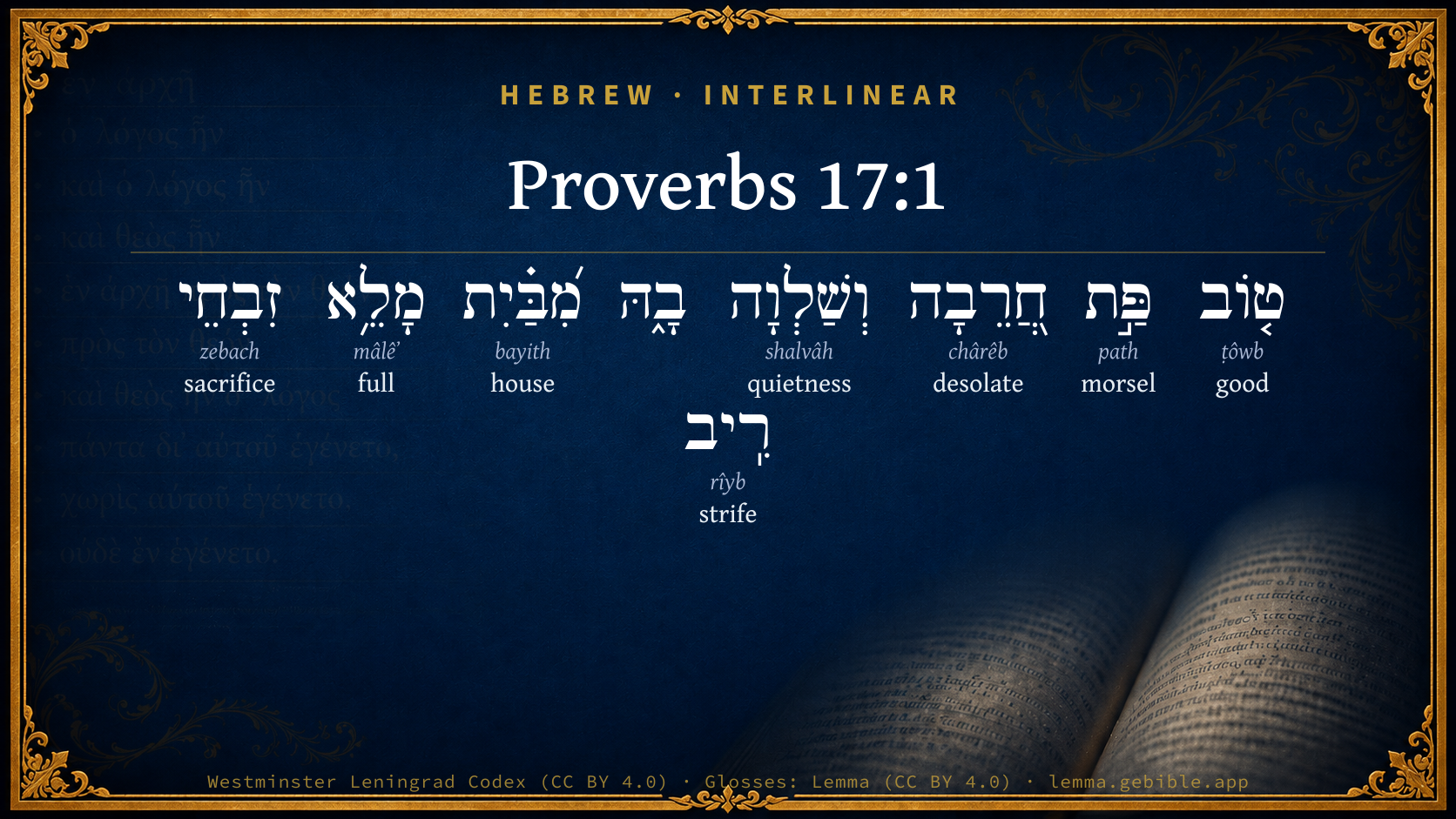
Proverbs 17:1

Hebrew (Westminster Leningrad Codex) Proverbs 17:1 appears in the Hebrew Old Testament. The text above is from the Westminster Leningrad Codex. Each word links to its Strong’s number, a concise gloss, and parsing drawn from the Open Scriptures Hebrew Bible morphology. Click any word for its full Brown-Driver-Briggs (BDB) entry.
Download image
Cite this verse

Proverbs 17:1 (World English Bible). Public Domain. Lemma interlinear Bible study tool, https://lemma.gebible.app/v/proverbs/17/1.

Show BibTeX & RIS
BibTeX
RIS
English Translation
Better is a dry morsel with quietness, Than a house full of feasting with strife.
World English Bible · Public Domain
Download a study sheet

One document with this verse’s original text, its word-by-word gloss line, the meaning frame, cross-references with their text, attributed commentary, and full source and license credits — printable, and it pastes into notes with its structure intact.

This verse Autodidact and up

Study sheet (.html) Plain text (.txt)

A passage Seminary Student

Up to 50 verses in one chapter. A passage sheet keeps up to 6 commentary sources and 12 cross-references per verse, in the order this page ranks them, and says so on the sheet whenever that leaves anything out. Ask for a single verse and you get the Autodidact verse sheet above.

Everything on this page stays free to read, with no account — the sheet is a download of what is already on screen, not access to it.

Want to remove ads? Support Godless Engineer
Compare translations 3

The same verse in 3 English versions, stacked beneath the original-language interlinear above. Click any original word for its lexicon entry.

Each is an independent rendering of the whole verse — the interlinear is not word-aligned to these translations.

Highlighted words mark where these versions differ — a whole-verse word diff, not a word-by-word alignment.

  • World English Bible Public Domain
    Better is a dry morsel with quietness, Than a house full of feasting with strife.
  • King James Version Public Domain
    Better is a dry morsel, and quietness therewith, than an house full of sacrifices with strife.
  • unfoldingWord Literal Text CC BY-SA 4.0
    Better a dry morsel and ease with it than a house full of sacrifices of quarreling.

unfoldingWord Literal Text — © unfoldingWord, licensed CC BY-SA 4.0. Word-aligned USFM3 via Door43 (git.door43.org/unfoldingWord/en_ult).

Versions to compare (up to 4)

3 of 4 selected

Show all 18 translations

Every available English version of this verse, each an independent rendering of the whole verse.

  • World English Bible Public Domain
    Better is a dry morsel with quietness, Than a house full of feasting with strife.
  • Berean Standard Bible Public Domain
    Better a dry morsel in quietness than a house full of feasting with strife.
  • Majority Standard Bible Public Domain
    Better a dry morsel in quietness than a house full of feasting with strife.
  • King James Version Public Domain
    Better is a dry morsel, and quietness therewith, than an house full of sacrifices with strife.
  • American Standard Version (1901) Public Domain
    Better is a dry morsel, and quietness therewith, Than a house full of feasting with strife.
  • Revised Version (1885) Public Domain
    Better is a dry morsel and quietness therewith, than an house full of feasting with strife.
  • Geneva Bible (1599) Public Domain
    Better is a dry morsell, if peace be with it, then an house full of sacrifices with strife.
  • Douay-Rheims (1899) Public Domain
    Better is a dry morsel with joy, than a house full of victims with strife.
  • Young's Literal Translation Public Domain
    Better `is' a dry morsel, and rest with it, Than a house full of the sacrifices of strife.
  • Literal Standard Version CC BY-SA 4.0
    Better [is] a dry morsel, and rest with it, || Than a house full of the sacrifices of strife.
  • Unlocked Literal Bible CC BY-SA 4.0
    It is better to have quiet with a dry morsel of bread than a house full of feasting with strife.
  • unfoldingWord Literal Text CC BY-SA 4.0
    Better a dry morsel and ease with it than a house full of sacrifices of quarreling.
  • Darby Bible Public Domain
    Better is a dry morsel, and quietness therewith, than a house full of feasting [with] strife.
  • World Messianic Bible Public Domain
    Better is a dry morsel with quietness, than a house full of feasting with strife.
  • Webster's Bible Public Domain
    Better is a dry morsel, and quietness with it, than a house full of sacrifices with strife.
  • Free Bible Version CC BY-SA 4.0
    Better to eat a dry scrap in peace than to feast in a house full of people arguing.
  • Bible in Basic English Public Domain
    Better a bit of dry bread in peace, than a house full of feasting and violent behaviour.
  • JPS Tanakh (1917) Public Domain
    Better is a dry morsel and quietness therewith, than a house full of feasting with strife.

Literal Standard Version (2020), Covenant Press — licensed CC BY-SA 4.0. Text via the HelloAO Bible API (eBible.org). Unlocked Literal Bible (unfoldingWord) — licensed CC BY-SA 4.0. Text via the HelloAO Bible API (eBible.org). unfoldingWord Literal Text — © unfoldingWord, licensed CC BY-SA 4.0. Word-aligned USFM3 via Door43 (git.door43.org/unfoldingWord/en_ult). Free Bible Version, Dr. Jonathan Gallagher — licensed CC BY-SA 4.0. Text via the HelloAO Bible API (eBible.org).

Word by word

More ways to search: Search by grammar → Find every occurrence → Compare this word →

Practice this passage: Drill this verse → Learn its vocabulary →

About this verse

These counts appear in no published source. They are computed here, from the morphology-tagged text and Lemma’s own curated glosses. What Lemma adds →

9
words
8
distinct lemmas
Wisdom
section

Notable vocabulary

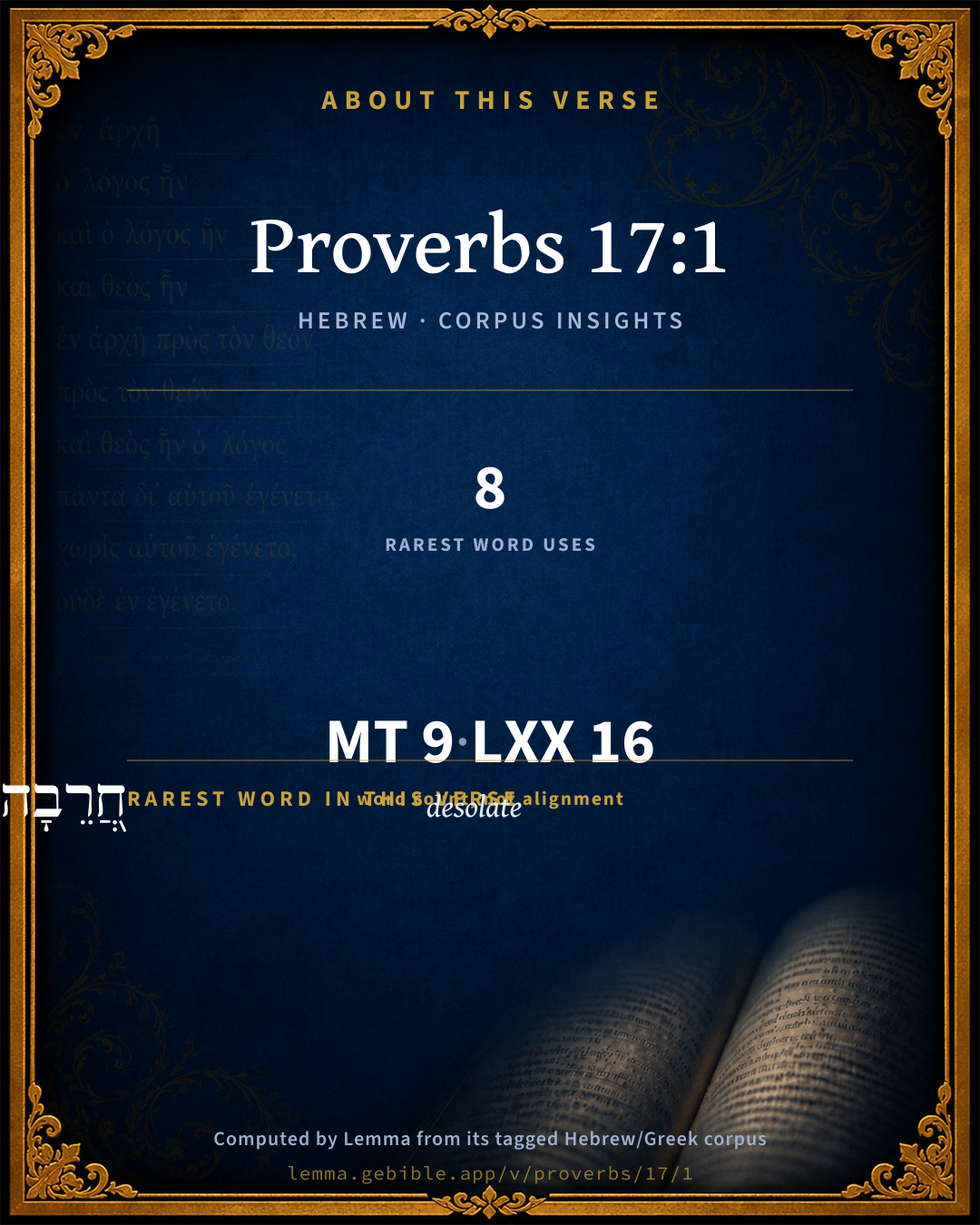
The rarest word here is חֲ֭רֵבָה desolate H2720 — appearing just 8 times in the whole Hebrew Bible.

Shared distinctive vocabulary

חֲ֭רֵבָה desolate H2720 occurs in 8 verses of the Hebrew Bible. Also found in:

Grammatical profile

  • 5 nouns
  • 3 adjectives
  • 1 preposition

Hebrew & Septuagint length

In English translation the verse runs 15 words from the Hebrew and 21 from the Septuagint (LXX English) — the Septuagint runs noticeably longer here. See the side-by-side →

A rough comparison of the two English renderings, which tokenize alike — not a word-level alignment.

Word counts can differ between the Hebrew and the Greek without any difference in meaning — e.g. the Hebrew direct-object marker אֵת has no separate Greek word, and Greek often adds the article ὁ.

In the original languages it is 9 Hebrew tokens and 16 Greek tokens — but the two are counted differently (Hebrew bundles its prefixes and suffixes into one token; the Greek is in lemma form), so that isn’t a like-for-like length.

Cross-references

4

Topical passages linked to Proverbs 17:1 in the Treasury of Scripture Knowledge — connected by theme and wording, ordered by reader-vote popularity; previews shown in the World English Bible.

  • Proverbs 15:17 Better is a dinner of herbs, where love is, Than a fattened calf with hatred.
  • Psalms 37:16 Better is a little that the righteous has, Than the abundance of many wicked.
  • Proverbs 21:19 It is better to dwell in a desert land, Than with a contentious and fretful woman.
  • Proverbs 21:9 It is better to dwell in the corner of the housetop, Than to share a house with a contentious woman.

Cross-references courtesy of OpenBible.info (CC BY 4.0).

Hebrew and Greek witnesses Masoretic Hebrew ↔ Greek Septuagint

The same verse in the two great witnesses to the Old Testament, shown verse-for-verse.

Here the Septuagint runs noticeably longer than the Hebrew — LXX2012 (modern English Septuagint) 21 words vs World English Bible 15. A rough length comparison of the two English translations, not a word-level alignment — read both below.

These are two independent witnesses, not word-aligned to each other, and the Septuagint is shown in lemma (dictionary) form.

Hebrew Proverbs 17:1 Masoretic · Westminster Leningrad Codex

ט֤וֹב פַּ֣ת חֲ֭רֵבָה וְשַׁלְוָה בָ֑הּ מִ֝בַּ֗יִת מָלֵ֥א זִבְחֵי רִֽיב

Better is a dry morsel with quietness, Than a house full of feasting with strife.

World English Bible · Public Domain

Greek LXX Proverbs 17:1 Septuagint · lemma form

κρείσσων ψωμός μετά ἡδονή ἐν εἰρήνη ἤ οἶκος πλήρης πολύς ἀγαθός καί ἄδικος θῦμα μετά μάχη

Better is a morsel with pleasure in peace, than a house full of many good things and unjust sacrifices, with strife.

LXX2012 (modern English Septuagint) · Public Domain

On this verse, Keil & Delitzsch discusses the Septuagint’s reading. Read the note in Commentary ↓

Hebrew: Westminster Leningrad Codex (CC BY 4.0). Greek: Septuagint (public domain); English from LXX2012 (modern English Septuagint) (Public Domain). How the Septuagint differs from the Hebrew →

Commentary

Notes on Proverbs 17:1 from classic Christian and Jewish commentators (each source and its license shown beneath its notes). The classic Christian expositions comment on the surrounding passage and are grouped to its opening verse, so a note may address several verses; the Jewish commentaries on the Tanakh (Rashi and others) are per-verse, so they appear only where the commentator wrote on this verse.

Lemma curates 59 commentaries, every one of them public domain or Creative Commons licensed, each selected and text-cleaned for this edition rather than reprinted as found. About our sources →

Trapp's Complete Commentary

John Trapp

Pro 17:1 Better [is] a dry morsel, and quietness therewith, than an house full of sacrifices [with] strife.

Ver. 1. Better is a dry morsel and quietness therewith.] Though there be not so much as a little vinegar to dip in. {Pro 14:17} {See Trapp on "Pro 14:17"} The Hebrew word properly signifies a morsel of bread, as Rabbi Elias tells us. So, then, better is a crust of coarse bread without any other dainties or dishes - never so little, with love and peace - than a houseful of sacrifices; that is, of good cheer, usual at offering up of sacrifices. {Pro 7:14} And hereunto Saint James seems to allude in Pro 5:5.

John Trapp, A Commentary or Exposition upon All the Books of the Old and New Testament (1647–1656) — public domain. Text from a community e-Sword module.

The Biblical Illustrator

Joseph S. Exell

Pro_17:1

Better is a dry morsel, and quietness therewith, than an house full of sacrifices with strife.

The maker and breaker of a familys peace

Truth sweetens the relations of life; falsehood eats like rust into their core. When they live in love, men meet each other softly and kindly, as the eyelids meet. Envy casts grains of sand between the two, and under each. Every movement then sends a shooting pain through all the body, and makes the salt tears flow. So good are peace and love for human kind, that with them a family will be happy, though they have nothing else in the world; and without them miserable, although they have the whole world at their command. A dinner of herbs and a stalled ox indicate the two extremes--humble poverty on the one side and pampered luxury on the other. When love leaves the family circle, it is no longer a piece of Gods own handiwork, and there is no security for safety in any of its motions. Love is the element in which all its relations are set, for softness and safety; and when it has evaporated, nothing remains but that each member of the house should be occupied in mounting a miserable guard over his own interests, and against the anticipated contact of the rest. In that dislocated house, each dreads all, and all dread each. Some rich families live in love, and doubly enjoy their abundance: some poor families quarrel over their herbs. Riches cannot secure happiness, and poverty cannot destroy it. Whether it be husband or wife, parent or child, master or servant, the disturber of a house must answer to its almighty Protector for abusing His gifts, and thwarting His gracious designs. (W. Arnot, D. D.)

The Biblical Illustrator, edited by Joseph S. Exell (c. 1880s–1900s) — public domain. Text from a community e-Sword module.

Joseph Benson's Commentary

Pro 17:1. Better is a dry morsel — “Bread with pulse, or husks,” as Bochart and Houbigant interpret it; which was the food of meaner persons; and quietness therewith — Peace, love, and concord among the members of a family; than a house full of sacrifices — Of the remainder of sacrifices, of which they used to make feasts; concerning which see on Pro 7:14 : or, of slain beasts, as the same word, זבחים, is used Gen 31:54, and elsewhere.

Joseph Benson's Commentary on the Old and New Testaments (1811–1818) — public domain. Text from a community e-Sword module.

The Preacher's Complete Homiletical Commentary

Joseph S. Exell (gen. ed.)

CRITICAL NOTES.—

Pro_17:1. Sacrifices, literally killings, i.e., slain beasts, not necessarily animals killed for sacrifice.

The Preacher's Complete Homiletical Commentary (gen. ed. Joseph S. Exell; Funk & Wagnalls, c. 1892) — public domain (pre-1929). A full-Bible homiletical/sermon-outline anthology covering 65 of 66 books (2 John is absent from the source module). Text from a community e-Sword module.

Keil & Delitzsch

C. F. Keil & F. Delitzsch

Pro 17:1

A comparative proverb with טוב, pairing with Pro 16:32 :

Better a dry piece of bread, and quietness therewith,

Than a house full of slain beasts with unquietness.

Similar to this in form and contents are Pro 15:16. and Pro 16:8. פּת חרבה is a piece of bread (פת, fem., as Pro 23:8) without savoury drink (Theodotion, καθ ̓ ἑαυτόν, i.e., nothing with it), cf. Lev 7:10, a meat-offering without the pouring out of oil. זבחים are not sacrificial gifts (Hitzig), but, as always, slain animals, i.e., either offerings or banquets of slain beasts; it is the old name of the שׁלמים (cf. Exo 18:12; Exo 24:5; Pro 7:14), part of which only were offered on the altar, and part presented as a banquet; and זבח (in contradist. to טבח, Lev 9:2; 43:16) denotes generally any kind of consecrated festival in connection with the worship of God, Sa1 20:29; cf. Gen 31:54. "Festivals of hatred" are festivals with hatred. מלא is part. with object.-accus.; in general מלא forms a constructive, מלא occurs only once (Jer 6:11), and מלאי not at all. We have already, Pro 7:14, remarked on the degenerating of the shelamı̂m feasts; from this proverb it is to be concluded that the merriment and the excitement bordering on intoxication (cf. with Hitzig, Sa1 1:13 and Sa1 1:3), such as frequently at the Kirmsen merry-makings, brought quarrels and strife, so that the poor who ate his dry bread in quiet peace could look on all this noise and tumult without envy.

Pro 17:2

2 A prudent servant shall rule over the degenerate son;

And he divides the inheritance among the brethren.

Regarding the contrasts of משׂכּיל and מבישׁ, vid., at Pro 10:5; Pro 14:35. The printed editions present בּבן־מבישׁ in genit. connection: a son of the scandalous class, which is admissible; but Cod. 1294 and Cod. Jaman,

(Note: The Cod. brought by Sapiir from Jemen, of which there is an account in the preface to the edition of Isaiah by Baer and me.)

Erf. No. 2, 3, write בּבן מבישׁ (with Tsere and Munach), and that is perhaps right, after Pro 10:5; Pro 17:25. The futures have here also a fut. signification: they say to what it will come. Grotius remarks, with reference to this: manumissus tutor filiis relinquetur; יחלק tutorio officio. But if he is a conscientious, unselfish tutor, he will not enrich himself by property which belongs to another; and thus, though not without provision, he is yet without an inheritance. And yet the supplanting of the degenerate is brought about by this, that he loses his inheritance, and the intelligent servant steps into his place. Has one then to suppose that the master of the house makes his servant a co-heir with his own children, and at the same time names him as his executor? That were a bad anachronism. The idea of the διαθήκη was, at the time when this proverb was coined, one unknown - Israelitish iniquity knows only the intestate right of inheritance, regulated by lineal and gradual succession. Then, if one thinks of the degenerate son, that he is disowned by the father, but that the intelligent servant is not rewarded during the life of his master for his true services, and that, after the death of the master, to such a degree he possesses the esteem and confidence of the family, that he it is who divides the inheritance among the brethren, i.e., occupies the place amongst them of distributor of the inheritance, not: takes a portion of the inheritance, for חלק has not the double meaning of the Lat. participare; it means to divide, and may, with בּ, mean "to give a part of anything" (Job 39:17); but, with the accus., nothing else than to distribute, e.g., Jos 18:2, where it is to be translated: "whose inheritance had not yet been distributed (not yet given to them)." Jerome, haereditatem dividet; and thus all translators, from the lxx to Luther.

Pro 17:3

3 The fining-pot for silver, and the furnace for gold;

And a trier of hearts is Jahve.

An emblematical proverb, which means that Jahve is for the heart what the smelting-pot (from צרף, to change, particularly to melt, to refine) is for silver, and what the smelting furnace (כוּר, from כּוּר, R. כר, to round, Exo 22:20) is for gold, that Jahve is for the heart, viz., a trier (בחן, to grind, to try by grinding, here as at Psa 7:10) of their nature and their contents, for which, of the proof of metals, is elsewhere (Pro 16:2; Pro 21:2; Pro 24:12) used the word (cf. בּחון, the essay-master, Jer 6:7) תּכן, weigher, or דּורשׁ, searcher (Ch1 28:9). Wherever the subject spoken of is God, the searcher of hearts, the plur. לבּות, once לבבות ecno ,, is used; the form לבבים occurs only in the status conjunctus with the suffix. In Pro 27:21 there follow the two figures, with which there is formed a priamel, as at Pro 26:3, another tertium comparationis.

Pro 17:4

4 A profligate person giveth heed to perverse lips;

Falsehood listeneth to a destructive tongue.

The meaning, at all events, is, that whoever gives ear with delight to words which are morally reprobate, and aimed at the destruction of neighbours, thereby characterizes himself as a profligate. Though מרע is probably not pred. but subj., yet so that what follows does not describe the מרע (the profligate hearkens...), but stamps him who does this as a מרע (a profligate, or, as we say: only a profligate...). מרע, for מרע, is warranted by Isa 9:16, where מרע (not מרע ton, according to which the Venet. here translates ἀπὸ κακοῦ) is testified to not only by correct codd. and editions, but also by the Masora (cf. Michlol 116b). הקשׁיב (from קשׁב, R. קש, to stiffen, or, as we say, to prick, viz., the ear) is generally united with ל or אל, but, as here and at Pro 29:12; Jer 6:19, also with על. און, wickedness, is the absolute contrast of a pious and philanthropic mind; הוּת, from הוּה, not in the sense of eagerness, as Pro 10:3; Pro 11:6, but of yawning depth, abyss, catastrophe (vid., at Psa 5:10), is equivalent to entire destruction - the two genitives denote the property of the lips and the tongue (labium nequam, lingua perniciosa), on the side of that which it instrumentally aims at (cf. Psa 36:4; Psa 52:4): practising mischief, destructive plans. שׁקר beginning the second line is generally regarded as the subj. parallel with מרע, as Luther, after Jerome, "A wicked man gives heed to wicked mouths, and a false man listens willingly to scandalous tongues." It is possible that שׁקר denotes incarnate falsehood, as רמיּה, Pro 12:27, incarnate slothfulness, cf. מרמה, Pro 14:25, and perhaps also Pro 12:17; צדק, Psa 58:2, תּוּשׁיּה, Mic 6:9; יצר סמוּך, Isa 26:13, etc., where, without supplying אישׁ (אנשׁי), the property stands instead of the person possession that property. The clause, that falsehood listeneth to a deceitful tongue, means that he who listens to it characterizes himself thereby, according to the proverb, simile simili gaudet, as a liar. But only as a liar? The punctuation before us, which represents מרע by Dechi as subj., or also pred., takes שׁקר מזין as obj. with מזין as its governing word, and why should not that be the view intended? The representation of the obj. is an inversion less bold than Isa 22:2; Isa 8:22, and that על here should not be so closely connected with the verb of hearing, as 4a lies near by this, that הקשׁיב על is elsewhere found, but not האזין על. Jewish interpreters, taking שׁקר as obj., try some other meaning of מזין than auscultans; but neither זון, to approach, nor זין, to arm (Venet. ψεῦδος ὁπλίζει), gives a meaning suitable to this place. מזין is equivalent to מאזין. As אאזין, Job 32:11, is contracted into אזין, so must מאזין, if the character of the part. shall be preserved, become מזין, mediated by מיזין.

Pro 17:5

5 He that mocketh the poor reproacheth his Maker;

He that rejoiceth over calamity remains not unpunished.

Line first is a variation of Pro 14:31. God is, according to Pro 22:2, the creator of the poor as well as of the rich. The poor, as a man, and as poor, is the work of God, the creator and governor of all things; thus, he who mocketh the poor, mocketh Him who called him into existence, and appointed him his lowly place. But in general, compassion and pity, and not joy (שׂמח ל, commonly with ל, of the person, e.g., Obad. Oba 1:12, the usual formula for ἐπιχαιρεκακία), is appropriate in the presence of misfortune (איד, from אוּד, to be heavily burdened), for such joy, even if he on whom the misfortune fell were our enemy, is a peccatum mortale, Job 31:29. There is indeed a hallowed joy at the actual revelation in history of the divine righteousness; but this would not be a hallowed joy if it were not united with deep sorrow over those who, accessible to no warning, have despised grace, and, by adding sin to sin, have provoked God's anger.

Keil & Delitzsch — Biblical Commentary on the Old Testament (1861–1891) — public domain (CC PDM 1.0). Text via the HelloAO Bible API. (Old Testament only.)

Lange's Commentary on the Holy Scriptures

β) Admonition to contentment and a peaceable disposition

Chap. 17

1     Better a dry morsel and quietness therewith

than a house full of slain beasts with strife.

2     A wise servant shall have rule over a degenerate son,

and shall have part of the inheritance among the brethren.

3     The fining pot is for silver, and the furnace for gold,

but he that trieth hearts is Jehovah.

4     Wickedness giveth heed to lying lips,

deceit giveth ear to a vile tongue.

5     He that mocketh the poor hath reproached his Maker,

he that rejoiceth over a calamity shall not be unpunished.

6     The crown of the old is children’s children,

the glory of children is their parents.

7     High speech doth not become the fool,

how much less do lying lips the noble!

8     As a precious stone is a gift in the eyes of him that receiveth it,

whithersoever it turneth it maketh prosperous.

9     He that covereth trangression seeketh after love;

but he that repeateth a matter estrangeth friends.

10     A reproof sinketh deeper into a wise man

than to chastise a fool an hundred times.

11     The rebellious seeketh only evil,

and a cruel messenger shall be sent after him.

12     Meet a bear robbed of her whelps,

and not a fool in his folly.

13     He that returneth evil for good,

from his house evil shall not depart.

14     As a breaking forth of waters is the beginning of strife;

before the strife poureth forth, cease!

15     He that acquitteth the wicked and he that condemneth the just,

an abomination to Jehovah are they both.

16     Why this price in the hand of a fool?

(It is) to get wisdom, and he hath no heart to it.

17     At all times the friend loveth,

but the brother is born of adversity.

18     A man void of understanding is he who striketh hands,

who becometh surety in the presence of his friend.

19     He loveth sin that loveth strife,

and he that buildeth high his doors seeketh destruction.

20     He that is of a false heart findeth no good,

he that goeth astray with his tongue falleth into evil.

21     He that begetteth a fool doeth it to his sorrow,

and the father of a fool hath no joy.

22     A joyous heart promoteth health,

but a broken spirit drieth the bones.

23     A gift from the bosom a wicked man will receive

to pervert the ways of justice.

24     Before the face of the wise is wisdom,

but the fool’s eyes are in the ends of the earth.

25     A grief to his father is a foolish son,

and a trouble to her that bare him.

26     Also to punish the righteous is not good,

to smite the noble contrary to right.

27     He that spareth his words hath knowledge,

and he that is quiet in temper is a man of understanding.

28     Even a fool who keepeth silence will be counted wise,

and he that shutteth his lips is wise.

GRAMMATICAL AND CRITICAL

Pro_17:4.—מֵרַע is probably not a Hiph. part.: “a wicked man,” but an abstract substantive, as the parallel term שֶׁקֶר; indicates (Ewald, Hitzig); and מֵזִין stands, according to the parallel מַקְשִׁיב for מַאֲזִין. [Bött. insists upon regarding the form as a Hiph. part. masc., distinguished by the vocalization from מֵרֵעַ “friend“ (see §§ 1124, A; 764, c); Fuerst gives to the full form מֵרֵעַ, which never occurs, but is assumed as the singular of מְרַעִים, the active signification “maleficus,” evil doer, but maintains that מֵרַע, which occurs only here except with a pausal modification, has naturally the neuter abstract meaning. See also Green, § 140, 5.—A.]

Pro_17:10.—From the infin. הַכּוֹת there is easily supplied as an object תֵּחַת—ּמַכָּה is the Imperf. of the verb נָחַת, descend, to penetrate (comp. Isa_30:30): the form without abbreviation would, according to Psa_38:3, have been תנחת. [So Bött. who also defends the position of the accent on the ground of emphasis (§ 497, 3), and criticizes, both on the ground of specific form and general construction, Fuerst’s assigning it as an apoc. Imperf. to חָתָה.—A.]

Pro_17:11.—That רַע is the subject of the clause, and not possibly מְרִי, as the Syr., Chald., Umbreit, Ewald, etc., maintain, appears from the position of אַךְ before the latter word, and also from the unquestionable reference of the בּוֹ in the 2d clause to רַע as a masculine substantive. [Rueetschi (as above, p. 146) replies that אַךְ may as well throw its emphasis on an entire proposition as on a single word (see Nordheimer, §1072, 4) and that בּוֹ refers to מְרִי the subject of the proposition, which is an abstract in the sense of a concrete. Versions and interpreters are very equally divided; with our author emphasizing מְרִי as object, “only rebellion, nothing but rebellion,” are the E. V., V. Ess, Bertheau, K., S.; with Rueetschi are De W., M., N. and substantially II. and W. We render with the latter in opposition to Zöckler’s view.—A.].

Pro_17:13. The K’thibh לֹא־תָמִישׁ is to be retained, since the Hiphil הֵמִישׁ has in Psa_55:12 also the intransitive meaning “depart.”

Pro_17:19. Aben ezra, Geier., Schultens, etc., take the expression “to make high the door, or gate,” as meaning “to open wide the mouth, to utter a vehement outcry” (פֶתַח being taken as equivalent to פֶה, as ostium is to os; comp. Psa_141:3; Ecc_12:4). But the idea would then be very obscurely expressed, and instead of מַגְבִּיהַּ we should expect מַגְדִּיל.

Pro_17:22. גֵּהָה is not equivalent to גֵּוָה or גְּוִיָּה, “body,” (Chald., Syr., Bertheau, etc.) but is to be derived from the radical גָהָה, Hos_5:13,—and therefore means “healing, recovery” (Hitzig, “the closing up of a wound”?) [Fuerst prefers the rendering of the Targ., Syr., etc.; Gesen. that adopted by the author.—A.].

Pro_17:27. The rendering which we give conforms to the K’thibh, וְקַר רוּחַ, to substitute for which with the K’ri (which is followed by the Vulg., Luther, etc.) יְקַר רוּחַ, “of a noble spirit,” seems here less appropriate. [The LXX follow the K’thibh].

EXEGETICAL

1. Pro_17:1-9. Admonitions to contentment and a wise moderation in earthly possessions, and in the use of the tongue.—Better a dry morsel and quietness therewith. “A dry piece of bread,” without wine, without even vinegar (Rth_2:14) or water with it (1Sa_25:11). The thing contrasted with it is זְבָחִים, not “sacrificial banquets” (Umbreit, Elster, [Fuerst]), but animals slaughtered for sacrifice, as constituting the chief element in a rich, sumptuous meal; comp. Pro_9:2; Gen_43:16. For the general meaning compare Pro_15:16-17; Pro_16:8.

Pro_17:2. A wise servant (comp. Pro_14:35) shall have rule over a degenerate son, lit., “a bad, unprofitable son,” who becomes impoverished and even a slave, because he has squandered his means, etc.—Among the brethren shall he divide the inheritance, i.e. among brethren who are sons of the testator, while he himself who inherits with them, is not a son but only a servant. Comp. Abraham’s apprehension in regard to his servant Eliezer, Gen_15:3 sq. With this expression “in the midst of the brethren” compare a similar one in Hos_13:15.

Pro_17:3. With clause a compare Pro_27:21 a (which is literally identical): with b compare Pro_15:11; Pro_16:2; Pro_21:2; Pro_24:12.

Pro_17:4. Wickedness giveth heed to lying lips. See critical notes. The meaning is plainly this: “A wicked heart, inwardly corrupt, gladly attends to lying talk; and deceit”—so clause b asserts in addition—i.e. a heart full of inward insincerity and hypocrisy, a hypocritical man given to lying (abstract for concrete), “hearkens to a perverse tongue,” i.e. finds pleasure in wicked discourse, which supplies words to its own base thoughts, and develops them into definite evil propositions and designs.

Pro_17:5. With a compare Pro_14:31.—He that rejoiceth over a calamity shall not be unpunished (comp. Pro_11:21; Pro_16:5). “Sudden misfortune,” according to clause a probably sudden poverty. Comp. Job_31:29, a similar utterance regarding the penal desert of an uncharitable delight in calamity.

Pro_17:6. With clause a comp. Psa_127:5.—The glory of children is their fathers. As the pride and honor of the gray-headed is the family circle that surrounds them, or the advancing series of their children, grandchildren, etc., so “on their part children, so long as they are not also parents, can only reach backward; and with the genealogy, the farther back it reaches, the honor of the family increases ”(Hitzig).

Pro_17:7. High speech doth not become the fool. “A lip of excess, of prominence” plainly denotes an assuming, imperious style of speech,—not the “elevated, or soaring,” as Ewald, Elster, Umbreit claim; for the parallel “lip of deceit” in clause b indicates its sinful character.—How much less do lying lips the noble? “The noble,” the spirit of lofty dispositions (comp. Pro_17:26),—to whom deceitfulness, and crafty, sly artifices of speech are less becoming than to any other man,—stands contrasted with the “fool” just as in Isa_32:5 sq.

Pro_17:8. As a precious stone is a gift in the eyes of him that receiveth it. Lit, “a stone of. loveliness,” a costly stone, gemma gratissima (Vulg.); comp. Pro_1:9.—The “master” of the gift is here evidently not its giver (Elster, comp. Luther, and many of the older expositors), but he that receives it, he who is won by it; and the “gift” is here to be taken not in the bad sense, of bribery (as below in Pro_17:23), but rather of lawful presents; comp. Pro_18:16.—Whithersoever it turneth it maketh prosperous; i.e. to whomsoever it may come it will have a good result and secure for its giver supporters and friends. The expression conforms to the idea of the “precious stone” in clause a (although it is not the jewel, but the gift that is subject of the verb “turneth”). For a really beautiful and well-cut stone sparkles, whichever way one may turn it, and from whichever side one may view it; just so is it with the good result of a well-directed generosity, by which the hearts of all are necessarily won. A truth which naturally is to be taken quite in a relative and conditional sense.

Pro_17:9. He that covereth transgression seeketh after love, i.e. not “seeks to gain the love of others” but “seeks to exercise love, a truly charitable spirit” (so Hitzig with undoubted correctness, in opposition to Bertheau). [Bridges and M. also take this view, which commends itself both as the deepest and the most disinterested representation.—A.]. For the “covering transgression” comp. Pro_10:12, and the remarks on the passage.—But he that repeateth a matter separateth friends (see Pro_16:28). “Repeateth a matter” (שָׁנָה בְדָבָר) is not “to return with remarks” or “with a word” [i.e. to repeat] (Ewald, Bertheau, Elster, Fuerst, etc.), but “to come back with a matter,” [Gesen.] i.e. to be continually reverting to something, repeatedly to bring it up and show it forth, instead of letting it alone and covering it with the mantle of charity. This expression is different both from the Latin, “ad alios deferre, denuntiare” (Winer) and also from the Greek δευτεροῦν λόγον. Comp. furthermore Sir_19:6-10.

2. Pro_17:10-20. Admonitions to a peaceable spirit; warnings against a contentious and uncharitable disposition.—A reproof sinketh deeper into a wise man than a hundred stripes into a fool, (comp. Deu_25:3); lit., “than to smite the fool with a hundred.” With the meaning of the verse compare Sallust’s Jugurtha, c. Proverbs 11 : altius in pectus descendit, and the common phrase “to make a deeper impression.”

Pro_17:11. Clause a, see critical notes for the reasons for our departure from Zöckler’s rendering.—And a cruel messenger shall be sent after him, i.e. by God, against whom we are to regard the “rebellion” mentioned in clause a as directed. So the LXX and Vulg. rendered in their day, and among recent interpreters Bertheau, e.g.; for to think of a mere human messenger, as in Pro_16:14, is forbidden by the analogy of passages like Psa_35:5-6; Psa_78:49; Hitzig’s rendering, however, “and a cruel angel (a wild demon of passion, as it were), is let loose within him,” is altogether artificial, and rests upon modern conceptions that are quite foreign to the Old Testament; besides we ought probably to have found בְּקִרְבּוֹ “in the midst of him,” instead of בּוֹ.

Pro_17:12. Meet a bear robbed of her Whelps. The Infin. abs. here stands for the Imper. or Jussive; comp. Gen_17:10; Deu_1:16; Jer_2:2, etc. For the use of the epicene דֹּב for the she-bear comp. Hos_13:8; 2Sa_17:8.—The “fool in his folly” is naturally a fool who is peculiarly malignant, one who is in a very paroxysm of folly, and whose raving is more dangerous than the madness of a wild beast. Comp. Schiller: “Gefährlich ists den Leu zu wecken,” etc. [’Tis perilous to wake the lion].

Pro_17:13. With clause a compare 1Sa_25:21; with b, 2Sa_3:29.—“Evil” here in the sense of misfortune, the penalty for acts of injustice done the good.

Pro_17:14. As a breaking forth of waters is the beginning of strife [Zöckler: “he letteth forth waters,” etc. Z. also conceives of the latter part of the clause as meaning literally “who (lets loose) the beginning of strife;” in his view the participle is to be repeated before the word רֵאשִׁית“beginning.” The use of the verb פטר in the sense of “send forth, bring out” is confirmed by the Targum on Exo_21:26. The participle cannot, however, in Z.’s view, be taken here in a neuter sense, as Ewald maintains (so Umbreit). Fuerst maintains the view of E. and U. and cites analogous forms of verbal nouns. We adopt it as justified by verbal analogies and simplifying the construction.—A.] Luther expresses the substantial idea thus: “He who begins strife is like him that tears away the dam from the waters.”—Before the strife poureth forth, cease! The meaning of the verb הִתְגַּלַּע which is best attested is here, as in Pro_18:1; Pro_20:3, “to roll forth.” Here, as in verse 8, the figurative conception employed in clause a influences the selection of the verb in b. The strife is conceived of as a flood which after its release rolls on irresistibly. Umbreit, Elster, etc., following the Chald. and Arabic, explain “before the strife becomes warm;” Hitzig (and Ewald also) “before the strife shows its teeth.” As though an altogether new figure could be so suddenly introduced here, whether it be that of a fire blazing up, or that of a lion showing his teeth! [As the word occurs but three times, and the cognate roots in the Hebrew and its sister languages are not decisive, the moral argument may well turn the scale; and this certainly favors the view in which Z. has the concurrence of Fuerst, Bertheau, Stuart, etc.—A.]

Pro_17:15. Comp.Pro_24:24; Isa_5:23.—An abomination to Jehovah are they both; lit., “an abhorrence of Jehovah are also they two;” comp. 2Sa_19:31, where גַּם, also, expresses as it does here the associating of a second with the one.

Pro_17:16. Why this price in the hand of a fool, etc. [While there is no essential disagreement among expositors in regard to the general meaning of the verse, they are divided as to the punctuation and the mutual relation of the clauses: The Hebrew points are not decisive. Z. agrees with the Vulg., E. V., H., S., etc. in making the sentence one complex interrogative sentence. De Dieu, Schultens, Van Ess, De Wette, Noyes, etc., make two interrogative clauses, followed by one affirmation. We have chosen the more equal division of the LXX.—A.] The getting or buying of wisdom is by no means a thing absolutely impossible, as appears from Pro_4:5, where express admonition is given to do this. But for earthly gold, for a price, it is not for sale, and especially not for the fool, who has no understanding. For the last clause, “and heart, understanding, is not, does not exist,” compare the substantially equivalent expression in Psa_32:9; also Jer_5:21, etc.

Pro_17:17. Compare Pro_18:24; also Sir_12:7.—But the brother is born of adversity. The ideas “friend” and “brother” are related the one as the climax of the other. The “friend,” the companion with whom one preserves a friendly intercourse cherishes a constant good-will toward his comrade; but it is only necessity that develops him further into a “brother,” as it gives the opportunity to attest his loving disposition by offerings of love, such as in truth only one brother makes for another. Comp. Ennius, in Cic. Læl. c. Proverbs 17 : Amicus certus in re incerta cernitur; and also the Arabic proverb (Sent. 53 in Erpenius Gramm.): “The friend one finds out not till one needs him.”—יִוָּלֵד “he is born,” as a new being, into the new conditions of the actual, brotherly relation. לְצָרָה must here mean “of adversity” (Hitzig, K.), not “in adversity” (Umbreit, N.), or “for adversity” (Ewald, Bertheau, Elster, De W., S., M., etc.). [The grammatical justification of Z.’s view is found mainly in the fact that לְ is ordinarily used when in a passive construction the efficient cause is to be expressed: see Gesen. Lehrgeb. § 221, Rod. Gesen. Heb. Gram. § 140. 2. Of course it may also denote the final cause.—A.]—For Pro_17:18 compare Pro_6:1-5; Pro_6:5.

Pro_17:19. With clause a compare Jam_1:20; with b, Pro_16:18.—Who buildeth high his doors; i.e. seeks to transform his simple residence into a proud and splendid edifice, but by that very process only hastens its “destruction” (lit., “shattering, downfall,” comp. the similar term in Pro_10:14, etc.). [Sharpe’s Texts of Bible explained, etc.: “Private houses were sometimes built ostentatiously with a lofty gateway which would naturally breed jealousy in the neighbors, and invite the visits of the tax-gatherer; and in a time when law was weak and property very unsafe, might easily lead to the ruin of its owner.”—A.] The sentiment is therefore directed against pride as the chief source of a quarrelsome spirit, and the most common cause of ruinous contention.

Pro_17:20. With clause a compare Pro_11:20; Pro_16:20.—He that wandereth with his tongue, i.e. speaks now this way, now that; therefore has a deceitful tongue, “a wayward tongue,” Pro_10:31 (comp. Pro_8:13).—Falleth into evil; see Pro_13:17. Observe the climax existing in the negative expression “no good” in a, and this “evil.”

3. Pro_17:21-28. Proverbs of various content, directed especially against want of sense, “and loquacity.—He that begetteth a fool doeth it to his own sorrow. Comp. Pro_10:1; Pro_18:13; and the converse of the thought here presented, Pro_23:24; also Pro_15:20.

Pro_17:22. A joyous heart promoteth health. See critical note. For the sentiment comp. Pro_15:13; with clause b in particular, Pro_3:8.

Pro_17:23. A gift from the bosom a wicked man will receive. “From the bosom,” i.e. secretly and stealthily; comp. Pro_21:14. The term “gift” is here used naturally of unlawful bribery.—With clause b compare Pro_18:5; Amo_2:7.

Pro_17:24. Before the face of the wise is wisdom. “Before the face,” here it would seem “very near” and therefore “close before the face” (Bertheau, Elster, etc.): or again with Ziegler, Hitzig, etc., the explanation may be in accordance with Deu_16:16, “Wisdom floats before the man of understanding, he has it in his eye” (comp. Pro_15:14).—But the eyes of the fool (range) to the end of the earth, i.e. “his mind is not on the subject, but roams in undefined, shadowy distance” (Hitzig); he thinks of many and various things, on every possible thing,—only not of the very thing that is needful and important; comp. Pro_4:25.

Pro_17:25. Comp. Pro_17:21; Pro_10:1.

Pro_17:26. Also to punish the righteous is not good, to smite the noble contrary to right. The also (גַּם) plainly gives prominence to the verb that immediately follows, and this verb should be allowed to retain its ordinary signification, “to punish with a fine, to impose a pecuniary fine” (comp. Pro_22:3). The fine as a comparatively light penalty, which may easily at one time or another fall with a certain justice even on a “just” man (e.g. when he from inadvertence has in some way injured the property of another), stands contrasted with the much severer punishment with stripes; and as these two verbal ideas are related, so are also the predicates “not good” (comp. Pro_17:20), and “contrary to right” (above desert, beyond all proportion to the just and reasonable), in the relation of a climax. On the other hand the “righteous” and the “noble” (as in Pro_17:7) are essentially persons of the same class. The proverb, which evidently contains an admonition to mild and reasonable treatment of upright men, or a warning against the inhuman enforcement of penal laws upon active and meritorious citizens, has been in many ways misunderstood and falsely applied; and this is true of most of the recent expositors with the exception of Umbreit, who alone interprets with entire correctness. (Bertheau and Elster are also essentially right, except that they do not take the עַל־ישֶׁר “contrary to right” as the predicate, but are disposed to connect it by way of more exact definition with the phrase “to smite the noble”). [The LXX, Vulg., followed by the E.V., W., M., H., N., render “for their equity.” S. and K. agree with Z., both in the meaning and the predicative construction.—A.]

Pro_17:27. With a comp. Pro_10:19.—And he that is of a quiet temper. Comp. the opposite of the “coolness of spirit” here intended (i.e. cautious, moderate, quietly considerate deportment); Psa_39:3 (4).

Pro_17:28. Comp. Job_13:5; Pro_10:19, etc.

DOCTRINAL AND ETHICAL

The introductory verse with its commendation of contentment and a peaceable spirit at the same time, or of contentment as the source and basis of a peaceable disposition and conduct, may be regarded as a prefatory announcement of the main subject of the chapter. Contentment in furthermore commended (at least indirectly) in Pro_17:2; Pro_17:5; Pro_17:8; Pro_17:16; Pro_17:19; Pro_17:22-24; a peaceable and forbearing disposition in Pro_17:4; Pro_17:9-15; Pro_17:17; Pro_17:19-20; Pro_17:26.—The summons which comes out in the opening verses, 1–9, to combine with contentment the appropriate restraint and regulation of the tongue,—or to be abstemious not merely with the mouth but with the tongue (by truthfulness and gentleness in speech, and by a taciturn disposition, Pro_17:28),—recurs again in the last two verses. It may therefore to a certain extent be regarded as in general the fundamental idea of the entire section. In the asceticism of the early Church and of the monasticism of the middle ages, this idea that there must be an inward organic coexistence of bodily and spiritual fasting, or that one should bring the tongue under a serious and strict discipline, as the organ not merely of taste, but also of speech, found as is well known only too prolific practical appreciation. For, appealing to the supposed model of Christ’s forty days of fasting in the wilderness, men added to the injunctions of fasting unnaturally strict prescriptions of silence in many forms (see my “Critical History of Asceticism,” pp. 297 sq.). Apart from these extravagances and exaggerations, the organic connection, and living reciprocity of influence between the activity of the tongue as an organ of taste and an organ of speech, such as exists in every man, is a matter deserving distinct recognition; and sins of the tongue in both directions must be with all earnestness shunned, and together subdued and destroyed (comp. James 3:22).

Other ethical sentiments of special value and compass are found in ver Proverbs 4 : the heavy guilt not only of the tempter, but also of the tempted, who, on account of his inward corruption and vileness, gives a ready hearing to the evil solicitations of the former; comp. Jam_1:14 sq.

Pro_17:6. The blessing of a consecrated domestic life, as it shows itself in both the parents and their posterity, in their mutual relations and demeanor. The opposite of this appears in Pro_17:21; Pro_17:25.

Pro_17:16. The pricelessness of true wisdom, and the worthlessness of earthly possessions and treasures in the hand of a fool.

Pro_17:17. The great worth of a true friend in time of need.

Pro_17:26. The necessity of a mild, considerate bearing on the part of persons in judicial and magisterial station, toward deserving citizens of the state, in cases where they have perchance gone astray or come short of duty. Comp. the exegetical remarks on this passage.

[Lawson, Pro_17:4 : “Wicked men have a great treasure of evil in their hearts, and yet have not enough to satisfy their own corrupt dispositions.

Pro_17:15. Justifying the wicked has an appearance of mercy in it, but there is cruelty to millions in unreasonable acts of mercy to individuals.—Ministers are guilty of the sin of condemning the righteous when they preach doctrines uuscripturally rigid, making those things to be sinful which are not condemned in the word of God, or carrying the marks necessary to discover grace to a pitch too high to suit the generality of true Christians, or applying to particular persons those terrors that do not justly belong to them. Such was the fault of Job’s friends.”]

HOMILETIC AND PRACTICAL

Homily on the entire chapter: A peaceable spirit and contentment as the sum of all wisdom; its opposite (contentiousness and foolish aspiring after things that are high, see especially Pro_17:19) as the source of all failure in things temporal as well as spiritual.—Stöcker: Of true temperance in controlling all unseasonable debate and strife; 1) the causes of these last (Pro_17:4-13); 2) the most important means of averting them (Pro_17:14-19); 3) the serious injuries and disadvantages which grow out of them (Pro_17:20-28).

Pro_17:1-8. Hasius (on Pro_17:2): To attain to power and influence in this world more depends on understanding and prudence than on birth and outward advantages.—Lange (on Pro_17:3): All human investigations and theories concerning the interior world of thought in man are inconclusive and deceptive. The searching of the heart of man is one of the kingly prerogatives of God.—[Trapp (on Pro_17:3): God tries us that He may make us know what is in us, what dross, what pure metal; and all may see that we are such as, for a need, can “glorify Him in the very fires” (Isa_24:15).—Bridges (on Pro_17:4): The listening ears share the responsibility of the naughty tongue.]—Zeltner (on Pro_17:4): According as the heart and disposition of a man are moulded, he delights either in good or in evil discourse.—Wohlfarth (on Pro_17:7): Force not thyself above, degrade not thyself below thy condition.—Von Gerlach (on Pro_17:7): The outward and the inward must always be in harmony, else a distorted and repulsive display results. As the fool cannot fitly speak of high things, so senseless must a falsehood appear to the noble.—Lange (on Pro_17:8): Though one may effect much with an unjust judge by presents, how much better will it be if thou bringest thine heart to the Lord thy God as a gift and offering!

Pro_17:9-15. [Lord Bacon (on Pro_17:9): There are two ways of making peace and reconciling differences; the one begins with amnesty, the other with a recital of injuries, combined with apologies and excuses. Now I remember that it was the opinion of a very wise man and a great politician, that “he who negotiates a peace, without recapitulating the grounds of difference, rather deludes the minds of the parties by representing the sweetness of concord, than reconciles them by equitable adjustment.” But Solomon, a wiser man than he, is of a contrary opinion, approving of amnesty and forbidding recapitulation of the past. For in it are these disadvantages; it is as the chafing of a sore; it creates the risk of a new quarrel (for the parties will never agree as to the proportions of injuries on either side); and, lastly, it brings it to a matter of apologies; whereas either party would rather be thought to have forgiven an injury than to have accepted an excuse.]—Melanchthon (on Pro_17:9-12): As the monitor must show sincerity and love of truth, and guard against a slanderous love of censure, so in him who is admonished, there is becoming a readiness to be instructed, and both must keep themselves free from φιλονεικία, from an ambitious quarrelsomeness.—Cramer (on Pro_17:10): To him who is of a noble sort words of rebuke are more grievous than blows, and he yields to the discipline of mere words.—Starke (on Pro_17:13): If God sharply punishes ingratitude, from this it is also evident how dear to Him, on the other hand, thankfulness must be.—(On Pro_17:14): From a little spark a great fire may arise (Jam_3:5); but he who buries in the ashes the kindling contention may thereby avert a great disaster.—[Trapp (on Pro_17:10): The fool is beaten, but not bent to goodness; amerced but not amended.—(On Pro_17:13): To render good for evil is Divine, good for good is human, evil for evil is brutish, evil for good is devilish.—Bridges (on Pro_17:15): If God justifies the wicked, it is on account of righteousness. If he condemn the just, it is on the imputation of unrighteousness. Nowhere throughout the universe do the moral perfections of the Governor of the world shine so gloriously as at the Cross of Calvary.]

Pro_17:16-22. Zeltner (on Pro_17:17): The most reliable and faithful friend, on whom one may depend most confidently in the very time of need, is the Lord Jesus. Strive for His friendship above all things, and thou hast treasure enough!—[Arnot (on Pro_17:17): In the Scriptures we learn where the fountain of true friendship lies, what is its nature, why its flow is impeded now, and when it shall be all over like the waves of the sea. Our best friendship is due to our best friend. He deserves it and desires it. The heart of the man Christ Jesus yearns for the reciprocated love of saved men, and grieves when it is not given.].—Starke (on Pro_17:19): He who first leaves room for one sin falls afterward into many others.—Contention and pride are almost always sisters, and of a most destructive sort.—Von Gerlach (on Pro_17:22): The heart, the fountain of life, works to bless the whole of man’s condition when it is really sound, i.e., when the grace of Jesus Christ has healed and renewed it.—[Trapp (on Pro_17:22): When faith hath once healed the conscience, and grace hath hushed the affection, and composed all within, so that there is a Sabbath of spirit, and a blessed tranquility lodged in the soul; then the body also is vigorous and vigetous, for most part in very good plight, and healthful constitution, which makes man’s life very comfortable.—Bridges (on Pro_17:22): Liveliness needs a guard lest it should degenerate into levity; a grave temperament lest it should sink into morbid depression. Christian principle on both sides is the principle of enlarged happiness and steady consistency.]

Pro_17:23-28. Starke (on Pro_17:24): The more one gapes after vanity, the more foolish does the heart become.—(On Pro_17:25): A wise father has indeed now and then a foolish son; if he has not himself perchance deserved this, by neglect in education, let him bear his cross with patience.—(On Pro_17:26): He sins doubly who declares evil good, and besides visits the goodness of a righteous man with penalties.—Berleburg Bible (on Pro_17:27-28): It is better to say nothing than foolish things.—Von Gerlach (on Pro_17:28): By silence a fool abates something of his senselessness, and since he gets the opportunity to collect himself and to reflect, a beginning of wisdom is developed in him.

Lange's Commentary on the Holy Scriptures (Critical, Doctrinal, and Homiletical), ed. John Peter Lange, English translation edited by Philip Schaff (1864–1880) — public domain. Text from a community e-Sword module.

Geneva Bible (1599)

Geneva Bible translators

For whereas were many sacrifices, there were many portions given to the people, wherewith they feasted.

Geneva Bible (1599) marginal notes — public domain. Text via Bolls.life.

Adam Clarke's Commentary

CHAPTER XVII

Contentment. The wise servant. The Lord tries the heart.

Children a crown to their parents. We should hide our

neighbour's faults. The poor should not be despised.

Litigations and quarrels to be avoided. Wealth is useless to

a fool. The good friend. A fool may pass for a wise man when

he holds his peace.

NOTES ON CHAP. XVII

Verse 1. Better is a dry morsel] Peace and contentment, and especially domestic peace, are beyond all other blessings.

A house full of sacrifices] A Hindoo priest, who officiates at a festival, sometimes receives so many offerings that his house is filled with them, so that many of them are damaged before they can be used.-Ward.

Adam Clarke's Commentary on the Bible (1810–1826) — public domain. Text from a community e-Sword/MySword module.

Ellicott's Commentary for English Readers

XVII.

(1) A house full of sacrifices.—Possibly the same as the “peace offerings” of Pro_7:14 (where see note). The consumption of these may have at times degenerated into licence (comp. 1Sa_1:13), and quarrelling have ensued.

A Bible Commentary for English Readers, edited by Charles John Ellicott (1878–1897) — public domain. Text from a community e-Sword module.

The Cambridge Bible for Schools and Colleges

gen. ed. J. J. S. Perowne

1. sacrifices with strife] Lit. sacrifices of strife, but better rendered, good cheer with strife, A.V. marg.; or, feasting with strife, R.V. text. This rendering, however, may be arrived at in either of two ways, (1) We may suppose that the ordinance of feasting on part of a sacrifice Lev_7:16; Lev_19:6-8) appealed so to the popular mind, that the restriction to “the place which the Lord their God should choose” (Deu_12:4-14) came to be neglected, and as is too commonly the case, with Christmas, for example, in our own day, the word which should have denoted a religious act before God, sank down to mean a mere worldly feast at home. (2) But it may be doubted whether the Heb. for sacrifice is not used here in the sense of animals slain or killed for eating, as in Deu_12:15; 1Sa_28:24; 1Ki_19:21; and Eze_39:17, compared with Rev_19:17, where θυσία of the LXX. becomes δεῖπνον. See also Mat_22:4.

The Cambridge Bible for Schools and Colleges (gen. ed. J. J. S. Perowne; Cambridge University Press, 1878–1918) — public domain. Text from a community e-Sword module.

Albert Barnes' Notes on the Bible

Sacrifices - The feast accompanied the offerings Pro 7:14. Part of the victims were burned upon the altar, the rest was consumed by the worshipper and his friends. The “house full of sacrifices” was therefore one abounding in sumptuous feasts.

Albert Barnes' Notes on the Bible (1834–1885) — public domain. Text from a community e-Sword/MySword module.

Haydock's Catholic Bible Commentary

Victims. Of which part was used for a feast, chap. vii. 14. (Calmet) --- Septuagint add, "of many goods, and unjust victims." (Haydock)

George Leo Haydock (1774–1849), Haydock's Catholic Family Bible and Commentary, 1859 edition — public domain. Excludes Psalms (Douay-Rheims chapter numbering differs from Protestant) and Deuterocanonical books (Catholic canon only).

Matthew Poole's English Annotations

Of sacrifices; of the remainders of sacrifices, of which they used to make feasts; of which See Poole "Pro 7:14". Or, of slain beasts, as that word is used, Gen 31:54, and elsewhere.

Matthew Poole's English Annotations on the Holy Bible (1683–1685) — public domain. Text from a community e-Sword/MySword module.

Dummelow's Commentary on the Holy Bible

J. R. Dummelow

1. Lit. 'the sacrifices of strife.' There would be no pleasure in the festal meal which followed a sacrifice (Pro_7:14) if it was accompanied with a quarrel. 'A little with quiet is the only diet.'

2. The Israelite slave was a member of the family (Gen_24:12; Deu_5:14, etc.), might become the heir (Gen_15:2-3) or marry the daughter (1Ch_2:34-35).

4. Naughty] injurious.

7. The proverb writers show no hope of redeeming the lost. Their verdict is, 'He that is filthy let him be filthy still.'

8. He who gives a bribe regards it as a precious stone, a stone which brings favour; whithersoever he turns he prospers. Philip of Macedon boasted that he had taken more towns with silver than with iron.

10. A hundred strokes would be more than double the number allowed by the law (Deu_25:3).

11. The meaning is doubtful. Either, 'An evil man seeketh only rebellion,' or, 'Rebellion seeketh only mischief.' The rebellion may be against God or the king; if the former, cp. Psa_78:49 for the cruel messenger.

14. Before it be meddled with] RV 'Before there be quarrelling.' The bursting of a dam begins with a small crack. 'Little strokes fell great oaks.'

16. Money cannot buy it if the mind is indisposed to it.

19. To 'exalt the gate' may mean to set oneself above the neighbours, and so become a target for their envy. But the original probably ran: 'He that speaketh proud words.'

24. The fool lacks the power of concentration.

27, 28. 'I have found nought of better service than silence.' 'Silence is a fence to wisdom.'

J. R. Dummelow, A Commentary on the Holy Bible (Macmillan, 1909) — public domain. Text from a community e-Sword module.

Whedon's Commentary on the Bible

Daniel D. Whedon

1. A dry morsel — As we say, a dry crust; that is, without any of the usual accompaniments of butter, drink, or anything to moisten or flavour it.

A house full of sacrifices — Or, slaughterings; slaughtered beasts.

With strife — Or, of strife. The expression may mean such slaughtered beasts as were obtained by strife, or were eaten with strife. Probably the latter is here intended. It is possible for both to be combined in the same feast. The allusion, probably, is to a feast upon the sacrifices, part being consumed on the altar, the remainder by the worshipper, his friends, and the priest. On first clause, compare Rth_2:14; on second clause, Gen_43:16; Pro_7:14; Pro_9:2; Isa_34:6. For general meaning, see Pro_15:16-17; Pro_16:18.

Daniel D. Whedon (gen. ed.), Commentary on the Old and New Testaments (1874–1909) — public domain. Text from a community e-Sword module.

The Pulpit Commentary

Comp. Pro_15:16, 17 16:8. Better (sweeter) is a dry morsel, and quietness therewith. Dry bread was soaked in wine or water before it was eaten. Thus Boaz bid Ruth "dip her morsel in the vinegar"; (Rth_2:14) thus Jesus gave the sop to Judas when he had dipped it. (Joh_13:26) The Septuagint is pleonastic, "Better is a morsel with joy in peace." Aben Ezra connects this verse with the last two of Pr 16, confining the application to the patient man; but the sentence seems rather to be independent and general. Than a house full of sacrifices with strife. Of the thank or peace offerings part only was burnt upon the altar, the rest was eaten by the offerer and his family; and as the victims were always the choicest animals, "a house full of sacrifices" would contain the materials for sumptuous feasting (see on Pro_7:4). The joyous family festival often degenerated into excess, which naturally led to quarrels and strife. (see 1Sa_1:5, 1Sa_1:6, 13 2:13, etc.) So the agapae of the early Church were desecrated by licence and selfishness. (1Co_11:20, etc.) Septuagint, "than a house full of many good things and unrighteous victims with contention." With this verse compare the Spanish proverb, "Mas vale un pedazo de pan con amor, que gallinas con dolor.

HOMILIES BY E. JOHNSON Vers. 1-9. Traits of outward dad inward happiness. Happiness depends more on the inward state than on the outward condition.

Hence

I CONTENTMENT AS AN ELEMENT OF HAPPINESS. (Ver. 1) The dry morsel, with rest and quiet in the spirit, is better, says the preacher, than the most luxurious meal; the allusion being to slaughtered sacrificial animals as the chief constituents of a rich repast. (Pro_9:2 Gen_43:16) It suggests the picture of "holy love, found in a cottage" (Matthew Henry). The secret of happiness lies rather in limiting our desires than in increasing our substance.

II PRUDENCE AND THRIFT. (Ver. 2) The prudent servant may rise, and probably not seldom did rise in ancient times, to superiority over the idle and dissipated son of the house. In this light Abraham looked upon Eliezer that he might probably step into the place of a son in his house. How much more depends, in reference to power and influence in this world, upon sense and prudence than upon birth and every external advantage!

III THE TRUE HEART. (Ver. 3) The heart which has been tried in the scales of Jehovah, assayed by the tests of an infallible truth. We need to remind ourselves how little we know of the depths of human character.

Our inquiries and our teachings are inadequate and deceptive. The search of the human heart is a royal privilege of God. Without the true, the divinely approved heart, there is no real root of good or bliss.

IV A SINCERE TEMPER. (Ver. 4) This is suggested, as often, by the hideous contrast of the wicked, inwardly corrupt heart, which willingly takes note of and inclines to lying words, to the tempter and his wishes. It takes pleasure in the "naughty words" it dares not, perhaps, utter itself; is glad to borrow words from another to fit its own evil thoughts. In contrast to this, the spirit of the candid and sincerely good man is that expressed by Bishop Hall, "If I cannot stop other men"s mouths from speaking ill, I will either open my mouth to reprove it, or else I will stop my ears from hearing it, and let him see in my face that he hath no room in my heart.

V COMPASSION, PITY, AND SYMPATHY. (Ver. 5) Contempt of the poor is contempt of the majesty of God. The greater part of poverty is not wilful; it is in the course of the providence of God. "To pour contempt on the current coin with the king"s image on it is treason against the sovereign." There is something worse than even this, viz. to rejoice in the calamities of others. It is a peculiarly inhuman view, and is certain to be punished in the remorse of the conscience, in the closing up of the way to God"s heart in the time of one"s own need.

VI FAMILY JOYS. (Ver. 6) To leave out these would be to leave out that which gives to life its chief fragrance and charm. As children are the pride and ornament of the parents, so the sons, on the other hand, so long as they themselves are not fathers, can only fall back upon the father. The family tree, the higher it rises and the more widely it extends, increases the honour of the race.

VII NOBLENESS Of SPEECH. (Ver. 7) The first element of this is, as so often insisted upon, truthfulness in the inward parts. The second is appropriateness, regard to what is becoming. Thus a high assuming tone ill befits the fool; much less falsity, affectation, hypocrisy, a noble mind. To recollect what is becoming in us is a great safeguard to morality and guide to conduct. In the common affairs of life we should not seek to rise above our station, nor should we fall below it. In religion there is also a just mean the recollection of what it is to be a Christian; and the effort not to rise above the humility of that position, as not to fall below its grandeur and nobility. "If truth be banished from all the rest of the world," said Louis IX of France, "it ought to be found in the breast of princes." Let us substitute the word "Christians.

VIII THE VALUE OF GIFTS. (Ver. 8) There seems to be no reason for taking this only in the bad sense with reference to bribery. Lawful gifts and presents have their charm as well as unlawful. The power of gold to corrupt; the saying of Philip of Macedon, that there was no fortress so strong but that it might be stormed if an ass laden with gold were driven to the gate; all this is well known. But equally true is it that honest gifts of kindness, having no impure purpose in view, are like jewels. They sparkle with the lustre of human love when turned in any light, and win friends and good will for the giver wherever he goes. It is the generous freedom to give, not necessarily of silver and gold, but of "such things as we have," which is here commended and noted as one of the secrets of happiness. The deepest joy is, in all true gifts, to be expressing the one great gift of the heart to God.

IX CONCEALING AND FORGIVING LOVE. (Ver. 9) Let us remind ourselves that in the Law the word for forgiving or atoning is "cover." And frequently we read of God covering the sins of the penitent. This relation is for the imitation of Christians, "followers of God as dear children." "Love covers a multitude of sins." Like the healing hand of Nature, which we see everywhere busy concealing unsightliness, veiling the old ruin with the beautiful ivy and other creeping plants. On the contrary, the talebearer has an eye for every crack and seam in the structure of society; tears open and causes to bleed the wounds that might have been healed. Be true, be gentle, be generous, be God-like and Christ-like, such are the main lessons of this section. J.

The Pulpit Commentary (1880–1919), ed. H.D.M. Spence-Jones & Joseph S. Exell — public domain. Text from a community e-Sword module.

Bridges on Proverbs

Charles Bridges

THE allusion is to the Jewish ordinance of feasting at home upon the remains of the sacrifices.†1 A house full of sacrifices was therefore a house of plentiful provision. Yet when the spirit of love does not rule, self predominates, the fruitful source of strife and confusion. Well may the Christian be content with his dry and quiet morsel, to be delivered from such jarrings. ’Holy love, found in a cottage,’†2 is better than the most luxurious feast in the palaces of strife. (Pro 15:17 .) The happiness is not adding to our condition, but straitening our desires, and proportioning them to our condition. The secret dew of the Lord’s blessing brings the rich gain of godly quietness (1Ti 6:6 ) and contentment, and provides a satisfied meal, and a well-furnished house in the poorest dwelling.

The marriage-feast perhaps was comparatively a dry morsel. Yet was this a feast of love better than the Pharisee’s house, full of sacrifices with strife.†3 Would we then enjoy our temporal mercies? Welcome the Savior to them. Cherish his Spirit. Eye his glory in their enjoyment. The scanty fare or the more abundant store will be alike blessed with the token of his presence, and the seal of his everlasting love.

Ponder every thought that may quiet to contentment. If you have not so many comforts as you had, or as you might have, or as others less deserving enjoy; yet have you not far more than you deserve? Might not a larger abundance have tempted you to forget God, and to live for the world? Will not the remembrance of the earthly lot which thy Savior chose, turn every thought of discontent into the adoring rapture of thankfulness and love? Such is the "great gain of godliness with contentment."

Footnotes:

†1 Lev 7:16; Lev 19:6 . 1Sa 9:24 .

†2 Henry.

†3 Joh 2:1-3, with Luk 7:36-39 ; Luk 11:37-38, Luk 11:45, Luk 11:53 .

Charles Bridges, An Exposition of the Book of Proverbs (1846) — public domain. Text from a community e-Sword module.

The Annotated Bible

Arno C. Gaebelein

CHAPTER 17 Diverse Proverbs

Of the twenty-eight proverbs found in this chapter we point out but a few. “The fining pot is for silver and the furnace for gold; but the LORD trieth the hearts” (Pro 17:3). Man may try silver and gold, but God only the hearts. And He tries the hearts by the refining process, trials and afflictions, the process which rests in His own hands. (See Psa 66:10-12; Mal 3:3-18; 1Pe 1:7.)

“He that covereth a transgression seeketh love, but he that repeateth a matter separateth very friends” (Pro 17:9). To cover a transgression does not mean to ignore sin. How he who has sinned and is in transgression is to be dealt with is given to us in Gal 6:1-5. To act in the spirit of love towards one who has sinned is Christ-like. To repeat the matter, gossip about it, harp on the shortcomings and failure, is Satan-like, for he is the accuser of the brethren.

“A friend loveth at all times, and a brother is born for adversity” Pro 17:17). This is beautifully illustrated in the case of David and Jonathan 1Sa 18:1-30; 1Sa 19:1-24; 1Sa 20:1-42). And the great Friend, the brother born for adversity, is the Lord Jesus Christ. He loveth at all times; His love is limitless and timeless. It is the love which passeth knowledge.

Arno C. Gaebelein, The Annotated Bible (1913–1922) — public domain. Text from a community e-Sword module.

Kretzmann's Popular Commentary

Paul E. Kretzmann

v. 1. Better is a dry morsel, without even the customary wine or diluted vinegar, and quietness therewith, harmony among all those at the table, than an house full of sacrifices, a great amount of the meat and other sumptuous foods served at sacrificial meals, with strife, hatred breaking out in quarrels, this being the danger when the rich went to excesses in their banquets.

Paul E. Kretzmann, Popular Commentary of the Bible (1921–1924) — public domain. Text from a community e-Sword module.

The Sermon Bible

William Robertson Nicoll (ed.)

Pro 17:15

These words may serve to show us that our estimate of other men is a matter of very solemn responsibility in God’s sight.

I. I will first insist on the general duty of conscientiousness in forming all our estimates of other men. We Christians are not driving on with the world, trampling down or lifting up other men as suits our purpose. We have a higher, a nobler work to do by others, even to uplift that standard of right and wrong of praise and blame, which reflects the purity and holiness of Him whom we serve. It should be our aim not to follow public opinion in such estimates, but to act for ourselves and for God.

II. "He that justifieth the wicked is an abomination to the Lord." Unholy and unprincipled life, wherever found, ought to be protested against by the servants of God. Here is their line of demarcation, and surely it is plain enough. Yet do we not constantly see it overstepped? Is it not constantly found that men, who would make a brother an offender for a word, whatever might be his usefulness and high Christian example, will at the same time condone the grossest moral faults, and even make idols of men who are the avowed enemies of Him whom they serve?

III. "He that condemneth the just." Here undoubtedly our fault is much more common, much more recklessly committed. We are always more prone to condemn than to justify. It is an abuse of our instinct of self-preservation to be ever ready with our hostility to other men. Notice a few ways in which we may, with God’s help, guard against this prevailing tendency of our day. (1) Look ever at the life, which is palpable, rather than at the motive of the creed, which is usually mere matter of surmise. (2) Avoid, and refuse to use, and protest against the use of, all party names. (3) Form your opinions of others, not at the prompting of the world, but as under the eye of God.

H. Alford, Quebec Chapel Sermons, vol. vii., p. 67.

References: Pro 17:16-20.— R. Wardlaw, Lectures on Proverbs, vol. ii., p. 147. Pro 17:17.— Spurgeon, Sermons, vol. xv., No. 899; W. Arnot, Laws from Heaven, 2nd series, p. 116; New Manual of Sunday School Addresses, p. 240. Pro 17:21-28.— R. Wardlaw, Lectures on Proverbs, vol. ii., p. 158.

Pro 17:20

Two bad things are reproved in these words: the first is a bad spirit, and the second is a bad habit; the first is the sullen, snarling spirit of discontent, which kills all hearty, genial gaiety; the second is the vicious habit of unbridled flippant talk, which goes far to destroy all cheerful, loving fellowship.

I. Of all the faults of our time, none is more glaring than this frowardness of heart which Solomon denounces in our text. We are all critics, and all fancy we have a right to have an opinion on all things. The vice of the age is a spirit of detraction. Such a spirit, says Solomon, findeth no good.

II. The captious man is never the loving one, and the unloving man can never be like Christ. He came among us not to excite us to a restless watching for evil, but to remind us that there was redemption promised from the evil, and to work out that redemption for us.

III. Remember that, the more stupid and dull we are, the more difficulties do we find; and the more we depart from virtue, the keener is our scent for vice. The man that is always looking out for what is wrong will gradually lose his interest in that which is perfect, till all that is simply pure and gentle and true and lovely will appear to him tame and insipid. The froward heart, which is always on the watch for faults and failure, goes on to require these things as its very daily food, and at last waxes frantic when there is no fault to find.

A. Jessopp, Norwich School Sermons, p. 210.

Pro 17:22

I. Consider the power which the mind can exert in support of the body, so long as itself is in good case. If it be true that the spirit of man has a medicinal power, that there is a strength in his nature which endows him with such control over the body that he can give it up to the worst tortures, and yet betray no fear, then it must be quite idle to argue that he possesses no power by which to keep passions in check, and to make a bold stand against the cravings of unrighteousness. We want no better argument by which to prove to man that there is a strength in his nature for offering resistance to evil, a strength for which he shall give account at the judgment, than that which we fetch from the fact that there is a strength for sustaining infirmity.

II. Consider how, if the mind itself be disordered, it will break down the body—"A broken spirit drieth the bones." We take the statement of Solomon to be that, though there is a strength in man through which he can bear up against physical pressure, there is comparatively none for the sustaining of mental. We will admit that under certain limitations men may endure mental pain as well as bodily. It is a fine argument for the immortality of the soul, for the certainty of her soaring above the wreck of matter, that, however she be assailed by pain, so long as the pain is unconnected with her everlasting destinies, she never fails, so to speak, as to pass beyond the hope of recovery. We believe that a truly broken spirit is that which is bruised with a sense of sin, and if this be a broken spirit, how true that "a broken spirit drieth the bones." Yet though a man may have been forced to say with Job, "The arrows of the Almighty are within me, the poison whereof drinketh up my spirit; the terrors of God do set themselves in array against me," he will have passed speedily on to the beholding Jesus dying, "the just for the unjust," to the viewing in Him the propitiation for sin, and the "Advocate with the Father."

H. Melvill, Penny Pulpit, No. 1896.

References: Pro 17:22.—S. Cox, An Expositor’s Notebook, p. 161; H. Melvill, Voices of the Year, vol. ii., p. 321. Pro 17:26.—J. H. Hitchens, Christian World Pulpit, vol. xx., p. 219. Pro 18:1-8.—R. Wardlaw, Lectures on Proverbs, vol. ii., p. 169. Pro 18:9-14.—Ibid., p. 180.

The Sermon Bible, ed. William Robertson Nicoll (1888–1900) — public domain. Text from a community e-Sword module.

unfoldingWord translationNotes

Door43 World Missions Community

to have quiet

Here "quiet" refers to "peace." AT: "to have peace" (See: Metonymy)

than a house full of feasting with strife

The words "to have" are understood from the previous phrase. They can be repeated. AT: "than to have a house full of feasting with strife" or "than to be in a house full of feasting where there is strife" (See: Ellipsis)

translationWords

bread

strife

wise

servant

shame

inherit

brother

unfoldingWord translationNotes — © Distant Shores Media and the Door43 World Missions Community, licensed CC BY-SA 4.0. Source: git.door43.org/Door43/en_tn.

Rashi

Rabbi Shlomo Yitzchaki (Rashi)

Better a piece of dry bread and tranquility with it It would have been better for the Holy One, blessed be He, to destroy His Temple and His city, for He would enjoy tranquility from the sins of Israel.

than a house full of sacrifices of strife For they were sacrificing sacrifices of strife in his Temple.

Rashi on the Tanakh — English translations: “The Judaica Press complete Tanach with Rashi, translated by A. J. Rosenberg” (CC BY 4.0); “Pentateuch with Rashi's commentary by M. Rosenbaum and A.M. Silbermann, 1929-1934” (public domain); “The Metsudah Tanach series, Lakewood, N.J” (CC BY 4.0); and “The Book of Joshua, Metsudah Publications, 1997” (CC BY 4.0). Text via Sefaria.

Lesson kit

Teaching starters — assembled from the data on this page, not authored interpretation. Every prompt links to the verse data it draws on. Edit before teaching.

Proverbs, in the Wisdom, opens this verse with 9 words (8 distinct Hebrew lemmas). Its most distinctive word is chârêb (“desolate”). The Greek Septuagint runs longer here. A historical commentator’s framing appears above. Read the whole chapter for the surrounding context.

Discussion questions

  1. What does “desolate” (chârêb) contribute to the verse as a whole?
  2. Leviticus 7:10 shares the word «desolate» with this verse. How do the two illuminate each other?
  3. Compared with the Hebrew, the Septuagint runs longer here. What questions does that raise?
  4. These translations render this verse differently. What is at stake in choosing one wording over another?
  5. Reading how Trapp's Complete Commentary and The Biblical Illustrator read this verse, where do the two commentators agree and where do they part?

Things to notice

Reading settings

Reading text

Shown beneath each verse's original-language words.

Old Testament
Old Testament edition

Read the OT as the Masoretic Hebrew (MT) or the Greek Septuagint (LXX).

English shown for the Greek Septuagint (in the Hebrew ↔ Greek comparison).

Comparing translations? Open the Compare panel on any verse page to stack up to four side by side.