
Psalms 73:10

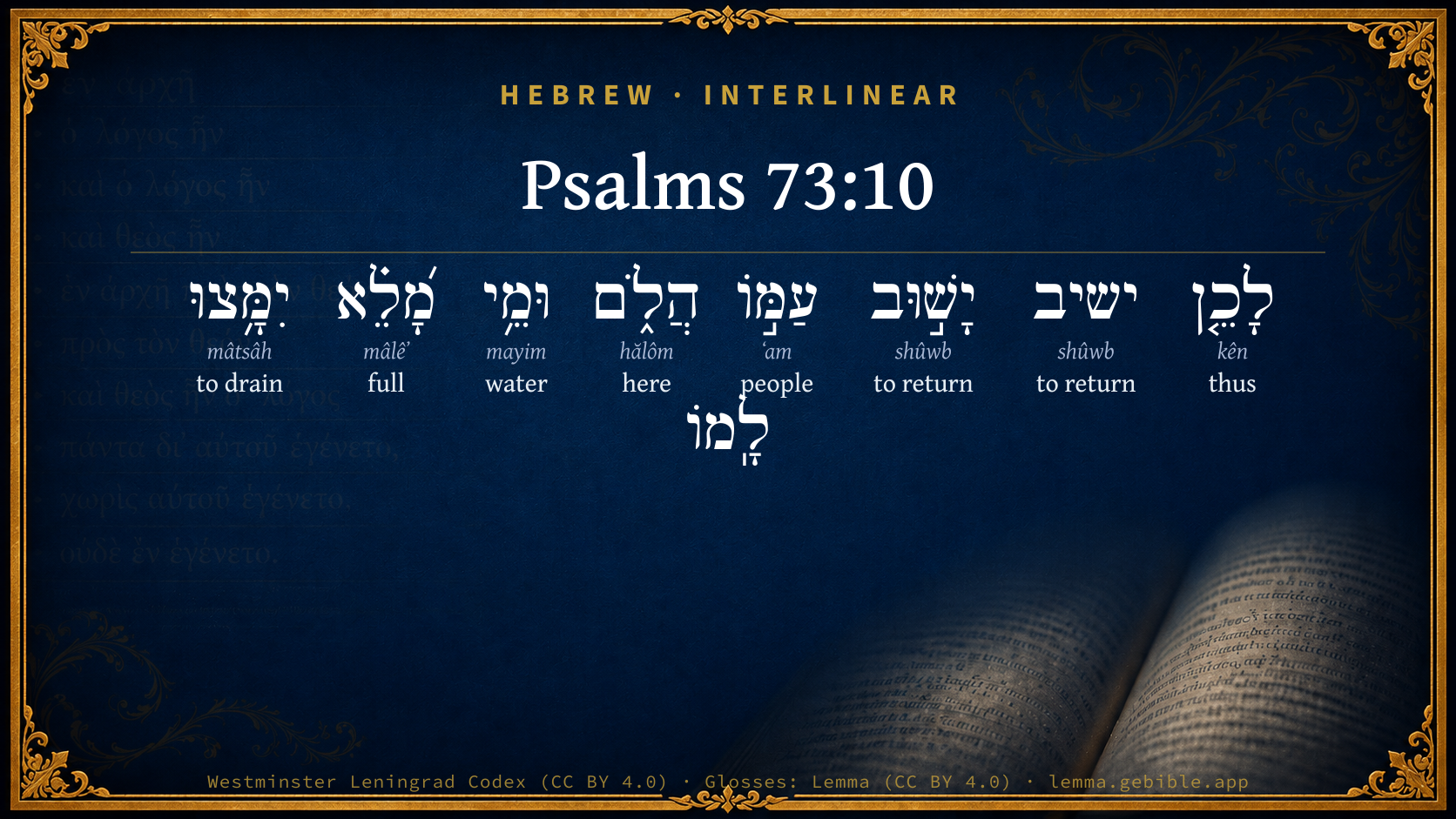
Hebrew (Westminster Leningrad Codex) Psalms 73:10 appears in the Hebrew Old Testament. The text above is from the Westminster Leningrad Codex. Each word links to its Strong’s number, a concise gloss, and parsing drawn from the Open Scriptures Hebrew Bible morphology. Click any word for its full Brown-Driver-Briggs (BDB) entry.
Download image
Cite this verse

Psalms 73:10 (World English Bible). Public Domain. Lemma interlinear Bible study tool, https://lemma.gebible.app/v/psalms/73/10.

Show BibTeX & RIS
BibTeX
RIS
English Translation
Therefore their people return to them, And they drink up waters of abundance.
World English Bible · Public Domain
Download a study sheet

One document with this verse’s original text, its word-by-word gloss line, the meaning frame, cross-references with their text, attributed commentary, and full source and license credits — printable, and it pastes into notes with its structure intact.

This verse Autodidact and up

Study sheet (.html) Plain text (.txt)

A passage Seminary Student

Up to 50 verses in one chapter. A passage sheet keeps up to 6 commentary sources and 12 cross-references per verse, in the order this page ranks them, and says so on the sheet whenever that leaves anything out. Ask for a single verse and you get the Autodidact verse sheet above.

Everything on this page stays free to read, with no account — the sheet is a download of what is already on screen, not access to it.

Want to remove ads? Support Godless Engineer
Compare translations 3

The same verse in 3 English versions, stacked beneath the original-language interlinear above. Click any original word for its lexicon entry.

Each is an independent rendering of the whole verse — the interlinear is not word-aligned to these translations.

Highlighted words mark where these versions differ — a whole-verse word diff, not a word-by-word alignment.

  • World English Bible Public Domain
    Therefore their people return to them, And they drink up waters of abundance.
  • King James Version Public Domain
    Therefore his people return hither: and waters of a full cup are wrung out to them.
  • unfoldingWord Literal Text CC BY-SA 4.0
    Therefore his people turn here, and waters of a full are drained by them.

unfoldingWord Literal Text — © unfoldingWord, licensed CC BY-SA 4.0. Word-aligned USFM3 via Door43 (git.door43.org/unfoldingWord/en_ult).

Versions to compare (up to 4)

3 of 4 selected

Show all 18 translations

Every available English version of this verse, each an independent rendering of the whole verse.

  • World English Bible Public Domain
    Therefore their people return to them, And they drink up waters of abundance.
  • Berean Standard Bible Public Domain
    So their people return to this place and drink up waters in abundance.
  • Majority Standard Bible Public Domain
    So their people return to this place and drink up waters in abundance.
  • King James Version Public Domain
    Therefore his people return hither: and waters of a full cup are wrung out to them.
  • American Standard Version (1901) Public Domain
    Therefore his people return hither: And waters of a full `cup' are drained by them.
  • Revised Version (1885) Public Domain
    Therefore his people return hither: and waters of a full cup are wrung out by them.
  • Geneva Bible (1599) Public Domain
    Therefore his people turne hither: for waters of a full cup are wrung out to them.
  • Douay-Rheims (1899) Public Domain
    Therefore will my people return here and full days shall be found in them.
  • Young's Literal Translation Public Domain
    Therefore do His people return hither, And waters of fulness are wrung out to them.
  • Literal Standard Version CC BY-SA 4.0
    Therefore His people return here, || And waters of fullness are wrung out to them.
  • Unlocked Literal Bible CC BY-SA 4.0
    Therefore his people turn to them and abundant waters are drained out.
  • unfoldingWord Literal Text CC BY-SA 4.0
    Therefore his people turn here, and waters of a full are drained by them.
  • Darby Bible Public Domain
    Therefore his people turn hither, and waters in fulness are wrung out to them.
  • World Messianic Bible Public Domain
    Therefore their people return to them, and they drink up waters of abundance.
  • Webster's Bible Public Domain
    Therefore his people return hither: and waters of a full cup are wrung out to them.
  • Free Bible Version CC BY-SA 4.0
    As a result people turn to them and drink in everything they say.
  • Bible in Basic English Public Domain
    For this reason they are full of bread; and water is ever flowing for them.
  • JPS Tanakh (1917) Public Domain
    Therefore His people return hither; and waters of fullness are drained out by them.

Literal Standard Version (2020), Covenant Press — licensed CC BY-SA 4.0. Text via the HelloAO Bible API (eBible.org). Unlocked Literal Bible (unfoldingWord) — licensed CC BY-SA 4.0. Text via the HelloAO Bible API (eBible.org). unfoldingWord Literal Text — © unfoldingWord, licensed CC BY-SA 4.0. Word-aligned USFM3 via Door43 (git.door43.org/unfoldingWord/en_ult). Free Bible Version, Dr. Jonathan Gallagher — licensed CC BY-SA 4.0. Text via the HelloAO Bible API (eBible.org).

Word by word

More ways to search: Search by grammar → Find every occurrence → Compare this word →

Practice this passage: Drill this verse → Learn its vocabulary →

About this verse

These counts appear in no published source. They are computed here, from the morphology-tagged text and Lemma’s own curated glosses. What Lemma adds →

9
words
7
distinct lemmas
Wisdom
section

Notable vocabulary

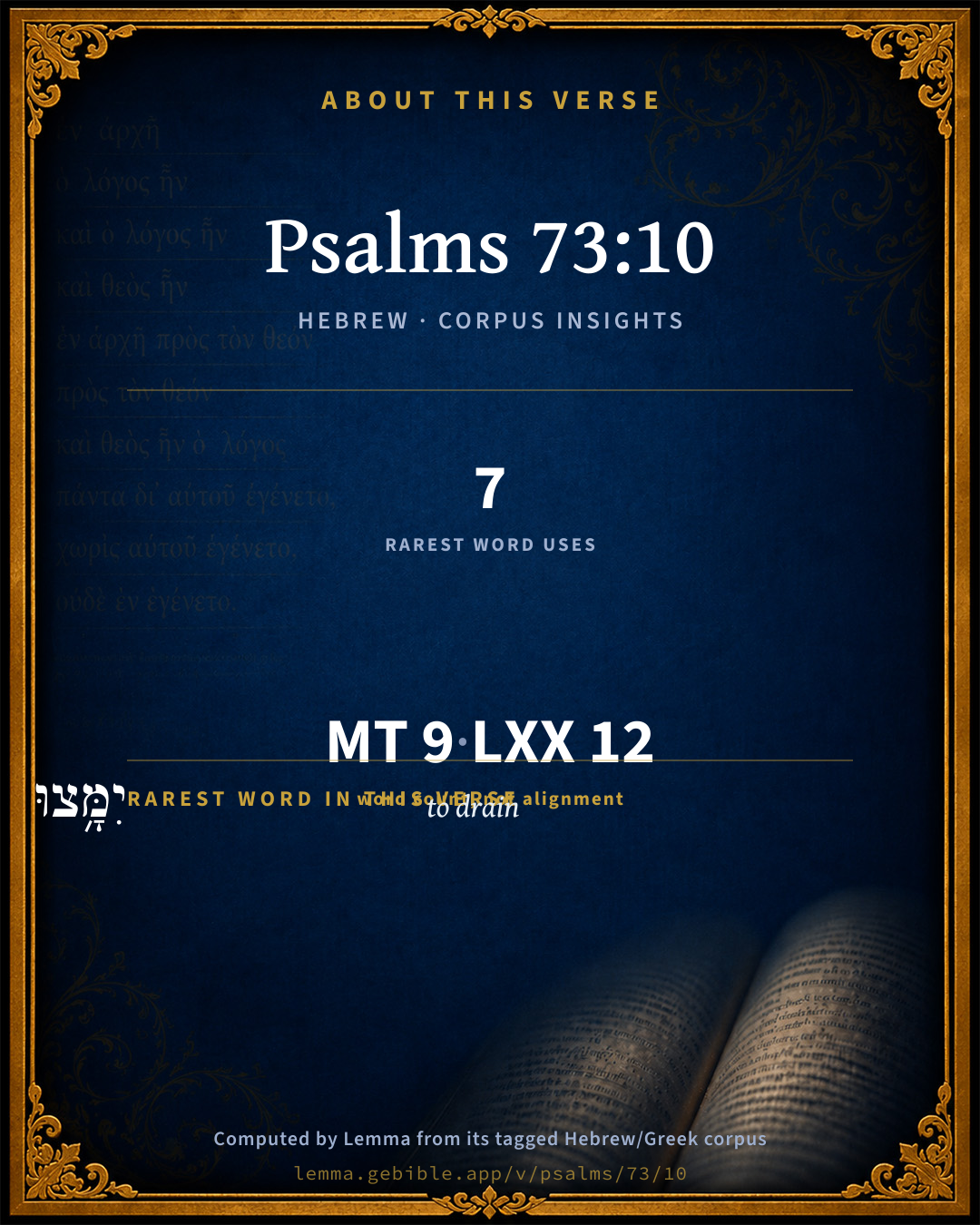
The rarest word here is יִמָּ֥צוּ to drain H4680 — appearing just 7 times in the whole Hebrew Bible.

Shared distinctive vocabulary

יִמָּ֥צוּ to drain H4680 occurs in 7 verses of the Hebrew Bible. Also found in:

Grammatical profile

  • 3 verbs
  • 2 nouns
  • 1 adjective
  • 1 preposition
  • 2 adverbs

Verb forms

  • ישיב Hiphil · Imperfect
  • יָשׁ֣וּב Qal · Imperfect
  • יִמָּ֥צוּ Niphal · Imperfect

Repetition

A word recurs within this verse — often emphatic in Hebrew:

  • ישיב to return H7725 ×2

Hebrew & Septuagint length

In English translation the verse runs 13 words from the Hebrew and 14 from the Septuagint (LXX English) — closely comparable.

A rough comparison of the two English renderings, which tokenize alike — not a word-level alignment.

Word counts can differ between the Hebrew and the Greek without any difference in meaning — e.g. the Hebrew direct-object marker אֵת has no separate Greek word, and Greek often adds the article ὁ.

In the original languages it is 9 Hebrew tokens and 12 Greek tokens — but the two are counted differently (Hebrew bundles its prefixes and suffixes into one token; the Greek is in lemma form), so that isn’t a like-for-like length.

Cross-references

1

Topical passages linked to Psalms 73:10 in the Treasury of Scripture Knowledge — connected by theme and wording, ordered by reader-vote popularity; previews shown in the World English Bible.

  • Psalms 75:8 For in the hand of Yahweh there is a cup, Full of foaming wine mixed with spices. He pours it out. Indeed the wicked of the earth drink and drink it to its very dregs.

Cross-references courtesy of OpenBible.info (CC BY 4.0).

Hebrew and Greek witnesses Masoretic Hebrew ↔ Greek Septuagint

The same verse in the two great witnesses to the Old Testament, shown verse-for-verse.

You’re reading Greek Psalm 72 (Hebrew Psalm 73). The Septuagint counts the superscription, so verse numbers can differ from the Hebrew — chapter-level alignment, not verse-by-verse. Numbering follows Rahlfs.

These are two independent witnesses, not word-aligned to each other, and the Septuagint is shown in lemma (dictionary) form.

Hebrew Psalms 73:10 Masoretic · Westminster Leningrad Codex

לָכֵ֤ן ישיב יָשׁ֣וּב עַמּ֣וֹ הֲלֹ֑ם וּמֵ֥י מָ֝לֵ֗א יִמָּ֥צוּ לָֽמוֹ

Therefore their people return to them, And they drink up waters of abundance.

World English Bible · Public Domain

Greek LXX Greek Psalm 72:10 Septuagint · lemma form

διά οὗτος ἐπιστρέφω ὁ λαός ἐγώ ἐνταῦθα καί ἡμέρα πλήρης εὑρίσκω αὐτός

Therefore shall my people return hither: and full days shall be found with them.

LXX2012 (modern English Septuagint) · Public Domain

On this verse, Adam Clarke's Commentary discusses the Septuagint’s reading. Read the note in Commentary ↓

Hebrew: Westminster Leningrad Codex (CC BY 4.0). Greek: Septuagint (public domain); English from LXX2012 (modern English Septuagint) (Public Domain). How the Septuagint differs from the Hebrew →

Commentary

Notes on Psalms 73:10 from classic Christian and Jewish commentators (each source and its license shown beneath its notes). The classic Christian expositions comment on the surrounding passage and are grouped to its opening verse, so a note may address several verses; the Jewish commentaries on the Tanakh (Rashi and others) are per-verse, so they appear only where the commentator wrote on this verse.

Lemma curates 59 commentaries, every one of them public domain or Creative Commons licensed, each selected and text-cleaned for this edition rather than reprinted as found. About our sources →

Trapp's Complete Commentary

John Trapp

Psa 73:10 Therefore his people return hither: and waters of a full [cup] are wrung out to them.

Ver. 10. Therefore his people return hither] i.e. Some good men are as wise (or rather as foolish) as I have been, to miscensure on this manner, and to repent me of my repentance, or to say, as Psa 73:11, "How doth God know?" &c.

And waters of a full cup are wrung out unto them] That is, because the wicked drink wine in bowls, their servants wringing the rich ripe grapes thereinto, as Gen 40:11. Or, because God sendeth them (his people) perpetual and extreme afflictions, which is meant, say some, by drinking off a cup, and squeezing all the liquor into it. Others read it, Full waters are wrung out to them, that is, say they, these their thoughts and speeches savouring of infidelity, shall cost them abundance of tears; as Peter’s fall did him.

John Trapp, A Commentary or Exposition upon All the Books of the Old and New Testament (1647–1656) — public domain. Text from a community e-Sword module.

The Biblical Illustrator

Joseph S. Exell

Psa_73:10

Therefore His people return hither, and waters of a full cup are wrung out to them.

The full cup for Christ and His people

It is great comfort to meet amid the many references to the ungodly the mention of the people of God. But in the text he tells the sad truth that, owing to what they saw of the prosperity of the ungodly, many of His people--Gods people--return hither, that is, to the same unhappy place of doubt and unbelief where his own feat had well nigh slipped. It is disreputable ground for a Christian, but many of them have been found there. Observe, then, the following three things, which are set forth in my text: first, the holy and honourable household specified as His people; second, their usual experience--a cup, a full cup, waters of a full cup wrung out to them. And then, in the third place, we will glance at the pattern and contrast all of this in the cup of Christ. (Joseph Irons.)

The Biblical Illustrator, edited by Joseph S. Exell (c. 1880s–1900s) — public domain. Text from a community e-Sword module.

Joseph Benson's Commentary

Psa 73:10. Therefore his people return hither — “It seems impossible to ascertain,” says Dr. Horne, “with any degree of precision, the meaning of this verse, or to whom it relates. Some think it intends those people who resort to the company of the wicked, because they find their temporal advantage by it; while others are of opinion that the people of God are meant, who, by continually revolving in their thoughts the subject here treated of, namely, the prosperity of the wicked, are sore grieved, and enforced to shed tears in abundance.” Certainly a variety of discordant interpretations have been given of the verse. But a literal translation, which the following is, seems, in some degree at least, to determine its meaning. Therefore — Hebrew, לכן, lachen, on this account, his people shall return thither, and waters of fullness shall be wrung out to them — As if he had said, Because of the prosperity of the wicked, and the afflicted state of the righteous, his people, that is, the people of God, will be under a strong temptation to return; and many will actually return to the company of the ungodly, which they had forsaken, in order to share their prosperity: but in consequence thereof, waters of a full cup shall be wrung out to them, they shall bring upon themselves many chastisements and troubles, and shall be oppressed with grief and sorrow for their sin and folly. Waters, in Scripture, frequently signify afflictions, although, it must be acknowledged, they also often signify mercies and comforts; but the former, and not the latter sense of the metaphor, seems to be intended here: for when did, or do, the people of God receive mercies and comforts, or blessings of any kind, by returning to the sins and follies which they had forsaken, or to the society of the ungodly, from which they had withdrawn themselves? Do they not uniformly meet with chastisement and trouble? The clause, “waters of a full cup,” &c., may probably refer to the cups of liquor, mingled with poison, which were, in those days, given to criminals. The verse, it must be observed, is in the future tense, and it seems most natural, as Mr. Scott has remarked, to interpret it as expressive of the psalmist’s apprehension, that the prosperity of daring sinners would eventually prove a strong temptation, and a great source of sorrow to believers.

Joseph Benson's Commentary on the Old and New Testaments (1811–1818) — public domain. Text from a community e-Sword module.

J. A. Alexander on Psalms

Joseph Addison Alexander

Psa 73:10. Therefore he brings back his people hither, and waters of fulness are wrung out to them (or drained by them). This obscure verse admits of several interpretations, the most natural of which understands the sense to be, that God still suffers or requires his people to survey the painful spectacle and drain the bitter draught presented by the undisturbed prosperity of wicked men. According to the masoretic reading in the margin of the Hebrew Bible, the first verb is intransitive, his people shall (or must) return thither. See above, on Psa 14:7; Psa 53:6.

Joseph Addison Alexander, The Psalms Translated and Explained (1850) — public domain. Text from a community e-Sword module.

Geneva Bible (1599)

Geneva Bible translators

Not only the reprobate, but also the people of God oftentimes fall back, seeing the prosperous estate of the wicked, and are overwhelmed with sorrows, thinking that God considereth not aright the estate of the godly.

Geneva Bible (1599) marginal notes — public domain. Text via Bolls.life.

Adam Clarke's Commentary

Verse 10. Therefore his people return hither] There are very few verses in the Bible that have been more variously translated than this; and, like the man in the fable, they have blown the hot to cool it, and the cold to warm it. It has been translated, "Therefore God's people fall off to them; and thence they reap no small advantage." And, "Therefore let his people come before them; and waters in full measure would be wrung out from them." That is, "Should God's people come before them, they would squeeze them to the utmost; they would wring out all the juice in their bodies." The Chaldee has, "Therefore, are they turned against the people of the Lord, that they may bruise and beat them with mallets; that they may pour out to them abundance of tears." The Vulgate, "Therefore shall my people return here, and days of abundance shall be found by them." The Septuagint is the same. The AEthiopic, Arabic, and Syriac, nearly the same. The Hebrew text is, לכן ישוב עמו הלם ומי מלא ימצו למו lachen yashub ammo (עמי ammi) halom; umey male yimmatsu lamo; "Therefore shall my people be converted, where they shall find abundance of waters." That is, The people, seeing the iniquity of the Babylonians, and feeling their oppressive hand, shall be converted to me; and I shall bring them to their own land, where they shall find an abundance of all the necessaries of life. I believe this to be the meaning; and thus we find their afflictions were sanctified to them; for they obliged them to return to God, and then God caused them to return to their own land. The Vulgate translates ומי מלא umey male, "abundance of waters," by et dies pleni, "and days of plenty;" for it has read ימי yemey, days, for ומי umey, and waters. Almost all the Versions support this reading; but it is not acknowledged by any MS. The old Psalter is here mutilated.

Adam Clarke's Commentary on the Bible (1810–1826) — public domain. Text from a community e-Sword/MySword module.

John Calvin's Commentaries

10. On this account his people will return hither. Commentators wrest this sentence into a variety of meanings. In the first place, as the relative his is used, without an antecedent indicating whose people are spoken of, some understand it simply of the ungodly, as if it had been said, That the ungodly always fall back upon this reflection: and they view the word people as denoting a great troop or band; for as soon as a wicked man raises his standard, he always succeeds in drawing a multitude of associates after him. They, therefore, think the meaning to be, that every prosperous ungodly man has people flocking about him, as it were, in troops; and that, when within his palace or magnificent mansion, they are content with getting water to drink; so much does this perverse imagination bewitch them. But there is another sense much more correct, and which is also approved by the majority of commentators; namely, that the people of God return hither. Some take the word הלם, halom, which we have rendered hither, as denoting afflicted; but this is a forced interpretation.

The meaning is not, however, as yet, sufficiently evident, and therefore we must inquire into it more closely. Some read the whole verse connectedly, thus: The people of God return hither, that they may drain full cups of the water of sorrow. But, in my opinion, this verse depends upon the preceding statements, and the sense is, That many who had been regarded as belonging to the people of God were carried away by this temptation, and were even shipwrecked and swallowed up by it. The prophet does not seem to speak here of the chosen people of God, but only to point to hypocrites and counterfeit Israelites who occupy a place in the Church. He declares that such persons are overwhelmed in destruction, because, being foolishly led away to envy the wicked, and to desire to follow them, they bid adieu to God and to all religion. Still, however, this might, without any impropriety, be referred to the chosen seed, many of whom are so violently harassed by this temptation, that they turn aside into crooked by-paths: not that they devote themselves to wickedness, but because they do not firmly persevere in the right path. The sense then will be, that not only the herd of the profane, but even true believers, who have determined to serve God, are tempted with this unlawful and perverse envy and emulation. What follows, Waters of a full cup are wrung out to them, seems to be the reason of the statement in the preceding clause, implying that they are tormented with vexation and sorrow, when no advantage appears to be derived from cultivating true religion. To be saturated with waters is put metaphorically for to drink the bitterest distresses, and to be filled with immeasurable sorrows.

John Calvin's Commentaries (1540-1563) — public domain. Text from the Calvin Translation Society English edition (1840s-50s) via the Christian Classics Ethereal Library (ccel.org). Calvin's coverage is partial (roughly two-thirds of the Bible); uncommented books and verses are honest gaps, never fabricated. The 19th-century editor's footnotes and remarks are omitted so the notes are faithfully Calvin's own voice.

Ellicott's Commentary for English Readers

(10) Therefore.—The Prayer Book version has undoubtedly caught the meaning here. It plainly describes the popularity gained (the surest way) by the self-applause described in the preceding verse. This version depends on the Hebrew margin, Therefore do the people turn hither (i.e., to them), and full waters (i.e., a cup full of adulation and flattery) are sucked out by them.

A Bible Commentary for English Readers, edited by Charles John Ellicott (1878–1897) — public domain. Text from a community e-Sword module.

The Cambridge Bible for Schools and Colleges

gen. ed. J. J. S. Perowne

10. A difficult verse. The general sense appears to be that attracted by the prosperity and pretensions of the wicked a crowd of imitators turn to follow them, and in their company drink to the dregs the cup of sinful pleasure. The Psalmist’s temptation is intensified as he contemplates the popularity of the wicked. Cp. Psa_49:13. The details however are obscure. Therefore, because they are deluded by the extravagant pretensions of the wicked. The pronoun his is commonly explained to refer to the wicked regarded as a whole, or to some conspicuous leader among them. The context hardly allows of its reference to God. But the LXX and Syr. may preserve the true reading ‘my people,’ the Psalmist speaking with sorrow of his deluded countrymen. Return should rather be turn; hither, to the wicked and their pernicious ways.

The reading of the Kthîbh given in R.V. marg., he will bring back his people hither, finds no support from the Ancient Versions, and admits of no satisfactory explanation. Waters of fulness are drained by them is a metaphor for the enjoyment of pleasure; or possibly for imbibing pernicious principles. Cp. Job_15:16; and the saying of Jose ben Joezer, “Let thy house be a meeting house for the wise … and drink their words with thirstiness.” Pirqe Aboth, i. 4, cp. 12.

10, 11. The mass of men are carried away by their evil example.

The Cambridge Bible for Schools and Colleges (gen. ed. J. J. S. Perowne; Cambridge University Press, 1878–1918) — public domain. Text from a community e-Sword module.

John Gill's Exposition

Therefore his people return hither,.... Either the true people of God, and so the Targum, the people of the Lord, and whom the psalmist owned for his people; for the Septuagint, Vulgate Latin, Syriac, Arabic, and Ethiopic versions, read "my people"; who seeing the prosperity of the wicked, and feeling their own afflictions, return to the same way of thinking, and fall by the same snare and temptation as the psalmist did; or such who were only the people of God by profession, but hypocrites, who observing the trouble that attends a religious life, and the prosperity of wicked men, return from the good ways of God they have outwardly walked in for some time, to the conversation of these men, and join themselves to them: or else, "his" being put for "their", the sense is, the people of these wicked men, of everyone of them, return unto them, and flock about them, and caress and flatter them, because of their prosperous circumstances, and join with them in their evil practices of oppression and slander; which sense seems best to agree with what goes before and follows after:

and waters of a full cup are wrung out to them; meaning either to the people of God, and to be understood either of the abundance of their tears, on account of their afflictions inward and outward; see Psa 6:6, so the Targum,

"and many tears flow unto them;''

or of their afflictions themselves, which are oftentimes compared to waters in Scripture; see Psa 42:7, which are given them in measure: it is a cup of them that is put into their hands, and in full measure; they have a full cup of them; many are their tribulations, through which they enter the kingdom, and they are all of God; it is he that wrings them out to them with his fatherly hand: or else, taking the people to mean the followers and companions of the wicked, the words are to be understood of the plenty of good things which such men enjoy in this life, their cup runs over; and indeed these seem to be the persons who are introduced speaking the following words.

John Gill's Exposition of the Whole Bible (1746–1763) — public domain (CC PDM 1.0). Text via the HelloAO Bible API.

Albert Barnes' Notes on the Bible

Therefore his people - Those that truly love God; the pious in the earth.

Return hither - Return to this subject. In their musings - their meditations on divine things - they come back to this inquiry. The subject occupies their minds, and they recur to it as a subject which perplexes them; as a thing that is incomprehensible. They think it over again and again, and are more and more perplexed and embarrassed. The difficulties which these facts suggest about God and his government are such that they cannot solve them.

And waters of a full cup are wrung out to them - literally, “waters of fullness;” or, full waters. The Chaldee renders this, “Many tears flow from them.” The Septuagint, and the Latin Vulgate, “And full days shall be found by them.” The word rendered “are wrung out” - from מצה mâtsâh - means properly to “suck;” then, to suck out; to drink greedily. See Isa 51:17. It is applied to one who drinks greedily of an intoxicating cup; and then, to one who drinks a cup of poison to the dregs. Psa 75:8. The meaning here is, that the facts in the case, and the questions which arose in regard to those facts, and which so perplexed them, were like a bitter cup; a cup of poison, or an intoxicating cup which overpowered their faculties - and that they, in their perplexities, “exhausted” the cup. They drank it all, even to the dregs. They did not merely taste it; but they drank it. It was a subject full of perplexity; a subject that wholly overpowered all their faculties, and “exhausted” all their powers.

Albert Barnes' Notes on the Bible (1834–1885) — public domain. Text from a community e-Sword/MySword module.

Matthew Poole's English Annotations

His people; either,

1. The people of those wicked blasphemers; all their children, and servants, and friends, encouraged by their example. Or rather,

2. The people of God, who is oft understood under the pronoun relative he or his, though he be not expressed, as Psa 105:19; Isa 30:23. See the like Psa 87:1; Son 1:2. But then as God’s people are of two sorts, some that are so really and sincerely, and others that are so only in profession and show, in which sense the whole body of the Israelitish nation, yea, even the wicked among them, are called his

people, as Psa 81:11; Isa 1:3; Jer 2:11, &c.; so this may be understood, either,

1. Of those true Israelites, Psa 73:1. Even the godly were startled and stumbled at this, as David was, Psa 37, and Jeremiah, Jer 12 But although they might have some murmuring thoughts about this matter, it seems not probable that they would either give way to such thoughts, or break forth into such expressions, as are here ascribed to them, Psa 73:11; nor are such things to be imputed to them without necessity; nor did either David or Jeremiah in their conflicts utter any thing of this nature. Or rather,

2. Of the carnal, hypocritical Israelites, who perceiving the impunity and prosperity of these ungodly wretches, were easily drawn to the approbation and imitation of their courses. And this may seem most suitable to the context; for the description of the condition, and carriage, and words of these ungodly men, which begins Psa 73:4, seems to be continued to Psa 73:13; then follows the psalmist’s reflection and consideration upon the whole matter, from Psa 73:13 to the end.

Return hither, or, turn hither, i.e. to this wicked company, or to their course.

Waters of a full cup are wrung out to them: waters, in Scripture, do ofttimes signify afflictions, and as oft comforts and mercies. So the sense may be, either,

1. And whilst the wicked prosper, God doth wring out waters out of the cup of tribulation, and causeth his holy ones to drink them up: compare Psa 75:8; 80:5; Isa 51:17; Jer 25:15, &c. Or rather,

2. And those hypocritical Israelites find themselves gainers by their apostacy, and they partake of the same prosperity with their leaders, and God seems to give them a full cup of consolation, and to pour forth his mercies upon them in such abundance, as if he would wring or squeeze out all his blessings out of his stores to bestow upon them. And meeting with such success to their wickedness, it is not strange if they put that question, Psa 73:11.

Matthew Poole's English Annotations on the Holy Bible (1683–1685) — public domain. Text from a community e-Sword/MySword module.

The Treasury of David

Charles H. Spurgeon

Ver. 10. Therefore his people return hither. God's people are driven to fly to his throne for shelter; the doggish tongues fetch home the sheep to the Shepherd. The saints come again, and again, to their Lord, laden with complaints on account of the persecutions which they endure from these proud and graceless men.

And waters of a full cup are wrung out to them. Though beloved of God, they have to drain the bitter cup; their sorrows are as full as the wicked man's prosperity. It grieves them greatly to see the enemies of God so high, and themselves so low, yet the Lord does not alter his dispensations, but continues still to chasten his children, and indulge his foes. The medicine cup is not for rebels, but for those whom Jehovah Rophi loves.

Ver. 10. Therefore his people return hither. It seems impossible to ascertain, with any degree of precision, the meaning of this verse, or to whom it relates. Some think it intends those people who resort to the company of the wicked, because they find their temporal advantage by it; while others are of opinion that the people of God are meant, who, by continually revolving in their thoughts the subject here treated of, namely, the prosperity of the wicked, are sore grieved and forced to shed tears in abundance. Mr. Mudge translates the verse thus: Therefore let his (God's) people come before them, and waters in full measure would be wrung out from them; that is, should God's people fall into their hands, they would squeeze them to the full, they would wring out all the juice out of their bodies. He takes waters in full measure to have been a proverbial expression. Samuel Burder.

Ver. 10.

I. The believer's cup is bitter.

II. It is full.

III. Its contents are varied waters.

IV. It is but a cup, measured and limited.

V. It is the cup of his people, and, consequently,

works good in the highest degree.

Psalms 73:11*

Charles H. Spurgeon's The Treasury of David (1869–1885) — public domain. Psalms only. Text from a community e-Sword/MySword module.

Whedon's Commentary on the Bible

Daniel D. Whedon

10. Therefore his people return hither—That is, “God still suffers or requires his people to survey the painful spectacle, and drain the bitter draught presented by the undisturbed prosperity of wicked men.”— Alexander. This is the most natural and best sustained sense of this obscure passage. See Psa_80:5. The verb שׁוב, (shoobh,) return, here denotes a subjective, or mental returning, as it often does; (see 2Ch_6:24; 2Ch_6:37-38; Mal_3:18;) and the adverbial pronoun, הלמ, (halom,) hither, is not to be understood of place, but of subject. God’s people mentally turn to this subject to consider the mystery of providence in allowing this difference between a suffering Church and the prosperous wicked.

Daniel D. Whedon (gen. ed.), Commentary on the Old and New Testaments (1874–1909) — public domain. Text from a community e-Sword module.

The Pulpit Commentary

Therefore his people return hither; rather, therefore he turns his people hitherward; i.e. by his great pretensions and his audacity, he (the wicked man) turns his followers to his own courses, and induces them to act as he acts. And waters of a full cup are wrung out to them; rather, and waters in abundance are drained by them. They "drink iniquity like water", (Job_15:16) "draining" the cup which is handed to them.

The doings of ungodly prosperity.

One of three of these doings seems to have been in the psalmist"s mind, but we cannot certainly say which. The words warrant either interpretation. Let us take, first, that one suggested by them as they stand in the Authorized Version, and as commonly read.

I THE PEOPLE OF GOD ARE LED ASTRAY. For by "his people" many understand the people of God to be meant, and that they, allured and ensnared by the glitter of earthly prosperity, turn from the ways of God to follow after these ungodly ones. "They are led away by the evil example, just as the psalmist confesses he himself was;" and they turn after them. (Cf. "Demas hath forsaken me, having loved this present world.") How often this happens" But what is meant by the "waters of a full cup," etc.? Either the cup of unholy pleasure, which they drain to the dregs; or else it is, as in Psa_80:5, and as actual experience attests, that when God"s people go astray, as here represented, it will be a full cup of sorrow and tears that they will have to drink, as indeed they do. The most miserable of men are backsliders from God. It cannot but be so. This is what our translators meant to imply by their rendering. But another meaning that the words warrant is

II A CROWD FOLLOW THEM, THAT IS, THE UNGODLY. The people spoken of are the crowd of hangers on to the prosperous those who will try to find favour with the rich and great of this world. The Prayer book Version thus sets it forth: "Therefore the people fall unto them, and there out suck they no small advantage." These hangers on are the people who attach themselves to the world"s rich ones, and "who gather like sheep to the water trough," in hopes of what they may get. But whether they get anything or no, the ungodly whom they follow do; they "suck no small advantage." They are yet more worshipped and fawned upon, and have ready to hand innumerable and willing tools to serve their purpose and to bring more "grist to their mill." And the result is that they get more proud and arrogant than ever (see ver. 11). But, child of God, whoe"er thou art, say to thy soul, "My soul, come not thou into their secret.

III THE PEOPLE OF GOD HAVE TO SUFFER BITTER PERSECUTION. So the Chaldee, the Septuagint, and the Vulgate seem to understand the words. The wicked turn upon God"s people, who are, in consequence, "fed with the bread of tears, and have given to them tears to drink without measure". (Psa_80:5) It is the predestined lot of the people of God; but our Saviour tells us that it is a blessed portion. The last and chiefest of the Beatitudes (Mt 5) declares, "Blessed are ye when men shall persecute you," etc. And it is so; for it shows, by your endurance of persecution, that you have found out the preciousness of the love of God, and know assuredly that, for the sake of it, you may be well content to die. That is knowledge which is, here and now, life eternal. May God keep us from exemplifying the first of these interpretations, and from forming part of that miserable crowd told of in the second! but if we are found amongst the third, then Christ will call us his blessed ones. S.C.

The Pulpit Commentary (1880–1919), ed. H.D.M. Spence-Jones & Joseph S. Exell — public domain. Text from a community e-Sword module.

John Wesley's Explanatory Notes

Turn - To this wicked company. Waters - And partake of the same prosperity with their leaders. God seems to give them a full cup of consolation, as if he would wring out all his blessings upon them.

John Wesley, Explanatory Notes Upon the Whole Bible (1754–1765) — public domain. Text via the GEBible commentary corpus.

unfoldingWord translationNotes

Door43 World Missions Community

General Information:

Asaph continues to describe how he sometimes wants to complain to God about those who are "arrogant" and "wicked" (Psalms 73:3).

his people turn to them

Possible meanings are 1) "God's people love the wicked people" or "the wicked people return to this place"

abundant waters are drained out

Possible meanings are 1) "God's people listen gladly to the words of the wicked people" or 2) "the wicked people have plenty of food to eat and wine to drink"

They say

the wicked people say

How does God know? Is there knowledge with the Most High?

These rhetorical questions are to show contempt for God. These questions can be translated as statements. AT: "Surely God does not know what we are doing. The Most High has no knowledge of it." (See: Rhetorical Question)

translationWords

people of God

turn

know

Most High

people group

unfoldingWord translationNotes — © Distant Shores Media and the Door43 World Missions Community, licensed CC BY-SA 4.0. Source: git.door43.org/Door43/en_tn.

Rashi

Rabbi Shlomo Yitzchaki (Rashi)

Therefore, His people will return here Since His people sees that the way of the wicked prospers, they will return on the way of the wicked, to adopt their ways.

here Heb. הלם, as (Jud. 18: 3): “Who brought you here (הלום)?” [Equivalent to] פֹּה.

and the waters of the full are drain water to them And the waters of the full stream—they are words of Torah—are considered by them as water that drains out, and they despise them.

Rashi on the Tanakh — English translations: “The Judaica Press complete Tanach with Rashi, translated by A. J. Rosenberg” (CC BY 4.0); “Pentateuch with Rashi's commentary by M. Rosenbaum and A.M. Silbermann, 1929-1934” (public domain); “The Metsudah Tanach series, Lakewood, N.J” (CC BY 4.0); and “The Book of Joshua, Metsudah Publications, 1997” (CC BY 4.0). Text via Sefaria.

Lesson kit

Teaching starters — assembled from the data on this page, not authored interpretation. Every prompt links to the verse data it draws on. Edit before teaching.

Psalms, in the Wisdom, opens this verse with 9 words (7 distinct Hebrew lemmas). Its most distinctive word is mâtsâh (“to drain”). A historical commentator’s framing appears above. Read the whole chapter for the surrounding context.

Discussion questions

  1. What does “to drain” (mâtsâh) contribute to the verse as a whole?
  2. How does Leviticus 1:15, which shares the word «to drain», read alongside this verse?
  3. What does the repetition of “to return” (2× in this one verse) do in this verse?
  4. The translations on this page render this verse differently — a whole-verse word diff, not a word-by-word alignment. What might account for the different wordings?
  5. «ישיב» is a Hiphil Imperfect verb. How does that grammatical form shape the action described?
  6. Compare how Trapp's Complete Commentary and The Biblical Illustrator read this verse. Where do they agree or differ?

Things to notice

Reading settings

Reading text

Shown beneath each verse's original-language words.

Old Testament
Old Testament edition

Read the OT as the Masoretic Hebrew (MT) or the Greek Septuagint (LXX).

English shown for the Greek Septuagint (in the Hebrew ↔ Greek comparison).

Comparing translations? Open the Compare panel on any verse page to stack up to four side by side.