Song of Solomon 5:14

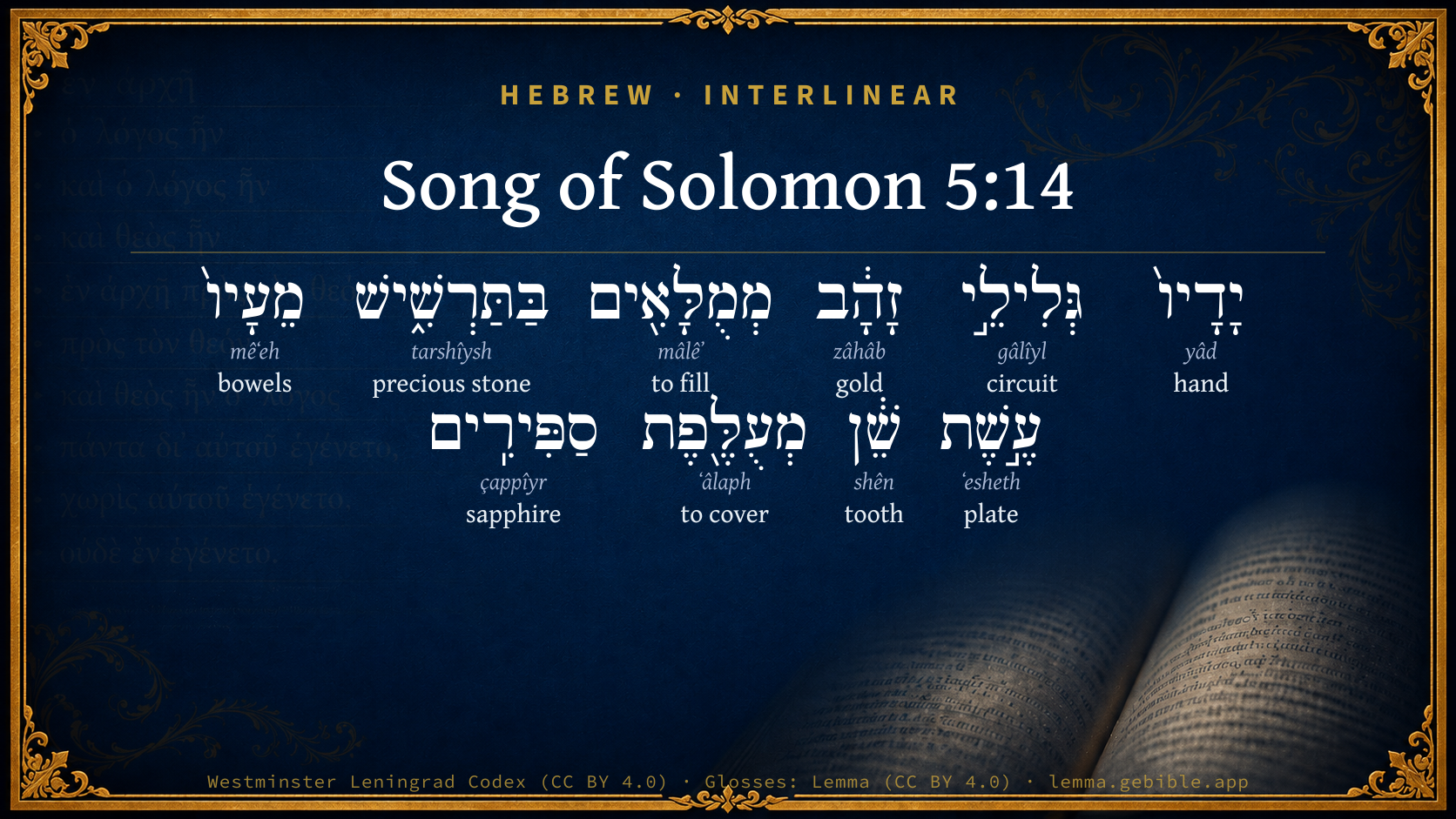
Hebrew (Westminster Leningrad Codex) Song of Solomon 5:14 appears in the Hebrew Old Testament. The text above is from the Westminster Leningrad Codex. Each word links to its Strong’s number, a concise gloss, and parsing drawn from the Open Scriptures Hebrew Bible morphology. Click any word for its full Brown-Driver-Briggs (BDB) entry.
Download image
Cite this verse

Song of Solomon 5:14 (World English Bible). Public Domain. Lemma interlinear Bible study tool, https://lemma.gebible.app/v/song-of-solomon/5/14.

Show BibTeX & RIS
BibTeX
RIS
English Translation
His hands are like rings of gold set with beryl. His body is like ivory work overlaid with sapphires.
World English Bible · Public Domain
Highlights
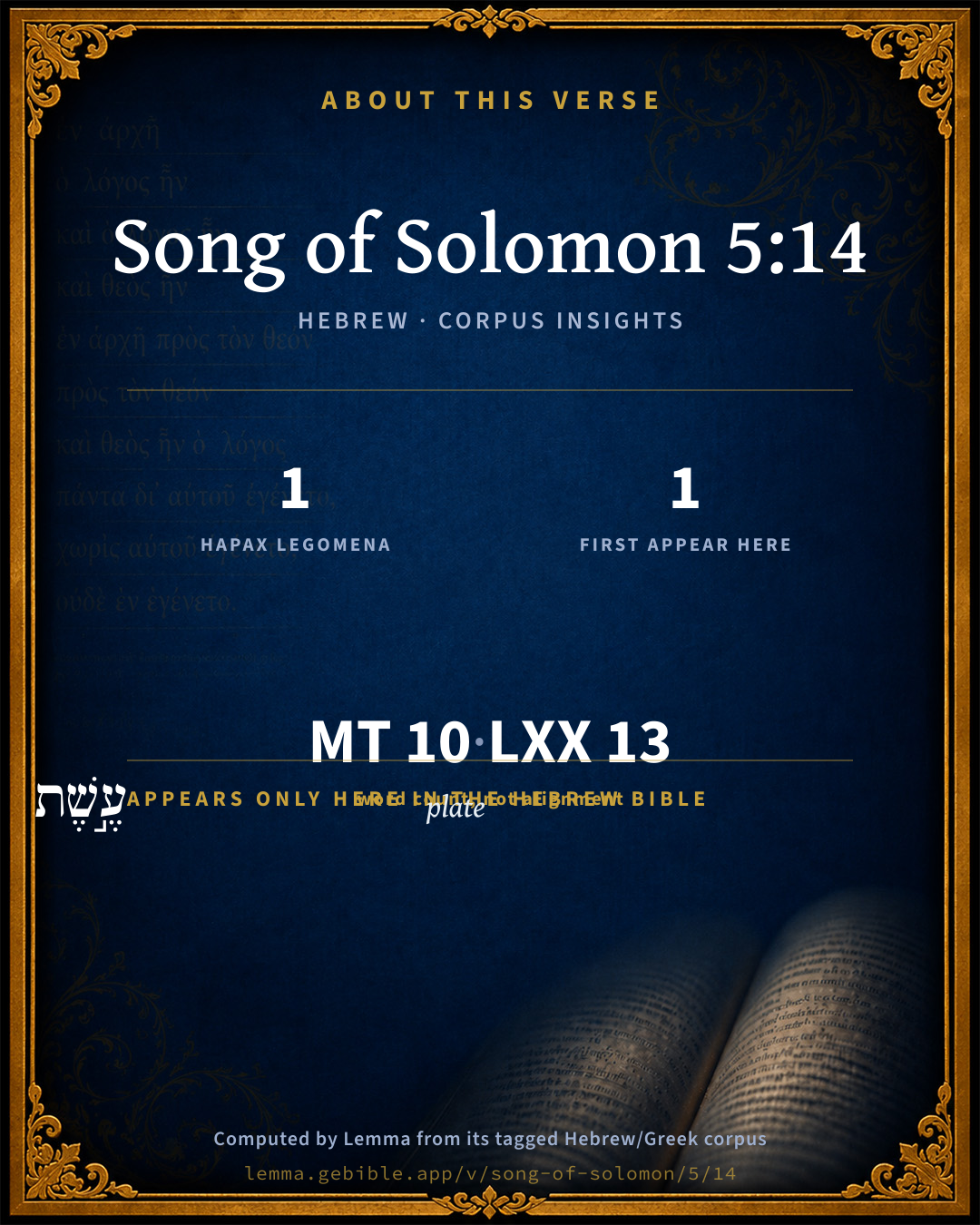
  • 1 hapax legomenon — only here in the Hebrew Bible
  • 1 first appearance in the Hebrew Bible
Full analysis ↓
Download a study sheet

One document with this verse’s original text, its word-by-word gloss line, the meaning frame, cross-references with their text, attributed commentary, and full source and license credits — printable, and it pastes into notes with its structure intact.

This verse Autodidact and up

Study sheet (.html) Plain text (.txt)

A passage Seminary Student

Up to 50 verses in one chapter. A passage sheet keeps up to 6 commentary sources and 12 cross-references per verse, in the order this page ranks them, and says so on the sheet whenever that leaves anything out. Ask for a single verse and you get the Autodidact verse sheet above.

Everything on this page stays free to read, with no account — the sheet is a download of what is already on screen, not access to it.

Want to remove ads? Support Godless Engineer
Compare translations 3

The same verse in 3 English versions, stacked beneath the original-language interlinear above. Click any original word for its lexicon entry.

Each is an independent rendering of the whole verse — the interlinear is not word-aligned to these translations.

Highlighted words mark where these versions differ — a whole-verse word diff, not a word-by-word alignment.

  • World English Bible Public Domain
    His hands are like rings of gold set with beryl. His body is like ivory work overlaid with sapphires.
  • King James Version Public Domain
    His hands are as gold rings set with the beryl: his belly is as bright ivory overlaid with sapphires.
  • unfoldingWord Literal Text CC BY-SA 4.0
    His arms rods of gold mounted with topaz; his belly a plate of ivory covered sapphires.

unfoldingWord Literal Text — © unfoldingWord, licensed CC BY-SA 4.0. Word-aligned USFM3 via Door43 (git.door43.org/unfoldingWord/en_ult).

Versions to compare (up to 4)

3 of 4 selected

Show all 18 translations

Every available English version of this verse, each an independent rendering of the whole verse.

  • World English Bible Public Domain
    His hands are like rings of gold set with beryl. His body is like ivory work overlaid with sapphires.
  • Berean Standard Bible Public Domain
    His arms are rods of gold set with beryl. His body is an ivory panel bedecked with sapphires.
  • Majority Standard Bible Public Domain
    His arms are rods of gold set with beryl. His body is polished ivory bedecked with sapphires.
  • King James Version Public Domain
    His hands are as gold rings set with the beryl: his belly is as bright ivory overlaid with sapphires.
  • American Standard Version (1901) Public Domain
    His hands are `as' rings of gold set with beryl: His body is `as' ivory work overlaid `with' sapphires.
  • Revised Version (1885) Public Domain
    His hands are as rings of gold set with beryl: his body is as ivory work overlaid with sapphires.
  • Geneva Bible (1599) Public Domain
    His hands as rings of gold set with the chrysolite, his belly like white yuorie couered with saphirs.
  • Douay-Rheims (1899) Public Domain
    His hands are turned and as of gold, full of hyacinths. His belly as of ivory, set with sapphires.
  • Young's Literal Translation Public Domain
    His hands rings of gold, set with beryl, His heart bright ivory, covered with sapphires,
  • Literal Standard Version CC BY-SA 4.0
    His hands rings of gold, set with beryl, || His heart bright ivory, covered with sapphires,
  • Unlocked Literal Bible CC BY-SA 4.0
    His arms are rounded gold set with jewels; his abdomen is ivory covered with sapphires.
  • unfoldingWord Literal Text CC BY-SA 4.0
    His arms rods of gold mounted with topaz; his belly a plate of ivory covered sapphires.
  • Darby Bible Public Domain
    His hands gold rings, set with the chrysolite; His belly is bright ivory, overlaid [with] sapphires;
  • World Messianic Bible Public Domain
    His hands are like rings of gold set with beryl. His body is like ivory work overlaid with sapphires.
  • Webster's Bible Public Domain
    His hands are as gold rings set with the beryl: his belly is as bright ivory overlaid with sapphires.
  • Free Bible Version CC BY-SA 4.0
    His arms are round bars of gold inlaid with jewels. His abdomen is like carved ivory inlaid with lapis lazuli.
  • Bible in Basic English Public Domain
    His hands are as rings of gold ornamented with beryl-stones; his body is as a smooth plate of ivory covered with sapphires.
  • JPS Tanakh (1917) Public Domain
    His hands are as rods of gold set with beryl; his body is as polished ivory overlaid with sapphires.

Literal Standard Version (2020), Covenant Press — licensed CC BY-SA 4.0. Text via the HelloAO Bible API (eBible.org). Unlocked Literal Bible (unfoldingWord) — licensed CC BY-SA 4.0. Text via the HelloAO Bible API (eBible.org). unfoldingWord Literal Text — © unfoldingWord, licensed CC BY-SA 4.0. Word-aligned USFM3 via Door43 (git.door43.org/unfoldingWord/en_ult). Free Bible Version, Dr. Jonathan Gallagher — licensed CC BY-SA 4.0. Text via the HelloAO Bible API (eBible.org).

Word by word

More ways to search: Search by grammar → Find every occurrence → Compare this word →

Practice this passage: Drill this verse → Learn its vocabulary →

עֶ֣שֶׁת
ʻesheth
H6247
“plate of”
Noun, Common, Masculine, Singular, Construct
Part of Speech
Noun
Type
Common
Gender
Masculine
Number
Singular
State
Construct
Full BDB Definition

Origin: from H6245

TWOT: 1716a

plate, slab, something fabricated
  1. יָדָיו֙ yâd H3027 “hands · his” Noun, Common, Both, Dual, Construct + Suffix, Personal, 3rd Person, Masculine, Singular
  2. גְּלִילֵ֣י gâlîyl H1550 “rods of” Noun, Common, Masculine, Plural, Construct
  3. זָהָ֔ב zâhâb H2091 “gold” Noun, Common, Masculine, Singular, Absolute
  4. מְמֻלָּאִ֖ים mâlêʼ H4390 “filled” Verb, Pual, Participle Passive, Masculine, Plural, Absolute
  5. בַּתַּרְשִׁ֑ישׁ tarshîysh H8658 “in/at the · precious stone” Preposition, Determined + Noun, Common, Masculine, Singular, Absolute
  6. מֵעָיו֙ mêʻeh H4578 “bowels · his” Noun, Common, Masculine, Plural, Construct + Suffix, Personal, 3rd Person, Masculine, Singular
  7. שֵׁ֔ן shên H8127 “tooth” Noun, Common, Both, Singular, Absolute
  8. מְעֻלֶּ֖פֶת ʻâlaph H5968 “covered” Verb, Pual, Participle Passive, Feminine, Singular, Absolute
  9. סַפִּירִֽים çappîyr H5601 “sapphires” Noun, Common, Masculine, Plural, Absolute

About this verse

These counts appear in no published source. They are computed here, from the morphology-tagged text and Lemma’s own curated glosses. What Lemma adds →

10
words
10
distinct lemmas
Wisdom
section

Notable vocabulary

1 hapax legomenon — a word that appears only here in the entire Hebrew Bible:

  • עֶ֣שֶׁת plate H6247

First appearance in Scripture

This word makes its first canonical appearance in the Hebrew Bible here:

  • עֶ֣שֶׁת plate H6247

Shared distinctive vocabulary

גְּלִילֵ֣י circuit H1550 occurs in 3 verses of the Hebrew Bible. Also found in:

Grammatical profile

  • 2 verbs
  • 8 nouns

Verb forms

  • מְמֻלָּאִ֖ים Pual · Participle Passive
  • מְעֻלֶּ֖פֶת Pual · Participle Passive

Hebrew & Septuagint length

In English translation the verse runs 19 words from the Hebrew and 19 from the Septuagint (LXX English) — the same length.

A rough comparison of the two English renderings, which tokenize alike — not a word-level alignment.

Word counts can differ between the Hebrew and the Greek without any difference in meaning — e.g. the Hebrew direct-object marker אֵת has no separate Greek word, and Greek often adds the article ὁ.

In the original languages it is 10 Hebrew tokens and 13 Greek tokens — but the two are counted differently (Hebrew bundles its prefixes and suffixes into one token; the Greek is in lemma form), so that isn’t a like-for-like length.

Cross-references

12

Topical passages linked to Song of Solomon 5:14 in the Treasury of Scripture Knowledge — connected by theme and wording, ordered by reader-vote popularity; previews shown in the World English Bible.

  • Exodus 24:10 They saw the God of Israel. Under his feet was like a paved work of sapphire stone, like the skies for clearness.
  • Isaiah 54:11 you afflicted, tossed with tempest, and not comforted, behold, I will set your stones in beautiful colors, and lay your foundations with sapphires.
  • Exodus 15:6 Your right hand, Yahweh, is glorious in power, Your right hand, Yahweh, dashes the enemy in pieces.
  • Exodus 28:20 and the fourth row a chrysolite, an onyx, and a jasper: they shall be enclosed in gold in their settings.
  • Exodus 39:13 and the fourth row, a chrysolite, an onyx, and a jasper. They were enclosed in gold settings.
  • Psalms 99:4 The King's strength also loves justice. You do establish equity. You execute justice and righteousness in Jacob.
  • Song of Solomon 7:2 Your body is like a round goblet, No mixed wine is wanting. Your waist is like a heap of wheat, Set about with lilies.
  • Isaiah 9:7 Of the increase of his government and of peace there shall be no end, on the throne of David, and on his kingdom, to establish it, and to uphold it with justice and with righteousness from henceforth even forever. The zeal of Yahweh of Hosts will perform this.
  • Isaiah 52:13 Behold, my servant shall deal wisely, he shall be exalted and lifted up, and shall be very high.
  • Ezekiel 1:16 The appearance of the wheels and their work was like a beryl: and they four had one likeness; and their appearance and their work was as it were a wheel within a wheel.
  • Ezekiel 1:26–28 Above the expanse that was over their heads was the likeness of a throne, as the appearance of a sapphire stone; and on the likeness of the throne was a likeness as the appearance of a man on it above.
  • Psalms 44:4–7 You are my King, God. Command victories for Jacob!

Cross-references courtesy of OpenBible.info (CC BY 4.0).

Hebrew and Greek witnesses Masoretic Hebrew ↔ Greek Septuagint

The same verse in the two great witnesses to the Old Testament, shown verse-for-verse.

These are two independent witnesses, not word-aligned to each other, and the Septuagint is shown in lemma (dictionary) form.

Hebrew Song of Solomon 5:14 Masoretic · Westminster Leningrad Codex

יָדָיו֙ גְּלִילֵ֣י זָהָ֔ב מְמֻלָּאִ֖ים בַּתַּרְשִׁ֑ישׁ מֵעָיו֙ עֶ֣שֶׁת שֵׁ֔ן מְעֻלֶּ֖פֶת סַפִּירִֽים

His hands are like rings of gold set with beryl. His body is like ivory work overlaid with sapphires.

World English Bible · Public Domain

Greek LXX Song of Solomon 5:14 Septuagint · lemma form

χείρ αὐτός τορευτός χρυσοῦς πληρόω θαρσις κοιλία αὐτός πυξίον ἐλεφάντινος ἐπί λίθος σάπφειρος

His hands are as turned gold set with beryl: his belly is an ivory tablet on a sapphire stone.

LXX2012 (modern English Septuagint) · Public Domain

On this verse, Ellicott's Commentary for English Readers discusses the Septuagint’s reading. Read the note in Commentary ↓

Hebrew: Westminster Leningrad Codex (CC BY 4.0). Greek: Septuagint (public domain); English from LXX2012 (modern English Septuagint) (Public Domain). How the Septuagint differs from the Hebrew →

Commentary

Notes on Song of Solomon 5:14 from classic Christian and Jewish commentators (each source and its license shown beneath its notes). The classic Christian expositions comment on the surrounding passage and are grouped to its opening verse, so a note may address several verses; the Jewish commentaries on the Tanakh (Rashi and others) are per-verse, so they appear only where the commentator wrote on this verse.

Lemma curates 59 commentaries, every one of them public domain or Creative Commons licensed, each selected and text-cleaned for this edition rather than reprinted as found. About our sources →

Trapp's Complete Commentary

John Trapp

Son 5:14 His hands [are as] gold rings set with the beryl: his belly [is as] bright ivory overlaid [with] sapphires.

Ver. 14. His hands are as gold rings set with the beryl.] Or, Chrysolite; Heb., Tarshish, whence our word turkeis, as it may seem, a precious stone, of colour blue like the sky, or, as others say, green like the sea. Asher was graven upon this stone, who dwelt near the sea. {Exo 28:20} Some write, that in former times this stone was most usually set in such rings as lovers did use to give one to another, or in marriage rings; because of the power that was thought to be in it to procure and continue love and liking one of them towards another. Whatsoever stone it is, whether a beryl, chrysolite, carbuncle, hyacinth, onyx (for all these ways it is rendered), the Church’s meaning is, that all the works of Christ, whether in the state of humiliation or of exaltation - for redemption we have by his abasement, application of it by his advancement - are most rare, dear, precious, and glorious, as numbers of rings filled with all manner of costly stones; they are acceptable and hononrable before God and man. And like as great men are known by their rings and rich jewels, so is Christ by his saints, the work of his hands. {Isa 64:8}

His belly is as bright ivory, overlaid with sapphires.] Heb., His bowels, in the dual - meaning his breast and belly, and there the heart and lights, those seats of the will and affections; here, the liver, stomach, entrails, which serve for nutrition and generation. By all this we may well understand Christ’s inward affections outwardly manifested. These are true and sincere, as bright and white "ivory"; they are also hearty and heavenly, as "sapphires"; various also and manifold, sicut sapphiri caeruleae sunt, his bowels yearn towards his afflicted people, his heart is turned within him, his "repentings are kindled together"; {Hos 11:8} so the poet,

“ Ingemuit miserans graviter, dextramque tetendit. ” - Virg.

John Trapp, A Commentary or Exposition upon All the Books of the Old and New Testament (1647–1656) — public domain. Text from a community e-Sword module.

Joseph Benson's Commentary

Son 5:14-16. His hands as gold rings set with beryl — Beautiful and precious, and richly adorned, as it were, with gold rings set with precious stones; his belly as bright ivory — Which seems to be here used for the whole body, reaching from the neck to the bottom of the belly; overlaid with sapphires — Of a pure and bright white colour, intermixed with blue veins; for some sapphires are of a bright blue colour. His legs as pillars of marble — White, and straight, and well shaped, and strong; set upon sockets of fine gold — His feet are compared to gold, for their singular brightness, for which they are compared to fine brass, Rev 1:15; his countenance — Hebrew, his aspect or appearance, his form or person; is as Lebanon, &c. — In respect of its cedars, tall, and upright, and stately. He is altogether lovely — Not to run out into more particulars. This is my beloved, O ye daughters, &c. — And therefore you have no cause to wonder if I am transported with love to so excellent a personage.

Joseph Benson's Commentary on the Old and New Testaments (1811–1818) — public domain. Text from a community e-Sword module.

Tyndale Open Study Notes

Tyndale Open Resources

5:14 The man’s body is portrayed as beautiful and precious. • Beryl is an olive-green gem. • Lapis lazuli is a blue gem.

Tyndale Open Study Notes — © Tyndale Open Resources, licensed CC BY-SA 4.0. Text via the HelloAO Bible API.

Geneva Bible (1599)

Geneva Bible translators

Hebrew, Tarshish.

Geneva Bible (1599) marginal notes — public domain. Text via Bolls.life.

Adam Clarke's Commentary

Verse 14. His hands - gold rings set with the beryl] This really seems to refer to gold rings set with precious stones on the fingers, and perhaps to circlets or bracelets about the wrists. Some suppose it to refer to the roundness and exquisite symmetry of the hand and fingers. תרשיש tarshish, which we translate beryl, a gem of a sea-green tint, had better be translated chrysolite, which is of a gold colour.

His belly - bright ivory overlaid with sapphires.] This must refer to some garment set with precious stones which went round his waist, and was peculiarly remarkable. If we take it literally, the sense is plain enough. His belly was beautifully white, and the blue veins appearing under the skin resembled the sapphire stone. But one can hardly think that this was intended.

Adam Clarke's Commentary on the Bible (1810–1826) — public domain. Text from a community e-Sword/MySword module.

Ellicott's Commentary for English Readers

(14) His hands . . .—Galil, translated ring, is more probably a cylinder (from galal, to roll), referring to the rounded arm, ending in a well-shaped hand with beautiful nails.

Beryl.—Heb. tarshish; LXX. θαρσις. Possibly “stones of Tarshish,” and if so, either chrysolite or topaz, both said to have been first found in Tartessus, an ancient city of Spain, between the two mouths of the Bœtis (Guadalquiver). Mentioned as one of the precious stones in the breastplate of the High Priest (Exo_28:20; Exo_39:13). The LXX. adopt the various renderings χρυσολίθο =ς, ἄνθραξ, λίθος ἄνθρακος, or, as here, keep the original word.

Bright ivory.—Literally, a work of ivory, i.e., a chef-d’œuvre in ivory.

Sapphires.—It is doubtful whether the sapphire of Scripture is the stone so called now, or the lapis-lazuli. The former best suits Exo_28:18 and Job_28:6, because lapis-lazuli is too soft for engraving. The comparison in the text either alludes to the blue veins showing through the white skin or to the colour of some portion of dress.

A Bible Commentary for English Readers, edited by Charles John Ellicott (1878–1897) — public domain. Text from a community e-Sword module.

The Cambridge Bible for Schools and Colleges

gen. ed. J. J. S. Perowne

14. gold rings] Rather, cylinders of gold. In Est_1:6, which is the only place in the O.T. besides this where the word occurs in a similar sense, it probably means ‘rods’ or ‘cylinders.’ Here it refers to the delicately rounded fingers forming the hand.

set] Cp. Exo_28:17.

the beryl] Better, chrysolite, i.e. topaz (R.V. marg.). His finger-nails are compared to transparent pink chrysolite.

his belly] R.V. rightly, his body. This is a piece of ivory work. Budde suggests a sheet of ivory.

overlaid with sapphires] R.V. margin, encrusted. What is meant is that his body was as beautiful as a piece of ivory work studded with sapphires. This is the only part of this description which might appear unmaidenly, but understood as above, it is quite compatible with the situation as supposed.

The Cambridge Bible for Schools and Colleges (gen. ed. J. J. S. Perowne; Cambridge University Press, 1878–1918) — public domain. Text from a community e-Sword module.

Albert Barnes' Notes on the Bible

His hands ... - Are golden rings or cylinders. The fingers of the bent or closed hand are compared to a massive ring or set of rings; or, if outstretched or straightened, to a row of golden rods or cylinders.

The beryl - The “tarshish” (compare Exo 28:20), probably the chrysolite of the ancients (so called from its gold color), the modern topaz.

His belly ... - His body (the Hebrew term applies to the whole body, from the shoulders to the thighs) is a piece of ivory workmanship overlaid with sapphires. The sapphire of the ancients seems to have been the lapis lazuli.

Albert Barnes' Notes on the Bible (1834–1885) — public domain. Text from a community e-Sword/MySword module.

Haydock's Catholic Bible Commentary

Hyacinths. Or purple veins. (Calmet) --- Protestants, "hands are as gold rings set with the beryl." Hebrew, "full of Tharsis," (Haydock) or precious stones, (Menochius) from that country, (Exodus xxviii.) with which his rings were ornamented. (Calmet) --- Sapphires. His belt or garment is thus ornamented. (Sanchez) --- The works of Christ proceeded from his infinite charity for mankind, whose salvation he greatly desired, (Mark vii. 37., and 1 Corinthians xv. 22., and 1 Timothy ii. 4.) so that none can perish but by their own fault. (Calmet)

George Leo Haydock (1774–1849), Haydock's Catholic Family Bible and Commentary, 1859 edition — public domain. Excludes Psalms (Douay-Rheims chapter numbering differs from Protestant) and Deuterocanonical books (Catholic canon only).

Matthew Poole's English Annotations

His hands; the instruments of action and of distribution, which may design the actions of Christ, and particularly his distributing gifts and graces to his members.

As gold rings set with the beryl; beautiful and precious, and richly adorned, as it were with gold rings set with precious stones.

His belly; which seems to be here used, either,

1. Metonymically for the bowels, which are contained in the belly. Or rather,

2. Synecdochically, for the whole body, reaching from the neck, to the bottom of the belly, which is distinguished from the face and the joints, which are described in the other clauses. For he speaks here of those parts which are visible to the eye. And thus here is a complete description of Christ’s beauty in all parts, from his head to his feet.

As bright ivory overlaid with sapphires; of a pure and bright white colour, intermixed with blue veins; for some sapphires are of a bright blue colour.

Matthew Poole's English Annotations on the Holy Bible (1683–1685) — public domain. Text from a community e-Sword/MySword module.

Whedon's Commentary on the Bible

Daniel D. Whedon

14. His hands, etc. — The rings… better as an adjective, smoothly rounded. The arms and fingers taper, preserving their fulness to the nails, which are like enamel of beryl, or chrysolite, (Hebrew, the stone of Tarshish,) now called topaz, of a clear brown yellow and of glassy lustre.

His belly — This word may refer to the entire surface of the body, and the word body would more truly translate it. The sapphire of the ancients was both our true sapphire — a sky-blue stone, nearly as valuable as the diamond — and the lapis lazuli, a blue with yellow specks. Probably the former is here meant, and as it overlays the body, it refers to the tunic. The hue of the sapphire is admirable to relieve and vary the general picture; nor is there anything indelicate in allusion to such parts of the person as, being usually covered, keep their whiteness.

Daniel D. Whedon (gen. ed.), Commentary on the Old and New Testaments (1874–1909) — public domain. Text from a community e-Sword module.

John Wesley's Explanatory Notes

Beryl - Beautiful, and precious, and richly adorned, as it were with gold rings set with precious stones. Belly - Which seems to be here used, for the whole body, reaching from the neck to the bottom of the belly. Saphires - Of a pure and bright white colour, intermixt with blue veins; for some saphires are of a bright blue colour.

John Wesley, Explanatory Notes Upon the Whole Bible (1754–1765) — public domain. Text via the GEBible commentary corpus.

unfoldingWord translationNotes

Door43 World Missions Community

General Information:

The young woman continues to describe the man.

His arms are rounded gold set with jewels

"His arms are cylinders of gold that have jewels all over them." The woman uses this image to say that his arms are beautiful and precious. The first readers would have understood this as a metaphor for the male body part (See: Song of Songs 5:3), but this would be difficult to bring out in translation. (See: Metaphor)

his abdomen is ivory covered with sapphires

"his belly is smooth ivory that has sapphires all over it." The woman uses this image to say that his belly is beautiful and precious. (See: Metaphor)

ivory

the white tusk or tooth of an animal that is similar to bone. People use ivory to make smooth and shiny pieces of art.

sapphires

valuable stones that are either 1) blue or 2) clear and either blue or golden

translationWords

gold

unfoldingWord translationNotes — © Distant Shores Media and the Door43 World Missions Community, licensed CC BY-SA 4.0. Source: git.door43.org/Door43/en_tn.

Rashi

Rabbi Shlomo Yitzchaki (Rashi)

wheels of gold Heb. גְלִילֵי זָהָב, like wheels of gold.

set with chrysolite Every term referring to the setting of a precious stone in gold is called מִלֵאת.

a block Heb. עֶשֶּׁת, an expression of (Jer. 5: 28): “They became fat; they became thick (עָשְּׁתוּ).” A thick mass is called עֶשֶּׁת, masse in French, a mass.

ivory Heb. שֵּׁן, from the bones of the elephant.

overlaid with sapphires Heb. מְעֻלֶפֶת, adorned and decorated with sapphires, an expression of (Gen. 38:14) וַתִּתְעַלָף, which the Targum renders: וְאִתַקְנַת, and she adorned herself.

Rashi on the Tanakh — English translations: “The Judaica Press complete Tanach with Rashi, translated by A. J. Rosenberg” (CC BY 4.0); “Pentateuch with Rashi's commentary by M. Rosenbaum and A.M. Silbermann, 1929-1934” (public domain); “The Metsudah Tanach series, Lakewood, N.J” (CC BY 4.0); and “The Book of Joshua, Metsudah Publications, 1997” (CC BY 4.0). Text via Sefaria.

Lesson kit

Teaching starters — assembled from the data on this page, not authored interpretation. Every prompt links to the verse data it draws on. Edit before teaching.

Song of Solomon, in the Wisdom, opens this verse with 10 words (10 distinct Hebrew lemmas). Its most distinctive word is ʻesheth (“plate”). A historical commentator’s framing appears above. Read the whole chapter for the surrounding context.

Discussion questions

  1. The word ʻesheth carries the sense “plate.” How does it shape the verse?
  2. 1 word here appears nowhere else in the Hebrew Bible. Why might the author reach for such rare wording?
  3. This is the first place “plate” appears in Scripture (first appears here). What does its debut here establish?
  4. How does 1 Kings 6:34, which shares the word «circuit», read alongside this verse?
  5. These translations render this verse differently; the difference is in the English rendering, not the original. What questions does that raise?
  6. «מְמֻלָּאִ֖ים» is a Pual Participle Passive verb. How does that grammatical form shape the action described?
  7. Compare how Trapp's Complete Commentary and Joseph Benson's Commentary read this verse. Where do they agree or differ?

Things to notice

Reading settings

Reading text

Shown beneath each verse's original-language words.

Old Testament
Old Testament edition

Read the OT as the Masoretic Hebrew (MT) or the Greek Septuagint (LXX).

English shown for the Greek Septuagint (in the Hebrew ↔ Greek comparison).

Comparing translations? Open the Compare panel on any verse page to stack up to four side by side.