
Ezekiel 28:12

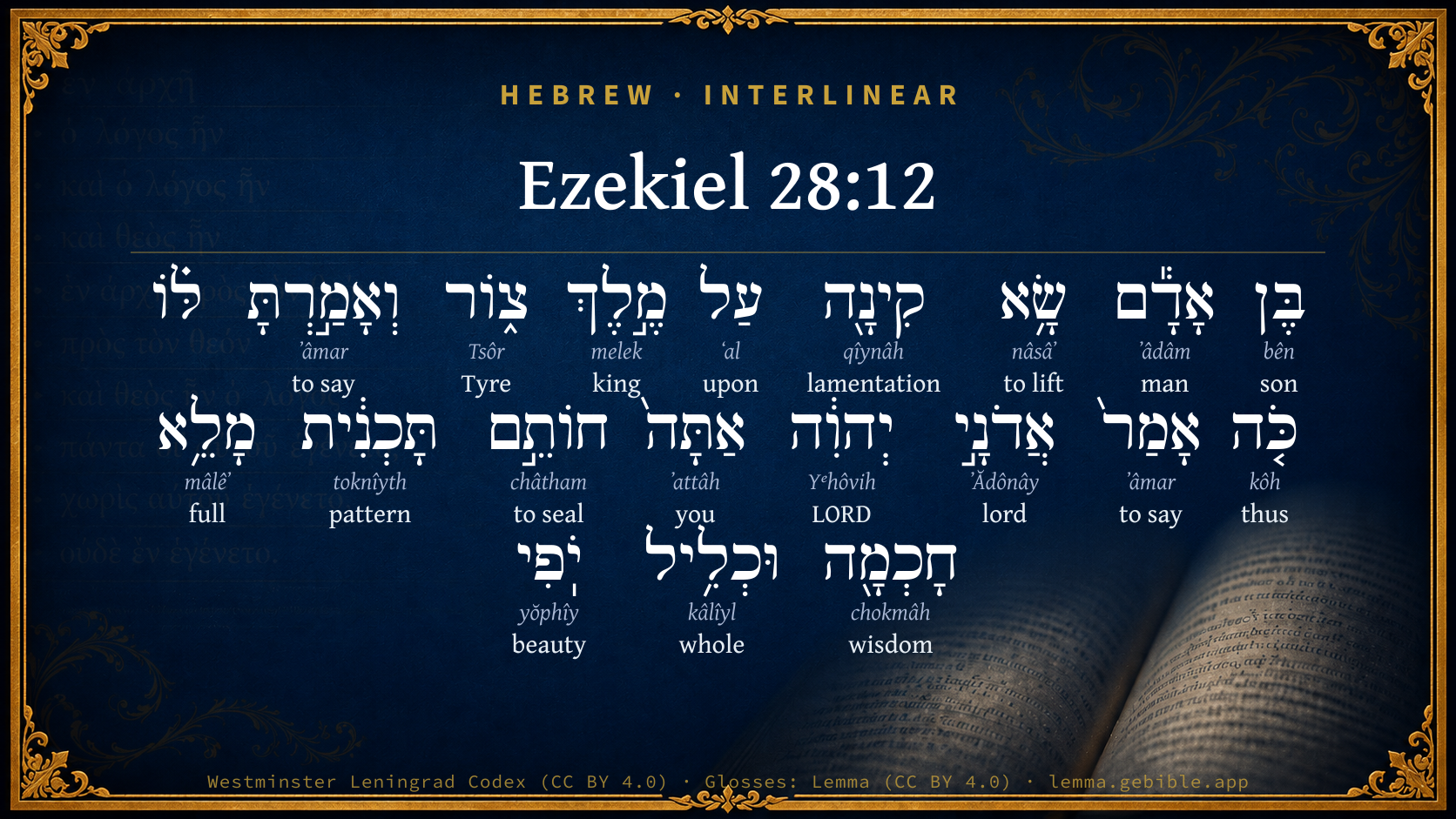
Hebrew (Westminster Leningrad Codex) Ezekiel 28:12 appears in the Hebrew Old Testament. The text above is from the Westminster Leningrad Codex. Each word links to its Strong’s number, a concise gloss, and parsing drawn from the Open Scriptures Hebrew Bible morphology. Click any word for its full Brown-Driver-Briggs (BDB) entry.
Download image
Cite this verse

Ezekiel 28:12 (World English Bible). Public Domain. Lemma interlinear Bible study tool, https://lemma.gebible.app/v/ezekiel/28/12.

Show BibTeX & RIS
BibTeX
RIS
English Translation
Son of man, take up a lamentation over the king of Tyre, and tell him, Thus says the Lord Yahweh: You seal up the sum, full of wisdom, and perfect in beauty.
World English Bible · Public Domain
Highlights
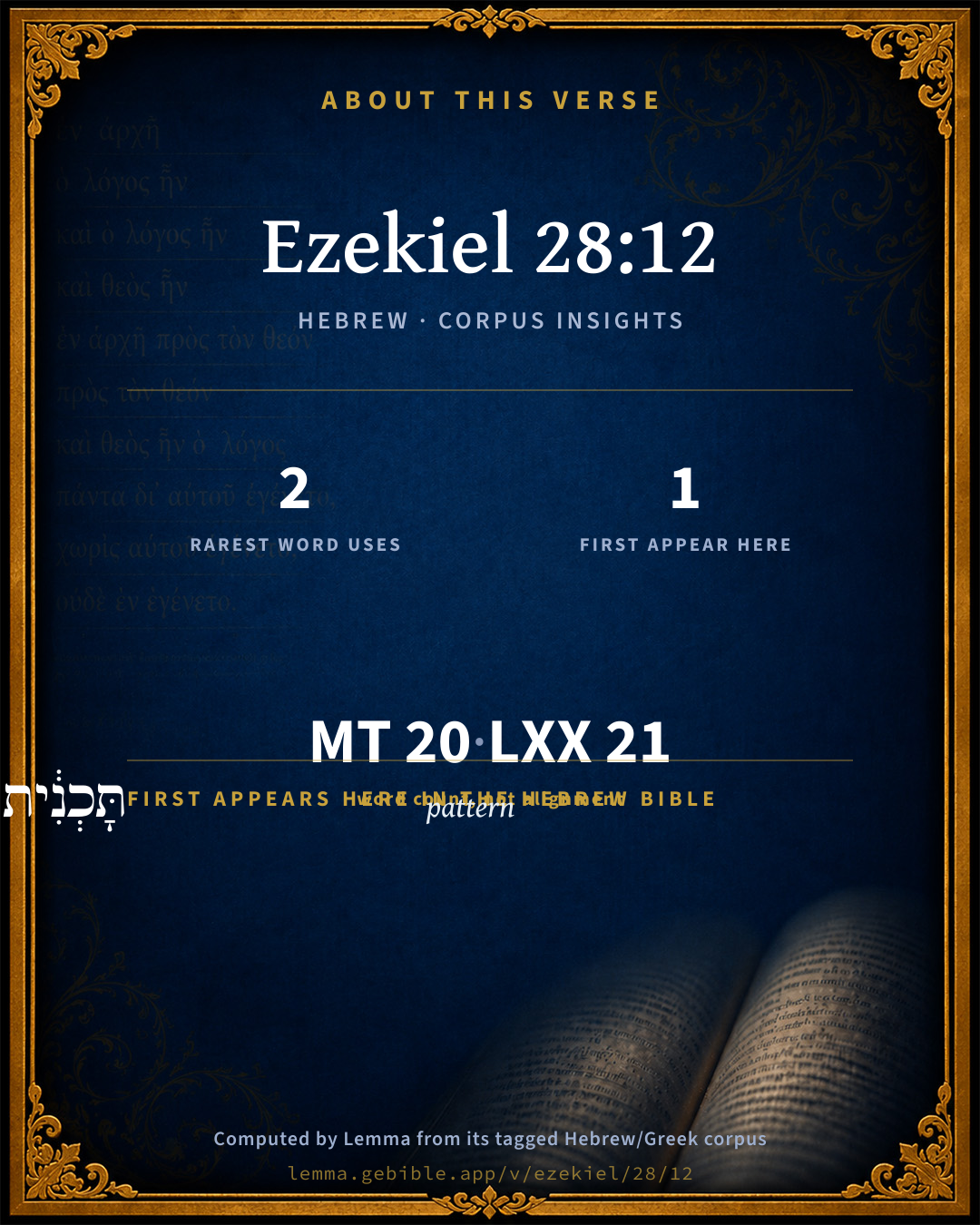
  • 1 first appearance in the Hebrew Bible
Full analysis ↓
Download a study sheet

One document with this verse’s original text, its word-by-word gloss line, the meaning frame, cross-references with their text, attributed commentary, and full source and license credits — printable, and it pastes into notes with its structure intact.

This verse Autodidact and up

Study sheet (.html) Plain text (.txt)

A passage Seminary Student

Up to 50 verses in one chapter. A passage sheet keeps up to 6 commentary sources and 12 cross-references per verse, in the order this page ranks them, and says so on the sheet whenever that leaves anything out. Ask for a single verse and you get the Autodidact verse sheet above.

Everything on this page stays free to read, with no account — the sheet is a download of what is already on screen, not access to it.

Want to remove ads? Support Godless Engineer
Compare translations 3

The same verse in 3 English versions, stacked beneath the original-language interlinear above. Click any original word for its lexicon entry.

Each is an independent rendering of the whole verse — the interlinear is not word-aligned to these translations.

Highlighted words mark where these versions differ — a whole-verse word diff, not a word-by-word alignment.

  • World English Bible Public Domain
    Son of man, take up a lamentation over the king of Tyre, and tell him, Thus says the Lord Yahweh: You seal up the sum, full of wisdom, and perfect in beauty.
  • King James Version Public Domain
    Son of man, take up a lamentation upon the king of Tyrus, and say unto him, Thus saith the Lord GOD; Thou sealest up the sum, full of wisdom, and perfect in beauty.
  • unfoldingWord Literal Text CC BY-SA 4.0
    “Son of man, lift up a lament for the king of Tyre and say to him, ‘The Lord Yahweh says this: You were the model of perfection, full of wisdom and perfect in beauty.

unfoldingWord Literal Text — © unfoldingWord, licensed CC BY-SA 4.0. Word-aligned USFM3 via Door43 (git.door43.org/unfoldingWord/en_ult).

Versions to compare (up to 4)

3 of 4 selected

Show all 18 translations

Every available English version of this verse, each an independent rendering of the whole verse.

  • World English Bible Public Domain
    Son of man, take up a lamentation over the king of Tyre, and tell him, Thus says the Lord Yahweh: You seal up the sum, full of wisdom, and perfect in beauty.
  • Berean Standard Bible Public Domain
    “Son of man, take up a lament for the king of Tyre and tell him that this is what the Lord GOD says: ‘You were the seal of perfection, full of wisdom and perfect in beauty.
  • Majority Standard Bible Public Domain
    “Son of man, take up a lament for the king of Tyre and tell him that this is what the Lord GOD says: ‘You were the seal of perfection, full of wisdom and perfect in beauty.
  • King James Version Public Domain
    Son of man, take up a lamentation upon the king of Tyrus, and say unto him, Thus saith the Lord GOD; Thou sealest up the sum, full of wisdom, and perfect in beauty.
  • American Standard Version (1901) Public Domain
    Son of man, take up a lamentation over the king of Tyre, and say unto him, Thus saith the Lord Jehovah: Thou sealest up the sum, full of wisdom, and perfect in beauty.
  • Revised Version (1885) Public Domain
    Son of man, take up a lamentation for the king of Tyre, and say unto him, Thus saith the Lord GOD: Thou sealest up the sum, full of wisdom, and perfect in beauty.
  • Geneva Bible (1599) Public Domain
    Sonne of man, take vp a lamentation vpon the King of Tyrus, and say vnto him, Thus sayeth the Lord God, Thou sealest vp the summe, and art full of wisedome and perfite in beautie.
  • Douay-Rheims (1899) Public Domain
    And say to him: Thus saith the Lord God: Thou wast the seal of resemblance, full of wisdom, and perfect in beauty.
  • Young's Literal Translation Public Domain
    `Son of man, lift up a lamentation for the king of Tyre, And thou hast said to him: Thus said the Lord Jehovah: Thou art sealing up a measurement, Full of wisdom, and perfect in beauty.
  • Literal Standard Version CC BY-SA 4.0
    “Son of man, lift up a lamentation for the king of Tyre, || And you have said to him, Thus said Lord YHWH: You are sealing up a measurement, || Full of wisdom, and perfect in beauty.
  • Unlocked Literal Bible CC BY-SA 4.0
    “Son of man, lift up a lament for the king of Tyre and say to him, 'The Lord Yahweh says this: You were the model of perfection, full of wisdom and perfect in beauty.
  • unfoldingWord Literal Text CC BY-SA 4.0
    “Son of man, lift up a lament for the king of Tyre and say to him, ‘The Lord Yahweh says this: You were the model of perfection, full of wisdom and perfect in beauty.
  • Darby Bible Public Domain
    Son of man, take up a lamentation upon the king of Tyre, and say unto him, Thus saith the Lord Jehovah: Thou, who sealest up the measure of perfection, full of wisdom and perfect in beauty,
  • World Messianic Bible Public Domain
    “Son of man, take up a lamentation over the king of Tyre, and tell him, ‘The Lord GOD says: “You were the seal of full measure, full of wisdom, and perfect in beauty.
  • Webster's Bible Public Domain
    Son of man, take up a lamentation upon the king of Tyre, and say to him, Thus saith the Lord GOD; Thou sealest up the sum, full of wisdom, and perfect in beauty.
  • Free Bible Version CC BY-SA 4.0
    “Son of man, sing a funeral song for the king of Tyre and tell him this is what the Lord God says: Once you were complete and perfect, full of wisdom and flawless in beauty.
  • Bible in Basic English Public Domain
    Son of man, make a song of grief for the king of Tyre, and say to him, This is what the Lord has said: You are all-wise and completely beautiful;
  • JPS Tanakh (1917) Public Domain
    'Son of man, take up a lamentation for the king of Tyre, and say unto him: Thus saith the Lord GOD: Thou seal most accurate, full of wisdom, and perfect in beauty,

Literal Standard Version (2020), Covenant Press — licensed CC BY-SA 4.0. Text via the HelloAO Bible API (eBible.org). Unlocked Literal Bible (unfoldingWord) — licensed CC BY-SA 4.0. Text via the HelloAO Bible API (eBible.org). unfoldingWord Literal Text — © unfoldingWord, licensed CC BY-SA 4.0. Word-aligned USFM3 via Door43 (git.door43.org/unfoldingWord/en_ult). Free Bible Version, Dr. Jonathan Gallagher — licensed CC BY-SA 4.0. Text via the HelloAO Bible API (eBible.org).

Word by word

More ways to search: Search by grammar → Find every occurrence → Compare this word →

Practice this passage: Drill this verse → Learn its vocabulary →

תָּכְנִ֔ית
toknîyth
H8508
“pattern”
Noun, Common, Feminine, Singular, Absolute
Part of Speech
Noun
Type
Common
Gender
Feminine
Number
Singular
State
Absolute
Full BDB Definition

Origin: from H8506

TWOT: 2511b

measurement, pattern, proportion
  1. בֶּן bên H1121 “son of” Noun, Common, Masculine, Singular, Construct
  2. אָדָ֕ם ʼâdâm H120 “man” Noun, Common, Masculine, Singular, Absolute
  3. שָׂ֥א nâsâʼ H5375 “lift” Verb, Qal, Imperative, 2nd Person, Masculine, Singular
  4. קִינָ֖ה qîynâh H7015 “lamentation” Noun, Common, Feminine, Singular, Absolute
  5. עַל ʻal H5921 “upon” Preposition
  6. מֶ֣לֶךְ melek H4428 “king of” Noun, Common, Masculine, Singular, Construct
  7. צ֑וֹר Tsôr H6865 “Tyre” Noun, Proper
  8. וְאָמַ֣רְתָּ ʼâmar H559 “and · to say” Conjunction + Verb, Qal, Sequential Perfect, 2nd Person, Masculine, Singular
  9. כֹּ֤ה kôh H3541 “thus” Adverb
  10. אָמַר֙ ʼâmar H559 “to say” Verb, Qal, Perfect, 3rd Person, Masculine, Singular
  11. אֲדֹנָ֣י ʼĂdônây H136 “Lord · my” Noun, Common, Masculine, Plural, Construct + Suffix, Personal, 1st Person, Common, Singular
  12. יְהוִ֔ה Yᵉhôvih H3069 “LORD” Noun, Proper
  13. אַתָּה֙ ʼattâh H859 “you” Pronoun, Personal, 2nd Person, Masculine, Singular
  14. חוֹתֵ֣ם châtham H2856 “sealing” Verb, Qal, Participle Active, Masculine, Singular, Construct
  15. מָלֵ֥א mâlêʼ H4392 “full” Adjective, Adjective, Masculine, Singular, Absolute
  16. חָכְמָ֖ה chokmâh H2451 “wisdom” Noun, Common, Feminine, Singular, Absolute
  17. וּכְלִ֥יל kâlîyl H3632 “and · whole of” Conjunction + Adjective, Adjective, Masculine, Singular, Construct
  18. יֹֽפִי yŏphîy H3308 “beauty” Noun, Common, Masculine, Singular, Absolute

About this verse

These counts appear in no published source. They are computed here, from the morphology-tagged text and Lemma’s own curated glosses. What Lemma adds →

20
words
18
distinct lemmas
Prophets
section

Notable vocabulary

The rarest word here is תָּכְנִ֔ית pattern H8508 — appearing just 2 times in the whole Hebrew Bible.

First appearance in Scripture

This word makes its first canonical appearance in the Hebrew Bible here:

  • תָּכְנִ֔ית pattern H8508

Shared distinctive vocabulary

תָּכְנִ֔ית pattern H8508 occurs in 2 verses of the Hebrew Bible. Also found in:

Grammatical profile

  • 4 verbs
  • 10 nouns
  • 2 adjectives
  • 1 pronoun
  • 2 prepositions
  • 1 adverb

Verb forms

  • שָׂ֥א Qal · Imperative
  • וְאָמַ֣רְתָּ Qal · Sequential Perfect
  • אָמַר֙ Qal · Perfect
  • חוֹתֵ֣ם Qal · Participle Active

Repetition

A word recurs within this verse — often emphatic in Hebrew:

  • וְאָמַ֣רְתָּ to say H559 ×2

Hebrew & Septuagint length

In English translation the verse runs 32 words from the Hebrew and 31 from the Septuagint (LXX English) — closely comparable.

A rough comparison of the two English renderings, which tokenize alike — not a word-level alignment.

Word counts can differ between the Hebrew and the Greek without any difference in meaning — e.g. the Hebrew direct-object marker אֵת has no separate Greek word, and Greek often adds the article ὁ.

In the original languages it is 20 Hebrew tokens and 21 Greek tokens — but the two are counted differently (Hebrew bundles its prefixes and suffixes into one token; the Greek is in lemma form), so that isn’t a like-for-like length.

Cross-references

23

Topical passages linked to Ezekiel 28:12 in the Treasury of Scripture Knowledge — connected by theme and wording, ordered by reader-vote popularity; previews shown in the World English Bible.

  • Ezekiel 19:1 Moreover, take up a lamentation for the princes of Israel,
  • Ezekiel 26:17 They shall take up a lamentation over you, and tell you, How are you destroyed, who were inhabited by seafaring men, the renowned city, who was strong in the sea, she and her inhabitants, who caused their terror to be on all who lived there!
  • 2 Corinthians 1:22 who also sealed us, and gave us the down payment of the Spirit in our hearts.
  • Colossians 1:9 For this cause, we also, since the day we heard this, don't cease praying and making requests for you, that you may be filled with the knowledge of his will in all spiritual wisdom and understanding,
  • Colossians 2:3 in whom are all the treasures of wisdom and knowledge hidden.
  • James 3:13–18 Who is wise and understanding among you? Let him show by his good conduct that his deeds are done in gentleness of wisdom.
  • 2 Chronicles 35:25 Jeremiah lamented for Josiah: and all the singing men and singing women spoke of Josiah in their lamentations to this day; and they made them an ordinance in Israel: and, behold, they are written in the lamentations.
  • Proverbs 21:30 There is no wisdom nor understanding Nor counsel against Yahweh.
  • Isaiah 10:13 For he has said, By the strength of my hand I have done it, and by my wisdom; for I have understanding: and I have removed the bounds of the peoples, and have robbed their treasures, and like a valiant man I have brought down those who sit [on thrones]:
  • Isaiah 14:4 that you shall take up this parable against the king of Babylon, and say, How has the oppressor ceased! the golden city ceased!
  • Jeremiah 9:17–20 Thus says Yahweh of Hosts, Consider you, and call for the mourning women, that they may come; and send for the skillful women, that they may come:
  • Jeremiah 9:23 Thus says Yahweh, Don't let the wise man glory in his wisdom, neither let the mighty man glory in his might, don't let the rich man glory in his riches;
  • Ezekiel 19:14 Fire is gone out of the rods of its branches, it has devoured its fruit, so that there is in it no strong rod to be a scepter to rule. This is a lamentation, and shall be for a lamentation.
  • Ezekiel 27:2–4 You, son of man, take up a lamentation over Tyre;
  • Ezekiel 27:32 In their wailing they shall take up a lamentation for you, and lament over you, [saying], Who is there like Tyre, like her who is brought to silence in the midst of the sea?
  • Ezekiel 28:2–5 Son of man, tell the prince of Tyre, Thus says the Lord Yahweh: Because your heart is lifted up, and you have said, I am a god, I sit in the seat of God, in the midst of the seas; yet you are man, and not God, though you did set your heart as the heart of God;-
  • Ezekiel 32:16 This is the lamentation with which they shall lament; the daughters of the nations shall lament therewith; over Egypt, and over all her multitude, shall they lament therewith, says the Lord Yahweh.
  • Luke 2:40 The child was growing, and was becoming strong in spirit, being filled with wisdom, and the grace of God was upon him.
  • Acts 6:3 Therefore select from among you, brothers, seven men of good report, full of the Holy Spirit and of wisdom, whom we may appoint over this business.
  • Romans 15:28 When therefore I have accomplished this, and have sealed to them this fruit, I will go on by way of you to Spain.
  • 1 Corinthians 1:19–20 For it is written, "I will destroy the wisdom of the wise, I will bring the discernment of the discerning to nothing."
  • 1 Corinthians 3:19 For the wisdom of this world is foolishness with God. For it is written, "He has taken the wise in their craftiness."
  • Ezekiel 32:2 Son of man, take up a lamentation over Pharaoh king of Egypt, and tell him, You were likened to a young lion of the nations: yet are you as a monster in the seas; and you did break forth with your rivers, and troubled the waters with your feet, and fouled their rivers.

Cross-references courtesy of OpenBible.info (CC BY 4.0).

Hebrew and Greek witnesses Masoretic Hebrew ↔ Greek Septuagint

The same verse in the two great witnesses to the Old Testament, shown verse-for-verse.

These are two independent witnesses, not word-aligned to each other, and the Septuagint is shown in lemma (dictionary) form.

Hebrew Ezekiel 28:12 Masoretic · Westminster Leningrad Codex

בֶּן אָדָ֕ם שָׂ֥א קִינָ֖ה עַל מֶ֣לֶךְ צ֑וֹר וְאָמַ֣רְתָּ לּ֗וֹ כֹּ֤ה אָמַר֙ אֲדֹנָ֣י יְהוִ֔ה אַתָּה֙ חוֹתֵ֣ם תָּכְנִ֔ית מָלֵ֥א חָכְמָ֖ה וּכְלִ֥יל יֹֽפִי

Son of man, take up a lamentation over the king of Tyre, and tell him, Thus says the Lord Yahweh: You seal up the sum, full of wisdom, and perfect in beauty.

World English Bible · Public Domain

Greek LXX Ezekiel 28:12 Septuagint · lemma form

υἱός ἄνθρωπος λαμβάνω θρῆνος ἐπί ὁ ἄρχων τύρος καί εἶπον αὐτός ὅδε λέγω κύριος κύριος σύ ἀποσφράγισμα ὁμοίωσις καί στέφανος κάλλος

Son of man, take up a lamentation for the prince of Tyre, and say to him, Thus says the Lord God; You are a seal of resemblance, and crown of beauty.

LXX2012 (modern English Septuagint) · Public Domain

On this verse, The Cambridge Bible for Schools and Colleges discusses the Septuagint’s reading. Read the note in Commentary ↓

Hebrew: Westminster Leningrad Codex (CC BY 4.0). Greek: Septuagint (public domain); English from LXX2012 (modern English Septuagint) (Public Domain). How the Septuagint differs from the Hebrew →

Targum (Aramaic paraphrase)

1

The Targum is the ancient Jewish Aramaic paraphrase of the Hebrew Scriptures — an interpretive translation, not the Hebrew text itself. Onkelos (literal) and Pseudo-Jonathan (expansive) render the Torah, and Jonathan the Prophets. Coverage is partial: where no permissively-licensed English translation exists for a verse, only the Aramaic is shown. This is verse-level text, not a word-by-word alignment to the Hebrew.

  1. Targum Jonathan Prophets (Joshua–Malachi)
    בַּר אָדָם טוֹל אִילְיָא עַל מַלְכָּא דְצוֹר וְתֵימַר לֵיהּ כִּדְנַן אֲמַר יְיָ אֱלֹהִים אַתְּ דָמֵי לְמָנָא דְצוּרְתָא דִי מְתַקֵן בְּחוּכְמְתָא וּמְשֻׁכְלַל בְּשׁוּפְרֵיהּ:

    (no public-domain English translation for this verse)

    Targum Jonathan — Aramaic: “Mikraot Gedolot” (public domain). English: “Sefaria Community Translation” (CC0 1.0 (public-domain dedication)); “London "Chaldee Paraphrase," 1871” (public domain). Text via Sefaria.

Commentary

Notes on Ezekiel 28:12 from classic Christian and Jewish commentators (each source and its license shown beneath its notes). The classic Christian expositions comment on the surrounding passage and are grouped to its opening verse, so a note may address several verses; the Jewish commentaries on the Tanakh (Rashi and others) are per-verse, so they appear only where the commentator wrote on this verse.

Lemma curates 59 commentaries, every one of them public domain or Creative Commons licensed, each selected and text-cleaned for this edition rather than reprinted as found. About our sources →

The Cambridge Bible for Schools and Colleges

gen. ed. J. J. S. Perowne

12. king of Tyrus] The prophet appears to use the terms king and prince (nagîd, or nasî) indifferently. LXX. of Ezek. reserves the term “king” for the rulers of Babylon and Egypt, except in general expressions like “kings of the earth,” or, of the nations (Eze_27:33; Eze_27:35, Eze_32:10).

sealest up the sum] The term “sum” only again ch. Eze_43:10 of the construction or idea of the temple, there rendered “pattern.” The verb is used of the work of God in ordering creation by weight and measure, Job_28:25; Isa_40:12-13. The phrase “thou sealest” is pointed as part. art the sealer of, but some MSS. and the ancient Versions read art the sealring of. To “seal” has always the natural sense, or means to close up, fasten up; it seems nowhere to mean to round off, complete or consummate. LXX. omits “full of wisdom,” and the first words are in parallelism to “the perfection of beauty.” This would suggest that the first words describe what the prince is or was, not what he did. The term rendered “sum” may mean symmetry (perfection), and the whole: thou wast the sealring of symmetry (perfection), and the perfection of beauty. In this case the prince is compared to a sealring of exquisite workmanship. On the other hand if part. be read, “thou wast the sealer of symmetry,” the conception of something impressing symmetry (upon all things) seems expressed. There might then be an allusion to the Wisdom; cf. the comparison of light to a seal Job_38:14.

12–19. Lament over the fall of the prince of Tyre

The passage is of extreme difficulty partly from the obscurity of several expressions in it, which do not occur again, and partly from allusions not now intelligible. The general drift of the passage is plain. (1) Eze_28:12-15. The prince of Tyre is represented as a glorious being placed in Eden the garden of God. He was the perfection of beauty, was set on the mountain of God, and was perfect in his ways from the day he was created till iniquity was found in him. (2) Eze_28:16-19. He fell from his high place through pride because of the multitude of his riches, and was therefore expelled from the garden of God.—Towards the end of the passage the allegory of a being in paradise is departed from and the actual circumstances of the prince and his city are more literally referred to. The text of LXX. diverges in important particulars from the Heb.

Particular difficulties, however, are numerous. 1. The expression “sealest up the sum,” Eze_28:12 is very obscure. For the participle “sealest” the ancient versions read signet or ring. That there is reference to a ring seems plain from Eze_28:13. 2. Again the cherub is referred to. There can be no doubt that the prophet has in his mind the story of Paradise (Genesis 2, 3). The cherub naturally belongs to the Paradise of God. In the Heb. text, as at present pointed (though the pointing is very anomalous) the prince is compared to the cherub, or said to be or have been the cherub. The text, however, permits the reading with or beside the cherub (v, 14, so LXX.). The prince sinned and was expelled from the garden of God where he was placed. The idea of the prophet is that pride and self-deification was the sin of the prince and caused his expulsion. This, however, in Ezek. is the sin of all the foreign princes or nations, Egypt no less than Tyre, and cannot be held part of a tradition of the Fall, or of paradise. That the prophet does refer to a fall and expulsion from paradise or destruction of the transgressor seems plain (Eze_28:16-17). But any fall of the cherub is not hinted at anywhere in the Old Test.; on the contrary the cherubs are represented as watchers and protectors of the garden of God against men (Gen_3:24). There are references in the Old Test. to the sin of higher beings (e.g. Gen_6:1; Isa_24:21), but the prophet’s allusions to the cherubs in other places make it very improbable that he should think of them as sinning. 3. It is probable, therefore, that it is the history of the first man that floats before his mind. The term “created” applied to the prince would hardly be used of the cherub. It is not unlikely, however, that Ezek. is in possession of traditions regarding Paradise more ample than those in Gen. or different from them. At the same time the divergences may be due to his own tendency to idealize. The prince of Tyre is represented as wiser than all men, even than Daniel; and in Job_15:7-8 the first man born is spoken of as possessing supernatural wisdom. The prophet might have before his mind that Wisdom which was the first of God’s works of old (Proverbs 8), and his architect in creation, and who realized herself in the symmetry of the universe.

The Cambridge Bible for Schools and Colleges (gen. ed. J. J. S. Perowne; Cambridge University Press, 1878–1918) — public domain. Text from a community e-Sword module.

Trapp's Complete Commentary

John Trapp

Eze 28:12 Son of man, take up a lamentation upon the king of Tyrus, and say unto him, Thus saith the Lord GOD; Thou sealest up the sum, full of wisdom, and perfect in beauty.

Ver. 12. Take up a lamentation for the king of Tyre.] Who shall have little leisure to lament for himself, his destruction shall be so sudden. See on Eze 27:2.

Thou sealest up the sum,] i.e., Thou art a pattern of perfection, in thine own conceit at least; for a seal hath in it the perfect form of him that is thereby represented, and then is a letter perfected when the last act of setting to a seal is done to it. {a} Tu es omnibus numeris absolutum exemplar; so Vatablus and the Tigurines.

{a} Literae consignatae et clausae et absolutae sunt. - Oecolamp.

John Trapp, A Commentary or Exposition upon All the Books of the Old and New Testament (1647–1656) — public domain. Text from a community e-Sword module.

Joseph Benson's Commentary

Eze 28:12-13. Take up a lamentation upon the king of Tyrus — See Eze 27:32. Thou sealest up the sum, full of wisdom, &c. — In thine own opinion thou art the perfect pattern of wisdom and all other excellences; thou possessest them in full measure, they are thine by an unalienable tenure, sealed up safely among thy treasures. The LXX. render this, Συ αποσφραγισμα ομοιωσεως, και στεφανος καλλους, Thou art the seal of likeness, and crown of beauty. To the same purpose the Vulgate, Tu signaculum similitudinis, plenus sapientia, perfectus decore: that is, says Lowth, “Thou art the image of God, an exact impression taken from that great copy. For the following verse shows that the expression alludes to Adam, when he was first created, and came pure out of the hands of his Maker; full of wisdom, and perfect in beauty.” Thou hast been in Eden — “As thy situation was pleasant, so wast thou plentifully supplied with every thing which could contribute to make thy life pleasant and happy. The state of paradise, in common speech, denotes a condition every way complete and happy. See Isa 51:3. The expression, as well as the whole context, alludes to the complete happiness which Adam enjoyed in paradise, before his apostacy and fall.” Every precious stone was thy covering — Not only was thy crown adorned with the choicest jewels, but thou wast arrayed with royal robes, enriched with gold and precious stones of all sorts. There is probably an allusion here to the precious stones which were placed in the high-priest’s breast-plate, as the next verse alludes to the cherubim over the mercy-seat. Accordingly the LXX. enlarge the number of the stones here mentioned from nine to twelve, and place them in the same order in which they are ranked Exo 28:17, &c. The workmanship of thy tabrets, &c.,was prepared in thee — Or, for thee, in the day thou wast created — The highest expressions of joy, such as are the sounding of all sorts of musical instruments, ushered thee into the world, according to the usual practice at the birth of great princes; and ever since thou hast been brought up in the choicest delicacies which a royal palace or a luxurious city could furnish.

Joseph Benson's Commentary on the Old and New Testaments (1811–1818) — public domain. Text from a community e-Sword module.

Scofield Reference Notes

C. I. Scofield

Thou

Here (Eze 28:12-15), as in Isa 14:12 the language goes beyond the king of Tyre to Satan, inspirer and unseen ruler of all such pomp and pride as that of Tyre. Instances of thus indirectly addressing Satan are:; Gen 3:14; Gen 3:15; Mat 16:23. The unfallen state of Satan is here described; his fall in Isa 14:12-14. (See Scofield "Rev 20:10"). But there is more. The vision is not of Satan in his own person, but of Satan fulfilling himself in and through an earthly king who arrogates to himself divine honours, so that the prince of Tyrus foreshadows the Beast.; Dan 7:8; Rev 19:20.

The Scofield Reference Bible (1917 edition), notes by C. I. Scofield — public domain. Text from a community e-Sword module.

Tyndale Open Study Notes

Tyndale Open Resources

28:12-19 This eulogy at first appears to take the prince of Tyre’s aspirations to divinity seriously. He was the very model of perfection, full of wisdom and . . . beauty. It turns out to be a sarcastic lament.

Tyndale Open Study Notes — © Tyndale Open Resources, licensed CC BY-SA 4.0. Text via the HelloAO Bible API.

Geneva Bible (1599)

Geneva Bible translators

He derideth the vain opinion and confidence that the Tyrians had in their riches, strength and pleasures.

Geneva Bible (1599) marginal notes — public domain. Text via Bolls.life.

Jamieson, Fausset & Brown

Robert Jamieson, A. R. Fausset & David Brown

sealest up the sum--literally, "Thou art the one sealing the sum of perfection." A thing is sealed when completed (Dan 9:24). "The sum" implies the full measure of beauty, from a Hebrew root, "to measure." The normal man--one formed after accurate rule.

Jamieson, Fausset & Brown — Commentary Critical and Explanatory on the Whole Bible (1871) — public domain (CC PDM 1.0). Text via the HelloAO Bible API.

Adam Clarke's Commentary

Verse 12. Thou sealest up] This has been translated, "Thou drawest thy own likeness." "Thou formest a portrait of thyself; and hast represented thyself the perfection of wisdom and beauty." I believe this to be the meaning of the place.

Adam Clarke's Commentary on the Bible (1810–1826) — public domain. Text from a community e-Sword/MySword module.

Ellicott's Commentary for English Readers

(12) Thou sealest up the sum.—Thou markest it as complete or perfect. (Comp. Dan_9:24; Job_9:7.) The word for sum occurs only here and in Eze_43:10, where it refers to the well measured and arranged building of the Temple.

A Bible Commentary for English Readers, edited by Charles John Ellicott (1878–1897) — public domain. Text from a community e-Sword module.

John Gill's Exposition

Take up a lamentation upon the king of Tyrus,.... Who is before called the prince of Tyre; and who he was See Gill on Eze 28:2, the bishop of Rome was first only a "nagid", a prince, ruler, governor, and leader in the church; afterwards he became a king, a head, even over other kings, princes, and states; perhaps this may also point to his twofold power, secular and ecclesiastical, and so he is represented by two beasts, Rev 13:1, here a lamentation or funeral ditty is ordered to be taken up and said for him, to denote his certain destruction and ruin; though some have thought the fall of the angels, and others the fall of Adam, is referred to; several passages are interpreted of Adam in the Talmud (l):

and say unto him, thus saith the Lord God, thou sealest up the sum; or "pattern" (m); of everything that is excellent; thou art in all things, consummately so, as that nothing could be added; that is, in his own esteem and account. Junius thinks it refers to the sealing of goods exported, for which a duty was to be paid, without doing which merchandise was not allowed. Antichrist would not suffer any to buy or sell but such as receive his mark or seal on their right hand, or in their forehead, Rev 13:16. Cocceius renders it, "the sealer of the measure" (n); and takes it to be an allusion to the custom of sealing measures, used in buying and selling; and that it respects the man of sin, who takes upon him the power of making rules and canons for faith and practice:

full of wisdom, and perfect in beauty; a most accomplished man for parts and person in his own conceit: antichrist assumes to himself a perfect knowledge of the Scriptures, and sets up himself as an infallible judge of controversies; and glories in the splendour and order of his church, and the government of it.

(l) T. Bab. Bava Bathra, fol. 75. 1. (m) "exemplar, sive specimen", Tigurine version: Castalio. (n) "Signator mensurae", Cocceius, Starckius.

John Gill's Exposition of the Whole Bible (1746–1763) — public domain (CC PDM 1.0). Text via the HelloAO Bible API.

Haydock's Catholic Bible Commentary

Resemblance. The king of Tyre, by his dignity and his natural perfections, bore in himself a certain resemblance to God, by reason of which he might be called the seal of resemblance, &c. But what is here said to him is commonly understood of Lucifer, the king over all the children of pride. (Challoner) --- A seal is perfect when it represents things exactly. The prophet speaks ironically, to repress the king’s vanity.

George Leo Haydock (1774–1849), Haydock's Catholic Family Bible and Commentary, 1859 edition — public domain. Excludes Psalms (Douay-Rheims chapter numbering differs from Protestant) and Deuterocanonical books (Catholic canon only).

Matthew Poole's English Annotations

A lamentation: see Eze 27:2.

The king; called prince, Eze 28:2.

Thou sealest up the sum; in the search into the frame of thy government, the management of it, the prosperity thereof, and its glory, power, riches, and confederacies, thou dost think thyself but just to thy kingdom to account it the perfect idea of a good government, that in the Tyrian state nothing is wanting that might be required in a good government, in the best government, and so sealest to the premises; thus vainly puffed up, thou wilt have it that fulness of wisdom and perfection of beauty are in thee, but neither thy wisdom shall prevent or defeat the attempts of thine enemies, nor thy beauty charm their rage; thou shalt fall by them.

Matthew Poole's English Annotations on the Holy Bible (1683–1685) — public domain. Text from a community e-Sword/MySword module.

Whedon's Commentary on the Bible

Daniel D. Whedon

12. Thou sealest up the sum — This is a very difficult phrase. It may be rendered, “Thou wast the seal ring of symmetry and the perfection of beauty;” or,” Thou wast the sealer of symmetry” (Davidson), i.e., impressed symmetry upon all things; or, “Thou settest the seal to thy completeness [perfection]” (Plumptre), i.e., the prince thinks himself to have attained the consummation of all beauty and wisdom. His signet ring represents the measure and power of the world. (Compare Orelli.)

Daniel D. Whedon (gen. ed.), Commentary on the Old and New Testaments (1874–1909) — public domain. Text from a community e-Sword module.

The Pulpit Commentary

Thou sealest up the sum, etc. The noun is found only there Eze_43:10, where it is translated "pattern," but is cognate with the word rendered" tale" (equivalent to "measure") of Exo_5:13, and "measure" in Eze_45:11. The probable meaning is, Thou settest the seal to thy completeness (perfection) Thou deemest that thou hast attained the consummation of all beauty and wisdom. The LXX and the Vulgate give, "Thou art a seal;" and this suggests a parallelism with Jeremiah"s works to Coniah. (Jer_22:24) The words were, of course, written with a keen irony. This was what the King of Tyro thought of himself.

The Pulpit Commentary (1880–1919), ed. H.D.M. Spence-Jones & Joseph S. Exell — public domain. Text from a community e-Sword module.

John Wesley's Explanatory Notes

Thou sealest up - Thou fanciest that fulness of wisdom, and perfection of beauty are in thee.

John Wesley, Explanatory Notes Upon the Whole Bible (1754–1765) — public domain. Text via the GEBible commentary corpus.

Rashi

Rabbi Shlomo Yitzchaki (Rashi)

You are the one who engraves images, etc. You are full of the wisdom to seal and to stamp every pattern and shape.

images [Heb. תָּכְנִית,] peinture in French, painting, engraving.

Rashi on the Tanakh — English translations: “The Judaica Press complete Tanach with Rashi, translated by A. J. Rosenberg” (CC BY 4.0); “Pentateuch with Rashi's commentary by M. Rosenbaum and A.M. Silbermann, 1929-1934” (public domain); “The Metsudah Tanach series, Lakewood, N.J” (CC BY 4.0); and “The Book of Joshua, Metsudah Publications, 1997” (CC BY 4.0). Text via Sefaria.

Lesson kit

Teaching starters — assembled from the data on this page, not authored interpretation. Every prompt links to the verse data it draws on. Edit before teaching.

Ezekiel, in the Prophets, opens this verse with 20 words (18 distinct Hebrew lemmas). Its most distinctive word is toknîyth (“pattern”). A historical commentator’s framing appears above. Read the whole chapter for the surrounding context.

Discussion questions

  1. What does “pattern” (toknîyth) contribute to the verse as a whole?
  2. The word “pattern” first appears here in Scripture. What is being introduced at this debut?
  3. Ezekiel 43:10 shares the word «pattern» with this verse. How do the two illuminate each other?
  4. “to say” occurs 2× in this one verse. What is the effect of the repetition?
  5. These translations render this verse differently. What is at stake in choosing one wording over another?
  6. The verb «שָׂ֥א» is Qal Imperative. How does its form color the action?
  7. Reading how The Cambridge Bible for Schools and Colleges and Trapp's Complete Commentary read this verse, where do the two commentators agree and where do they part?

Things to notice

Reading settings

Reading text

Shown beneath each verse's original-language words.

Old Testament
Old Testament edition

Read the OT as the Masoretic Hebrew (MT) or the Greek Septuagint (LXX).

English shown for the Greek Septuagint (in the Hebrew ↔ Greek comparison).

Comparing translations? Open the Compare panel on any verse page to stack up to four side by side.