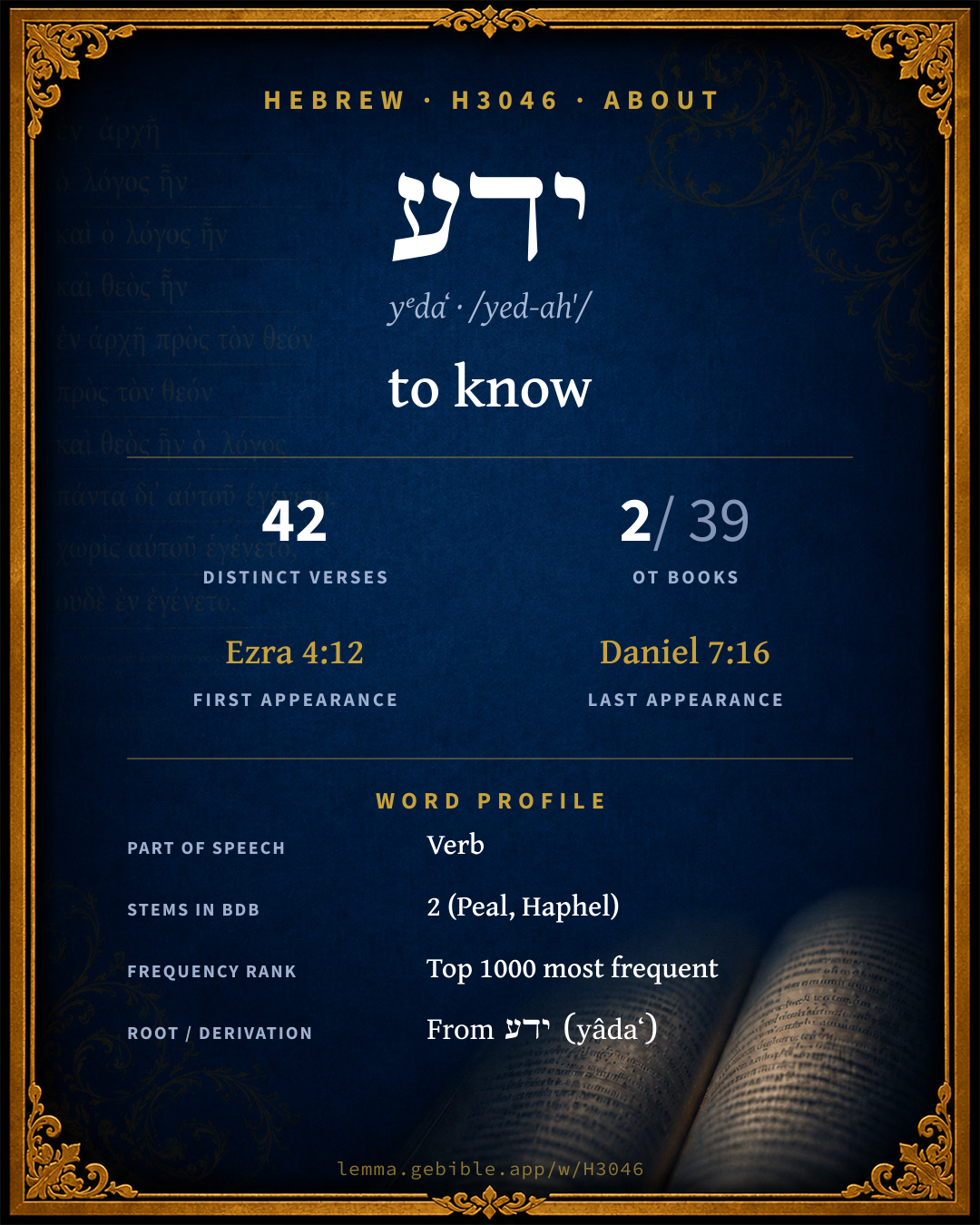
יְדַע
to know
‘to know’ is one of 3 main senses fuller range ↓
Full lexicon entry — Brown-Driver-Briggs (BDB)
From Brown-Driver-Briggs (BDB)
Where this word appears
See every Hiphil verb in the Hebrew Bible →
Grammar key — what these labels mean
Part of speech
- Verb
- An action or state-of-being word.
Stem
- Hiphil
- The causative active stem (“he caused / brought about”).
- Qal
- The basic, simple active stem — the plain form of the verb (“he wrote”).
- Qal Passive
- An archaic passive of the Qal, preserved in a few forms.
Form
- Infinitive Construct
- A bound verbal noun, frequently with prepositions (“to write / in writing”).
- Imperfect
- An incomplete, ongoing, or future action (“he will / would write”).
- Participle Passive
- A verbal adjective expressing action received (“written”).
- Perfect
- A completed action or state — Hebrew marks aspect (completeness) more than strict tense (“he wrote”).
- Participle Active
- A verbal adjective expressing ongoing or characteristic action (“writing / one who writes”).
- Imperative
- A direct command (“write!”).
State
- Absolute
- The independent form of a noun, not bound to a following word.
- Construct
- A noun bound to a following noun in a possessive / “of” relationship (the construct chain).
Person
- 2nd Person
- The one addressed (“you”).
- 3rd Person
- The one spoken about (“he / she / it / they”).
- 1st Person
- The speaker (“I / we”).
Gender
- Masculine
- Grammatically masculine.
- Common
- Either gender — not distinguished for this form.
Number
- Singular
- One.
- Plural
- More than one (in Hebrew, generally three or more).
Every verse where H3046 appears in the Book of Daniel — 33 distinct verses. Click any verse to open its interlinear word-by-word view. Verse text shown in the World English Bible for context — . Each verse’s Hebrew form is shown with its reference; the English is not keyword-highlighted, since the data carries no word-level English alignment. Use “Compare translations” on any verse to read it across multiple English versions. This concordance covers the Hebrew Bible; Septuagint (Greek Old Testament) occurrences are not indexed here.
Daniel
- Daniel 2:5 תְהֽוֹדְעוּנַּ֨/נִי֙ Hiphil impf 2mp + sfx pers 1cs The king answered the Chaldeans, The thing is gone from me: if you don't make known to me the dream and the interpretation of it, you shall be cut in pieces, and your houses shall be made a dunghill.
- Daniel 2:8 יָדַ֣ע Qal ptcp.act ms The king answered, I know of a certainty that you would gain time, because you see the thing is gone from me.
- Daniel 2:9 תְהֽוֹדְעֻנַּ֜/נִי וְֽ/אִנְדַּ֕ע Hiphil impf 2mp + sfx pers 1cs conj + Qal impf 1cs But if you don't make known to me the dream, there is but one law for you; for you have prepared lying and corrupt words to speak before me, until the time be changed: therefore tell me the dream, and I shall know that you can show me the interpretation of it.
- Daniel 2:15 הוֹדַ֥ע Hiphil pf 3ms he answered Arioch the king's captain, Why is the decree so urgent from the king? Then Arioch made the thing known to Daniel.
- Daniel 2:17 הוֹדַֽע Hiphil pf 3ms Then Daniel went to his house, and made the thing known to Hananiah, Mishael, and Azariah, his companions:
- Daniel 2:21 לְ/יָדְעֵ֥י prep + Qal ptcp.act mp cs He changes the times and the seasons; he removes kings, and sets up kings; he gives wisdom to the wise, and knowledge to those who have understanding;
- Daniel 2:22 יָדַע֙ Qal ptcp.act ms he reveals the deep and secret things; he knows what is in the darkness, and the light dwells with him.
- Daniel 2:23 הֽוֹדַעְתַּ֨/נִי֙ הוֹדַעְתֶּֽ/נָא Hiphil pf 2ms + sfx pers 1cs Hiphil pf 2ms + sfx pers 1cp I thank you, and praise you, you God of my fathers, who have given me wisdom and might, and have now made known to me what we desired of you; for you have made known to us the king's matter.
- Daniel 2:25 יְהוֹדַֽע Hiphil impf 3ms Then Arioch brought in Daniel before the king in haste, and said thus to him, I have found a man of the children of the captivity of Judah, who will make known to the king the interpretation.
- Daniel 2:26 לְ/הוֹדָעֻתַ֛/נִי prep + Hiphil inf.cs + sfx pers 1cs The king answered Daniel, whose name was Belteshazzar, Are you able to make known to me the dream which I have seen, and the interpretation of it?
- Daniel 2:28 וְ/הוֹדַ֗ע conj + Hiphil pf 3ms but there is a God in heaven who reveals secrets, and he has made known to the king Nebuchadnezzar what shall be in the latter days. Your dream, and the visions of your head on your bed, are these:
- Daniel 2:29 הוֹדְעָ֖/ךְ Hiphil pf 3ms + sfx pers 2ms as for you, O king, your thoughts came [into your mind] on your bed, what should happen hereafter; and he who reveals secrets has made known to you what shall happen.
- Daniel 2:30 יְהוֹדְע֔וּן תִּנְדַּֽע Hiphil impf 3mp Qal impf 2ms But as for me, this secret is not revealed to me for any wisdom that I have more than any living, but to the intent that the interpretation may be made known to the king, and that you may know the thoughts of your heart.
- Daniel 2:45 הוֹדַ֣ע Hiphil pf 3ms Because you saw that a stone was cut out of the mountain without hands, and that it broke in pieces the iron, the brass, the clay, the silver, and the gold; the great God has made known to the king what shall happen hereafter: and the dream is certain, and the interpretation of it sure.
- Daniel 3:18 יְדִ֥יעַ Qal ptcp.pass ms But if not, be it known to you, O king, that we will not serve your gods, nor worship the golden image which you have set up.
- Daniel 4:6 יְהֽוֹדְעֻנַּֽ/נִי Hiphil impf 3mp + sfx pers 1cs Therefore made I a decree to bring in all the wise men of Babylon before me, that they might make known to me the interpretation of the dream.
- Daniel 4:7 מְהוֹדְעִ֥ין Hiphil ptcp.act mp Then came in the magicians, the enchanters, the Chaldeans, and the soothsayers; and I told the dream before them; but they did not make known to me the interpretation of it.
- Daniel 4:9 יִדְעֵ֗ת Qal pf 1cs Belteshazzar, master of the magicians, because I know that the spirit of the holy gods is in you, and no secret troubles you, tell me the visions of my dream that I have seen, and the interpretation of it.
- Daniel 4:17 יִנְדְּע֣וּן Qal impf 3mp The sentence is by the decree of the watchers, and the demand by the word of the holy ones; to the intent that the living may know that the Most High rules in the kingdom of men, and gives it to whoever he will, and sets up over it the lowest of men.
- Daniel 4:18 לְ/הוֹדָ֣עֻתַ֔/נִי prep + Hiphil inf.cs + sfx pers 1cs This dream I, king Nebuchadnezzar, have seen; and you, Belteshazzar, declare the interpretation, because all the wise men of my kingdom are not able to make known to me the interpretation; but you are able; for the spirit of the holy gods is in you.
- Daniel 4:25 תִנְדַּ֗ע Qal impf 2ms that you shall be driven from men, and your dwelling shall be with the animals of the field, and you shall be made to eat grass as oxen, and shall be wet with the dew of the sky, and seven times shall pass over you; until you know that the Most High rules in the kingdom of men, and gives it to whoever he will.
- Daniel 4:26 תִנְדַּ֔ע Qal impf 2ms Whereas they commanded to leave the stump of the roots of the tree; your kingdom shall be sure to you, after that you shall have known that the heavens do rule.
- Daniel 4:32 תִנְדַּ֗ע Qal impf 2ms and you shall be driven from men; and they dwelling shall be with the animals of the field; you shall be made to eat grass as oxen; and seven times shall pass over you; until you know that the Most High rules in the kingdom of men, and gives it to whoever he will.
- Daniel 5:8 לְ/הוֹדָעָ֥ה prep + Hiphil inf.cs Then came in all the king's wise men; but they could not read the writing, nor make known to the king the interpretation.
- Daniel 5:15 לְ/הוֹדָעֻתַ֑/נִי prep + Hiphil inf.cs + sfx pers 1cs Now the wise men, the enchanters, have been brought in before me, that they should read this writing, and make known to me the interpretation of it; but they could not show the interpretation of the thing.
- Daniel 5:16 לְ/הוֹדָ֣עֻתַ֔/נִי prep + Hiphil inf.cs + sfx pers 1cs But I have heard of you, that you can give interpretations, and dissolve doubts; now if you can read the writing, and make known to me the interpretation of it, you shall be clothed with purple, and have a chain of gold about your neck, and shall be the third ruler in the kingdom.
- Daniel 5:17 אֲהוֹדְעִנֵּֽ/הּ Hiphil impf 1cs + sfx pers 3ms Then Daniel answered before the king, Let your gifts be to yourself, and give your rewards to another; nevertheless I will read the writing to the king, and make known to him the interpretation.
- Daniel 5:21 יְדַ֗ע Qal pf 3ms and he was driven from the sons of men, and his heart was made like the animals', and his dwelling was with the wild donkeys; he was fed with grass like oxen, and his body was wet with the dew of the sky; until he knew that the Most High God rules in the kingdom of men, and that he sets up over it whoever he will.
- Daniel 5:22 יְדַֽעְתָּ Qal pf 2ms You his son, Belshazzar, have not humbled your heart, though you knew all this,
- Daniel 5:23 יָדְעִ֖ין Qal ptcp.act mp but have lifted up yourself against the Lord of heaven; and they have brought the vessels of his house before you, and you and your lords, your wives and your concubines, have drunk wine from them; and you have praised the gods of silver and gold, of brass, iron, wood, and stone, which don't see, nor hear, nor know; and the God in whose hand your breath is, and whose are all your ways, you have not glorified.
- Daniel 6:10 יְדַ֜ע Qal pf 3ms When Daniel knew that the writing was signed, he went into his house (now his windows were open in his chamber toward Jerusalem) and he kneeled on his knees three times a day, and prayed, and gave thanks before his God, as he did before.
- Daniel 6:15 דַּ֤ע Qal impv 2ms Then these men assembled together to the king, and said to the king, Know, O king, that it is a law of the Medes and Persians, that no interdict nor statute which the king establishes may be changed.
- Daniel 7:16 יְהוֹדְעִנַּֽ/נִי Hiphil impf 3ms + sfx pers 1cs I came near to one of those who stood by, and asked him the truth concerning all this. So he told me, and made me know the interpretation of the things.
About this entry
At a glance — auto-summarized from this page’s data, not written by a person. Every figure links to its source below. This summary describes the numbers; it doesn’t interpret them.
At its core, ידע (yᵉdaʻ) means “to know.” Its uses cluster heavily in Daniel (79% of all occurrences). With 42 verses in 2 books, it is a moderately common word in the Hebrew Bible. Read the stem: it spans 2 stems, including Peal and Haphel. Translators differ — “make known” in the King James Version, then “known” (unfoldingWord Literal Text), as the renderings breakdown shows. Each statement above links to its evidence; the full detail follows below.
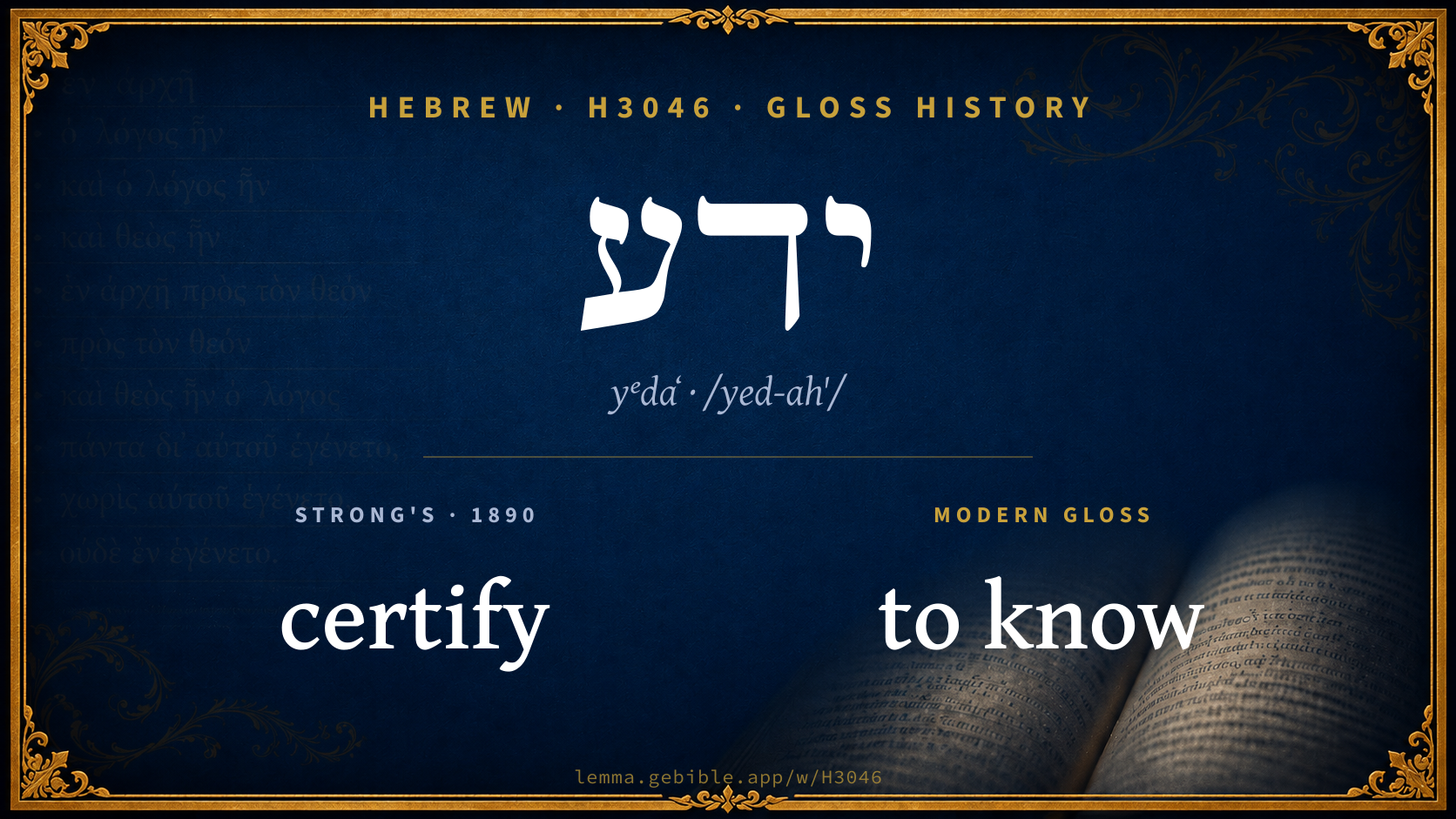
Gloss history
Strong's 1890 vs modern scholarship
About this word
Strong's H3046 catalogs a Hebrew word from the Hebrew Old Testament.
These counts are not copied from any lexicon or concordance. They are computed here, from the morphology-tagged Hebrew Old Testament. What Lemma adds →
- 42
- distinct verses
- The word appears in 42 distinct verses.
- 2 / 39
- OT books
- The word appears in 2 of 39 Old Testament books.
- #783
- by frequency
- Top 1000 most frequent Hebrew words (rank 783 of 8,640 Hebrew words by occurrence).
View all 42 occurrences in the concordance →
By traditional corpus
Conventional, traditional groupings — biblical authorship is debated, so this is a traditional corpus grouping, not an authorship claim. Each share is this word’s portion of its verses in that division of the Hebrew canon. Each figure is a share of the word’s 42 distinct verses.
- Writings (Ketuvim) 42 verses · 100%
How translations render this word
Counts come from each version’s own published word-to-Strong’s tagging or interlinear alignment — an approximate guide to how each version renders this word, not a word-level alignment the data otherwise carries. Because each total is that version’s own tagged count, the per-version totals vary from one another and need not match the appearance or distinct-verse counts above. These counts may also differ from a printed concordance because Lemma counts each distinctly tagged rendering and does not collapse phrase taggings into a single head-word total. This is a fixed set of word-tagged versions (KJV, ASV, BSB, ULT) and does not change with the reading translation you choose elsewhere. Each version’s license is shown beside its name below (and on Sources).
- King James Version: Make known 9×, Know 7×, Known 4×
- American Standard Version: Know 6×, Known 6×, Make known 6×
- Berean Standard Bible: Know 3×, Known 3×, Me 3×
- unfoldingWord Literal Text: Known 6×, Know 5×, Make known to me 4×
King James Version Public Domain
Renders H3046 across 46 tagged occurrences — most commonly:
Plus 20 renderings that appear only once — usually multi-word phrases or single function words the recovered tagging swept in, not distinct renderings. Not rendered by a distinct English word in 1 further occurrence.
American Standard Version Public Domain
Renders H3046 across 46 tagged occurrences — most commonly:
Plus 22 renderings that appear only once — usually multi-word phrases or single function words the recovered tagging swept in, not distinct renderings.
Berean Standard Bible Public Domain
Renders H3046 across 44 tagged occurrences — most commonly:
Plus 27 renderings that appear only once — usually multi-word phrases or single function words the recovered tagging swept in, not distinct renderings. Not rendered by a distinct English word in 3 further occurrences.
unfoldingWord Literal Text CC BY-SA 4.0
Renders H3046 across 56 tagged occurrences — most commonly:
Plus 32 renderings that appear only once — usually multi-word phrases or single function words the recovered tagging swept in, not distinct renderings.
Senses in the full BDB
Hebrew verbs can shift meaning by stem (binyan): Qal is the basic action, Niphal is often passive or reflexive, Piel often intensifies or makes it factitive, and Hiphil is typically causative. The senses below are grouped under the stem BDB assigns to each. This entry also uses Peal (the basic Aramaic stem, parallel to Qal) and Haphel (the causative Aramaic stem, parallel to Hiphil).
What do BDB’s symbols mean?
BDB uses these scholarly abbreviations:
| Symbol | Meaning |
|---|---|
| 𝔊 | the Septuagint (the ancient Greek translation, LXX) |
| 𝔙 | the Vulgate (the Latin translation) |
| 𝔖 | the Syriac version (the Peshitta) |
| 𝔗 | the Targum (the Aramaic translation) |
| ψ | the Psalms |
| √ | root (the underlying root or stem) |
| ‖ | parallel passage (a synonymous or contrasted parallel) |
| † | the dagger: every passage where the word occurs is cited |
The 2 senses and sub-senses the full Brown-Driver-Briggs lexicon distinguishes for this word, in lexicon order (not ranked by frequency), with BDB’s own verbatim wording and sub-sense lettering. Shown in Hebrew script with BDB’s own scholarly abbreviations. The condensed entry is in the Lexicon Entry tab. See also the Forms in the corpus table below.
Peal
- . know
Haphel
- . cause to know, inform
Senses from the full Brown-Driver-Briggs lexicon (Brown, Driver, Briggs; Oxford 1906 — public domain), digitized via Sefaria, supplemented by the OpenScriptures HebrewLexicon (CC BY 4.0). Full attribution on Sources.
Word origin
Derived from ידע (yâdaʻ) (H3045) — to know.
Jastrow Dictionary
A second Hebrew/Aramaic lexicon for comparison, covering Aramaic and post-biblical (Talmudic, Targumic, Midrashic) usage that the biblical-Hebrew BDB does not. Matched by lemma rather than by Strong’s number, so a lemma may carry more than one Jastrow headword (shown separately below), and the entries cover usage well beyond the Bible.
יָדַע
- [to point out, select, love,]
- 1. to recognize, know; to find out. Pes. 87ᵇ כיון שי׳ שחטא when he was convinced that he had done wrong. Ib. ואין אתה יוֹדֵעַ אם וכ׳ and thou knowest not whether &c. Ib. יודע הקב"ה את ישראל וכ׳ the Lord knows that Israel cannot endure the cruel persecutions of Rome (v. Rabb. D. S. a. l. note); Yalk. Hos. 529. Shebu. 4ᵇ; ib. 5ᵃ ונעלם מבלל שי׳ it says, ‘and it escaped his memory’ (Lev. V, 3)—this proves that there was a time when he knew (the nature of his act, v. יְדִיעָה). Zeb. 115ᵇ דבר זה … ולא יְדָעוֹ וכ׳ this word (Ex. XXIX, 43) the Lord had said to Moses, but he did not understand it, until the sons of Aaron died. Ib. כיון שי׳ … יְדוּעֵי מקום הן when Aaron learned that his sons were the chosen of the Lord (Lev. X, 3); a. v. fr.—Part. pass. יָדוּעַ a) chosen. Pl. יְדוּעִים, constr. יְדוּעֵי, v. supra.—b) known, special, certain. Sifra Vayikra, Ḥobah, Par. 6, ch. VIII חטא י׳ a known (discovered) sin, v. יְדִיעָה. Y. Sot. I, 16ᶜ טומאה יְדוּעָה (not ידוע) an ascertained levitical uncleanness, opp. ספק; a. fr.—בְּיָדוּעַ it is sure. R. Hash. 20ᵇ בי׳ שנראה וכ׳ the moon must have been visible &c. Succ. 49ᵇ כל אדם … בי׳ שהוא וכ׳ a popular man (v. חֵן) is, you may be sure, a God-fearing man; a. fr. e.g. Leviticus 5:3
- 2. (euphem.) to have sexual intercourse with. Yeb. 57ᵃ בלא יְדָעָהּ when he never had connection with her. Esth. R. to III, 7 שלא יְדָעָהּ איש וכ׳ whom no man except her husband touched; a. e.
- to make known, inform. Gen. R. s. 22, beg. (ref. to Gen. IV, 1, reading יִדַּע for homiletical purposes) ה׳ דרך ארץ לכל he showed to all the way of the land (propagation, v. דֶּרֶךְ). Ḥull. V, 3 צריך להוֹדִיעַ must inform (the purchaser). Ab. IV, 22 לֵידַע להודיע ולהִוָּורַע to learn, to proclaim and to be made to feel (be thoroughly convinced). Sabb. 10ᵇ צריך להוֹדִיעוֹ must inform him. Ib. לך והוֹדִיעֵם go and tell them. Ib. הנותן … צריך לה׳ לאמו he who gives bread to a child must inform his mother; a. fr. e.g. Genesis 4:1
- to be informed, become conscious; to be made known. Shebu. I, 6 ה׳ ולא ה׳ whether he became conscious (of his transgression) or not. Sifra Vayikra, Ḥobah, ch. XX, Par. 12 (ref. to Lev. IV, 23; 28) את ה׳ שלהם when they become known; a. fr.—B. Bath. 113ᵇ הוֹדְעָה Ms. M. (v. אָרַע II). e.g. Leviticus 4:23
- same. Hor. III, 3. Ab. IV, 22, v. supra. Shebu. 9ᵇ שסופו לִיוָּדַע of which he is likely to be informed. Ḥull. 9ᵃ עד שיִוָּדַע לך, v. חֲזָקָה. Nidd. IX, 5, v. infra; a. fr.
- , Nithpa. נִתְוַודַּע
- 1. same. Bekh. 25ᵇ עד שיִתְוַורַּע הטומאה (Nidd. l. c. עד שיודע לך וכ׳) until he ascertains the exact place of uncleanness; Pes. 10ᵃ עד שתִּיוָּדַע לך Ms. M. (v. Rabb. D. S. a. l.). Y. Sabb. III, 6ᵇ נתודע לו וכ׳ he found it out after sunset; a. fr.
- 2. (v. מוֹדַע) to force one’s self upon the notice of, to pretend friendship for. Ab. I, 10 אל תִּתְוַדַּע לרשות do not make thyself a partisan of the (foreign) government.
יְדַע
- Targ. Gen. IV, 1; a. fr.—Ib. XXX, 26; a. fr:—Fut. יִדַּע, יִנְדַּע (fr. נדע). Targ. Ps. XXXIX, 5 אִידַּע Ms. (ed. אֵידַע). Targ. Ex. VIII, 6; a. fr.—Ber. 33ᵇ אנא לא האי יְדַעְנָע I learned nothing either about this &c. Snh. 103ᵃ (prov.—of one who derives no lesson from adversity or success) בכיי ליה למר ולא י׳ וכ׳ Ms. M. (ed. דלא, v. Rabb. D. S. a. l.) they lament to you and you understand it not, they laugh to you and you understand it not; וי ליה למאן דלא י׳ וכ׳ (not למר) woe to him who knows not the difference between good and evil; a. fr.
- as preced. Hif. Targ. Ex. XXXIII, 13. Targ. Ps. CVI, 8 לאוֹדָעָה (Ms. לאַנְדָּ׳, v. supra); a. fr.—Snh. 11ᵇ מְהוֹדְעִין אנחנא וכ׳ we (the Sanhedrin) notify you &c.; Y. ib. I, 18ᵈ top מוֹדַעְנָא; Tosef. ib. II, 6 מְהוֹדַעְנָא (Var. מְהוֹדְעֵי אנחנא). Sabb. 33ᵇ מאן לוֹדְעֵיה לבר וכ׳ (Ms. M. מוֹדְעֵיה) Oh, that some one would inform the son of Yoḥai &c. Ned. 62ᵃ לאוֹדוּעֵי נפשיה to make one’s self known (as a scholar). Gen. R. s. 11 מנאן את מוֹדַע לי (some ed. מְיַדַּע) how will you prove it to me?; a. fr.
- same. Cant. R. to III, 6 לינא מְיַדַּע לדין וכ׳ shall I not let him know with whom he is dealing?. Gen. R. s. 11, v. supra.—Part. pass. מְיַדַּע friend. Targ. Ps. LXXXVIII, 9 מְיַדְּעַי Ms. (ed. מיודעי, hebraism).
- to be made known, to make one’s self known. Targ. O. Gen. XLV, 1. Ib. XLI, 21; a. fr.—[Targ. Y. Deut. XXI, 11 תתידעון, read: תיתרעון, as in v. 14.]—Hor. 2ᵃ כי מִתְיַדַּע להו לבי דינא if the court were made aware of it. Sabb. 71ᵇ א׳ ליה קודם וכ׳ he became aware of it before setting the sacrifice aside; a. e.
A Dictionary of the Targumim, the Talmud Babli and Yerushalmi, and the Midrashic Literature (Marcus Jastrow; London, Luzac, 1903) — Public Domain. Digitized via Sefaria. Digitized via Sefaria. Full attribution on Sources.
Forms in the corpus
The 44 distinct written forms H3046 takes in the Hebrew Bible, most frequent first — each parse links to that stem’s occurrences in the concordance. Hebrew forms include their vowel points and cantillation, so a single lemma takes many written forms.
Same root — word family
Other BDB entries built from the same root as H3046, grouped by Strong’s listed origin. These share a root / origin per the lexicon — not necessarily a shared meaning. Each links to that word’s own entry.
Derives from
Shares the same root
- דע dêaʻ H1843 knowledge
- דעת daʻath H1847 knowledge
- ידעני yiddᵉʻônîy H3049 soothsayer
- מדע maddâʻ H4093 knowledge
- מודע môwdaʻ H4129 kinsman
- מודעת môwdaʻath H4130 kindred
Proper names from this root
People and places named from this root — a name, not an additional meaning of the word.
- דעואל Dᵉʻûwʼêl H1845 Deuel
- ידוע Yaddûwaʻ H3037 Jaddua
- ידיעאל Yᵉdîyʻăʼêl H3043 Jediael
- ידע Yâdâʻ H3047 Jada
- ידעיה Yᵉdaʻyâh H3048 Jedaiah
Compare all same-root words → Showing 4 of 13 — not the complete family. 5 of the same-root words are proper names (people or places). They share a root, not necessarily a meaning.
Septuagint verse parallels
This word appears in 38 verses that also exist in the Greek Old Testament (Septuagint), out of the 42 Hebrew verses it occurs in. You can read those verses in Greek by switching the Old Testament edition to the Septuagint.
Read these verses in the Septuagint
This is a verse-level parallel only — the same verses exist in both the Hebrew and Greek Old Testaments. No word-level Hebrew↔Greek correspondence is claimed: the data carries no such alignment, so no Greek word is shown as this Hebrew word’s translation. Coverage is not total — the Septuagint omits the deuterocanon and renumbers the Psalms, so some Hebrew verses have no direct Greek parallel.