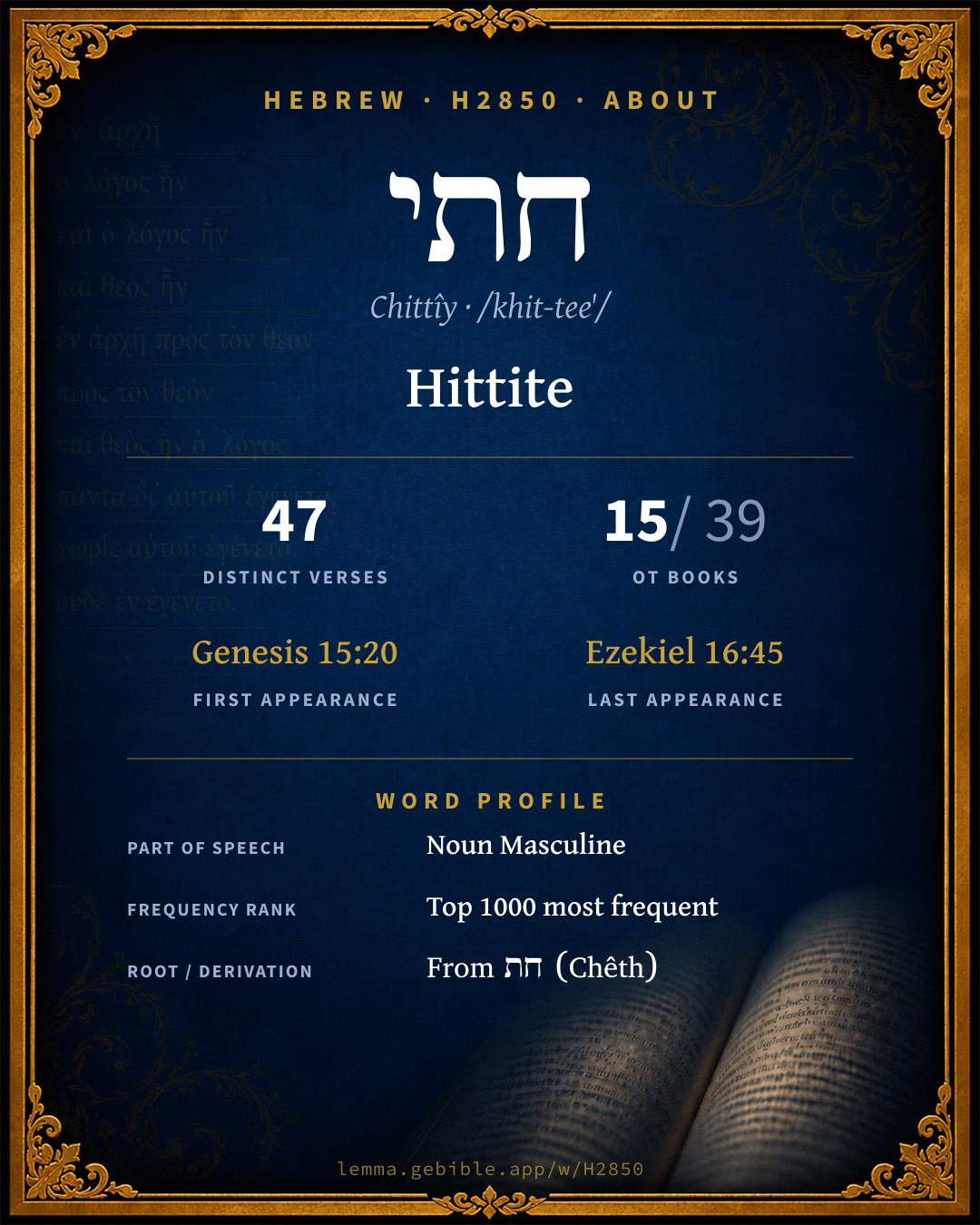
חִתִּי
Hittite
BDB lists 2 entries for ‘Hittite’ fuller range ↓
Full lexicon entry — Brown-Driver-Briggs (BDB)
From Brown-Driver-Briggs (BDB)
Where this word appears
Grammar key — what these labels mean
Part of speech
- Noun
- A naming word — a person, place, thing, or idea.
Noun type
- Gentilic
- A noun naming a member of a people, tribe, or region of origin (e.g. an Israelite, a Moabite).
State
- Absolute
- The independent form of a noun, not bound to a following word.
Gender
- Masculine
- Grammatically masculine.
- Feminine
- Grammatically feminine.
Number
- Singular
- One.
- Plural
- More than one (in Hebrew, generally three or more).
Grammatical forms
- Noun, Gentilic, Masculine, Singular, Absolute 41 times (85%)
- Noun, Gentilic, Masculine, Plural, Absolute 5 times (10%)
- Noun, Gentilic, Feminine, Plural, Absolute 1 time (2%)
- Noun, Gentilic, Feminine, Singular, Absolute 1 time (2%)
Parsed forms decoded from the imported morphology (morphhb / Westminster Leningrad Codex — WLC text public domain, morphhb tagging CC BY 4.0), counted across 48 parsed occurrences — not distinct verses.
Every verse where H2850 appears — 47 distinct verses across 15 books. Click any verse to open its interlinear word-by-word view. Verse text shown in the World English Bible for context — . Each verse’s Hebrew form is shown with its reference; the English is not keyword-highlighted, since the data carries no word-level English alignment. Use “Compare translations” on any verse to read it across multiple English versions. This concordance covers the Hebrew Bible; Septuagint (Greek Old Testament) occurrences are not indexed here.
Genesis 8 verses
- Genesis 15:20 הַ/חִתִּ֥י ptcl def.art + n Gentilic ms the Hittites, the Perizzites, the Rephaim,
- Genesis 23:10 הַ/חִתִּ֤י ptcl def.art + n Gentilic ms Now Ephron was sitting in the midst of the children of Heth. Ephron the Hittite answered Abraham in the hearing of the children of Heth, even of all who went in at the gate of his city, saying,
- Genesis 25:9 הַֽ/חִתִּ֔י ptcl def.art + n Gentilic ms Isaac and Ishmael, his sons, buried him in the cave of Machpelah, in the field of Ephron, the son of Zohar the Hittite, which is before Mamre,
- Genesis 26:34 הַֽ/חִתִּ֑י הַֽ/חִתִּֽי ptcl def.art + n Gentilic ms ptcl def.art + n Gentilic ms When Esau was forty years old, he took as wife Judith, the daughter of Beeri the Hittite, and Basemath, the daughter of Elon the Hittite.
- Genesis 36:2 הַֽ/חִתִּ֔י ptcl def.art + n Gentilic ms Esau took his wives from the daughters of Canaan: Adah the daughter of Elon, the Hittite; and Oholibamah the daughter of Anah, the daughter of Zibeon, the Hivite;
- Genesis 49:29 הַֽ/חִתִּֽי ptcl def.art + n Gentilic ms He charged them, and said to them, "I am to be gathered to my people. Bury me with my fathers in the cave that is in the field of Ephron the Hittite,
- Genesis 49:30 הַ/חִתִּ֖י ptcl def.art + n Gentilic ms in the cave that is in the field of Machpelah, which is before Mamre, in the land of Canaan, which Abraham bought with the field from Ephron the Hittite as a burial place.
- Genesis 50:13 הַ/חִתִּ֖י ptcl def.art + n Gentilic ms for his sons carried him into the land of Canaan, and buried him in the cave of the field of Machpelah, which Abraham bought with the field, for a possession of a burying-place, from Ephron the Hittite, before Mamre.
Exodus 7 verses
- Exodus 3:8 וְ/הַ֣/חִתִּ֔י conj + ptcl def.art + n Gentilic ms I have come down to deliver them out of the hand of the Egyptians, and to bring them up out of that land to a good and large land, to a land flowing with milk and honey; to the place of the Canaanite, the Hittite, the Amorite, the Perizzite, the Hivite, and the Jebusite.
- Exodus 3:17 וְ/הַ֣/חִתִּ֔י conj + ptcl def.art + n Gentilic ms and I have said, I will bring you up out of the affliction of Egypt to the land of the Canaanite, the Hittite, the Amorite, the Perizzite, the Hivite, and the Jebusite, to a land flowing with milk and honey."'
- Exodus 13:5 וְ/הַ/חִתִּ֨י conj + ptcl def.art + n Gentilic ms It shall be, when Yahweh shall bring you into the land of the Canaanite, and the Hittite, and the Amorite, and the Hivite, and the Jebusite, which he swore to your fathers to give you, a land flowing with milk and honey, that you shall keep this service in this month.
- Exodus 23:23 וְ/הַ֣/חִתִּ֔י conj + ptcl def.art + n Gentilic ms For my angel shall go before you, and bring you in to the Amorite, the Hittite, the Perizzite, the Canaanite, the Hivite, and the Jebusite; and I will cut them off.
- Exodus 23:28 הַ/חִתִּ֖י ptcl def.art + n Gentilic ms I will send the hornet before you, which will drive out the Hivite, the Canaanite, and the Hittite, from before you.
- Exodus 33:2 וְ/הַֽ/חִתִּי֙ conj + ptcl def.art + n Gentilic ms I will send an angel before you; and I will drive out the Canaanite, the Amorite, and the Hittite, and the Perizzite, the Hivite, and the Jebusite:
- Exodus 34:11 וְ/הַ/חִתִּי֙ conj + ptcl def.art + n Gentilic ms Observe that which I command you this day. Behold, I drive out before you the Amorite, the Canaanite, the Hittite, the Perizzite, the Hivite, and the Jebusite.
Numbers 1 verse
Deuteronomy 2 verses
- Deuteronomy 7:1 הַֽ/חִתִּי֩ ptcl def.art + n Gentilic ms When Yahweh your God shall bring you into the land where you go to possess it, and shall cast out many nations before you, the Hittite, and the Girgashite, and the Amorite, and the Canaanite, and the Perizzite, and the Hivite, and the Jebusite, seven nations greater and mightier than you;
- Deuteronomy 20:17 הַ/חִתִּ֤י ptcl def.art + n Gentilic ms but you shall utterly destroy them: the Hittite, and the Amorite, the Canaanite, and the Perizzite, the Hivite, and the Jebusite; as Yahweh your God has commanded you;
Joshua 6 verses
- Joshua 1:4 הַֽ/חִתִּ֔ים ptcl def.art + n Gentilic mp From the wilderness, and this Lebanon, even to the great river, the river Euphrates, all the land of the Hittites, and to the great sea toward the going down of the sun, shall be your border.
- Joshua 3:10 הַ/חִתִּ֜י ptcl def.art + n Gentilic ms Joshua said, Hereby you shall know that the living God is among you, and that he will without fail drive out from before you the Canaanite, and the Hittite, and the Hivite, and the Perizzite, and the Girgashite, and the Amorite, and the Jebusite.
- Joshua 9:1 הַֽ/חִתִּי֙ ptcl def.art + n Gentilic ms It happened, when all the kings who were beyond the Jordan, in the hill-country, and in the lowland, and on all the shore of the great sea in front of Lebanon, the Hittite, and the Amorite, the Canaanite, the Perizzite, the Hivite, and the Jebusite, heard of it;
- Joshua 11:3 וְ/הַ/חִתִּ֛י conj + ptcl def.art + n Gentilic ms to the Canaanite on the east and on the west, and the Amorite, and the Hittite, and the Perizzite, and the Jebusite in the hill-country, and the Hivite under Hermon in the land of Mizpah.
- Joshua 12:8 הַֽ/חִתִּי֙ ptcl def.art + n Gentilic ms in the hill-country, and in the lowland, and in the Arabah, and in the slopes, and in the wilderness, and in the South; the Hittite, the Amorite, and the Canaanite, the Perizzite, the Hivite, and the Jebusite:
- Joshua 24:11 וְ/הַֽ/חִתִּי֙ conj + ptcl def.art + n Gentilic ms You went over the Jordan, and came to Jericho: and the men of Jericho fought against you, the Amorite, and the Perizzite, and the Canaanite, and the Hittite, and the Girgashite, the Hivite, and the Jebusite; and I delivered them into your hand.
Judges 2 verses
- Judges 1:26 הַ/חִתִּ֑ים ptcl def.art + n Gentilic mp The man went into the land of the Hittites, and built a city, and called the name of it Luz, which is the name of it to this day.
- Judges 3:5 הַ/חִתִּ֤י ptcl def.art + n Gentilic ms The children of Israel lived among the Canaanites, the Hittites, and the Amorites, and the Perizzites, and the Hivites, and the Jebusites:
1 Samuel 1 verse
2 Samuel 8 verses
- 2 Samuel 11:3 הַ/חִתִּֽי ptcl def.art + n Gentilic ms David send and inquired after the woman. One said, Is not this Bathsheba, the daughter of Eliam, the wife of Uriah the Hittite?
- 2 Samuel 11:6 הַ/חִתִּ֑י ptcl def.art + n Gentilic ms David sent to Joab, [saying], Send me Uriah the Hittite. Joab sent Uriah to David.
- 2 Samuel 11:17 הַ/חִתִּֽי ptcl def.art + n Gentilic ms The men of the city went out, and fought with Joab: and there fell some of the people, even of the servants of David; and Uriah the Hittite died also.
- 2 Samuel 11:21 הַ/חִתִּ֖י ptcl def.art + n Gentilic ms who struck Abimelech the son of Jerubbesheth? Didn't a woman cast an upper millstone on him from the wall, so that he died at Thebez? Why did you go so near the wall?' then shall you say, 'Your servant Uriah the Hittite is dead also.'"
- 2 Samuel 11:24 הַ/חִתִּ֖י ptcl def.art + n Gentilic ms The shooters shot at your servants from off the wall; and some of the king's servants are dead, and your servant Uriah the Hittite is dead also.
- 2 Samuel 12:9 הַֽ/חִתִּי֙ ptcl def.art + n Gentilic ms Why have you despised the word of Yahweh, to do that which is evil in his sight? You have struck Uriah the Hittite with the sword, and have taken his wife to be your wife, and have slain him with the sword of the children of Ammon.
- 2 Samuel 12:10 הַ/חִתִּ֔י ptcl def.art + n Gentilic ms Now therefore the sword will never depart from your house, because you have despised me, and have taken the wife of Uriah the Hittite to be your wife.'
- 2 Samuel 23:39 הַֽ/חִתִּ֔י ptcl def.art + n Gentilic ms Uriah the Hittite: thirty-seven in all.
1 Kings 4 verses
- 1 Kings 9:20 הַ/חִתִּ֤י ptcl def.art + n Gentilic ms As for all the people who were left of the Amorites, the Hittites, the Perizzites, the Hivites, and the Jebusites, who were not of the children of Israel;
- 1 Kings 10:29 הַ/חִתִּ֛ים ptcl def.art + n Gentilic mp A chariot came up and went out of Egypt for six hundred [shekels] of silver, and a horse for one hundred fifty; and so for all the kings of the Hittites, and for the kings of Syria, did they bring them out by their means.
- 1 Kings 11:1 חִתִּיֹּֽת n Gentilic fp Now king Solomon loved many foreign women, together with the daughter of Pharaoh, women of the Moabites, Ammonites, Edomites, Sidonians, and Hittites;
- 1 Kings 15:5 הַ/חִתִּֽי ptcl def.art + n Gentilic ms because David did that which was right in the eyes of Yahweh, and didn't turn aside from anything that he commanded him all the days of his life, except only in the matter of Uriah the Hittite.
2 Kings 1 verse
1 Chronicles 1 verse
2 Chronicles 2 verses
- 2 Chronicles 1:17 הַֽ/חִתִּ֛ים ptcl def.art + n Gentilic mp They brought up and brought out of Egypt a chariot for six hundred pieces of silver, and a horse for one hundred fifty: and so for all the kings of the Hittites, and the kings of Syria, did they bring them out by their means.
- 2 Chronicles 8:7 הַ/חִתִּ֜י ptcl def.art + n Gentilic ms As for all the people who were left of the Hittites, and the Amorites, and the Perizzites, and the Hivites, and the Jebusites, who were not of Israel;
Ezra 1 verse
Nehemiah 1 verse
Ezekiel 2 verses
- Ezekiel 16:3 חִתִּֽית n Gentilic ms and say, Thus says the Lord Yahweh to Jerusalem: Your birth and your birth is of the land of the Canaanite; the Amorite was your father, and your mother was a Hittite.
- Ezekiel 16:45 חִתִּ֔ית n Gentilic fs You are the daughter of your mother, who loathes her husband and her children; and you are the sister of your sisters, who loathed their husbands and their children: your mother was a Hittite, and your father an Amorite.
About this entry
At a glance — auto-summarized from this page’s data, not written by a person. Every figure links to its source below. This summary describes the numbers; it doesn’t interpret them.
The Hebrew name חתי centers on the idea of “Hittite.” Its earliest occurrence is Genesis 15:20. Spanning 47 verses in 15 books, it ranks among the moderately common words of the Hebrew Bible. Dig into 47-verse concordance and the renderings breakdown below.
Gloss history
Strong's 1890 vs modern scholarship
About this word
Strong's H2850 catalogs a Hebrew word from the Hebrew Old Testament.
These counts are not copied from any lexicon or concordance. They are computed here, from the morphology-tagged Hebrew Old Testament. What Lemma adds →
- 47
- distinct verses
- The word appears in 47 distinct verses.
- 15 / 39
- OT books
- The word appears in 15 of 39 Old Testament books.
- #767
- by frequency
- Top 1000 most frequent Hebrew words (rank 767 of 8,640 Hebrew words by occurrence).
View all 47 occurrences in the concordance →
By section of the Old Testament
By traditional corpus
Conventional, traditional groupings — biblical authorship is debated, so this is a traditional corpus grouping, not an authorship claim. Each share is this word’s portion of its verses in that division of the Hebrew canon. Each figure is a share of the word’s 47 distinct verses.
- Prophets (Nevi'im) 24 verses · 51%
- Torah (Pentateuch) 18 verses · 38%
- Writings (Ketuvim) 5 verses · 11%
How translations render this word
Counts come from each version’s own published word-to-Strong’s tagging or interlinear alignment — an approximate guide to how each version renders this word, not a word-level alignment the data otherwise carries. Because each total is that version’s own tagged count, the per-version totals vary from one another and need not match the appearance or distinct-verse counts above. These counts may also differ from a printed concordance because Lemma counts each distinctly tagged rendering and does not collapse phrase taggings into a single head-word total. This is a fixed set of word-tagged versions (KJV, ASV, BSB, ULT) and does not change with the reading translation you choose elsewhere. Each version’s license is shown beside its name below (and on Sources).
BDB lists this Strong’s number as 2 distinct words (homographs). Each count above pools all of them and is not split by sense — see the Senses section below. A low-frequency rendering may belong to a different one of those words, not the primary meaning.
- King James Version†: Hittite 25×, Hittites 20×
- American Standard Version†: Hittite 34×, Hittites 10×, Was a hittite 2×
- Berean Standard Bible†: Hittites 26×, Hittite 20×
- unfoldingWord Literal Text†: Hittite 30×, Hittites 15×, Was a hittite 2×
King James Version Public Domain
Renders H2850 across 48† tagged occurrences — most commonly:
Plus 3 renderings that appear only once — usually multi-word phrases or single function words the recovered tagging swept in, not distinct renderings.
American Standard Version Public Domain
Renders H2850 across 48† tagged occurrences — most commonly:
Plus 2 renderings that appear only once — usually multi-word phrases or single function words the recovered tagging swept in, not distinct renderings.
Berean Standard Bible Public Domain
Renders H2850 across 48† tagged occurrences — most commonly:
Plus 2 renderings that appear only once — usually multi-word phrases or single function words the recovered tagging swept in, not distinct renderings.
unfoldingWord Literal Text CC BY-SA 4.0
Renders H2850 across 48† tagged occurrences — most commonly:
Plus 1 rendering that appears only once — usually multi-word phrases or single function words the recovered tagging swept in, not distinct renderings.
Senses in the full BDB
What do BDB’s symbols mean?
BDB uses these scholarly abbreviations:
| Symbol | Meaning |
|---|---|
| 𝔊 | the Septuagint (the ancient Greek translation, LXX) |
| 𝔙 | the Vulgate (the Latin translation) |
| 𝔖 | the Syriac version (the Peshitta) |
| 𝔗 | the Targum (the Aramaic translation) |
| ψ | the Psalms |
| √ | root (the underlying root or stem) |
| ‖ | parallel passage (a synonymous or contrasted parallel) |
| † | the dagger: every passage where the word occurs is cited |
The 4 senses and sub-senses the full Brown-Driver-Briggs lexicon distinguishes for this word, in lexicon order (not ranked by frequency), with BDB’s own verbatim wording and sub-sense lettering. Shown in Hebrew script with BDB’s own scholarly abbreviations. The condensed entry is in the Lexicon Entry tab. See also the Forms in the corpus table below.
- 1. adj., of seller of Machpelah to Abr., עֶפְרוֹן הַחִתִּי Gn 23:10; 49:29, 30; 50:13; עֶפְרֹן בֶּן־צֹחַר הַח׳ 25:9 (all P); of fathers of Esau’s wives בְּאֵרִי הַח׳ Gn 26:34; אֵילוֹן הַח׳ v 34; 36:2 (all P); also of warriors of David, אֲחִימֶלֶךְ הַח׳ 1 S 26:6, and especially אוּרִיָּה הַח׳ 2 S 11:3, 6, 17, 21, 24; 12:9, 10; 23:39 1 K 15:5 1 Ch 11:41; fs. = subst., only of (religious) ancestry of Jerus. Ez 16:3 thy father was the Amorite, and thy mother was a Hittite woman חִתִּית, similarly v 45; fpl.; = subst. of Sol.’s foreign wives, חִתִּיֹּת 1 K 11:1 Hittite women (+ מוֹאֲבִיּוֹת, עַמּוֹנִיּוֹת, אֲדֹמִיִּת, צֵדְנִיֹּת). e.g. Genesis 23:10
- 2. n. usually
- a. coll. הַחִתִּי the Hittites: in lists of Canaanitish peoples Gn 15:20 (JE), Ex 3:8, 17 (both J), 13:5, 23:23, 28; 33:2; 34:11 Nu 13:29 Jos 3:10 (all JE), Dt 7:1; 20:17 Jos 9:1; 12:8; 24:11 (all D); read also for הַחִוִּי Ju 3:3 (so We Mey BuUrg. 350); in Jos 11:3 (D) del. הַחִתִּי We Mey Bul.c., and read then הַחִתִּי for הַחִוִּי v b (so 𝔊, not 𝔊L); further 1 K 9:20 = 2 Ch 8:7, Ezr 9:1 Ne 9:8. e.g. Genesis 15:20
- b. pl. הַחִתִּים: כֹּל אֶרֶץ הַחִתִּים Jos 1:4 (D) nearly = land of Canaanites; ארץ הַח׳ specif. of northern home of Hittites Ju 1:26; so also 2 S 24:6 where read אֶרֶץ הַחִתִּים קֵ֫דְשָׁה (for MT תחתים חָדְשִׁי, v. חָדְשִׁי, קֵדֶשׁ); מַלְכֵי הַחִתִּים 1 K 10:29 = 2 Ch 1:17 (both + מַלְכֵי אֲרָם), 2 K 7:6 (+ מַלְכֵי מִצְרַיִם, both feared by אֲרָם). Hence it appears that הַחִתִּי(ם) had their proper seat in the north—where also they were encountered by Assyrians from time of TP I (v. Schr Dll.c.), and by Egyptians from time of Tutmes III (v. W Max Mülll.c.).—(cf. also Ju 3:3 Jos 11:3 supr.), but that individual Hittites were known in Isr. (cf., besides 1 S 2:6 2 S 11:3 etc., 1 K 9:20 supr.); that the Hittites were regarded (by JED) as one of the peoples of Canaan, and that the name even came to be used in more gen. sense for Canaanites. Only in P do they appear as having a definite settlement in the south, and are designated by בְּנֵי־חֵת (v. חֵת), as well as by the adj. הַחתִּי. e.g. Joshua 1:4
Senses from the full Brown-Driver-Briggs lexicon (Brown, Driver, Briggs; Oxford 1906 — public domain), digitized via Sefaria, supplemented by the OpenScriptures HebrewLexicon (CC BY 4.0). Full attribution on Sources.
Word origin
adj. et n.gent. Hittite(s) (Egyptian Ḫ-tá, Ḫetá. W Max MüllAsien u. Europa, 319 ff.; Assyrian Ḫatti, SchrKG 192 ff. COT on Gn 10:19 DlPa, 269 ff.; Tel-el-Amarna Ḫatti, Ḫatta BezTel el Amarn. Brit. Mus. 150)—m. always c. art. הַחִתִּי Gn 23:10 Ex 3:8 +; f. חִתִּית Ez 16:3, 45; mpl. הַחִתִּים Jos 1:4 + 3 times; fpl. חִתִּיֹּת 1 K 11:1;—
— Brown-Driver-Briggs (Oxford 1906, public domain), digitized via Sefaria, supplemented by the OpenScriptures HebrewLexicon (CC BY 4.0). See Sources.
Derived from חת (Chêth) (H2845) — Heth.
Jastrow Dictionary
A second Hebrew/Aramaic lexicon for comparison, covering Aramaic and post-biblical (Talmudic, Targumic, Midrashic) usage that the biblical-Hebrew BDB does not. Matched by lemma rather than by Strong’s number, so a lemma may carry more than one Jastrow headword (shown separately below), and the entries cover usage well beyond the Bible.
חתי
- , (v. נחת); Hif. הֶחֱתִי(א) to put down, rest. Y. Yoma V, 42ᵇ bot. יחליף … ויַחֲתִי let him change hands … and set (the pan) down. Ib. אם ה׳ מימינו וכ׳ if he set it down from his right towards his left side.
חֲתֵי
- Af. אַחֲתֵי same. Yoma 47ᵃ ונַחְתְיָהּ למחתה וכ׳ (v. Rabb. D. S. a. l. notes 3, 4) and let him put the pan on top of it. V. נְחַת.
חתי ²
- (b. h.) to dig, esp. to take coals out with a pan. Yoma IV, 4 בכל יום היה חוֹתֶה וכ׳ every other day the priest used to take coals out in a silver pan &c. Sabb. VIII, 7 כדי לַחְתּוֹת בו את האור large enough to take fire out in it. Zeb. 64ᵃ; a. fr.—Y. Yoma IV, 41ᶜ bot. צריך לחות (read לחתות) he must take coals out as before.
- to stir embers, rake. Sabb. 34ᵇ שמא יְחַתֶּה בגחלים he might rake the coals under the ashes. [Ḥull. 27ᵃ, v. חָתַת].
חֲתִי
- Targ. Is. XXX, 14.—Part. חָאתֵי. Targ. Prov. XXV, 22 ed. Lag. (oth. ed. חָתֵי).—
- to stir. Ab. Zar. 38ᵇ וחַתֵּה בה חַתּוּיֵי ed. (v. Rabb. D. S. a. l. note 8), v. חֲרֵי.
A Dictionary of the Targumim, the Talmud Babli and Yerushalmi, and the Midrashic Literature (Marcus Jastrow; London, Luzac, 1903) — Public Domain. Digitized via Sefaria. Digitized via Sefaria. Full attribution on Sources.
Forms in the corpus
The 27 distinct written forms H2850 takes in the Hebrew Bible, most frequent first — each parse links to that state’s occurrences in the concordance. Hebrew forms include their vowel points and cantillation, so a single lemma takes many written forms.
| Form | Parsing | Example | Uses |
|---|---|---|---|
| הַ/חִתִּ֖י | Noun, Gentilic, Masculine, Singular, Absolute | Exodus 23:28 | 5 |
| הַ/חִתִּ֜י | Noun, Gentilic, Masculine, Singular, Absolute | Ezra 9:1 | 4 |
| הַ/חִתִּ֤י | Noun, Gentilic, Masculine, Singular, Absolute | Deuteronomy 20:17 | 4 |
| הַ/חִתִּֽי | Noun, Gentilic, Masculine, Singular, Absolute | 1 Kings 15:5 | 3 |
| הַֽ/חִתִּ֔י | Noun, Gentilic, Masculine, Singular, Absolute | Genesis 25:9 | 3 |
| הַֽ/חִתִּי֙ | Noun, Gentilic, Masculine, Singular, Absolute | 2 Samuel 12:9 | 3 |
| וְ/הַ֣/חִתִּ֔י | Noun, Gentilic, Masculine, Singular, Absolute | Exodus 3:8 | 3 |
| הַ/חִתִּ֔י | Noun, Gentilic, Masculine, Singular, Absolute | 1 Chronicles 11:41 | 2 |
| הַ/חִתִּ֛ים | Noun, Gentilic, Masculine, Plural, Absolute | 1 Kings 10:29 | 2 |
| הַֽ/חִתִּֽי | Noun, Gentilic, Masculine, Singular, Absolute | Genesis 26:34 | 2 |
| הַ/חִתִּ֑י | Noun, Gentilic, Masculine, Singular, Absolute | 2 Samuel 11:6 | 1 |
| הַ/חִתִּ֑ים | Noun, Gentilic, Masculine, Plural, Absolute | Judges 1:26 | 1 |
| הַ/חִתִּ֗י | Noun, Gentilic, Masculine, Singular, Absolute | 1 Samuel 26:6 | 1 |
| הַ/חִתִּ֥י | Noun, Gentilic, Masculine, Singular, Absolute | Genesis 15:20 | 1 |
| הַֽ/חִתִּ֑י | Noun, Gentilic, Masculine, Singular, Absolute | Genesis 26:34 | 1 |
| הַֽ/חִתִּ֔ים | Noun, Gentilic, Masculine, Plural, Absolute | Joshua 1:4 | 1 |
| הַֽ/חִתִּ֛ים | Noun, Gentilic, Masculine, Plural, Absolute | 2 Chronicles 1:17 | 1 |
| הַֽ/חִתִּי֩ | Noun, Gentilic, Masculine, Singular, Absolute | Deuteronomy 7:1 | 1 |
| וְ/הַ/חִתִּ֛י | Noun, Gentilic, Masculine, Singular, Absolute | Joshua 11:3 | 1 |
| וְ/הַ/חִתִּ֨י | Noun, Gentilic, Masculine, Singular, Absolute | Exodus 13:5 | 1 |
| וְ/הַ/חִתִּי֙ | Noun, Gentilic, Masculine, Singular, Absolute | Exodus 34:11 | 1 |
| וְ/הַֽ/חִתִּי֙ | Noun, Gentilic, Masculine, Singular, Absolute | Exodus 33:2 | 1 |
| וְ/הַֽ/חִתִּי֙ | Noun, Gentilic, Masculine, Singular, Absolute | Joshua 24:11 | 1 |
| וְ֠/הַֽ/חִתִּי | Noun, Gentilic, Masculine, Singular, Absolute | Numbers 13:29 | 1 |
| חִתִּ֔ית | Noun, Gentilic, Feminine, Singular, Absolute | Ezekiel 16:45 | 1 |
| חִתִּֽית | Noun, Gentilic, Masculine, Singular, Absolute | Ezekiel 16:3 | 1 |
| חִתִּיֹּֽת | Noun, Gentilic, Feminine, Plural, Absolute | 1 Kings 11:1 | 1 |
Bible dictionary
Public-domain dictionary articles matched to this entry by name (Hittite). A biblical name can be shared by more than one person or place, so an article may treat several.
Hitchcock's Bible Names Dictionary · Roswell D. Hitchcock, 1869
one who is broken; who fears
Classic public-domain reference works; full attribution on Sources.
Septuagint verse parallels
This word appears in 45 verses that also exist in the Greek Old Testament (Septuagint), out of the 47 Hebrew verses it occurs in. You can read those verses in Greek by switching the Old Testament edition to the Septuagint.
Read these verses in the Septuagint
- Genesis 15:20
- Exodus 3:8
- Numbers 13:29
- Deuteronomy 7:1
- Joshua 1:4
- Judges 1:26
- 1 Samuel 26:6
- 2 Samuel 11:3
- 1 Kings 10:29
- 2 Kings 7:6
- 1 Chronicles 11:41
- 2 Chronicles 1:17
This is a verse-level parallel only — the same verses exist in both the Hebrew and Greek Old Testaments. No word-level Hebrew↔Greek correspondence is claimed: the data carries no such alignment, so no Greek word is shown as this Hebrew word’s translation. Coverage is not total — the Septuagint omits the deuterocanon and renumbers the Psalms, so some Hebrew verses have no direct Greek parallel.