
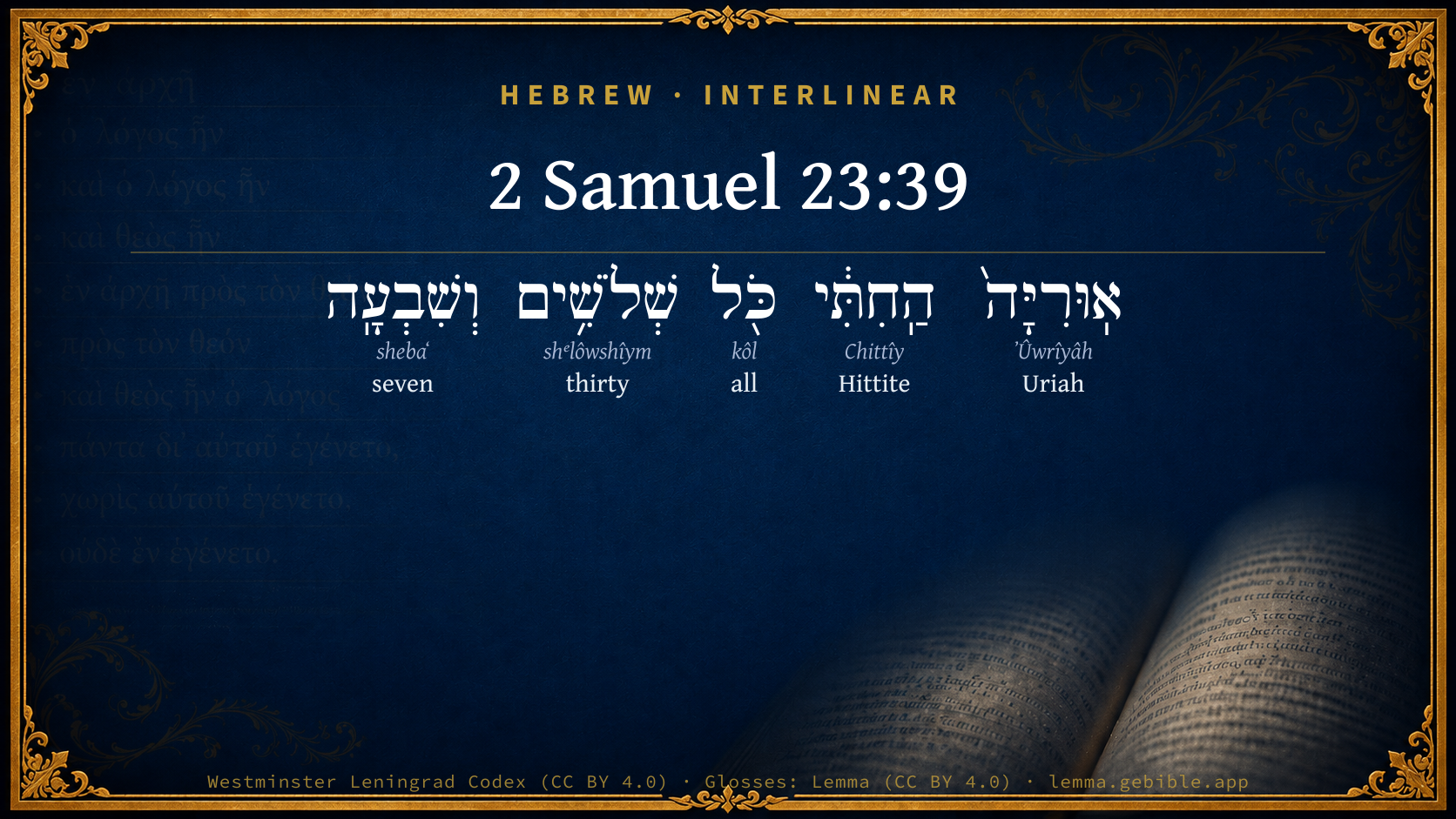
2 Samuel 23:39

Hebrew (Westminster Leningrad Codex) 2 Samuel 23:39 appears in the Hebrew Old Testament. The text above is from the Westminster Leningrad Codex. Each word links to its Strong’s number, a concise gloss, and parsing drawn from the Open Scriptures Hebrew Bible morphology. Click any word for its full Brown-Driver-Briggs (BDB) entry.
Download image
Cite this verse

2 Samuel 23:39 (World English Bible). Public Domain. Lemma interlinear Bible study tool, https://lemma.gebible.app/v/2-samuel/23/39.

Show BibTeX & RIS
BibTeX
RIS
English Translation
Uriah the Hittite: thirty-seven in all.
World English Bible · Public Domain
Download a study sheet

One document with this verse’s original text, its word-by-word gloss line, the meaning frame, cross-references with their text, attributed commentary, and full source and license credits — printable, and it pastes into notes with its structure intact.

This verse Autodidact and up

Study sheet (.html) Plain text (.txt)

A passage Seminary Student

Up to 50 verses in one chapter. A passage sheet keeps up to 6 commentary sources and 12 cross-references per verse, in the order this page ranks them, and says so on the sheet whenever that leaves anything out. Ask for a single verse and you get the Autodidact verse sheet above.

Everything on this page stays free to read, with no account — the sheet is a download of what is already on screen, not access to it.

Want to remove ads? Support Godless Engineer
Compare translations 3

The same verse in 3 English versions, stacked beneath the original-language interlinear above. Click any original word for its lexicon entry.

Each is an independent rendering of the whole verse — the interlinear is not word-aligned to these translations.

Highlighted words mark where these versions differ — a whole-verse word diff, not a word-by-word alignment.

  • World English Bible Public Domain
    Uriah the Hittite: thirty-seven in all.
  • King James Version Public Domain
    Uriah the Hittite: thirty and seven in all.
  • unfoldingWord Literal Text CC BY-SA 4.0
    Uriah the Hittite; all, 37.

unfoldingWord Literal Text — © unfoldingWord, licensed CC BY-SA 4.0. Word-aligned USFM3 via Door43 (git.door43.org/unfoldingWord/en_ult).

Versions to compare (up to 4)

3 of 4 selected

Show all 18 translations

Every available English version of this verse, each an independent rendering of the whole verse.

  • World English Bible Public Domain
    Uriah the Hittite: thirty-seven in all.
  • Berean Standard Bible Public Domain
    and Uriah the Hittite. There were thirty-seven in all.
  • Majority Standard Bible Public Domain
    and Uriah the Hittite. There were thirty-seven in all.
  • King James Version Public Domain
    Uriah the Hittite: thirty and seven in all.
  • American Standard Version (1901) Public Domain
    Uriah the Hittite: thirty and seven in all.
  • Revised Version (1885) Public Domain
    Uriah the Hittite: thirty and seven in all.
  • Geneva Bible (1599) Public Domain
    Uriiah the Hittite, thirtie and seuen in all.
  • Douay-Rheims (1899) Public Domain
    Urias the Hethite, thirty and seven in all.
  • Young's Literal Translation Public Domain
    Uriah the Hittite; in all thirty and seven.
  • Literal Standard Version CC BY-SA 4.0
    Uriah the Hittite: thirty-seven in all.
  • Unlocked Literal Bible CC BY-SA 4.0
    Uriah the Hittite—thirty-seven in all.
  • unfoldingWord Literal Text CC BY-SA 4.0
    Uriah the Hittite; all, 37.
  • Darby Bible Public Domain
    Uriah the Hittite: thirty-seven in all.
  • World Messianic Bible Public Domain
    and Uriah the Hittite: thirty-seven in all.
  • Webster's Bible Public Domain
    Uriah the Hittite: thirty and seven in all.
  • Free Bible Version CC BY-SA 4.0
    and Uriah the Hittite; a total of thirty-seven.
  • Bible in Basic English Public Domain
    Uriah the Hittite: thirty-seven in number.
  • JPS Tanakh (1917) Public Domain
    Uriah the Hittite. Thirty and seven in all.

Literal Standard Version (2020), Covenant Press — licensed CC BY-SA 4.0. Text via the HelloAO Bible API (eBible.org). Unlocked Literal Bible (unfoldingWord) — licensed CC BY-SA 4.0. Text via the HelloAO Bible API (eBible.org). unfoldingWord Literal Text — © unfoldingWord, licensed CC BY-SA 4.0. Word-aligned USFM3 via Door43 (git.door43.org/unfoldingWord/en_ult). Free Bible Version, Dr. Jonathan Gallagher — licensed CC BY-SA 4.0. Text via the HelloAO Bible API (eBible.org).

Word by word

More ways to search: Search by grammar → Find every occurrence → Compare this word →

Practice this passage: Drill this verse → Learn its vocabulary →

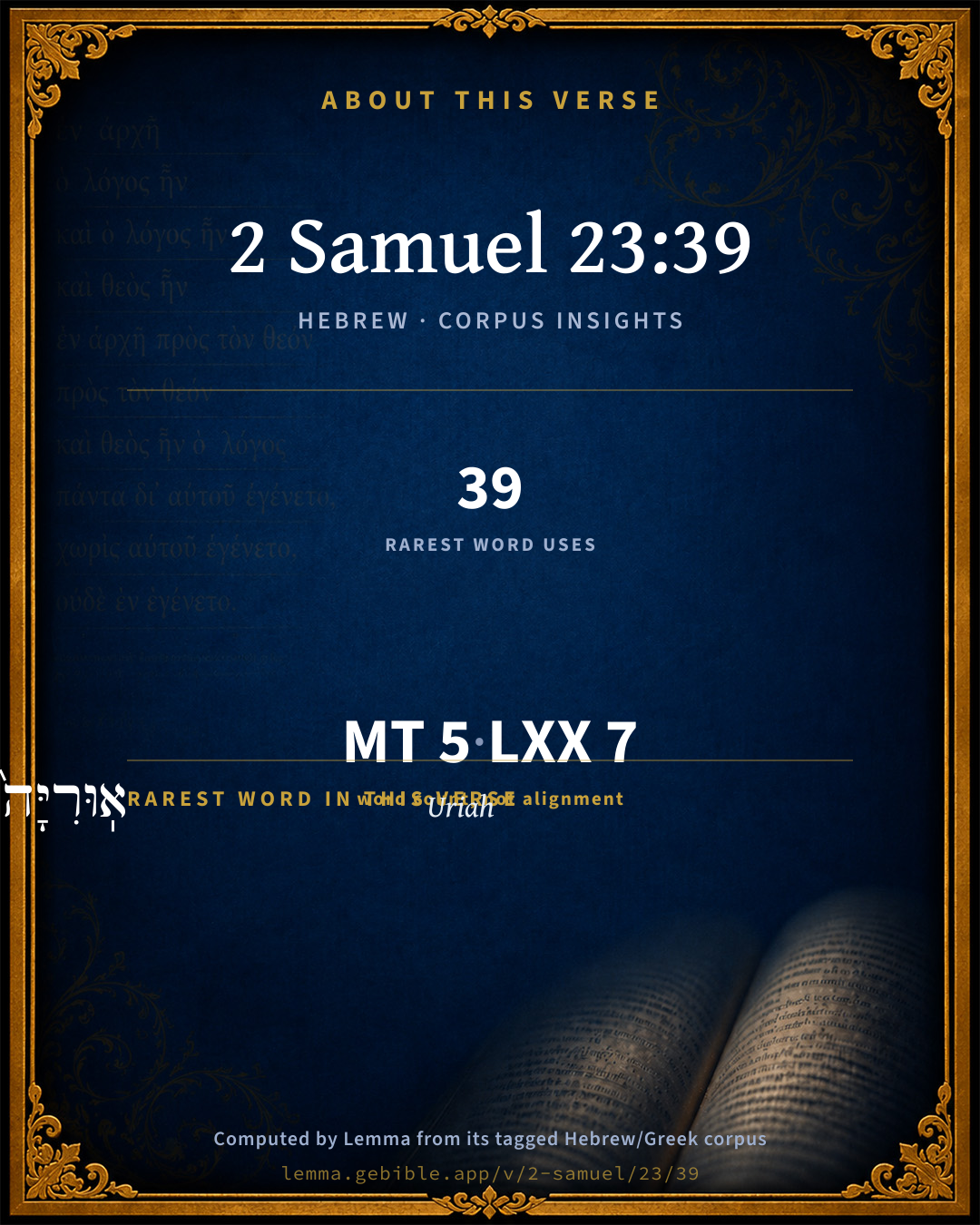
About this verse

These counts appear in no published source. They are computed here, from the morphology-tagged text and Lemma’s own curated glosses. What Lemma adds →

5
words
5
distinct lemmas
Historical
section

Shared distinctive vocabulary

אֽוּרִיָּה֙ Uriah H223 occurs in 33 verses of the Hebrew Bible. Also found in:

Grammatical profile

  • 3 nouns
  • 2 adjectives

Hebrew & Septuagint length

In English translation the verse runs 6 words from the Hebrew and 6 from the Septuagint (LXX English) — the same length.

A rough comparison of the two English renderings, which tokenize alike — not a word-level alignment.

Word counts can differ between the Hebrew and the Greek without any difference in meaning — e.g. the Hebrew direct-object marker אֵת has no separate Greek word, and Greek often adds the article ὁ.

In the original languages it is 5 Hebrew tokens and 7 Greek tokens — but the two are counted differently (Hebrew bundles its prefixes and suffixes into one token; the Greek is in lemma form), so that isn’t a like-for-like length.

Cross-references

6

Topical passages linked to 2 Samuel 23:39 in the Treasury of Scripture Knowledge — connected by theme and wording, ordered by reader-vote popularity; previews shown in the World English Bible.

  • 2 Samuel 11:3 David send and inquired after the woman. One said, Is not this Bathsheba, the daughter of Eliam, the wife of Uriah the Hittite?
  • 2 Samuel 12:9 Why have you despised the word of Yahweh, to do that which is evil in his sight? You have struck Uriah the Hittite with the sword, and have taken his wife to be your wife, and have slain him with the sword of the children of Ammon.
  • 1 Kings 15:5 because David did that which was right in the eyes of Yahweh, and didn't turn aside from anything that he commanded him all the days of his life, except only in the matter of Uriah the Hittite.
  • Matthew 1:6 Jesse became the father of David the king. David became the father of Solomon by her who had been the wife of Uriah.
  • 2 Samuel 11:6–27 David sent to Joab, [saying], Send me Uriah the Hittite. Joab sent Uriah to David.
  • 1 Chronicles 11:41 Uriah the Hittite, Zabad the son of Ahlai,

Cross-references courtesy of OpenBible.info (CC BY 4.0).

Hebrew and Greek witnesses Masoretic Hebrew ↔ Greek Septuagint

The same verse in the two great witnesses to the Old Testament, shown verse-for-verse.

These are two independent witnesses, not word-aligned to each other, and the Septuagint is shown in lemma (dictionary) form.

Hebrew 2 Samuel 23:39 Masoretic · Westminster Leningrad Codex

אֽוּרִיָּה֙ הַֽחִתִּ֔י כֹּ֖ל שְׁלֹשִׁ֥ים וְשִׁבְעָֽה

Uriah the Hittite: thirty-seven in all.

World English Bible · Public Domain

Greek LXX 2 Samuel 23:39 Septuagint · lemma form

ουριας ὁ χετταῖος πᾶς τριάκοντα καί ἑπτά

Urias the Chettite: thirty-seven in all.

LXX2012 (modern English Septuagint) · Public Domain

Hebrew: Westminster Leningrad Codex (CC BY 4.0). Greek: Septuagint (public domain); English from LXX2012 (modern English Septuagint) (Public Domain). How the Septuagint differs from the Hebrew →

Targum (Aramaic paraphrase)

1

The Targum is the ancient Jewish Aramaic paraphrase of the Hebrew Scriptures — an interpretive translation, not the Hebrew text itself. Onkelos (literal) and Pseudo-Jonathan (expansive) render the Torah, and Jonathan the Prophets. Coverage is partial: where no permissively-licensed English translation exists for a verse, only the Aramaic is shown. This is verse-level text, not a word-by-word alignment to the Hebrew.

  1. Targum Jonathan Prophets (Joshua–Malachi)
    אוּרִיָה חִתָּאָה כָּל גִבָּרַיָא תְלָתִין וּשְׁבָע:

    (no public-domain English translation for this verse)

    Targum Jonathan — Aramaic: “Mikraot Gedolot” (public domain). English: “Sefaria Community Translation” (CC0 1.0 (public-domain dedication)); “London "Chaldee Paraphrase," 1871” (public domain). Text via Sefaria.

Commentary

Notes on 2 Samuel 23:39 from classic Christian and Jewish commentators (each source and its license shown beneath its notes). The classic Christian expositions comment on the surrounding passage and are grouped to its opening verse, so a note may address several verses; the Jewish commentaries on the Tanakh (Rashi and others) are per-verse, so they appear only where the commentator wrote on this verse.

Lemma curates 59 commentaries, every one of them public domain or Creative Commons licensed, each selected and text-cleaned for this edition rather than reprinted as found. About our sources →

Tyndale Open Study Notes

Tyndale Open Resources

23:39 The very last name mentioned is Uriah the Hittite. There is an earlier reference to his father-in-law, Eliam, father of Bathsheba (23:34; see 11:3). By contrast, the Chronicler, who never mentioned David’s sins against Bathsheba and Uriah, placed Uriah’s name inconspicuously in the middle of the list of David’s mighty men (1 Chr 11:10-47). This author not only described the sins (2 Sam 11:1-27) but puts emphasis on Uriah’s name by placing it at the end of this list. Uriah was no ordinary conscript but a loyal member of David’s elite guard, which makes David’s treachery against him all the worse. • There were thirty-seven in all: Only thirty-six names are mentioned, assuming that “Shammah . . . from Harar” (23:11) is different from “Shammah from Harod” (23:25), and that “Benaiah son of Jehoiada” (23:20) is different from “Benaiah from Pirathon” (23:30). Perhaps the thirty-seventh warrior was Joab, who is mentioned only peripherally (23:18, 37) and is absent from the list of names. Many commentators say that he is excluded because he was David’s chief military leader and did not need to be included. The omission could also represent David’s long and troubled association with Joab, who was eventually executed when Solomon carried out David’s deathbed command (1 Kgs 2:5-6, 28-34).

Tyndale Open Study Notes — © Tyndale Open Resources, licensed CC BY-SA 4.0. Text via the HelloAO Bible API.

Geneva Bible (1599)

Geneva Bible translators

These came to David, and helped to restore him to his Kingdom.

Geneva Bible (1599) marginal notes — public domain. Text via Bolls.life.

Adam Clarke's Commentary

Verse 39. Uriah the Hittite: thirty and seven in all.] To these the author of 1Ch 11:41 adds Zabad son of Ahlai.

1Ch 11:42 - Adina the son of Shiza the Reubenite, a captain of the Reubenites, and thirty with him.

1Ch 11:43 - Hanan the son of Maachah, and Joshaphat the Mithnite,

1Ch 11:44 - Uzzia the Ashterathite, Shama and Jehiel the sons of Hothan the Aroerite,

1Ch 11:45 - Jediael the son of Shimri, and Joha his brother, the Tizite,

1Ch 11:46 - Eliel the Mahavite, and Jeribai, and Joshaviah, the sons of Elnaam, and Ithmah the Moabite,

1Ch 11:47 - Eliel, and Obed, and Jasiel the Mesobaite.

THE 4th and 5th verses 2Sa 23:4; 2Sa 23:5 are very obscure; L. De Dieu gives them a good meaning, if not the true one: -

"The perpetuity of his kingdom David amplifies by a comparison to three natural things, which are very grateful to men, but not constant and stable. For the sun arises and goes down again; the morning may be clear, but clouds afterwards arise; and the tender grass springs up, but afterwards withers. Not so, said he, is my kingdom before God; it is flourishing like all these, but perpetual, for he has made an everlasting covenant with me, though some afflictions have befallen me; and he has not made all my salvation and desire to grow."

De Dieu repeats כ ke, the note of similitude, thrice; and the following is his version: -

"The God of Israel said, the Rock of Israel spake unto me, (or concerning me:) The just man ruleth among men; he ruleth in the fear of God. And, as the sun ariseth with a shining light; as the morning is without clouds by reason of its splendour; as, from rain, the tender grass springeth out of the earth; truly so is not my house with God: because he hath made an everlasting covenant with me; disposed in all things, and well kept and preserved in that order. Although he doth not make all my deliverance and desire to grow, i.e., though some adversities happen to me and my family; yet, that always remains, which, in the covenant of God made with me, is in all things orderly, disposed, and preserved."

See Bishop Patrick on the place.

Once more I must beg the reader to refer to the First Dissertation of Dr. Kennicott, on the present state of the printed Hebrew text; in which there is not only great light cast on this subject, several corruptions in the Hebrew text being demonstrated, but also many valuable criticisms on different texts in the sacred writings. There are two Dissertations, 2 vols. 8vo.; and both very valuable.

Adam Clarke's Commentary on the Bible (1810–1826) — public domain. Text from a community e-Sword/MySword module.

Ellicott's Commentary for English Readers

(39) Thirty and seven in all.—Only thirty-six names have been given, but either the third unnamed person in the second triad of heroes is counted, or else in 2Sa_23:34 the names of the two given in Chronicles should be substituted for the one in the text here.

In 1Ch_11:41-47 sixteen more names are given, either of men who took the place of these heroes as they died, or simply of other heroes thought worthy of record, though hardly reckoned with this especial body.

A Bible Commentary for English Readers, edited by Charles John Ellicott (1878–1897) — public domain. Text from a community e-Sword module.

The Cambridge Bible for Schools and Colleges

gen. ed. J. J. S. Perowne

39. Uriah] See on ch. 2Sa_11:3.

thirty and seven in all] This total is obtained either (a) by reckoning three in the first class (2Sa_23:8-12), two in the second (2Sa_23:18-23), and thirty-two in the third (2Sa_23:24-39), emending 2Sa_23:34 by the help of Chron. so as to contain three names: or (b) if the text of 2Sa_23:34 is retained, by counting three in the second class, though only two are mentioned by name. Joab, as commander-in-chief, is not reckoned in the total.

In 1Ch_11:41-47 sixteen additional names are given, possibly either of those who became members of the body when its number was not rigidly limited to thirty, or of those who took the places vacated by death.

The Cambridge Bible for Schools and Colleges (gen. ed. J. J. S. Perowne; Cambridge University Press, 1878–1918) — public domain. Text from a community e-Sword module.

Albert Barnes' Notes on the Bible

Thirty and seven in all - This reckoning is correct, though only 36 “names” are given, the names of only two of the second triad being recorded, but 31 names are given from 2Sa 23:24 to the end, which, added to the two triads, or six, makes 37. Joab as captain of the whole host stands quite alone. In 1Ch 11:41-47; after Uriah the Hittite, there follow sixteen other names, probably the names of those who took the places of those in the former list, who died from time to time, or who were added when the number was less rigidly restricted to thirty.

Albert Barnes' Notes on the Bible (1834–1885) — public domain. Text from a community e-Sword/MySword module.

Haydock's Catholic Bible Commentary

Urias, the husband of Bethsabee. We have observed (ver. 25,) that in Paralipomenon the number of 37 is completed by Zabad, instead of Elica. (Haydock) --- Only 36 are specified in these catalogues, as the name of the sixth hero (ver. 18,) is omitted, whom some take to be Sobati, Jonathan, (chap. xxi. 22,) Joiada, (ver. 20,) or Joab. (Calmet) --- But the truth is, Joab is not mentioned here at all, as he was sufficiently known for the chief; (1 Paralipomenon xi. 6,) and he makes up the number of 37. The sixth, therefore, was Asael; (ver. 24,) and after him there are exactly 30. For though Gonni be lost, (ver. 32,) Semma is substituted in the following verse. (Haydock)

George Leo Haydock (1774–1849), Haydock's Catholic Family Bible and Commentary, 1859 edition — public domain. Excludes Psalms (Douay-Rheims chapter numbering differs from Protestant) and Deuterocanonical books (Catholic canon only).

Matthew Poole's English Annotations

Here are but thirty-six named; either therefore one must be supplied whose name is not expressed among the three second worthies, or Joab is comprehended in the number, as being the lord-general of all.

Matthew Poole's English Annotations on the Holy Bible (1683–1685) — public domain. Text from a community e-Sword/MySword module.

The Pulpit Commentary

Uriah the Hittite (see note on 2Sa_11:3) Thirty and seven in all. "The thirty" became a technical name, and might receive additional members. But if we suppose Asahel"s place to have been filled up, the number is exact, there being thirty ordinary members, three chiefs of the first class, and three of the second, of whom, however, one name is omitted. In Chronicles sixteen additional names are given, who were probably men admitted to the order to fill up vacancies.

The Pulpit Commentary (1880–1919), ed. H.D.M. Spence-Jones & Joseph S. Exell — public domain. Text from a community e-Sword module.

Rashi

Rabbi Shlomo Yitzchaki (Rashi)

Thirty-seven. They are not [all] mentioned here and I say Yoav did not have to be mentioned because he was the general [commanding] the army and the rest that are missing it is possible that they are three or four sons of Yeshai.

Rashi on the Tanakh — English translations: “The Judaica Press complete Tanach with Rashi, translated by A. J. Rosenberg” (CC BY 4.0); “Pentateuch with Rashi's commentary by M. Rosenbaum and A.M. Silbermann, 1929-1934” (public domain); “The Metsudah Tanach series, Lakewood, N.J” (CC BY 4.0); and “The Book of Joshua, Metsudah Publications, 1997” (CC BY 4.0). Text via Sefaria.

Lesson kit

Teaching starters — assembled from the data on this page, not authored interpretation. Every prompt links to the verse data it draws on. Edit before teaching.

2 Samuel, in the Historical, opens this verse with 5 words (5 distinct Hebrew lemmas). Its most distinctive word is ʼÛwrîyâh (“Uriah”). A historical commentator’s framing appears above. Read the whole chapter for the surrounding context.

Discussion questions

  1. What does “Uriah” (ʼÛwrîyâh) contribute to the verse as a whole?
  2. 2 Samuel 11:3 shares the word «Uriah» with this verse. How do the two illuminate each other?
  3. The translations on this page render this verse differently — a whole-verse word diff, not a word-by-word alignment. What might account for the different wordings?
  4. Reading how Tyndale Open Study Notes and Geneva Bible (1599) read this verse, where do the two commentators agree and where do they part?

Things to notice

Reading settings

Reading text

Shown beneath each verse's original-language words.

Old Testament
Old Testament edition

Read the OT as the Masoretic Hebrew (MT) or the Greek Septuagint (LXX).

English shown for the Greek Septuagint (in the Hebrew ↔ Greek comparison).

Comparing translations? Open the Compare panel on any verse page to stack up to four side by side.