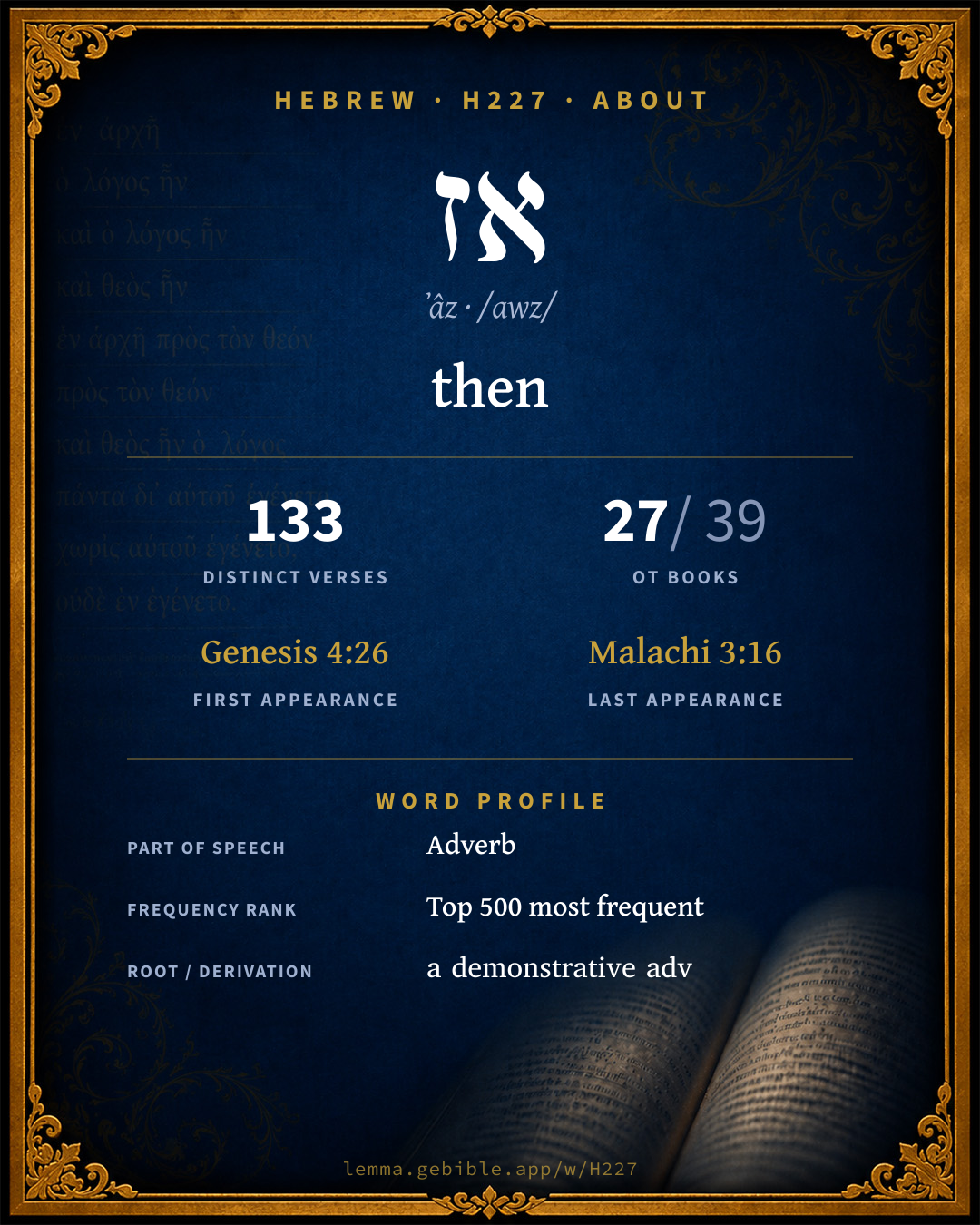
אָז
then
‘then’ is one of 3 main senses fuller range ↓
Full lexicon entry — Brown-Driver-Briggs (BDB)
From Brown-Driver-Briggs (BDB)
Where this word appears
Grammar key — what these labels mean
Part of speech
- Adverb
- A word that modifies a verb, adjective, or other adverb.
Every verse where H227 appears in the Book of Isaiah — 16 distinct verses. Click any verse to open its interlinear word-by-word view. Verse text shown in the World English Bible for context — . Each verse’s Hebrew form is shown with its reference; the English is not keyword-highlighted, since the data carries no word-level English alignment. Use “Compare translations” on any verse to read it across multiple English versions. This concordance covers the Hebrew Bible; Septuagint (Greek Old Testament) occurrences are not indexed here.
Isaiah
- Isaiah 14:8 מֵ/אָ֣ז prep + adv Yes, the fir trees rejoice at you, [and] the cedars of Lebanon, [saying], Since you are laid low, no lumberjack is come up against us.
- Isaiah 16:13 מֵ/אָֽז prep + adv This is the word that Yahweh spoke concerning Moab in time past.
- Isaiah 33:23 אָ֣ז adv Your rigging is untied; they could not strengthen the foot of their mast, they could not spread the sail: then was the prey of a great spoil divided; the lame took the prey.
- Isaiah 35:5 אָ֥ז adv Then the eyes of the blind shall be opened, and the ears of the deaf shall be unstopped.
- Isaiah 35:6 אָ֣ז adv Then shall the lame man leap as a hart, and the tongue of the mute shall sing; for in the wilderness shall waters break out, and streams in the desert.
- Isaiah 41:1 אָ֣ז adv Keep silence before me, islands; and let the peoples renew their strength: let them come near; then let them speak; let us come near together to judgment.
- Isaiah 44:8 מֵ/אָ֛ז prep + adv Don't fear, neither be afraid: haven't I declared to you of old, and shown it? You are my witnesses. Is there a God besides me? Indeed, there is not. I don't know any Rock.
- Isaiah 45:21 מֵ/אָ֣ז prep + adv Declare you, and bring [it] forth; yes, let them take counsel together: who has shown this from ancient time? who has declared it of old? Haven't I, Yahweh? and there is no God else besides me, a just God and a Savior; there is no one besides me.
- Isaiah 48:3 מֵ/אָ֣ז prep + adv I have declared the former things from of old; yes, they went forth out of my mouth, and I shown them: suddenly I did them, and they happened.
- Isaiah 48:5 מֵ/אָ֔ז prep + adv therefore I have declared it to you from of old; before it came to pass I shown it you; lest you should say, My idol has done them, and my engraved image, and my molten image, has commanded them.
- Isaiah 48:7 מֵ/אָ֔ז prep + adv They are created now, and not from of old; and before this day you didn't hear them; lest you should say, Behold, I knew them.
- Isaiah 48:8 מֵ/אָ֖ז prep + adv Yes, you didn't hear; yes, you didn't know; yes, from of old your ear was not opened: for I knew that you did deal very treacherously, and was called a transgressor from the womb.
- Isaiah 58:8 אָ֣ז adv Then shall your light break forth as the morning, and your healing shall spring forth speedily; and your righteousness shall go before you; the glory of Yahweh shall by your rearward.
- Isaiah 58:9 אָ֤ז adv Then shall you call, and Yahweh will answer; you shall cry, and he will say, Here I am. If you take away from the midst of you the yoke, the putting forth of the finger, and speaking wickedly;
- Isaiah 58:14 אָ֗ז adv then shall you delight yourself in Yahweh; and I will make you to ride on the high places of the earth; and I will feed you with the heritage of Jacob your father: for the mouth of Yahweh has spoken it.
- Isaiah 60:5 אָ֤ז adv Then you shall see and be radiant, and your heart shall thrill and be enlarged; because the abundance of the sea shall be turned to you, the wealth of the nations shall come to you.
About this entry
At a glance — auto-summarized from this page’s data, not written by a person. Every figure links to its source below. This summary describes the numbers; it doesn’t interpret them.
אז (ʼâz) is a Hebrew verb most often rendered “then.” It first appears in Genesis 4:26. It turns up in 133 verses across 27 books, a common footprint. It is not a single-sense word — see its full sense range. From the same root come אזי. For the data behind this summary, explore the sense tree and the renderings breakdown below.
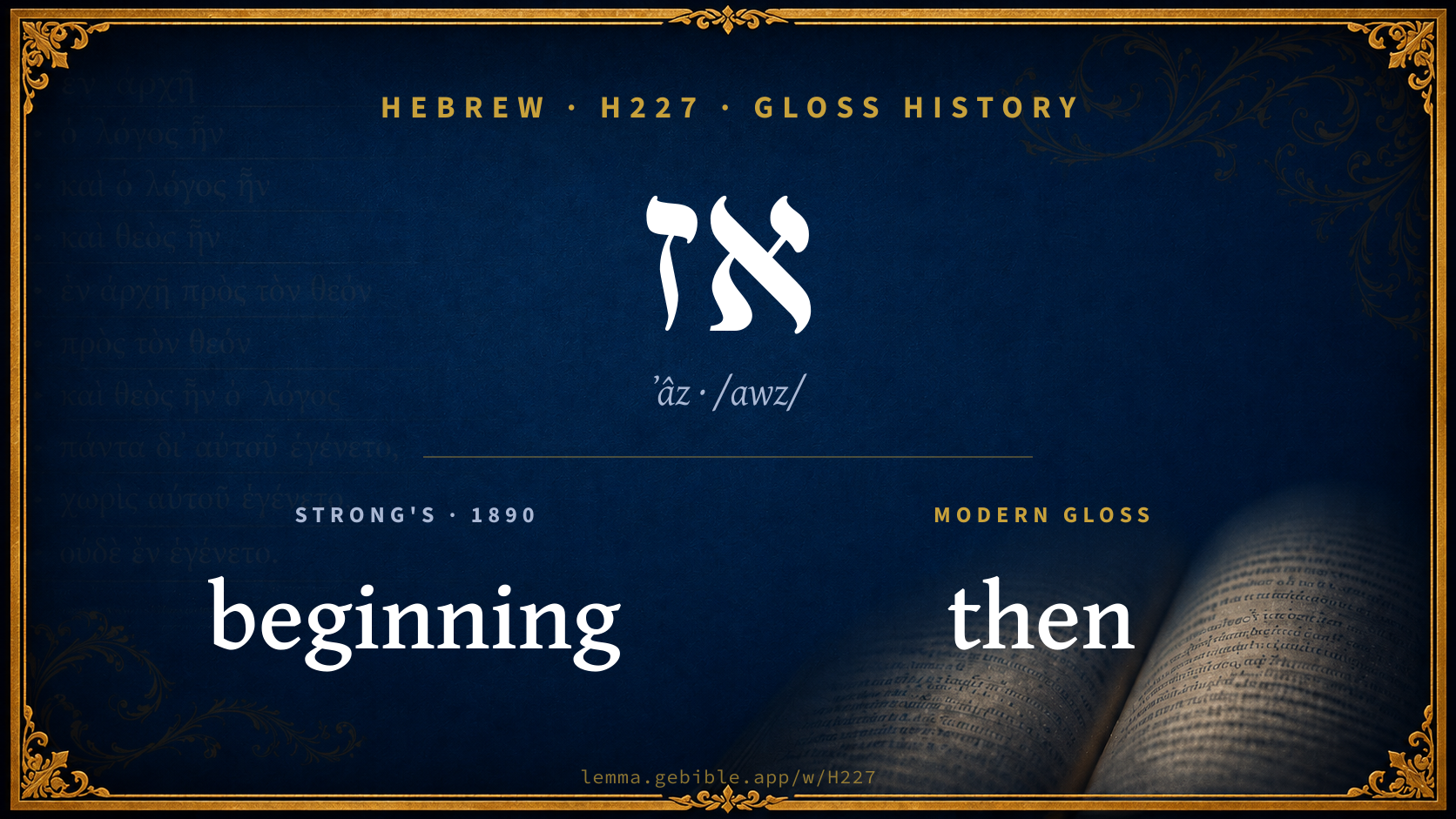
Gloss history
Strong's 1890 vs modern scholarship
About this word
Strong's H227 catalogs a Hebrew word from the Hebrew Old Testament.
These counts are not copied from any lexicon or concordance. They are computed here, from the morphology-tagged Hebrew Old Testament. What Lemma adds →
- 133
- distinct verses
- The word appears in 133 distinct verses.
- 27 / 39
- OT books
- The word appears in 27 of 39 Old Testament books.
- #318
- by frequency
- Top 500 most frequent Hebrew words (rank 318 of 8,640 Hebrew words by occurrence).
View all 133 occurrences in the concordance →
By section of the Old Testament
By traditional corpus
Conventional, traditional groupings — biblical authorship is debated, so this is a traditional corpus grouping, not an authorship claim. Each share is this word’s portion of its verses in that division of the Hebrew canon. Each figure is a share of the word’s 133 distinct verses.
- Prophets (Nevi'im) 71 verses · 53%
- Writings (Ketuvim) 43 verses · 32%
- Torah (Pentateuch) 19 verses · 14%
How translations render this word
Counts come from each version’s own published word-to-Strong’s tagging or interlinear alignment — an approximate guide to how each version renders this word, not a word-level alignment the data otherwise carries. Because each total is that version’s own tagged count, the per-version totals vary from one another and need not match the appearance or distinct-verse counts above. These counts may also differ from a printed concordance because Lemma counts each distinctly tagged rendering and does not collapse phrase taggings into a single head-word total. This is a fixed set of word-tagged versions (KJV, ASV, BSB, ULT) and does not change with the reading translation you choose elsewhere. Each version’s license is shown beside its name below (and on Sources).
- King James Version: Then 5×, Since 2×, Yet 2×
- American Standard Version: Then 7×, Old 2×, Time past 2×
- Berean Standard Bible: Then 63×, Time 23×, Long ago 5×
- unfoldingWord Literal Text: Then 122×, Since 4×, And 2×
King James Version Public Domain
Renders H227 across 22 tagged occurrences — most commonly:
Plus 13 renderings that appear only once — usually multi-word phrases or single function words the recovered tagging swept in, not distinct renderings.
American Standard Version Public Domain
Renders H227 across 22 tagged occurrences — most commonly:
Plus 9 renderings that appear only once — usually multi-word phrases or single function words the recovered tagging swept in, not distinct renderings.
Berean Standard Bible Public Domain
Renders H227 across 119 tagged occurrences — most commonly:
Plus 14 renderings that appear only once — usually multi-word phrases or single function words the recovered tagging swept in, not distinct renderings. Not rendered by a distinct English word in 21 further occurrences.
unfoldingWord Literal Text CC BY-SA 4.0
Renders H227 across 138 tagged occurrences — most commonly:
Plus 8 renderings that appear only once — usually multi-word phrases or single function words the recovered tagging swept in, not distinct renderings.
Senses in the full BDB
What do BDB’s symbols mean?
BDB uses these scholarly abbreviations:
| Symbol | Meaning |
|---|---|
| 𝔊 | the Septuagint (the ancient Greek translation, LXX) |
| 𝔙 | the Vulgate (the Latin translation) |
| 𝔖 | the Syriac version (the Peshitta) |
| 𝔗 | the Targum (the Aramaic translation) |
| ψ | the Psalms |
| √ | root (the underlying root or stem) |
| ‖ | parallel passage (a synonymous or contrasted parallel) |
| † | the dagger: every passage where the word occurs is cited |
The 6 senses and sub-senses the full Brown-Driver-Briggs lexicon distinguishes for this word, in lexicon order (not ranked by frequency), with BDB’s own verbatim wording and sub-sense lettering. Shown in Hebrew script with BDB’s own scholarly abbreviations. The condensed entry is in the Lexicon Entry tab. See also the Forms in the corpus table below.
- 1. strictly temporal:
- a. of past time:—without a verb Gn 12:6; 13:7 Jos 14:11 2 S 23:14; with a pf. Gn 4:26 Ex 4:26 Jos 10:33 Ju 8:3; 13:21 Je 22:15 אָז טוֹב לוֹ then was it well to him (cf. v 16 Ho 2:9); more usually (especially when = thereupon) with an impf. (v. Dr§ 27) Ex 15:1 Nu 21:17 Jos 8:30: 10:12; 22:1 1 K 3:16; 8:1; 9:11 (v. DrIntr. 192) al. e.g. Genesis 12:6
- b. of fut. time (usually where some emph. is intended), with impf. Is 35:5, 6; 60:5 Mi 3:4, rather differently Lv 26:41 1 S 20:12; rarely with pf. 2 S 5:24b (will have gone forth) Is 33:23: with an accompanying logical force, implying the fulfilment of a condition, then = if or when this has been done (with the impf.) Gn 24:41 Ex 12:44, 48 Dt 29:19 Jos 1:8 1 S 6:3 Is 58:8, 9 Je 11:15 Hi Ke ψ 19:14; 51:21 Pr 3:23 Jb 11:15; 13:20; 22:26. e.g. Isaiah 35:5
- c. in poetry אז is sometimes used to throw emphasis on a particular feature of the description Gn 49:4 Ex 15:15 Ju 5:8, 11, 13, 19, 22 Is 33:23; 41:1 Hb 1:11 ψ 2:5; 96:12. e.g. Genesis 49:4
- d. it points back with emphasis to an inf. with בּ 2 S 5:24a ψ 126:2(×2) Jb 28:27; 33:16; to בַּיּוֹם הַהוּא (anomalously) 1 Ch 16:7. e.g. 2 Samuel 5:24
- 2. expressing logical sequence strictly: in the apod.:—after אם (rare) for sake of special emphasis Is 58:14 Pr 2:5 Jb 9:31; = in that case, after לוּ or לוּלֵא 2 S 2:27 hadst thou not spoken, כִּי אָז surely then had the people, etc. 19:7 ψ 119:92; after אחלי 2 K 5:3 ψ 119:6; after a suppressed protasis 2 K 13:19 Jb 3:13 יָשַׁנְתִּי יָנוּחַ לִי I had slept, then were there rest for me; Jos 22:31 (strangely) = now, as things are; Ec 2:15 = that being so. (122 times besides מאז and מן־אז. Seldom used except where some special emphasis is desired. ‘Then’ of AV RV more commonly represents וְ, especially in the apodosis.) e.g. Isaiah 58:14
Senses from the full Brown-Driver-Briggs lexicon (Brown, Driver, Briggs; Oxford 1906 — public domain), digitized via Sefaria, supplemented by the OpenScriptures HebrewLexicon (CC BY 4.0). Full attribution on Sources.
Word origin
adv. (cf. إِذًا, ࠀࠃ: also Biblical Aramaic אֱדַיִן, proposes a subst. = time: see מֵאָז) at that time, then, whether expressing duration, or inception (= thereupon).
— Brown-Driver-Briggs (Oxford 1906, public domain), digitized via Sefaria, supplemented by the OpenScriptures HebrewLexicon (CC BY 4.0). See Sources.
Origin: a demonstrative adv
Forms in the corpus
The 30 distinct written forms H227 takes in the Hebrew Bible, most frequent first — each parse links to that state’s occurrences in the concordance. Hebrew forms include their vowel points and cantillation, so a single lemma takes many written forms.
| Form | Parsing | Example | Uses |
|---|---|---|---|
| אָ֣ז | Adverb | Deuteronomy 4:41 | 41 |
| אָ֤ז | Adverb | Exodus 15:15 | 16 |
| אָ֖ז | Adverb | Exodus 12:44 | 14 |
| אָ֚ז | Adverb | Exodus 4:26 | 9 |
| אָ֥ז | Adverb | Genesis 12:6 | 9 |
| אָ֛ז | Adverb | 2 Chronicles 24:17 | 8 |
| אָ֗ז | Adverb | 2 Samuel 5:24 | 6 |
| אָז֩ | Adverb | 1 Kings 11:7 | 4 |
| אָ֭ז | Adverb | Job 9:31 | 3 |
| מֵ/אָ֔ז | Adverb | 2 Samuel 15:34 | 3 |
| מֵ/אָ֣ז | Adverb | Isaiah 14:8 | 3 |
| אָ֠ז | Adverb | Deuteronomy 29:20 | 2 |
| אָ֡ז | Adverb | 1 Kings 9:11 | 2 |
| אָ֧ז | Adverb | 1 Kings 16:21 | 2 |
| מֵ/אָ֖ז | Adverb | Exodus 9:24 | 2 |
| מֵ/אָ֥ז | Adverb | Exodus 4:10 | 2 |
| מֵ/אָֽז | Adverb | Isaiah 16:13 | 2 |
| אָ֝֗ז | Adverb | Psalms 119:92 | 1 |
| אָ֥֨ז | Adverb | Psalms 56:9 | 1 |
| אָז֙ | Adverb | 1 Samuel 20:12 | 1 |
| וְ/אָ֖ז | Adverb | Leviticus 26:41 | 1 |
| וְ/אָ֗ז | Adverb | Jeremiah 32:2 | 1 |
| וְ/אָ֥ז | Adverb | Joshua 1:8 | 1 |
| וְ/אָז֙ | Adverb | Exodus 12:48 | 1 |
| וּ/מֵ/אָ֞ז | Adverb | Exodus 5:23 | 1 |
| מֵ/אָ֑ז | Adverb | Psalms 93:2 | 1 |
| מֵ/אָ֛ז | Adverb | Isaiah 44:8 | 1 |
| מֵ/אָ֤ז | Adverb | Ruth 2:7 | 1 |
| מֵ/אָז֩ | Adverb | Genesis 39:5 | 1 |
| מֵ֠/אָז | Adverb | Joshua 14:10 | 1 |
Same root — word family
Other BDB entries built from the same root as H227, grouped by Strong’s listed origin. These share a root / origin per the lexicon — not necessarily a shared meaning. Each links to that word’s own entry.
Derived from this word
Compare all same-root words → They share a root, not necessarily a meaning.
Septuagint verse parallels
This word appears in 125 verses that also exist in the Greek Old Testament (Septuagint), out of the 133 Hebrew verses it occurs in. You can read those verses in Greek by switching the Old Testament edition to the Septuagint.
Read these verses in the Septuagint
- Genesis 4:26
- Exodus 4:10
- Leviticus 26:34
- Numbers 21:17
- Deuteronomy 4:41
- Joshua 1:8
- Judges 5:8
- Ruth 2:7
- 1 Samuel 6:3
- 2 Samuel 2:27
- 1 Kings 3:16
- 2 Kings 5:3
This is a verse-level parallel only — the same verses exist in both the Hebrew and Greek Old Testaments. No word-level Hebrew↔Greek correspondence is claimed: the data carries no such alignment, so no Greek word is shown as this Hebrew word’s translation. Coverage is not total — the Septuagint omits the deuterocanon and renumbers the Psalms, so some Hebrew verses have no direct Greek parallel.