
Job 9:31

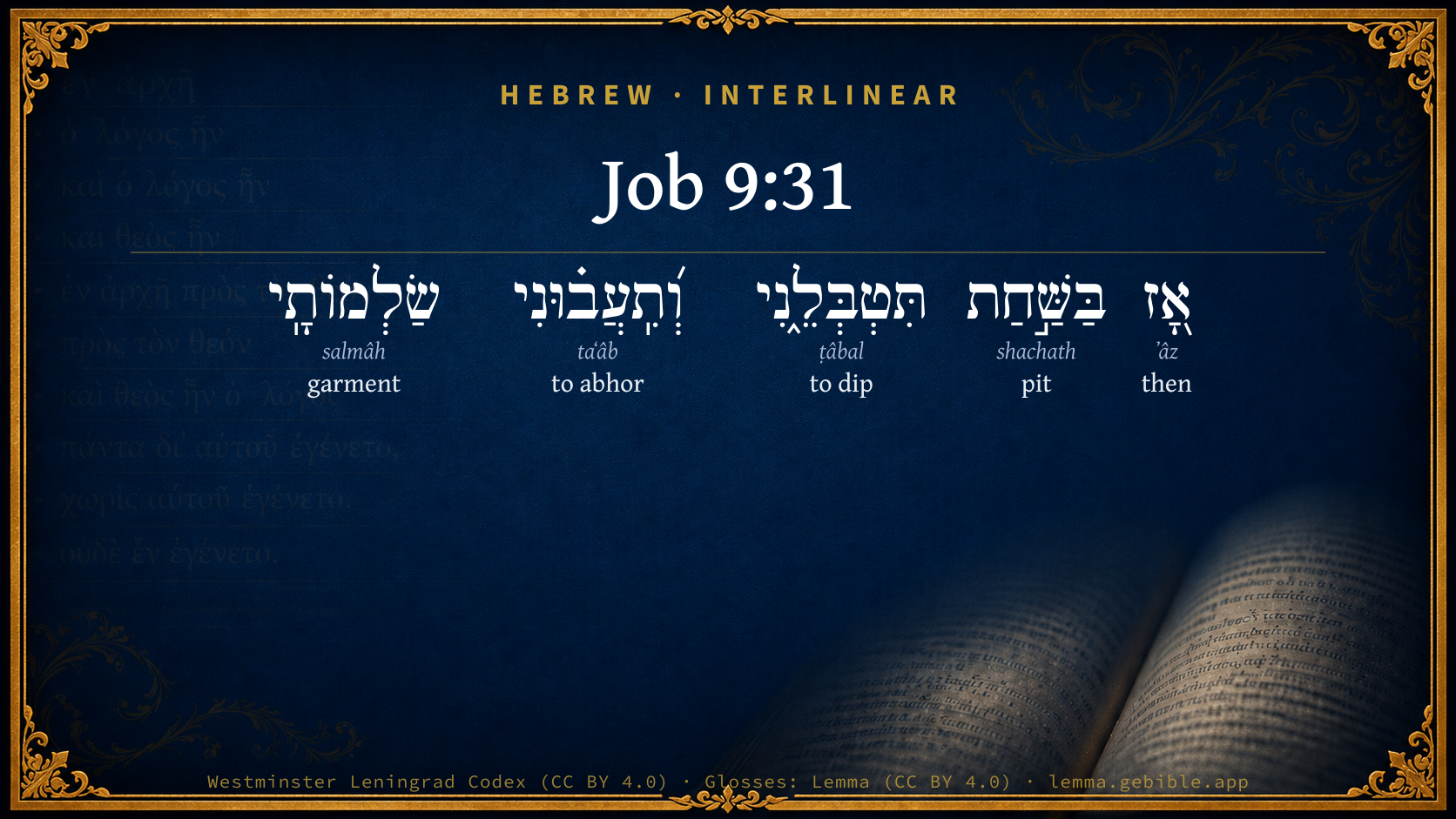
Hebrew (Westminster Leningrad Codex) Job 9:31 appears in the Hebrew Old Testament. The text above is from the Westminster Leningrad Codex. Each word links to its Strong’s number, a concise gloss, and parsing drawn from the Open Scriptures Hebrew Bible morphology. Click any word for its full Brown-Driver-Briggs (BDB) entry.
Download image
Cite this verse

Job 9:31 (World English Bible). Public Domain. Lemma interlinear Bible study tool, https://lemma.gebible.app/v/job/9/31.

Show BibTeX & RIS
BibTeX
RIS
English Translation
Yet you will plunge me in the ditch. My own clothes shall abhor me.
World English Bible · Public Domain
Highlights
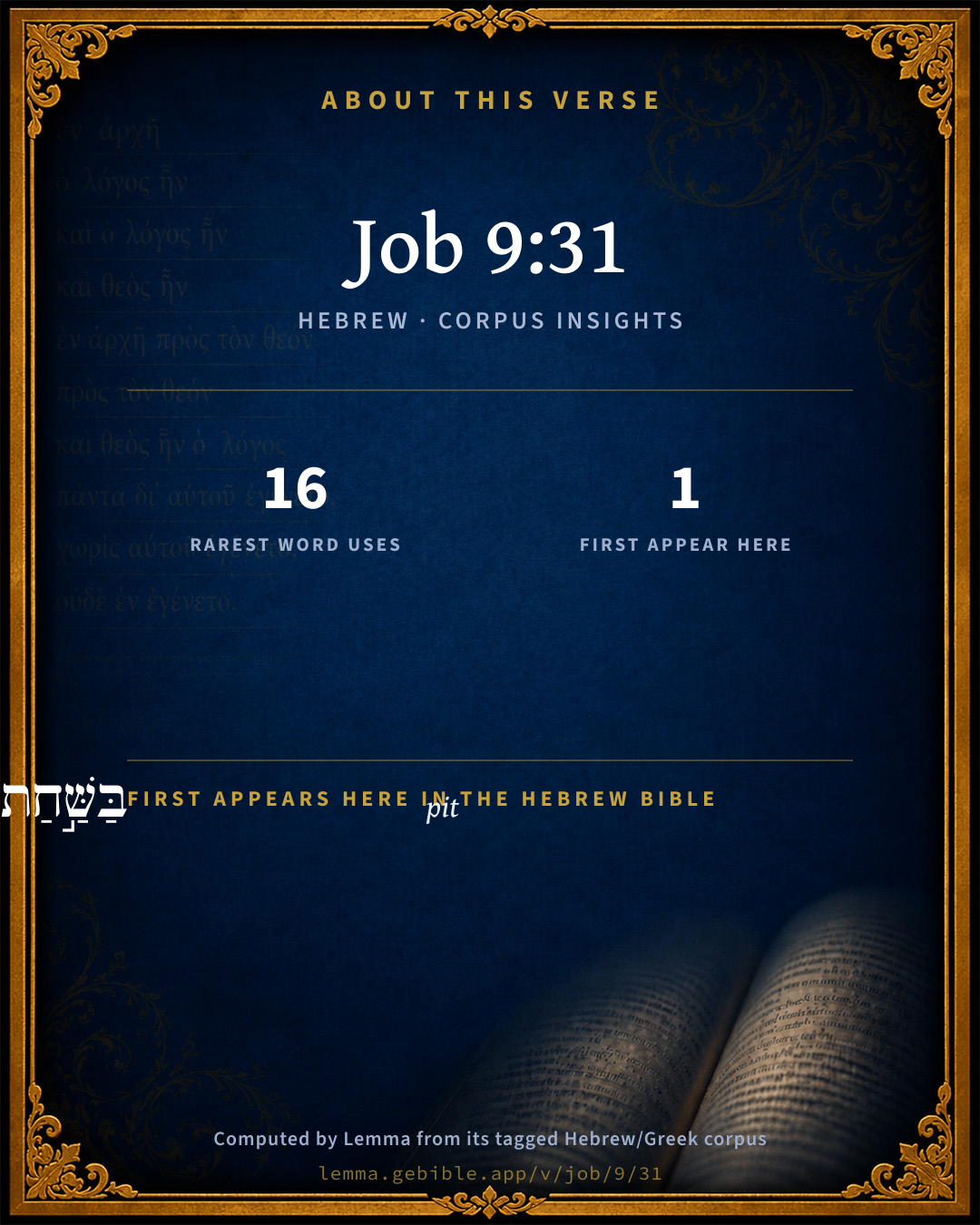
  • 1 first appearance in the Hebrew Bible
Full analysis ↓
Download a study sheet

One document with this verse’s original text, its word-by-word gloss line, the meaning frame, cross-references with their text, attributed commentary, and full source and license credits — printable, and it pastes into notes with its structure intact.

This verse Autodidact and up

Study sheet (.html) Plain text (.txt)

A passage Seminary Student

Up to 50 verses in one chapter. A passage sheet keeps up to 6 commentary sources and 12 cross-references per verse, in the order this page ranks them, and says so on the sheet whenever that leaves anything out. Ask for a single verse and you get the Autodidact verse sheet above.

Everything on this page stays free to read, with no account — the sheet is a download of what is already on screen, not access to it.

Want to remove ads? Support Godless Engineer
Compare translations 3

The same verse in 3 English versions, stacked beneath the original-language interlinear above. Click any original word for its lexicon entry.

Each is an independent rendering of the whole verse — the interlinear is not word-aligned to these translations.

Highlighted words mark where these versions differ — a whole-verse word diff, not a word-by-word alignment.

  • World English Bible Public Domain
    Yet you will plunge me in the ditch. My own clothes shall abhor me.
  • King James Version Public Domain
    Yet shalt thou plunge me in the ditch, and mine own clothes shall abhor me.
  • unfoldingWord Literal Text CC BY-SA 4.0
    then you would plunge me into a ditch, and my clothes would abhor me.

unfoldingWord Literal Text — © unfoldingWord, licensed CC BY-SA 4.0. Word-aligned USFM3 via Door43 (git.door43.org/unfoldingWord/en_ult).

Versions to compare (up to 4)

3 of 4 selected

Show all 18 translations

Every available English version of this verse, each an independent rendering of the whole verse.

  • World English Bible Public Domain
    Yet you will plunge me in the ditch. My own clothes shall abhor me.
  • Berean Standard Bible Public Domain
    then You would plunge me into the pit, and even my own clothes would despise me.
  • Majority Standard Bible Public Domain
    then You would plunge me into the pit, and even my own clothes would despise me.
  • King James Version Public Domain
    Yet shalt thou plunge me in the ditch, and mine own clothes shall abhor me.
  • American Standard Version (1901) Public Domain
    Yet wilt thou plunge me in the ditch, And mine own clothes shall abhor me.
  • Revised Version (1885) Public Domain
    Yet wilt thou plunge me in the ditch, and mine own clothes shall abhor me.
  • Geneva Bible (1599) Public Domain
    Yet shalt thou plunge mee in the pit, and mine owne clothes shall make me filthie.
  • Douay-Rheims (1899) Public Domain
    Yet thou shalt plunge me in filth, and my garments shall abhor me,
  • Young's Literal Translation Public Domain
    Then in corruption Thou dost dip me, And my garments have abominated me.
  • Literal Standard Version CC BY-SA 4.0
    Then You dip me in corruption, || And my garments have detested me.
  • Unlocked Literal Bible CC BY-SA 4.0
    God would plunge me in a ditch, and my own clothes would be disgusted with me.
  • unfoldingWord Literal Text CC BY-SA 4.0
    then you would plunge me into a ditch, and my clothes would abhor me.
  • Darby Bible Public Domain
    Then wouldest thou plunge me in the ditch, and mine own clothes would abhor me.
  • World Messianic Bible Public Domain
    yet you will plunge me in the ditch. My own clothes will abhor me.
  • Webster's Bible Public Domain
    Yet wilt thou plunge me in the ditch, and my own clothes shall abhor me.
  • Free Bible Version CC BY-SA 4.0
    you would toss me into a slime pit so that even my own clothes would hate me!
  • Bible in Basic English Public Domain
    Then you will have me pushed into the dust, so that I will seem disgusting to my very clothing.
  • JPS Tanakh (1917) Public Domain
    Yet wilt Thou plunge me in the ditch, and mine own clothes shall abhor me.

Literal Standard Version (2020), Covenant Press — licensed CC BY-SA 4.0. Text via the HelloAO Bible API (eBible.org). Unlocked Literal Bible (unfoldingWord) — licensed CC BY-SA 4.0. Text via the HelloAO Bible API (eBible.org). unfoldingWord Literal Text — © unfoldingWord, licensed CC BY-SA 4.0. Word-aligned USFM3 via Door43 (git.door43.org/unfoldingWord/en_ult). Free Bible Version, Dr. Jonathan Gallagher — licensed CC BY-SA 4.0. Text via the HelloAO Bible API (eBible.org).

Word by word

More ways to search: Search by grammar → Find every occurrence → Compare this word →

Practice this passage: Drill this verse → Learn its vocabulary →

About this verse

These counts appear in no published source. They are computed here, from the morphology-tagged text and Lemma’s own curated glosses. What Lemma adds →

5
words
5
distinct lemmas
Wisdom
section

Notable vocabulary

The rarest word here is תִּטְבְּלֵ֑נִי to dip H2881 — appearing just 16 times in the whole Hebrew Bible.

First appearance in Scripture

This word makes its first canonical appearance in the Hebrew Bible here:

  • בַּשַּׁ֣חַת pit H7845

Shared distinctive vocabulary

תִּטְבְּלֵ֑נִי to dip H2881 occurs in 16 verses of the Hebrew Bible. Also found in:

Grammatical profile

  • 2 verbs
  • 2 nouns
  • 1 adverb

Verb forms

  • תִּטְבְּלֵ֑נִי Qal · Imperfect
  • וְ֝תִֽעֲב֗וּנִי Piel · Sequential Perfect

Hebrew & Septuagint length

In English translation the verse runs 14 words from the Hebrew and 13 from the Septuagint (LXX English) — closely comparable.

A rough comparison of the two English renderings, which tokenize alike — not a word-level alignment.

Word counts can differ between the Hebrew and the Greek without any difference in meaning — e.g. the Hebrew direct-object marker אֵת has no separate Greek word, and Greek often adds the article ὁ.

Cross-references

5

Topical passages linked to Job 9:31 in the Treasury of Scripture Knowledge — connected by theme and wording, ordered by reader-vote popularity; previews shown in the World English Bible.

  • Job 9:20 Though I am righteous, my own mouth shall condemn me. Though I am blameless, it shall prove me perverse.
  • Job 15:6 Your own mouth condemns you, and not I; Yes, your own lips testify against you.
  • Isaiah 59:6 Their webs shall not become garments, neither shall they cover themselves with their works: their works are works of iniquity, and the act of violence is in their hands.
  • Isaiah 64:6 For we are all become as one who is unclean, and all our righteousness are as a polluted garment: and we all do fade as a leaf; and our iniquities, like the wind, take us away.
  • Philippians 3:8–9 Yes most assuredly, and I count all things to be loss for the excellency of the knowledge of Christ Jesus, my Lord, for whom I suffered the loss of all things, and count them nothing but refuse, that I may gain Christ

Cross-references courtesy of OpenBible.info (CC BY 4.0).

Hebrew and Greek witnesses Masoretic Hebrew ↔ Greek Septuagint

The same verse in the two great witnesses to the Old Testament, shown verse-for-verse.

These are two independent witnesses, not word-aligned to each other, and the Septuagint is shown in lemma (dictionary) form.

Hebrew Job 9:31 Masoretic · Westminster Leningrad Codex

אָ֭ז בַּשַּׁ֣חַת תִּטְבְּלֵ֑נִי וְ֝תִֽעֲב֗וּנִי שַׂלְמוֹתָֽי

Yet you will plunge me in the ditch. My own clothes shall abhor me.

World English Bible · Public Domain

Greek LXX Job 9:31 Septuagint · lemma form

ἱκανῶς ἐν ῥύπος ἐγώ βάπτω βδελύσσω δέ ἐγώ ὁ στολή

you had thoroughly plunged me in filth, and my garment had abhorred me.

LXX2012 (modern English Septuagint) · Public Domain

Hebrew: Westminster Leningrad Codex (CC BY 4.0). Greek: Septuagint (public domain); English from LXX2012 (modern English Septuagint) (Public Domain). How the Septuagint differs from the Hebrew →

Commentary

Notes on Job 9:31 from classic Christian and Jewish commentators (each source and its license shown beneath its notes). The classic Christian expositions comment on the surrounding passage and are grouped to its opening verse, so a note may address several verses; the Jewish commentaries on the Tanakh (Rashi and others) are per-verse, so they appear only where the commentator wrote on this verse.

Lemma curates 59 commentaries, every one of them public domain or Creative Commons licensed, each selected and text-cleaned for this edition rather than reprinted as found. About our sources →

Trapp's Complete Commentary

John Trapp

Job 9:31 Yet shalt thou plunge me in the ditch, and mine own clothes shall abhor me.

Ver. 31. Thou shalt plunge me in the ditch] Thou shalt declare me to be no less loathsome than he that, having fallen into a foul guzzle, or nasty jakes, abhorreth himself and his own clothes, being ready to lay up his gorge at the sight and smell of them. The Vulgar hath it, Sordibus intinges me, thou shalt dip me in the dirt over head and ears, and stain me all over, as dyers do the cloth they colour. By the ditch, Beza and others understand the grave; and by clothes, grave clothes, q.d. My very winding sheet shall abhor my filthiness. Take the proud Pharisee for instance, and Popish merit mongers, whom the Lord abhorreth.

John Trapp, A Commentary or Exposition upon All the Books of the Old and New Testament (1647–1656) — public domain. Text from a community e-Sword module.

Tyndale Open Study Notes

Tyndale Open Resources

9:31 The muddy ditch (literally pit) can refer to the place of the dead (17:14; 33:18), so it might allude to the defilement of death. • The filthy clothing of guilt contrasts with the clean clothes of acquittal (Zech 3:3-5; see Isa 61:10; 64:6; Rev 19:8).

Tyndale Open Study Notes — © Tyndale Open Resources, licensed CC BY-SA 4.0. Text via the HelloAO Bible API.

Geneva Bible (1599)

Geneva Bible translators

Whatsoever I would use to cover my filthiness with, shall disclose me so much more.

Geneva Bible (1599) marginal notes — public domain. Text via Bolls.life.

Adam Clarke's Commentary

Verse 31. And mine own clothes shall abhor me.] Such is thine infinite purity, when put in opposition to the purity of man, that it will bear no comparison. Searched and tried by the eye of God, I should be found as a leper, so that my own clothes would dread to touch me, for fear of being infected by my corruption. This is a strong and bold figure; and is derived from the corrupted state of his body, which his clothes dreaded to touch, because of the contagious nature of his disorder.

Adam Clarke's Commentary on the Bible (1810–1826) — public domain. Text from a community e-Sword/MySword module.

The Cambridge Bible for Schools and Colleges

gen. ed. J. J. S. Perowne

31. An expressive figure for, to cover again with uncleanness. The naked body (Job_9:30) is supposed plunged in the ditch, and the clothes refuse to cover so foul an object.

The Cambridge Bible for Schools and Colleges (gen. ed. J. J. S. Perowne; Cambridge University Press, 1878–1918) — public domain. Text from a community e-Sword module.

John Gill's Exposition

For he is not a man, as I am,.... For though the parts and members of an human body are sometimes ascribed to him, yet these are to be understood by an anthropopathy, speaking after the manner of men, there being something in him, which in a figurative sense answers to these; otherwise we are not to conceive of any corporeal shape in him, or that there is any likeness to which he is to be compared: he is a spirit infinite, immortal, immense, invisible, pure and holy, just and true, and without iniquity; whereas Job was but a man, a finite, feeble, mortal creature, and a sinful one; and therefore there being such a vast disparity between them, it was in vain to litigate a point with him, to plead his cause before him, or attempt to vindicate his innocence; the potsherds may strive and contend with the potsherds of the earth their equals, but not with God their Creator, who is more than a match for them; he sees impurity where man sees it not, and can bring a charge against him, and support it, where he thought there was none, and therefore it is a vain thing to enter the lists with him:

that I should answer him; not to questions put by him, but in a judicial way to charges and accusations he should exhibit; no man in this sense can answer him, for one of a thousand he may bring, and men are chargeable with; wherefore Job once and again determines he would not pretend to answer him, as he knew he could not, see Job 9:3,

and we should come together in judgment; in any court of judicature, before any judge, to have the cause between us heard, and tried, and determined; for in what court of judicature can he be convened into? or what judge is there above him, before whom he can be summoned? or is capable of judging and determining the cause between us? there is the high court of heaven, where we must all appear, and the judgment seat of Christ, before which we must all stand; and God is the judge of all, to whom we must come, and by whose sentence we must be determined; but there is no court, no judge, no judgment superior to him and his; there is no annulling his sentence, or making an appeal from him to another; there is no coming together at all, and much less "alike" (p), as some render it, or upon equal terms; the difference between him and his creatures being so vastly great.

(p) "pariter", Junius & Tremellius, Drusius.

John Gill's Exposition of the Whole Bible (1746–1763) — public domain (CC PDM 1.0). Text via the HelloAO Bible API.

Albert Barnes' Notes on the Bible

Yet shalt thou plunge me in the ditch - God would treat me as if he should throw me into the gutter, and as if I were wholly defiled and polluted. The meaning is, God would not admit the proofs which I should adduce of my innocence, but would overwhelm me with the demonstrations of my guilt. I doubt not that Job urged this with some degree of impatience, and with some improper feelings. He felt, evidently, that God was so great and powerful, that it was vain to contend with him. But it is true in a higher and more important sense than he seems to have understood it. After all the efforts which we can make to justify, vindicate, or purify ourselves, it is in the power of God to overwhelm us with the consciousness of guilt. He has access to the heart. He can show us our past sins. He can recall what we have forgotten, and overwhelm us with the remembrance of our deep depravity. It is in vain, therefore, for any man to attempt to justify himself before God. After the most labored argument to prove his own innocence, after all the confidence which he can repose in his own morality and his own righteousness, still God can with infinite ease overwhelm him with the consciousness of guilt. How many people that were once relying on their own morality for their salvation, have been bowed down with a consciousness of guilt in a revival of religion! How many who halve been trusting to their own righteousness have been overwhelmed with deep and awful conviction, when they have been brought to lie on a bed of death! Let no man, therefore, rely on his own righteousness, when God accuses him with being a sinner. Let no one trust to his own morality for salvation - for soon it will all be seen to be insufficient, and the soul must appear covered over with the consciousness of guilt at the awful bar of God.

And mine own clothes shall abhor me - Margin, Make me to be abhorred. That is, they shall be filthy and offensive - like one who has been rolled in the mire. God has power to make me seem defiled and loathsome, notwithstanding all my efforts to cleanse myself.

Albert Barnes' Notes on the Bible (1834–1885) — public domain. Text from a community e-Sword/MySword module.

Haydock's Catholic Bible Commentary

Abhor me. This striking expression intimates something extremely filthy. God will make his servants discern many stains, even when they have aimed at the greatest purity. (Calmet)

George Leo Haydock (1774–1849), Haydock's Catholic Family Bible and Commentary, 1859 edition — public domain. Excludes Psalms (Douay-Rheims chapter numbering differs from Protestant) and Deuterocanonical books (Catholic canon only).

Matthew Poole's English Annotations

In the ditch, i.e. in miry and puddle water, whereby I shall become most filthy. But as Job’s washing, so God’s plunging him, &c., is not understood really, as if God would make him filthy; but only judicially, that God would prove him to be a most guilty and filthy creature, notwithstanding all the professions and evidences of his purity before men.

Mine own clothes shall abhor me, i.e. I shall be so altogether filthy, that my own clothes, if they had any sense in them, would abhor to touch me: a figure called prosopopaeia.

Matthew Poole's English Annotations on the Holy Bible (1683–1685) — public domain. Text from a community e-Sword/MySword module.

Whedon's Commentary on the Bible

Daniel D. Whedon

31. Truly man’s defilement must be great if so be, after he has cleansed himself with the best detergents of his day, God’s purity would cast him, the naked one, into a slimy pit, so that his own clothes should conceive a horror of him — “start back in terror at the idea of being put on and defiled by such a horrible creature.” — Schlottmann. See sermon by Dr. Chalmers, (Job_9:30-33,) on an estimate of the morality that is without godliness.

Daniel D. Whedon (gen. ed.), Commentary on the Old and New Testaments (1874–1909) — public domain. Text from a community e-Sword module.

The Pulpit Commentary

Yet shalt thou plunge me in the ditch. Yet would God with ease undo his work, show his purity to be impure, his righteousness to be filthy rags, and thus, as it were, replunge him in the mire and clay from which he had sought to free himself, and hold him forth a more loathsome wretch than ever. And mine own clothes shall abhor me. So loathsome would he be that his very garments, stained and fouled by his disease, would shrink away from him and hate to touch him.

The Pulpit Commentary (1880–1919), ed. H.D.M. Spence-Jones & Joseph S. Exell — public domain. Text from a community e-Sword module.

John Wesley's Explanatory Notes

Yet - God would prove him to be a most guilty creature, notwithstanding all his purity before men. Abhor - I shall be so filthy, that my own clothes, if they had any sense in them, would abhor to touch me.

John Wesley, Explanatory Notes Upon the Whole Bible (1754–1765) — public domain. Text via the GEBible commentary corpus.

Rashi

Rabbi Shlomo Yitzchaki (Rashi)

You will plunge me into the ditch to be sullied and contaminated; i.e., You will find great iniquity in me.

Rashi on the Tanakh — English translations: “The Judaica Press complete Tanach with Rashi, translated by A. J. Rosenberg” (CC BY 4.0); “Pentateuch with Rashi's commentary by M. Rosenbaum and A.M. Silbermann, 1929-1934” (public domain); “The Metsudah Tanach series, Lakewood, N.J” (CC BY 4.0); and “The Book of Joshua, Metsudah Publications, 1997” (CC BY 4.0). Text via Sefaria.

Lesson kit

Teaching starters — assembled from the data on this page, not authored interpretation. Every prompt links to the verse data it draws on. Edit before teaching.

Job, in the Wisdom, opens this verse with 5 words (5 distinct Hebrew lemmas). Its most distinctive word is ṭâbal (“to dip”). A historical commentator’s framing appears above. Read the whole chapter for the surrounding context.

Discussion questions

  1. What does “to dip” (ṭâbal) contribute to the verse as a whole?
  2. The word “pit” first appears here in Scripture. What is being introduced at this debut?
  3. Genesis 37:31 shares the word «to dip» with this verse. How do the two illuminate each other?
  4. These translations render this verse differently; the difference is in the English rendering, not the original. What questions does that raise?
  5. The verb «תִּטְבְּלֵ֑נִי» is Qal Imperfect. How does its form color the action?
  6. Reading how Trapp's Complete Commentary and Tyndale Open Study Notes read this verse, where do the two commentators agree and where do they part?

Things to notice

  • 1 word makes its first canonical appearance in Scripture here.
  • These translations choose different wording for 7 words in this verse.
  • 5 distinct Hebrew lemmas span 5 words in this verse.

Reading settings

Reading text

Shown beneath each verse's original-language words.

Old Testament
Old Testament edition

Read the OT as the Masoretic Hebrew (MT) or the Greek Septuagint (LXX).

English shown for the Greek Septuagint (in the Hebrew ↔ Greek comparison).

Comparing translations? Open the Compare panel on any verse page to stack up to four side by side.