Isaiah 48:7

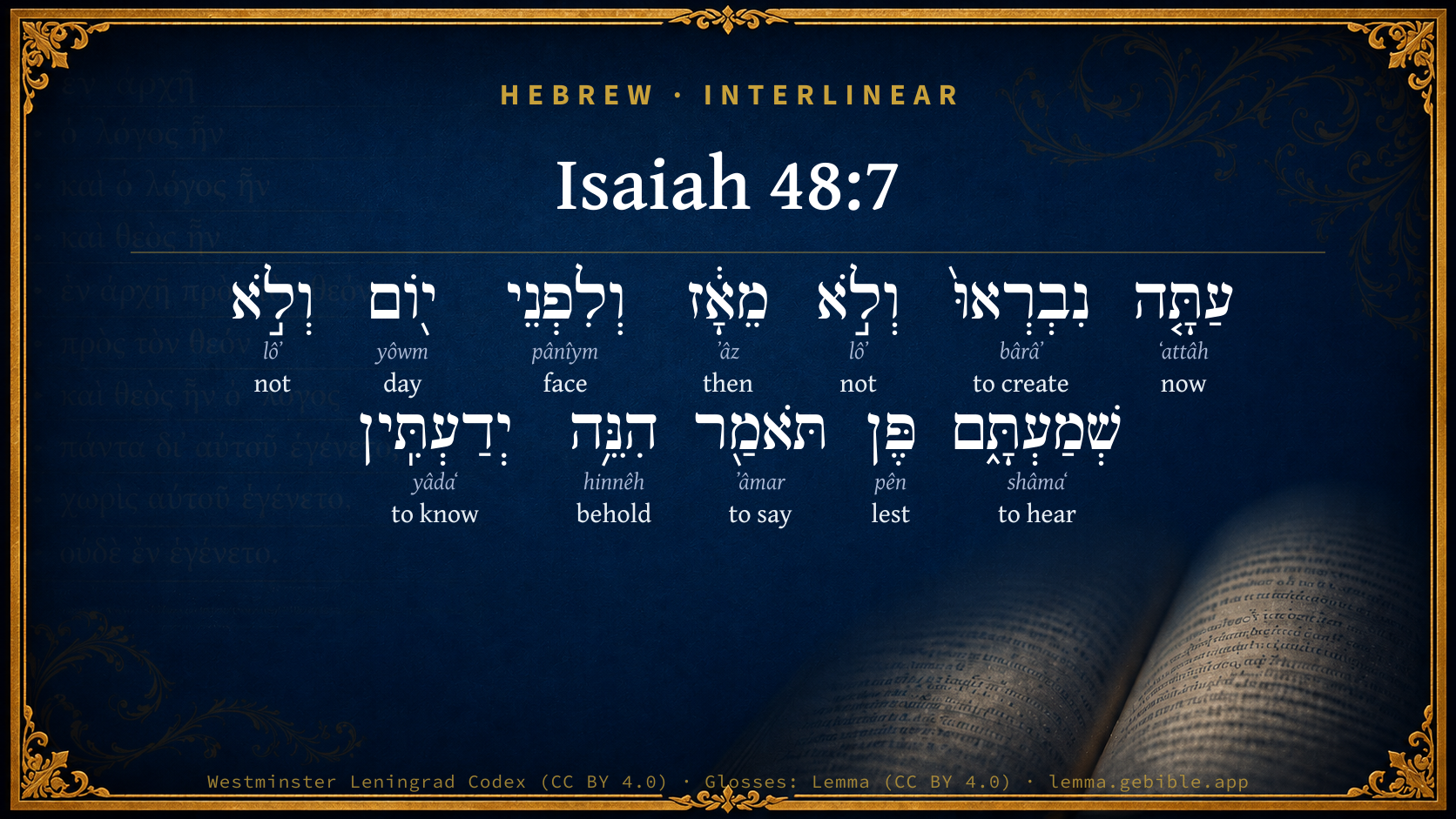
Hebrew (Westminster Leningrad Codex) Isaiah 48:7 appears in the Hebrew Old Testament. The text above is from the Westminster Leningrad Codex. Each word links to its Strong’s number, a concise gloss, and parsing drawn from the Open Scriptures Hebrew Bible morphology. Click any word for its full Brown-Driver-Briggs (BDB) entry.
Download image
Cite this verse

Isaiah 48:7 (World English Bible). Public Domain. Lemma interlinear Bible study tool, https://lemma.gebible.app/v/isaiah/48/7.

Show BibTeX & RIS
BibTeX
RIS
English Translation
They are created now, and not from of old; and before this day you didn't hear them; lest you should say, Behold, I knew them.
World English Bible · Public Domain
Download a study sheet

One document with this verse’s original text, its word-by-word gloss line, the meaning frame, cross-references with their text, attributed commentary, and full source and license credits — printable, and it pastes into notes with its structure intact.

This verse Autodidact and up

Study sheet (.html) Plain text (.txt)

A passage Seminary Student

Up to 50 verses in one chapter. A passage sheet keeps up to 6 commentary sources and 12 cross-references per verse, in the order this page ranks them, and says so on the sheet whenever that leaves anything out. Ask for a single verse and you get the Autodidact verse sheet above.

Everything on this page stays free to read, with no account — the sheet is a download of what is already on screen, not access to it.

Want to remove ads? Support Godless Engineer
Compare translations 3

The same verse in 3 English versions, stacked beneath the original-language interlinear above. Click any original word for its lexicon entry.

Each is an independent rendering of the whole verse — the interlinear is not word-aligned to these translations.

Highlighted words mark where these versions differ — a whole-verse word diff, not a word-by-word alignment.

  • World English Bible Public Domain
    They are created now, and not from of old; and before this day you didn't hear them; lest you should say, Behold, I knew them.
  • King James Version Public Domain
    They are created now, and not from the beginning; even before the day when thou heardest them not; lest thou shouldest say, Behold, I knew them.
  • unfoldingWord Literal Text CC BY-SA 4.0
    Now they are created, and not from then, and to the face of today, and you have not heard, lest you should say, ‘Behold, I knew.’ q1

unfoldingWord Literal Text — © unfoldingWord, licensed CC BY-SA 4.0. Word-aligned USFM3 via Door43 (git.door43.org/unfoldingWord/en_ult).

Versions to compare (up to 4)

3 of 4 selected

Show all 18 translations

Every available English version of this verse, each an independent rendering of the whole verse.

  • World English Bible Public Domain
    They are created now, and not from of old; and before this day you didn't hear them; lest you should say, Behold, I knew them.
  • Berean Standard Bible Public Domain
    They are created now, and not long ago; you have not heard of them before today. So you cannot claim, ‘I already knew them!’
  • Majority Standard Bible Public Domain
    They are created now, and not long ago; you have not heard of them before today. So you cannot claim, ‘I already knew them!’
  • King James Version Public Domain
    They are created now, and not from the beginning; even before the day when thou heardest them not; lest thou shouldest say, Behold, I knew them.
  • American Standard Version (1901) Public Domain
    They are created now, and not from of old; and before this day thou heardest them not; lest thou shouldest say, Behold, I knew them.
  • Revised Version (1885) Public Domain
    They are created now, and not from of old; and before this day thou heardest them not; lest thou shouldest say, Behold, I knew them.
  • Geneva Bible (1599) Public Domain
    They are created now, and not of olde, and euen before this thou heardest them not, lest thou shouldest say, Beholde, I knewe them.
  • Douay-Rheims (1899) Public Domain
    They are created now, and not of old: and before the day, when thou heardest them not, lest thou shouldst say: Behold I knew them.
  • Young's Literal Translation Public Domain
    Now they have been produced and not from that time, Yea, before the day, and thou hast not heard them, Lest thou say, `Lo, I have known them.'
  • Literal Standard Version CC BY-SA 4.0
    Now they have been produced and not from that time, || Indeed, before the day, and you have not heard them, || Lest you say, Behold, I have known them.
  • Unlocked Literal Bible CC BY-SA 4.0
    Now, and not from previously, they come into being, and before today you have not heard about them, so you will not be able to say, 'Yes, I knew about them.'
  • unfoldingWord Literal Text CC BY-SA 4.0
    Now they are created, and not from then, and to the face of today, and you have not heard, lest you should say, ‘Behold, I knew.’ q1
  • Darby Bible Public Domain
    they are created now, and not long ago; and before this day thou hast not heard them, lest thou shouldest say, Behold, I knew them.
  • World Messianic Bible Public Domain
    They are created now, and not from of old. Before today, you didn’t hear them, lest you should say, ‘Behold, I knew them.’
  • Webster's Bible Public Domain
    They are created now, and not from the beginning; even before the day when thou heardst them not; lest thou shouldst say, Behold, I knew them.
  • Free Bible Version CC BY-SA 4.0
    These are brand-new, not something from the past. Before today you won't have heard anything about them, so you can't say, “Oh yes, I know about that.”
  • Bible in Basic English Public Domain
    They have only now been effected, and not in the past: and before this day they had not come to your ears; for fear that you might say, I had knowledge of them.
  • JPS Tanakh (1917) Public Domain
    They are created now, and not from of old, and before this day thou heardest them not; lest thou shouldest say: 'Behold, I knew them.'

Literal Standard Version (2020), Covenant Press — licensed CC BY-SA 4.0. Text via the HelloAO Bible API (eBible.org). Unlocked Literal Bible (unfoldingWord) — licensed CC BY-SA 4.0. Text via the HelloAO Bible API (eBible.org). unfoldingWord Literal Text — © unfoldingWord, licensed CC BY-SA 4.0. Word-aligned USFM3 via Door43 (git.door43.org/unfoldingWord/en_ult). Free Bible Version, Dr. Jonathan Gallagher — licensed CC BY-SA 4.0. Text via the HelloAO Bible API (eBible.org).

Word by word

More ways to search: Search by grammar → Find every occurrence → Compare this word →

Practice this passage: Drill this verse → Learn its vocabulary →

נִבְרְאוּ֙
bârâʼ
H1254
“to create”
Verb, Niphal, Perfect, 3rd Person, Common, Plural
Part of Speech
Verb
Stem
Niphal
Form
Perfect
Person
3rd Person
Gender
Common
Number
Plural
Full BDB Definition

Origin: a primitive root

TWOT: 278

to create, shape, form - (Qal) to shape, fashion, create (always with God as subject) - of heaven and earth - of individual man - of new conditions and circumstances - of transformations - (Niphal) to be created - of heaven and earth - of birth - of something new - of miracles - (Piel) - to cut down - to cut out - to be fat - (Hiphil) to make yourselves fat
  1. עַתָּ֤ה ʻattâh H6258 “now” Adverb
  2. וְלֹ֣א lôʼ H3808 “and · not” Conjunction + Particle, Negative
  3. מֵאָ֔ז ʼâz H227 “from · then” Preposition + Adverb
  4. וְלִפְנֵי pânîym H6440 “and · to/for · face(s) of” Conjunction + Preposition + Noun, Common, Both, Plural, Construct
  5. י֖וֹם yôwm H3117 “day” Noun, Common, Masculine, Singular, Absolute
  6. וְלֹ֣א lôʼ H3808 “and · not” Conjunction + Particle, Negative
  7. שְׁמַעְתָּ֑ם shâmaʻ H8085 “to hear · them” Verb, Qal, Perfect, 2nd Person, Masculine, Singular + Suffix, Personal, 3rd Person, Masculine, Plural
  8. פֶּן pên H6435 “lest” Conjunction
  9. תֹּאמַ֖ר ʼâmar H559 “to say” Verb, Qal, Imperfect, 2nd Person, Masculine, Singular
  10. הִנֵּ֥ה hinnêh H2009 “behold” Particle, Demonstrative
  11. יְדַעְתִּֽין yâdaʻ H3045 “to know · them” Verb, Qal, Perfect, 1st Person, Common, Singular + Suffix, Personal, 3rd Person, Feminine, Plural

About this verse

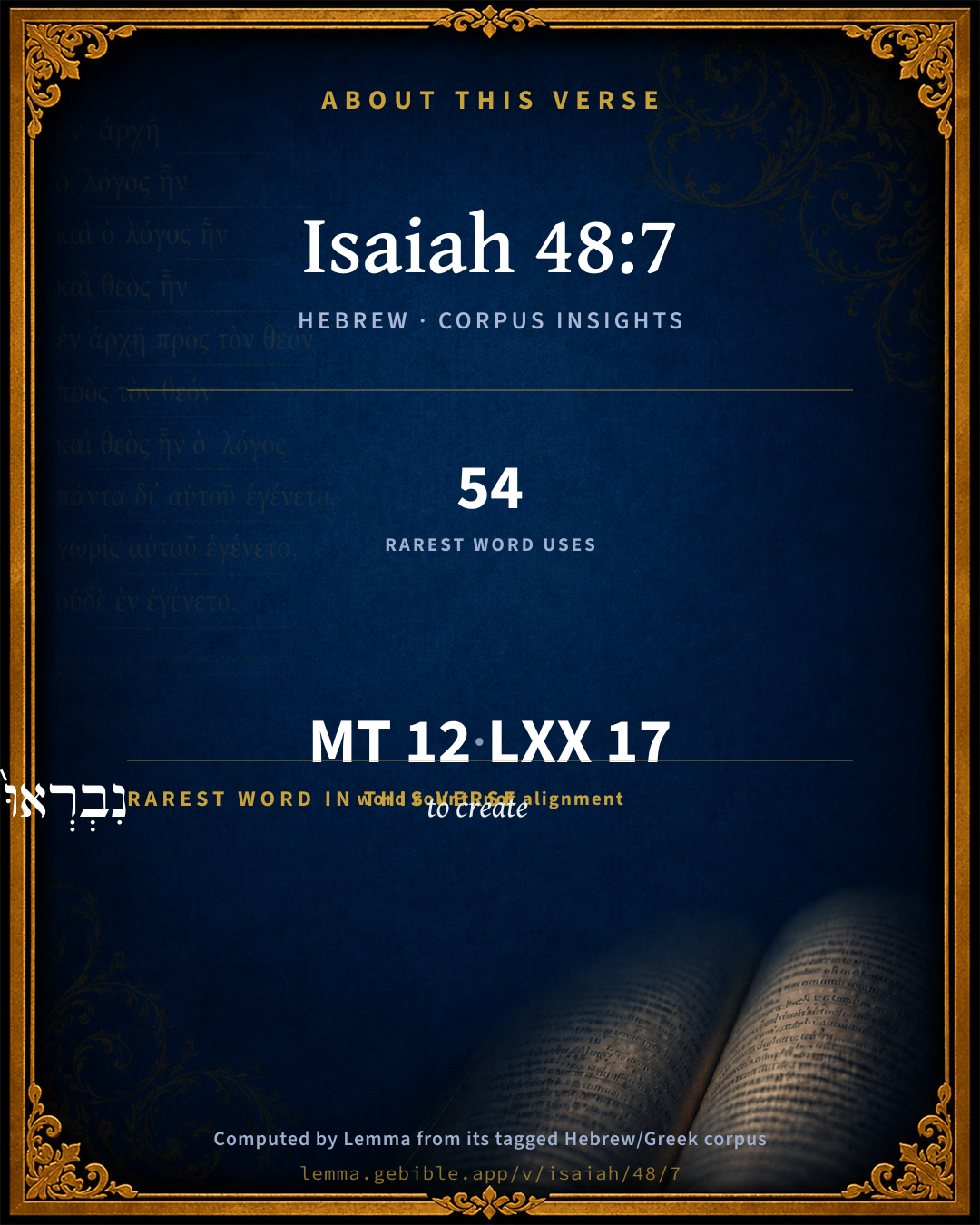
These counts appear in no published source. They are computed here, from the morphology-tagged text and Lemma’s own curated glosses. What Lemma adds →

12
words
11
distinct lemmas
Prophets
section

Shared distinctive vocabulary

נִבְרְאוּ֙ to create H1254 occurs in 46 verses of the Hebrew Bible. Also found in:

Grammatical profile

  • 4 verbs
  • 2 nouns
  • 1 conjunction
  • 2 adverbs
  • 3 particles

Verb forms

  • נִבְרְאוּ֙ Niphal · Perfect
  • שְׁמַעְתָּ֑ם Qal · Perfect
  • תֹּאמַ֖ר Qal · Imperfect
  • יְדַעְתִּֽין Qal · Perfect

Repetition

A word recurs within this verse — often emphatic in Hebrew:

  • וְלֹ֣א not H3808 ×2

Hebrew & Septuagint length

In English translation the verse runs 25 words from the Hebrew and 24 from the Septuagint (LXX English) — closely comparable.

A rough comparison of the two English renderings, which tokenize alike — not a word-level alignment.

Word counts can differ between the Hebrew and the Greek without any difference in meaning — e.g. the Hebrew direct-object marker אֵת has no separate Greek word, and Greek often adds the article ὁ.

In the original languages it is 12 Hebrew tokens and 17 Greek tokens — but the two are counted differently (Hebrew bundles its prefixes and suffixes into one token; the Greek is in lemma form), so that isn’t a like-for-like length.

Hebrew and Greek witnesses Masoretic Hebrew ↔ Greek Septuagint

The same verse in the two great witnesses to the Old Testament, shown verse-for-verse.

These are two independent witnesses, not word-aligned to each other, and the Septuagint is shown in lemma (dictionary) form.

Hebrew Isaiah 48:7 Masoretic · Westminster Leningrad Codex

עַתָּ֤ה נִבְרְאוּ֙ וְלֹ֣א מֵאָ֔ז וְלִפְנֵי י֖וֹם וְלֹ֣א שְׁמַעְתָּ֑ם פֶּן תֹּאמַ֖ר הִנֵּ֥ה יְדַעְתִּֽין

They are created now, and not from of old; and before this day you didn't hear them; lest you should say, Behold, I knew them.

World English Bible · Public Domain

Greek LXX Isaiah 48:7 Septuagint · lemma form

νῦν γίγνομαι καί οὐ πάλαι καί οὐ πρότερος ἡμέρα ἀκούω αὐτός μή εἶπον ὅτι ναί γιγνώσκω αὐτός

Now they come to pass, and not formerly: and you heard not of them in former days: say not you, Yes, I know them.

LXX2012 (modern English Septuagint) · Public Domain

On this verse, Albert Barnes' Notes on the Bible discusses the Septuagint’s reading. Read the note in Commentary ↓

Hebrew: Westminster Leningrad Codex (CC BY 4.0). Greek: Septuagint (public domain); English from LXX2012 (modern English Septuagint) (Public Domain). How the Septuagint differs from the Hebrew →

Targum (Aramaic paraphrase)

1

The Targum is the ancient Jewish Aramaic paraphrase of the Hebrew Scriptures — an interpretive translation, not the Hebrew text itself. Onkelos (literal) and Pseudo-Jonathan (expansive) render the Torah, and Jonathan the Prophets. Coverage is partial: where no permissively-licensed English translation exists for a verse, only the Aramaic is shown. This is verse-level text, not a word-by-word alignment to the Hebrew.

  1. Targum Jonathan Prophets (Joshua–Malachi)
    כְּעַן אִתְבְּרִיאָה וְלָא מִבְכֵן וּקְדָם יוֹם מֵיתֵיהוֹן וְלָא בְסַרְתִּינוּן דִלְמָא תֵימַר הָא יְדַעְתִּינוּן:

    They are created now, and not of old; yea, I have not announced them before the day of their coming to pass, lest thou shouldest say, Behold, I have known them.

    Targum Jonathan — Aramaic: “Mikraot Gedolot” (public domain). English: “Sefaria Community Translation” (CC0 1.0 (public-domain dedication)); “London "Chaldee Paraphrase," 1871” (public domain). Text via Sefaria.

Commentary

Notes on Isaiah 48:7 from classic Christian and Jewish commentators (each source and its license shown beneath its notes). The classic Christian expositions comment on the surrounding passage and are grouped to its opening verse, so a note may address several verses; the Jewish commentaries on the Tanakh (Rashi and others) are per-verse, so they appear only where the commentator wrote on this verse.

Lemma curates 59 commentaries, every one of them public domain or Creative Commons licensed, each selected and text-cleaned for this edition rather than reprinted as found. About our sources →

Trapp's Complete Commentary

John Trapp

Isa 48:7 They are created now, and not from the beginning; even before the day when thou heardest them not; lest thou shouldest say, Behold, I knew them.

Ver. 7. They are created now,] i.e., They are now brought to light by my revelations and predictions.

Behold, I knew them.] By my gods or diviners, or by my natural sagacity.

John Trapp, A Commentary or Exposition upon All the Books of the Old and New Testament (1647–1656) — public domain. Text from a community e-Sword module.

Geneva Bible (1599)

Geneva Bible translators

Showing that man’s arrogance is the cause why God doth not declare all things at once, lest they should attribute this knowledge to their own wisdom.

Geneva Bible (1599) marginal notes — public domain. Text via Bolls.life.

Jamieson, Fausset & Brown

Robert Jamieson, A. R. Fausset & David Brown

Not like natural results from existing causes, the events when they took place were like acts of creative power, such as had never before been "from the beginning."

even before the day when--rather [MAURER], "And before the day (of their occurrence) thou hast not heard of them"; that is, by any human acuteness; they are only heard of by the present inspired announcement.

Jamieson, Fausset & Brown — Commentary Critical and Explanatory on the Whole Bible (1871) — public domain (CC PDM 1.0). Text via the HelloAO Bible API.

Ellicott's Commentary for English Readers

(7) They are created now . . .—The verb is an unusual one, as applied to the events of history. What is meant is that the things which had been from the beginning in the mind of God are now, for the first time, manifested, through the prophet, as about to pass into act. What these are the prophet develops in the following chapters, as including the spiritual redemption and restoration of Israel. They were kept in store, as it were, to make men wonder (Rom_16:25-26).

Even before the day when . . .—Better, and before to-day thou heardest them not. . . . The reason given for what we might almost call this method of reserve and reticence, was that the people had been till now unprepared to receive the truth, and in their state it would but have increased their condemnation (Joh_16:12; Mar_4:33).

A Bible Commentary for English Readers, edited by Charles John Ellicott (1878–1897) — public domain. Text from a community e-Sword module.

The Cambridge Bible for Schools and Colleges

gen. ed. J. J. S. Perowne

7. They are created now] To create is to call into being by a word; and the idea here seems to be that the prophetic word which announces, is at the same time the creative fiat of Jehovah.

not from the beginning] not aforetime (see Isa_48:3).

even before the day when &c.] Render with R.V. and before this day thou heardest them not. The phrase “before the day” means “heretofore,” the opposite of “from this day forth” in ch. Isa_43:13.

Behold, I knew them] The events would have lost the effect of novelty if announced long before. Unbelief dies hard; when it can no longer say, “My idol did it,” it is apt to take refuge in another subterfuge and say, “It is what I expected.”

The Cambridge Bible for Schools and Colleges (gen. ed. J. J. S. Perowne; Cambridge University Press, 1878–1918) — public domain. Text from a community e-Sword module.

John Gill's Exposition

They are created now, and not from the beginning,.... Not that they were now done or brought into being, for as yet Cyrus was not born; though the raising of him up, and holding his right hand, and his executing the counsel of God, are spoken of as if they were already done, because of the certainty of them, Isa 45:1. Aben Ezra interprets "created" by "decreed"; though these were not now decreed by God; for no new decrees are made by him; but those which were made by him of old were now revealed and made manifest by prophecy, which is the sense of the phrase; so Kimchi observes,

"the time when they went out of the mouth of God is the time of their creation.''

Thus in like manner the incarnation of Christ, his sufferings and death, and salvation by him, things decreed from eternity, are spoken of in this prophecy as if actually done, because of the clear manifestation and certainty of them:

even before the day when thou heardest them not; they were in the breast of God, kept and reserved in his mind, and therefore are before called hidden things, before the Israelites heard anything of them; as were the things respecting Christ, and salvation by him; which were not only in God, who created all things by Christ, but were revealed before the Israelites had any knowledge of them, even to Adam and Eve, immediately after their fall; and were spoken of by all the holy prophets from the beginning of the world:

lest thou shouldest say, behold, I knew them; lest they should ascribe their present knowledge of them to their own sagacity and penetration; as if they were not obliged to a divine revelation, but of themselves had got the secret, and became acquainted with these things.

John Gill's Exposition of the Whole Bible (1746–1763) — public domain (CC PDM 1.0). Text via the HelloAO Bible API.

Albert Barnes' Notes on the Bible

They are created now - The Septuagint renders this, Νῦν γίνεται nun ginetai - ‘Done now;’ and many expositors interpret it in the sense that they are now brought into light, as if they were created. Aben Ezra renders it, ‘They are decreed and determined by me.’ Rosenmuller supposes that it refers to the revelation, or making known those things. Lowth renders it, ‘They are produced now, and not of old.’ Noyes, ‘It is revealed now, and not long ago.’ But the sense is probably this: God is saying that they did not foresee them, nor were they able to conjecture them by the contemplation of any natural causes. There were no natural causes in operation at the time the predictions were made, respecting the destruction of Babylon, by which it could be conjectured that that event would take place; and when the event occurred, it was as if it had been created anew. It was the result of Almighty power and energy, and was to be traced to him alone. The sense is, that it could no more be predicted, at the time when the prophecy was uttered, from the operation of any natural causes, than an act of creation could be predicted, which depended on the exercise of the divine will alone. It was a case which God only could understand, in the same way as he alone could understand the purposes and the time of his own act of creating the world.

And not from the beginning - The events have not been so formed from the beginning that they could be predicted by the operation of natural causes, and by political sagacity.

Even before the day when thou heardest them not - The sense of this probably, ‘and before this day thou hast not heard of them;’ that is, these predictions pertain to new events, and are not to be found in antecedent prophecies. The prophet did not speak now of the deliverance from Egypt, and of the blessings of the promised land, which had constituted the burden of many of the former prophecies, but he spoke of a new thing; of the deliverance from Babylon, and of events which they could by no natural sagacity anticipate, so that they could claim that they knew them.

Lest thou shouldest say, Behold, I knew them - The taking of Babylon by Cyrus, and the deliverance of the exiles from their bondage, are events which can be foreseen only by God. Yet the prophet says that he had declared these events, which thus lay entirely beyond the power of human conjecture, long before they occurred, so that they could not possibly pretend that they knew them by any natural sagacity, or that an idol had effected this.

Albert Barnes' Notes on the Bible (1834–1885) — public domain. Text from a community e-Sword/MySword module.

Haydock's Catholic Bible Commentary

Knew. Therefore I did not speak of the liberation from Egypt, but from Babylon, which is represented as just taking place. (Calmet)

George Leo Haydock (1774–1849), Haydock's Catholic Family Bible and Commentary, 1859 edition — public domain. Excludes Psalms (Douay-Rheims chapter numbering differs from Protestant) and Deuterocanonical books (Catholic canon only).

Matthew Poole's English Annotations

They are created now, i.e. revealed unto thee by me; brought to light, as things are by creation. Things are frequently said to be made or done in Scripture, when they are declared or manifested. Job 5:3, I cursed, i.e. I pronounced it cursed. Psa 2:4, That thou mightest be justified, i.e. declared and acknowledged to be just. Hos 5:15, Till they acknowledge their offence; which in the Hebrew is, till they be guilty. Not from the beginning, Heb. not from thence; not from these ancient times, when other things were revealed unto thee. Even before the day, Heb. and (or, or, as this particle is frequently used) before this day. Such pronouns are oft understood, as we have seen; and this day answers to nor in the first clause; and this clause seems to be added as an exposition of the next foregoing clause, which is more general and ambiguous, not from then or before this day.

When thou heardest them not, Heb. and thou didst not hear them, to wit, before this time, in which God hath revealed them to time by my ministry.

Lest thou shouldest say, Behold, I knew them; either by thine own sagacity, or by the help of thine idols. The sense is, That it might appear that thou hadst the knowledge of these things only from me, who made known unto thee only what and when I pleased.

Matthew Poole's English Annotations on the Holy Bible (1683–1685) — public domain. Text from a community e-Sword/MySword module.

The Pulpit Commentary

They are created now. The revelation to man of what has lain secret in God"s counsels from all eternity is a sort of creation. As Nagelbach well says, it converts the logov endiayetov into a logov proforikov and therefore is one step towards actual accomplishment. The mystery of "the Servant of the Lord," and of atonement and salvation through him, had hitherto been hid away in God", (Eph_3:9) and was now for the first time to be made known to such as had "eyes to see" and "cars to hear" by the teaching of the evangelical prophet. Even before the day when thou heardest them not; rather, and before to-day thou heardest them not. Whatever shadows of evangelic truth are discernible in the Law and in the earlier psalms, they did not constitute a revelation of the way of salvation at all comparable to that contained in Isaiah"s later chapters. Lest thou shouldest say, Behold, I knew them. If the "new things" of Isaiah"s prophecy had been revealed many centuries before, they would not have impressed the Jews of Isaiah"s time, or even of the Captivity period, as they did by having been reserved to a comparatively late date. They would have seemed to most of them an old and trite story.

The Pulpit Commentary (1880–1919), ed. H.D.M. Spence-Jones & Joseph S. Exell — public domain. Text from a community e-Sword module.

John Wesley's Explanatory Notes

Created - Revealed to thee by me; brought to light, as things are by creation. Not - Hebrew. not from thence, not from these ancient times when other things were revealed to thee. Or - Hebrew. and (or, or, as this particle is frequently used) before this day. This day answers to now in the first clause: and seems to be added as an exposition of it. Before this time in which God hath revealed them to thee by my ministry. I knew - Either by thine own sagacity: or by the help of thine idols.

John Wesley, Explanatory Notes Upon the Whole Bible (1754–1765) — public domain. Text via the GEBible commentary corpus.

J. A. Alexander on Isaiah

Joseph Addison Alexander

“Now they are created (i.e., brought into existence for the first time) and not of old, or never before.” The literal meaning of the next words is, “and before the day and thou hast not heard them.” This probably means ‘before this day (or before to-day) thou hast never heard them.’ The same reason is assigned as before: “Lest thou shouldest say, Behold, I knew them.”

Joseph Addison Alexander, The Prophecies of Isaiah (1846–1847; New York: Scribner, 1870–1878) — public domain. Text from a community e-Sword module.

Rashi

Rabbi Shlomo Yitzchaki (Rashi)

Now they have been created and not from then are they.

and before the day that they take place I let you hear of them.

and you did not hear them until this day. The words, “and before the day,” refer back to “I let you hear,” as stated above.

Rashi on the Tanakh — English translations: “The Judaica Press complete Tanach with Rashi, translated by A. J. Rosenberg” (CC BY 4.0); “Pentateuch with Rashi's commentary by M. Rosenbaum and A.M. Silbermann, 1929-1934” (public domain); “The Metsudah Tanach series, Lakewood, N.J” (CC BY 4.0); and “The Book of Joshua, Metsudah Publications, 1997” (CC BY 4.0). Text via Sefaria.

Ibn Ezra

Rabbi Abraham ibn Ezra

נבראו They are decreed.

And before the day, on which I told you. ולא שמעתם Thou heardest them not. The ו introduces the principal sentence, as فَ in Arabic; comp. אברהם ביום השלישי וישא when the third day came, Abraham lifted up (Gen. 22:4)

Ibn Ezra on the Tanakh — English translations: “Sefaria Community Translation” (CC0 1.0 (public-domain dedication)); “Yalkut, Sifsei Chachomim Chumash, Metsudah Publications, 2009” (CC BY 4.0); and “Commentary of Ibn Ezra on Isaiah - trans. by M. Friedlander, 1873” (public domain). Text via Sefaria.

Lesson kit

Teaching starters — assembled from the data on this page, not authored interpretation. Every prompt links to the verse data it draws on. Edit before teaching.

Isaiah, in the Prophets, opens this verse with 12 words (11 distinct Hebrew lemmas). Its most distinctive word is bârâʼ (“to create”). A historical commentator’s framing appears above. Read the whole chapter for the surrounding context.

Discussion questions

  1. The word bârâʼ carries the sense “to create.” How does it shape the verse?
  2. Genesis 1:1 shares the word «to create» with this verse. How do the two illuminate each other?
  3. “not” occurs 2× in this one verse. What is the effect of the repetition?
  4. These translations render this verse differently; the difference is in the English rendering, not the original. What questions does that raise?
  5. The verb «נִבְרְאוּ֙» is Niphal Perfect. How does its form color the action?
  6. Reading how Trapp's Complete Commentary and Geneva Bible (1599) read this verse, where do the two commentators agree and where do they part?

Things to notice

Reading settings

Reading text

Shown beneath each verse's original-language words.

Old Testament
Old Testament edition

Read the OT as the Masoretic Hebrew (MT) or the Greek Septuagint (LXX).

English shown for the Greek Septuagint (in the Hebrew ↔ Greek comparison).

Comparing translations? Open the Compare panel on any verse page to stack up to four side by side.