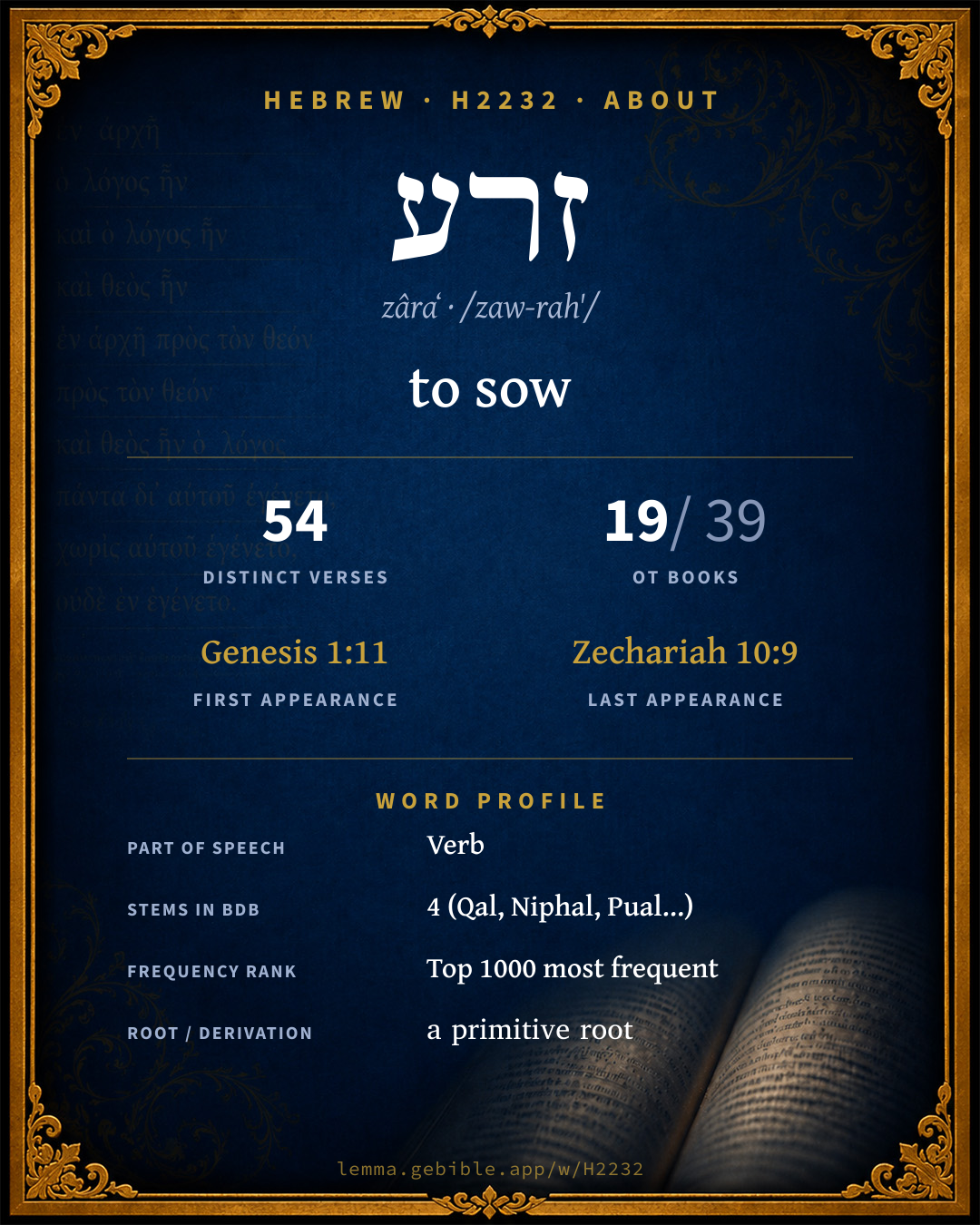
זָרַע
to sow
‘to sow’ is one of 3 main senses fuller range ↓
Full lexicon entry — Brown-Driver-Briggs (BDB)
From Brown-Driver-Briggs (BDB)
Where this word appears
See every Qal verb in the Hebrew Bible →
Grammar key — what these labels mean
Part of speech
- Verb
- An action or state-of-being word.
Stem
- Qal
- The basic, simple active stem — the plain form of the verb (“he wrote”). Here: ‘lit. sow’
- Niphal
- Usually the simple passive or reflexive of the Qal (“he was written”). Here: ‘be sown’
- Hiphil
- The causative active stem (“he caused / brought about”). Here: ‘produce seed’
- Pual
- The passive counterpart of the Piel.
Form
- Imperfect
- An incomplete, ongoing, or future action (“he will / would write”).
- Participle Active
- A verbal adjective expressing ongoing or characteristic action (“writing / one who writes”).
- Sequential Perfect
- A perfect with prefixed waw continuing a preceding imperfect or command (waw-consecutive perfect).
- Imperative
- A direct command (“write!”).
- Sequential Imperfect
- An imperfect with prefixed waw — the standard past-narrative form (waw-consecutive imperfect).
- Infinitive Construct
- A bound verbal noun, frequently with prepositions (“to write / in writing”).
- Perfect
- A completed action or state — Hebrew marks aspect (completeness) more than strict tense (“he wrote”).
- Cohortative
- A first-person volitional form expressing wish or resolve (“let me / let us write”).
- Jussive
- A third- or second-person volitional form expressing wish or command (“let him write”).
- Participle Passive
- A verbal adjective expressing action received (“written”).
State
- Absolute
- The independent form of a noun, not bound to a following word.
- Construct
- A noun bound to a following noun in a possessive / “of” relationship (the construct chain).
Person
- 2nd Person
- The one addressed (“you”).
- 3rd Person
- The one spoken about (“he / she / it / they”).
- 1st Person
- The speaker (“I / we”).
Gender
- Masculine
- Grammatically masculine.
- Feminine
- Grammatically feminine.
- Common
- Either gender — not distinguished for this form.
Number
- Singular
- One.
- Plural
- More than one (in Hebrew, generally three or more).
Grammatical forms 30 distinct
- Verb, Qal, Imperfect, 2nd Person, Masculine, Singular 11 times (20%)
- Verb, Qal, Participle Active, Masculine, Singular, Absolute 6 times (11%)
- Verb, Qal, Sequential Perfect, 2nd Person, Masculine, Plural 3 times (5%)
- Verb, Niphal, Imperfect, 3rd Person, Masculine, Singular 3 times (5%)
- Verb, Qal, Imperative, 2nd Person, Masculine, Plural 3 times (5%)
- Verb, Hiphil, Participle Active, Masculine, Singular, Absolute 2 times (4%)
- Verb, Qal, Imperfect, 2nd Person, Masculine, Plural 2 times (4%)
- Verb, Qal, Sequential Perfect, 1st Person, Common, Singular 2 times (4%)
+22 more forms (24 occurrences)
Parsed forms decoded from the imported morphology (morphhb / Westminster Leningrad Codex — WLC text public domain, morphhb tagging CC BY 4.0), counted across 56 parsed occurrences — not distinct verses.
Every verse where H2232 appears — 54 distinct verses across 19 books. Click any verse to open its interlinear word-by-word view. Verse text shown in the World English Bible for context — . Each verse’s Hebrew form is shown with its reference; the English is not keyword-highlighted, since the data carries no word-level English alignment. Use “Compare translations” on any verse to read it across multiple English versions. This concordance covers the Hebrew Bible; Septuagint (Greek Old Testament) occurrences are not indexed here.
Genesis 5 verses
- Genesis 1:11 מַזְרִ֣יעַ Hiphil ptcp.act ms God said, "Let the earth put forth grass, herbs yielding seed, and fruit trees bearing fruit after their kind, with its seed in it, on the earth," and it was so.
- Genesis 1:12 מַזְרִ֤יעַ Hiphil ptcp.act ms The earth brought forth grass, herbs yielding seed after their kind, and trees bearing fruit, with its seed in it, after their kind: and God saw that it was good.
- Genesis 1:29 זֹרֵ֣עַ זֹרֵ֣עַ Qal ptcp.act ms Qal ptcp.act ms God said, "Behold, I have given you every herb yielding seed, which is on the surface of all the earth, and every tree, which bears fruit yielding seed. It will be your food.
- Genesis 26:12 וַ/יִּזְרַ֤ע conj + Qal wimpf 3ms Isaac sowed in that land, and reaped in the same year one hundred times what he planted. Yahweh blessed him.
- Genesis 47:23 וּ/זְרַעְתֶּ֖ם conj + Qal wpf 2mp Then Joseph said to the people, "Behold, I have bought you and your land today for Pharaoh. Behold, here is seed for you, and you shall sow the land.
Exodus 2 verses
- Exodus 23:10 תִּזְרַ֣ע Qal impf 2ms "For six years you shall sow your land, and shall gather in its increase,
- Exodus 23:16 תִּזְרַ֖ע Qal impf 2ms And the feast of harvest, the first fruits of your labors, which you sow in the field: and the feast of harvest, at the end of the year, when you gather in your labors out of the field.
Leviticus 9 verses
- Leviticus 11:37 יִזָּרֵ֑עַ Niphal impf 3ms If part of their carcass falls on any sowing seed which is to be sown, it is clean.
- Leviticus 12:2 תַזְרִ֔יעַ Hiphil impf 3fs "Speak to the children of Israel, saying, 'If a woman conceives, and bears a male child, then she shall be unclean seven days; as in the days of her monthly period she shall be unclean.
- Leviticus 19:19 תִזְרַ֣ע Qal impf 2ms "'You shall keep my statutes. "'You shall not crossbreed different kinds of animals. "'you shall not sow your field with two kinds of seed; "'neither shall there come upon on you a garment made of two kinds of material.
- Leviticus 25:3 תִּזְרַ֣ע Qal impf 2ms Six years you shall sow your field, and six years you shall prune your vineyard, and gather in its fruits;
- Leviticus 25:4 תִזְרָ֔ע Qal impf 2ms but in the seventh year there shall be a Sabbath of solemn rest for the land, a Sabbath to Yahweh. You shall not sow your field or prune your vineyard.
- Leviticus 25:11 תִזְרָ֔עוּ Qal impf 2mp That fiftieth year shall be a jubilee to you. In it you shall not sow, neither reap that which grows of itself, nor gather from the undressed vines.
- Leviticus 25:20 נִזְרָ֔ע Qal impf 1cp If you said, "What shall we eat the seventh year? Behold, we shall not sow, nor gather in our increase;"
- Leviticus 25:22 וּ/זְרַעְתֶּ֗ם conj + Qal wpf 2mp You shall sow the eighth year, and eat of the fruits, the old store; until the ninth year, until its fruits come in, you shall eat the old store.
- Leviticus 26:16 וּ/זְרַעְתֶּ֤ם conj + Qal wpf 2mp I also will do this to you: I will appoint terror over you, even consumption and fever, that shall consume the eyes, and make the soul to pine away; and you will sow your seed in vain, for your enemies will eat it.
Numbers 1 verse
Deuteronomy 4 verses
- Deuteronomy 11:10 תִּזְרַע֙ Qal impf 2ms For the land, where you go in to possess it, isn't as the land of Egypt, from whence you came out, where you sowed your seed, and watered it with your foot, as a garden of herbs;
- Deuteronomy 21:4 יִזָּרֵ֑עַ Niphal impf 3ms and the elders of that city shall bring down the heifer to a valley with running water, which is neither plowed nor sown, and shall break the heifer's neck there in the valley.
- Deuteronomy 22:9 תִזְרַ֥ע תִּזְרָ֔ע Qal impf 2ms Qal impf 2ms You shall not sow your vineyard with two kinds of seed, lest the whole fruit be forfeited, the seed which you have sown, and the increase of the vineyard.
- Deuteronomy 29:23 תִזָּרַע֙ Niphal impf 3fs [and that] the whole land of it is sulfur, and salt, [and] a burning, [that] it is not sown, nor bears, nor any grass grows therein, like the overthrow of Sodom and Gomorrah, Admah and Zeboiim, which Yahweh overthrew in his anger, and in his wrath:
Judges 2 verses
- Judges 6:3 זָרַ֣ע Qal pf 3ms So it was, when Israel had sown, that the Midianites came up, and the Amalekites, and the children of the east; they came up against them;
- Judges 9:45 וַ/יִּזְרָעֶ֖/הָ conj + Qal wimpf 3ms + sfx pers 3fs Abimelech fought against the city all that day; and he took the city, and killed the people who were therein: and he beat down the city, and sowed it with salt.
2 Kings 1 verse
Job 2 verses
Psalms 3 verses
- Psalms 97:11 זָרֻ֣עַ Qal ptcp.pass ms Light is sown for the righteous, And gladness for the upright in heart.
- Psalms 107:37 וַ/יִּזְרְע֣וּ conj + Qal wimpf 3mp Sow fields, plant vineyards, And reap the fruits of increase.
- Psalms 126:5 הַ/זֹּרְעִ֥ים ptcl def.art + Qal ptcp.act mp Those who sow in tears will reap in joy.
Proverbs 2 verses
Ecclesiastes 2 verses
- Ecclesiastes 11:4 יִזְרָ֑ע Qal impf 3ms He who observes the wind won't sow; And he who regards the clouds won't reap.
- Ecclesiastes 11:6 זְרַ֣ע Qal impv 2ms In the morning sow your seed, And in the evening don't withhold your hand; For you don't know which will prosper, whether this or that, Or whether they both will be equally good.
Isaiah 7 verses
- Isaiah 17:10 תִּזְרָעֶֽ/נּוּ Qal impf 2ms + sfx pers 3ms For you have forgotten the God of your salvation, and have not been mindful of the rock of your strength; therefore you plant pleasant plants, and set it with strange slips.
- Isaiah 28:24 לִ/זְרֹ֑עַ prep + Qal inf.cs Does he who plows to sow plow continually? does he [continually] open and harrow his ground?
- Isaiah 30:23 תִּזְרַ֣ע Qal impf 2ms He will give the rain for your seed, with which you shall sow the ground; and bread of the increase of the ground, and it shall be fat and plenteous. In that day shall your cattle feed in large pastures;
- Isaiah 32:20 זֹרְעֵ֖י Qal ptcp.act mp cs Blessed are you who sow beside all waters, who send forth the feet of the ox and the donkey.
- Isaiah 37:30 זִרְע֧וּ Qal impv 2mp This shall be the sign to you: you shall eat this year that which grows of itself, and in the second year that which springs of the same; and in the third year sow you, and reap, and plant vineyards, and eat the fruit of it.
- Isaiah 40:24 זֹרָ֔עוּ Pual pf 3cp Yes, they have not been planted; yes, they have not been sown; yes, their stock has not taken root in the earth: moreover he blows on them, and they wither, and the whirlwind takes them away as stubble.
- Isaiah 55:10 לַ/זֹּרֵ֔עַ prep det + Qal ptcp.act ms For as the rain comes down and the snow from the sky, and doesn't return there, but waters the earth, and makes it bring forth and bud, and gives seed to the sower and bread to the eater;
Jeremiah 6 verses
- Jeremiah 2:2 זְרוּעָֽה Qal ptcp.pass fs Go, and cry in the ears of Jerusalem, saying, Thus says Yahweh, I remember for you the kindness of your youth, the love of your weddings; how you went after me in the wilderness, in a land that was not sown.
- Jeremiah 4:3 תִּזְרְע֖וּ Qal juss 2mp For thus says Yahweh to the men of Judah and to Jerusalem, Break up your fallow ground, and don't sow among thorns.
- Jeremiah 12:13 זָרְע֤וּ Qal pf 3cp They have sown wheat, and have reaped thorns; they have put themselves to pain, and profit nothing: and you shall be ashamed of your fruits, because of the fierce anger of Yahweh.
- Jeremiah 31:27 וְ/זָרַעְתִּ֗י conj + Qal wpf 1cs Behold, the days come, says Yahweh, that I will sow the house of Israel and the house of Judah with the seed of man, and with the seed of animal.
- Jeremiah 35:7 תִזְרָ֨עוּ֙ Qal impf 2mp neither shall you build house, nor sow seed, nor plant vineyard, nor have any; but all your days you shall dwell in tents; that you may live many days in the land in which you sojourn.
- Jeremiah 50:16 זוֹרֵ֨עַ֙ Qal ptcp.act ms Cut off the sower from Babylon, and him who handles the sickle in the time of harvest: for fear of the oppressing sword they shall turn everyone to his people, and they shall flee everyone to his own land.
Ezekiel 1 verse
Hosea 3 verses
- Hosea 2:23 וּ/זְרַעְתִּ֤י/הָ conj + Qal wpf 1cs + sfx pers 3fs I will sow her to me in the earth; And I will have mercy on her who had not obtained mercy; And I will tell those who were not my people, 'You are my people;' And they will say, 'My God!'"
- Hosea 8:7 יִזְרָ֖עוּ Qal impf 3mp For they sow the wind, And they will reap the whirlwind. He has no standing grain. The stalk will yield no head. If it does yield, strangers will swallow it up.
- Hosea 10:12 זִרְע֨וּ Qal impv 2mp Sow to yourselves in righteousness, Reap according to kindness. Break up your fallow ground; For it is time to seek Yahweh, Until he comes and rains righteousness on you.
Micah 1 verse
Nahum 1 verse
Haggai 1 verse
Zechariah 1 verse
About this entry
At a glance — auto-summarized from this page’s data, not written by a person. Every figure links to its source below. This summary describes the numbers; it doesn’t interpret them.
At its core, זרע (zâraʻ) means “to sow.” Read the stem: it spans 4 stems, including Qal and Niphal. With 54 verses in 19 books, it is a moderately common word in the Hebrew Bible. First canonically at Genesis 1:11, it enters the text early. From the same root come זרוע, זרוע and זרע. Dig into 54-verse concordance and the renderings breakdown below.
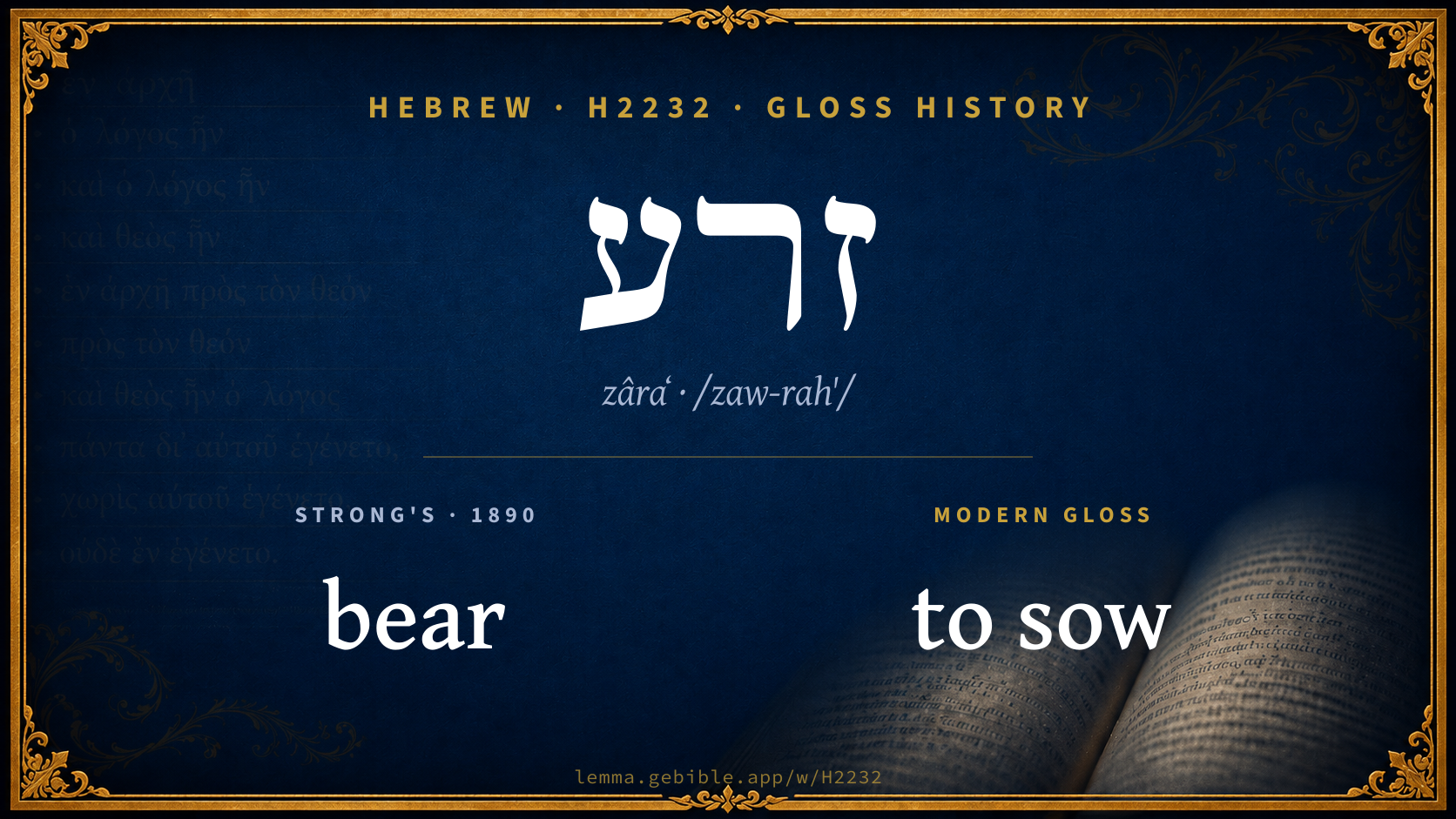
Gloss history
Strong's 1890 vs modern scholarship
About this word
Strong's H2232 catalogs a Hebrew word from the Hebrew Old Testament.
These counts are not copied from any lexicon or concordance. They are computed here, from the morphology-tagged Hebrew Old Testament. What Lemma adds →
- 54
- distinct verses
- The word appears in 54 distinct verses.
- 19 / 39
- OT books
- The word appears in 19 of 39 Old Testament books.
- #678
- by frequency
- Top 1000 most frequent Hebrew words (rank 678 of 8,640 Hebrew words by occurrence).
View all 54 occurrences in the concordance →
By section of the Old Testament
By traditional corpus
Conventional, traditional groupings — biblical authorship is debated, so this is a traditional corpus grouping, not an authorship claim. Each share is this word’s portion of its verses in that division of the Hebrew canon. Each figure is a share of the word’s 54 distinct verses.
- Prophets (Nevi'im) 24 verses · 44%
- Torah (Pentateuch) 21 verses · 39%
- Writings (Ketuvim) 9 verses · 17%
How translations render this word
Counts come from each version’s own published word-to-Strong’s tagging or interlinear alignment — an approximate guide to how each version renders this word, not a word-level alignment the data otherwise carries. Because each total is that version’s own tagged count, the per-version totals vary from one another and need not match the appearance or distinct-verse counts above. These counts may also differ from a printed concordance because Lemma counts each distinctly tagged rendering and does not collapse phrase taggings into a single head-word total. This is a fixed set of word-tagged versions (KJV, ASV, BSB, ULT) and does not change with the reading translation you choose elsewhere. Each version’s license is shown beside its name below (and on Sources).
- King James Version: Sow 9×, Thou shalt sow 4×, I will sow 3×
- American Standard Version: Sow 9×, Yielding 4×, I will sow 3×
- Berean Standard Bible: Sow 13×, You will sow 3×, He who sows 2×
- unfoldingWord Literal Text: Sow 11×, You shall 4×, You shall sow 4×
King James Version Public Domain
Renders H2232 across 56 tagged occurrences — most commonly:
Plus 23 renderings that appear only once — usually multi-word phrases or single function words the recovered tagging swept in, not distinct renderings.
American Standard Version Public Domain
Renders H2232 across 56 tagged occurrences — most commonly:
Plus 29 renderings that appear only once — usually multi-word phrases or single function words the recovered tagging swept in, not distinct renderings.
Berean Standard Bible Public Domain
Renders H2232 across 53 tagged occurrences — most commonly:
Plus 29 renderings that appear only once — usually multi-word phrases or single function words the recovered tagging swept in, not distinct renderings. Not rendered by a distinct English word in 2 further occurrences.
unfoldingWord Literal Text CC BY-SA 4.0
Renders H2232 across 66 tagged occurrences — most commonly:
Plus 32 renderings that appear only once — usually multi-word phrases or single function words the recovered tagging swept in, not distinct renderings.
24 senses and sub-senses in the full BDB
Hebrew verbs can shift meaning by stem (binyan): Qal is the basic action, Niphal is often passive or reflexive, Piel often intensifies or makes it factitive, and Hiphil is typically causative. The senses below are grouped under the stem BDB assigns to each. This entry also uses Pual (the passive of Piel).
What do BDB’s symbols mean?
BDB uses these scholarly abbreviations:
| Symbol | Meaning |
|---|---|
| 𝔊 | the Septuagint (the ancient Greek translation, LXX) |
| 𝔙 | the Vulgate (the Latin translation) |
| 𝔖 | the Syriac version (the Peshitta) |
| 𝔗 | the Targum (the Aramaic translation) |
| ψ | the Psalms |
| √ | root (the underlying root or stem) |
| ‖ | parallel passage (a synonymous or contrasted parallel) |
| † | the dagger: every passage where the word occurs is cited |
The 24 senses and sub-senses the full Brown-Driver-Briggs lexicon distinguishes for this word, in lexicon order (not ranked by frequency), with BDB’s own verbatim wording and sub-sense lettering. Shown in Hebrew script with BDB’s own scholarly abbreviations. The condensed entry is in the Lexicon Entry tab. See also the Forms in the corpus table below.
Qal
- Pf. 3 ms. זָרַע Ju 6:3; 1 s. וְזָרַעְתִּ֫י Je 31:27; sf. וּזְרַעְתִּיהָ consec. Ho 2:25; 3 pl. זָֽרְעוּ Je 12:13; 2 mpl. זְרַעְתֶּם Hg 1:6; וּזְרַעְתֶּם consec. Gn 47:23 + 2 times; Impf. יִזְרָ֑ע Ec 11:4; וַיִּזְרַע Gn 26:12; sf. וַיִּזְרָעֶהָ Ju 9:45; 1 s. אֶזְרְעָה Jb 31:8; sf. וְאֶזְרָעֵם Zc 10:9, etc.; Imv. ms. זְרַע Ec 11:6; mpl. זִרְעוּ Ho 10:12 + 2 times; Inf. לִזְרֹעַ Is 28:24; Pt. act. זֹרֵעַ Is 55:10 + 3 times; זוֹרֵעַ Pr 22:8 Je 50:16, etc.; Pt. pass. sm. זָרֻעַ ψ 97:11 (but v. infr.); f. זְרוּעָה Je 2:2;— e.g. Judges 6:3
- 1. lit. sow:
- a. abs. sow (seed), do one’s sowing Ju 6:3 Gn 26:12 (J), Is 28:24 (after ploughing חרשׁ); זִרְעוּ וקצרו ונטעו כרמים Is 37:30=2 K 19:29; ‖ קצר also Mi 6:15 Lv 25:11 (H), Ec 11:4: ‖ אסף Lv 25:20 (H); opp. אכל Jb 31:8; זֹרְעֵי על־כל־מים Is 32:20 (on cstr. cf. Ges§ 130, 1); c. את־השּׁנה הַשׁמינִת Lv 25:22; sq. הַרְבֵּה Hg 1:6 (opp. הָבֵא מְעָ֑ט). e.g. Judges 6:3
- b. c. acc. of land אדמה Ex 23:10 (JE; ‖ אסף), Gn 47:23 (J); filed (שׂדה) Lv 25:3 (‖ אסף), cf. v 4 ψ 107:37; as pt. pass. אֶרֶץ לֹא וְרוּעָה Je 2:2 (‖ מִדְבָּר). e.g. Exodus 23:10
- c. c. acc. of seed ז׳ אֶת־זַרְעֲךָ Dt 11:10, cf. 22:9 Je 35:7 Lv 26:16 (H) Ec 11:6; sq. חִטִּים Je 12:13 (‖ קצר); cf. also בִּכּוּרֵי מַעֲשֶׂיךָ אשׁר תזרע בַּשָּׁדֶה Ex 23:16 (JE). e.g. Deuteronomy 11:10
- d. sq. 2 acc. לֹא תזרע כַּרְמְךָ כִּלְאָ֑יִם Dt 22:9; cf. שָׂדְךָ לֹא תִזְרַע כִּלְאַיִם Lv 19:19 (H); זַרְעֲךָ אשׁר־תזרע את־האדמה Is 30:23; also of destroyed city וַיִּזְרָעֶהָ מֶ֑לַח Ju 9:45. e.g. Deuteronomy 22:9
- e. pt. act. as subst. זוֹרֵעַ Je 50:16 (‖ תֹּפֵשׂ מַגָּל בְּעֵת קָציר); לַזֹּרֵעַ Is 55:10 (‖ לָאֹכֵל). e.g. Jeremiah 50:16
- 2. of shrub and tree producing, yielding seed, c. acc. cogn. Gn 1:29(×2) (P), cf. Hiph. e.g. Genesis 1:29
- 3. fig.:
- a. of Yahweh’s sowing (planting) Isr. in the land וזרעתיה לי בָארץ Ho 2:25 (We וזרעתיהו, obj. being Jezreel); on the other hand וְאֶזְרָעֵם בָּעַמִּים Zc 10:9. e.g. Hosea 2:25
- b. c. 2 acc., of Yahweh’s fructifying Isr. and Judah וזרעתי את־בית ישׂראל ואת־ב׳ יהודה זֶרַע אדם וזרע בהמה Je 31:27. e.g. Jeremiah 31:27
- c. of moral action, זִרְעוּ לָכֶם לִצְדָקָה Ho 10:12 (‖ קצר); ז׳צדקה Pr 11:18; אַל־תִּזְרְעוּ אֶל־קֹצִים Je 4:3 sow not in among thorns (said of a few righteous deeds amid much wickedness); especially of evil-doing רוּחַ יזרעו וְסוּפָתָה יִקְצֹ֑רוּ Ho 8:7; זֹרְעֵי עָמָל Jb 4:8 (‖ קצר); זוֹרֵעַ עַוְלָה יקצור־אָוֶן Pr 22:8. e.g. Hosea 10:12
- d. of Israel’s practising idolatry זְמֹרַת זָר תִּזְרָעֶ֑נּוּ Is 17:10 (2 acc.) e.g. Isaiah 17:10
- e. הזרעים בדמעה בְּרִנָּה יִקְצֹ֑רוּ ψ 126:5 metaph. of distress followed by joy. e.g. Psalms 126:5
- f. אוֹר זָרֻעַ לַצַּדִּיק ψ 97:11 read prob. זָרַח, Vrss Ol Hu Bae Che al. e.g. Psalms 97:11
Niphal
- be sown, fructified, Pf. 3 fs. וְנִזְרְעָה consec. Nu 5:28; 2 mpl. וְנִזְרַעְתֶּם consec. Ez 36:9; Impf. 3 ms. יִזָּרַע Na 1:14; יִזָּרֵ֑עַ Dt 21:4 Lv 11:37; 3 fs. תִּזָּרַע Dt 29:22;— e.g. Numbers 5:28
- 1. be sown:
- a. subj. אֶרֶץ, לֹא תִזּ׳ ולא תַּצְמִחַ Dt 29:22, cf. (of נַחַל אֵיתָן) לא יֵעָבֵד בּוֹ ולא יִזּ׳ Dt 21:4; in address to הָרֵי ישׂראל, וְנֶעֱבַדְתֶּם וְנִזְרַעְתֶּם Ez 36:9. e.g. Deuteronomy 29:22
- b. subj. זֶרַע, זֶרַע זֵרוּעַ אשׁר יִזָּרֵעַ Lv 11:37 (P); fig. לֹא יִזּ׳ מִשִּׁמְךָ עוֹד Na 1:14 no more of thy name be sown, in judgment against Nineveh. e.g. Leviticus 11:37
- 2. be fructified, made pregnant וְנִזְרְעָה זָ֑רַע Nu 5:28 (P; of woman). e.g. Numbers 5:28
Pual
- Pf. 3 pl. זֹרָ֑עוּ Is 40:24 of princes and judges under fig. of trees (‖ נִטָּ֑עוּ, שֹׁרֵשׁ בָּאָרֶץ גִּזְעָם). e.g. Isaiah 40:24
Hiphil
- Impf. 3 fs. תַּזְרִיעַ Lv 12:2; Pt. מַזְרִיעַ Gn 1:11, 12;— e.g. Leviticus 12:2
- 1. produce seed, of herb, c. acc. cogn. Gn 1:11, 12; appar. denom. from זֶרַע; cf. Qal 2. e.g. Genesis 1:11
- 2. of a woman,=bear a child תַּזְרִיעַ וְיָֽלְדָה זָכָר Lv 12:2. e.g. Leviticus 12:2
Senses from the full Brown-Driver-Briggs lexicon (Brown, Driver, Briggs; Oxford 1906 — public domain), digitized via Sefaria, supplemented by the OpenScriptures HebrewLexicon (CC BY 4.0). Full attribution on Sources.
Word origin
vb. sow, scatter seed (NH id.; Assyrian zirû TPPrism vi. 15; Arabic زَرَعَ; Aramaic ܙܪܰܥ, זְרַע; Ethiopic ዘርአ: ዘርዐ: but in Sab. דֿרא DHMZMG 1883, 15 and in n.pr., Id. in MV10, pp. 242, 983)—
— Brown-Driver-Briggs (Oxford 1906, public domain), digitized via Sefaria, supplemented by the OpenScriptures HebrewLexicon (CC BY 4.0). See Sources.
Origin: a primitive root
Jastrow Dictionary
A second Hebrew/Aramaic lexicon for comparison, covering Aramaic and post-biblical (Talmudic, Targumic, Midrashic) usage that the biblical-Hebrew BDB does not. Matched by lemma rather than by Strong’s number, so a lemma may carry more than one Jastrow headword (shown separately below), and the entries cover usage well beyond the Bible.
זָרַע
- to strew, sow. Kil. I, 9. Ib. II, 3 אֶזְרַע, v. אָפַךְ; a. fr.—Part. pass. זָרוּעַ, f. זְרוּעָה; pl. זְרוּעִים &c. Ib. ז׳ חטים sown with wheat; a. fr.—Y. Sot. I, 17ᵇ top כשם … בנותיהן זרועות וכ׳ as well as their vineyards are sown with mixed seeds, so are their daughters &c. (faithless wives).
- to be sown, to be stocked with seed. Gen. R. s. 83, end, a. e. בשבילי נִזְרְעָה וכ׳ the field has been sown for my sake. Shebi. IV, 2 תִּזָרֵעַ may be sown; a. fr.
- to emit semen(also used of women emitting a secretion at coition). Ber. 60ᵃ, a. e. איש מַזְרִיעַ תחלה when the male is the first to emit semen; אשה מַזְרַעַת וכ׳ when the female is the first &c.; a. fr.
זְרַע I
- Targ. Jud. VI, 3; a. fr.—Part. זָרֵעַ, (זְרִיעַ) זָרֵיעַ. Targ. Prov. XI, 18; a. fr.—Targ. Is. XXVIII, 25 זָרְעֵי. Ib. XXXII, 20 זָרְעִין.—R. Hash. 16ᵃ לִיזְרַע חרפא let him sow early seed (barley &c.). Y. Peah VII, 20ᵇ top הוה ז׳ חקלא וכ׳ planted carrots on his field; a. fr.
- as preced. Nif. Targ. O. Deut. XXIX, 22; a. e.—Y. Peah l. c. אִזְדַּרְעוּן they have been planted.
- as preced. Hif. Y. Kil. I, 27ᵃ bot. ומַזְרְעִין and they copulated.
זֶרַע
- preced.) seed; animalic semen (mostly שִׁכְבַת ז׳). Gen. R. s. 73 נעשו המים ז׳ וכ׳ the water in their bellies turned into semen. Y. Kil. I, 27ᵃ bot. נוטל הימנו ז׳ he may take seed thereof. Shebi. II, 8 שזרעו לז׳ which he planted for the sake of obtaining seed, opp. לירק for using it as vegetable; a. fr.—Trnsf. issue, descent. Gen. R. s. 23; s. 51 אותו ז׳ שהוא וכ׳ that issue which was to come from a foreign place (Moab). Ber. 31ᵇ ז׳ שמושח וכ׳ a descendant who will anoint two men; a. fr.—Pl. זְרָעִים. Peah II, 3 הכל מפסיק לז׳ all of them form a partition with regard to seeds (making each field separately subject to Peah), opp. to trees. Kil. III, 2 כל מין ז׳ all kinds of seeds (small vegetable), opp. ירקות large beans &c.; a. fr.—Y. Shebi. II, 34ᵃ top ששה זְרָעִין six sowing seasons during a Sabbatical period.—סֶרֶר ז׳ or ז׳ Order of Seeds, Z’raim, the first of the six orders of the Mishnah a. Tosefta. Sabb. 31ᵃ. Esth. R. to I, 2.
זְרַע II
- Targ. O. Gen. I, 11; a. fr. בר ז׳ that which is fit for propagation, seed-capsule, v. בִּיזְרָא. Targ. Prov. XI, 21; a. fr.—Targ. Ps. XXXVII, 26 Ms. (ed. דרעיה, v. דְּרַע II).—Y. Snh. VII, end, 25ᵈ ז׳ דכיתן flax-seed.
A Dictionary of the Targumim, the Talmud Babli and Yerushalmi, and the Midrashic Literature (Marcus Jastrow; London, Luzac, 1903) — Public Domain. Digitized via Sefaria. Digitized via Sefaria. Full attribution on Sources.
Forms in the corpus
The 51 distinct written forms H2232 takes in the Hebrew Bible, most frequent first — each parse links to that stem’s occurrences in the concordance. Hebrew forms include their vowel points and cantillation, so a single lemma takes many written forms.
Same root — word family
Other BDB entries built from the same root as H2232, grouped by Strong’s listed origin. These share a root / origin per the lexicon — not necessarily a shared meaning. Each links to that word’s own entry.
Derived from this word
- זרוע zᵉrôwaʻ H2220 arm
- זרוע zêrûwaʻ H2221 seed
- זרע zeraʻ H2233 seed
- זרע zêrôaʻ H2235 vegetables
- מזרע mizrâʻ H4218 seed
Proper names from this root
People and places named from this root — a name, not an additional meaning of the word.
Compare all same-root words → Showing 4 of 7 — not the complete family. 1 of the same-root words is a proper name (a person or place). They share a root, not necessarily a meaning.
Septuagint verse parallels
This word appears in 51 verses that also exist in the Greek Old Testament (Septuagint), out of the 54 Hebrew verses it occurs in. You can read those verses in Greek by switching the Old Testament edition to the Septuagint.
Read these verses in the Septuagint
- Genesis 1:11
- Exodus 23:10
- Leviticus 11:37
- Numbers 5:28
- Deuteronomy 11:10
- Judges 6:3
- 2 Kings 19:29
- Job 4:8
- Psalms 126:5
- Proverbs 11:18
- Ecclesiastes 11:4
- Isaiah 17:10
This is a verse-level parallel only — the same verses exist in both the Hebrew and Greek Old Testaments. No word-level Hebrew↔Greek correspondence is claimed: the data carries no such alignment, so no Greek word is shown as this Hebrew word’s translation. Coverage is not total — the Septuagint omits the deuterocanon and renumbers the Psalms, so some Hebrew verses have no direct Greek parallel.