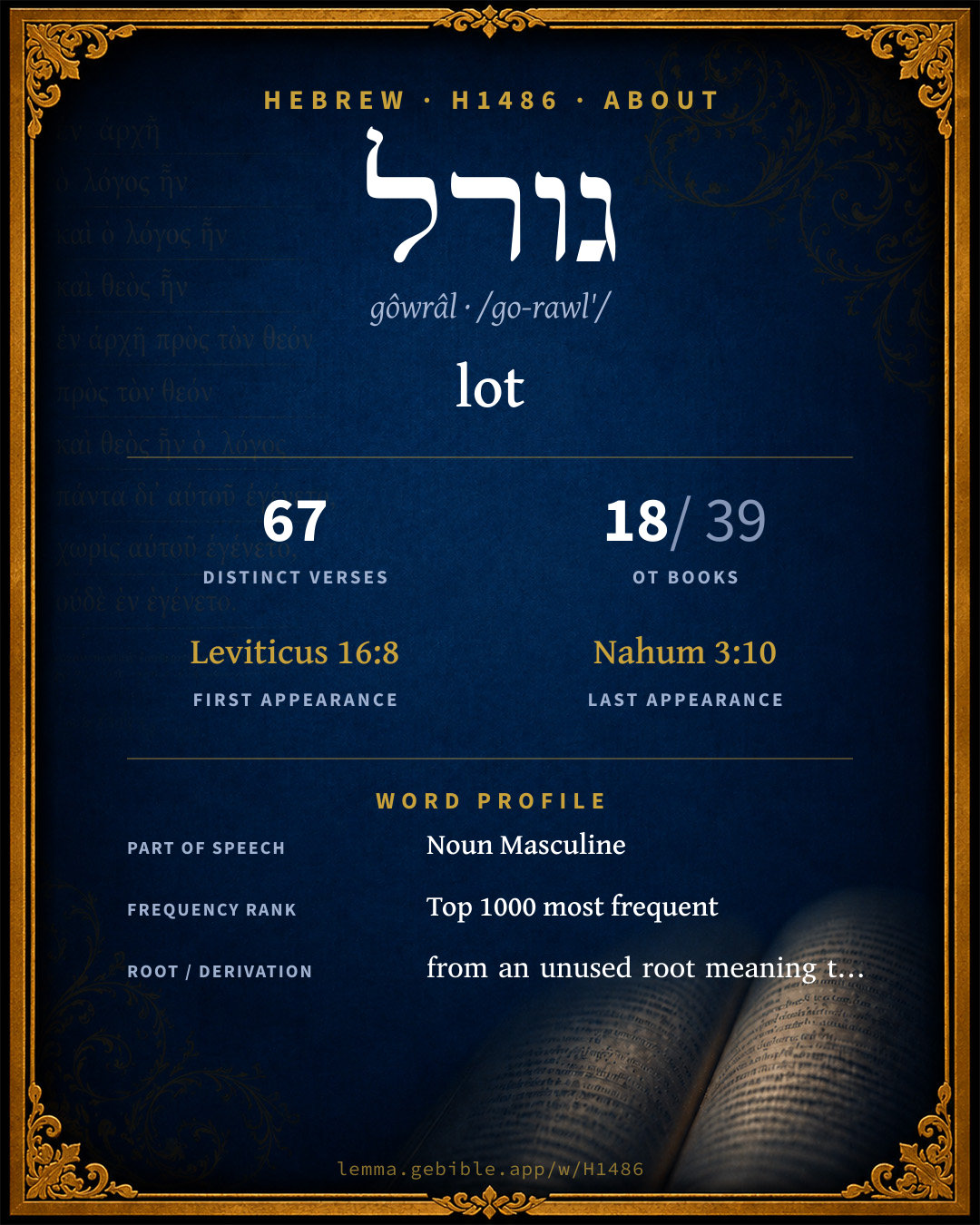
גּוֹרָל
lot
‘lot’ is one of 2 main senses fuller range ↓
Full lexicon entry — Brown-Driver-Briggs (BDB)
From Brown-Driver-Briggs (BDB)
Where this word appears
See every Absolute-state word in the Hebrew Bible →
Grammar key — what these labels mean
Part of speech
- Noun
- A naming word — a person, place, thing, or idea.
Noun type
- Common
- A common noun — a general class of person, place, or thing (“king,” “city,” “water”), not a specific name.
State
- Absolute
- The independent form of a noun, not bound to a following word.
- Construct
- A noun bound to a following noun in a possessive / “of” relationship (the construct chain).
Gender
- Masculine
- Grammatically masculine.
Number
- Singular
- One.
- Plural
- More than one (in Hebrew, generally three or more).
1 verse where H1486 appears in the Construct state in the Book of Isaiah. Filtered view — show all forms. Click any verse to open its interlinear word-by-word view. Verse text shown in the World English Bible for context — . Each verse’s Hebrew form is shown with its reference; the English is not keyword-highlighted, since the data carries no word-level English alignment. Use “Compare translations” on any verse to read it across multiple English versions. This concordance covers the Hebrew Bible; Septuagint (Greek Old Testament) occurrences are not indexed here.
Isaiah
About this entry
At a glance — auto-summarized from this page’s data, not written by a person. Every figure links to its source below. This summary describes the numbers; it doesn’t interpret them.
At its core, גורל (gôwrâl) means “lot.” Scripture first uses it in Leviticus 16:8. It appears 67 verses across 18 books of the Hebrew Bible, among its moderately common vocabulary. The word gravitates to Joshua (36%), then 1 Chronicles and Numbers. Not a single-sense word: explore its full sense range. Dig into 67-verse concordance and the renderings breakdown below.
Gloss history
Strong's 1890 vs modern scholarship
About this word
Strong's H1486 catalogs a Hebrew word from the Hebrew Old Testament.
These counts are not copied from any lexicon or concordance. They are computed here, from the morphology-tagged Hebrew Old Testament. What Lemma adds →
- 67
- distinct verses
- The word appears in 67 distinct verses.
- 18 / 39
- OT books
- The word appears in 18 of 39 Old Testament books.
- #519
- by frequency
- Top 1000 most frequent Hebrew words (rank 519 of 8,640 Hebrew words by occurrence).
View all 67 occurrences in the concordance →
Most concentrated in
- Joshua 24 verses 36%
- 1 Chronicles 11 verses 16%
- Numbers 6 verses 9%
By section of the Old Testament
By traditional corpus
Conventional, traditional groupings — biblical authorship is debated, so this is a traditional corpus grouping, not an authorship claim. Each share is this word’s portion of its verses in that division of the Hebrew canon. Each figure is a share of the word’s 67 distinct verses.
- Prophets (Nevi'im) 36 verses · 54%
- Writings (Ketuvim) 22 verses · 33%
- Torah (Pentateuch) 9 verses · 13%
How translations render this word
Counts come from each version’s own published word-to-Strong’s tagging or interlinear alignment — an approximate guide to how each version renders this word, not a word-level alignment the data otherwise carries. Because each total is that version’s own tagged count, the per-version totals vary from one another and need not match the appearance or distinct-verse counts above. These counts may also differ from a printed concordance because Lemma counts each distinctly tagged rendering and does not collapse phrase taggings into a single head-word total. This is a fixed set of word-tagged versions (KJV, ASV, BSB, ULT) and does not change with the reading translation you choose elsewhere. Each version’s license is shown beside its name below (and on Sources).
- King James Version: Lot 45×, Lots 16×, Had by lot 3×
- American Standard Version: Lot 44×, Lots 13×, Had by lot 3×
- Berean Standard Bible: Lot 34×, Lots 17×, Allotment 3×
- unfoldingWord Literal Text: Lot 54×, Lots 14×, The 10×
King James Version Public Domain
Renders H1486 across 77 tagged occurrences — most commonly:
Plus 11 renderings that appear only once — usually multi-word phrases or single function words the recovered tagging swept in, not distinct renderings.
American Standard Version Public Domain
Renders H1486 across 77 tagged occurrences — most commonly:
Plus 13 renderings that appear only once — usually multi-word phrases or single function words the recovered tagging swept in, not distinct renderings.
Berean Standard Bible Public Domain
Renders H1486 across 74 tagged occurrences — most commonly:
Plus 12 renderings that appear only once — usually multi-word phrases or single function words the recovered tagging swept in, not distinct renderings. Not rendered by a distinct English word in 3 further occurrences.
unfoldingWord Literal Text CC BY-SA 4.0
Renders H1486 across 90 tagged occurrences — most commonly:
Plus 3 renderings that appear only once — usually multi-word phrases or single function words the recovered tagging swept in, not distinct renderings.
13 senses and sub-senses in the full BDB
What do BDB’s symbols mean?
BDB uses these scholarly abbreviations:
| Symbol | Meaning |
|---|---|
| 𝔊 | the Septuagint (the ancient Greek translation, LXX) |
| 𝔙 | the Vulgate (the Latin translation) |
| 𝔖 | the Syriac version (the Peshitta) |
| 𝔗 | the Targum (the Aramaic translation) |
| ψ | the Psalms |
| √ | root (the underlying root or stem) |
| ‖ | parallel passage (a synonymous or contrasted parallel) |
| † | the dagger: every passage where the word occurs is cited |
The 13 senses and sub-senses the full Brown-Driver-Briggs lexicon distinguishes for this word, in lexicon order (not ranked by frequency), with BDB’s own verbatim wording and sub-sense lettering. Shown in Hebrew script with BDB’s own scholarly abbreviations. The condensed entry is in the Lexicon Entry tab. See also the Forms in the corpus table below.
- 1. lot for dividing land, especially that which Joshua cast at Shiloh לִפְנֵי י׳ Jos 18:6 (יָרָה) v 8, 10 (both הִשְׁלִיךְ; all three sq. לְ of pers. for whom; all JE); cf. 19:51 (P); so of lot coming up, or forth, עָלָה Jos 18:11 (cstr.; P), also sq. לְ pers. 19:10 (P), & foll. c. יָצָא 16:1 (JE), Nu 33:54 Jos 19:1, 17, 24, 32, 40; 21:4 (all P); be divided by lot יֵהָלֵק בְּג׳ Nu 26:55, or according to lot עַל־פִּי הַגּ׳ תֵּחָלֵק v 56; apportion by lot הִתְנַחֲלוּ בְּג׳ 33:54; 34:13, נַחַל בְּג׳ Jos 19:51; give by lot נָתַן בְּג׳ Nu 36:2 נָתַן בַּגּ׳ Jos 21:8 (all P) 1 Ch 6:50; have by lot הָיָה ל׳ בַּגּ׳ Jos 21:4, & (היה om.) v 5, 6 (all P) cf. 1 Ch 6:46, 48; also Jos 21:10 (P; הַגּ׳ רִאישֹׁנָה, only here f.; 𝔊—not 𝔊L—om. ראישׁנה, & so) ‖ 1 Ch 6:39; cf. further Is 34:17 (הִפִּיל לְ). e.g. Joshua 18:6
- 2. lot for assigning to service, duty or punishment,
- a. concerning the goats on day of atonement, Lv 16:8 (נָתַן עַל) v 8, 8 (sq. לְ); cf. v 9, 10 (עָלָה עַל; all P). e.g. Leviticus 16:8
- b. assigning priests to their courses, singers, musicians & porters to their duties, by lot חָלַק בְּג׳ 1 Ch 24:5; הִפִּיל ג׳ v 31; 25:8; 26:13 (sq. לְ of position) v 14; of lot coming forth (יָצָא לְ pers.) 24:7 (cf. v 7, 18) 25:9 (cf. v 9–31) 26:14 cf. וַיֵּצֵא גּוֹרָלוֹ v 14. e.g. 1 Chronicles 24:5
- c. cast lots for dwelling in Jerus. (הִפִּיל ג׳) Ne 11:1 (sq. inf.) e.g. Nehemiah 11:1
- d. for supplying wood for altar-fire Ne 10:35 (הִפִּיל עַל); here belongs prob. also e.g. Nehemiah 10:35
- e. Ju 20:9 עָלֶיהָ בְּג׳, ref. to v 10 (determining who shall go up, and who supply provision) 𝔊 ἀναβησόμεθα ἐπʼ αὐτὴν ἐν κλήρῳ so Stu (insert perhaps נעלה), cf. AV RV, BuRS 151 (who reads נַפִּילָה בְּג׳); > 𝔖 Be Ke who ref. ג׳ here to division of land of captured city. e.g. Judges 20:9
- f. to determine guilty persons Jon 1:7(×2) (both הִפִּיל) v 7 (נָפַל עַל); so appar. Ez 24:6 of inhab. of Jerus. under fig. of flesh in pot לֹא־נָפַל עָלֶיהָ ג׳ no lot is fallen over it, i.e. no discrimination is made, destruction is to include the whole city; (cf. also Jos 7:14 ff. 1 S 14:41 ff. where divine agency in detection is prominent but word גּוֹרָל not used). e.g. Jonah 1:7
- g. in allotting slaves Jo 4:3 אֶל־עַמִּי יַדּוּ ג׳; Na 3:10 (יַדּוּ עַל); so Ob 11 וְעַל־יְרוּשָׁלַםִ יַדּוּ ג׳,—all c. vb. ידד q.v. e.g. Joel 4:3
- h. in distributing plundered garments ψ 22:19 (הִפִּיל על). e.g. Psalms 22:19
- i. to determine favourable day for a scheme, הִפִּיל Est 3:7 (לִפְנֵי הָמָן) 9:24 (sq. inf.; v. also פּוּר). e.g. Esther 3:7
- 3. thing assigned, apportioned, allotted especially of land assigned by lot, allotment Jos 15:1; 17:1; 21:38 (all P), 17:14, 17 = portion, share (‖ נַחֲלָה; JE); cf. גֹּרַל נַחֲלָתֵנוּ Nu 36:3 (P), גּוֹרַל נַחֲלָתָם Jos 14:2 (P; but perhaps read abs. גּוֹרָל cf. Di); also גְּבוּל גּוֹרָלָם 18:11 (P) the boundary of their allotment; עָרֵי גוֹרָלָם 21:20 (P); v. further Ju 1:3(×2); so prob. Mi 2:5 הִשְׁלִיךְ חֶבֶל בְּג׳ (Hi Che; cf. also Ew); ψ 125:3, land, exposed to oppressive exaction; also fig. of י׳ as portion, allotment of his people ψ 16:5 (so Che, & on תָּמִיד for תּוֹמִיךְ cf. his crit. n.; v. also Ew; otherwise De al.;—‖ מְנָת חֶלְקִי); on the other hand, of idols Is 57:6 (‖ חֵלֶק); also עָמַד לְג׳ Dn 12:13, of allotted portion, share, in the Messianic consummation; more generally, one’s portion, lot, fortune גּוֹרָֽלְךָ תַּפִּיל בְּתוֹכֵנוּ Pr 1:14 cast thy fortune into the midst of us, in with us (‖ כִּיס אֶחָד יִהְיֶה לְכֻלָּנוּ). e.g. Joshua 15:1
- 4. portion = recompence, retribution Is 17:14 (‖ חֵלֶק), Je 13:25 (‖ מְנָת מִדַּיִךְ), both implying divine agency. e.g. Isaiah 17:14
Senses from the full Brown-Driver-Briggs lexicon (Brown, Driver, Briggs; Oxford 1906 — public domain), digitized via Sefaria, supplemented by the OpenScriptures HebrewLexicon (CC BY 4.0). Full attribution on Sources.
Word origin
n.m. Lv 16:8 & (†Jos 21:10, but v. infr.) f. lot, (NH id. & demon. Hiph. הִגְרִיל cast lots)—abs. ג׳ Jos 16:1 + 51 times; cstr. גּוֹרַל Jos 18:11 + 2 times, גֹּרַל Nu 36:3; sf. גּוֹרָלִי ψ 16:5, גֹּרָלִי Ju 1:3, גּוֹרָֽלְךָ Pr 1:14, גֹּרָֽלְךָ Dn 12:13, גּוֹרָלֶ֑ךָ Ju 1:3, גּוֹרָלֵךְ Je 13:25 Is 57:6, גּוֹרָלוֹ 1 Ch 26:14, גּוֹרָלָם Jos 18:11 + 2 times; pl. גּוֹרָלוֹת Jon 1:7 + 8 times, גֹּרָלוֹת Lv 16:8;—a lot cast for the decision of questions Pr 18:18, designation of persons, etc., for service or punishment, assignment of property, etc.; prob. stones put into the bosom-fold of a garment, Pr 16:33 (בַּחֵיק יוּטַל אֶת־הַגּ׳), or into a vessel, and shaken until one springs out (עָלָה, יָצָא, or—late—נָפַל); this was regarded originally as divine decision (cf. on Urim & Thummim p. 22, supr.); for the agent, the usual verbs are הִשְׁלִיךְ, יָרָה, נָתַן, and הִפִּיל. Particularly:—
— Brown-Driver-Briggs (Oxford 1906, public domain), digitized via Sefaria, supplemented by the OpenScriptures HebrewLexicon (CC BY 4.0). See Sources.
Origin: from an unused root meaning to be rough (as stone)
Jastrow Dictionary
A second Hebrew/Aramaic lexicon for comparison, covering Aramaic and post-biblical (Talmudic, Targumic, Midrashic) usage that the biblical-Hebrew BDB does not. Matched by lemma rather than by Strong’s number, so a lemma may carry more than one Jastrow headword (shown separately below), and the entries cover usage well beyond the Bible.
גּוֹרָל
- [a little ball or stone,] lot. Yoma 39ᵃ; a. fr.—Pl. גּוֹרָלוֹת. Ib. IV, 1; a. fr.—Denom. הִגְרִיל to cast lots. Ib. 39ᵇ; a. fr. V. הַגְרָלָה.
A Dictionary of the Targumim, the Talmud Babli and Yerushalmi, and the Midrashic Literature (Marcus Jastrow; London, Luzac, 1903) — Public Domain. Digitized via Sefaria. Digitized via Sefaria. Full attribution on Sources.
Forms in the corpus
The 57 distinct written forms H1486 takes in the Hebrew Bible, most frequent first — each parse links to that state’s occurrences in the concordance. Hebrew forms include their vowel points and cantillation, so a single lemma takes many written forms.
Same root — word family
Other BDB entries built from the same root as H1486, grouped by Strong’s listed origin. These share a root / origin per the lexicon — not necessarily a shared meaning. Each links to that word’s own entry.
Derived from this word
Compare all same-root words → They share a root, not necessarily a meaning.
Septuagint verse parallels
This word appears in 63 verses that also exist in the Greek Old Testament (Septuagint), out of the 67 Hebrew verses it occurs in. You can read those verses in Greek by switching the Old Testament edition to the Septuagint.
Read these verses in the Septuagint
- Leviticus 16:8
- Numbers 26:55
- Joshua 14:2
- Judges 1:3
- 1 Chronicles 6:54
- Esther 3:7
- Psalms 16:5
- Proverbs 1:14
- Isaiah 17:14
- Jeremiah 13:25
- Ezekiel 24:6
- Daniel 12:13
This is a verse-level parallel only — the same verses exist in both the Hebrew and Greek Old Testaments. No word-level Hebrew↔Greek correspondence is claimed: the data carries no such alignment, so no Greek word is shown as this Hebrew word’s translation. Coverage is not total — the Septuagint omits the deuterocanon and renumbers the Psalms, so some Hebrew verses have no direct Greek parallel.