1 Chronicles 25:9

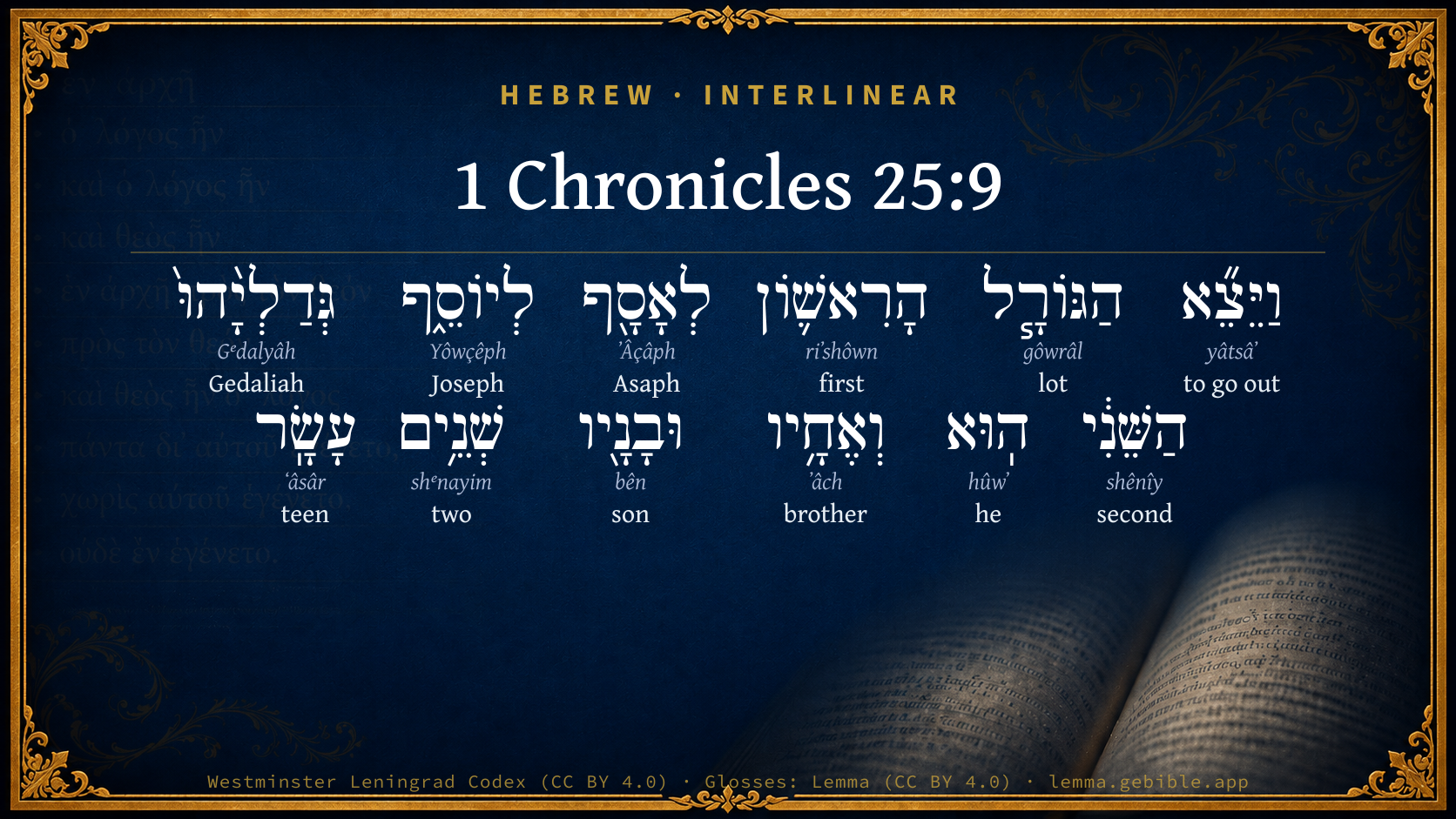
Hebrew (Westminster Leningrad Codex) 1 Chronicles 25:9 appears in the Hebrew Old Testament. The text above is from the Westminster Leningrad Codex. Each word links to its Strong’s number, a concise gloss, and parsing drawn from the Open Scriptures Hebrew Bible morphology. Click any word for its full Brown-Driver-Briggs (BDB) entry.
Download image
Cite this verse

1 Chronicles 25:9 (World English Bible). Public Domain. Lemma interlinear Bible study tool, https://lemma.gebible.app/v/1-chronicles/25/9.

Show BibTeX & RIS
BibTeX
RIS
English Translation
Now the first lot came forth for Asaph to Joseph: the second to Gedaliah; he and his brothers and sons were twelve:
World English Bible · Public Domain
Download a study sheet

One document with this verse’s original text, its word-by-word gloss line, the meaning frame, cross-references with their text, attributed commentary, and full source and license credits — printable, and it pastes into notes with its structure intact.

This verse Autodidact and up

Study sheet (.html) Plain text (.txt)

A passage Seminary Student

Up to 50 verses in one chapter. A passage sheet keeps up to 6 commentary sources and 12 cross-references per verse, in the order this page ranks them, and says so on the sheet whenever that leaves anything out. Ask for a single verse and you get the Autodidact verse sheet above.

Everything on this page stays free to read, with no account — the sheet is a download of what is already on screen, not access to it.

Want to remove ads? Support Godless Engineer
Compare translations 3

The same verse in 3 English versions, stacked beneath the original-language interlinear above. Click any original word for its lexicon entry.

Each is an independent rendering of the whole verse — the interlinear is not word-aligned to these translations.

Highlighted words mark where these versions differ — a whole-verse word diff, not a word-by-word alignment.

  • World English Bible Public Domain
    Now the first lot came forth for Asaph to Joseph: the second to Gedaliah; he and his brothers and sons were twelve:
  • King James Version Public Domain
    Now the first lot came forth for Asaph to Joseph: the second to Gedaliah, who with his brethren and sons were twelve:
  • unfoldingWord Literal Text CC BY-SA 4.0
    And the first lot came out for Asaph, for Joseph; the second, Gedaliah, him and his brothers and his sons, 12;

unfoldingWord Literal Text — © unfoldingWord, licensed CC BY-SA 4.0. Word-aligned USFM3 via Door43 (git.door43.org/unfoldingWord/en_ult).

Versions to compare (up to 4)

3 of 4 selected

Show all 18 translations

Every available English version of this verse, each an independent rendering of the whole verse.

  • World English Bible Public Domain
    Now the first lot came forth for Asaph to Joseph: the second to Gedaliah; he and his brothers and sons were twelve:
  • Berean Standard Bible Public Domain
    The first lot, which was for Asaph, fell to Joseph, his sons, and his brothers—12 in all; the second to Gedaliah, his sons, and his brothers—12 in all;
  • Majority Standard Bible Public Domain
    The first lot, which was for Asaph, fell to Joseph, his sons, and his brothers—12 in all; the second to Gedaliah, his sons, and his brothers—12 in all;
  • King James Version Public Domain
    Now the first lot came forth for Asaph to Joseph: the second to Gedaliah, who with his brethren and sons were twelve:
  • American Standard Version (1901) Public Domain
    Now the first lot came forth for Asaph to Joseph: the second to Gedaliah; he and his brethren and sons were twelve:
  • Revised Version (1885) Public Domain
    Now the first lot came forth for Asaph to Joseph: the second to Gedaliah; he and his brethren and sons were twelve:
  • Geneva Bible (1599) Public Domain
    And the first lot fell to Ioseph which was of Asaph, the second, to Gedaliah, who with his brethren and his sonnes were twelue.
  • Douay-Rheims (1899) Public Domain
    And the first lot came forth to Joseph, who was of Asaph. The second to Godolias, to him and his sons, and his brethren twelve.
  • Young's Literal Translation Public Domain
    And the first lot goeth out for Asaph to Joseph; `to' Gedaliah the second; he, and his brethren and his sons, twelve;
  • Literal Standard Version CC BY-SA 4.0
    And the first lot goes out for Asaph to Joseph; the second, Gedaliah—him, and his brothers and his sons—twelve;
  • Unlocked Literal Bible CC BY-SA 4.0
    Now regarding Asaph's sons: The first lot fell to Joseph's family; the second fell to Gedaliah's family, twelve persons in number;
  • unfoldingWord Literal Text CC BY-SA 4.0
    And the first lot came out for Asaph, for Joseph; the second, Gedaliah, him and his brothers and his sons, 12;
  • Darby Bible Public Domain
    And the first lot came forth for Asaph to Joseph; to Gedaliah the second: he and his brethren and his sons were twelve.
  • World Messianic Bible Public Domain
    Now the first lot came out for Asaph to Joseph; the second to Gedaliah, he and his brothers and sons were twelve;
  • Webster's Bible Public Domain
    Now the first lot came forth for Asaph to Joseph: the second to Gedaliah, who with his brethren and sons were twelve:
  • Free Bible Version CC BY-SA 4.0
    The first lot, which was for Asaph, fell to Joseph, his sons, and his brother, 12 in total. The second fell to Gedaliah, his sons, and his brothers, 12 in total.
  • Bible in Basic English Public Domain
    Now of the group of Asaph, the first name to come out was Joseph; the second Gedaliah; he and his brothers and sons were twelve?
  • JPS Tanakh (1917) Public Domain
    Now the first lot came forth for Asaph to Joseph; the second to Gedaliah; he and his brethren and sons were twelve;

Literal Standard Version (2020), Covenant Press — licensed CC BY-SA 4.0. Text via the HelloAO Bible API (eBible.org). Unlocked Literal Bible (unfoldingWord) — licensed CC BY-SA 4.0. Text via the HelloAO Bible API (eBible.org). unfoldingWord Literal Text — © unfoldingWord, licensed CC BY-SA 4.0. Word-aligned USFM3 via Door43 (git.door43.org/unfoldingWord/en_ult). Free Bible Version, Dr. Jonathan Gallagher — licensed CC BY-SA 4.0. Text via the HelloAO Bible API (eBible.org).

Word by word

More ways to search: Search by grammar → Find every occurrence → Compare this word →

Practice this passage: Drill this verse → Learn its vocabulary →

גְּדַלְיָ֨הוּ֙
Gᵉdalyâh
H1436
“Gedaliah”
Noun, Proper
Part of Speech
Noun
Type
Proper
Full BDB Definition

Origin: from H1431 and H3050

TWOT: None

Gedaliah = "Jehovah is great" - a son of Jeduthun in the time of David - son of Ahikam, the governor of Judea appointed by Nebuchadnezzar - son of Pashur, one of the chiefs of Jerusalem in the time of Jeremiah - son of Amariah and grandson of Hezekiah - a priest of the sons of Jeshua in the time of Ezra
  1. וַיֵּצֵ֞א yâtsâʼ H3318 “and · to go out” Conjunction + Verb, Qal, Sequential Imperfect, 3rd Person, Masculine, Singular
  2. הַגּוֹרָ֧ל gôwrâl H1486 “the · lot” Particle, Definite Article + Noun, Common, Masculine, Singular, Absolute
  3. הָרִאשׁ֛וֹן riʼshôwn H7223 “the · first” Particle, Definite Article + Adjective, Ordinal number, Masculine, Singular, Absolute
  4. לְאָסָ֖ף ʼÂçâph H623 “to/for · Asaph” Preposition + Noun, Proper
  5. לְיוֹסֵ֑ף Yôwçêph H3130 “to/for · Joseph” Preposition + Noun, Proper
  6. הַשֵּׁנִ֔י shênîy H8145 “the · second” Particle, Definite Article + Adjective, Ordinal number, Masculine, Singular, Absolute
  7. הֽוּא hûwʼ H1931 “he” Pronoun, Personal, 3rd Person, Masculine, Singular
  8. וְאֶחָ֥יו ʼâch H251 “and · brothers · his” Conjunction + Noun, Common, Masculine, Plural, Construct + Suffix, Personal, 3rd Person, Masculine, Singular
  9. וּבָנָ֖יו bên H1121 “and · sons · his” Conjunction + Noun, Common, Masculine, Plural, Construct + Suffix, Personal, 3rd Person, Masculine, Singular
  10. שְׁנֵ֥ים shᵉnayim H8147 “two” Adjective, Cardinal number, Masculine, Dual, Absolute
  11. עָשָֽׂר ʻâsâr H6240 “teen” Adjective, Cardinal number, Masculine, Singular, Absolute

About this verse

These counts appear in no published source. They are computed here, from the morphology-tagged text and Lemma’s own curated glosses. What Lemma adds →

12
words
12
distinct lemmas
Historical
section

Shared distinctive vocabulary

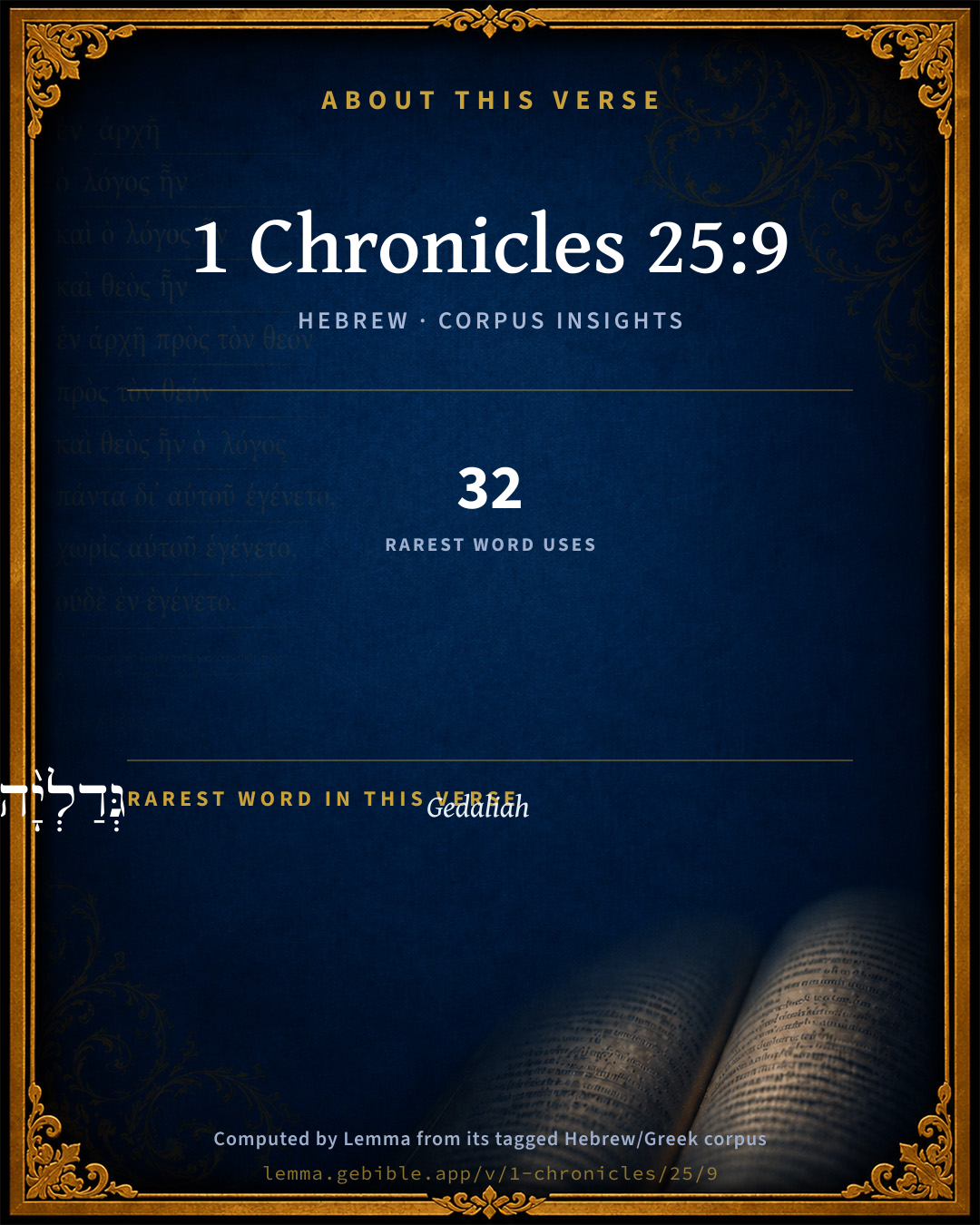
גְּדַלְיָ֨הוּ֙ Gedaliah H1436 occurs in 31 verses of the Hebrew Bible. Also found in:

Grammatical profile

  • 1 verb
  • 6 nouns
  • 4 adjectives
  • 1 pronoun

Verb forms

  • וַיֵּצֵ֞א Qal · Sequential Imperfect

Hebrew & Septuagint length

In English translation the verse runs 22 words from the Hebrew and 31 from the Septuagint (LXX English) — the Septuagint runs noticeably longer here. See the side-by-side →

A rough comparison of the two English renderings, which tokenize alike — not a word-level alignment.

Word counts can differ between the Hebrew and the Greek without any difference in meaning — e.g. the Hebrew direct-object marker אֵת has no separate Greek word, and Greek often adds the article ὁ.

Hebrew and Greek witnesses Masoretic Hebrew ↔ Greek Septuagint

The same verse in the two great witnesses to the Old Testament, shown verse-for-verse.

Here the Septuagint runs noticeably longer than the Hebrew — LXX2012 (modern English Septuagint) 31 words vs World English Bible 22. A rough length comparison of the two English translations, not a word-level alignment — read both below.

These are two independent witnesses, not word-aligned to each other, and the Septuagint is shown in lemma (dictionary) form.

Hebrew 1 Chronicles 25:9 Masoretic · Westminster Leningrad Codex

וַיֵּצֵ֞א הַגּוֹרָ֧ל הָרִאשׁ֛וֹן לְאָסָ֖ף לְיוֹסֵ֑ף גְּדַלְיָ֨הוּ֙ הַשֵּׁנִ֔י הֽוּא וְאֶחָ֥יו וּבָנָ֖יו שְׁנֵ֥ים עָשָֽׂר

Now the first lot came forth for Asaph to Joseph: the second to Gedaliah; he and his brothers and sons were twelve:

World English Bible · Public Domain

Greek LXX 1 Chronicles 25:9 Septuagint · lemma form

καί ἐκἔρχομαι ὁ κλῆρος ὁ πρῶτος υἱός αὐτός καί ἀδελφός αὐτός ὁ ασαφ ὁ ιωσηφ γοδολια ὁ δεύτερος ηνια ἀδελφός αὐτός καί υἱός αὐτός δέκα δύο

And the first lot of his sons and of his brethren came forth to Asaph the son of Joseph, namely, Godolias: the second Heneia, his sons and his brethren being twelve.

LXX2012 (modern English Septuagint) · Public Domain

On this verse, Haydock's Catholic Bible Commentary discusses the Septuagint’s reading. Read the note in Commentary ↓

Hebrew: Westminster Leningrad Codex (CC BY 4.0). Greek: Septuagint (public domain); English from LXX2012 (modern English Septuagint) (Public Domain). How the Septuagint differs from the Hebrew →

Commentary

Notes on 1 Chronicles 25:9 from classic Christian and Jewish commentators (each source and its license shown beneath its notes). The classic Christian expositions comment on the surrounding passage and are grouped to its opening verse, so a note may address several verses; the Jewish commentaries on the Tanakh (Rashi and others) are per-verse, so they appear only where the commentator wrote on this verse.

Lemma curates 59 commentaries, every one of them public domain or Creative Commons licensed, each selected and text-cleaned for this edition rather than reprinted as found. About our sources →

The Cambridge Bible for Schools and Colleges

gen. ed. J. J. S. Perowne

9. for Asaph] A comparison of 1Ch_25:9-31 with 1Ch_25:2-4 shews that the first, third, fifth and seventh lots fell to Asaph, the second, fourth, eighth, tenth, twelfth and fourteenth to Jeduthun, and the rest (fourteen in number) to Heman.

The Cambridge Bible for Schools and Colleges (gen. ed. J. J. S. Perowne; Cambridge University Press, 1878–1918) — public domain. Text from a community e-Sword module.

Joseph Benson's Commentary

1Ch 25:9. To Joseph — For the family of Asaph, of which Joseph was. Here that clause, he, his sons, and his brethren were twelve, is to be understood as it is expressed in all the following verses, otherwise they do not make up that number of two hundred and eighty-eight, mentioned 1Ch 25:7.

Joseph Benson's Commentary on the Old and New Testaments (1811–1818) — public domain. Text from a community e-Sword module.

Geneva Bible (1599)

Geneva Bible translators

So that he served in the first turn, and the rest everyone as his turn followed orderly.

Geneva Bible (1599) marginal notes — public domain. Text via Bolls.life.

Adam Clarke's Commentary

Verse 9. For Asaph to Joseph] His first-born.

The second to Gedaliah] The first-born of Jeduthun.

Adam Clarke's Commentary on the Bible (1810–1826) — public domain. Text from a community e-Sword/MySword module.

Ellicott's Commentary for English Readers

(9) Now the first lot came forth for Asaph to Joseph.—See 1Ch_25:2, according to which Joseph was the second “son” of Asaph. Although not stated in the text, it must have been true of Joseph as of all the following heads, that “he, and his sons and his brethren were twelve.” The specified total of 288 (1Ch_25:7) requires it.

The second to Gedaliah, who with his brethren and sons were twelve.—Rather, Gedaliah was the second, he and his brethren and his sons—twelve. The “brethren” and “sons” of the chiefs, in this and the following verses, are the eleven masters, or proficients, in each class.

Brethren.—Fellow-clansmen, or associates.

Sons.—Disciples, or subordinates.

Perhaps, however, we should think of elder and younger families, grouped together in one class.

A Bible Commentary for English Readers, edited by Charles John Ellicott (1878–1897) — public domain. Text from a community e-Sword module.

John Gill's Exposition

Now the first lot came forth for Asaph to Joseph,.... His second son to the preference of the firstborn, Ch1 25:2,

the second to Gedaliah, who with his brethren and sons were twelve: and which must also be understood of Joseph, and supplied to him; for those being both in one verse, as Jarchi observes, it is but once mentioned, but must be supplied, or otherwise the number of two hundred and eighty eight could not be made up; the same is observed of all the other lots and courses to the end of the chapter as here, and therefore need no more remarks.

Next: 1 Chronicles Chapter 26

John Gill's Exposition of the Whole Bible (1746–1763) — public domain (CC PDM 1.0). Text via the HelloAO Bible API.

Haydock's Catholic Bible Commentary

Asaph. Add, "to him, and (Haydock) to his sons, and his brethren, twelve," who taught the rest. Unless these twelve be admitted, (Tirinus) as in the sequel, (Haydock) the number 288 will not be found, ver. 7. (Tirinus) --- Septuagint is very confused: "And the first (entire) lot of his sons and brethren came out to Asaph, of Joseph, Godolias: the second Enia, his brethren, and his sons, twelve." Hebrew, "the first lot came forth for Asaph to Joseph; the second to," &c. (Protestants) In all the subsequent verses they read, "he, his sons, and his brethren, were twelve." Why Asaph should be mentioned any more than Idithun or Heman, does not appear. Their children are placed indiscriminately by lot. (Haydock)

George Leo Haydock (1774–1849), Haydock's Catholic Family Bible and Commentary, 1859 edition — public domain. Excludes Psalms (Douay-Rheims chapter numbering differs from Protestant) and Deuterocanonical books (Catholic canon only).

Matthew Poole's English Annotations

For Asaph to Joseph, i.e. for the family of Asaph, of which Joseph was. Here that clause, he, his sons, and his brethren, were twelve, is to be understood, as it is expressed in all the following verses, otherwise they do not make up that number of two hundred and eighty-eight mentioned 1Ch 25:7.

To Gedaliah, who, Heb. he; which word being here expressed, is rightly understood and supplied in the rest.

Matthew Poole's English Annotations on the Holy Bible (1683–1685) — public domain. Text from a community e-Sword/MySword module.

The Pulpit Commentary

Vers. 9-31. List of the choirs in the order in which their lots came. The formula, his sons, and his brethren, which follows twenty-two out of the twenty-four leaders" names which now come before us, is absent from ver. 9, where we should have looked for it, viz. after the name Joseph. It has been supposed that this is a mere omission of carelessness. But this can scarcely be asserted conclusively. It is observable, for instance, that the order of the formula in the same verse, on occasion of its very first occurrence, is not identical with the other twenty-two instances of it, the word "brethren" preceding "sons," and the pronoun "he" being expressed. The preposition (l) is sometimes expressed and sometimes not expressed before both the proper names and the ordinal numerals of the list. Examination of the contents of these verses shows, either that it was due to the Divine direction of the lot (Pro_16:33) that an issue resulted which looks so unlike mere chance, and the system of which is so methodical and traceable; or that the lot-taking was not one of families and sons, all thrown together from the first. This supposition would, of course, leave room for some such ingenious hypothesis as that of Berthean, too artificial by far to be defensible except as a theory that would indeed work out the result. He suggests that the modus operandi was by two urns, one for the first seven odd numbers, into which were put the names of Asaph"s four sons and of the second, third, and fourth of Heman; the other for the first seven even numbers, into which were put the six sons of Jeduthun and the first of Heman. Turning from such a concocted theory to these verses, we find that the first cast brings to the surface the second son of Asaph, and the second cast brings up the eldest son of Jeduthun. At the end of the seventh all of Asaph"s sons are exhausted, and what would have been his next place (the ninth) is occupied by the second son of Heman, whose eldest had just taken the sixth place so thrown out by the lot. At the end of the fourteenth throw Jeduthun"s six sons are all used up, and all the remaining places belong to Heman"s sons, but still in the order in which they are thrown out by the lot.

The Pulpit Commentary (1880–1919), ed. H.D.M. Spence-Jones & Joseph S. Exell — public domain. Text from a community e-Sword module.

John Wesley's Explanatory Notes

To Joseph - For the family of Asaph, of which Joseph was. Here that clause, he, his sons, and his brethren were twelve, is to be understood, as it is expressed in all the following verses, otherwise they do not make up that number of two hundred and eighty-eight mentioned ver. 7.

John Wesley, Explanatory Notes Upon the Whole Bible (1754–1765) — public domain. Text via the GEBible commentary corpus.

Keil & Delitzsch

C. F. Keil & F. Delitzsch

Now the first lot came forth for Asaph to Joseph,.... His second son to the preference of the firstborn, Ch1 25:2,

the second to Gedaliah, who with his brethren and sons were twelve: and which must also be understood of Joseph, and supplied to him; for those being both in one verse, as Jarchi observes, it is but once mentioned, but must be supplied, or otherwise the number of two hundred and eighty eight could not be made up; the same is observed of all the other lots and courses to the end of the chapter as here, and therefore need no more remarks.

Next: 1 Chronicles Chapter 26

Keil & Delitzsch — Biblical Commentary on the Old Testament (1861–1891) — public domain (CC PDM 1.0). Text via the HelloAO Bible API. (Old Testament only.)

unfoldingWord translationNotes

Door43 World Missions Community

General Information:

This begins the list of 24 lots that were cast to choose the order in which families would serve. This list ends in 1 Chronicles 25:31.

The first lot ... the second ... the third ... the fourth ... the fifth

"Lot number 1 ... lot number 2 ... lot number 3 ... lot number 4 ... lot number 5." This shows the order in which the families were chosen by lots. If this is unnatural in your language you may use "The initial" for "The first" and "the next" for all of the following ones. (See: Ordinal Numbers)

The first lot fell to Joseph's family

For all of the other people in the list, the text specifies that there were "twelve persons in number." Since this was true for Joseph's family too, you may want to state it clearly. AT: "The first lot fell to Joseph's family, twelve persons in number" (See: Assumed Knowledge and Implicit Information)

Joseph ... Zaccur ... Nethaniah

See how you translated the names of these men in 1 Chronicles 25:2. (See: How to Translate Names)

the second fell to

This refers to the second lot. The word "lot" may be stated clearly here and in the phrases concerning the rest of the lots. AT: "the second lot fell to" (See: Ellipsis)

Gedaliah

See how you translated this man's name in 1 Chronicles 25:3. (See: How to Translate Names)

twelve persons

"12 people" (See: Numbers)

Izri

This name is spelled Zeri in 1 Chronicles 25:3. (See: How to Translate Names)

unfoldingWord translationNotes — © Distant Shores Media and the Door43 World Missions Community, licensed CC BY-SA 4.0. Source: git.door43.org/Door43/en_tn.

Rashi

Rabbi Shlomo Yitzchaki (Rashi)

And the first lot of Asaph came out to Joseph his first son.

Gedaliah the second Gedaliah was the firstborn of Jeduthun.

he and his brethren and his sons, twelve The meaning is that for every watch twelve Levites would come, for all of them equalled two hundred and eighty-eight, and if you divide them into twenty-four parts, each part will consist of twelve Levites. So it appears to me. And this is the meaning of “and his brethren and his sons”: referring to Joseph and to Gedaliah. And since they are both mentioned in one verse, he wrote only once, “he and his sons and his brethren.” And not every “his brethren,” and “their brethren” in this context mean his actual brothers; but he calls one group brethren (in German, Bruderschaft).

Rashi on the Tanakh — English translations: “The Judaica Press complete Tanach with Rashi, translated by A. J. Rosenberg” (CC BY 4.0); “Pentateuch with Rashi's commentary by M. Rosenbaum and A.M. Silbermann, 1929-1934” (public domain); “The Metsudah Tanach series, Lakewood, N.J” (CC BY 4.0); and “The Book of Joshua, Metsudah Publications, 1997” (CC BY 4.0). Text via Sefaria.

Lesson kit

Teaching starters — assembled from the data on this page, not authored interpretation. Every prompt links to the verse data it draws on. Edit before teaching.

1 Chronicles, in the Historical, opens this verse with 12 words (12 distinct Hebrew lemmas). Its most distinctive word is Gᵉdalyâh (“Gedaliah”). The Greek Septuagint runs longer here. A historical commentator’s framing appears above. Read the whole chapter for the surrounding context.

Discussion questions

  1. What does “Gedaliah” (Gᵉdalyâh) contribute to the verse as a whole?
  2. How does 2 Kings 25:22, which shares the word «Gedaliah», read alongside this verse?
  3. The Septuagint runs longer here than the Hebrew. What might account for the difference?
  4. These translations render this verse differently; the difference is in the English rendering, not the original. What questions does that raise?
  5. «וַיֵּצֵ֞א» is a Qal Sequential Imperfect verb. How does that grammatical form shape the action described?
  6. Compare how The Cambridge Bible for Schools and Colleges and Joseph Benson's Commentary read this verse. Where do they agree or differ?

Things to notice

Reading settings

Reading text

Shown beneath each verse's original-language words.

Old Testament
Old Testament edition

Read the OT as the Masoretic Hebrew (MT) or the Greek Septuagint (LXX).

English shown for the Greek Septuagint (in the Hebrew ↔ Greek comparison).

Comparing translations? Open the Compare panel on any verse page to stack up to four side by side.