
Ezekiel 24:6

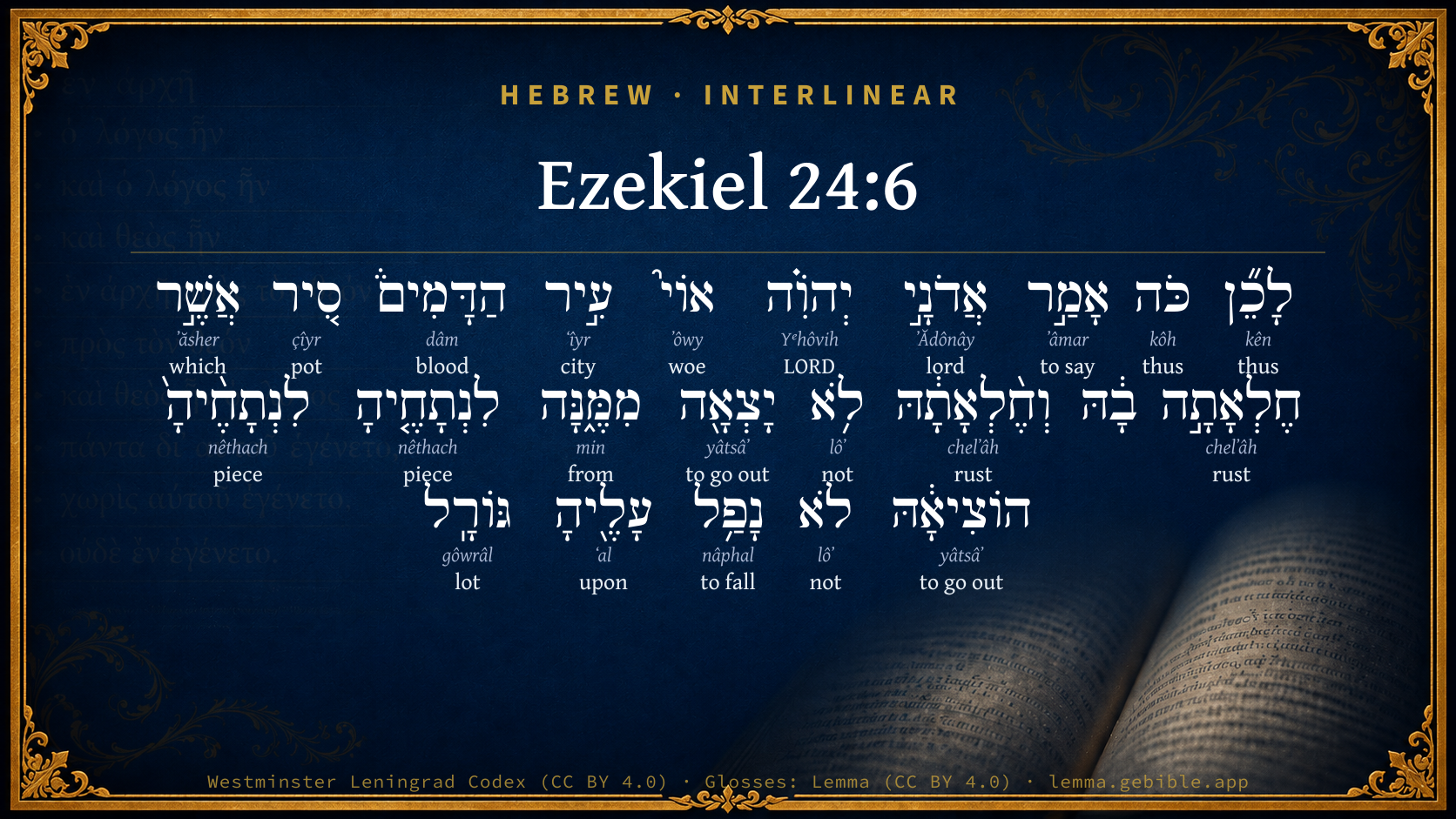
Hebrew (Westminster Leningrad Codex) Ezekiel 24:6 appears in the Hebrew Old Testament. The text above is from the Westminster Leningrad Codex. Each word links to its Strong’s number, a concise gloss, and parsing drawn from the Open Scriptures Hebrew Bible morphology. Click any word for its full Brown-Driver-Briggs (BDB) entry.
Download image
Cite this verse

Ezekiel 24:6 (World English Bible). Public Domain. Lemma interlinear Bible study tool, https://lemma.gebible.app/v/ezekiel/24/6.

Show BibTeX & RIS
BibTeX
RIS
English Translation
Therefore thus says the Lord Yahweh: Woe to the bloody city, to the caldron whose rust is therein, and whose rust is not gone out of it! take out of it piece after piece; No lot is fallen on it.
World English Bible · Public Domain
Highlights
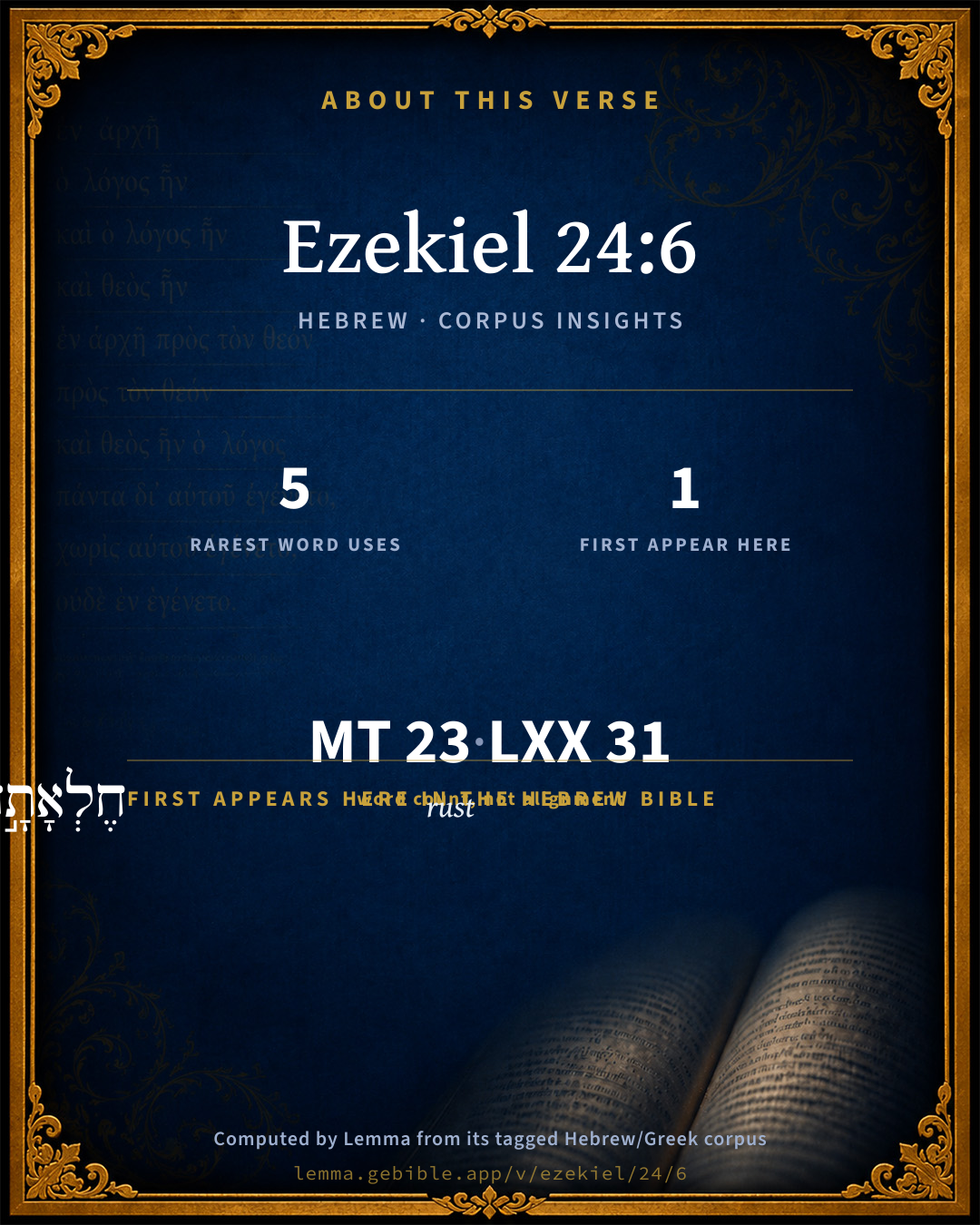
  • 1 first appearance in the Hebrew Bible
Full analysis ↓
Download a study sheet

One document with this verse’s original text, its word-by-word gloss line, the meaning frame, cross-references with their text, attributed commentary, and full source and license credits — printable, and it pastes into notes with its structure intact.

This verse Autodidact and up

Study sheet (.html) Plain text (.txt)

A passage Seminary Student

Up to 50 verses in one chapter. A passage sheet keeps up to 6 commentary sources and 12 cross-references per verse, in the order this page ranks them, and says so on the sheet whenever that leaves anything out. Ask for a single verse and you get the Autodidact verse sheet above.

Everything on this page stays free to read, with no account — the sheet is a download of what is already on screen, not access to it.

Want to remove ads? Support Godless Engineer
Compare translations 3

The same verse in 3 English versions, stacked beneath the original-language interlinear above. Click any original word for its lexicon entry.

Each is an independent rendering of the whole verse — the interlinear is not word-aligned to these translations.

Highlighted words mark where these versions differ — a whole-verse word diff, not a word-by-word alignment.

  • World English Bible Public Domain
    Therefore thus says the Lord Yahweh: Woe to the bloody city, to the caldron whose rust is therein, and whose rust is not gone out of it! take out of it piece after piece; No lot is fallen on it.
  • King James Version Public Domain
    Wherefore thus saith the Lord GOD; Woe to the bloody city, to the pot whose scum is therein, and whose scum is not gone out of it! bring it out piece by piece; let no lot fall upon it.
  • unfoldingWord Literal Text CC BY-SA 4.0
    Therefore the Lord Yahweh says this: Woe to the city of blood, a cooking pot that has rust in it and that rust will not come out of it. Take piece after piece from it, but do not cast lots for it.

unfoldingWord Literal Text — © unfoldingWord, licensed CC BY-SA 4.0. Word-aligned USFM3 via Door43 (git.door43.org/unfoldingWord/en_ult).

Versions to compare (up to 4)

3 of 4 selected

Show all 18 translations

Every available English version of this verse, each an independent rendering of the whole verse.

  • World English Bible Public Domain
    Therefore thus says the Lord Yahweh: Woe to the bloody city, to the caldron whose rust is therein, and whose rust is not gone out of it! take out of it piece after piece; No lot is fallen on it.
  • Berean Standard Bible Public Domain
    Therefore this is what the Lord GOD says: ‘Woe to the city of bloodshed, to the pot now rusted, whose rust will not come off! Empty it piece by piece; cast no lots for its contents.
  • Majority Standard Bible Public Domain
    Therefore this is what the Lord GOD says: ‘Woe to the city of bloodshed, to the pot now rusted, whose rust will not come off! Empty it piece by piece; cast no lots for its contents.
  • King James Version Public Domain
    Wherefore thus saith the Lord GOD; Woe to the bloody city, to the pot whose scum is therein, and whose scum is not gone out of it! bring it out piece by piece; let no lot fall upon it.
  • American Standard Version (1901) Public Domain
    Wherefore thus saith the Lord Jehovah: Woe to the bloody city, to the caldron whose rust is therein, and whose rust is not gone out of it! take out of it piece after piece; No lot is fallen upon it.
  • Revised Version (1885) Public Domain
    Wherefore thus saith the Lord GOD: Woe to the bloody city, to the caldron whose rust is therein, and whose rust is not gone out of it! bring it out piece by piece; no lot is fallen upon it.
  • Geneva Bible (1599) Public Domain
    Because the Lord God sayth thus, Woe to the bloody citie, euen to the pot, whose skomme is therein, and whose skomme is not gone out of it: bring it out piece by piece: let no lot fall vpon it.
  • Douay-Rheims (1899) Public Domain
    Therefore thus saith the Lord God: Woe to the bloody city, to the pot whose rust is in it, and its rust is not gone out of it: cast it out piece by piece, there hath no lot fallen upon it.
  • Young's Literal Translation Public Domain
    Therefore, thus said the Lord Jehovah: Wo `to' the city of blood, A pot whose scum `is' in it, And its scum hath not come out of it, By piece of it, by piece of it bring it out, Not fallen on it hath a lot.
  • Literal Standard Version CC BY-SA 4.0
    Therefore, thus said Lord YHWH: Woe [to] the city of blood, || A pot whose scum [is] in it, || And its scum has not come out of it, || By piece of it, by piece of it bring it out, a lot has not fallen on it.
  • Unlocked Literal Bible CC BY-SA 4.0
    Therefore the Lord Yahweh says this: Woe to the city of blood, a cooking pot that has rust in it and that rust will not come out of it. Take piece after piece from it, but do not cast lots for it.
  • unfoldingWord Literal Text CC BY-SA 4.0
    Therefore the Lord Yahweh says this: Woe to the city of blood, a cooking pot that has rust in it and that rust will not come out of it. Take piece after piece from it, but do not cast lots for it.
  • Darby Bible Public Domain
    Therefore thus saith the Lord Jehovah: Woe to the bloody city, to the pot whose rust is therein, and whose rust is not gone out of it! Bring it out piece by piece; let no lot fall upon it:
  • World Messianic Bible Public Domain
    “‘Therefore the Lord GOD says: “Woe to the bloody city, to the cauldron whose rust is in it, and whose rust hasn’t gone out of it! Take out of it piece after piece without casting lots for it.
  • Webster's Bible Public Domain
    Wherefore thus saith the Lord GOD; Woe to the bloody city, to the pot whose scum is therein, and whose scum is not gone out of it! bring it out piece by piece; let no lot fall upon it.
  • Free Bible Version CC BY-SA 4.0
    So this is what the Lord God says: Disaster is coming to the city that has shed so much blood! It is symbolized by the rusted pot, whose rust can't be cleaned off. Take out the meat bit by bit as it comes—don't choose which piece.
  • Bible in Basic English Public Domain
    For this is what the Lord has said: A curse is on the town of blood, the cooking-pot which is unclean inside, which has never been made clean! take out its bits; its fate is still to come on it.
  • JPS Tanakh (1917) Public Domain
    Wherefore thus saith the Lord GOD: Woe to the bloody city, to the pot whose filth is therein, and whose filth is not gone out of it! bring it out piece by piece; no lot is fallen upon it.

Literal Standard Version (2020), Covenant Press — licensed CC BY-SA 4.0. Text via the HelloAO Bible API (eBible.org). Unlocked Literal Bible (unfoldingWord) — licensed CC BY-SA 4.0. Text via the HelloAO Bible API (eBible.org). unfoldingWord Literal Text — © unfoldingWord, licensed CC BY-SA 4.0. Word-aligned USFM3 via Door43 (git.door43.org/unfoldingWord/en_ult). Free Bible Version, Dr. Jonathan Gallagher — licensed CC BY-SA 4.0. Text via the HelloAO Bible API (eBible.org).

Word by word

More ways to search: Search by grammar → Find every occurrence → Compare this word →

Practice this passage: Drill this verse → Learn its vocabulary →

חֶלְאָתָ֣ה
chelʼâh
H2457
“rust · her”
Noun, Common, Feminine, Singular, Construct + Suffix, Personal, 3rd Person, Feminine, Singular
Part of Speech
Noun
Type
Common
Gender
Feminine
Number
Singular
State
Construct
Full BDB Definition

Origin: from H2456

TWOT: 649a

rust, scum
  1. לָכֵ֞ן kên H3651 “to/for · thus” Preposition + Adverb
  2. כֹּה kôh H3541 “thus” Adverb
  3. אָמַ֣ר ʼâmar H559 “to say” Verb, Qal, Perfect, 3rd Person, Masculine, Singular
  4. אֲדֹנָ֣י ʼĂdônây H136 “Lord · my” Noun, Common, Masculine, Plural, Construct + Suffix, Personal, 1st Person, Common, Singular
  5. יְהֹוִ֗ה Yᵉhôvih H3069 “LORD” Noun, Proper
  6. אוֹי֮ ʼôwy H188 “woe” Particle, Interjection
  7. עִ֣יר ʻîyr H5892 “city of” Noun, Common, Feminine, Singular, Construct
  8. הַדָּמִים֒ dâm H1818 “the · blood” Particle, Definite Article + Noun, Common, Masculine, Plural, Absolute
  9. סִ֚יר çîyr H5518 “pot” Noun, Common, Both, Singular, Absolute
  10. אֲשֶׁ֣ר ʼăsher H834 “which” Particle, Relative
  11. וְחֶ֨לְאָתָ֔הּ chelʼâh H2457 “and · rust · her” Conjunction + Noun, Common, Feminine, Singular, Construct + Suffix, Personal, 3rd Person, Feminine, Singular
  12. לֹ֥א lôʼ H3808 “not” Particle, Negative
  13. יָצְאָ֖ה yâtsâʼ H3318 “to go out” Verb, Qal, Perfect, 3rd Person, Feminine, Singular
  14. מִמֶּ֑נָּה min H4480 “from · her” Preposition + Suffix, Personal, 3rd Person, Feminine, Singular
  15. לִנְתָחֶ֤יהָ nêthach H5409 “to/for · pieces · her” Preposition + Noun, Common, Masculine, Plural, Construct + Suffix, Personal, 3rd Person, Feminine, Singular
  16. לִנְתָחֶ֨יהָ֙ nêthach H5409 “to/for · pieces · her” Preposition + Noun, Common, Masculine, Plural, Construct + Suffix, Personal, 3rd Person, Feminine, Singular
  17. הוֹצִיאָ֔הּ yâtsâʼ H3318 “go out · her” Verb, Hiphil, Imperative, 2nd Person, Masculine, Singular + Suffix, Personal, 3rd Person, Feminine, Singular
  18. לֹא lôʼ H3808 “not” Particle, Negative
  19. נָפַ֥ל nâphal H5307 “to fall” Verb, Qal, Perfect, 3rd Person, Masculine, Singular
  20. עָלֶ֖יהָ ʻal H5921 “upon · her” Preposition + Suffix, Personal, 3rd Person, Feminine, Singular
  21. גּוֹרָֽל gôwrâl H1486 “lot” Noun, Common, Masculine, Singular, Absolute

About this verse

These counts appear in no published source. They are computed here, from the morphology-tagged text and Lemma’s own curated glosses. What Lemma adds →

23
words
18
distinct lemmas
Prophets
section

Notable vocabulary

The rarest word here is חֶלְאָתָ֣ה rust H2457 — appearing just 5 times in the whole Hebrew Bible.

First appearance in Scripture

This word makes its first canonical appearance in the Hebrew Bible here:

  • חֶלְאָתָ֣ה rust H2457

Shared distinctive vocabulary

חֶלְאָתָ֣ה rust H2457 occurs in 3 verses of the Hebrew Bible. Also found in:

Grammatical profile

  • 4 verbs
  • 10 nouns
  • 3 prepositions
  • 2 adverbs
  • 4 particles

Verb forms

  • אָמַ֣ר Qal · Perfect
  • יָצְאָ֖ה Qal · Perfect
  • הוֹצִיאָ֔הּ Hiphil · Imperative
  • נָפַ֥ל Qal · Perfect

Repetition

Words recur within this verse — often emphatic in Hebrew:

  • חֶלְאָתָ֣ה rust H2457 ×2
  • יָצְאָ֖ה to go out H3318 ×2
  • לִנְתָחֶ֤יהָ piece H5409 ×2
  • לֹ֥א not H3808 ×2

Hebrew & Septuagint length

In English translation the verse runs 40 words from the Hebrew and 37 from the Septuagint (LXX English) — closely comparable.

A rough comparison of the two English renderings, which tokenize alike — not a word-level alignment.

Word counts can differ between the Hebrew and the Greek without any difference in meaning — e.g. the Hebrew direct-object marker אֵת has no separate Greek word, and Greek often adds the article ὁ.

In the original languages it is 23 Hebrew tokens and 31 Greek tokens — but the two are counted differently (Hebrew bundles its prefixes and suffixes into one token; the Greek is in lemma form), so that isn’t a like-for-like length.

Cross-references

27

Topical passages linked to Ezekiel 24:6 in the Treasury of Scripture Knowledge — connected by theme and wording, ordered by reader-vote popularity; previews shown in the World English Bible.

  • Ezekiel 22:2 You, son of man, will you judge, will you judge the bloody city? then cause her to know all her abominations.
  • Nahum 3:1 Woe to the bloody city! It is all full of lies and robbery. The prey doesn't depart.
  • 2 Kings 24:4 and also for the innocent blood that he shed; for he filled Jerusalem with innocent blood: and Yahweh would not pardon.
  • Ezekiel 22:27 Her princes in the midst of it are like wolves ravening the prey, to shed blood, [and] to destroy souls, that they may get dishonest gain.
  • Obadiah 1:11 In the day that you stood on the other side, in the day that strangers carried away his substance, and foreigners entered into his gates, and cast lots for Jerusalem, even you were like one of them.
  • Micah 7:2 The godly man has perished out of the earth, And there is no one upright among men. They all lie in wait for blood; Every man hunts his brother with a net.
  • Nahum 3:10 Yet was she carried away. She went into captivity. Her young children also were dashed in pieces at the head of all the streets, and they cast lots for her honorable men, and all her great men were bound in chains.
  • Joshua 7:16–18 So Joshua rose up early in the morning, and brought Israel near by their tribes; and the tribe of Judah was taken:
  • Joshua 10:22 Then said Joshua, Open the mouth of the cave, and bring forth those five kings to me out of the cave.
  • 1 Samuel 14:40–42 Then said he to all Israel, Be you on one side, and I and Jonathan my son will be on the other side. The people said to Saul, Do what seems good to you.
  • 2 Samuel 8:2 He struck Moab, and measured them with the line, making them to lie down on the ground; and he measured two lines to put to death, and one full line to keep alive. The Moabites became servants to David, and brought tribute.
  • 2 Kings 21:16 Moreover Manasseh shed innocent blood very much, until he had filled Jerusalem from one end to another; besides his sin with which he made Judah to sin, in doing that which was evil in the sight of Yahweh.
  • Jeremiah 6:29 The bellows blow fiercely; the lead is consumed of the fire: in vain do they go on refining; for the wicked are not plucked away.
  • Ezekiel 9:5–6 To the others he said in my hearing, Go you through the city after him, and strike: don't let your eye spare, neither have you pity;
  • Ezekiel 11:6–9 You have multiplied your slain in this city, and you have filled the streets of it with the slain.
  • Ezekiel 11:11 This [city] shall not be your caldron, neither shall you be the flesh in the midst of it; I will judge you in the border of Israel;
  • Ezekiel 22:6–9 Behold, the princes of Israel, everyone according to his power, have been in you to shed blood.
  • Ezekiel 22:12 In you have they taken bribes to shed blood; you have taken interest and increase, and you have greedily gained of your neighbors by oppression, and have forgotten me, says the Lord Yahweh.
  • Ezekiel 23:37–45 For they have committed adultery, and blood is in their hands; and with their idols have they committed adultery; and they have also caused their sons, whom they bore to me, to pass through [the fire] to them to be devoured.
  • Ezekiel 24:9 Therefore thus says the Lord Yahweh: Woe to the bloody city! I also will make the pile great.
  • Ezekiel 24:11–13 Then set it empty on the coals of it, that it may be hot, and the brass of it may burn, and that the filthiness of it may be molten in it, that the rust of it may be consumed.
  • Joel 3:3 And have cast lots for my people, And have given a boy for a prostitute, And sold a girl for wine, that they may drink.
  • Jonah 1:7 They all said to each other, "Come, let us cast lots, that we may know for whose cause this evil is on us." So they cast lots, and the lot fell on Jonah.
  • Matthew 23:35 that on you may come all the righteous blood shed on the earth, from the blood of righteous Abel to the blood of Zachariah son of Barachiah, whom you killed between the sanctuary and the altar.
  • Revelation 11:7–8 When they have finished their testimony, the beast that comes up out of the abyss will make war with them, and overcome them, and kill them.
  • Revelation 17:6 I saw the woman drunken with the blood of the saints, and with the blood of the martyrs of Jesus. When I saw her, I wondered with great amazement.
  • Revelation 18:24 In her was found the blood of prophets and of saints, and of all who have been slain on the earth."

Cross-references courtesy of OpenBible.info (CC BY 4.0).

Hebrew and Greek witnesses Masoretic Hebrew ↔ Greek Septuagint

The same verse in the two great witnesses to the Old Testament, shown verse-for-verse.

These are two independent witnesses, not word-aligned to each other, and the Septuagint is shown in lemma (dictionary) form.

Hebrew Ezekiel 24:6 Masoretic · Westminster Leningrad Codex

לָכֵ֞ן כֹּה אָמַ֣ר אֲדֹנָ֣י יְהֹוִ֗ה אוֹי֮ עִ֣יר הַדָּמִים֒ סִ֚יר אֲשֶׁ֣ר חֶלְאָתָ֣ה בָ֔הּ וְחֶ֨לְאָתָ֔הּ לֹ֥א יָצְאָ֖ה מִמֶּ֑נָּה לִנְתָחֶ֤יהָ לִנְתָחֶ֨יהָ֙ הוֹצִיאָ֔הּ לֹא נָפַ֥ל עָלֶ֖יהָ גּוֹרָֽל

Therefore thus says the Lord Yahweh: Woe to the bloody city, to the caldron whose rust is therein, and whose rust is not gone out of it! take out of it piece after piece; No lot is fallen on it.

World English Bible · Public Domain

Greek LXX Ezekiel 24:6 Septuagint · lemma form

διά οὗτος ὅδε λέγω κύριος ὦ πόλις αἷμα λέβης ἐν ὅς εἰμί ἰός ἐν αὐτός καί ὁ ἰός οὐ ἐκἔρχομαι ἐκ αὐτός κατά μέλος αὐτός ἐκφέρω οὐ πίπτω ἐπί αὐτός κλῆρος

Therefore thus says the Lord; O bloody city, the caldron in which there is scum, and the scum has not gone out of, she has brought it forth piece by piece, no lot has fallen upon it.

LXX2012 (modern English Septuagint) · Public Domain

Hebrew: Westminster Leningrad Codex (CC BY 4.0). Greek: Septuagint (public domain); English from LXX2012 (modern English Septuagint) (Public Domain). How the Septuagint differs from the Hebrew →

Targum (Aramaic paraphrase)

1

The Targum is the ancient Jewish Aramaic paraphrase of the Hebrew Scriptures — an interpretive translation, not the Hebrew text itself. Onkelos (literal) and Pseudo-Jonathan (expansive) render the Torah, and Jonathan the Prophets. Coverage is partial: where no permissively-licensed English translation exists for a verse, only the Aramaic is shown. This is verse-level text, not a word-by-word alignment to the Hebrew.

  1. Targum Jonathan Prophets (Joshua–Malachi)
    בְּכֵן כִּדְנַן אֲמַר יְיָ אֱלֹהִים וַי עַל קַרְתָּא דְאָשְׁדֵי דָם זַכַּאי בְּגַוָהּ דְהִיא כְדוּדָא דְזִיהוּמְתֵּיהּ בֵּיהּ וְזִיהוּמְתֵּיהּ לָא נַפְקַת מִנֵיהּ גָלוּ עַל גָלוּ אִתַּפֵּק עַמָא מִדְלָא יִתְעֲבֵיר בָּהּ תִּיוּבָא:

    (no public-domain English translation for this verse)

    Targum Jonathan — Aramaic: “Mikraot Gedolot” (public domain). English: “Sefaria Community Translation” (CC0 1.0 (public-domain dedication)); “London "Chaldee Paraphrase," 1871” (public domain). Text via Sefaria.

Commentary

Notes on Ezekiel 24:6 from classic Christian and Jewish commentators (each source and its license shown beneath its notes). The classic Christian expositions comment on the surrounding passage and are grouped to its opening verse, so a note may address several verses; the Jewish commentaries on the Tanakh (Rashi and others) are per-verse, so they appear only where the commentator wrote on this verse.

Lemma curates 59 commentaries, every one of them public domain or Creative Commons licensed, each selected and text-cleaned for this edition rather than reprinted as found. About our sources →

Ellicott's Commentary for English Readers

(6) Scum.—This word, which occurs five times in these verses (Eze_24:6; Eze_24:11-12), is found nowhere else. Interpreters are agreed in the correctness of the old Greek version of it, rust. The thought is, that not only the inhabitants of the city are wicked, but that this wickedness is so great that the city itself (represented by the cauldron) is, as it were, corroded with rust. It is therefore to be utterly destroyed, “brought out piece by piece” (see 2Ki_25:10); no lot is to fall upon it to make a discrimination, since nothing is to be spared. All previous judgments had been partial; this is to be complete.

(6-14) These verses contain the application of the parable in two distinct parts (Eze_24:6-14), but in such wise that the literal and the figurative continually run together. A new feature, that of the rust on the cauldron, is also introduced. A somewhat similar figure may be found in Isa_4:4, but with the difference that Ezekiel, as usual, goes much more into minute details.

A Bible Commentary for English Readers, edited by Charles John Ellicott (1878–1897) — public domain. Text from a community e-Sword module.

Trapp's Complete Commentary

John Trapp

Eze 24:6 Wherefore thus saith the Lord GOD; Woe to the bloody city, to the pot whose scum [is] therein, and whose scum is not gone out of it! bring it out piece by piece; let no lot fall upon it.

Ver. 6. Woe to the bloody city,] i.e., Blood guilty, and full of crimes capital that call for blood.

To the pot whose scum is in it.] Who are hardened in their wickedness, which is evident to all men, and are not amended by punishments.

Let no lot fall upon it,] i.e., Let none escape unpunished. In wars often they cast lots to save some and slay some.

John Trapp, A Commentary or Exposition upon All the Books of the Old and New Testament (1647–1656) — public domain. Text from a community e-Sword module.

Joseph Benson's Commentary

Eze 24:6-8. Wherefore thus saith the Lord — Here begins an explication of the preceding symbolical representation; Wo to the bloody city — Jerusalem, which is this pot; whose scum is therein — Whose filthiness, or wickedness, is not purged out of it. Bring it out piece by piece — One piece after another till all be taken. Let nothing be left in it; let it be emptied of every thing. This signified the entire ruin and spoil of the city and the inhabitants of it, all without distinction being either killed or carried into captivity. Let no lot fall upon it — There shall be no lot cast to determine who shall be spared and who consumed, or who shall be left and who carried into captivity; for they shall be all either destroyed or carried away. For her blood is in the midst of her — The innocent blood which she hath shed. She set it upon the top of a rock — Openly and publicly, without fear, or shame, or reluctance; she set it where it might be seen by all, and seen long; she shed blood in a presumptuous manner, and with a high hand; she was impudent and barefaced in her cruelties; she did not seek to cover or excuse them. She poured it not upon the ground, to cover it with dust — As being ashamed of shedding it. “These words allude to the command of the law: Lev 17:13, that they should cover the blood of any beast, or other living creature which was slain, with dust; which precept was not only intended to prevent their eating of blood, but also to give men a sort of horror or aversion to bloodshed.” — Lowth. That it might cause fury to come up to take vengeance — For such impudent murders as these, which even dared the divine indignation. I have set her blood upon the top of a rock — Her punishment shall be as notorious in the sight of the world as her sin was. I will punish it so openly, and in such a manner, as shall not be soon forgotten.

Joseph Benson's Commentary on the Old and New Testaments (1811–1818) — public domain. Text from a community e-Sword module.

Tyndale Open Study Notes

Tyndale Open Resources

24:6-8 The cooking pot was beyond cleansing. Jerusalem was full of blood that she had shed and left exposed. The Old Testament required that the blood of animals shed for meat be covered with earth (Lev 17:13). By leaving the blood of her innocent victims exposed, Jerusalem was doubly guilty. Her own blood would justly be splashed on the rocks (cp. Ps 137:8-9).

Tyndale Open Study Notes — © Tyndale Open Resources, licensed CC BY-SA 4.0. Text via the HelloAO Bible API.

Geneva Bible (1599)

Geneva Bible translators

Signifying that they should not be destroyed all at once, but by little and little.

Whose iniquities and wicked citizens there yet remain.

Spare none estate or condition.

Geneva Bible (1599) marginal notes — public domain. Text via Bolls.life.

Jamieson, Fausset & Brown

Robert Jamieson, A. R. Fausset & David Brown

scum--not ordinary, but poisonous scum, that is, the people's all-pervading wickedness.

bring it out piece by piece--"it," the contents of the pot; its flesh, that is, "I will destroy the people of the city, not all at the same time, but by a series of successive attacks." Not as FAIRBAIRN, "on its every piece let it (the poisonous scum) go forth."

let no lot fall upon it--that is, no lot, such as is sometimes cast, to decide who are to be destroyed and who saved (Sa2 8:2; Joe 3:3; Oba 1:11; Nah 3:10). In former carryings away of captives, lots were cast to settle who were to go, and who to stay, but now all alike are to be cast out without distinction of rank, age, or sex.

Jamieson, Fausset & Brown — Commentary Critical and Explanatory on the Whole Bible (1871) — public domain (CC PDM 1.0). Text via the HelloAO Bible API.

Adam Clarke's Commentary

Verse 6. Let no lot fall upon it.] Pull out the flesh indiscriminately; let no piece be chosen for king or priest; thus showing that all should be involved in one indiscriminate ruin.

Adam Clarke's Commentary on the Bible (1810–1826) — public domain. Text from a community e-Sword/MySword module.

The Cambridge Bible for Schools and Colleges

gen. ed. J. J. S. Perowne

6. Explanation: the caldron is Jerusalem, the bloody city.

whose scum] rust.

bring it out] i.e. the caldron as having contents.

let no lot fall] The contents (the inhabitants) shall be pulled out indiscriminately. The dispersion is alluded to.

The Cambridge Bible for Schools and Colleges (gen. ed. J. J. S. Perowne; Cambridge University Press, 1878–1918) — public domain. Text from a community e-Sword module.

John Gill's Exposition

Wherefore thus saith the Lord God, woe to the bloody city,.... Here the parable begins to be explained; and shows that by the pot is meant the city of Jerusalem, called the bloody city, because of the blood of the prophets, and of righteous persons, and of innocent babes, that was shed in it; and which was the cause of the judgments of God coming upon her, which would issue in her destruction, and therefore "woe unto her"; see Mat 23:37,

to the pot whose scum is therein, and whose scum is not gone out of it; when a pot boils, a scum arises, and appears upon the top of the water, which the cook usually takes off: this denotes the filthiness and wickedness of the people of the Jews, which would work up and be seen by the judgments of God upon them; yet should not be removed, but continue on them, unrepented of, and unpardoned. It signifies that they would remain hardened in their sins; and that the judgments of God would have no effect upon them to bring them to repentance; and that God would have no mercy on them, or pardon their sins:

bring it out piece by piece: the people that were in Jerusalem, of every class and rank, of every age and sex; suggesting that they should not be all destroyed at once, but some at one time, and some at another; some in one way, and some in another; some by famine, others by the pestilence, and others by the sword; some by sallying out upon the enemy; others by endeavouring to make their escape privately, and fall into their hands:

let no lot fall upon it; to save some, and destroy others, as is often done in war; signifying that all were destined to destruction, some way or another; and none should be spared; they that escaped the pestilence should die by famine; and they that escaped them both should die by the sword; and they that escaped all three should be carried into captivity. The Targum is,

"captivity upon captivity shall go out with her, because repentance was not in her.''

John Gill's Exposition of the Whole Bible (1746–1763) — public domain (CC PDM 1.0). Text via the HelloAO Bible API.

Albert Barnes' Notes on the Bible

Scum - Better, rust (and in Eze 24:11-12).

Bring it out piece by piece - It, the city; bring out the inhabitants, one by one, clear the city of them, whether by death, exile, or captivity.

Let no lot fall upon it - In the captivity of Jehoiakim and in that of Jehoiachin, some were taken, others left. Now all shall be removed.

Albert Barnes' Notes on the Bible (1834–1885) — public domain. Text from a community e-Sword/MySword module.

Haydock's Catholic Bible Commentary

Rust: the inveterate malice of the city, ver. 12. --- Upon it. Hurl the pieces of meat out of the pot, without any choice. (Calmet) --- All the people shall feel my indignation, the rich as well as the poor, ver. 13. (Haydock)

George Leo Haydock (1774–1849), Haydock's Catholic Family Bible and Commentary, 1859 edition — public domain. Excludes Psalms (Douay-Rheims chapter numbering differs from Protestant) and Deuterocanonical books (Catholic canon only).

Matthew Poole's English Annotations

All this allegory contains woeful and heavy tidings, misery and desolation to them that are represented by it.

The bloody city; see Eze 22:2,3; Jerusalem, which is this pot.

Whose scum is therein; filthiness, her abominations, all her lewdness, are still within. her; they have not been punished, restrained, or cast out by the execution of just and good laws; but the citizens have with obstinacy, impenitence, and with impudence continued in them.

Whose scum is not gone out of it; the same thing repeated for confirming what was said.

Bring it out piece by piece; let them know it shall be a lingering destruction to them, yet a total, one piece after another, till all be consumed.

Let no lot fall upon it; lots are for saving some, and determining who they shall be; but here shall no such discrimination be made, no sparing any and slaying others by lot, who do not die shall go into captivity.

Matthew Poole's English Annotations on the Holy Bible (1683–1685) — public domain. Text from a community e-Sword/MySword module.

Whedon's Commentary on the Bible

Daniel D. Whedon

6. Scum — Rather, rust (as also Eze_24:11-12).

Therein — Rather, thereon. Usually the rust is removed from a pot before using it, but here it is to remain as the symbol of Jerusalem’s iniquity (Qimchi).

Let no lot fall upon it — Qimchi explains that the pieces are so small that not a single limb can be recognized, nor lots cast upon them to assign them any special destination; or that the pot itself is corrupted and eaten with verdigris, and therefore the meat is unclean and no part of it fit to be eaten; or that the inhabitants are to be snatched out of the city indiscriminately; or no lot is to be taken (2Sa_8:2), for all alike must perish. Modern expositors select from these explanations according to taste.

Daniel D. Whedon (gen. ed.), Commentary on the Old and New Testaments (1874–1909) — public domain. Text from a community e-Sword module.

The Pulpit Commentary

Scum. The word is not found elsewhere. The Authorized Version follows the Vulgate. Keil and the Revised Version give "rust." As the cauldron was of brass (Ver. 11), this must have been the verdigris which was eating into the metal, and which even the blazing fire could not get rid of. The pieces that are to be brought out are the inhabitants of Jerusalem, who are to be carried into exile. There was to be "no lot cast," as was often done with prisoners of war, taking every tenth man (decimating) of the captives for death or exile. (comp. 2Sa_8:2) All alike were doomed. (Joe_3:3)

The Pulpit Commentary (1880–1919), ed. H.D.M. Spence-Jones & Joseph S. Exell — public domain. Text from a community e-Sword module.

John Wesley's Explanatory Notes

The bloody city - Jerusalem. Whose scum - Her wickedness is still within her. Piece by piece - One piece after another 'till all be consumed. No lot - Lots are for saving some, but here shall be no sparing any.

John Wesley, Explanatory Notes Upon the Whole Bible (1754–1765) — public domain. Text via the GEBible commentary corpus.

unfoldingWord translationNotes

Door43 World Missions Community

General Information:

Yahweh continues telling a parable to Ezekiel about a cooking pot that represents Jerusalem. This parable continues through Ezekiel 24:14. (See: Parables)

the city of blood

Here "blood" is a reference to "murder." AT: "the city of murderers" (See: Metonymy)

a cooking pot

Yahweh continues to compare Jerusalem to a cooking pot. AT: "it is like a cooking pot" (See: Metaphor)

rust

the red material that forms on metal. Rust eats away at metal and eventually destroys it

Take piece after piece

Yahweh does not give this command to a specific person. This is a general command given to an unspecified person within this metaphor.

but do not cast lots for it

Casting lots was a way of choosing which pieces of meat to take out, but because Yahweh wants to take out all of the pieces of meat, there is no need to cast lots.

translationWords

woe

blood

lots

unfoldingWord translationNotes — © Distant Shores Media and the Door43 World Missions Community, licensed CC BY-SA 4.0. Source: git.door43.org/Door43/en_tn.

Rashi

Rabbi Shlomo Yitzchaki (Rashi)

and its filth Its filth, which they remove from its surface by boiling it, is called escume in Old French, foam, ecume in Modern French. This means: the wicked within her have not come out.

limb by limb Exile after exile, who went out and defected to the Chaldeans, every man by himself.

no lot has fallen on it Not like other pots, whose pieces they take out all at once in order to place before each one his portion and his lot. Jonathan renders: because they did not repent within it. [Therefore,] the lot of the Omnipresent did not fall on it.

Rashi on the Tanakh — English translations: “The Judaica Press complete Tanach with Rashi, translated by A. J. Rosenberg” (CC BY 4.0); “Pentateuch with Rashi's commentary by M. Rosenbaum and A.M. Silbermann, 1929-1934” (public domain); “The Metsudah Tanach series, Lakewood, N.J” (CC BY 4.0); and “The Book of Joshua, Metsudah Publications, 1997” (CC BY 4.0). Text via Sefaria.

Lesson kit

Teaching starters — assembled from the data on this page, not authored interpretation. Every prompt links to the verse data it draws on. Edit before teaching.

Ezekiel, in the Prophets, opens this verse with 23 words (18 distinct Hebrew lemmas). Its most distinctive word is chelʼâh (“rust”). A historical commentator’s framing appears above. Read the whole chapter for the surrounding context.

Discussion questions

  1. What does “rust” (chelʼâh) contribute to the verse as a whole?
  2. This is the first place “rust” appears in Scripture (first appears here). What does its debut here establish?
  3. How does Ezekiel 24:11, which shares the word «rust», read alongside this verse?
  4. What does the repetition of “rust” (2× in this one verse) do in this verse?
  5. The translations on this page render this verse differently — a whole-verse word diff, not a word-by-word alignment. What might account for the different wordings?
  6. «אָמַ֣ר» is a Qal Perfect verb. How does that grammatical form shape the action described?
  7. Compare how Ellicott's Commentary for English Readers and Trapp's Complete Commentary read this verse. Where do they agree or differ?

Things to notice

Reading settings

Reading text

Shown beneath each verse's original-language words.

Old Testament
Old Testament edition

Read the OT as the Masoretic Hebrew (MT) or the Greek Septuagint (LXX).

English shown for the Greek Septuagint (in the Hebrew ↔ Greek comparison).

Comparing translations? Open the Compare panel on any verse page to stack up to four side by side.