
Proverbs 16:33

Hebrew (Westminster Leningrad Codex) Proverbs 16:33 appears in the Hebrew Old Testament. The text above is from the Westminster Leningrad Codex. Each word links to its Strong’s number, a concise gloss, and parsing drawn from the Open Scriptures Hebrew Bible morphology. Click any word for its full Brown-Driver-Briggs (BDB) entry.
Download image
Cite this verse

Proverbs 16:33 (World English Bible). Public Domain. Lemma interlinear Bible study tool, https://lemma.gebible.app/v/proverbs/16/33.

Show BibTeX & RIS
BibTeX
RIS
English Translation
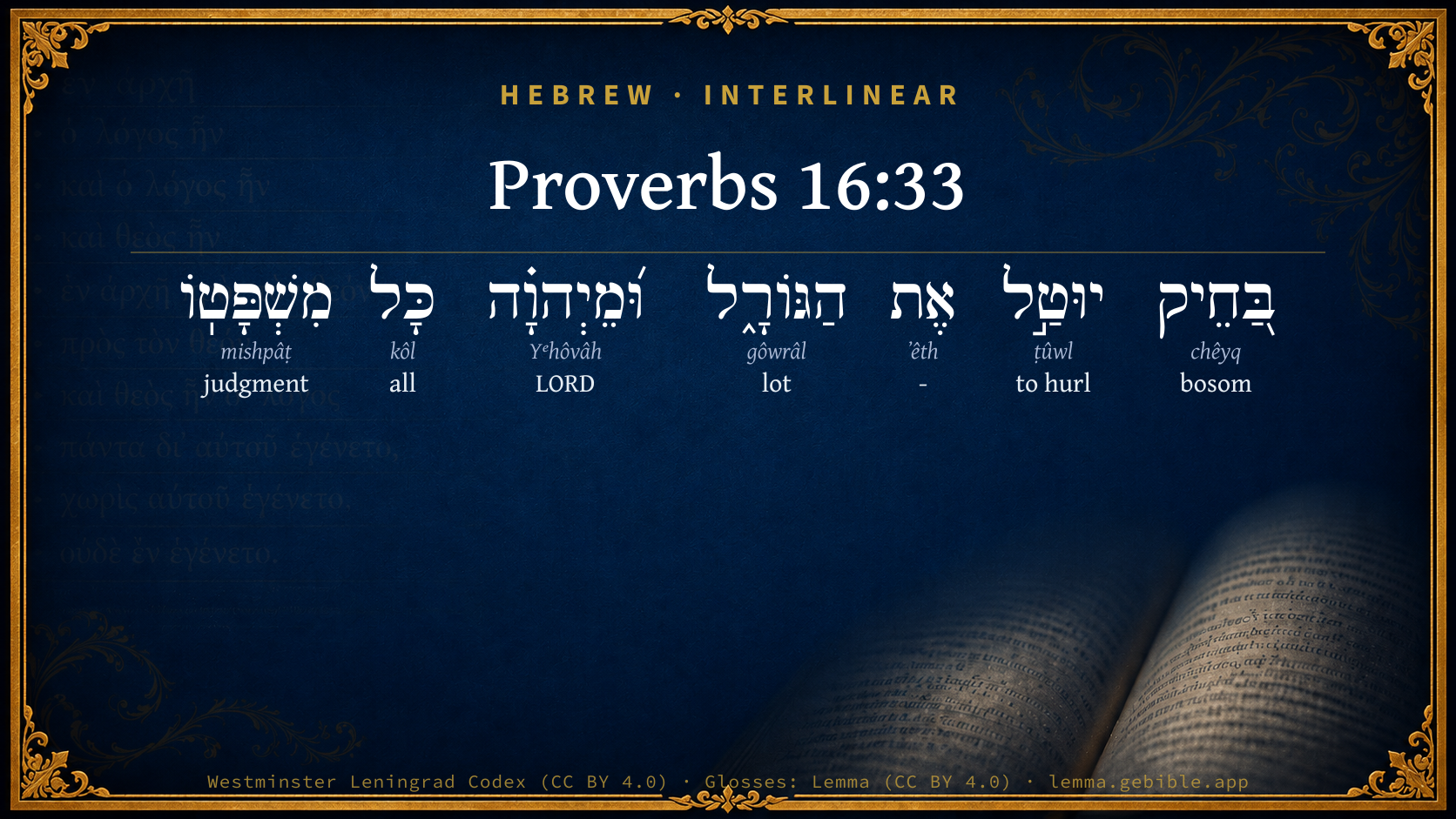
The lot is cast into the lap, But its every decision is from Yahweh.
World English Bible · Public Domain
Download a study sheet

One document with this verse’s original text, its word-by-word gloss line, the meaning frame, cross-references with their text, attributed commentary, and full source and license credits — printable, and it pastes into notes with its structure intact.

This verse Autodidact and up

Study sheet (.html) Plain text (.txt)

A passage Seminary Student

Up to 50 verses in one chapter. A passage sheet keeps up to 6 commentary sources and 12 cross-references per verse, in the order this page ranks them, and says so on the sheet whenever that leaves anything out. Ask for a single verse and you get the Autodidact verse sheet above.

Everything on this page stays free to read, with no account — the sheet is a download of what is already on screen, not access to it.

Want to remove ads? Support Godless Engineer
Compare translations 3

The same verse in 3 English versions, stacked beneath the original-language interlinear above. Click any original word for its lexicon entry.

Each is an independent rendering of the whole verse — the interlinear is not word-aligned to these translations.

Highlighted words mark where these versions differ — a whole-verse word diff, not a word-by-word alignment.

  • World English Bible Public Domain
    The lot is cast into the lap, But its every decision is from Yahweh.
  • King James Version Public Domain
    The lot is cast into the lap; but the whole disposing thereof is of the LORD.
  • unfoldingWord Literal Text CC BY-SA 4.0
    Into the lap a lot is cast, but its every judgment from Yahweh.

unfoldingWord Literal Text — © unfoldingWord, licensed CC BY-SA 4.0. Word-aligned USFM3 via Door43 (git.door43.org/unfoldingWord/en_ult).

Versions to compare (up to 4)

3 of 4 selected

Show all 18 translations

Every available English version of this verse, each an independent rendering of the whole verse.

  • World English Bible Public Domain
    The lot is cast into the lap, But its every decision is from Yahweh.
  • Berean Standard Bible Public Domain
    The lot is cast into the lap, but its every decision is from the LORD.
  • Majority Standard Bible Public Domain
    The lot is cast into the lap, but its every decision is from the LORD.
  • King James Version Public Domain
    The lot is cast into the lap; but the whole disposing thereof is of the LORD.
  • American Standard Version (1901) Public Domain
    The lot is cast into the lap; But the whole disposing thereof is of Jehovah.
  • Revised Version (1885) Public Domain
    The lot is cast into the lap; but the whole disposing thereof is of the LORD.
  • Geneva Bible (1599) Public Domain
    The lot is cast into the lap: but the whole disposition thereof is of the Lord.
  • Douay-Rheims (1899) Public Domain
    Lots are cast into the lap, but they are disposed of by the Lord.
  • Young's Literal Translation Public Domain
    Into the centre is the lot cast, And from Jehovah `is' all its judgment!
  • Literal Standard Version CC BY-SA 4.0
    The lot is cast into the center, || And all its judgment [is] from YHWH!
  • Unlocked Literal Bible CC BY-SA 4.0
    The lots are cast into the lap, but the decision is from Yahweh.
  • unfoldingWord Literal Text CC BY-SA 4.0
    Into the lap a lot is cast, but its every judgment from Yahweh.
  • Darby Bible Public Domain
    The lot is cast into the lap; but the whole decision is of Jehovah.
  • World Messianic Bible Public Domain
    The lot is cast into the lap, but its every decision is from the LORD.
  • Webster's Bible Public Domain
    The lot is cast into the lap: but the whole disposing of it is from the LORD.
  • Free Bible Version CC BY-SA 4.0
    The lot is thrown into the lap, but the Lord makes every decision.
  • Bible in Basic English Public Domain
    A thing may be put to the decision of chance, but it comes about through the Lord.
  • JPS Tanakh (1917) Public Domain
    The lot is cast into the lap; but the whole disposing thereof is of the LORD.

Literal Standard Version (2020), Covenant Press — licensed CC BY-SA 4.0. Text via the HelloAO Bible API (eBible.org). Unlocked Literal Bible (unfoldingWord) — licensed CC BY-SA 4.0. Text via the HelloAO Bible API (eBible.org). unfoldingWord Literal Text — © unfoldingWord, licensed CC BY-SA 4.0. Word-aligned USFM3 via Door43 (git.door43.org/unfoldingWord/en_ult). Free Bible Version, Dr. Jonathan Gallagher — licensed CC BY-SA 4.0. Text via the HelloAO Bible API (eBible.org).

Word by word

More ways to search: Search by grammar → Find every occurrence → Compare this word →

Practice this passage: Drill this verse → Learn its vocabulary →

About this verse

These counts appear in no published source. They are computed here, from the morphology-tagged text and Lemma’s own curated glosses. What Lemma adds →

7
words
7
distinct lemmas
Wisdom
section

Notable vocabulary

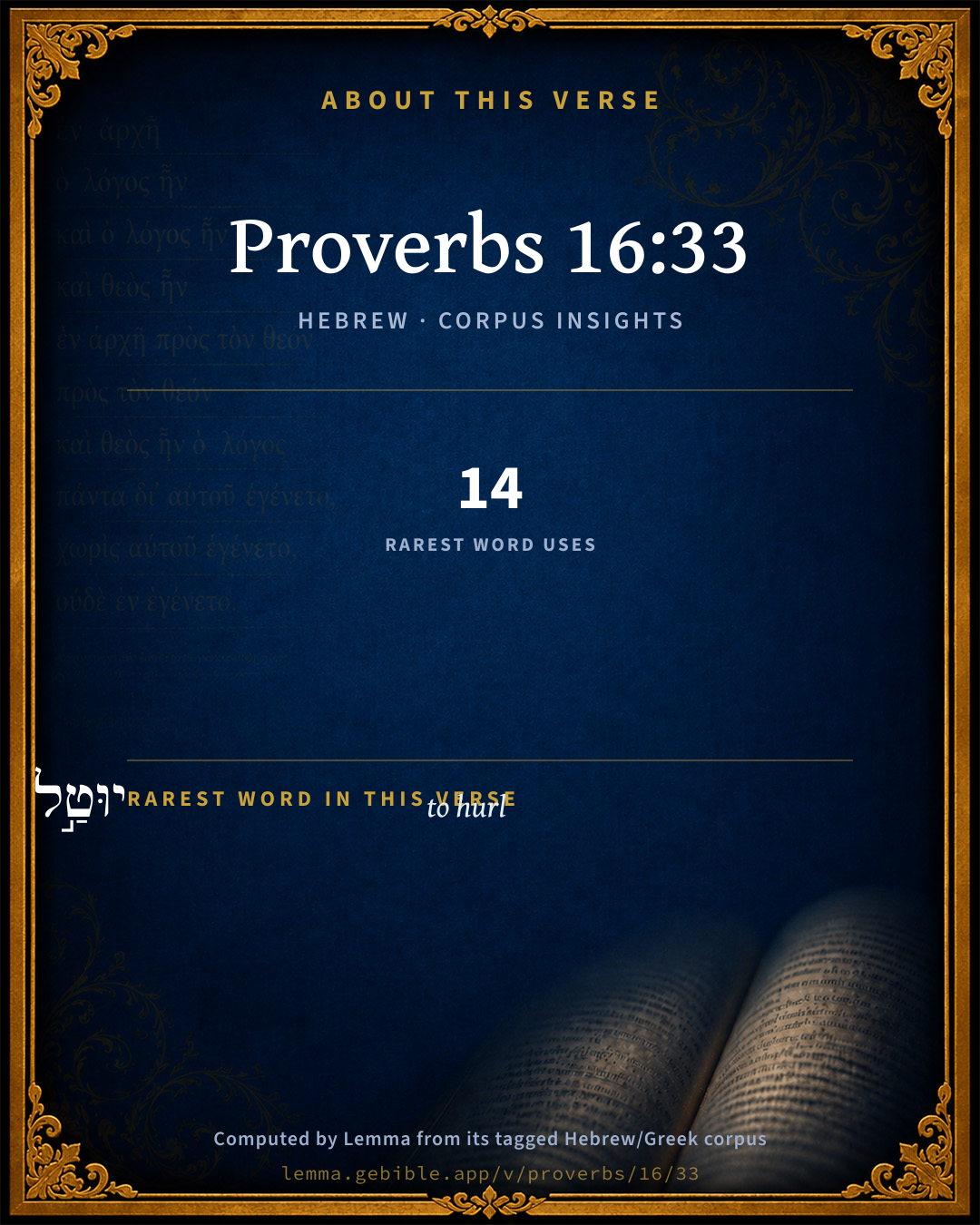
The rarest word here is יוּטַ֣ל to hurl H2904 — appearing just 14 times in the whole Hebrew Bible.

Shared distinctive vocabulary

יוּטַ֣ל to hurl H2904 occurs in 14 verses of the Hebrew Bible. Also found in:

Grammatical profile

  • 1 verb
  • 5 nouns
  • 1 particle

Verb forms

  • יוּטַ֣ל Hophal · Imperfect

Hebrew & Septuagint length

In English translation the verse runs 14 words from the Hebrew and 17 from the Septuagint (LXX English) — closely comparable.

A rough comparison of the two English renderings, which tokenize alike — not a word-level alignment.

Word counts can differ between the Hebrew and the Greek without any difference in meaning — e.g. the Hebrew direct-object marker אֵת has no separate Greek word, and Greek often adds the article ὁ.

Cross-references

10

Topical passages linked to Proverbs 16:33 in the Treasury of Scripture Knowledge — connected by theme and wording, ordered by reader-vote popularity; previews shown in the World English Bible.

  • Proverbs 18:18 The lot settles disputes, And keeps strong ones apart.
  • Jonah 1:7 They all said to each other, "Come, let us cast lots, that we may know for whose cause this evil is on us." So they cast lots, and the lot fell on Jonah.
  • Acts 1:26 They drew lots for them, and the lot fell on Matthias, and he was numbered with the eleven apostles.
  • 1 Samuel 14:41–42 Therefore Saul said to Yahweh, the God of Israel, Show the right. Jonathan and Saul were taken [by lot]; but the people escaped.
  • Proverbs 29:26 Many seek the ruler's favor, But a man's justice comes from Yahweh.
  • Numbers 26:55–65 Notwithstanding, the land shall be divided by lot: according to the names of the tribes of their fathers they shall inherit.
  • Joshua 7:14 In the morning therefore you shall be brought near by your tribes: and it shall be, that the tribe which Yahweh takes shall come near by families; and the family which Yahweh shall take shall come near by households; and the household which Yahweh shall take shall come near man by man.
  • Joshua 18:5 They shall divide it into seven portions: Judah shall abide in his border on the south, and the house of Joseph shall abide in their border on the north.
  • Nehemiah 11:1 The princes of the people lived in Jerusalem: the rest of the people also cast lots, to bring one of ten to dwell in Jerusalem the holy city, and nine parts in the [other] cities.
  • Joshua 18:10 Joshua cast lots for them in Shiloh before Yahweh: and there Joshua divided the land to the children of Israel according to their divisions.

Cross-references courtesy of OpenBible.info (CC BY 4.0).

Hebrew and Greek witnesses Masoretic Hebrew ↔ Greek Septuagint

The same verse in the two great witnesses to the Old Testament, shown verse-for-verse.

These are two independent witnesses, not word-aligned to each other, and the Septuagint is shown in lemma (dictionary) form.

Hebrew Proverbs 16:33 Masoretic · Westminster Leningrad Codex

בַּ֭חֵיק יוּטַ֣ל אֶת הַגּוֹרָ֑ל וּ֝מֵיְהוָ֗ה כָּל מִשְׁפָּטֽוֹ

The lot is cast into the lap, But its every decision is from Yahweh.

World English Bible · Public Domain

Greek LXX Proverbs 16:33 Septuagint · lemma form
All evils come upon the ungodly into their bosoms; but all righteous things come of the Lord.

LXX2012 (modern English Septuagint) · Public Domain

On this verse, Haydock's Catholic Bible Commentary discusses the Septuagint’s reading. Read the note in Commentary ↓

Hebrew: Westminster Leningrad Codex (CC BY 4.0). Greek: Septuagint (public domain); English from LXX2012 (modern English Septuagint) (Public Domain). How the Septuagint differs from the Hebrew →

Commentary

Notes on Proverbs 16:33 from classic Christian and Jewish commentators (each source and its license shown beneath its notes). The classic Christian expositions comment on the surrounding passage and are grouped to its opening verse, so a note may address several verses; the Jewish commentaries on the Tanakh (Rashi and others) are per-verse, so they appear only where the commentator wrote on this verse.

Lemma curates 59 commentaries, every one of them public domain or Creative Commons licensed, each selected and text-cleaned for this edition rather than reprinted as found. About our sources →

Trapp's Complete Commentary

John Trapp

Pro 16:33 The lot is cast into the lap; but the whole disposing thereof [is] of the LORD.

Ver. 33. The lot is cast into the lap.] This sentence at first sight seems light and unworthy of the place it holds in this book. But as every line in the holy Bible is pure, precious, and profitable, so this sets forth a matter of very great moment - viz., that the providence of God extendeth to the disposing of all things, even those things, also, that in regard of as are merely contingent and casual. Lottery is guided by providence, as in the finding out of Achan, designing of Saul to be king, dividing the land among the Israelites, &c. Chance-medley {a} is providence {Exo 22:1-31} Cambyses, lighting off his horse, after he had been showing great cruelty to them of Athens, his sword flew out of his scabbard and slew him. Disponit Deus membra pulicis et culicis, saith Augustine: God disposeth of gnats and flies. Birds flying seem to fly at liberty, yet are they guided by an overruling hand; {Mat 10:26-31} he teacheth them to build their nests; {Psa 84:3} ÷ in the word קן for a nest there is written bigger than ordinary, to imply so much, say Hebricians; he also provides them their meat, their several meats in due season - the young raven especially, {Psa 147:9} if that be true that Aristotle {b} reporteth. This doctrine of God’s particular providence rightly resented, yields incredible profit and comfort. See my Love Tokens, pp. 11, 12.

{a} Accident or casualty not purely accidental, but of a mixed character. Chiefly in manslaughter by chance-medley (for which later writers often use chance-medley itself): ‘the casual killing of a man, not altogether without the killer’s fault, though without an evil intent; homicide by misadventure; homicide mixt’ (Cowel).

{b} Hist. animal., lib. ix. cap. 31.

John Trapp, A Commentary or Exposition upon All the Books of the Old and New Testament (1647–1656) — public domain. Text from a community e-Sword module.

The Biblical Illustrator

Joseph S. Exell

Pro_16:33

The lot is cast into the lap; but the whole disposing thereof is of the Lord.

All contingencies under the direction of Gods providence

I. Consider the result of a lot in reference to men. Why suspend the decision of some dubious case upon it? It implies something future, and something contingent. It is something absolutely out of the reach of mans knowledge, and equally out of reach of his power. A contingent event baffles mans knowledge and evades his power.

II. Consider the result of a lot in respect of God. All contingencies are comprehended by a certain Divine knowledge, and governed by as certain and steady a providence. God directs the greatest casualties under His providence to certain ends, in reference to societies and to particular persons. In the latter case, touching their lives, their health, their reputation, their friendships, and their employments or preferments. Since the interest of governments and nations, of princes and private persons, notwithstanding all the contrivance and power that human nature can exert about them, remain so wholly contingent, as to us, surely all the reason of mankind cannot suggest any solid ground of satisfaction, but in making that God our friend who is the sole and absolute disposer of all these things, and in carrying a conscience so clear towards Him as may encourage us with confidence to cast ourselves upon Him, and in all casualties still to promise ourselves the best events from His providence, to whom nothing is casual, who constantly wills the truest happiness of those that trust in Him, and works all things according to the counsel of that blessed will. (R. South.)

Grounds and limitations of human responsibility

Define the provinces of human and Divine agency. Our duty is commensurate with our power. We are responsible for the moral character of what is done just so far as it depends upon ourselves. Within the circle where man has the power to will and to do of his own pleasure is the field of human agency. Here man is held responsible. All beyond this province of human responsibility is done by the power of God. This thought of Divine providence is the most consoling and inspiring that ever visits the heart, though it cannot give joy to the heart where it is not welcomed. Our knowledge of human and Divine agency is constantly extending. We are continually opening upon new views, which show us that many things which are called acts of God come within the sphere of our own responsibility, and are, in truth, our own actions springing from our own doing or our own neglect; and the consequences of them we must expect to bear. Moreover, the arts and improvements of civil life are continually investing men with new powers, and given him a mastery over nature which in former days he never dreamed of possessing. Then is not the sphere of Divine providence getting lessened? Nay, the more we feel our own responsibility, the more shall we recognise the agency of Heaven in all things. What is it we adore in the providence of God? It is its vast reach of vision, and its ever steadfastly pressing on to that which is right. (W. B. O. Peabody.)

Divine providence

The general doctrine of providence derives support from sources independent of Divine revelation. It is another term for the government of God, by which all events are made to concur with His wise and holy purposes. Look at providence--

1. In the mode of its operations.

2. In the vastness of its range.

3. In the punishment of the wicked.

4. In its aspect on the Church.

The doctrine of Divine providence is full of consolation. All must be right when God controls and reigns over all. (John George.)

Gods providence even in trifles

Gods providence may be seen not only in the whirlwind and the hurricane, the lightning and the storm, but also in the very least of natural manifestations. Surely, without unduly pressing our text, we may bring forward a familiar illustration of the way in which even trifles, as man calls them, have been made to work out mighty results. Take, for instance, the discovery of the laws of gravitation, and the great results in which that discovery has issued: how it opened the way to the understanding of the courses of the heavenly bodies; how the orbits of the planets, and their distances, and their relative positions at various periods came to be clearly defined; the influence of these discoveries on the laws of navigation, and the consequent facilities for communication between places separated by thousands of miles upon the ocean. We are daily in the enjoyment of the conveniences and luxuries which spring from these discoveries. We may be ignorant of the laws which have been deduced, or even of the practical applications of these laws; of their results in adding to our comforts we cannot be ignorant. Now, is it too much to say that these discoveries are the result of Gods providential government? But, if this be granted, we cannot stop here; it follows that the means by which this knowledge was acquired were not beyond the Divine control; nay, rather were subservient to it, and governed by it. And so, at last, we see by manifest logical conclusion that the finger of God may be traced even in that trifle, as it might have been called, which led the wise mans mind to excogitate the mysteries among which we live. And whether we endeavour to trace the working of the finger of God in the intricacies of the human mind, or in the external influences which affect the mind, or in the coincidences by which great events are deduced from small beginnings, yet in each alike we may say, and say with reason, It is the Lords doing, and it is marvellous in our eyes. Apply this lesson in another way, to the case of sickness--for here, again, we may attain to very practical results. Now, I apprehend that the generality of men do certainly look upon sickness as a casualty--a mere matter of accident or chance. If you were to question them strictly you might at last extract from them in general terms a confession that God is the author of life or death, of health or sickness; but it has no practical effect. It is not a really powerful religious principle, for they are ever speaking of proximate causes, and not of the great First Cause. Take now a particular case, in part illustrative of my meaning; it shall be the case of the blind man, recorded in St. Joh_9:1-41. I adduce this case to illustrate the general principle that sickness cometh not by chance, but by Gods will and permission, and that its results are known by God, and that it comes to accomplish the purpose for which He hath sent it. Again, the same order and regularity are observable in the kingdom of grace. All the profit and advantage which men receive from the ministry of the Word and Sacraments is of God. An eloquent sermon may be delivered, but the preacher cannot tell whose heart it may reach or whose mind it may affect. The lot is cast, as it were, into the lap; the preacher knoweth not the issue thereof, for the whole disposing of it is of the Lord. Now, I think that these considerations may have a very practical effect upon us; they touch our every-day life; they console us in failure, when failure results from no lack of diligence on our part; they humble us in success. But does this lead us to believe in any doctrines like those of the fatalists? By no means. Every man is a free agent, working out for himself future weal or woe as he will. His mind is fixed in a certain course, and his thoughts tend to that direction. God often checks him if he is going astray, and pleads with him, and throws hindrances in the paths which lead to evil. And though a mans course of life may be evil, yet there are influences which are running counter to that evil course, and checking him, and compelling him to pause and think. And why is this--but because, though the lot be cast into the lap, yet the whole disposing thereof is of the Lord? (W. S. Simpson, M.A.)

The Lords disposing

After all, what silly and short-sighted children we are! Only spelling out the alphabet in Gods infant school, and yet aspiring to a seat in His cabinet! How differently our life-stories will read when we have a chance to correct them in the clear light of heaven! Then we shall discover under the head of Accidents there was written as in invisible ink, The lot is cast into the lap, but the disposing thereof is of the Lord. On the page that we had surrounded with black lines, and inscribed it Obituaries, we shall see how distinctly a Divine finger has written, Whom I love I chasten. (Theodore L. Cuyler.)

.

The Biblical Illustrator, edited by Joseph S. Exell (c. 1880s–1900s) — public domain. Text from a community e-Sword module.

Joseph Benson's Commentary

Pro 16:33. The lot is cast into the lap — As the ancient practice was in dividing inheritances, and deciding in doubtful cases; but the whole disposing thereof is of the Lord — The event, though casual to men, is directed and determined by God’s counsel and providence. But it is to be well observed, that when solemn appeals are made to divine providence, by the casting of lots, for the deciding of a matter of moment, which could not otherwise be at all, or not so well, decided, God must be applied to by prayer to give a perfect lot, 1Sa 14:41; Act 1:24; and his decision must afterward be acquiesced in with entire satisfaction, under a persuasion that it is wise and righteous.

Joseph Benson's Commentary on the Old and New Testaments (1811–1818) — public domain. Text from a community e-Sword module.

The Preacher's Complete Homiletical Commentary

Joseph S. Exell (gen. ed.)

MAIN HOMILETICS OF Pro_16:33

THE LOT AND ITS DISPOSER

I. There is a special Providence of God in the midst of His universal government. In nature there is a manifestation of a universal Providence ruling over all God’s creatures. But the individual is not lost in the multitude—each bird of the air and every blade of grass in the field is under the special supervision of its Creator. And God is Ruler in the army of heaven and among the inhabitants of the earth, but He does not deal with either angels or men in the mass as human rulers must do, but knows, and cares for, and guides the destinies of the individual man—the disposal of the lot of each one is from the Lord.

II. The special Providence of God works through human instrumentality. Reference is here doubtless made to the ancient custom of casting lots to ascertain the Divine will. This was done at the division of the land of Canaan among the children of Israel, on the occasion of the election of their first king, and in choosing the apostle who took the place of Judas among the twelve. In all these cases it was recognised that there was no chance in the disposal of the lot—that the decision in each case was from the Lord Himself—but in each case human instrumentality was used by Him to make known His will. This linking of human instrumentality with Divine sovereignty is found in all God’s dealings with men. He has promised that seedtime and harvest shall not cease while the earth continues, but he requires men to sow the grain to bring about the harvest. The “casting of the lot” is symbolic of the part that human effort takes in the government of the world—although God is above and behind it, he does not work without it.

OUTLINES AND SUGGESTIVE COMMENTS

One general principle regarding the employment of the “lot” is sufficiently manifest, namely, that it should never be introduced except in cases where reason and evidence are incompetent to decide. And we may, I think, safely go so far as to affirm that in cases of importance and of extremity—that is, where other means of arriving at a satisfactory conclusion or a harmonious agreement have failed—there does not appear to be anything in Scripture by which such an appeal can be considered as interdicted.… Still, if there is nothing interdictory of the use of it, there is nothing that makes it obligatory in any specified circumstances; and it is clear that, if used at all, it should be used seriously and sparingly. It is very wrong, and the reverse of truth, to speak of any matter whatever as being in this way referred to chance. There is no such thing. Chance is nothing—an absolute nonentity. It is a mere term for expressing our ignorance. Every turn of the dice in the box is regulated by certain physical laws, so that, if we knew all the turns, we could infallibly tell what number would cast up. Besides, in no case is there a more thorough disavowal of chance than in the use of the lot. It is the strongest and most direct recognition that can be made of a particular providence—of the constant and minute superintendence of an omniscient, overruling mind.—Wardlaw.

Everything is a wheel of Providence. Who directed the Ishmaelites on their journey to Egypt at the very moment that Joseph was cast into the pit? Who guided Pharaoh’s daughter to the stream just when the ark, with its precious deposit, was committed to the waters? What gave Ahasuerus a sleepless night, that he might be amused with the records of his kingdom?—Bridges.

The Preacher's Complete Homiletical Commentary (gen. ed. Joseph S. Exell; Funk & Wagnalls, c. 1892) — public domain (pre-1929). A full-Bible homiletical/sermon-outline anthology covering 65 of 66 books (2 John is absent from the source module). Text from a community e-Sword module.

Tyndale Open Study Notes

Tyndale Open Resources

16:33 We may throw the dice: These dice were not for gambling but were a means commissioned by God to determine his will (Exod 28:30; see also Josh 14:2; 1 Sam 10:17-27; 14:40-43).

Tyndale Open Study Notes — © Tyndale Open Resources, licensed CC BY-SA 4.0. Text via the HelloAO Bible API.

Geneva Bible (1599)

Geneva Bible translators

So that there is nothing that ought to be attributed to fortune: for all things are determined in the counsel of God which shall come to pass.

Geneva Bible (1599) marginal notes — public domain. Text via Bolls.life.

Matthew Henry's Commentary

Note, 1. The divine Providence orders and directs those things which to us are perfectly casual and fortuitous. Nothing comes to pass by chance, nor is an event determined by a blind fortune, but every thing by the will and counsel of God. What man has neither eye nor hand in God is intimately concerned in. 2. When solemn appeals are made to Providence by the casting of lots, for the deciding of that matter of moment which could not otherwise be at all, or not so well, decided, God must be eyed in it, by prayer, that it may be disposed aright (Give a perfect lot, Sa1 14:41; Act 1:24), and by acquiescing in it when it is disposed, being satisfied that the hand of God is in it and that hand directed by infinite wisdom. All the disposals of Providence concerning our affairs we must look upon to be the directing of our lot, the determining of what we referred to God, and must be reconciled to them accordingly.

Matthew Henry's Commentary on the Whole Bible (1708–1710) — public domain (CC PDM 1.0). Text via the HelloAO Bible API.

Jamieson, Fausset & Brown

Robert Jamieson, A. R. Fausset & David Brown

Seemingly the most fortuitous events are ordered by God.

Next: Proverbs Chapter 17

Jamieson, Fausset & Brown — Commentary Critical and Explanatory on the Whole Bible (1871) — public domain (CC PDM 1.0). Text via the HelloAO Bible API.

Adam Clarke's Commentary

Verse 33. The lot is cast into the lap] On the lot, See Clarke on Nu 26:55. How far it may be proper now to put difficult matters to the lot, after earnest prayer and supplication, I cannot say. Formerly, it was both lawful and efficient; for after it was solemnly cast, the decision was taken as coming immediately from the Lord. It is still practiced, and its use is allowed even by writers on civil law. But those who need most to have recourse to the lot are those who have not piety to pray nor faith to trust to God for a positive decision. The lot should never be resorted to in indifferent matters; they should be those of the greatest importance, in which it appears impossible for human prudence or foresight to determine. In such cases the lot is an appeal to God, and he disposes of it according to his goodness, mercy, and truth. The result, therefore, cannot be fortuitous.

Adam Clarke's Commentary on the Bible (1810–1826) — public domain. Text from a community e-Sword/MySword module.

Ellicott's Commentary for English Readers

(33) The lot is cast into the lap . . .—In other words, much that we attribute to chance is due to the providence of God. (Comp. Mat_10:29-30.) This should be an encouragement to trust in Him.

A Bible Commentary for English Readers, edited by Charles John Ellicott (1878–1897) — public domain. Text from a community e-Sword module.

The Cambridge Bible for Schools and Colleges

gen. ed. J. J. S. Perowne

33. the lap] from the folds of which it was drawn or shaken out.

disposing] Lit. judgement. The decision, which when appealed to as arbiter it pronounces, is not its own but Jehovah’s.

The religion of the O.T. incorporated into itself the use of the lot as it did many other common customs (see Jos_7:14-18; 1Sa_14:42). With the gift of Pentecost, however, the religious use of it appears to have ceased. No mention is found of it in the N.T. after Act_1:26.

The Cambridge Bible for Schools and Colleges (gen. ed. J. J. S. Perowne; Cambridge University Press, 1878–1918) — public domain. Text from a community e-Sword module.

Albert Barnes' Notes on the Bible

Disposing - Better, the judgment or sentence which depends upon the lot. The lots were thrown into the gathered folds of a robe, and then drawn out. Where everything seemed the merest chance, there the faithful Israelite teacher recognized the guidance of a higher will. Compare the case of Achan Jos 7:18, and of Jonathan 1Sa 14:37-42. The process here described would seem to have been employed ordinarily in trials where the judges could not decide on the facts before them (compare Pro 18:18).

Albert Barnes' Notes on the Bible (1834–1885) — public domain. Text from a community e-Sword/MySword module.

Haydock's Catholic Bible Commentary

CHAPTER XVI.

Lord. So the apostles had recourse to them, (Acts i. 26.) as the Cophts[Copts?] and Nestorians still do when there is a dispute about the election of a patriarch. (Renaudot iv. Perpet. i. 7. and 9.) --- This mode may settle disputes, chap. xviii. 18. But we must not have recourse to it, except where the Church permits, lest we become the dupes of an idle curiosity. (Calmet) --- Nothing happens by chance. (St. Augustine, City of God v. 9.) --- Septuagint, "all things come into the breast of the unjust; but all just things proceed from the Lord." (Haydock)

George Leo Haydock (1774–1849), Haydock's Catholic Family Bible and Commentary, 1859 edition — public domain. Excludes Psalms (Douay-Rheims chapter numbering differs from Protestant) and Deuterocanonical books (Catholic canon only).

Matthew Poole's English Annotations

The lot is cast into the lap; as the ancient practice was in dividing inheritances, and deciding doubtful things, of which see Num 26:55; Jos 7:16; 1Sa 10:20,21; 14:41,42; Pr 1:14; Act 1:26.

The whole disposing thereof is of the Lord; the event, though casual to men, is directed and determined by God’s counsel and providence.

Matthew Poole's English Annotations on the Holy Bible (1683–1685) — public domain. Text from a community e-Sword/MySword module.

Whedon's Commentary on the Bible

Daniel D. Whedon

33. Lap — Literally, bosom. It may mean the hollow part of a vase or urn. It is also applied to the receptacles formed by the mode of wearing the long loose garments peculiar to the East. The ancients used a portion of their garments, perhaps the bosom of the dress, as a container of the גורל, (goral,) calculi, or small stones, which were used for the purpose of lot-casting.

The whole disposing thereof — כל משׁפשׂו, (kol-mishpato,) the whole judgment or decision of it, is of the Lord. The result was regarded in effect, as a divine decision. The decision by lot is very ancient. It still continues to this day, and probably will continue to the end of time. For in some respects it is the best and most satisfactory (or the least unsatisfactory) way in which a decision can be made. In those things wherein it is proper to employ the lot, men will submit to a decision made in this manner which they would hardly yield to if made in any other.

Daniel D. Whedon (gen. ed.), Commentary on the Old and New Testaments (1874–1909) — public domain. Text from a community e-Sword module.

The Pulpit Commentary

The lot is cast into the lap. The bosom or fold of the garment. (Pro_6:27 Pro_17:23 Pro_21:14) It is not quite clear what articles the Jews used in their divinations by lot. Probably they employed stones, differing in shape or colour, or having some distinguishing mark. These were placed in a vessel or in the fold of a garment, and drawn or shaken thence. Such a practice has been common in all ages and countries; and though only cursorily mentioned in the Mosaic legislation, (Num_26:55) it was used by the Jews from the time of Joshua, and in the earliest days of the Christian Church. (see Jos_18:10 Jud_1:20:9 1Sa_10:20, 21 Act_1:23, etc.) As by this means man"s agency was minimized, and all partiality and chicanery were excluded, the decision was regarded as directed by Providence. There is one case only of ordeal in the Law, and that under suspicion of adultery. (Num_5:12, etc.) In the Epistle to the Hebrews, in place of the lot we read, (Heb_6:16) "An oath for confirmation is to them an end of all strife." The whole disposing thereof is of the Lord. In these eases the Jew learned to see, in what we call chance, the overruling of Divine power. But this was not blind superstition. He did not feel justified in resorting to this practice on every trivial occasion, as persons used the Sortes Virgilianae or even the verses of the Bible for the same purpose. The lot was employed religiously in cases where other means of decision were not suitable or available; it was not to supersede common prudence or careful investigation; but, for example, in trials where the evidence was conflicting and the judges could not determine the case, the merits were ascertained by lot. (comp. Pro_18:18) After the effusion of the Holy Spirit, the apostles never resorted to divination, and the Christian Church has wisely repudiated the practice of all such modes of discovering the Divine will. Septuagint, "For the unrighteous all things fall into their bosom, but from the Lord are all just things," which may mean either that, though the wicked seem to prosper, God still works out his righteous ends; or the evil suffer retribution, and thus God"s justice is displayed.

The lottery of life.

I LIFE APPEARS TO BE A LOTTERY. "The lot is cast into the lap." We seem to depend largely on chance.

1. We are ignorant of important facts. We are obliged to grope our way through many dark places. Life comes to us veiled in mystery. It may be that certain material considerations would greatly modify our action if only we knew them, yet we must act without regard to them, from sheer ignorance.

2. We cannot, predict the future. Even when we do grasp the essential points of our situation in the present, we cannot tell what new possibilities may emerge. A sudden turn of the kaleidoscope may give an entirely novel complexion to life.

3. We are unable to master our circumstances. We find ourselves surrounded by innumerable influences which we may understand, more or less, but which we cannot alter. Sometimes it appears as though we were no more free agents than the driftwood that is cast up on the beach by the angry surf. Circumstances are too strong for us, and we must let circumstances take their course.

4. We cannot control the course of events. Many things happen quite outside the range of our lives, yet their results will strike across the path of our own actions. Other people are busy planning and working, and we do not all consult together and work in harmony. When many hands throw the shuttle it is impossible to bring out and sure design.

II GOD DISPOSES OF THE LOTTERY OF LIES. Voltaire says, "Chance is a word void of sense; nothing can exist without a cause." It is but a name for our ignorance of the course of events, Nevertheless, if there were no mind behind the apparent confusion of life, universal causation would but give us a blind and purposeless fate no better, surely, than a wild and chaotic chance. But to one who believes in God the terrible uncertainty of the lottery of life is a great reason for prayer and trust.

1. God knows all. He knows every fact, and he foresees the whole future. Herein we have a grand reason fir faith. One who knows so much more than we do must needs often act in a way that we do not understand. But his infinite knowledge is a reason for our unlimited trust in him.

2. God controls all. Events seem to be tossed about in the lap of chance. Yet just as surely as laws of motion govern the slightest movement of all the leaves that are blown by an autumn wind, Divine purposes control all human events, in the midst of their seeming confusion. This runs; be so if God is God. "He maketh kings to sit in sovereignty; He maketh subjects to their power obey; He pulleth down, he setteth up on high; He gives to this, from that he takes away; For all we have is his; what he will do, he may. (Spenser.)

Chance and providence.

I CHANCE IS BUT AN EXPRESSION OF HUMAN IGNORANCE. When we speak of that which is contingent, we mean something the law of which is not yet known.

II MAN"S CONTROL OVER EVENTS IS LIMITED. We can give the external occasion to a decision; the decision itself rests with a higher power.

III GOD OVERRULES ALL THINGS, AND OVERRULES THEM FOR THE BEST. To pretend that we are not free is to deny our nature, and so to deny him; and it is also a denial of him to think that we can be absolute masters of our fate. Between night and day truths that are obscure and convictions that are clear our life is balanced. Life rests on two pillars the providence of God and the responsibility of man. J

The Pulpit Commentary (1880–1919), ed. H.D.M. Spence-Jones & Joseph S. Exell — public domain. Text from a community e-Sword module.

John Wesley's Explanatory Notes

The lot - As the ancient practice was in deciding doubtful things. The event of which though casual to men, is directed by God's providence.

John Wesley, Explanatory Notes Upon the Whole Bible (1754–1765) — public domain. Text via the GEBible commentary corpus.

Bridges on Proverbs

Charles Bridges

The lot cast into the lap, or into the bottom of an urn,†1 often determined important matters. Officers were thus chosen;†2 work determined;†3 dwellings fixed;†4 discoveries made;†5 contentions caused to cease.†6 Yet the LORD’s disposal was manifestly shewn. Canaan was thus divided, so as to accord fully with Jacob’s prophecies.†7 The offender was brought to justice.†8 What could be more beyond human direction? Yet what more entirely under the Divine disposal? No one doubted the decision. Saul was acknowledged to be King,†9 Matthias was numbered among the Apostles†10 — without disputing. Even when cast profanely or superstitiously, the same Sovereignty overruled. Haman’s lot was so disposed, as wholly to overthrow his exterminative project; giving full time for the deliverance of his victims.†11 The soldier’s lot was the direct fulfillment of a prophecy, that could not otherwise have been accomplished.†12 The Heathen sailors cast it in ignorance; yet was it the Divine discovery of the guilty criminal. (Jon 1:7 .) Heathen divinations were controlled by the same absolute power. (Eze 21:21-22 .)

The lot is however a solemn matter, not to be lightly cast. (Act 1:24-26 .) It is and acknowledgment of absolute Sovereignty; giving up our personal responsibility, and virtually appealing to an Omniscient, Omnipresent, Omnipotent God. It teaches us, that things that we conceive to be accident are really under Providence. ’What is chance to man is the appointment of God.’†13 The lot, cast ’at peradventure, carrying a show of casualty,’†14 is under a certain disposal. Yet admitting it to be a Scriptural ordinance, its expediency under our more full light is more than doubtful. "We have" at least "a more sure word of prophecy, whereunto we do well that we take heed, as unto a light that shineth in a dark place." (2Pe 1:19 .) The book of God is given us expressly as "a lamp to our feet, and a light to our path." (Psa 119:105 .) The rule is more clear in itself, and linked with a most encouraging promise — "In all thy ways acknowledge him, and he shall direct thy paths." (Pro 3:6 .) It is far better to exercise faith, than indolently to tamper with personal responsibility.

The instructive lesson to learn, is that there is no blank in the most minute circumstances. Things, not only apparently contingent, but depending upon a whole train of contingencies, are exactly fulfilled. The name of a King (1Ki 13:2 ), or of a deliverer (Isa 44:28 ), is declared many hundred years before their existence — before therefore it could be known to any — save the Omniscient Governor of the universe — whether such persons would exist. The falling of a hair or a sparrow is directed, no less than the birth and death of Princes, or the revolutions of empires. (Mat 10:29-30 .) Everything is a wheel of Providence. Who directed the Ishmaelites on their journey to Egypt at the very moment, that Joseph was cast into the pit?†15 Who guided Pharaoh’s daughter to the stream, just when the ark, with its precious deposit, was committed to the waters? (Exo 2:3-5 .) What gave Ahasuerus a sleepless night, that he might be amused with the records of his kingdom? (Est 6:1 .) Who prepared the whale at the very time and place, that Jonah’s lot was cast? (Jon 1:17 .) Who can fail to see the hand of God, most wonderful in the most apparently casual contingencies, overruling all second causes to fulfill his will while they work their own? ’When kingdoms are tossed up and down like a tennis-ball (Isa 22:18 ); not one event can fly out of the bounds of his Providence. The smallest are not below it. Not a sparrow falls to the ground without it. Not a hair, but it is numbered by it.’†16

Footnotes:

†1 Parkhurst translates the word to mean the bottom or midst of an urn or vessel, into which the lots were cast.

†2 1Ch 24:5 .

†3 Luk 1:9.

†4 Neh 11:1.

†5 1Sa 14:41 .

†6 Pro 18:18.

†7 Num 26:55. Jos 18:8 .

†8 Jos 7:16.

†9 1Sa 10:20-24 .

†10 Act 1:26.

†11 Est 3:7; Est 9:1, 2.

†12 Joh 19:24, with Psa 22:18 .

†13 Scott in loco.

†14 Bishop Hall.

†15 Gen 37:25. ’The unparalleled story of Joseph’ — as Dr. South remarks in his striking Sermon on this text — ’seems to be made up of nothing else but chance and little contingencies, all tending to mighty ends.’

†16 Polhill on the Divine Will, p. 159.

Charles Bridges, An Exposition of the Book of Proverbs (1846) — public domain. Text from a community e-Sword module.

Kretzmann's Popular Commentary

Paul E. Kretzmann

v. 33. The lot is cast into the lap, apparently at random; but the whole disposing thereof is of the Lord, the decision rests with Him, for even those events which seem to us most fortuitous and subject only to chance are ordered, and governed by God.

Paul E. Kretzmann, Popular Commentary of the Bible (1921–1924) — public domain. Text from a community e-Sword module.

unfoldingWord translationNotes

Door43 World Missions Community

The lots are cast into the lap

This can be stated in active form. AT: "A person throws the lots into his lap" (See: Active or Passive)

the decision is from Yahweh

Possible meanings are 1) Yahweh decides how the lots will land or 2) it is not the lots, but Yahweh who determines what will happen.

translationWords

lots

Yahweh

unfoldingWord translationNotes — © Distant Shores Media and the Door43 World Missions Community, licensed CC BY-SA 4.0. Source: git.door43.org/Door43/en_tn.

Rashi

Rabbi Shlomo Yitzchaki (Rashi)

The lot is cast in the lap By himself, a person cast lots.

but all his judgment to choose for each one his share.

Rashi on the Tanakh — English translations: “The Judaica Press complete Tanach with Rashi, translated by A. J. Rosenberg” (CC BY 4.0); “Pentateuch with Rashi's commentary by M. Rosenbaum and A.M. Silbermann, 1929-1934” (public domain); “The Metsudah Tanach series, Lakewood, N.J” (CC BY 4.0); and “The Book of Joshua, Metsudah Publications, 1997” (CC BY 4.0). Text via Sefaria.

Lesson kit

Teaching starters — assembled from the data on this page, not authored interpretation. Every prompt links to the verse data it draws on. Edit before teaching.

Proverbs, in the Wisdom, opens this verse with 7 words (7 distinct Hebrew lemmas). Its most distinctive word is ṭûwl (“to hurl”). A historical commentator’s framing appears above. Read the whole chapter for the surrounding context.

Discussion questions

  1. What does “to hurl” (ṭûwl) contribute to the verse as a whole?
  2. 1 Samuel 18:11 shares the word «to hurl» with this verse. How do the two illuminate each other?
  3. These translations render this verse differently; the difference is in the English rendering, not the original. What questions does that raise?
  4. The verb «יוּטַ֣ל» is Hophal Imperfect. How does its form color the action?
  5. Reading how Trapp's Complete Commentary and The Biblical Illustrator read this verse, where do the two commentators agree and where do they part?

Things to notice

Reading settings

Reading text

Shown beneath each verse's original-language words.

Old Testament
Old Testament edition

Read the OT as the Masoretic Hebrew (MT) or the Greek Septuagint (LXX).

English shown for the Greek Septuagint (in the Hebrew ↔ Greek comparison).

Comparing translations? Open the Compare panel on any verse page to stack up to four side by side.