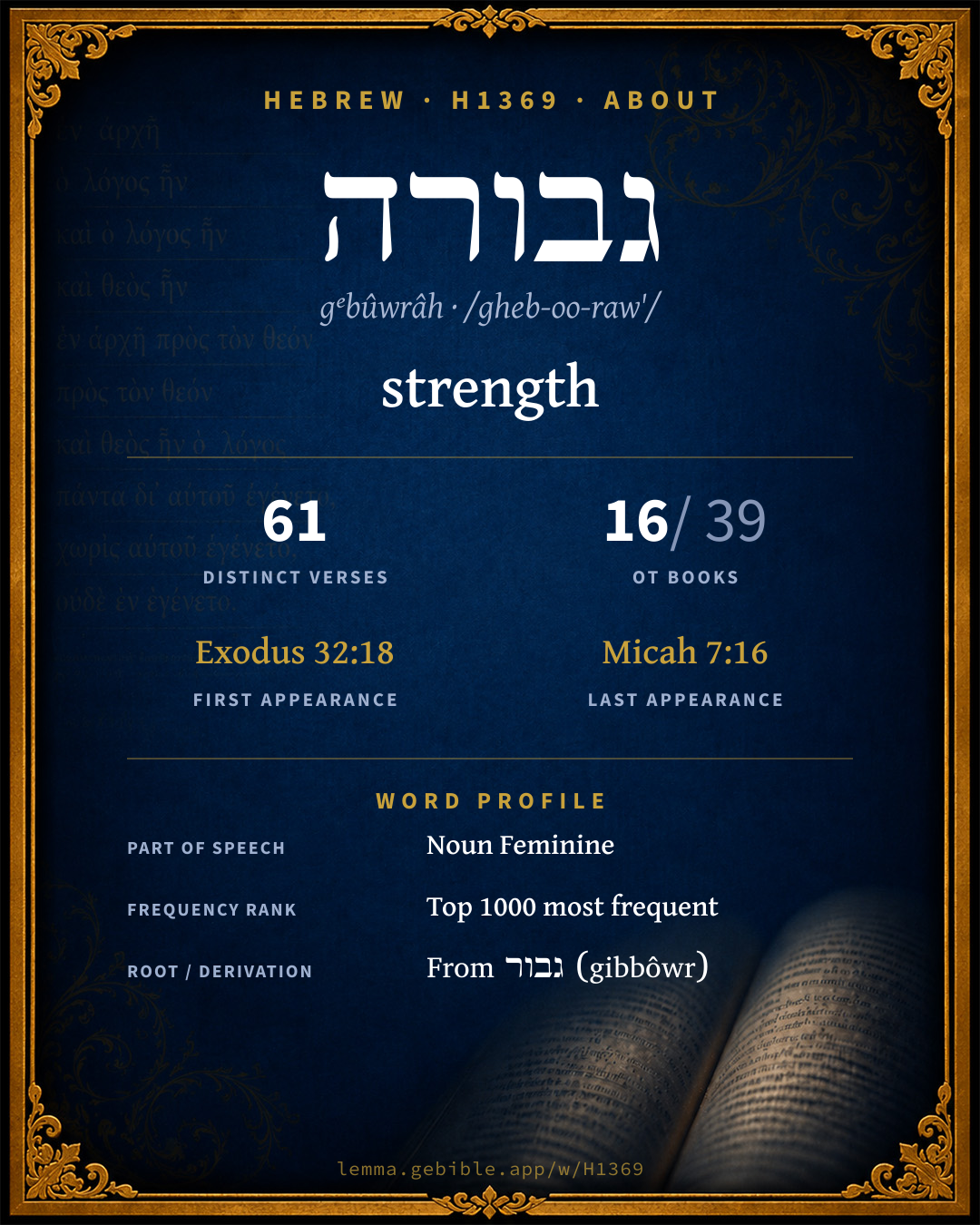
גְּבוּרָה
strength
‘strength’ is one of 4 main senses fuller range ↓
Full lexicon entry — Brown-Driver-Briggs (BDB)
From Brown-Driver-Briggs (BDB)
Where this word appears
See every Construct-state word in the Hebrew Bible →
Grammar key — what these labels mean
Part of speech
- Noun
- A naming word — a person, place, thing, or idea.
Noun type
- Common
- A common noun — a general class of person, place, or thing (“king,” “city,” “water”), not a specific name.
State
- Construct
- A noun bound to a following noun in a possessive / “of” relationship (the construct chain).
- Absolute
- The independent form of a noun, not bound to a following word.
Gender
- Feminine
- Grammatically feminine.
Number
- Singular
- One.
- Plural
- More than one (in Hebrew, generally three or more).
6 verses where H1369 appears in the Construct state in the Book of 2 Kings. Filtered view — show all forms. Click any verse to open its interlinear word-by-word view. Verse text shown in the World English Bible for context — . Each verse’s Hebrew form is shown with its reference; the English is not keyword-highlighted, since the data carries no word-level English alignment. Use “Compare translations” on any verse to read it across multiple English versions. This concordance covers the Hebrew Bible; Septuagint (Greek Old Testament) occurrences are not indexed here.
2 Kings
- 2 Kings 10:34 גְּבוּרָת֑/וֹ n c fs cs + sfx pers 3ms Now the rest of the acts of Jehu, and all that he did, and all his might, aren't they written in the book of the chronicles of the kings of Israel?
- 2 Kings 13:8 וּ/גְבוּרָת֑/וֹ conj + n c fs cs + sfx pers 3ms Now the rest of the acts of Jehoahaz, and all that he did, and his might, aren't they written in the book of the chronicles of the kings of Israel?
- 2 Kings 13:12 וּ/גְב֣וּרָת֔/וֹ conj + n c fs cs + sfx pers 3ms Now the rest of the acts of Joash, and all that he did, and his might with which he fought against Amaziah king of Judah, aren't they written in the book of the chronicles of the kings of Israel?
- 2 Kings 14:15 וּ/גְב֣וּרָת֔/וֹ conj + n c fs cs + sfx pers 3ms Now the rest of the acts of Jehoash which he did, and his might, and how he fought with Amaziah king of Judah, aren't they written in the book of the chronicles of the kings of Israel?
- 2 Kings 14:28 וּ/גְבוּרָת֣/וֹ conj + n c fs cs + sfx pers 3ms Now the rest of the acts of Jeroboam, and all that he did, and his might, how he warred, and how he recovered Damascus, and Hamath, [which had belonged] to Judah, for Israel, aren't they written in the book of the chronicles of the kings of Israel?
- 2 Kings 20:20 גְּב֣וּרָת֔/וֹ n c fs cs + sfx pers 3ms Now the rest of the acts of Hezekiah, and all his might, and how he made the pool, and the conduit, and brought water into the city, aren't they written in the book of the chronicles of the kings of Judah?
About this entry
At a glance — auto-summarized from this page’s data, not written by a person. Every figure links to its source below. This summary describes the numbers; it doesn’t interpret them.
גבורה — transliterated gᵉbûwrâh — is a Hebrew noun carrying the sense “strength.” It is not a single-sense word — see its full sense range. The Hebrew Bible uses it across 61 verses — moderately common. More than a quarter of its appearances fall in Psalms. It first appears in Exodus 32:18. See the sense tree, 61-verse concordance, and the renderings breakdown below.
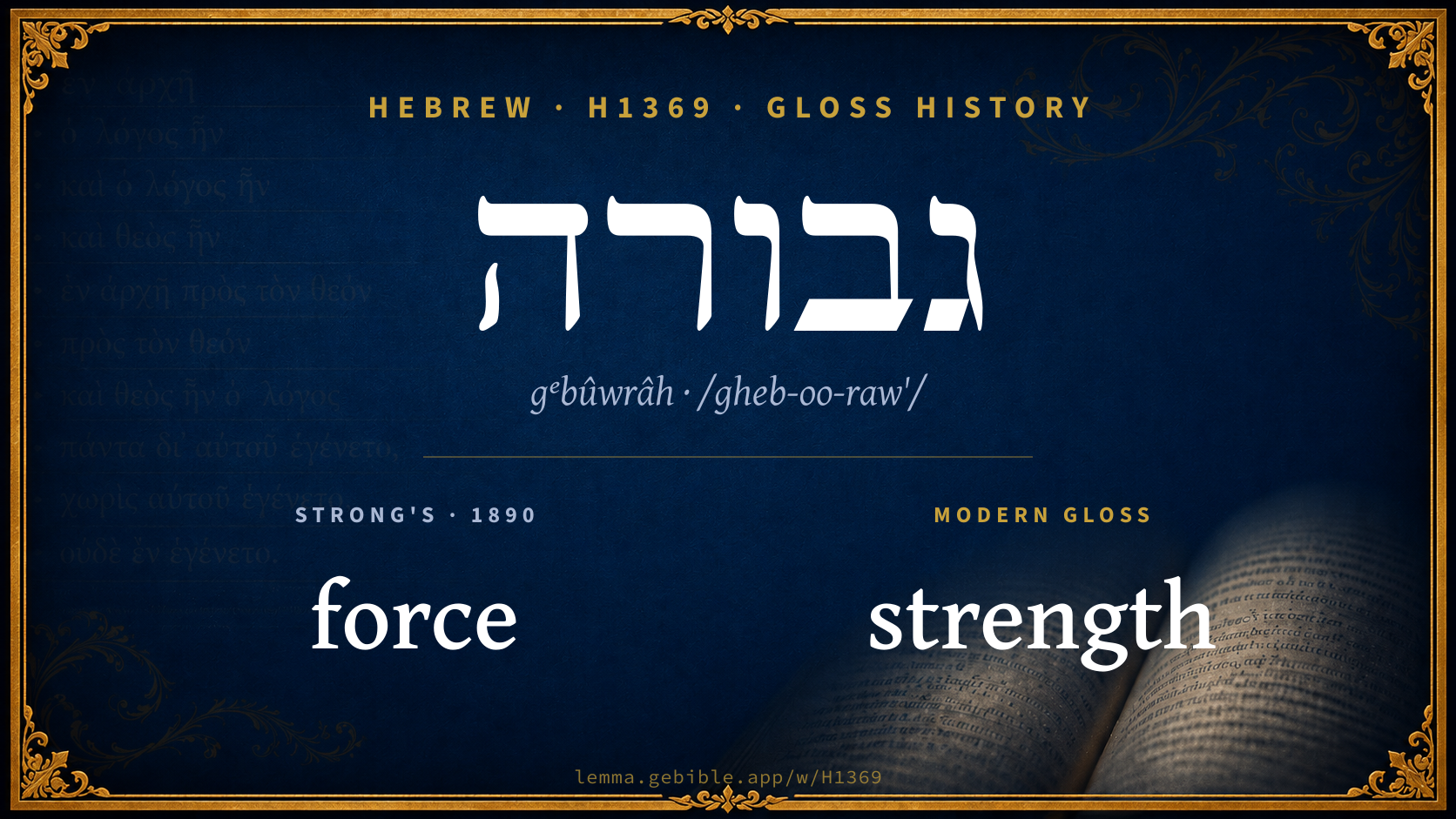
Gloss history
Strong's 1890 vs modern scholarship
About this word
Strong's H1369 catalogs a Hebrew word from the Hebrew Old Testament.
These counts are not copied from any lexicon or concordance. They are computed here, from the morphology-tagged Hebrew Old Testament. What Lemma adds →
- 61
- distinct verses
- The word appears in 61 distinct verses.
- 16 / 39
- OT books
- The word appears in 16 of 39 Old Testament books.
- #623
- by frequency
- Top 1000 most frequent Hebrew words (rank 623 of 8,640 Hebrew words by occurrence).
View all 61 occurrences in the concordance →
By section of the Old Testament
By traditional corpus
Conventional, traditional groupings — biblical authorship is debated, so this is a traditional corpus grouping, not an authorship claim. Each share is this word’s portion of its verses in that division of the Hebrew canon. Each figure is a share of the word’s 61 distinct verses.
- Prophets (Nevi'im) 30 verses · 49%
- Writings (Ketuvim) 29 verses · 48%
- Torah (Pentateuch) 2 verses · 3%
How translations render this word
Counts come from each version’s own published word-to-Strong’s tagging or interlinear alignment — an approximate guide to how each version renders this word, not a word-level alignment the data otherwise carries. Because each total is that version’s own tagged count, the per-version totals vary from one another and need not match the appearance or distinct-verse counts above. These counts may also differ from a printed concordance because Lemma counts each distinctly tagged rendering and does not collapse phrase taggings into a single head-word total. This is a fixed set of word-tagged versions (KJV, ASV, BSB, ULT) and does not change with the reading translation you choose elsewhere. Each version’s license is shown beside its name below (and on Sources).
- King James Version: Might 22×, Strength 12×, Power 8×
- American Standard Version: Might 27×, Strength 6×, All his might 3×
- Berean Standard Bible: Might 22×, Strength 13×, Power 8×
- unfoldingWord Literal Text: Might 30×, Strength 9×, Power 5×
King James Version Public Domain
Renders H1369 across 61 tagged occurrences — most commonly:
Plus 12 renderings that appear only once — usually multi-word phrases or single function words the recovered tagging swept in, not distinct renderings.
American Standard Version Public Domain
Renders H1369 across 61 tagged occurrences — most commonly:
Plus 16 renderings that appear only once — usually multi-word phrases or single function words the recovered tagging swept in, not distinct renderings.
Berean Standard Bible Public Domain
Renders H1369 across 60 tagged occurrences — most commonly:
Plus 12 renderings that appear only once — usually multi-word phrases or single function words the recovered tagging swept in, not distinct renderings. Not rendered by a distinct English word in 1 further occurrence.
unfoldingWord Literal Text CC BY-SA 4.0
Renders H1369 across 62 tagged occurrences — most commonly:
Plus 9 renderings that appear only once — usually multi-word phrases or single function words the recovered tagging swept in, not distinct renderings.
Senses in the full BDB
What do BDB’s symbols mean?
BDB uses these scholarly abbreviations:
| Symbol | Meaning |
|---|---|
| 𝔊 | the Septuagint (the ancient Greek translation, LXX) |
| 𝔙 | the Vulgate (the Latin translation) |
| 𝔖 | the Syriac version (the Peshitta) |
| 𝔗 | the Targum (the Aramaic translation) |
| ψ | the Psalms |
| √ | root (the underlying root or stem) |
| ‖ | parallel passage (a synonymous or contrasted parallel) |
| † | the dagger: every passage where the word occurs is cited |
The 3 senses and sub-senses the full Brown-Driver-Briggs lexicon distinguishes for this word, in lexicon order (not ranked by frequency), with BDB’s own verbatim wording and sub-sense lettering. Shown in Hebrew script with BDB’s own scholarly abbreviations. The condensed entry is in the Lexicon Entry tab. See also the Forms in the corpus table below.
- 1. strength, cf. horse Jb 39:19 ψ 147:10, crocodile Jb 41:4, sun Ju 5:31, body of man ψ 90:10 Ec 9:16; 10:17. e.g. Job 39:19
- 2. might, valour, of warriors Ju 8:21 Pr 8:14 Is 3:25; 28:6; 30:15 Je 9:22; 23:10; 49:35; 51:30 Ez 32:29, 30 Mi 3:8; 7:16; קוֹל עֲנוֹת גְּבוּרָה noise of shouting in warlike strength Ex 32:18 (E); עֵצָה וּגְבוּרָה 2 K 18:20 Is 11:2; 36:5; cf. phrases of compiler of Kings כֹּל גְּבוּרָתוֹ 1 K 15:23 2 K 10:34; 20:20; אֲשֶׁר עָשָׂה וּגְבוּרָתוֹ 1 K 16:5, 27; 22:46 2 K 13:8, 12; 14:15, 28; cf. also מַלְכוּתוֹ וּגְבוּרָתוֹ 1 Ch 29:30, תָקְפּוֹ וּגְבוּרָתוֹ Est 10:2. e.g. Judges 8:21
- 3. might of God Jb 26:14 ψ 21:14; 54:3; 65:7; 66:7; 71:18; 80:3; 89:14; 106:8; 145:11 Is 33:13 Je 10:6; 16:21; cf. phrases כח וגבורה 1 Ch 29:12 2 Ch 20:6, חכמה וג׳ Jb 12:13, משׁפט וג׳ Mi 3:8, הגדלה והג׳ 1 Ch 29:11; גְּבוּרוֹת mighty deeds of God Dt 3:24 ψ 20:7; 71:16; 106:2; 145:4, 12; 150:2 Is 63:15. e.g. Job 26:14
Senses from the full Brown-Driver-Briggs lexicon (Brown, Driver, Briggs; Oxford 1906 — public domain), digitized via Sefaria, supplemented by the OpenScriptures HebrewLexicon (CC BY 4.0). Full attribution on Sources.
Word origin
n.f. strength, might—Ex 32:18 + 16 times; cstr. גְּבוּרַת ψ 147:10; sf. גְּבוּרָתוֹ + (sfs. 32 times); pl. גְּבוּרוֹת Jb 41:4 + 3 times; גְּבֻרוֹת ψ 71:16; גְּבוּרֹתֶיךָ Dt 3:24 + (sfs. 6 times);—
— Brown-Driver-Briggs (Oxford 1906, public domain), digitized via Sefaria, supplemented by the OpenScriptures HebrewLexicon (CC BY 4.0). See Sources.
Derived from גבור (gibbôwr) (H1368) — mighty.
Jastrow Dictionary
A second Hebrew/Aramaic lexicon for comparison, covering Aramaic and post-biblical (Talmudic, Targumic, Midrashic) usage that the biblical-Hebrew BDB does not. Matched by lemma rather than by Strong’s number, so a lemma may carry more than one Jastrow headword (shown separately below), and the entries cover usage well beyond the Bible.
גְּבוּרָה
- 1. superiority, strength, might. Yoma 69ᵇ זו היא גְּבוּרָתוֹ Ms. M. (ed. גְּבוּרַת גבורתו) in this His strength consists (in His long-suffering). Kidd. 49ᵇ י׳ קבים ג׳ וכ׳ ten measures of bravery have come down into the world, nine of which the Persians have taken; Esth. R. to I, 3. Num. R. s. 10 (allud. to Koh. X, 17 a. Is. V, 22) ג׳ של תורה וכ׳ the strength (acquired by the study) of the Law consists in ‘happy’, the strength of wine in ‘woe’; a. fr.— הַגְּ׳ Divine Majesty, the Lord. Sabb. 87ᵃ. Ib. 88ᵇ, a. fr. מפי הג׳ from the mouth of the Lord. e.g. Ecclesiastes 10:17
- 3. high age, v. infra.—Pl. גְּבוּרוֹת 1) manifestations of Divine power, wonders. Yoma l. c. איה גְּבוּרוֹתָיו where are the evidences of His power (that we should call Him גבור)?—2) G’buroth, the second section of the T’fillah (v. אָבוֹת), praising the powers of the Lord, also called תְּחִיַית הַמֵּתִים. Y. Ber. IV, end, 8ᶜ this is the order &c. אבות וג׳ וכ׳ Aboth, G’buroth, and Kiddush hash-Shem (K’dushah).—ג׳ גְּשָׁמִים the power of rain, a clause praising the Lord for giving rains, inserted in G’buroth. Ber. V, 2 מזכירין ג׳ גש׳ we mention ‘the power of rain’, i.e. insert the clause, in ‘the Resurrection’, contrad. to the prayer for rain (שַׁאֲלָה). Taan. 2ᵃ מאי ג׳ גש׳ וכ׳ why is it named G’buroth G’shamim? Ans. מפני שיורדין בגבורה because the rains come down through (God’s) wonderful power (ref. to Job. V, 9—10).—3) (allusion to Ps. XC, 10) the age of eighty. M. Kat. 28ᵃ שמונים ג׳ (Ms. M. גבורה) ‘eighty years’ is called g’buroth (g’burah). Treat. S’maḥoth III, 8 מיתה של גבורה (Y. Bicc. II, 64ᶜ bot. של זקנה) a death of g’burah (at a high age); Ab. V, 21 בן שמנים לגבורה. M. Kat. l. c. הגיע לג׳ if one has reached the age of eighty. e.g. Job 5:9
A Dictionary of the Targumim, the Talmud Babli and Yerushalmi, and the Midrashic Literature (Marcus Jastrow; London, Luzac, 1903) — Public Domain. Digitized via Sefaria. Digitized via Sefaria. Full attribution on Sources.
Forms in the corpus
The 51 distinct written forms H1369 takes in the Hebrew Bible, most frequent first — each parse links to that state’s occurrences in the concordance. Hebrew forms include their vowel points and cantillation, so a single lemma takes many written forms.
Same root — word family
Other BDB entries built from the same root as H1369, grouped by Strong’s listed origin. These share a root / origin per the lexicon — not necessarily a shared meaning. Each links to that word’s own entry.
Derives from
Derived from this word
Compare all same-root words → They share a root, not necessarily a meaning.
Septuagint verse parallels
This word appears in 56 verses that also exist in the Greek Old Testament (Septuagint), out of the 61 Hebrew verses it occurs in. You can read those verses in Greek by switching the Old Testament edition to the Septuagint.
Read these verses in the Septuagint
- Exodus 32:18
- Deuteronomy 3:24
- Judges 5:31
- 1 Kings 15:23
- 2 Kings 10:34
- 1 Chronicles 29:11
- 2 Chronicles 20:6
- Esther 10:2
- Job 12:13
- Psalms 20:6
- Proverbs 8:14
- Ecclesiastes 9:16
This is a verse-level parallel only — the same verses exist in both the Hebrew and Greek Old Testaments. No word-level Hebrew↔Greek correspondence is claimed: the data carries no such alignment, so no Greek word is shown as this Hebrew word’s translation. Coverage is not total — the Septuagint omits the deuterocanon and renumbers the Psalms, so some Hebrew verses have no direct Greek parallel.