
Jeremiah 49:35

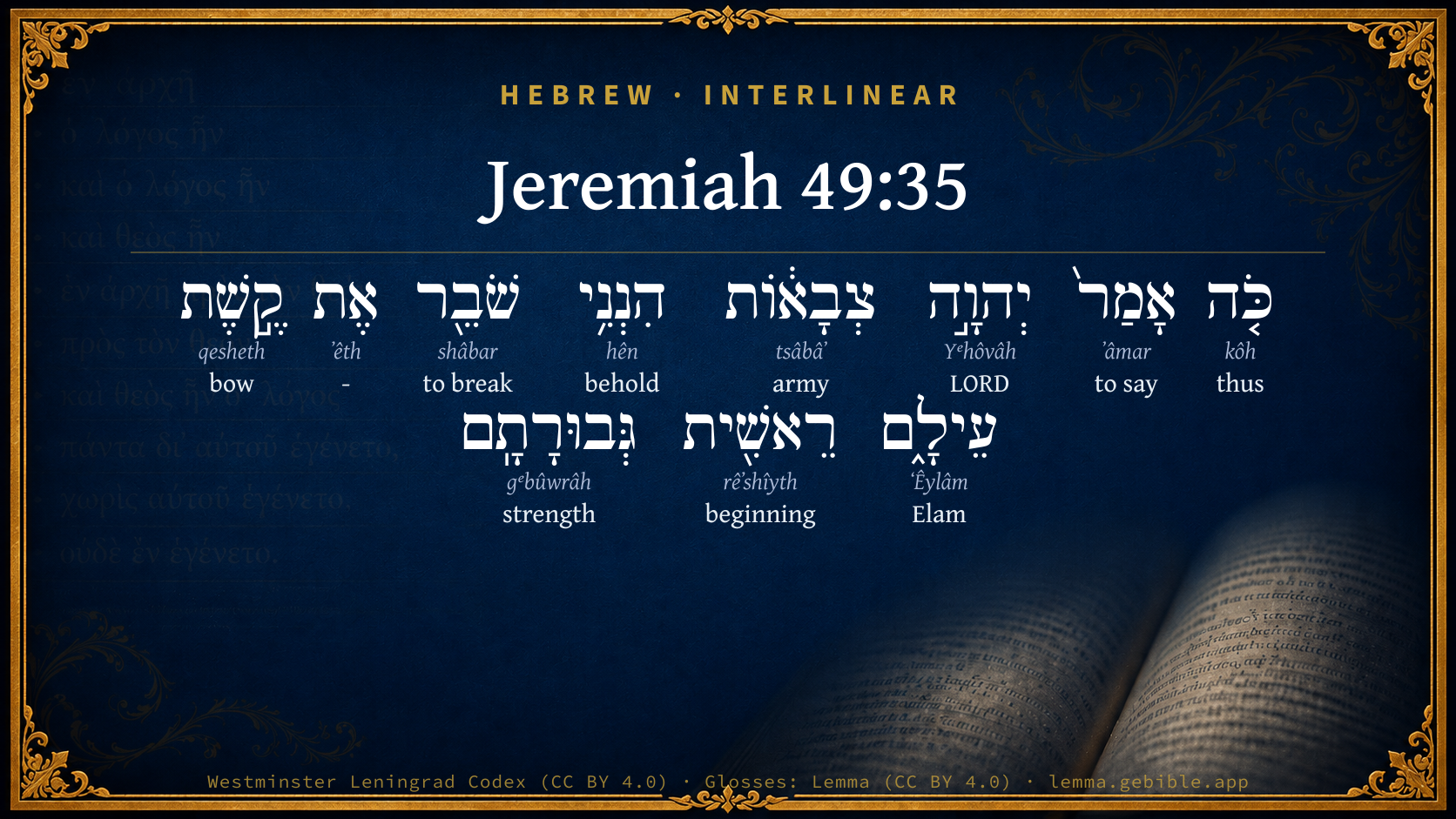
Hebrew (Westminster Leningrad Codex) Jeremiah 49:35 appears in the Hebrew Old Testament. The text above is from the Westminster Leningrad Codex. Each word links to its Strong’s number, a concise gloss, and parsing drawn from the Open Scriptures Hebrew Bible morphology. Click any word for its full Brown-Driver-Briggs (BDB) entry.
Download image
Cite this verse

Jeremiah 49:35 (World English Bible). Public Domain. Lemma interlinear Bible study tool, https://lemma.gebible.app/v/jeremiah/49/35.

Show BibTeX & RIS
BibTeX
RIS
English Translation
Thus says Yahweh of Hosts: Behold, I will break the bow of Elam, the chief of their might.
World English Bible · Public Domain
Download a study sheet

One document with this verse’s original text, its word-by-word gloss line, the meaning frame, cross-references with their text, attributed commentary, and full source and license credits — printable, and it pastes into notes with its structure intact.

This verse Autodidact and up

Study sheet (.html) Plain text (.txt)

A passage Seminary Student

Up to 50 verses in one chapter. A passage sheet keeps up to 6 commentary sources and 12 cross-references per verse, in the order this page ranks them, and says so on the sheet whenever that leaves anything out. Ask for a single verse and you get the Autodidact verse sheet above.

Everything on this page stays free to read, with no account — the sheet is a download of what is already on screen, not access to it.

Want to remove ads? Support Godless Engineer
Compare translations 3

The same verse in 3 English versions, stacked beneath the original-language interlinear above. Click any original word for its lexicon entry.

Each is an independent rendering of the whole verse — the interlinear is not word-aligned to these translations.

Highlighted words mark where these versions differ — a whole-verse word diff, not a word-by-word alignment.

  • World English Bible Public Domain
    Thus says Yahweh of Hosts: Behold, I will break the bow of Elam, the chief of their might.
  • King James Version Public Domain
    Thus saith the LORD of hosts; Behold, I will break the bow of Elam, the chief of their might.
  • unfoldingWord Literal Text CC BY-SA 4.0
    “Yahweh of hosts says this: See, I am about to break the bowmen of Elam, the main part of their power.

unfoldingWord Literal Text — © unfoldingWord, licensed CC BY-SA 4.0. Word-aligned USFM3 via Door43 (git.door43.org/unfoldingWord/en_ult).

Versions to compare (up to 4)

3 of 4 selected

Show all 18 translations

Every available English version of this verse, each an independent rendering of the whole verse.

  • World English Bible Public Domain
    Thus says Yahweh of Hosts: Behold, I will break the bow of Elam, the chief of their might.
  • Berean Standard Bible Public Domain
    This is what the LORD of Hosts says: “Behold, I will shatter Elam’s bow, the mainstay of their might.
  • Majority Standard Bible Public Domain
    This is what the LORD of Hosts says: “Behold, I will shatter Elam’s bow, the mainstay of their might.
  • King James Version Public Domain
    Thus saith the LORD of hosts; Behold, I will break the bow of Elam, the chief of their might.
  • American Standard Version (1901) Public Domain
    Thus saith Jehovah of hosts: Behold, I will break the bow of Elam, the chief of their might.
  • Revised Version (1885) Public Domain
    Thus saith the LORD of hosts: Behold, I will break the bow of Elam; the chief of their might.
  • Geneva Bible (1599) Public Domain
    Thus sayeth the Lord of hostes, Beholde, I will breake the bowe of Elam, euen the chiefe of their strength.
  • Douay-Rheims (1899) Public Domain
    Thus saith the Lord of hosts: Behold I will break the bow of Elam, and their chief strength.
  • Young's Literal Translation Public Domain
    `Thus said Jehovah of Hosts: Lo, I am breaking the bow of Elam, The beginning of their might.
  • Literal Standard Version CC BY-SA 4.0
    “Thus said YHWH of Hosts: Behold, I am breaking the bow of Elam, || The beginning of their might.
  • Unlocked Literal Bible CC BY-SA 4.0
    “Yahweh of hosts says this: See, I am about to break the bowmen of Elam, the main part of their power.
  • unfoldingWord Literal Text CC BY-SA 4.0
    “Yahweh of hosts says this: See, I am about to break the bowmen of Elam, the main part of their power.
  • Darby Bible Public Domain
    Thus saith Jehovah of hosts: Behold, I will break the bow of Elam, the chief of their might.
  • World Messianic Bible Public Domain
    “The LORD of Hosts says: ‘Behold, I will break the bow of Elam, the chief of their might.
  • Webster's Bible Public Domain
    Thus saith the LORD of hosts; Behold, I will break the bow of Elam, the chief of their might.
  • Free Bible Version CC BY-SA 4.0
    This is what the Lord Almighty says: Look! I'm going to smash the bows of the Elamites, the weapon they rely on for their power.
  • Bible in Basic English Public Domain
    This is what the Lord of armies has said: See, I will have the bow of Elam, their chief strength, broken.
  • JPS Tanakh (1917) Public Domain
    Thus saith the LORD of hosts: Behold, I will break the bow of Elam, the chief of their might.

Literal Standard Version (2020), Covenant Press — licensed CC BY-SA 4.0. Text via the HelloAO Bible API (eBible.org). Unlocked Literal Bible (unfoldingWord) — licensed CC BY-SA 4.0. Text via the HelloAO Bible API (eBible.org). unfoldingWord Literal Text — © unfoldingWord, licensed CC BY-SA 4.0. Word-aligned USFM3 via Door43 (git.door43.org/unfoldingWord/en_ult). Free Bible Version, Dr. Jonathan Gallagher — licensed CC BY-SA 4.0. Text via the HelloAO Bible API (eBible.org).

Word by word

More ways to search: Search by grammar → Find every occurrence → Compare this word →

Practice this passage: Drill this verse → Learn its vocabulary →

עֵילָ֑ם
ʻÊylâm
H5867
“Elam”
Noun, Proper
Part of Speech
Noun
Type
Proper
Full BDB Definition

Origin: probably from H5956

TWOT: None

Elam = "eternity" - a Korhite Levite in the time of David (noun proper masculine) - a chief man of the tribe of Benjamin (noun proper masculine) - ancestor of a family of exiles who returned with Zerubbabel (noun proper masculine) - a chief of the people who signed the covenant with Nehemiah (noun proper masculine) - another ancestor of another family of exiles who returned with Zerubbabel (noun proper masculine) - a priest who assisted at the dedication of the wall of Jerusalem in the time of Nehemiah (noun proper masculine) - another head of a family of returning exiles (noun proper masculine) - a province east of Babylon and northeast of the lower Tigris (noun proper locative)
  1. כֹּ֤ה kôh H3541 “thus” Adverb
  2. אָמַר֙ ʼâmar H559 “to say” Verb, Qal, Perfect, 3rd Person, Masculine, Singular
  3. יְהוָ֣ה Yᵉhôvâh H3068 “LORD” Noun, Proper
  4. צְבָא֔וֹת tsâbâʼ H6635 “armies” Noun, Common, Both, Plural, Absolute
  5. הִנְנִ֥י hên H2005 “behold · me” Particle, Demonstrative + Suffix, Personal, 1st Person, Common, Singular
  6. שֹׁבֵ֖ר shâbar H7665 “breaking” Verb, Qal, Participle Active, Masculine, Singular, Absolute
  7. אֶת ʼêth H853 “-” Particle, Direct Object
  8. קֶ֣שֶׁת qesheth H7198 “bow of” Noun, Common, Feminine, Singular, Construct
  9. רֵאשִׁ֖ית rêʼshîyth H7225 “beginning of” Noun, Common, Feminine, Singular, Construct
  10. גְּבוּרָתָֽם gᵉbûwrâh H1369 “strength · their” Noun, Common, Feminine, Singular, Construct + Suffix, Personal, 3rd Person, Masculine, Plural

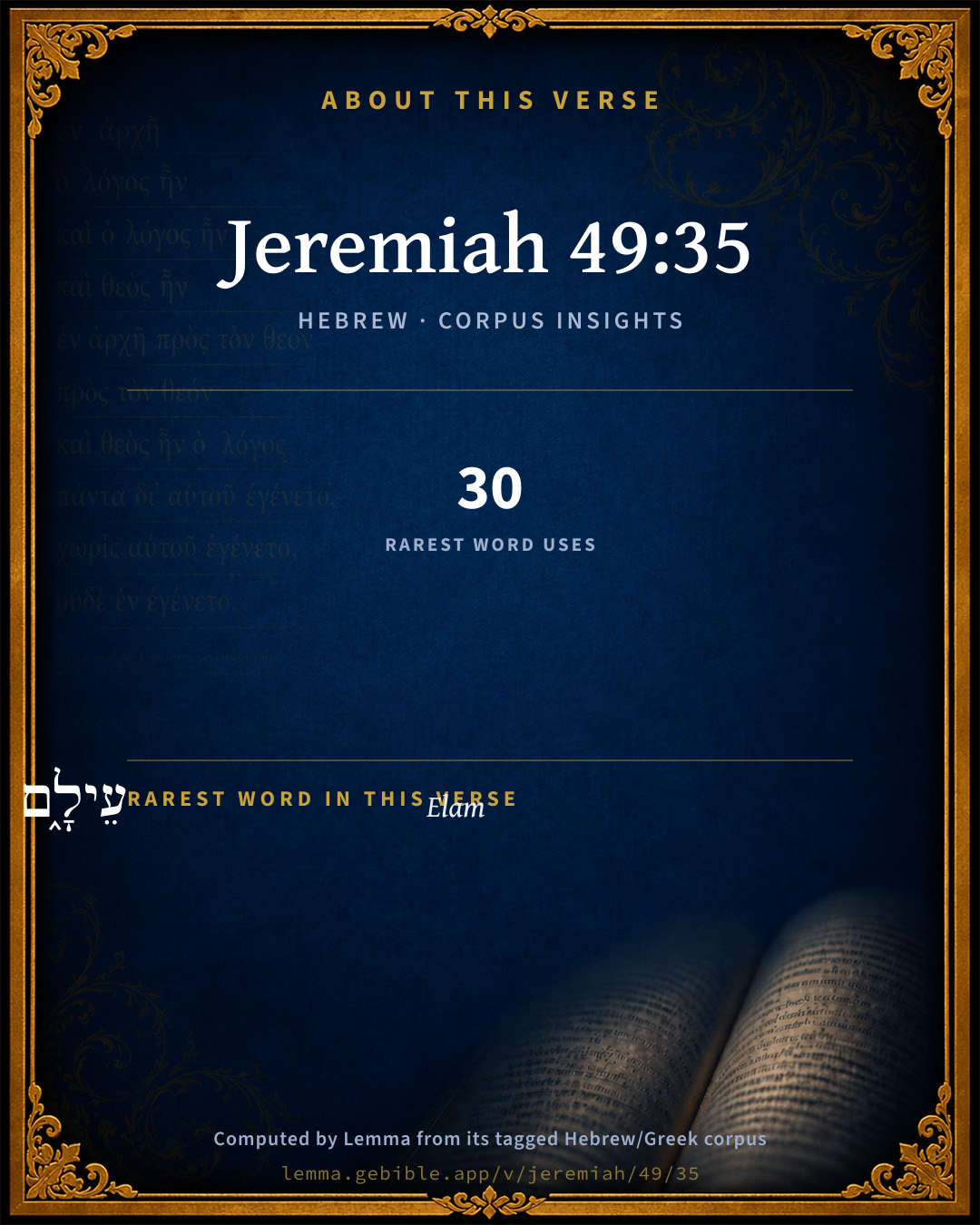
About this verse

These counts appear in no published source. They are computed here, from the morphology-tagged text and Lemma’s own curated glosses. What Lemma adds →

11
words
11
distinct lemmas
Prophets
section

Shared distinctive vocabulary

עֵילָ֑ם Elam H5867 occurs in 27 verses of the Hebrew Bible. Also found in:

Grammatical profile

  • 2 verbs
  • 6 nouns
  • 1 adverb
  • 2 particles

Verb forms

  • אָמַר֙ Qal · Perfect
  • שֹׁבֵ֖ר Qal · Participle Active

Cross-references

5

Topical passages linked to Jeremiah 49:35 in the Treasury of Scripture Knowledge — connected by theme and wording, ordered by reader-vote popularity; previews shown in the World English Bible.

  • Isaiah 22:6 Elam bore the quiver, with chariots of men [and] horsemen; and Kir uncovered the shield.
  • Psalms 46:9 He makes wars cease to the end of the earth. He breaks the bow, and shatters the spear. He burns the chariots in the fire.
  • Jeremiah 51:56 for the destroyer is come on her, even on Babylon, and her mighty men are taken, their bows are broken in pieces; for Yahweh is a God of recompenses, he will surely requite.
  • Jeremiah 50:14 Set yourselves in array against Babylon round about, all you who bend the bow; shoot at her, spare no arrows: for she has sinned against Yahweh.
  • Jeremiah 50:29 Call together the archers against Babylon, all those who bend the bow; encamp against her round about; let none of it escape: recompense her according to her work; according to all that she has done, do to her; for she has been proud against Yahweh, against the Holy One of Israel.

Cross-references courtesy of OpenBible.info (CC BY 4.0).

Hebrew and Greek witnesses Masoretic Hebrew ↔ Greek Septuagint

The same verse in the two great witnesses to the Old Testament, shown verse-for-verse.

These are two independent witnesses, not word-aligned to each other, and the Septuagint is shown in lemma (dictionary) form.

Hebrew Jeremiah 49:35 Masoretic · Westminster Leningrad Codex

כֹּ֤ה אָמַר֙ יְהוָ֣ה צְבָא֔וֹת הִנְנִ֥י שֹׁבֵ֖ר אֶת קֶ֣שֶׁת עֵילָ֑ם רֵאשִׁ֖ית גְּבוּרָתָֽם

Thus says Yahweh of Hosts: Behold, I will break the bow of Elam, the chief of their might.

World English Bible · Public Domain

Greek LXX Structure differs

In the Septuagint, Jeremiah is about an eighth shorter than the Hebrew and arranges its material differently — the Oracles Against the Nations (Hebrew chapters 46–51) appear in the middle of the Greek book, after 25:13. Because the chapter and verse boundaries do not line up, a verse-for-verse comparison with the Hebrew is not shown.

A verse-for-verse comparison isn’t shown here because the chapters and verses don’t line up. Switch to the LXX edition with the MT / LXX toggle above to read the Greek directly.

Hebrew: Westminster Leningrad Codex (CC BY 4.0). Greek: Septuagint (public domain); English from a public-domain English Septuagint. How the Septuagint differs from the Hebrew →

Targum (Aramaic paraphrase)

1

The Targum is the ancient Jewish Aramaic paraphrase of the Hebrew Scriptures — an interpretive translation, not the Hebrew text itself. Onkelos (literal) and Pseudo-Jonathan (expansive) render the Torah, and Jonathan the Prophets. Coverage is partial: where no permissively-licensed English translation exists for a verse, only the Aramaic is shown. This is verse-level text, not a word-by-word alignment to the Hebrew.

  1. Targum Jonathan Prophets (Joshua–Malachi)
    כִּדְנַן אֲמַר יְיָ צְבָאוֹת הָא אֲנָא תְבַר יַת תְּקוֹף עֵילָם רֵישׁ גִבָּרוּתְהוֹן:

    (no public-domain English translation for this verse)

    Targum Jonathan — Aramaic: “Mikraot Gedolot” (public domain). English: “Sefaria Community Translation” (CC0 1.0 (public-domain dedication)); “London "Chaldee Paraphrase," 1871” (public domain). Text via Sefaria.

Commentary

Notes on Jeremiah 49:35 from classic Christian and Jewish commentators (each source and its license shown beneath its notes). The classic Christian expositions comment on the surrounding passage and are grouped to its opening verse, so a note may address several verses; the Jewish commentaries on the Tanakh (Rashi and others) are per-verse, so they appear only where the commentator wrote on this verse.

Lemma curates 59 commentaries, every one of them public domain or Creative Commons licensed, each selected and text-cleaned for this edition rather than reprinted as found. About our sources →

Trapp's Complete Commentary

John Trapp

Jer 49:35 Thus saith the LORD of hosts; Behold, I will break the bow of Elam, the chief of their might.

Ver. 35. Behold, I will break the bow of Elam.] In the use whereof they excelled, being very skilful archers. {Isa 22:6} Guns today carry it as bows of old.

John Trapp, A Commentary or Exposition upon All the Books of the Old and New Testament (1647–1656) — public domain. Text from a community e-Sword module.

Joseph Benson's Commentary

Jer 49:35-38. Behold, I will break the bow of Elam — The Elamites were famous archers, as this expression intimates, as also Isaiah’s words, Isa 22:6; And Elam bare the quiver. Strabo also says, that the mountainous parts of Elymais bred chiefly archers; στρατιωτας τρεφει τοξοτας τους πλειστους, lib. 16. p. 744. Livy, and other heathen writers, also speak of the Elymæan archers. Upon Elam will I bring the four winds, &c. — I will bring enemies upon Elam from every quarter; and scatter them to every quarter. Wars and commotions are metaphorically denoted by winds. And I will send the sword after them — Even after they are driven out of their own country, my judgments shall pursue them. And I will set my throne in Elam — As Nebuchadnezzar acted under the commission of God, and had authority from him to conquer this and the neighbouring nations, and is called God’s servant, the establishing of his power was in effect the setting up of the throne or dominion of Jehovah. Some, however, think this is spoken of the Persian monarchy, established there by Cyrus, who is expressly called, in Scripture, God’s anointed one, whom he had particularly chosen.

Joseph Benson's Commentary on the Old and New Testaments (1811–1818) — public domain. Text from a community e-Sword module.

Tyndale Open Study Notes

Tyndale Open Resources

49:35 The Elamite warriors were expert archers, but their skills could not save Elam.

Tyndale Open Study Notes — © Tyndale Open Resources, licensed CC BY-SA 4.0. Text via the HelloAO Bible API.

Geneva Bible (1599)

Geneva Bible translators

Because the Persians were good archers, he showeth that the thing wherein they put their trust, should not profit them.

Geneva Bible (1599) marginal notes — public domain. Text via Bolls.life.

Jamieson, Fausset & Brown

Robert Jamieson, A. R. Fausset & David Brown

bow--Elam was famed for its bowmen (Isa 22:6).

chief of their might--in opposition to "bow," that is, bowmen, who constituted their main strength.

Jamieson, Fausset & Brown — Commentary Critical and Explanatory on the Whole Bible (1871) — public domain (CC PDM 1.0). Text via the HelloAO Bible API.

Adam Clarke's Commentary

Verse 35. I will break the bow of Elam] They were eminent archers; and had acquired their power and eminence by their dexterity in the use of the bow. See Isa 22:6. Strabo, Livy, and others speak of their eminence in archery.

Adam Clarke's Commentary on the Bible (1810–1826) — public domain. Text from a community e-Sword/MySword module.

John Calvin's Commentaries

Then God, in the first place, declares that he would break the bow of Elam The Parthians and other Orientals, we know, were very skillful archers; for every nation possesses its own peculiar excellency in connection with war. Some excel in the use of one kind of weapons, and others in the use of another kind. Formerly light infantry were in high repute among the Italians; the Gauls excelled in mailed horsemen. Though, now, all things are changed, yet still every nation differs as to its peculiar art in war. Now historians testify that the Orientals were very skillful in the use of the bow and arrow. It is, then, no wonder that the Prophet speaks of the bow of this people, and calls it the chief part of their strength, as they excelled in this sort of fighting. The Parthians were indeed much dreaded by the Romans; they pretended to flee, and then they turned back and made an impetuous attack on their enemies. They had also arrows dipped in poison. By these means they conquered large armies. For the Romans laid by their darts and fought hand in hand, and carried on a standing fight, so to speak; but when the Parthians kept discharging their arrows, they almost always fought unsuccessfully with them. I refer to this, that we may know that the bow was not without reason called the chief of their might, for it was by it that they were superior to other nations, though they could not fight hand in hand nor with drawn swords. It afterwards follows —

John Calvin's Commentaries (1540-1563) — public domain. Text from the Calvin Translation Society English edition (1840s-50s) via the Christian Classics Ethereal Library (ccel.org). Calvin's coverage is partial (roughly two-thirds of the Bible); uncommented books and verses are honest gaps, never fabricated. The 19th-century editor's footnotes and remarks are omitted so the notes are faithfully Calvin's own voice.

Ellicott's Commentary for English Readers

(35) I will break the bow of Elam.—As in Isa_22:6; Herod. vii. 61, Elam was conspicuous for its archers. We are reminded of the account which Herodotus gives (ii. 136) of the three things taught to the youth of Persia—to ride, to draw the bow, and to speak the truth. This weapon was “the chief of their might.”

A Bible Commentary for English Readers, edited by Charles John Ellicott (1878–1897) — public domain. Text from a community e-Sword module.

The Cambridge Bible for Schools and Colleges

gen. ed. J. J. S. Perowne

35. the bow of Elam] For Elam’s prowess with the bow cp. Isa_22:6.

The Cambridge Bible for Schools and Colleges (gen. ed. J. J. S. Perowne; Cambridge University Press, 1878–1918) — public domain. Text from a community e-Sword module.

John Gill's Exposition

Thus saith the Lord of hosts, I will break the bow of Elam,.... The inhabitants of this country were famous for their skill in archery; See Gill on Isa 22:6; this the Lord threatens to break, so that it, should be useless, and of no more service to them to defend themselves, or annoy others. Their strength, as the Targum; that in which their great strength and security lay; in which they put their trust and confidence, as follows:

the chief of their might; which may be interpreted, by way of apposition, of their bow, the chief instrument of their might and power; or may design their mighty men, the archers themselves, who should be destroyed, even Elam itself, and all the inhabitants of it; especially their warriors, who should be slain or carried captive.

John Gill's Exposition of the Whole Bible (1746–1763) — public domain (CC PDM 1.0). Text via the HelloAO Bible API.

Albert Barnes' Notes on the Bible

The bow was the national weapon of Elam, and therefore the “chief of their might,” that on which their strength in war depended.

Albert Barnes' Notes on the Bible (1834–1885) — public domain. Text from a community e-Sword/MySword module.

Matthew Poole's English Annotations

All those Eastern people were famous for the use of the bow, the Elamites in special, Isa 22:6; those bows were the chief of their offensive armour, though by the chief of their might may also be meant their most mighty and strong warriors. This prophecy is probably judged to be fulfilled when the Persians made a defection from the king of the Medes, who was son-in-law to Nebuchadnezzar. Others think that this prophecy was accomplished by Alexander the emperor of Greece, or rather by his successors.

Matthew Poole's English Annotations on the Holy Bible (1683–1685) — public domain. Text from a community e-Sword/MySword module.

Whedon's Commentary on the Bible

Daniel D. Whedon

35. Bow of Elam — The national weapon of the Elamites.

Daniel D. Whedon (gen. ed.), Commentary on the Old and New Testaments (1874–1909) — public domain. Text from a community e-Sword module.

The Pulpit Commentary

The bow of Elam. So Isaiah in prophetic vision, "And Elam bare the quiver". (Jer_22:6)

The Pulpit Commentary (1880–1919), ed. H.D.M. Spence-Jones & Joseph S. Exell — public domain. Text from a community e-Sword module.

Rashi

Rabbi Shlomo Yitzchaki (Rashi)

the bow of Elam The might of Elam (other editions: the strength of Elam).

the chief of their might The best of their might.

Rashi on the Tanakh — English translations: “The Judaica Press complete Tanach with Rashi, translated by A. J. Rosenberg” (CC BY 4.0); “Pentateuch with Rashi's commentary by M. Rosenbaum and A.M. Silbermann, 1929-1934” (public domain); “The Metsudah Tanach series, Lakewood, N.J” (CC BY 4.0); and “The Book of Joshua, Metsudah Publications, 1997” (CC BY 4.0). Text via Sefaria.

Lesson kit

Teaching starters — assembled from the data on this page, not authored interpretation. Every prompt links to the verse data it draws on. Edit before teaching.

Jeremiah, in the Prophets, opens this verse with 11 words (11 distinct Hebrew lemmas). Its most distinctive word is ʻÊylâm (“Elam”). A historical commentator’s framing appears above. Read the whole chapter for the surrounding context.

Discussion questions

  1. The word ʻÊylâm carries the sense “Elam.” How does it shape the verse?
  2. Genesis 10:22 shares the word «Elam» with this verse. How do the two illuminate each other?
  3. These translations render this verse differently; the difference is in the English rendering, not the original. What questions does that raise?
  4. The verb «אָמַר֙» is Qal Perfect. How does its form color the action?
  5. Reading how Trapp's Complete Commentary and Joseph Benson's Commentary read this verse, where do the two commentators agree and where do they part?

Things to notice

Reading settings

Reading text

Shown beneath each verse's original-language words.

Old Testament
Old Testament edition

Read the OT as the Masoretic Hebrew (MT) or the Greek Septuagint (LXX).

English shown for the Greek Septuagint (in the Hebrew ↔ Greek comparison).

Comparing translations? Open the Compare panel on any verse page to stack up to four side by side.