
Psalms 106:2

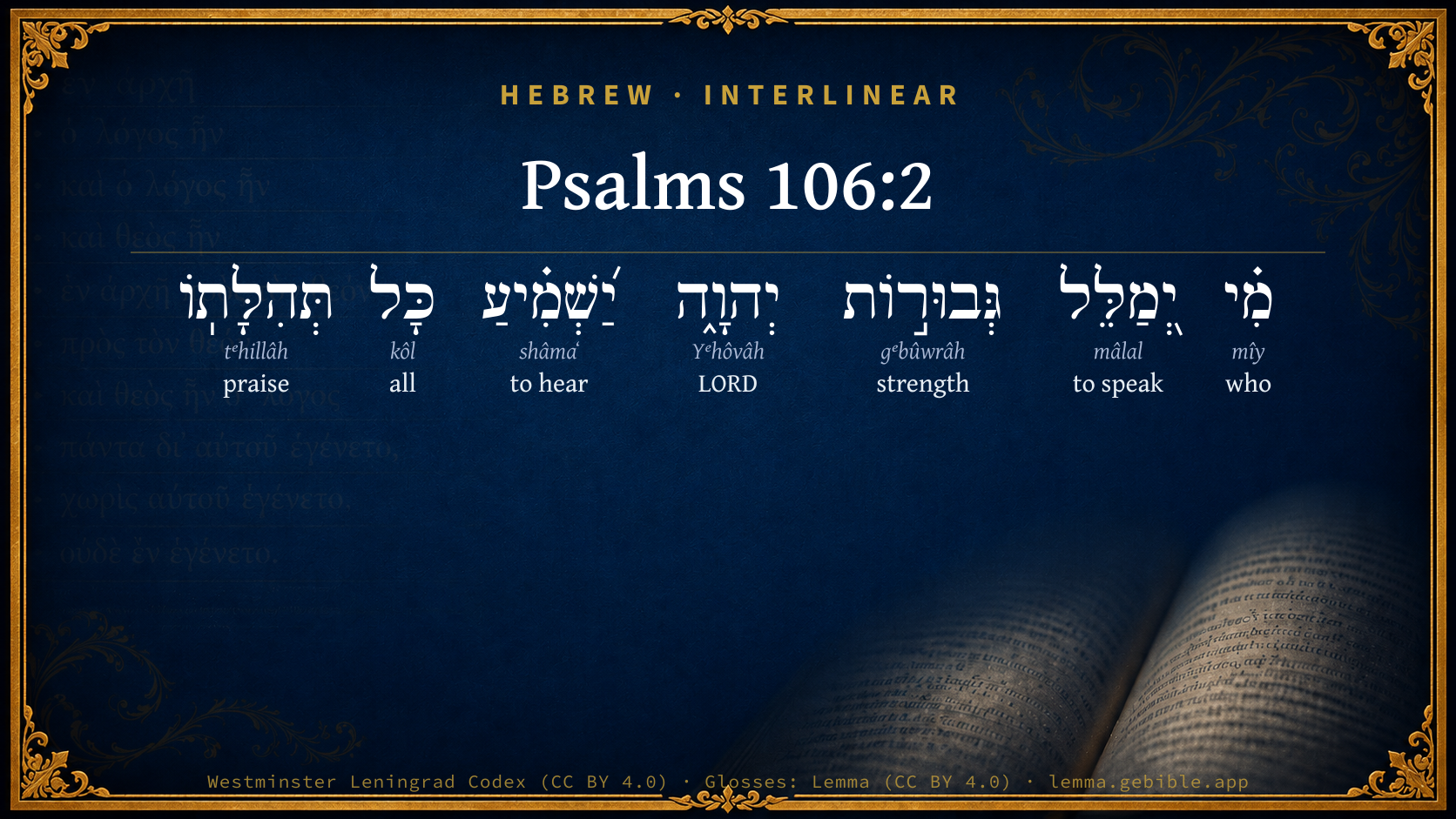
Hebrew (Westminster Leningrad Codex) Psalms 106:2 appears in the Hebrew Old Testament. The text above is from the Westminster Leningrad Codex. Each word links to its Strong’s number, a concise gloss, and parsing drawn from the Open Scriptures Hebrew Bible morphology. Click any word for its full Brown-Driver-Briggs (BDB) entry.
Download image
Cite this verse

Psalms 106:2 (World English Bible). Public Domain. Lemma interlinear Bible study tool, https://lemma.gebible.app/v/psalms/106/2.

Show BibTeX & RIS
BibTeX
RIS
English Translation
Who can utter the mighty acts of Yahweh, Or fully declare all his praise?
World English Bible · Public Domain
Download a study sheet

One document with this verse’s original text, its word-by-word gloss line, the meaning frame, cross-references with their text, attributed commentary, and full source and license credits — printable, and it pastes into notes with its structure intact.

This verse Autodidact and up

Study sheet (.html) Plain text (.txt)

A passage Seminary Student

Up to 50 verses in one chapter. A passage sheet keeps up to 6 commentary sources and 12 cross-references per verse, in the order this page ranks them, and says so on the sheet whenever that leaves anything out. Ask for a single verse and you get the Autodidact verse sheet above.

Everything on this page stays free to read, with no account — the sheet is a download of what is already on screen, not access to it.

Want to remove ads? Support Godless Engineer
Compare translations 3

The same verse in 3 English versions, stacked beneath the original-language interlinear above. Click any original word for its lexicon entry.

Each is an independent rendering of the whole verse — the interlinear is not word-aligned to these translations.

Highlighted words mark where these versions differ — a whole-verse word diff, not a word-by-word alignment.

  • World English Bible Public Domain
    Who can utter the mighty acts of Yahweh, Or fully declare all his praise?
  • King James Version Public Domain
    Who can utter the mighty acts of the LORD? who can shew forth all his praise?
  • unfoldingWord Literal Text CC BY-SA 4.0
    Who can utter the mighty acts of Yahweh, proclaim all of his praise?

unfoldingWord Literal Text — © unfoldingWord, licensed CC BY-SA 4.0. Word-aligned USFM3 via Door43 (git.door43.org/unfoldingWord/en_ult).

Versions to compare (up to 4)

3 of 4 selected

Show all 18 translations

Every available English version of this verse, each an independent rendering of the whole verse.

  • World English Bible Public Domain
    Who can utter the mighty acts of Yahweh, Or fully declare all his praise?
  • Berean Standard Bible Public Domain
    Who can describe the mighty acts of the LORD or fully proclaim His praise?
  • Majority Standard Bible Public Domain
    Who can describe the mighty acts of the LORD or fully proclaim His praise?
  • King James Version Public Domain
    Who can utter the mighty acts of the LORD? who can shew forth all his praise?
  • American Standard Version (1901) Public Domain
    Who can utter the mighty acts of Jehovah, Or show forth all his praise?
  • Revised Version (1885) Public Domain
    Who can utter the mighty acts of the LORD, or shew forth all his praise?
  • Geneva Bible (1599) Public Domain
    Who can expresse the noble actes of the Lord, or shewe forth all his prayse?
  • Douay-Rheims (1899) Public Domain
    Who shall declare the powers of the Lord? who shall set forth all his praises?
  • Young's Literal Translation Public Domain
    Who doth utter the mighty acts of Jehovah? Soundeth all His praise?
  • Literal Standard Version CC BY-SA 4.0
    Who utters the mighty acts of YHWH? Sounds all His praise?
  • Unlocked Literal Bible CC BY-SA 4.0
    Who can recount the mighty acts of Yahweh or proclaim in full all his praiseworthy deeds?
  • unfoldingWord Literal Text CC BY-SA 4.0
    Who can utter the mighty acts of Yahweh, proclaim all of his praise?
  • Darby Bible Public Domain
    Who can utter the mighty acts of Jehovah? [who] can shew forth all his praise?
  • World Messianic Bible Public Domain
    Who can utter the mighty acts of the LORD, or fully declare all his praise?
  • Webster's Bible Public Domain
    Who can utter the mighty acts of the LORD? who can show forth all his praise?
  • Free Bible Version CC BY-SA 4.0
    Who can give an account of all the wonderful things the Lord has done? Who can give him all the praise he is due?
  • Bible in Basic English Public Domain
    Who is able to give an account of the great acts of the Lord, or to make clear all his praise?
  • JPS Tanakh (1917) Public Domain
    Who can express the mighty acts of the LORD, or make all His praise to be heard?

Literal Standard Version (2020), Covenant Press — licensed CC BY-SA 4.0. Text via the HelloAO Bible API (eBible.org). Unlocked Literal Bible (unfoldingWord) — licensed CC BY-SA 4.0. Text via the HelloAO Bible API (eBible.org). unfoldingWord Literal Text — © unfoldingWord, licensed CC BY-SA 4.0. Word-aligned USFM3 via Door43 (git.door43.org/unfoldingWord/en_ult). Free Bible Version, Dr. Jonathan Gallagher — licensed CC BY-SA 4.0. Text via the HelloAO Bible API (eBible.org).

Word by word

More ways to search: Search by grammar → Find every occurrence → Compare this word →

Practice this passage: Drill this verse → Learn its vocabulary →

About this verse

These counts appear in no published source. They are computed here, from the morphology-tagged text and Lemma’s own curated glosses. What Lemma adds →

7
words
7
distinct lemmas
Wisdom
section

Notable vocabulary

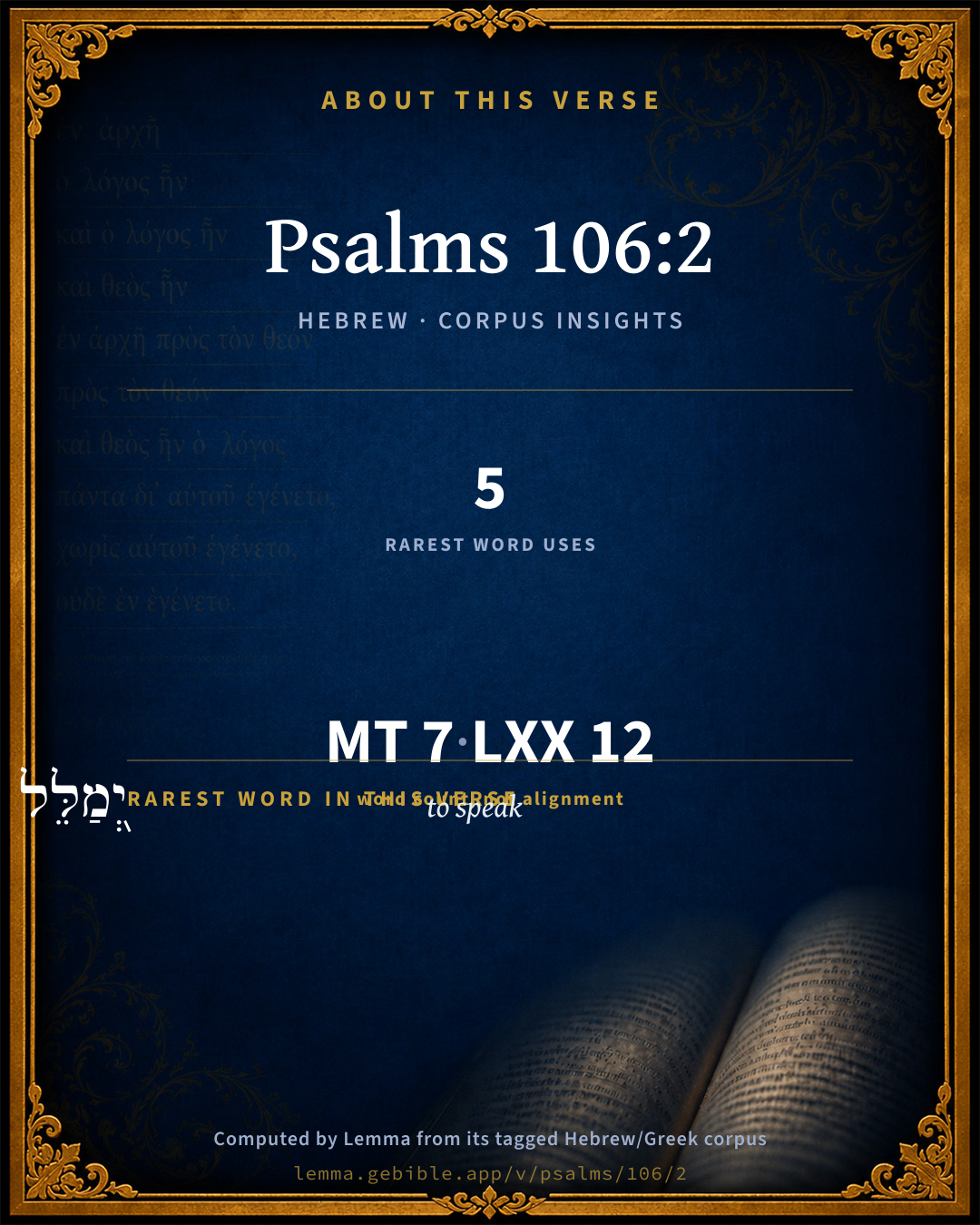
The rarest word here is יְ֭מַלֵּל to speak H4448 — appearing just 5 times in the whole Hebrew Bible.

Shared distinctive vocabulary

יְ֭מַלֵּל to speak H4448 occurs in 5 verses of the Hebrew Bible. Also found in:

Grammatical profile

  • 2 verbs
  • 4 nouns
  • 1 particle

Verb forms

  • יְ֭מַלֵּל Piel · Imperfect
  • יַ֝שְׁמִ֗יעַ Hiphil · Imperfect

Hebrew & Septuagint length

In English translation the verse runs 14 words from the Hebrew and 18 from the Septuagint (LXX English) — closely comparable.

A rough comparison of the two English renderings, which tokenize alike — not a word-level alignment.

Word counts can differ between the Hebrew and the Greek without any difference in meaning — e.g. the Hebrew direct-object marker אֵת has no separate Greek word, and Greek often adds the article ὁ.

In the original languages it is 7 Hebrew tokens and 12 Greek tokens — but the two are counted differently (Hebrew bundles its prefixes and suffixes into one token; the Greek is in lemma form), so that isn’t a like-for-like length.

Cross-references

9

Topical passages linked to Psalms 106:2 in the Treasury of Scripture Knowledge — connected by theme and wording, ordered by reader-vote popularity; previews shown in the World English Bible.

  • Romans 11:33 Oh the depth of the riches both of the wisdom and the knowledge of God! How unsearchable are his judgments, and his ways past tracing out!
  • Ephesians 1:19 and what is the exceeding greatness of his power toward us who believe, according to that working of the strength of his might
  • Psalms 139:17–18 How precious to me are your thoughts, God! How vast is the sum of them!
  • Psalms 145:3–12 Great is Yahweh, and greatly to be praised! His greatness is unsearchable.
  • Nehemiah 9:5 Then the Levites, Jeshua, and Kadmiel, Bani, Hashabneiah, Sherebiah, Hodiah, Shebaniah, [and] Pethahiah, said, Stand up and bless Yahweh your God from everlasting to everlasting; and blessed be your glorious name, which is exalted above all blessing and praise.
  • Job 5:9 Who does great things that can't be fathomed, Marvelous things without number;
  • Job 26:14 Behold, these are but the outskirts of his ways. How small a whisper do we hear of him! But the thunder of his power who can understand?"
  • Psalms 40:5 Many, Yahweh, my God, are the wonderful works which you have done, And your thoughts which are toward us. They can't be set in order to you; If I would declare and speak of them, they are more than can be numbered.
  • Ephesians 3:18 may be strengthened to comprehend with all the saints what is the breadth and length and height and depth,

Cross-references courtesy of OpenBible.info (CC BY 4.0).

Hebrew and Greek witnesses Masoretic Hebrew ↔ Greek Septuagint

The same verse in the two great witnesses to the Old Testament, shown verse-for-verse.

You’re reading Greek Psalm 105 (Hebrew Psalm 106). The Septuagint counts the superscription, so verse numbers can differ from the Hebrew — chapter-level alignment, not verse-by-verse. Numbering follows Rahlfs.

These are two independent witnesses, not word-aligned to each other, and the Septuagint is shown in lemma (dictionary) form.

Hebrew Psalms 106:2 Masoretic · Westminster Leningrad Codex

מִ֗י יְ֭מַלֵּל גְּבוּר֣וֹת יְהוָ֑ה יַ֝שְׁמִ֗יעַ כָּל תְּהִלָּתֽוֹ

Who can utter the mighty acts of Yahweh, Or fully declare all his praise?

World English Bible · Public Domain

Greek LXX Greek Psalm 105:2 Septuagint · lemma form

τίς λαλέω ὁ δυναστεία ὁ κύριος ἀκουστός ποιέω πᾶς ὁ αἴνεσις αὐτός

Who shall tell the mighty acts of the Lord? who shall cause all his praises to be heard?

LXX2012 (modern English Septuagint) · Public Domain

Hebrew: Westminster Leningrad Codex (CC BY 4.0). Greek: Septuagint (public domain); English from LXX2012 (modern English Septuagint) (Public Domain). How the Septuagint differs from the Hebrew →

Commentary

Notes on Psalms 106:2 from classic Christian and Jewish commentators (each source and its license shown beneath its notes). The classic Christian expositions comment on the surrounding passage and are grouped to its opening verse, so a note may address several verses; the Jewish commentaries on the Tanakh (Rashi and others) are per-verse, so they appear only where the commentator wrote on this verse.

Lemma curates 59 commentaries, every one of them public domain or Creative Commons licensed, each selected and text-cleaned for this edition rather than reprinted as found. About our sources →

Trapp's Complete Commentary

John Trapp

Psa 106:2 Who can utter the mighty acts of the LORD? [who] can shew forth all his praise?

Ver. 2. Who can utter, &c.] i.e. To the just worth of them; none can: they are fitter to be admired than possible to be uttered. It is enough that we do what we can toward the work. God accepteth according to that a man hath, and not according to that he hath not, 2Co 8:12; he taketh it for no small praise when we thus acknowledge him to be above all praise.

Who can show forth all his praise?] Quis fando exprimat? Surely none can. David saith he will, Psa 9:1, but soon found his utter inability; for according to thy name, O Lord, so is thy praise, saith he in another psalm. The best way is, as here in the ensuing verses, to submit to God’s justice, and to implore his mercy, and to study integrity, Psa 106:3-6.

John Trapp, A Commentary or Exposition upon All the Books of the Old and New Testament (1647–1656) — public domain. Text from a community e-Sword module.

J. A. Alexander on Psalms

Joseph Addison Alexander

2. (Psa 106:2) Who shall tell the mighty deeds of Jehovah? (Who) shall utter all his praise? The potential meaning (who can tell?) is here included in the simple future. Mighty deeds answers to a single word in Hebrew meaning strengths or powers. The expression is borrowed from Deu 3:24, where the English Bible has the singular form might. The verb translated utter is a causative, who shall cause to hear or to be heard? See above, on Psa 26:7. The interrogation involves a negative assertion, namely, that they cannot be fully expressed or duly celebrated.

Joseph Addison Alexander, The Psalms Translated and Explained (1850) — public domain. Text from a community e-Sword module.

Tyndale Open Study Notes

Tyndale Open Resources

106:2-3 Wise people who practice justice and righteousness receive encouragement to proclaim the Lord’s great acts.

Tyndale Open Study Notes — © Tyndale Open Resources, licensed CC BY-SA 4.0. Text via the HelloAO Bible API.

Adam Clarke's Commentary

Verse 2. Who can utter the mighty acts of the Lord?] His acts are all acts of might; and particularly those in behalf of his followers.

Adam Clarke's Commentary on the Bible (1810–1826) — public domain. Text from a community e-Sword/MySword module.

John Calvin's Commentaries

2 Who shall express. This verse is susceptible of two interpretations; for if you read it in connection with the one immediately following, the sense will be, that all men are not alike equal to the task of praising God, because the ungodly and the wicked do nothing else than profane his holy name with their unclean lips; as it is said in the fiftieth psalm: “But unto the wicked God saith, What hast thou to do to declare my statutes, or that thou shouldest take my covenant in thy mouth?” And hence to this sentence the following clause should have been annexed, in the form of a reply, Blessed are they that keep judgment I am of opinion, however, that the prophet had another design, namely, that there is no man who has ever endeavored to concentrate all his energies, both physical and mental, in the praising of God, but will find himself inadequate for so lofty a subject, the transcendent grandeur of which overpowers all our senses. Not that he exalts the power of God designedly to deter us from celebrating its praises, but rather as the means of stirring us up to do so to the utmost of our power. Is it any reason for ceasing our exertions, that with whatever alacrity we pursue our course, we yet come far short of perfection? But the thing which ought to inspire us with the greatest encouragement is, the knowledge that, though ability may fail us, the praises which from the heart we offer to God are pleasing to him; only let us beware of callousness; for it would certainly be very absurd for those who cannot attain to a tithe of perfection, to make that the occasion of their not reaching to the hundredth part of it.

John Calvin's Commentaries (1540-1563) — public domain. Text from the Calvin Translation Society English edition (1840s-50s) via the Christian Classics Ethereal Library (ccel.org). Calvin's coverage is partial (roughly two-thirds of the Bible); uncommented books and verses are honest gaps, never fabricated. The 19th-century editor's footnotes and remarks are omitted so the notes are faithfully Calvin's own voice.

Ellicott's Commentary for English Readers

(2) Praise.—Tehillah, a term that has become technical for a liturgic hymn. (Tehillîm is the general Hebrew word for the psalter. See Gen. Introduction.) The psalmist asks in this verse who is worthy or privileged to sing a tehillah, and replies himself that loyalty to the covenant confers this privilege.

A Bible Commentary for English Readers, edited by Charles John Ellicott (1878–1897) — public domain. Text from a community e-Sword module.

The Cambridge Bible for Schools and Colleges

gen. ed. J. J. S. Perowne

2. No human voice can adequately celebrate Jehovah’s mighty acts (Psa_106:8; Psa_20:6) or worthily proclaim His praises (Psa_18:3). For the thought cp. Psa_40:5; and note again the parallels in Isa_63:15 (“thy mighty acts,” R.V.), 7 (“the praises of the Lord”).

The Cambridge Bible for Schools and Colleges (gen. ed. J. J. S. Perowne; Cambridge University Press, 1878–1918) — public domain. Text from a community e-Sword module.

John Gill's Exposition

Who can utter the mighty acts of the Lord?.... Or powers (i); to which answers the Greek word for the miracles of Christ, Mat 11:20, and Kimchi here restrains them to the wonders wrought in Egypt, and at the Red sea: but they may as well be extended to the mighty acts of God, and the effects of his power, in the creation of all things out of nothing; in the sustaining and government of the world; in the redemption of his people by Christ; in the conversion of sinners, and in the final perseverance of the saints; in all which there are such displays of the power of God as cannot be uttered and declared by mortal tongues.

Who can show forth all his praise? all those things done by him, worthy of praise, they are so many and so great? see Psa 40:5.

(i) "potentias", V. L. Michaelis; "virtutes", Cocceius.

John Gill's Exposition of the Whole Bible (1746–1763) — public domain (CC PDM 1.0). Text via the HelloAO Bible API.

Albert Barnes' Notes on the Bible

Who can utter the mighty acts of the Lord? - Who can speak the great things of God? Who can find language which will suitably express what he has done, or which will “come up” in sublimity to his acts? In other words, human language must fall immeasurably short of adequately expressing the praises of Yahweh, or conveying the fullness of what he has done. Who has not felt this when he has endeavored to praise God in a proper manner? Compare the notes at Psa 40:5.

Who can shew forth all his praise - Hebrew, “Cause to be heard.” That is, Language cannot be found which would cause “it to be heard” in a suitable manner.

Albert Barnes' Notes on the Bible (1834–1885) — public domain. Text from a community e-Sword/MySword module.

Matthew Poole's English Annotations

i.e. His praiseworthy actions, by a usual metonymy.

Matthew Poole's English Annotations on the Holy Bible (1683–1685) — public domain. Text from a community e-Sword/MySword module.

The Treasury of David

Charles H. Spurgeon

Ver. 2. Who can utter the mighty acts of the LORD? What tongue of men or angels can duly describe the great displays of divine power? They are unutterable. Even those who saw them could not fully tell them.

Who can shew forth all his praise? To declare his works is the same thing as to praise him, for his own doings are his best commendation. We cannot say one tenth so much for him as his own character and acts have already done? Those who praise the Lord have an infinite subject, a subject which will not be exhausted throughout eternity by the most enlarged intellects, nay, nor by the whole multitude of the redeemed, though no man can number them. The questions of this verse never can be answered; their challenge can never be accepted, except in that humble measure which can be reached by a holy life and a grateful heart.

Ver. 2. Who can utter? etc. This verse is susceptible of two interpretations; for if you read it in connection with the one immediately following, the sense will be, that all men are not alike equal to the task of praising God, because the ungodly and the wicked do nothing else than profane his holy name with their unclean lips; as it is said in the fiftieth psalm: "But unto the wicked God saith, What hast thou to do to declare my statutes, or that thou shouldest take my covenant in thy mouth?" And hence to this sentence the following clause should have been annexed, in the form of a reply, "Blessed are they that keep judgment." I am of opinion, however, that the prophet had another design, namely, that there is no man who has ever endeavoured to concentrate all his energies, both physical and mental, in the praising of God, but will find himself inadequate for so lofty a subject, the transcendant grandeur of which overpowers all our senses. Not that he exalts the power of God designedly to deter us from celebrating its praises, but rather as the means of stirring us up to do so to the utmost of our power. Is it any reason for ceasing our exertions, that with whatever alacrity we pursue our course, we yet come far short of perfection? But the thing which ought to inspire us with the greatest encouragement is the knowledge that, though ability may fail us, the praises which from the heart we offer to God are pleasing to him; only let us beware of callousness; for it would certainly be very absurd for those who cannot attain to a tithe of perfection, to make that the occasion of their not reaching to the hundredth part of it. John Calvin.

Ver. 2. Who can utter the mighty acts of the LORD? etc. Our sight fails us when we look upon the sun, overpowered by the splendour of his ways; and the mind's eye suffers the like in every meditation on God, and the more attention is bestowed in thinking of God, the more is the mental vision blinded by the very light of its own thoughts. For what canst thou say of him, what, I repeat, canst thou adequately say of him, who is more sublime than all loftiness, and more exalted than all height, and deeper than all depth, and clearer than all light, and brighter than all brightness, and more splendid than all splendour, stronger than all strength, more vigorous than all vigour, fairer than all beauty, truer than all truth, and more puissant than puissance, and greater than all majesty, and mightier than all might, richer than all riches, wiser than all wisdom, gentler than all gentleness, more just than all justice, more merciful than all mercy? Tertullian, quoted by Neale and Littledale.

Ver. 2. Who can utter the mighty acts of the LORD? etc. This may be resolved either into a negation or restriction. Few or none can "utter the mighty acts of the LORD, "can "show forth all his praise"; few can do it in an acceptable manner, and none can do it in a perfect manner. And indeed it is not unusual in Scripture for such kind of interrogations to amount unto either a negation, or at least an expression of the rareness and difficulty of the thing spoken of: 1Co 2:16 Ps 92:1 Isa 53:1. Without a full confession of mercies it is not possible to make either a due valuation of them, or a just requital of them. And how impossible a thing it is fully to recount mercies, you may see by Ps 40:5; "Many, O Lord my God, are thy wonderful works which thou hast done, and thy thoughts which are toward us: they cannot be reckoned up in order unto thee: if I would declare and speak of them, they are more than can be numbered." Henry Jeanes, in "The Works of Heaven upon Earth", 1649.

Ver. 2. Mighty acts of the Lord. Or powers, to which answers the Greek word for the miracles of Christ (Mt 11:20, 21), and Kimchi here restrains them to the wonders wrought in Egypt and at the Red Sea; but they may as well be extended to the mighty acts of God, and the effects of his power, in the creation of all things out of nothing; in the sustentation and government of the world; in the redemption of his people by Christ; in the conversion of sinners, and in the final perseverance of the saints; in all which there are such displays of the power of God as cannot be uttered and declared by mortal tongues. John Gill.

Ver. 2.

1. A challenge.

2. A suggestion: at least let us do what we can.

3. An ambition: in the ages to come we will make known with the church to angels, and all intelligent beings, the mighty acts of divine grace.

4. A questionshall I be there?

Psalms 106:3*

Charles H. Spurgeon's The Treasury of David (1869–1885) — public domain. Psalms only. Text from a community e-Sword/MySword module.

Whedon's Commentary on the Bible

Daniel D. Whedon

2. Who can utter—God’s manifested goodness is unspeakable, inexhaustible.

Daniel D. Whedon (gen. ed.), Commentary on the Old and New Testaments (1874–1909) — public domain. Text from a community e-Sword module.

The Pulpit Commentary

Who can utter the mighty acts of the Lord? (comp. Psa_50:2; and for the impossibility of expressing God"s greatness, see Job_11:7-9 Psa_92:5 Isa_40:12-17 Rom_11:33-36) Who can show forth all his praise? i.e. "all the praise really due to him."

The Pulpit Commentary (1880–1919), ed. H.D.M. Spence-Jones & Joseph S. Exell — public domain. Text from a community e-Sword module.

Lesson kit

Teaching starters — assembled from the data on this page, not authored interpretation. Every prompt links to the verse data it draws on. Edit before teaching.

Psalms, in the Wisdom, opens this verse with 7 words (7 distinct Hebrew lemmas). Its most distinctive word is mâlal (“to speak”). A historical commentator’s framing appears above. Read the whole chapter for the surrounding context.

Discussion questions

  1. The word mâlal carries the sense “to speak.” How does it shape the verse?
  2. How does Genesis 21:7, which shares the word «to speak», read alongside this verse?
  3. These translations render this verse differently. What is at stake in choosing one wording over another?
  4. «יְ֭מַלֵּל» is a Piel Imperfect verb. How does that grammatical form shape the action described?
  5. Compare how Trapp's Complete Commentary and J. A. Alexander on Psalms read this verse. Where do they agree or differ?

Things to notice

Reading settings

Reading text

Shown beneath each verse's original-language words.

Old Testament
Old Testament edition

Read the OT as the Masoretic Hebrew (MT) or the Greek Septuagint (LXX).

English shown for the Greek Septuagint (in the Hebrew ↔ Greek comparison).

Comparing translations? Open the Compare panel on any verse page to stack up to four side by side.