
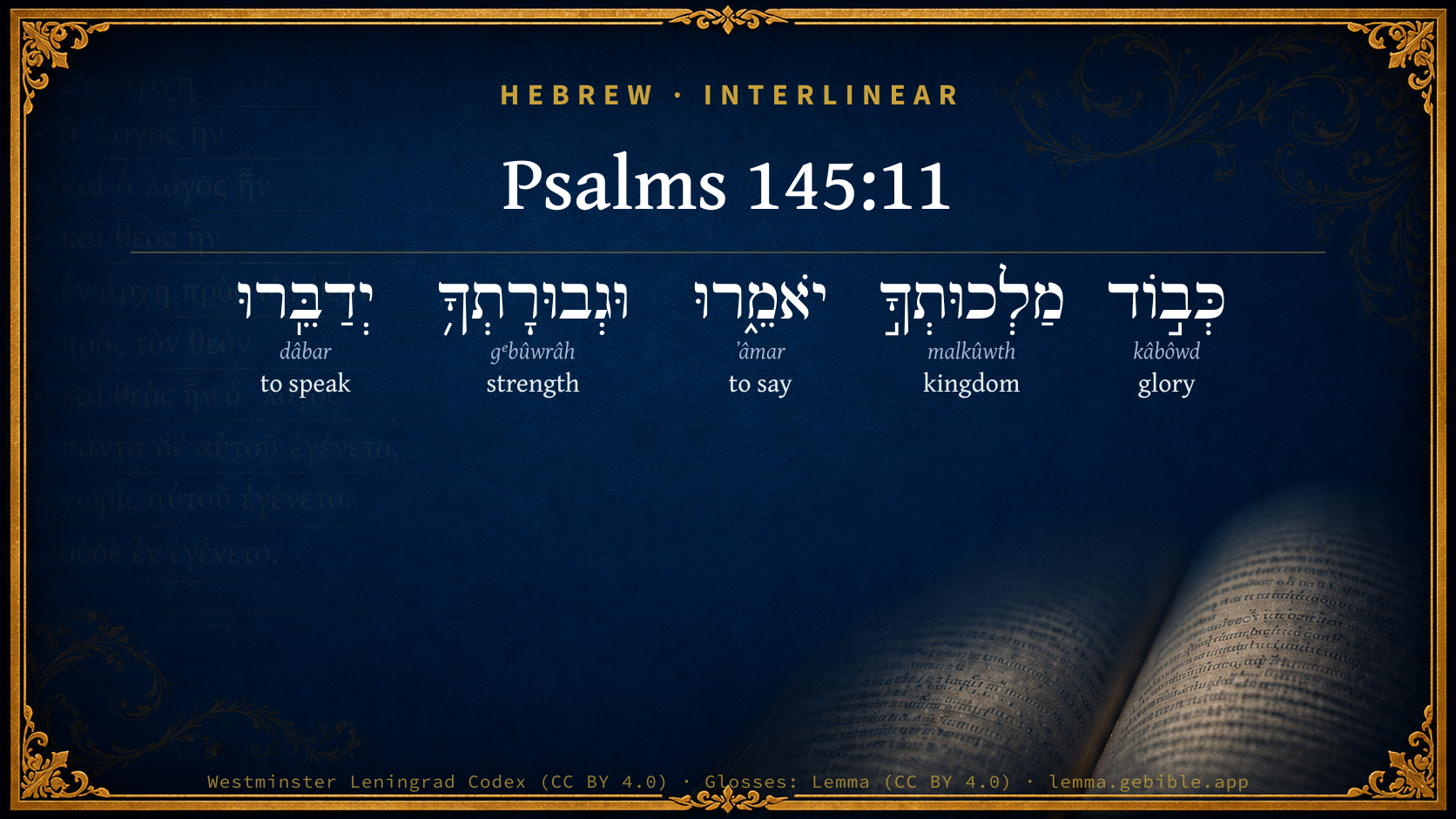
Psalms 145:11

Hebrew (Westminster Leningrad Codex) Psalms 145:11 appears in the Hebrew Old Testament. The text above is from the Westminster Leningrad Codex. Each word links to its Strong’s number, a concise gloss, and parsing drawn from the Open Scriptures Hebrew Bible morphology. Click any word for its full Brown-Driver-Briggs (BDB) entry.
Download image
Cite this verse

Psalms 145:11 (World English Bible). Public Domain. Lemma interlinear Bible study tool, https://lemma.gebible.app/v/psalms/145/11.

Show BibTeX & RIS
BibTeX
RIS
English Translation
They will speak of the glory of your kingdom, And talk about your power;
World English Bible · Public Domain
Download a study sheet

One document with this verse’s original text, its word-by-word gloss line, the meaning frame, cross-references with their text, attributed commentary, and full source and license credits — printable, and it pastes into notes with its structure intact.

This verse Autodidact and up

Study sheet (.html) Plain text (.txt)

A passage Seminary Student

Up to 50 verses in one chapter. A passage sheet keeps up to 6 commentary sources and 12 cross-references per verse, in the order this page ranks them, and says so on the sheet whenever that leaves anything out. Ask for a single verse and you get the Autodidact verse sheet above.

Everything on this page stays free to read, with no account — the sheet is a download of what is already on screen, not access to it.

Want to remove ads? Support Godless Engineer
Compare translations 3

The same verse in 3 English versions, stacked beneath the original-language interlinear above. Click any original word for its lexicon entry.

Each is an independent rendering of the whole verse — the interlinear is not word-aligned to these translations.

Highlighted words mark where these versions differ — a whole-verse word diff, not a word-by-word alignment.

  • World English Bible Public Domain
    They will speak of the glory of your kingdom, And talk about your power;
  • King James Version Public Domain
    They shall speak of the glory of thy kingdom, and talk of thy power;
  • unfoldingWord Literal Text CC BY-SA 4.0
    They will tell the glory of your kingdom, and they will speak your power,

unfoldingWord Literal Text — © unfoldingWord, licensed CC BY-SA 4.0. Word-aligned USFM3 via Door43 (git.door43.org/unfoldingWord/en_ult).

Versions to compare (up to 4)

3 of 4 selected

Show all 18 translations

Every available English version of this verse, each an independent rendering of the whole verse.

  • World English Bible Public Domain
    They will speak of the glory of your kingdom, And talk about your power;
  • Berean Standard Bible Public Domain
    They will tell of the glory of Your kingdom and speak of Your might,
  • Majority Standard Bible Public Domain
    They will tell of the glory of Your kingdom and speak of Your might,
  • King James Version Public Domain
    They shall speak of the glory of thy kingdom, and talk of thy power;
  • American Standard Version (1901) Public Domain
    They shall speak of the glory of thy kingdom, And talk of thy power;
  • Revised Version (1885) Public Domain
    They shall speak of the glory of thy kingdom, and talk of thy power;
  • Geneva Bible (1599) Public Domain
    They shewe the glory of thy kingdome, and speake of thy power,
  • Douay-Rheims (1899) Public Domain
    Deliver me, And rescue me out of the hand of strange children; whose mouth hath spoken vanity: and their right hand is the right hand of iniquity:
  • Young's Literal Translation Public Domain
    The honour of Thy kingdom they tell, And `of' Thy might they speak,
  • Literal Standard Version CC BY-SA 4.0
    They tell of the glory of Your kingdom, || And they speak of Your might,
  • Unlocked Literal Bible CC BY-SA 4.0
    Your faithful ones will speak of the glory of your kingdom, and they will tell of your power.
  • unfoldingWord Literal Text CC BY-SA 4.0
    They will tell the glory of your kingdom, and they will speak your power,
  • Darby Bible Public Domain
    They shall tell of the glory of thy kingdom, and speak of thy power;
  • World Messianic Bible Public Domain
    They will speak of the glory of your kingdom, and talk about your power,
  • Webster's Bible Public Domain
    They shall speak of the glory of thy kingdom, and talk of thy power;
  • Free Bible Version CC BY-SA 4.0
    They will praise the glory of your kingdom, and talk about your power.
  • Bible in Basic English Public Domain
    Their words will be of the glory of your kingdom, and their talk of your strength;
  • JPS Tanakh (1917) Public Domain
    They shall speak of the glory of Thy kingdom, and talk of Thy might;

Literal Standard Version (2020), Covenant Press — licensed CC BY-SA 4.0. Text via the HelloAO Bible API (eBible.org). Unlocked Literal Bible (unfoldingWord) — licensed CC BY-SA 4.0. Text via the HelloAO Bible API (eBible.org). unfoldingWord Literal Text — © unfoldingWord, licensed CC BY-SA 4.0. Word-aligned USFM3 via Door43 (git.door43.org/unfoldingWord/en_ult). Free Bible Version, Dr. Jonathan Gallagher — licensed CC BY-SA 4.0. Text via the HelloAO Bible API (eBible.org).

Word by word

More ways to search: Search by grammar → Find every occurrence → Compare this word →

Practice this passage: Drill this verse → Learn its vocabulary →

About this verse

These counts appear in no published source. They are computed here, from the morphology-tagged text and Lemma’s own curated glosses. What Lemma adds →

5
words
5
distinct lemmas
Wisdom
section

Grammatical profile

  • 2 verbs
  • 3 nouns

Verb forms

  • יֹאמֵ֑רוּ Qal · Imperfect
  • יְדַבֵּֽרוּ Piel · Imperfect

Hebrew & Septuagint length

In English translation the verse runs 14 words from the Hebrew and 14 from the Septuagint (LXX English) — the same length.

A rough comparison of the two English renderings, which tokenize alike — not a word-level alignment.

Word counts can differ between the Hebrew and the Greek without any difference in meaning — e.g. the Hebrew direct-object marker אֵת has no separate Greek word, and Greek often adds the article ὁ.

Cross-references

16

Topical passages linked to Psalms 145:11 in the Treasury of Scripture Knowledge — connected by theme and wording, ordered by reader-vote popularity; previews shown in the World English Bible.

  • 1 Chronicles 29:11–12 Yours, Yahweh, is the greatness, the power, the glory, the victory, and the majesty: for all that is in the heavens and in the earth is yours. Yours is the kingdom, Yahweh, and you are exalted as head above all.
  • Psalms 45:6–7 Your throne, God, is forever and ever. A scepter of equity is the scepter of your kingdom.
  • Psalms 93:1–2 Yahweh reigns! He is clothed with majesty! Yahweh is armed with strength. The world also is established. It can't be moved.
  • Isaiah 9:6–7 For to us a child is born, to us a son is given; and the government shall be on his shoulder: and his name shall be called Wonderful, Counselor, Mighty God, Everlasting Father, Prince of Peace.
  • Daniel 7:13–14 I saw in the night-visions, and, behold, there came with the clouds of the sky one like a son of man, and he came even to the ancient of days, and they brought him near before him.
  • Revelation 11:15–17 The seventh angel sounded, and great voices in heaven followed, saying, "The kingdom of the world has become the Kingdom of our Lord, and of his Christ. He will reign forever and ever!"
  • Psalms 2:6–8 "Yet I have set my king on my holy hill of Zion."
  • Psalms 72:1–20 God, give the king your justice; Your righteousness to the royal son.
  • Psalms 96:10–97:12 Say among the nations, "Yahweh reigns." The world is also established. It can't be moved. He will judge the peoples with equity.
  • Psalms 99:1–4 Yahweh reigns! Let the peoples tremble. He sits enthroned among the cherubim. Let the earth be moved.
  • Isaiah 24:23 Then the moon shall be confounded, and the sun ashamed; for Yahweh of Hosts will reign on Mount Zion, and in Jerusalem; and before his elders shall be glory.
  • Isaiah 33:21–22 But there Yahweh will be with us in majesty, a place of broad rivers and streams, in which shall go no galley with oars, neither shall gallant ship pass thereby.
  • Zechariah 9:9 Rejoice greatly, daughter of Zion! Shout, daughter of Jerusalem! Behold, your king comes to you! He is righteous, and having salvation; Lowly, and riding on a donkey, Even on a colt, the foal of a donkey.
  • Matthew 6:13 Bring us not into temptation, but deliver us from the evil one. For yours is the Kingdom, the power, and the glory forever. Amen.'
  • Mark 11:9–10 Those who went in front, and those who followed, cried out, "Hosanna! Blessed is he who comes in the name of the Lord!
  • Revelation 5:12–13 saying with a loud voice, "Worthy is the Lamb who has been killed to receive the power, wealth, wisdom, strength, honor, glory, and blessing!"

Cross-references courtesy of OpenBible.info (CC BY 4.0).

Hebrew and Greek witnesses Masoretic Hebrew ↔ Greek Septuagint

The same verse in the two great witnesses to the Old Testament, shown verse-for-verse.

You’re reading Greek Psalm 144 (Hebrew Psalm 145). The Septuagint counts the superscription, so verse numbers can differ from the Hebrew — chapter-level alignment, not verse-by-verse. Numbering follows Rahlfs.

These are two independent witnesses, not word-aligned to each other, and the Septuagint is shown in lemma (dictionary) form.

Hebrew Psalms 145:11 Masoretic · Westminster Leningrad Codex

כְּב֣וֹד מַלְכוּתְךָ֣ יֹאמֵ֑רוּ וּגְבוּרָתְךָ֥ יְדַבֵּֽרוּ

They will speak of the glory of your kingdom, And talk about your power;

World English Bible · Public Domain

Greek LXX Greek Psalm 144:11 Septuagint · lemma form

δόξα ὁ βασιλεία σύ εἶπον καί ὁ δυναστεία σύ λαλέω

They shall speak of the glory of your kingdom, and talk of your dominion;

LXX2012 (modern English Septuagint) · Public Domain

Hebrew: Westminster Leningrad Codex (CC BY 4.0). Greek: Septuagint (public domain); English from LXX2012 (modern English Septuagint) (Public Domain). How the Septuagint differs from the Hebrew →

Commentary

Notes on Psalms 145:11 from classic Christian and Jewish commentators (each source and its license shown beneath its notes). The classic Christian expositions comment on the surrounding passage and are grouped to its opening verse, so a note may address several verses; the Jewish commentaries on the Tanakh (Rashi and others) are per-verse, so they appear only where the commentator wrote on this verse.

Lemma curates 59 commentaries, every one of them public domain or Creative Commons licensed, each selected and text-cleaned for this edition rather than reprinted as found. About our sources →

Trapp's Complete Commentary

John Trapp

Psa 145:11 They shall speak of the glory of thy kingdom, and talk of thy power;

Ver. 11. They shall speak of the glory] That kingdom of the saints of the Most High, which is far beyond the grandeur and splendour of all the four great monarchies, as is to be seen Dan 7:27.

John Trapp, A Commentary or Exposition upon All the Books of the Old and New Testament (1647–1656) — public domain. Text from a community e-Sword module.

The Biblical Illustrator

Joseph S. Exell

Psa_145:11

They shall speak of the glory of Thy kingdom.

Christian conversation

It is much to be regretted that true children of the Lord often talk too little of Him. What is the conversation of half the professors of the present day? Honesty compels us to say that, in many cases, it is a mass of froth and falsehood, and, in many more cases, it is altogether objectionable; if it is not light and frivolous, it is utterly apart from the Gospel, and does not minister grace unto the hearers. One of the great lacks of the Church nowadays is not so much Christian preaching as Christian talking,--not so much Christian prayer in the prayer-meeting as Christian conversation in the parlour. How little do we hear concerning Christi

I. A subject for conversation.

1. The glory of Christs kingdom.

(1) Make known His mighty acts. Tell it the wide world oer that the Lord of hosts is the God of battles; He is the conqueror of men and of devils; He is Master in His own dominions. Tell ye the glory of His kingdom, and rehearse His mighty acts. Christian, exhaust that theme if thou canst.

(2) Then, in speaking of the glory of Christs kingdom, talk of its glorious majesty (verse 12). Tell of the crown of grace which He wears continually; tell of the crown of victory which perpetually proclaims the triumphs He has won over the foe; tell of the crown of love wherewith His Father crowned Him in the day of His espousals to His Church,--the crown which He has won by ten thousand hearts which He has broken, and untold myriads of spirits which He has bound up.

(3) Talk of its duration, for much of the honour of the Kingdom depends upon the time it has lasted (verse 13).

2. Christs power.

(1) Upholding (verse 14).

(2) Exalting (verse 14).

(3) Providing (verse 15).

II. The causes which will make Christians talk of the glory of Christs kingdom and His power?

1. One cause is, that it is the kingdom of their own King.

2. The Christian must talk of the Kings victories because all those victories were won for Him; he recollects that his Master never fought a battle for Himself,--never slew an enemy for Himself. He slew them all for His people.

3. The Christian must talk of it because he himself has had a good share in fighting some of the battles. You know how old soldiers will shoulder their crutch, and tell how fields were won. Recollect that you have been a soldier in the army of the Lord; and that, in the last day, when He gives away the medals in heaven, you will have one; when He gives away the crowns, you will have one. We can talk about the battles, for we were in them; we can speak of the victories, for we helped to win them. It is to our own praise as well as to our Masters when we talk of His wondrous acts.

4. But the best reason why the Christian should talk of his Master is this, if he has Christ in his heart, the truth must come out; he cannot help it.

III. What would be the effect of our talking more of Christs kingdom and power?

1. The first effect would be that the world would believe us more.

2. If our conversations were more concerning Christ, we, as Christian men, should grow faster, and be more happy. In this way you would remove bickerings better than by all the sermons that could be preached, and be promoting a true evangelical alliance far more excellent and efficient than all the alliances which Than can form.

3. If we oftener talked of Christ like this, how useful we might be in the salvation of souls! Souls are often converted through godly conversation. Simple words frequently do more good than long sermons. Disjointed, unconnected sentences are often of more use than the most finely polished periods or rounded Sentences. If you would be useful, let the praises of Christ be ever on your tongue; let Him live on your lips. (C. H. Spurgeon.)

Declaring Gods doings

Of one of the statues in the Campanile, Florence, it is said that Donatello, when giving it the last stroke of his chisel, exclaimed in enthusiastic admiration, Speak! So Christ, when He calls men from their sins and recreated them in His own image, says, Tell what things God hath done for you.

The glory of Christs kingdom

I. In its origin. It was the object of the divine and eternal purposes of the Father; an object to which all other purposes were subservient. It entered into the councils of the Eternal before the foundation of the world was laid. It was a grand design, intended to include the reign of God over the mind and heart of man; a purpose to establish a kingdom, the subject, s of which should be raised to be partakers of the same nature as their Sovereign.

II. In the manner and spirit of its administration (2Sa_23:1-4; Isa_11:4-5; Mat_11:28; Luk_17:21; Rom_14:17; 2Co_3:3; Joh_10:4-5; Joh_17:24; Joh_14:3).

III. In the character of His subjects.

1. They are enlightened: they have just conceptions of things; they are delivered out of darkness, which envelops the rest of mankind, as the children of Israel had light in the land of Goshen when the habitations of the Egyptians were in darkness.

2. They are renewed: the Spirit of God changes their heart; they are made imperfectly, yet truly holy; they have a principle in them that aims at perfection; their characters are mixed, but the best part struggles against the worst, and will finally triumph.

3. They have in them a preparation for perfect blessedness.

IV. In the privileges attached to it.

1. Peace.

2. Dignity.

3. Immortality. (R. Hall, M. A.)

The glory of Gods rule

I. In the universality of its extent. His kingdom extends over all, over all matter, and over all mind. It includes the microscopic atom and the mightiest orb; the lowest fiend and the sublimest angel.

II. In the righteousness of its foundation. God has a right to rule the universe.

1. On the ground of proprietorship He owns all.

2. On the ground of capacity. No one else has the power.

3. On the ground of character. He is infinitely good.

III. In the benevolence of its operations. Unlike all human kings, He rules not for His own aggrandizement or interest, but simply for the good of His subjects.

IV. In the indestructibleness OF ITS NATURE. Human kingdoms have in them the seeds of decay; they chase each other from the scene like the clouds before the wind. All of them are but as little bubbles on the stream, by a breath or a touch they are broken and lost. But His kingdom will endure for ever. (David Thomas, D. D.)

The Biblical Illustrator, edited by Joseph S. Exell (c. 1880s–1900s) — public domain. Text from a community e-Sword module.

The Treasury of David

Charles H. Spurgeon

Ver. 11. They shall speak of the glory of thy kingdom. Excellent themes for saintly minds. Those who bless God from their hearts rejoice to see him enthroned, glorified, and magnified in power. No subject is more profitable for humility, obedience, hope, and joy than that of the reigning power of the Lord our God. His works praise him, but they cannot crown him: this remains for holy hands and hearts. It is their high pleasure to tell of the glory of his kingdom in its justice, kindness, eternity, and so forth. Kingdoms of earth are glorious for riches, for extent of territory, for victories, for liberty, for commerce, and other matters; but in all true glories the kingdom of Jehovah excels them. We have seen a palace dedicated "to all the glories of France"; but time, eternity, and all space are filled with the glories of God: on these we love to speak. And talk of thy power. This power supports the kingdom and displays the glory, and we are sure to talk of it when the glory of the divine kingdom is under discussion. God's power to create or to destroy, to bless or to punish, to strengthen or to crush, is matter for frequent rehearsal. All power comes from God. Apart from him the laws of nature would be inoperative. His power is the one source of force mechanical, vital, mental, spiritual. Beyond the power of God which has been put forth, infinite force lies latent in himself. Who can calculate the reserve forces of the Infinite? How, then, can his kingdom fail? We hear talk of the five great powers, but what are they to the One Great Power? The Lord is "the blessed and only Potentate." Let us accustom ourselves to think more deeply and speak more largely of this power which ever makes for righteousness and works for mercy.

Ver. 11. They shall speak of the glory of thy kingdom, etc. The glory of a kingdom is synonymous with its power. The power of a kingdom consists in the number of its subjects, and the sufficiency of its revenues to maintain them. Now, the glory, or the power of God's kingdom, may be inferred from the difference between it and that of man. There are four points of difference. First, the kings of this world have but few subjects, with but little wealth, not more than the population and riches of one kingdom, or one province, while God reigns over all angels, all men, all demons; and all wealth on land, in the sea, or in the air, belongs to him. There is another difference, that while the kings of this world rule their subjects, they are still ruled by them, they are dependent on them, could do nothing without them; and, however abundant their revenues may be, they are generally in want, nay, even in debt, and, consequently, always calling for fresh tributes and taxes; but God, while he governs all, is subject to none, because he needs nobody's help or assistance. Instead of being in want, he abounds in everything, because he could, in one moment, bring from nothing much more than he now beholds or enjoys. The third difference is a consequence of the second, while the kings of this world seem so to enjoy their honours and dignities, they are, at the same time, suffering acutely from interior fears, doubts, and cares, which have sometimes been so burdensome, as to cause them to abdicate altogether. God never suffers such pressure, is subject to no fear, no misgivings, but reigns absolutely in perfect tranquillity. The fourth difference, an essential one, is, that the kings of the world reign but for a time;but God reigneth for ever. Robert Bellarmine.

Ver. 11. They shall speak...and talk. Joy and sorrow are hard to conceal; as from the countenance, so from the tongue. There is so much correspondence betwixt the heart and tongue that they will move at once: every man therefore speaks of his own pleasure and care; the hunter and falconer of his game; the ploughman of his team; the soldier of his march and colours. If the heart were as full of God, the tongue could not refrain from talking of him: the rareness of Christian communication argues the common poverty of grace. If Christ be not in our hearts, we are godless; if he be there without our joy, we are senseless; if we rejoice in him and speak not of him, we are shamefully unthankful. Every man taketh, yea, raiseth occasion, to bring in speech of what he liketh. As I will think of thee always, O Lord, so it shall be my joy to speak of thee often; and if I find not opportunity, I will make it. Joseph Hall.

Ver. 11. The glory of Christ's kingdom. The glory of this kingdom is manifested,

1. In its origin.

2. In the manner and spirit of its administration.

3. In the character of its subjects.

4. In the privileges that are attached to it. Robert Hall.

Ver. 11-12. Talk transfigured.

1. The faculty of talk is extensively possessed.

2. Is commonly misused.

3. May be nobly employed.

4. Will then be gloriously useful. C. A. D.

Ver. 11-13. To show the greatness of God's kingdom, David observes,

1. The pomp of it. Would we by faith look within the veil, we should "speak of the glory of his kingdom" (Ps 145:11); "and the glorious majesty of it" (Ps 145:12).

2. The power of it. When "they speak of the glory of God's kingdom", they must "talk of his power", the extent of it, the efficacy of it.

3. The perpetuity of it (Ps 145:13). The thrones of earthly princes totter, and the flowers of their crowns wither, monarchs come to an end; but, Lord, "thy kingdom is an everlasting kingdom." Matthew Henry.

Psalms 145:12*

Charles H. Spurgeon's The Treasury of David (1869–1885) — public domain. Psalms only. Text from a community e-Sword/MySword module.

J. A. Alexander on Psalms

Joseph Addison Alexander

11. (Psa 145:11) The glory of thy reign they utter, and thy might they speak. Compare Psa 103:19. Thy reign or kingdom, which is universal. The whole phrase may mean thy royal dignity or honour.

Joseph Addison Alexander, The Psalms Translated and Explained (1850) — public domain. Text from a community e-Sword module.

Geneva Bible (1599)

Geneva Bible translators

The Praise of thy glory appeareth in all thy creatures: and though the wicked would obscure the same by their silence, yet the faithful are ever mindful of the same.

Geneva Bible (1599) marginal notes — public domain. Text via Bolls.life.

Jamieson, Fausset & Brown

Robert Jamieson, A. R. Fausset & David Brown

The declaration of God's glory is for the extension of His knowledge and perfections in the world.

Jamieson, Fausset & Brown — Commentary Critical and Explanatory on the Whole Bible (1871) — public domain (CC PDM 1.0). Text via the HelloAO Bible API.

Ellicott's Commentary for English Readers

(11, 12) It is the privilege of the saints to impress the less favoured natures with the glory of the Divine kingdom, which the theocratic relation has displayed in and to them.

A Bible Commentary for English Readers, edited by Charles John Ellicott (1878–1897) — public domain. Text from a community e-Sword module.

The Cambridge Bible for Schools and Colleges

gen. ed. J. J. S. Perowne

11. thy power] Thy might, as in Psa_145:4; Psa_145:12.

The Cambridge Bible for Schools and Colleges (gen. ed. J. J. S. Perowne; Cambridge University Press, 1878–1918) — public domain. Text from a community e-Sword module.

John Gill's Exposition

They shall speak of the glory of thy kingdom,.... That is, the saints who are his special workmanship, in the celebration of his praise; and, while they are blessing him, will take particular notice, and make particular mention of his kingdom, and the glory of it; not only his kingdom of nature and providence, which ruleth over all, angels and men, good and bad; which deserves the notice of the saints, and is matter of great joy unto them, that their King reigns in the world, but also, and rather, his kingdom of grace, in which he rules by his Spirit and grace in the hearts of his people; which is not worldly, but spiritual; is not with outward observation, but lies within the heart, and makes the Lord's people all glorious within; consisting of peace, righteousness, and joy in the Holy Ghost, and is what can never be removed. The church is Christ's kingdom, in which he reigns; and all the subjects of it are kings and priests unto God: here proper laws are made and observed, and officers appointed to explain them, and see them put in execution; glorious ordinances are administered, in which Christ the King is seen in his beauty; and the glorious Gospel, which is his sceptre, is held forth, and by which he rules in the midst of his enemies. More especially this may regard the glorious kingdom of Christ in the latter day; both in his spiritual reign, in which there will be a great display of glory; as a large effusion of the Spirit; much spiritual light and knowledge; great holiness of heart and life; an abundance of peace, temporal and spiritual; great purity of Gospel doctrine, worship, and ordinances: and also in his personal reign; when he will appear glorious, and reign before his ancients gloriously, and his saints will appear with him in glory; the New Jerusalem will have the glory of God upon her; a glory there will be then both upon the bodies and souls of the saints Christ will have with him in that state:

and talk of thy power; not only as exerted in creation and providence; but of his power in working out the salvation of men; and in conquering and subduing all the spiritual enemies of his people, sin, Satan, the world, and death; in raising himself from the dead, as he will all his saints by the same power at the last day; in going forth into the Gentile world in the ministry of the word, conquering and to conquer, making it powerful and effectual to the conversion of thousands: and also of his power in heaven and in earth, given him as Mediator; and which he has exercised and does exercise on the behalf of his church, and for its protection and welfare: and especially of the more open display of it in the latter day, when he shall take to himself his great power and reign; then will his saints talk of it with great pleasure and thankfulness; see Rev 11:15.

John Gill's Exposition of the Whole Bible (1746–1763) — public domain (CC PDM 1.0). Text via the HelloAO Bible API.

Albert Barnes' Notes on the Bible

They shall speak of the glory of thy kingdom - Of thy reign; of the great principles of thy government and laws. They see in that reign evidence that thou art worthy of universal praise. Seeing this, it becomes to them a subject on which they talk or converse (compare Mal 3:16) - a subject of interest to their hearts, and “out of the abundance of the heart the mouth speaks.” People talk about that which interests them; those things in which they have pleasure; those which they desire to understand; those in which they see difficulties that they would wish to have solved. It is one of the characteristics of the “saints” - of the people of God - that they do talk about God and his kingdom; that the subject is to them a pleasant theme of meditation and conversation; that they have the kind of pleasure in talking about God which other people have in conversing about their farms or their merchandise, their children and friends, the news of the day, politics, literature, or science.

And talk of thy power - As put forth in the works of creation; as manifested in the dispensations of thy providence; as evinced in the conversion of sinners; as displayed in carrying thy truth around the world; as exhibited in sustaining fine sufferer, and in giving peace and support to the dying.

Albert Barnes' Notes on the Bible (1834–1885) — public domain. Text from a community e-Sword/MySword module.

The Pulpit Commentary

They shall speak of the glory of thy kingdom. (comp. Psa_22:28 Psa_45:6) The "glory" of God"s kingdom is such that the faithful are naturally drawn to "speak" of it. "His kingdom is an everlasting kingdom, and his dominion endureth throughout all ages" (ver. 13). "His kingdom ruleth over all" (Psa_103:19) heaven and earth, and hell, and all space, and whatever space contains. There is no limit either to its extent or its duration. And its "glory" transcends all. human thought much more all description. "Eye hath not seen, nor ear heard," etc. And talk of thy power. "Power" is of the essence of kingship, and comes naturally to the front whenever the character of a kingdom is spoken of.

The Pulpit Commentary (1880–1919), ed. H.D.M. Spence-Jones & Joseph S. Exell — public domain. Text from a community e-Sword module.

Lesson kit

Teaching starters — assembled from the data on this page, not authored interpretation. Every prompt links to the verse data it draws on. Edit before teaching.

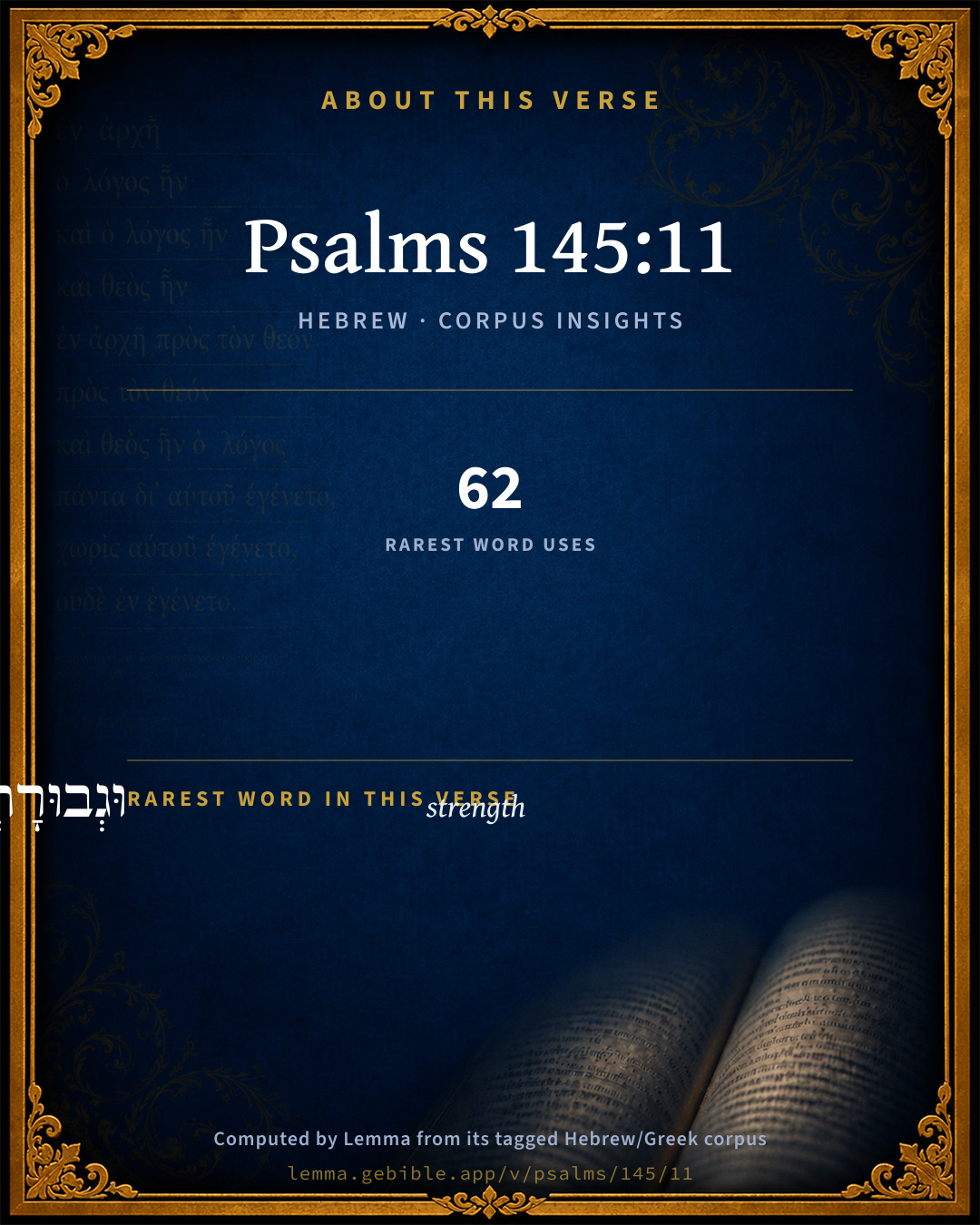
Psalms, in the Wisdom, opens this verse with 5 words (5 distinct Hebrew lemmas). Its most distinctive word is gᵉbûwrâh (“strength”). A historical commentator’s framing appears above. Read the whole chapter for the surrounding context.

Discussion questions

  1. The word gᵉbûwrâh carries the sense “strength.” How does it shape the verse?
  2. 1 Chronicles 29:11–12 shares this passage’s theme. How do the two illuminate each other?
  3. These translations render this verse differently; the difference is in the English rendering, not the original. What questions does that raise?
  4. The verb «יֹאמֵ֑רוּ» is Qal Imperfect. How does its form color the action?
  5. Reading how Trapp's Complete Commentary and The Biblical Illustrator read this verse, where do the two commentators agree and where do they part?

Things to notice

Reading settings

Reading text

Shown beneath each verse's original-language words.

Old Testament
Old Testament edition

Read the OT as the Masoretic Hebrew (MT) or the Greek Septuagint (LXX).

English shown for the Greek Septuagint (in the Hebrew ↔ Greek comparison).

Comparing translations? Open the Compare panel on any verse page to stack up to four side by side.