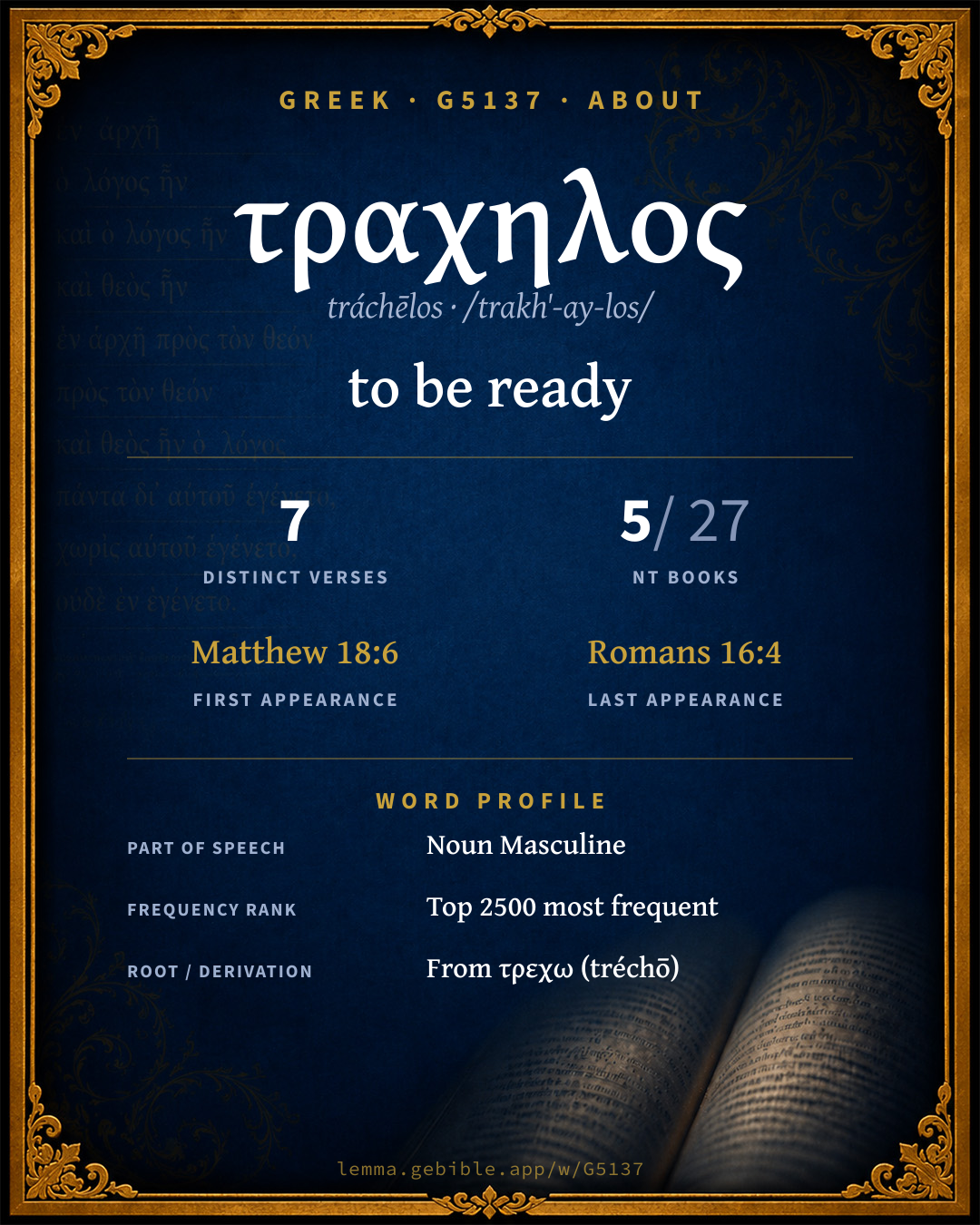
τράχηλος
to be ready
Full lexicon entry — Thayer's Greek Lexicon
From Thayer's Greek Lexicon
Where this word appears
Grammar key — what these labels mean
Part of speech
- Noun
- A naming word — a person, place, thing, or idea.
Case
- Accusative
- The case of the direct object and of extent.
Gender
- Masculine
- Grammatically masculine.
Number
- Singular
- One.
Every verse where G5137 appears — 7 distinct verses across 5 books. Click any verse to open its interlinear word-by-word view. Verse text shown in the World English Bible for context — . Each verse’s Greek form is shown with its reference; the English is not keyword-highlighted, since the data carries no word-level English alignment. Use “Compare translations” on any verse to read it across multiple English versions. This concordance covers the Greek New Testament; Septuagint (Greek Old Testament) occurrences of this word are not indexed here.
Matthew 1 verse
Mark 1 verse
Luke 2 verses
- Luke 15:20 τράχηλον n acc sg masc "He arose, and came to his father. But while he was still far off, his father saw him, and was moved with compassion, and ran, and fell on his neck, and kissed him.
- Luke 17:2 τράχηλον n acc sg masc It would be better for him if a millstone were hung around his neck, and he were thrown into the sea, rather than that he should cause one of these little ones to stumble.
Acts 2 verses
Romans 1 verse
About this entry
At a glance — auto-summarized from this page’s data, not written by a person. Every figure links to its source below. This summary describes the numbers; it doesn’t interpret them.
τραχηλος (tráchēlos) is a Greek noun most often rendered “to be ready.” Scripture first uses it in Matthew 18:6. Spanning 7 verses in 5 books, it ranks among the uncommon words of the Greek New Testament. Luke dominates its distribution — 2 of 7 verses. Sharing its root, it stands alongside τρεχω, δρομος and τροχος. For the data behind this summary, explore the sense tree and the renderings breakdown below.
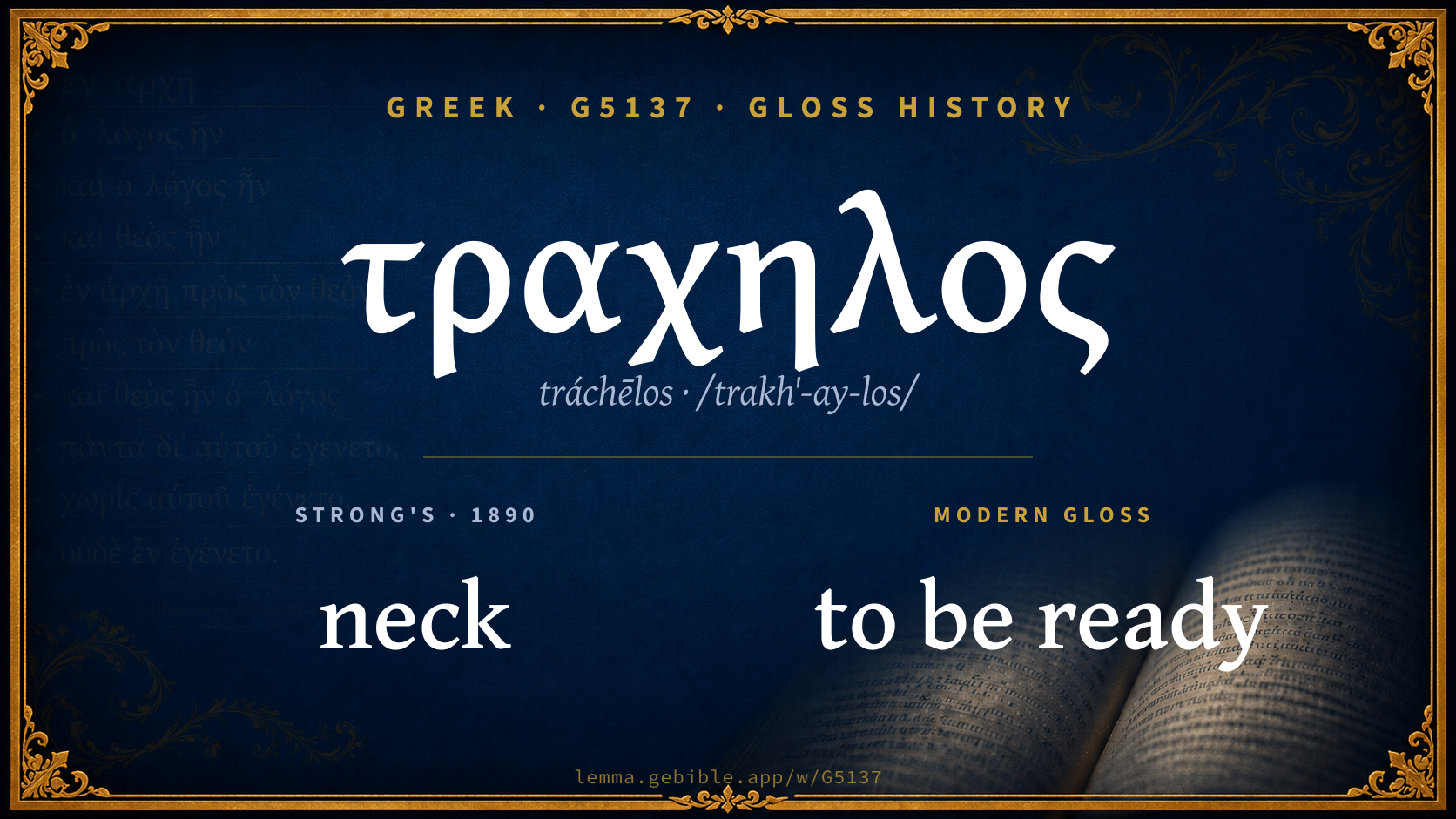
Gloss history
Strong's 1890 vs modern scholarship
About this word
Strong's G5137 catalogs a Greek word from the Greek New Testament.
These counts are not copied from any lexicon or concordance. They are computed here, from the morphology-tagged Greek New Testament. What Lemma adds →
- 7
- distinct verses
- The word appears in 7 distinct verses.
- 5 / 27
- NT books
- The word appears in 5 of 27 New Testament books.
- #1,358
- by frequency
- Top 2500 most frequent Greek words (rank 1,358 of 5,347 Greek words by occurrence).
View all 7 occurrences in the concordance →
By section of the New Testament
By traditional corpus
Conventional, traditional groupings — biblical authorship is debated, so this is a traditional corpus grouping, not an authorship claim. Some books belong to more than one corpus (Luke is in both the Gospels and the Lukan corpus, and so on), so these shares overlap and need not total 100%. Each figure is a share of the word’s 7 distinct verses.
- Gospels 4 verses · 57%
- Lukan (Luke–Acts) 4 verses · 57%
- Pauline corpus 1 verse · 14%
How translations render this word
Counts come from each version’s own published word-to-Strong’s tagging or interlinear alignment — an approximate guide to how each version renders this word, not a word-level alignment the data otherwise carries. Because each total is that version’s own tagged count, the per-version totals vary from one another and need not match the appearance or distinct-verse counts above. These counts may also differ from a printed concordance because Lemma counts each distinctly tagged rendering and does not collapse phrase taggings into a single head-word total. This is a fixed set of word-tagged versions (KJV, ASV, BSB, ULT) and does not change with the reading translation you choose elsewhere. Each version’s license is shown beside its name below (and on Sources).
- King James Version: Neck 6×
- American Standard Version: Neck 5×
- Berean Standard Bible: Neck 3×
- unfoldingWord Literal Text: Neck 7×
King James Version Public Domain
Renders G5137 across 7 tagged occurrences — most commonly:
Plus 1 rendering that appears only once — usually multi-word phrases or single function words the recovered tagging swept in, not distinct renderings.
American Standard Version Public Domain
Renders G5137 across 6 tagged occurrences — most commonly:
Plus 1 rendering that appears only once — usually multi-word phrases or single function words the recovered tagging swept in, not distinct renderings.
Berean Standard Bible Public Domain
Renders G5137 across 4 tagged occurrences — most commonly:
Plus 1 rendering that appears only once — usually multi-word phrases or single function words the recovered tagging swept in, not distinct renderings. Not rendered by a distinct English word in 3 further occurrences.
unfoldingWord Literal Text CC BY-SA 4.0
Renders G5137 across 7 tagged occurrences — most commonly:
Senses in Thayer's
The 1 sense Thayer's distinguishes for this word, in lexicon order (not ranked by frequency or importance). The full entry — with sub-senses — is in the Lexicon Entry tab.
- to be ready to incur the most imminent peril to life
Word origin
Derived from τρεχω (tréchō) (G5143) — to run.
Probably from G5143 (through the idea of mobility ); the throat ( neck ) that is (figuratively) life : - neck.
— Strong’s Exhaustive Concordance (1890), public domain.
Same root — word family
Other Thayer's entries built from the same root as G5137, grouped by Strong’s listed origin. These share a root / origin per the lexicon — not necessarily a shared meaning. Each links to that word’s own entry.
Derives from
Shares the same root
Derived from this word
Compare all same-root words → Showing 4 of 5 — not the complete family. They share a root, not necessarily a meaning.
Septuagint usage
The same Greek word τραχηλος appears 58 times in the Greek Old Testament (Septuagint), across 56 verses in 17 books.
- 58
- LXX occurrences
- Tagged occurrences of this Greek word in the Septuagint.
- 56
- verses
- Distinct Septuagint verses containing this word.
- 17 / 39
- OT books
- The word appears in 17 of the 39 Old Testament books.
Sample Septuagint occurrences
- Genesis 27:16 τράχηλος
- Deuteronomy 10:16 τράχηλος
- Joshua 10:24 τράχηλος
- Judges 5:30 τράχηλος
- 2 Chronicles 30:8 τράχηλος
- Ezra 13:5 τράχηλος
- Job 39:19 τράχηλος
- Proverbs 1:9 τράχηλος
- Song of Solomon 1:10 τράχηλος
- Isaiah 3:16 τράχηλος
- Jeremiah 7:26 τράχηλος
- Lamentations 1:14 τράχηλος
Septuagint occurrences (same lexeme)
Every verse where the same Strong’s number (G5137) appears in the Greek Septuagint — showing the first 50 of 56. Verse text shown in the World English Bible for context; the Greek form is the matched word — the English is not keyword-highlighted.
- Genesis 27:16 τράχηλος She put the skins of the kids of the goats on his hands, and on the smooth of his neck.
- Genesis 27:40 τράχηλος By your sword will you live, and you will serve your brother. It will happen, when you will break loose, That you shall shake his yoke from off your neck."
- Genesis 33:4 τράχηλος Esau ran to meet him, embraced him, fell on his neck, kissed him, and they wept.
- Genesis 41:42 τράχηλος Pharaoh took off his signet ring from his hand, and put it on Joseph's hand, and arrayed him in robes of fine linen, and put a gold chain about his neck,
- Genesis 45:14 τράχηλος He fell on his brother Benjamin's neck, and wept, and Benjamin wept on his neck.
- Genesis 46:29 τράχηλος Joseph made ready his chariot, and went up to meet Israel, his father, in Goshen. He presented himself to him, and fell on his neck, and wept on his neck a good while.
- Deuteronomy 10:16 τράχηλος Circumcise therefore the foreskin of your heart, and be no more stiff-necked.
- Deuteronomy 28:48 τράχηλος therefore shall you serve your enemies whom Yahweh shall send against you, in hunger, and in thirst, and in nakedness, and in want of all things: and he shall put a yoke of iron on your neck, until he have destroyed you.
- Deuteronomy 31:27 τράχηλος For I know your rebellion, and your stiff neck: behold, while I am yet alive with you this day, you have been rebellious against Yahweh; and how much more after my death?
- Deuteronomy 33:29 τράχηλος Happy are you, Israel: Who is like you, a people saved by Yahweh, The shield of your help, The sword of your excellency! Your enemies shall submit themselves to you; You shall tread on their high places.
- Joshua 10:24 τράχηλος It happened, when they brought forth those kings to Joshua, that Joshua called for all the men of Israel, and said to the chiefs of the men of war who went with him, Come near, put your feet on the necks of these kings. They came near, and put their feet on the necks of them.
- Judges 5:30 τράχηλος Have they not found, have they not divided the spoil? A lady, two ladies to every man; To Sisera a spoil of dyed garments, A spoil of dyed garments embroidered, Of dyed garments embroidered on both sides, on the necks of the spoil?
- Judges 8:21 τράχηλος Then Zebah and Zalmunna said, Rise you, and fall on us; for as the man is, so is his strength. Gideon arose, and killed Zebah and Zalmunna, and took the crescents that were on their camels' necks.
- Judges 8:26 τράχηλος The weight of the golden ear-rings that he requested was one thousand and seven hundred [shekels] of gold, besides the crescents, and the pendants, and the purple clothing that was on the kings of Midian, and besides the chains that were about their camels' necks.
- 2 Chronicles 30:8 τράχηλος Now don't you be stiff-necked, as your fathers were; but yield yourselves to Yahweh, and enter into his sanctuary, which he has sanctified forever, and serve Yahweh your God, that his fierce anger may turn away from you.
- 2 Chronicles 36:13 τράχηλος He also rebelled against king Nebuchadnezzar, who had made him swear by God: but he stiffened his neck, and hardened his heart against turning to Yahweh, the God of Israel.
- Ezra 13:5 τράχηλος
- Ezra 19:16 τράχηλος
- Ezra 19:17 τράχηλος
- Ezra 19:29 τράχηλος
- Job 39:19 τράχηλος "Have you given the horse might? Have you clothed his neck with a quivering mane?
- Job 41:14 τράχηλος Who can open the doors of his face? Around his teeth is terror.
- Proverbs 1:9 τράχηλος For they will be a garland to grace your head, And chains around your neck.
- Proverbs 3:3 τράχηλος Don't let kindness and truth forsake you. Bind them around your neck. Write them on the tablet of your heart.
- Proverbs 3:22 τράχηλος So they will be life to your soul, And grace for your neck.
- Proverbs 6:21 τράχηλος Bind them continually on your heart. Tie them around your neck.
- Song of Solomon 1:10 τράχηλος Your cheeks are beautiful with earrings, Your neck with strings of jewels.
- Song of Solomon 4:4 τράχηλος Your neck is like David's tower built for an armory, Whereon there hang a thousand shields, All the shields of the mighty men.
- Song of Solomon 4:9 τράχηλος You have ravished my heart, my sister, my bride. You have ravished my heart with one of your eyes, With one chain of your neck.
- Song of Solomon 7:5 τράχηλος Your head on you is like Carmel, The hair of your head like purple; The king is held captive in its tresses.
- Isaiah 3:16 τράχηλος Moreover Yahweh said, "Because the daughters of Zion are haughty, And walk with outstretched necks and flirting eyes, Walking to trip as they go, Jingling ornaments on their feet;
- Isaiah 9:3 τράχηλος You have multiplied the nation, you have increased their joy: they joy before you according to the joy in harvest, as men rejoice when they divide the spoil.
- Isaiah 30:28 τράχηλος and his breath is as an overflowing stream, that reaches even to the neck, to sift the nations with the sieve of destruction: and a bridle that causes to err [shall be] in the jaws of the peoples.
- Isaiah 48:4 τράχηλος Because I knew that you are obstinate, and your neck is an iron sinew, and your brow brass;
- Isaiah 52:2 τράχηλος Shake yourself from the dust; arise, sit [on your throne], Jerusalem: loose yourself from the bonds of your neck, captive daughter of Zion.
- Isaiah 58:5 τράχηλος Is such the fast that I have chosen? the day for a man to afflict his soul? Is it to bow down his head as a rush, and to spread sackcloth and ashes under him? will you call this a fast, and an acceptable day to Yahweh?
- Jeremiah 7:26 τράχηλος yet they didn't listen to me, nor inclined their ear, but made their neck stiff: they did worse than their fathers.
- Jeremiah 17:23 τράχηλος But they didn't listen, neither turn their ear, but made their neck stiff, that they might not hear, and might not receive instruction.
- Jeremiah 19:15 τράχηλος Thus says Yahweh of Hosts, the God of Israel, Behold, I will bring on this city and on all its towns all the evil that I have pronounced against it; because they have made their neck stiff, that they may not hear my words.
- Jeremiah 34:2 τράχηλος Thus says Yahweh, the God of Israel, Go, and speak to Zedekiah king of Judah, and tell him, Thus says Yahweh, Behold, I will give this city into the hand of the king of Babylon, and he shall burn it with fire:
- Jeremiah 34:8 τράχηλος The word that came to Jeremiah from Yahweh, after that the king Zedekiah had made a covenant with all the people who were at Jerusalem, to proclaim liberty to them;
- Jeremiah 34:11 τράχηλος but afterwards they turned, and caused the servants and the handmaids, whom they had let go free, to return, and brought them into subjection for servants and for handmaids.
- Jeremiah 34:12 τράχηλος Therefore the word of Yahweh came to Jeremiah from Yahweh, saying,
- Jeremiah 35:10 τράχηλος but we have lived in tents, and have obeyed, and done according to all that Jonadab our father commanded us.
- Jeremiah 35:11 τράχηλος But it happened, when Nebuchadrezzar king of Babylon came up into the land, that we said, Come, and let us go to Jerusalem for fear of the army of the Chaldeans, and for fear of the army of the Syrians; so we dwell at Jerusalem.
- Jeremiah 35:12 τράχηλος Then came the word of Yahweh to Jeremiah, saying,
- Jeremiah 35:14 τράχηλος The words of Jonadab the son of Rechab, that he commanded his sons, not to drink wine, are performed; and to this day they drink none, for they obey their father's commandment: but I have spoken to you, rising up early and speaking; and you have not listened to me.
- Jeremiah 37:8 τράχηλος The Chaldeans shall come again, and fight against this city; and they shall take it, and burn it with fire.
- Lamentations 1:14 τράχηλος The yoke of my transgressions is bound by his hand; They are knit together, they are come up on my neck; he has made my strength to fail: The Lord has delivered me into their hands, against whom I am not able to stand.
- Lamentations 5:5 τράχηλος Our pursuers are on our necks: We are weary, and have no rest.
These are occurrences of the same Greek lexeme (G5137) in the Septuagint — not a translation of any one Hebrew word. The store carries no word-level Hebrew↔Greek alignment, so no Hebrew original is asserted here. Counts come from the recovered LXX Strong's tagging — high-frequency vocabulary is well covered, while rare or late forms may be untagged — so they reflect tagged occurrences and may slightly undercount.