Jeremiah 35:10

Hebrew (Westminster Leningrad Codex) Jeremiah 35:10 appears in the Hebrew Old Testament. The text above is from the Westminster Leningrad Codex. Each word links to its Strong’s number, a concise gloss, and parsing drawn from the Open Scriptures Hebrew Bible morphology. Click any word for its full Brown-Driver-Briggs (BDB) entry.
Download image
Cite this verse

Jeremiah 35:10 (World English Bible). Public Domain. Lemma interlinear Bible study tool, https://lemma.gebible.app/v/jeremiah/35/10.

Show BibTeX & RIS
BibTeX
RIS
English Translation
but we have lived in tents, and have obeyed, and done according to all that Jonadab our father commanded us.
World English Bible · Public Domain
Download a study sheet

One document with this verse’s original text, its word-by-word gloss line, the meaning frame, cross-references with their text, attributed commentary, and full source and license credits — printable, and it pastes into notes with its structure intact.

This verse Autodidact and up

Study sheet (.html) Plain text (.txt)

A passage Seminary Student

Up to 50 verses in one chapter. A passage sheet keeps up to 6 commentary sources and 12 cross-references per verse, in the order this page ranks them, and says so on the sheet whenever that leaves anything out. Ask for a single verse and you get the Autodidact verse sheet above.

Everything on this page stays free to read, with no account — the sheet is a download of what is already on screen, not access to it.

Want to remove ads? Support Godless Engineer
Compare translations 3

The same verse in 3 English versions, stacked beneath the original-language interlinear above. Click any original word for its lexicon entry.

Each is an independent rendering of the whole verse — the interlinear is not word-aligned to these translations.

Highlighted words mark where these versions differ — a whole-verse word diff, not a word-by-word alignment.

  • World English Bible Public Domain
    but we have lived in tents, and have obeyed, and done according to all that Jonadab our father commanded us.
  • King James Version Public Domain
    But we have dwelt in tents, and have obeyed, and done according to all that Jonadab our father commanded us.
  • unfoldingWord Literal Text CC BY-SA 4.0
    We have lived in tents and we have obeyed and done all that Jonadab our ancestor commanded us.

unfoldingWord Literal Text — © unfoldingWord, licensed CC BY-SA 4.0. Word-aligned USFM3 via Door43 (git.door43.org/unfoldingWord/en_ult).

Versions to compare (up to 4)

3 of 4 selected

Show all 18 translations

Every available English version of this verse, each an independent rendering of the whole verse.

  • World English Bible Public Domain
    but we have lived in tents, and have obeyed, and done according to all that Jonadab our father commanded us.
  • Berean Standard Bible Public Domain
    But we have lived in tents and have obeyed and done exactly as our forefather Jonadab commanded us.
  • Majority Standard Bible Public Domain
    But we have lived in tents and have obeyed and done exactly as our forefather Jonadab commanded us.
  • King James Version Public Domain
    But we have dwelt in tents, and have obeyed, and done according to all that Jonadab our father commanded us.
  • American Standard Version (1901) Public Domain
    but we have dwelt in tents, and have obeyed, and done according to all that Jonadab our father commanded us.
  • Revised Version (1885) Public Domain
    but we have dwelt in tents, and have obeyed, and done according to all that Jonadab our father commanded us.
  • Geneva Bible (1599) Public Domain
    But we haue remained in tentes, and haue obeyed, and done according to all that Ionadab our father commanded vs.
  • Douay-Rheims (1899) Public Domain
    But we have dwelt in tents, and have been obedient according to all that Jonadab our father commanded us.
  • Young's Literal Translation Public Domain
    and we dwell in tents, and we hearken, and we do according to all that Jonadab our father commanded us;
  • Literal Standard Version CC BY-SA 4.0
    and we dwell in tents, and we listen, and we do according to all that Jonadab our father commanded us;
  • Unlocked Literal Bible CC BY-SA 4.0
    We have lived in tents and we have obeyed and done all that Jonadab our ancestor commanded us.
  • unfoldingWord Literal Text CC BY-SA 4.0
    We have lived in tents and we have obeyed and done all that Jonadab our ancestor commanded us.
  • Darby Bible Public Domain
    but we have dwelt in tents, and have obeyed and done according to all that Jonadab our father commanded us.
  • World Messianic Bible Public Domain
    but we have lived in tents, and have obeyed, and done according to all that Jonadab our father commanded us.
  • Webster's Bible Public Domain
    But we have dwelt in tents, and have obeyed, and done according to all that Jonadab our father commanded us.
  • Free Bible Version CC BY-SA 4.0
    We've lived in tents and have obeyed our forefather Jonadab, following everything he ordered us to do.
  • Bible in Basic English Public Domain
    But we have been living in tents, and have done everything which Jonadab our father gave us orders to do.
  • JPS Tanakh (1917) Public Domain
    but we have dwelt in tents, and have hearkened, and done according to all that Jonadab our father commanded us.

Literal Standard Version (2020), Covenant Press — licensed CC BY-SA 4.0. Text via the HelloAO Bible API (eBible.org). Unlocked Literal Bible (unfoldingWord) — licensed CC BY-SA 4.0. Text via the HelloAO Bible API (eBible.org). unfoldingWord Literal Text — © unfoldingWord, licensed CC BY-SA 4.0. Word-aligned USFM3 via Door43 (git.door43.org/unfoldingWord/en_ult). Free Bible Version, Dr. Jonathan Gallagher — licensed CC BY-SA 4.0. Text via the HelloAO Bible API (eBible.org).

Word by word

More ways to search: Search by grammar → Find every occurrence → Compare this word →

Practice this passage: Drill this verse → Learn its vocabulary →

יוֹנָדָ֥ב
Yôwnâdâb
H3122
“Jonadab”
Noun, Proper
Part of Speech
Noun
Type
Proper
Full BDB Definition

Origin: a form of H3082

TWOT: None

Jonadab or Jehonadab = "Jehovah is willing" - a son of Rechab, chief of the Rechabites, in the time of Jehu and Ahab - a nephew of David
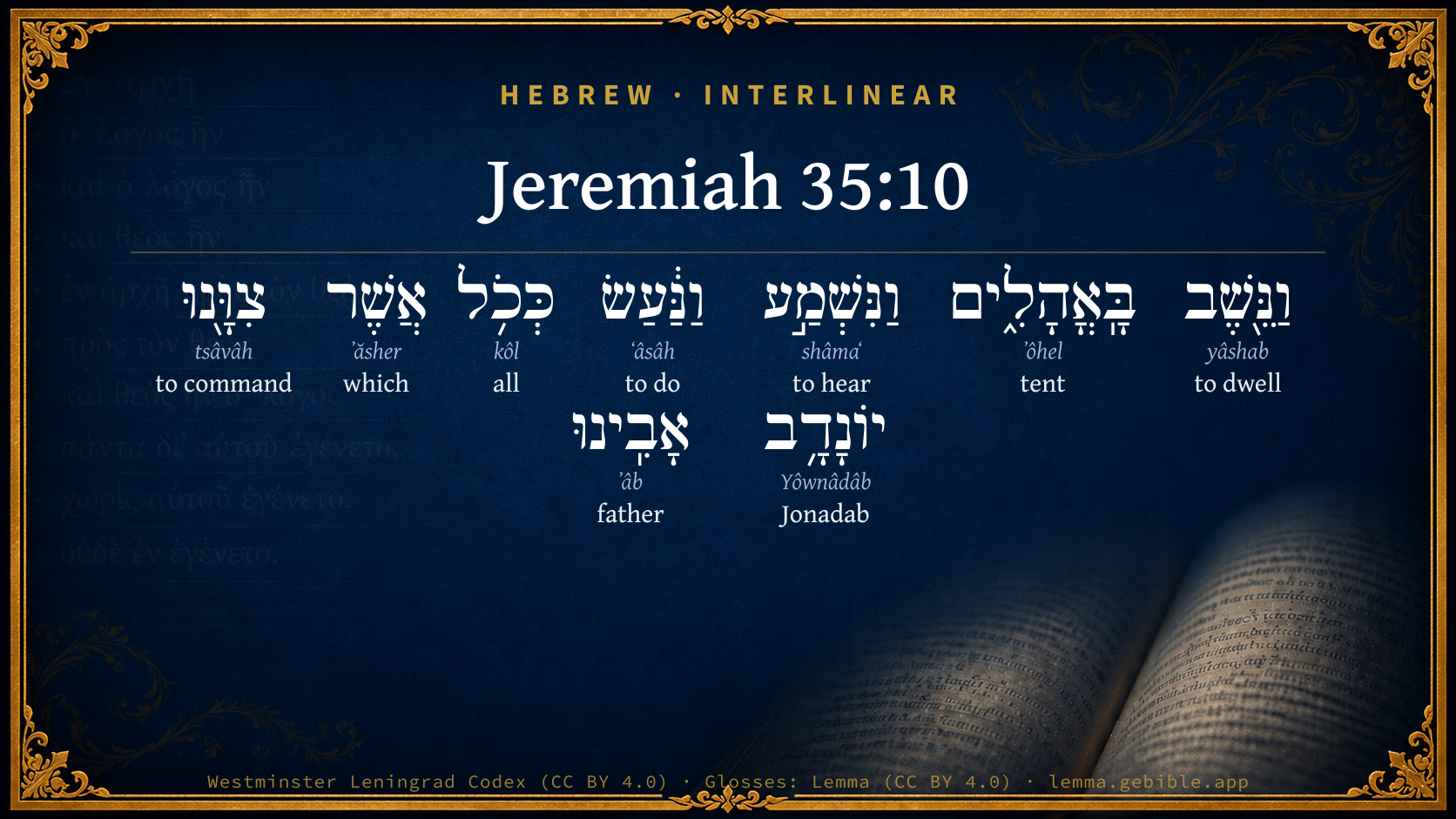
  1. וַנֵּ֖שֶׁב yâshab H3427 “and · to dwell” Conjunction + Verb, Qal, Sequential Imperfect, 1st Person, Common, Plural
  2. בָּֽאֳהָלִ֑ים ʼôhel H168 “in/at · tents” Preposition + Noun, Common, Masculine, Plural, Absolute
  3. וַנִּשְׁמַ֣ע shâmaʻ H8085 “and · to hear” Conjunction + Verb, Qal, Sequential Imperfect, 1st Person, Common, Plural
  4. וַנַּ֔עַשׂ ʻâsâh H6213 “and · to do” Conjunction + Verb, Qal, Sequential Imperfect, 1st Person, Common, Plural
  5. כְּכֹ֥ל kôl H3605 “like/as · all” Preposition + Noun, Common, Masculine, Singular, Absolute
  6. אֲשֶׁר ʼăsher H834 “which” Particle, Relative
  7. צִוָּ֖נוּ tsâvâh H6680 “to command · us” Verb, Piel, Perfect, 3rd Person, Masculine, Singular + Suffix, Personal, 1st Person, Common, Plural
  8. אָבִֽינוּ ʼâb H1 “father · our” Noun, Common, Masculine, Singular, Construct + Suffix, Personal, 1st Person, Common, Plural

About this verse

These counts appear in no published source. They are computed here, from the morphology-tagged text and Lemma’s own curated glosses. What Lemma adds →

9
words
9
distinct lemmas
Prophets
section

Notable vocabulary

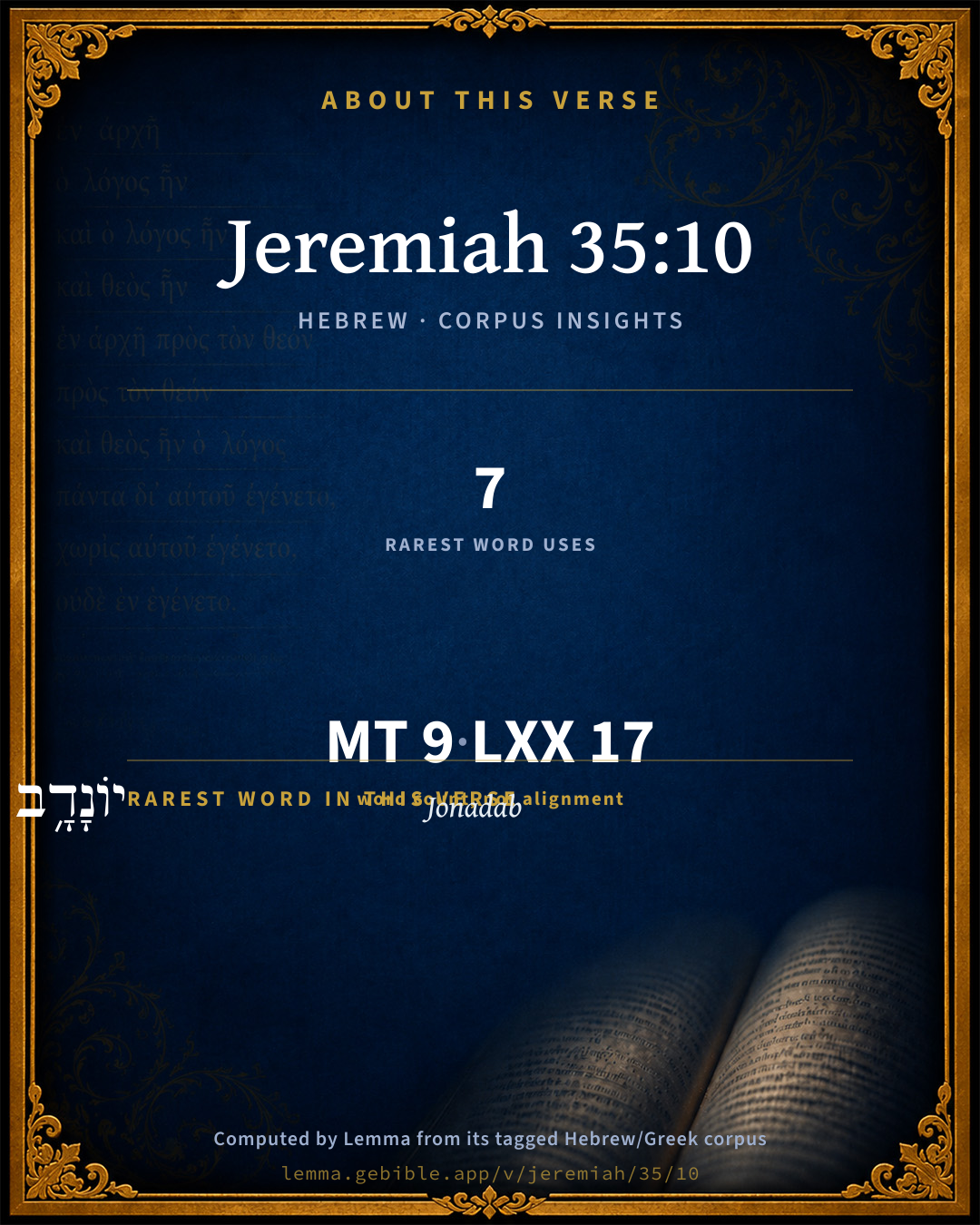
The rarest word here is יוֹנָדָ֥ב Jonadab H3122 — appearing just 7 times in the whole Hebrew Bible.

Shared distinctive vocabulary

יוֹנָדָ֥ב Jonadab H3122 occurs in 6 verses of the Hebrew Bible. Also found in:

Grammatical profile

  • 4 verbs
  • 4 nouns
  • 1 particle

Verb forms

  • וַנֵּ֖שֶׁב Qal · Sequential Imperfect
  • וַנִּשְׁמַ֣ע Qal · Sequential Imperfect
  • וַנַּ֔עַשׂ Qal · Sequential Imperfect
  • צִוָּ֖נוּ Piel · Perfect

Hebrew & Septuagint length

In the original languages it is 9 Hebrew tokens and 17 Greek tokens — but the two are counted differently (Hebrew bundles its prefixes and suffixes into one token; the Greek is in lemma form), so that isn’t a like-for-like length.

Hebrew and Greek witnesses Masoretic Hebrew ↔ Greek Septuagint

The same verse in the two great witnesses to the Old Testament, shown verse-for-verse.

These are two independent witnesses, not word-aligned to each other, and the Septuagint is shown in lemma (dictionary) form.

Hebrew Jeremiah 35:10 Masoretic · Westminster Leningrad Codex

וַנֵּ֖שֶׁב בָּֽאֳהָלִ֑ים וַנִּשְׁמַ֣ע וַנַּ֔עַשׂ כְּכֹ֥ל אֲשֶׁר צִוָּ֖נוּ יוֹנָדָ֥ב אָבִֽינוּ

but we have lived in tents, and have obeyed, and done according to all that Jonadab our father commanded us.

World English Bible · Public Domain

Greek LXX Structure differs

In the Septuagint, Jeremiah is about an eighth shorter than the Hebrew and arranges its material differently — the Oracles Against the Nations (Hebrew chapters 46–51) appear in the middle of the Greek book, after 25:13. Because the chapter and verse boundaries do not line up, a verse-for-verse comparison with the Hebrew is not shown.

A verse-for-verse comparison isn’t shown here because the chapters and verses don’t line up. Switch to the LXX edition with the MT / LXX toggle above to read the Greek directly.

Hebrew: Westminster Leningrad Codex (CC BY 4.0). Greek: Septuagint (public domain); English from a public-domain English Septuagint. How the Septuagint differs from the Hebrew →

Targum (Aramaic paraphrase)

1

The Targum is the ancient Jewish Aramaic paraphrase of the Hebrew Scriptures — an interpretive translation, not the Hebrew text itself. Onkelos (literal) and Pseudo-Jonathan (expansive) render the Torah, and Jonathan the Prophets. Coverage is partial: where no permissively-licensed English translation exists for a verse, only the Aramaic is shown. This is verse-level text, not a word-by-word alignment to the Hebrew.

  1. Targum Jonathan Prophets (Joshua–Malachi)
    וִיתֵיבְנָא בְּמַשְׁכְּנִין וְקַבֵּילְנָא וַעֲבַדְנָא כְּכֹל דְפַקֵידְנָא יוֹנָדָב אֲבוּנָא:

    (no public-domain English translation for this verse)

    Targum Jonathan — Aramaic: “Mikraot Gedolot” (public domain). English: “Sefaria Community Translation” (CC0 1.0 (public-domain dedication)); “London "Chaldee Paraphrase," 1871” (public domain). Text via Sefaria.

Commentary

Notes on Jeremiah 35:10 from classic Christian and Jewish commentators (each source and its license shown beneath its notes). The classic Christian expositions comment on the surrounding passage and are grouped to its opening verse, so a note may address several verses; the Jewish commentaries on the Tanakh (Rashi and others) are per-verse, so they appear only where the commentator wrote on this verse.

Lemma curates 59 commentaries, every one of them public domain or Creative Commons licensed, each selected and text-cleaned for this edition rather than reprinted as found. About our sources →

Trapp's Complete Commentary

John Trapp

Jer 35:10 But we have dwelt in tents, and have obeyed, and done according to all that Jonadab our father commanded us.

Ver. 10. But we have dwelt in tents.] And fed much upon dairy produce, as did Heber the Kenite, who was one of them, {Jdg 4:19} living in abstinence and bodily labour, that we might be free to divine contemplations.

John Trapp, A Commentary or Exposition upon All the Books of the Old and New Testament (1647–1656) — public domain. Text from a community e-Sword module.

Geneva Bible (1599)

Geneva Bible translators

Which was now for the space of three hundred years from Jehu to Jehoiakim.

Geneva Bible (1599) marginal notes — public domain. Text via Bolls.life.

John Gill's Exposition

But we have dwelt in tents,.... Ever since, until very lately, when they had taken up their dwelling in Jerusalem; the reason of which is presently given:

and have obeyed, and done according to all Jonadab our father commanded us; and should it be objected, that in one point they had not obeyed, in that they had left their tents, and now dwelt in Jerusalem; they had this to say in answer to it, and as the reason of their so doing, as follows:

John Gill's Exposition of the Whole Bible (1746–1763) — public domain (CC PDM 1.0). Text via the HelloAO Bible API.

Matthew Poole's English Annotations

Tents; movable habitations, which they could with little labour remove from place to place, as they had convenience to feed their flocks: this was their ordinary way of living, until necessity compelled them to come and live in Jerusalem.

Matthew Poole's English Annotations on the Holy Bible (1683–1685) — public domain. Text from a community e-Sword/MySword module.

John Wesley's Explanatory Notes

Tents - Moveable habitations, which they could with little labour remove to feed their flocks.

John Wesley, Explanatory Notes Upon the Whole Bible (1754–1765) — public domain. Text via the GEBible commentary corpus.

Lesson kit

Teaching starters — assembled from the data on this page, not authored interpretation. Every prompt links to the verse data it draws on. Edit before teaching.

Jeremiah, in the Prophets, opens this verse with 9 words (9 distinct Hebrew lemmas). Its most distinctive word is Yôwnâdâb (“Jonadab”). A historical commentator’s framing appears above. Read the whole chapter for the surrounding context.

Discussion questions

  1. The word Yôwnâdâb carries the sense “Jonadab.” How does it shape the verse?
  2. 2 Samuel 13:3 shares the word «Jonadab» with this verse. How do the two illuminate each other?
  3. These translations render this verse differently. What is at stake in choosing one wording over another?
  4. The verb «וַנֵּ֖שֶׁב» is Qal Sequential Imperfect. How does its form color the action?
  5. Reading how Trapp's Complete Commentary and Geneva Bible (1599) read this verse, where do the two commentators agree and where do they part?

Things to notice

Reading settings

Reading text

Shown beneath each verse's original-language words.

Old Testament
Old Testament edition

Read the OT as the Masoretic Hebrew (MT) or the Greek Septuagint (LXX).

English shown for the Greek Septuagint (in the Hebrew ↔ Greek comparison).

Comparing translations? Open the Compare panel on any verse page to stack up to four side by side.