
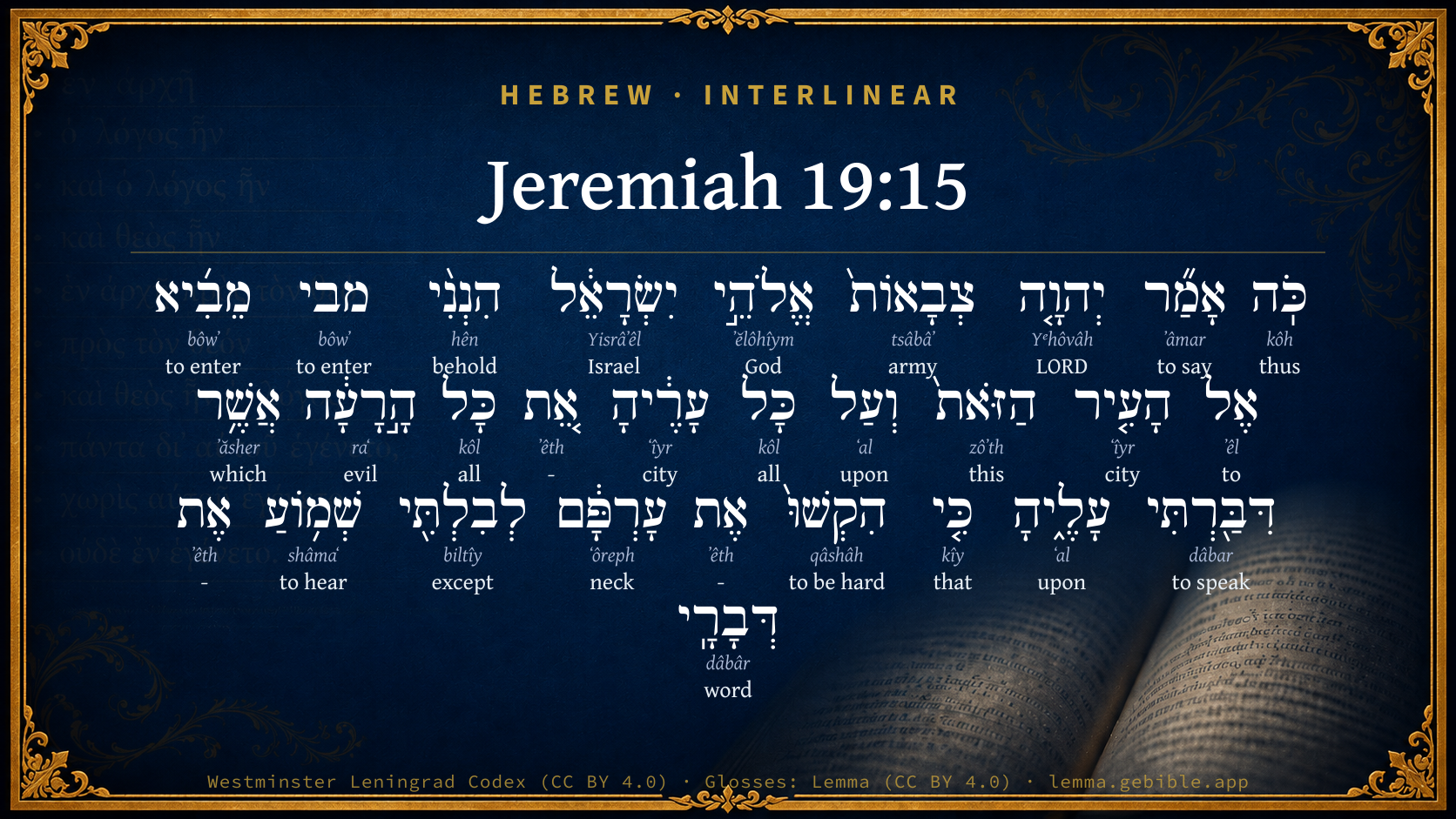
Jeremiah 19:15

Hebrew (Westminster Leningrad Codex) Jeremiah 19:15 appears in the Hebrew Old Testament. The text above is from the Westminster Leningrad Codex. Each word links to its Strong’s number, a concise gloss, and parsing drawn from the Open Scriptures Hebrew Bible morphology. Click any word for its full Brown-Driver-Briggs (BDB) entry.
Download image
Cite this verse

Jeremiah 19:15 (World English Bible). Public Domain. Lemma interlinear Bible study tool, https://lemma.gebible.app/v/jeremiah/19/15.

Show BibTeX & RIS
BibTeX
RIS
English Translation
Thus says Yahweh of Hosts, the God of Israel, Behold, I will bring on this city and on all its towns all the evil that I have pronounced against it; because they have made their neck stiff, that they may not hear my words.
World English Bible · Public Domain
Download a study sheet

One document with this verse’s original text, its word-by-word gloss line, the meaning frame, cross-references with their text, attributed commentary, and full source and license credits — printable, and it pastes into notes with its structure intact.

This verse Autodidact and up

Study sheet (.html) Plain text (.txt)

A passage Seminary Student

Up to 50 verses in one chapter. A passage sheet keeps up to 6 commentary sources and 12 cross-references per verse, in the order this page ranks them, and says so on the sheet whenever that leaves anything out. Ask for a single verse and you get the Autodidact verse sheet above.

Everything on this page stays free to read, with no account — the sheet is a download of what is already on screen, not access to it.

Want to remove ads? Support Godless Engineer
Compare translations 3

The same verse in 3 English versions, stacked beneath the original-language interlinear above. Click any original word for its lexicon entry.

Each is an independent rendering of the whole verse — the interlinear is not word-aligned to these translations.

Highlighted words mark where these versions differ — a whole-verse word diff, not a word-by-word alignment.

  • World English Bible Public Domain
    Thus says Yahweh of Hosts, the God of Israel, Behold, I will bring on this city and on all its towns all the evil that I have pronounced against it; because they have made their neck stiff, that they may not hear my words.
  • King James Version Public Domain
    Thus saith the LORD of hosts, the God of Israel; Behold, I will bring upon this city and upon all her towns all the evil that I have pronounced against it, because they have hardened their necks, that they might not hear my words.
  • unfoldingWord Literal Text CC BY-SA 4.0
    “Thus says Yahweh of Armies, the God of Israel: ‘Behold me, bringing to this city and to all its towns all the evil that I have spoken against it, because they have stiffened their neck so as not to hear my words.’”

unfoldingWord Literal Text — © unfoldingWord, licensed CC BY-SA 4.0. Word-aligned USFM3 via Door43 (git.door43.org/unfoldingWord/en_ult).

Versions to compare (up to 4)

3 of 4 selected

Show all 18 translations

Every available English version of this verse, each an independent rendering of the whole verse.

  • World English Bible Public Domain
    Thus says Yahweh of Hosts, the God of Israel, Behold, I will bring on this city and on all its towns all the evil that I have pronounced against it; because they have made their neck stiff, that they may not hear my words.
  • Berean Standard Bible Public Domain
    “This is what the LORD of Hosts, the God of Israel, says: ‘Behold, I am about to bring on this city and on all the villages around it every disaster I have pronounced against them, because they have stiffened their necks so as not to heed My words.’”
  • Majority Standard Bible Public Domain
    “This is what the LORD of Hosts, the God of Israel, says: ‘Behold, I am about to bring on this city and on all the villages around it every disaster I have pronounced against them, because they have stiffened their necks so as not to heed My words.’”
  • King James Version Public Domain
    Thus saith the LORD of hosts, the God of Israel; Behold, I will bring upon this city and upon all her towns all the evil that I have pronounced against it, because they have hardened their necks, that they might not hear my words.
  • American Standard Version (1901) Public Domain
    Thus saith Jehovah of hosts, the God of Israel, Behold, I will bring upon this city and upon all its towns all the evil that I have pronounced against it; because they have made their neck stiff, that they may not hear my words.
  • Revised Version (1885) Public Domain
    Thus saith the LORD of hosts, the God of Israel, Behold, I will bring upon this city and upon all her towns all the evil that I have pronounced against it; because they have made their neck stiff, that they might not hear my words.
  • Geneva Bible (1599) Public Domain
    Thus saith the Lord of hostes, the God of Israel, Beholde, I will bring vpon this citie, and vpon all her townes, all the plagues that I haue pronounced against it, because they haue hardened their neckes, and would not heare my wordes.
  • Douay-Rheims (1899) Public Domain
    Thus saith the Lord of hosts, the God of Israel: Behold I will bring in upon this city, and upon all the cities thereof all the evils that I have spoken against it: because they have hardened their necks, and they might not hear my words.
  • Young's Literal Translation Public Domain
    `Thus said Jehovah of Hosts, God of Israel: Lo, I am bringing in unto this city, and on all its cities, all the evil that I have spoken against it, for they have hardened their neck -- not to hear My words!'
  • Literal Standard Version CC BY-SA 4.0
    “Thus said YHWH of Hosts, God of Israel: Behold, I am bringing to this city, and on all its cities, all the calamity that I have spoken against it, for they have hardened their neck to not hear My words!”
  • Unlocked Literal Bible CC BY-SA 4.0
    “Yahweh of hosts, God of Israel, says this, 'See, I am about to bring to this city and to all of its towns all the disaster that I have proclaimed against it, since they stiffened their neck and refused to listen to my words.'”
  • unfoldingWord Literal Text CC BY-SA 4.0
    “Thus says Yahweh of Armies, the God of Israel: ‘Behold me, bringing to this city and to all its towns all the evil that I have spoken against it, because they have stiffened their neck so as not to hear my words.’”
  • Darby Bible Public Domain
    Thus saith Jehovah of hosts, the God of Israel: Behold, I will bring upon this city and upon all her cities all the evil that I have spoken against it; for they have hardened their necks, not to hear my words.
  • World Messianic Bible Public Domain
    “The LORD of Hosts, the God of Israel says, ‘Behold, I will bring on this city and on all its towns all the evil that I have pronounced against it, because they have made their neck stiff, that they may not hear my words.’”
  • Webster's Bible Public Domain
    Thus saith the LORD of hosts, the God of Israel; Behold, I will bring upon this city and upon all her towns all the evil that I have pronounced against it, because they have hardened their necks, that they might not hear my words.
  • Free Bible Version CC BY-SA 4.0
    This is what the Lord Almighty, the God of Israel, says: Watch out! I am about to bring down on this city and on all its surrounding villages every disaster I warned them about, because they have stubbornly refused to listen to what I say.
  • Bible in Basic English Public Domain
    The Lord of armies, the God of Israel, has said: See, I will send on this town and on all her towns all the evil which I have said; because they made their necks stiff, so that they might not give ear to my words.
  • JPS Tanakh (1917) Public Domain
    'Thus saith the LORD of hosts, the God of Israel: Behold, I will bring upon this city and upon all her towns all the evil that I have pronounced against it; because they have made their neck stiff, that they might not hear My words.'

Literal Standard Version (2020), Covenant Press — licensed CC BY-SA 4.0. Text via the HelloAO Bible API (eBible.org). Unlocked Literal Bible (unfoldingWord) — licensed CC BY-SA 4.0. Text via the HelloAO Bible API (eBible.org). unfoldingWord Literal Text — © unfoldingWord, licensed CC BY-SA 4.0. Word-aligned USFM3 via Door43 (git.door43.org/unfoldingWord/en_ult). Free Bible Version, Dr. Jonathan Gallagher — licensed CC BY-SA 4.0. Text via the HelloAO Bible API (eBible.org).

Word by word

More ways to search: Search by grammar → Find every occurrence → Compare this word →

Practice this passage: Drill this verse → Learn its vocabulary →

הִקְשׁוּ֙
qâshâh
H7185
“to be hard”
Verb, Hiphil, Perfect, 3rd Person, Common, Plural
Part of Speech
Verb
Stem
Hiphil
Form
Perfect
Person
3rd Person
Gender
Common
Number
Plural
Full BDB Definition

Origin: a primitive root

TWOT: 2085

to be hard, be severe, be fierce, be harsh - (Qal) - to be hard, be difficult - to be hard, be severe - (Niphal) - to be ill-treated - to be hard pressed - (Piel) to have severe labour (of women) - (Hiphil) - to make difficult, make difficulty - to make severe, make burdensome - to make hard, make stiff, make stubborn - of obstinacy (figuratively) - to show stubbornness
  1. כֹּֽה kôh H3541 “thus” Adverb
  2. אָמַ֞ר ʼâmar H559 “to say” Verb, Qal, Perfect, 3rd Person, Masculine, Singular
  3. יְהוָ֤ה Yᵉhôvâh H3068 “LORD” Noun, Proper
  4. צְבָאוֹת֙ tsâbâʼ H6635 “armies” Noun, Common, Both, Plural, Absolute
  5. אֱלֹהֵ֣י ʼĕlôhîym H430 “God(s) of” Noun, Common, Masculine, Plural, Construct
  6. יִשְׂרָאֵ֔ל Yisrâʼêl H3478 “Israel” Noun, Proper
  7. הִנְנִ֨י hên H2005 “behold · me” Particle, Demonstrative + Suffix, Personal, 1st Person, Common, Singular
  8. מבי bôwʼ H935 “entering” Verb, Hiphil, Participle Active, Masculine, Singular, Absolute
  9. מֵבִ֜יא bôwʼ H935 “entering” Verb, Hiphil, Participle Active, Masculine, Singular, Absolute
  10. אֶל ʼêl H413 “to” Preposition
  11. הָעִ֤יר ʻîyr H5892 “the · city” Particle, Definite Article + Noun, Common, Feminine, Singular, Absolute
  12. הַזֹּאת֙ zôʼth H2063 “the · this” Particle, Definite Article + Pronoun, Demonstrative, Feminine, Singular
  13. וְעַל ʻal H5921 “and · upon” Conjunction + Preposition
  14. כָּל kôl H3605 “all of” Noun, Common, Masculine, Singular, Construct
  15. עָרֶ֔יהָ ʻîyr H5892 “cities · her” Noun, Common, Feminine, Plural, Construct + Suffix, Personal, 3rd Person, Feminine, Singular
  16. אֵ֚ת ʼêth H853 “-” Particle, Direct Object
  17. כָּל kôl H3605 “all of” Noun, Common, Masculine, Singular, Construct
  18. הָ֣רָעָ֔ה raʻ H7451 “the · evil” Particle, Definite Article + Noun, Common, Feminine, Singular, Absolute
  19. אֲשֶׁ֥ר ʼăsher H834 “which” Particle, Relative
  20. דִּבַּ֖רְתִּי dâbar H1696 “to speak” Verb, Piel, Perfect, 1st Person, Common, Singular
  21. עָלֶ֑יהָ ʻal H5921 “upon · her” Preposition + Suffix, Personal, 3rd Person, Feminine, Singular
  22. כִּ֤י kîy H3588 “that” Conjunction
  23. אֶת ʼêth H853 “-” Particle, Direct Object
  24. עָרְפָּ֔ם ʻôreph H6203 “neck · their” Noun, Common, Masculine, Singular, Construct + Suffix, Personal, 3rd Person, Masculine, Plural
  25. לְבִלְתִּ֖י biltîy H1115 “to/for · except” Preposition + Conjunction
  26. שְׁמ֥וֹעַ shâmaʻ H8085 “to hear” Verb, Qal, Infinitive Construct
  27. אֶת ʼêth H853 “-” Particle, Direct Object
  28. דְּבָרָֽי dâbâr H1697 “words · my” Noun, Common, Masculine, Plural, Construct + Suffix, Personal, 1st Person, Common, Singular

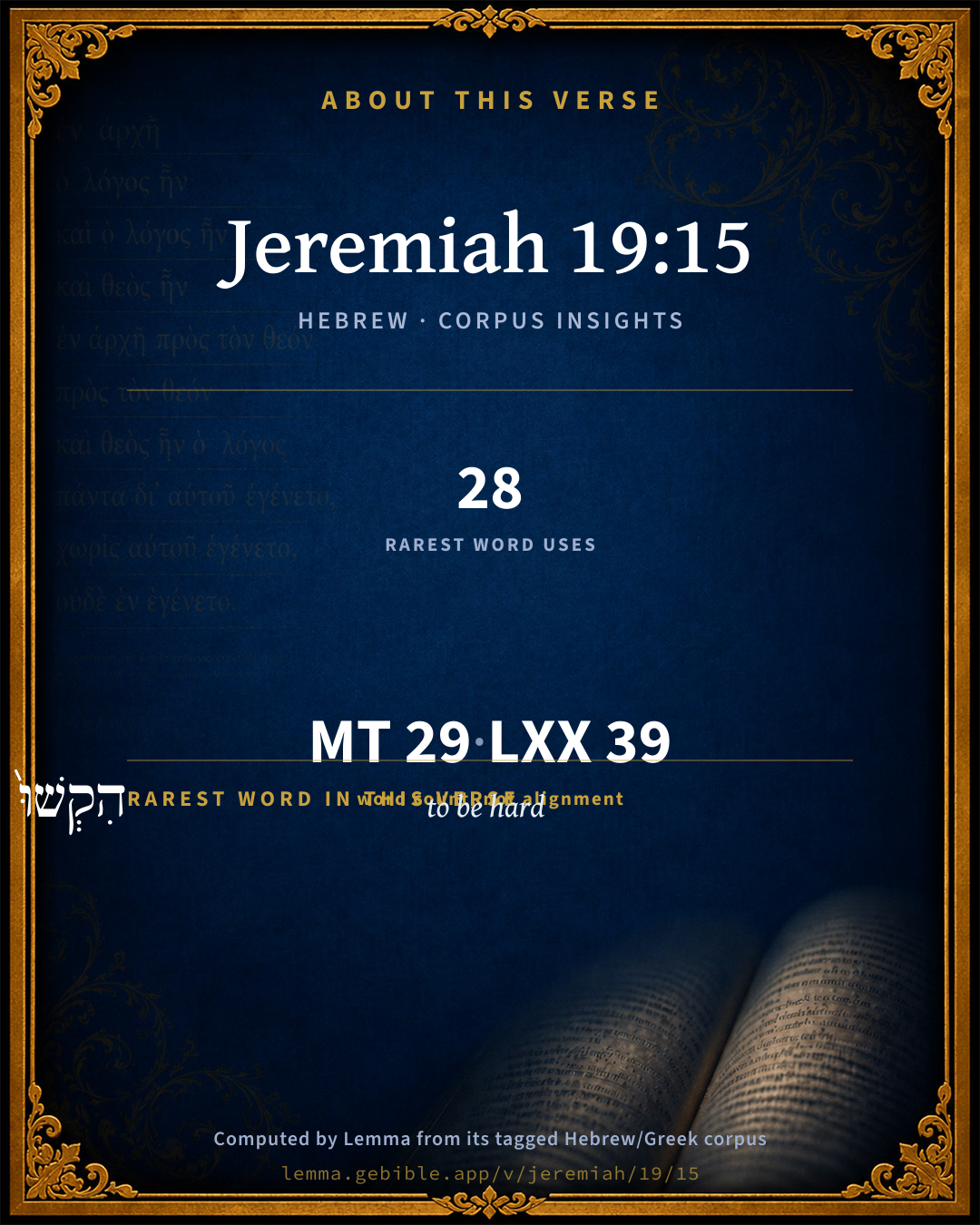
About this verse

These counts appear in no published source. They are computed here, from the morphology-tagged text and Lemma’s own curated glosses. What Lemma adds →

29
words
23
distinct lemmas
Prophets
section

Shared distinctive vocabulary

הִקְשׁוּ֙ to be hard H7185 occurs in 28 verses of the Hebrew Bible. Also found in:

Grammatical profile

  • 6 verbs
  • 11 nouns
  • 1 pronoun
  • 3 prepositions
  • 2 conjunctions
  • 1 adverb
  • 5 particles

Verb forms

  • אָמַ֞ר Qal · Perfect
  • מבי Hiphil · Participle Active
  • מֵבִ֜יא Hiphil · Participle Active
  • דִּבַּ֖רְתִּי Piel · Perfect
  • הִקְשׁוּ֙ Hiphil · Perfect
  • שְׁמ֥וֹעַ Qal · Infinitive Construct

Repetition

Words recur within this verse — often emphatic in Hebrew:

  • מבי to enter H935 ×2
  • הָעִ֤יר city H5892 ×2
  • וְעַל upon H5921 ×2
  • כָּל all H3605 ×2

Hebrew & Septuagint length

In the original languages it is 29 Hebrew tokens and 39 Greek tokens — but the two are counted differently (Hebrew bundles its prefixes and suffixes into one token; the Greek is in lemma form), so that isn’t a like-for-like length.

Cross-references

9

Topical passages linked to Jeremiah 19:15 in the Treasury of Scripture Knowledge — connected by theme and wording, ordered by reader-vote popularity; previews shown in the World English Bible.

  • Jeremiah 7:26 yet they didn't listen to me, nor inclined their ear, but made their neck stiff: they did worse than their fathers.
  • Jeremiah 17:23 But they didn't listen, neither turn their ear, but made their neck stiff, that they might not hear, and might not receive instruction.
  • Nehemiah 9:29 and testified against them, that you might bring them again to your law. Yet they dealt proudly, and didn't listen to your commandments, but sinned against your ordinances, (which if a man do, he shall live in them), and withdrew the shoulder, and hardened their neck, and would not hear.
  • 2 Chronicles 36:16–17 but they mocked the messengers of God, and despised his words, and scoffed at his prophets, until the wrath of Yahweh arose against his people, until there was no remedy.
  • Nehemiah 9:17 and refused to obey, neither were mindful of your wonders that you did among them, but hardened their neck, and in their rebellion appointed a captain to return to their bondage. But you are a God ready to pardon, gracious and merciful, slow to anger, and abundant in loving kindness, and didn't forsake them.
  • Jeremiah 35:15–17 I have sent also to you all my servants the prophets, rising up early and sending them, saying, Return you now every man from his evil way, and amend your doings, and don't go after other gods to serve them, and you shall dwell in the land which I have given to you and to your fathers: but you have not inclined your ear, nor listened to me.
  • Acts 7:51–52 "You stiff-necked and uncircumcised in heart and ears, you always resist the Holy Spirit! As your fathers did, so you do.
  • Psalms 58:2–5 No, in your heart you plot injustice. You measure out the violence of your hands in the earth.
  • Zechariah 7:11–14 But they refused to listen, and turned their backs, and stopped their ears, that they might not hear.

Cross-references courtesy of OpenBible.info (CC BY 4.0).

Hebrew and Greek witnesses Masoretic Hebrew ↔ Greek Septuagint

The same verse in the two great witnesses to the Old Testament, shown verse-for-verse.

These are two independent witnesses, not word-aligned to each other, and the Septuagint is shown in lemma (dictionary) form.

Hebrew Jeremiah 19:15 Masoretic · Westminster Leningrad Codex

כֹּֽה אָמַ֞ר יְהוָ֤ה צְבָאוֹת֙ אֱלֹהֵ֣י יִשְׂרָאֵ֔ל הִנְנִ֨י מבי מֵבִ֜יא אֶל הָעִ֤יר הַזֹּאת֙ וְעַל כָּל עָרֶ֔יהָ אֵ֚ת כָּל הָ֣רָעָ֔ה אֲשֶׁ֥ר דִּבַּ֖רְתִּי עָלֶ֑יהָ כִּ֤י הִקְשׁוּ֙ אֶת עָרְפָּ֔ם לְבִלְתִּ֖י שְׁמ֥וֹעַ אֶת דְּבָרָֽי

Thus says Yahweh of Hosts, the God of Israel, Behold, I will bring on this city and on all its towns all the evil that I have pronounced against it; because they have made their neck stiff, that they may not hear my words.

World English Bible · Public Domain

Greek LXX Structure differs

In the Septuagint, Jeremiah is about an eighth shorter than the Hebrew and arranges its material differently — the Oracles Against the Nations (Hebrew chapters 46–51) appear in the middle of the Greek book, after 25:13. Because the chapter and verse boundaries do not line up, a verse-for-verse comparison with the Hebrew is not shown.

A verse-for-verse comparison isn’t shown here because the chapters and verses don’t line up. Switch to the LXX edition with the MT / LXX toggle above to read the Greek directly.

Hebrew: Westminster Leningrad Codex (CC BY 4.0). Greek: Septuagint (public domain); English from a public-domain English Septuagint. How the Septuagint differs from the Hebrew →

Targum (Aramaic paraphrase)

1

The Targum is the ancient Jewish Aramaic paraphrase of the Hebrew Scriptures — an interpretive translation, not the Hebrew text itself. Onkelos (literal) and Pseudo-Jonathan (expansive) render the Torah, and Jonathan the Prophets. Coverage is partial: where no permissively-licensed English translation exists for a verse, only the Aramaic is shown. This is verse-level text, not a word-by-word alignment to the Hebrew.

  1. Targum Jonathan Prophets (Joshua–Malachi)
    כִּדְנַן אֲמַר יְיָ צְבָאוֹת אֱלָהָא דְיִשְׂרָאֵל הָא אֲנָא מַיְתֵי עַל קַרְתָּא הָדָא וְעַל כָּל קִרְוָהָא יַת כָּל בִּישְׁתָּא דִגְזָרֵית עֲלָהּ אֲרֵי אַקְשִׁיאוּ יַת קְדַלְהוֹן בְּדִיל דְלָא לְקַבָּלָא יַת פִּתְגָמָי:

    (no public-domain English translation for this verse)

    Targum Jonathan — Aramaic: “Mikraot Gedolot” (public domain). English: “Sefaria Community Translation” (CC0 1.0 (public-domain dedication)); “London "Chaldee Paraphrase," 1871” (public domain). Text via Sefaria.

Commentary

Notes on Jeremiah 19:15 from classic Christian and Jewish commentators (each source and its license shown beneath its notes). The classic Christian expositions comment on the surrounding passage and are grouped to its opening verse, so a note may address several verses; the Jewish commentaries on the Tanakh (Rashi and others) are per-verse, so they appear only where the commentator wrote on this verse.

Lemma curates 59 commentaries, every one of them public domain or Creative Commons licensed, each selected and text-cleaned for this edition rather than reprinted as found. About our sources →

Trapp's Complete Commentary

John Trapp

Jer 19:15 Thus saith the LORD of hosts, the God of Israel; Behold, I will bring upon this city and upon all her towns all the evil that I have pronounced against it, because they have hardened their necks, that they might not hear my words.

Ver. 15. Because they have hardened their necks.] Which may seem possessed with an iron sinew, so stiff they are and sturdy, having manum in aure, aurem in cervice, cervicem in corde, cor in obstinatione, {a} their hand on their ear, their ear in their neck, their neck in their heart, and their heart in obstinace, &c.

{a} A Lapide.

John Trapp, A Commentary or Exposition upon All the Books of the Old and New Testament (1647–1656) — public domain. Text from a community e-Sword module.

Jamieson, Fausset & Brown

Robert Jamieson, A. R. Fausset & David Brown

her towns--the suburban villages and towns near Jerusalem, such as Bethany.

Next: Jeremiah Chapter 20

Jamieson, Fausset & Brown — Commentary Critical and Explanatory on the Whole Bible (1871) — public domain (CC PDM 1.0). Text via the HelloAO Bible API.

Adam Clarke's Commentary

Verse 15. Because they have hardened their necks] A metaphor taken from unruly and unbroken oxen, who resist the yoke, break and run away with their gears. So this people had broken and destroyed the yoke of the law.

Adam Clarke's Commentary on the Bible (1810–1826) — public domain. Text from a community e-Sword/MySword module.

John Calvin's Commentaries

The reason is subjoined, Because they have hardened their neck. He again confirms what we have before observed, — that they had fallen, not through ignorance, but through perverseness; for they had learned with sufficient clearness from the law what was right, and they had also been often warned by the prophets. Hence then their wickedness appeared and their untameable spirit, for they had heard the sound doctrine of the law, and had many to warn them.

Now this passage teaches us that there is no pardon left for us, when we, as it were, avowedly reject the yoke of God. And this ought to be carefully noticed, for we see how difficult it is to subdue men, even when they confess that the word of God is what they hear. Since then there is in all mankind an innate perverseness, that hardly one in a hundred allows himself to be ruled by God’s word, it behoves us seriously to consider what is here said, — that they are unworthy of mercy who harden their neck. Hence it is said in Psalm 95:8,

“Harden not your hearts like your fathers.”

And a clearer definition follows, That they might not hear my words. Though there be hardness in all mortals, yet when the doctrine of salvation is made known and not received, then a greater impiety and pride shew themselves; for in that case, men hear God speaking, and yet rob him of his authority. It then follows, that the more clearly God makes known his truth, the less ground of excuse there is; for then especially comes to light the impiety of men, and their disdain seems incapable of being subdued.

John Calvin's Commentaries (1540-1563) — public domain. Text from the Calvin Translation Society English edition (1840s-50s) via the Christian Classics Ethereal Library (ccel.org). Calvin's coverage is partial (roughly two-thirds of the Bible); uncommented books and verses are honest gaps, never fabricated. The 19th-century editor's footnotes and remarks are omitted so the notes are faithfully Calvin's own voice.

Ellicott's Commentary for English Readers

(15) Thus saith the Lord of hosts.—The address to the people could hardly have been confined to the limits of a single verse, and it is probable, therefore, that we have here but the summary of a discourse, so like in substance to what had been given before that the prophet did not think it necessary to report it at length.

A Bible Commentary for English Readers, edited by Charles John Ellicott (1878–1897) — public domain. Text from a community e-Sword module.

The Cambridge Bible for Schools and Colleges

gen. ed. J. J. S. Perowne

15. all her towns] all the others belonging to Judah. Cp. Jer_34:1. have made their neck stiff] See on Jer_7:26.

The Cambridge Bible for Schools and Colleges (gen. ed. J. J. S. Perowne; Cambridge University Press, 1878–1918) — public domain. Text from a community e-Sword module.

Matthew Poole's English Annotations

He assureth the people from God that he would most certainly justify all his words, and bring to pass all his threats against that city. and that they must thank themselves for it, for hardening their heart, so as all that he had said made no impression upon them, nor found any place with them.

Matthew Poole's English Annotations on the Holy Bible (1683–1685) — public domain. Text from a community e-Sword/MySword module.

The Pulpit Commentary

Upon all her towns. The cities of Judah are regarded as in a manner subject to the capital.

The Pulpit Commentary (1880–1919), ed. H.D.M. Spence-Jones & Joseph S. Exell — public domain. Text from a community e-Sword module.

Lesson kit

Teaching starters — assembled from the data on this page, not authored interpretation. Every prompt links to the verse data it draws on. Edit before teaching.

Jeremiah, in the Prophets, opens this verse with 29 words (23 distinct Hebrew lemmas). Its most distinctive word is qâshâh (“to be hard”). A historical commentator’s framing appears above. Read the whole chapter for the surrounding context.

Discussion questions

  1. The word qâshâh carries the sense “to be hard.” How does it shape the verse?
  2. How does Genesis 35:16, which shares the word «to be hard», read alongside this verse?
  3. What does the repetition of “to enter” (2× in this one verse) do in this verse?
  4. The translations on this page render this verse differently — a whole-verse word diff, not a word-by-word alignment. What might account for the different wordings?
  5. «אָמַ֞ר» is a Qal Perfect verb. How does that grammatical form shape the action described?
  6. Compare how Trapp's Complete Commentary and Jamieson, Fausset & Brown read this verse. Where do they agree or differ?

Things to notice

Reading settings

Reading text

Shown beneath each verse's original-language words.

Old Testament
Old Testament edition

Read the OT as the Masoretic Hebrew (MT) or the Greek Septuagint (LXX).

English shown for the Greek Septuagint (in the Hebrew ↔ Greek comparison).

Comparing translations? Open the Compare panel on any verse page to stack up to four side by side.