
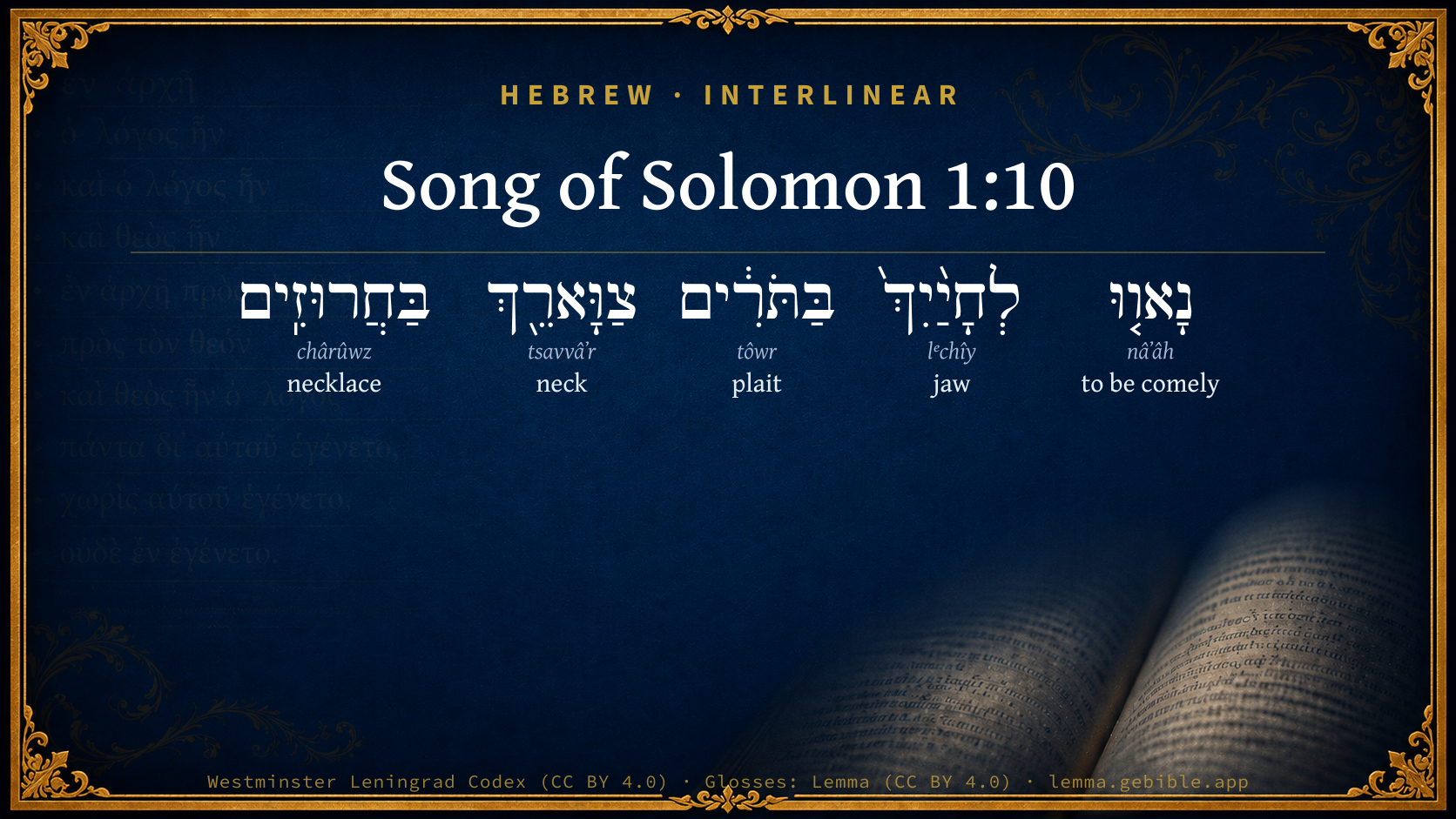
Song of Solomon 1:10

Hebrew (Westminster Leningrad Codex) Song of Solomon 1:10 appears in the Hebrew Old Testament. The text above is from the Westminster Leningrad Codex. Each word links to its Strong’s number, a concise gloss, and parsing drawn from the Open Scriptures Hebrew Bible morphology. Click any word for its full Brown-Driver-Briggs (BDB) entry.
Download image
Cite this verse

Song of Solomon 1:10 (World English Bible). Public Domain. Lemma interlinear Bible study tool, https://lemma.gebible.app/v/song-of-solomon/1/10.

Show BibTeX & RIS
BibTeX
RIS
English Translation
Your cheeks are beautiful with earrings, Your neck with strings of jewels.
World English Bible · Public Domain
Highlights
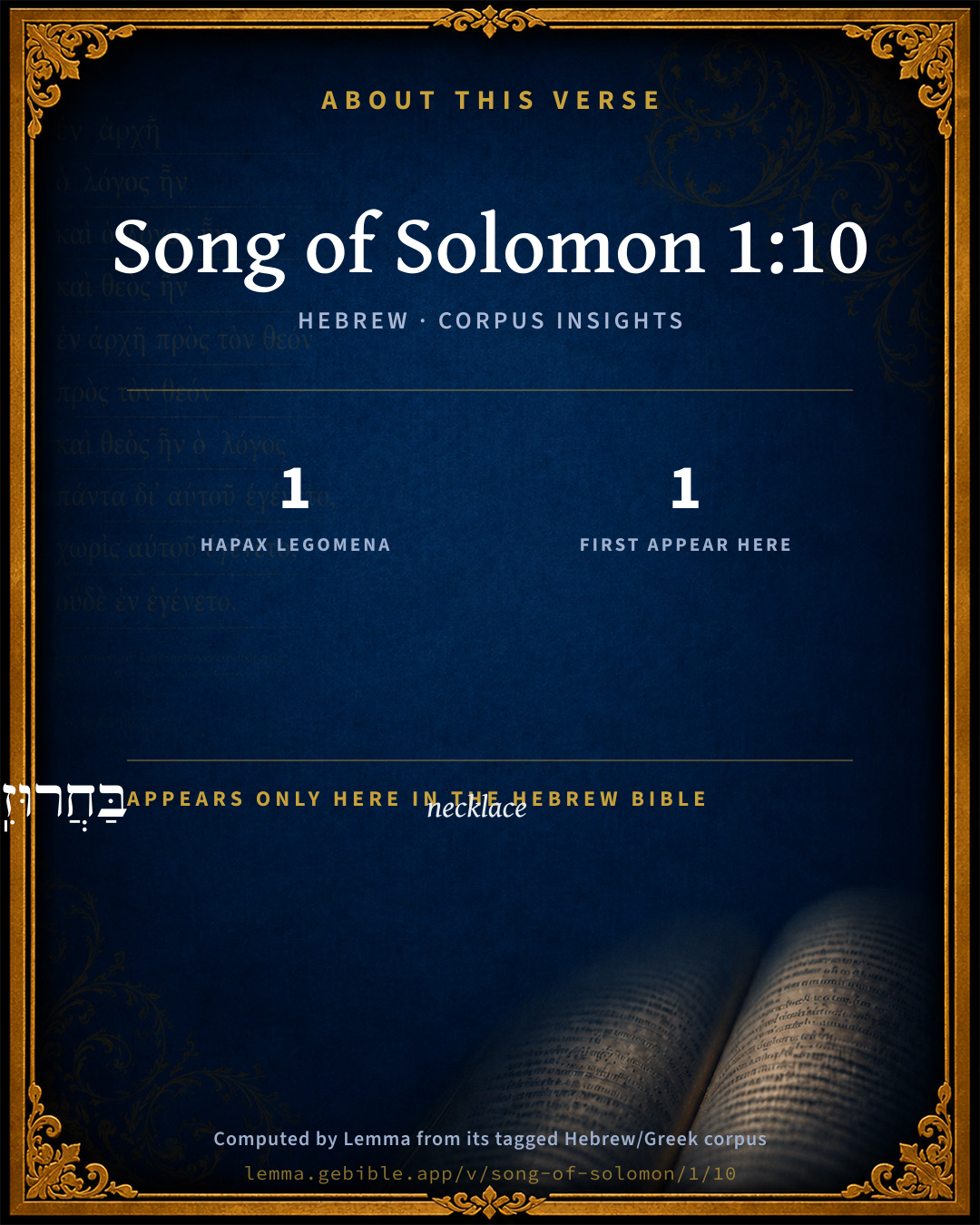
  • 1 hapax legomenon — only here in the Hebrew Bible
  • 1 first appearance in the Hebrew Bible
Full analysis ↓
Download a study sheet

One document with this verse’s original text, its word-by-word gloss line, the meaning frame, cross-references with their text, attributed commentary, and full source and license credits — printable, and it pastes into notes with its structure intact.

This verse Autodidact and up

Study sheet (.html) Plain text (.txt)

A passage Seminary Student

Up to 50 verses in one chapter. A passage sheet keeps up to 6 commentary sources and 12 cross-references per verse, in the order this page ranks them, and says so on the sheet whenever that leaves anything out. Ask for a single verse and you get the Autodidact verse sheet above.

Everything on this page stays free to read, with no account — the sheet is a download of what is already on screen, not access to it.

Want to remove ads? Support Godless Engineer
Compare translations 3

The same verse in 3 English versions, stacked beneath the original-language interlinear above. Click any original word for its lexicon entry.

Each is an independent rendering of the whole verse — the interlinear is not word-aligned to these translations.

Highlighted words mark where these versions differ — a whole-verse word diff, not a word-by-word alignment.

  • World English Bible Public Domain
    Your cheeks are beautiful with earrings, Your neck with strings of jewels.
  • King James Version Public Domain
    Thy cheeks are comely with rows of jewels, thy neck with chains of gold.
  • unfoldingWord Literal Text CC BY-SA 4.0
    Your cheeks are beautiful with earrings; your neck with necklaces.

unfoldingWord Literal Text — © unfoldingWord, licensed CC BY-SA 4.0. Word-aligned USFM3 via Door43 (git.door43.org/unfoldingWord/en_ult).

Versions to compare (up to 4)

3 of 4 selected

Show all 18 translations

Every available English version of this verse, each an independent rendering of the whole verse.

  • World English Bible Public Domain
    Your cheeks are beautiful with earrings, Your neck with strings of jewels.
  • Berean Standard Bible Public Domain
    Your cheeks are beautiful with ornaments, your neck with strings of jewels.
  • Majority Standard Bible Public Domain
    Your cheeks are beautiful with ornaments, your neck with strings of jewels.
  • King James Version Public Domain
    Thy cheeks are comely with rows of jewels, thy neck with chains of gold.
  • American Standard Version (1901) Public Domain
    Thy cheeks are comely with plaits `of hair', Thy neck with strings of jewels.
  • Revised Version (1885) Public Domain
    Thy cheeks are comely with plaits of hair, thy neck with strings of jewels
  • Geneva Bible (1599) Public Domain
    We will make thee borders of golde with studdes of siluer.
  • Douay-Rheims (1899) Public Domain
    We will make thee chains of gold, inlaid with silver.
  • Young's Literal Translation Public Domain
    Comely have been thy cheeks with garlands, Thy neck with chains.
  • Literal Standard Version CC BY-SA 4.0
    Your cheeks have been lovely with garlands, your neck with chains.
  • Unlocked Literal Bible CC BY-SA 4.0
    Your cheeks are beautiful with ornaments, your neck with strings of jewels.
  • unfoldingWord Literal Text CC BY-SA 4.0
    Your cheeks are beautiful with earrings; your neck with necklaces.
  • Darby Bible Public Domain
    Thy cheeks are comely with bead-rows, Thy neck with ornamental chains.
  • World Messianic Bible Public Domain
    Your cheeks are beautiful with earrings, your neck with strings of jewels.
  • Webster's Bible Public Domain
    Thy cheeks are comely with rows of jewels, thy neck with chains of gold.
  • Free Bible Version CC BY-SA 4.0
    Your beautiful cheeks adorned with ornaments, your neck with strings of jewels.
  • Bible in Basic English Public Domain
    Your face is a delight with rings of hair, your neck with chains of jewels.
  • JPS Tanakh (1917) Public Domain
    Thy cheeks are comely with circlets, thy neck with beads.

Literal Standard Version (2020), Covenant Press — licensed CC BY-SA 4.0. Text via the HelloAO Bible API (eBible.org). Unlocked Literal Bible (unfoldingWord) — licensed CC BY-SA 4.0. Text via the HelloAO Bible API (eBible.org). unfoldingWord Literal Text — © unfoldingWord, licensed CC BY-SA 4.0. Word-aligned USFM3 via Door43 (git.door43.org/unfoldingWord/en_ult). Free Bible Version, Dr. Jonathan Gallagher — licensed CC BY-SA 4.0. Text via the HelloAO Bible API (eBible.org).

Word by word

More ways to search: Search by grammar → Find every occurrence → Compare this word →

Practice this passage: Drill this verse → Learn its vocabulary →

About this verse

These counts appear in no published source. They are computed here, from the morphology-tagged text and Lemma’s own curated glosses. What Lemma adds →

5
words
5
distinct lemmas
Wisdom
section

Notable vocabulary

1 hapax legomenon — a word that appears only here in the entire Hebrew Bible:

  • בַּחֲרוּזִֽים necklace H2737

First appearance in Scripture

This word makes its first canonical appearance in the Hebrew Bible here:

  • בַּחֲרוּזִֽים necklace H2737

Shared distinctive vocabulary

נָאו֤וּ to be comely H4998 occurs in 3 verses of the Hebrew Bible. Also found in:

Grammatical profile

  • 1 verb
  • 4 nouns

Verb forms

  • נָאו֤וּ Qal · Perfect

Hebrew & Septuagint length

In English translation the verse runs 12 words from the Hebrew and 14 from the Septuagint (LXX English) — closely comparable.

A rough comparison of the two English renderings, which tokenize alike — not a word-level alignment.

Word counts can differ between the Hebrew and the Greek without any difference in meaning — e.g. the Hebrew direct-object marker אֵת has no separate Greek word, and Greek often adds the article ὁ.

Cross-references

12

Topical passages linked to Song of Solomon 1:10 in the Treasury of Scripture Knowledge — connected by theme and wording, ordered by reader-vote popularity; previews shown in the World English Bible.

  • Ezekiel 16:11–13 I decked you with ornaments, and I put bracelets on your hands, and a chain on your neck.
  • 1 Peter 3:4 but in the hidden person of the heart, in the incorruptible adornment of a gentle and quiet spirit, which is in the sight of God very precious.
  • Genesis 24:47 I asked her, and said, 'Whose daughter are you?' She said, 'The daughter of Bethuel, Nahor's son, whom Milcah bare to him.' I put the ring on her nose, and the bracelets on her hands.
  • Song of Solomon 5:13 His cheeks are like a bed of spices with towers of perfumes. His lips are like lilies, dropping liquid myrrh.
  • Genesis 24:22 It happened, as the camels had done drinking, that the man took a golden ring of half a shekel weight, and two bracelets for her hands of ten shekels weight of gold,
  • Genesis 41:42 Pharaoh took off his signet ring from his hand, and put it on Joseph's hand, and arrayed him in robes of fine linen, and put a gold chain about his neck,
  • Numbers 31:50 We have brought Yahweh's offering, what every man has gotten, of jewels of gold, ankle-chains, and bracelets, signet-rings, ear-rings, and armlets, to make atonement for our souls before Yahweh.
  • Proverbs 1:9 For they will be a garland to grace your head, And chains around your neck.
  • Song of Solomon 4:9 You have ravished my heart, my sister, my bride. You have ravished my heart with one of your eyes, With one chain of your neck.
  • Isaiah 3:18–21 In that day the Lord will take away the beauty of their anklets, the headbands, the crescent necklaces,
  • 2 Peter 1:3–4 seeing that his divine power has granted to us all things that pertain to life and godliness, through the knowledge of him who called us by his own glory and virtue;
  • Isaiah 61:10 I will greatly rejoice in Yahweh, my soul shall be joyful in my God; for he has clothed me with the garments of salvation, he has covered me with the robe of righteousness, as a bridegroom decks himself with a garland, and as a bride adorns herself with her jewels.

Cross-references courtesy of OpenBible.info (CC BY 4.0).

Hebrew and Greek witnesses Masoretic Hebrew ↔ Greek Septuagint

The same verse in the two great witnesses to the Old Testament, shown verse-for-verse.

These are two independent witnesses, not word-aligned to each other, and the Septuagint is shown in lemma (dictionary) form.

Hebrew Song of Solomon 1:10 Masoretic · Westminster Leningrad Codex

נָאו֤וּ לְחָיַ֨יִךְ֙ בַּתֹּרִ֔ים צַוָּארֵ֖ךְ בַּחֲרוּזִֽים

Your cheeks are beautiful with earrings, Your neck with strings of jewels.

World English Bible · Public Domain

Greek LXX Song of Solomon 1:10 Septuagint · lemma form

τίς ὡραιοῦμαι σιαγών σύ ὡς τρυγών τράχηλος σύ ὡς ὁρμίσκος

How are your cheeks beautiful as those of a dove, your neck as chains!

LXX2012 (modern English Septuagint) · Public Domain

On this verse, The Cambridge Bible for Schools and Colleges discusses the Septuagint’s reading. Read the note in Commentary ↓

Hebrew: Westminster Leningrad Codex (CC BY 4.0). Greek: Septuagint (public domain); English from LXX2012 (modern English Septuagint) (Public Domain). How the Septuagint differs from the Hebrew →

Commentary

Notes on Song of Solomon 1:10 from classic Christian and Jewish commentators (each source and its license shown beneath its notes). The classic Christian expositions comment on the surrounding passage and are grouped to its opening verse, so a note may address several verses; the Jewish commentaries on the Tanakh (Rashi and others) are per-verse, so they appear only where the commentator wrote on this verse.

Lemma curates 59 commentaries, every one of them public domain or Creative Commons licensed, each selected and text-cleaned for this edition rather than reprinted as found. About our sources →

Trapp's Complete Commentary

John Trapp

Son 1:10 Thy cheeks are comely with rows [of jewels], thy neck with chains [of gold].

Ver. 10. Thy cheeks are comely,] i.e., Thy whole face, by a synecdoche, though the cheeks are instanced, as being the seat of shamefacedness modesty, and beauty - such as was found in Esther, whose son, Artaxerxes Longimanus, was held the fairest man alive; {a} Aspasia Milesia, the wife of Cyrus, who was styled καλη και σορη, fair and wise and the Lady Jane Grey, whose excellent beauty was adorned with all variety of virtues, as a clear sky with stars, saith the historian, {b} as a princely diadem with jewels. Hence she became most dear to King Edward VI, who appointed her his successor. But nothing so dear to him, nor so happy in her succession, as the Church is to Christ, who lively describes her inward beauty, which he looks upon as a rich pearl in a rude shell, or as those "tents of Kedar" aforementioned, {Son 1:5} which though coarse and homely for the outward hue, yet, for the precious gems, jewels, and sweet odours that were couched in them, were very desirable.

With rows of jewels.] A metaphor from fair women richly adorned. Holy women may be costly attired, gratior est pulchro, &c., though Seneca thinks that he was in an error that said so, since virtue needs no garnish, but is magnum sui decus, et corpus consecrat, its own greatest glory, and consecrates the body wherein it dwelleth. St Peter also prescribes ladies an excellent dress. {1Pe 3:3-4} Tertullian comes after with his Vestite vos serico pietatis, &c., Clothe yourselves with the silk of piety, with the satin of sanctity, with the purple of purity. Taliter pigmentatae Christum habebitis amatorem, Being thus arrayed and adorned, you shall have Christ to be your suitor.

Thy neck with chains,] scil., Of pearl or precious stones, that is, of heavenly graces drawn all upon that one thread of humility, which is the ribbon or string that ties together all those precious pearls. Humility is των αρετων θησαυροφυλακιον, saith Basil, the treasuress of the rest of the virtues. It is συνδεσμος των αγαθων, saith Chrysostom, the bond of all good things, the "bond of perfection," as St Paul saith of charity. Hence St Peter’s word, εγκομβωσασθε, {1Pe 5:5} Be ye clothed with humility, comes of κομβος, for a knot; and it signifies not only alligare, to knit the graces together, and to preserve them from being made a prey to pride, but also innodare, say some, to tie knots, as delicate and curious women use to do of ribbons to adorn their necks, or other parts; as if humility was the knot of every virtue, and the ornament of every grace. On the contrary, pride is said to "compass evil men about as a chain," {Psa 73:6} which, oh how ugly and unseemly is it on the neck of beauty, back of honour, head of learning!

{a} Omnium hominum pulcherrimus. - Aenil. Prob. Aelian, lib. 12, cap. 1

{b} Sir John Heywood.

John Trapp, A Commentary or Exposition upon All the Books of the Old and New Testament (1647–1656) — public domain. Text from a community e-Sword module.

The Biblical Illustrator

Joseph S. Exell

Son_1:10

Thy cheeks are comely with rows of jewels, thy neck with chains of gold.

The bride adorned with jewels

I. The graces of the Holy Spirit are that adorning of the Church which is visible to all spiritual discernment. Faith itself is a very choice jewel, but we are to have rows of jewels--faith in exercise; faith, as a principle, honouring Christ; as a hand, laying hold of Christ; as an eye, beholding His beauty; as a warrior, conquering all that opposes Christ--faith victorious over the world--the grace of faith. The next jewel the apostle mentions is hope. We must take care we do not get it exchanged for a pebble, or some portion of mud, as formalists, and hypocrites, and profane persons do, hoping that they will be saved, hoping that God will forgive them, and that they will get to heaven and the like. Pass on to mark another brilliant jewel--love. Not only the love of God shed abroad in the heart, though that is very blessed, but love as a grace of the Holy Spirit. Then we go on to another jewel, a very lovely one, though frequently out of sight--humility. God resisteth the proud, but giveth grace to the humble; He giveth it first, and giveth grace to supply it. Another jewel in close connection with humility is meekness. Let this mind be in you which was also in Christ Jesus. He was meek and lowly of heart, and enjoins His disciples to imitate Him, that they may find rest to their souls. Another very brilliant jewel is zeal. I do not want the meekness and humility of the Christian to dwindle down into Laodicean carelessness--that would tarnish his jewels; but I want the zeal of the Lord of Hosts, which is said to have eaten up my glorious Master, to eat me up also. I want, as He was, to be clothed with zeal, as with a cloak. I will mention another jewel, making seven on this side of the face. It is a quiet jewel, but a very important one. I mean patience. In patience possess ye your souls. Let patience have her perfect work. I might lengthen this row of jewels, but I leave you to do it in your retirement, for I want to turn to the other cheek, and notice those jewels which are visible to the world. And when I have exhibited both cheeks to you, you may follow the advice of our Lord, If thine enemy smite thee on the one cheek, turn to him the other also. If they smite you on the cheek I have been naming, they will not hurt one of the jewels. Now let us look at the other. The first jewel I mention is decision. A very important one, for you must know that if you are like the Israelites, halting between two opinions, the world will laugh at you; if they find you one hour very devout in the house of God, or perhaps reading the Bible or some good book, or even holding conversation scripturally and profitably on spiritual things, and another at some silly amusement, some careless kill-time pursuit of the world, they will say your religion is all hypocrisy, and I should not wonder if they are very near the mark. Oh, for more decision! Then there is another jewel that the world will look at and admire--integrity. Oh, the disgracefulness of everything like duplicity among those who profess to belong to Christ! Oh, the dignity of a Christian being blessed with that integrity which says what it means, and means what it says--that will not, cannot, say and unsay, but is ever in the same mind as to the things which relate to Gods glory, and to his own perseverance in the divine life! Mark, another prominent jewel before the world is self-denial, just the contrast of selfishness. Again, another of these visible jewels is fortitude, which bears up the soul with a holy confidence, and shows a firm front to every enemy, and causes the soul to put on the armour of God, and make its stand in the evil day, and having done all, to stand. Circumspection must be reckoned among the jewels that are visible to the world. Hence it is written, See, then, that ye walk circumspectly, not as fools, but as wise. And again, Walk in wisdom toward them that are without. But there are two more I must just mention. Devotion. The spirit of devotion is invisible to the world, but its manifestation will be seen. Just the contrast of that levity, and carelessness, and trifling that characterize so many professors. Then there is one jewel more I must name--joy The God of hope fill you with all joy and peace in believing This, of course, will include gratitude, which, also, is a grace; but I put them together, and just remark that we are exhorted to rejoice in the Lord always.

II. The brides neck and its ornaments. The first question that arises is, What are we to understand by the neck of the Church? The neck is the part that unites the body and the head. Then it must be the covenant of grace that is the neck; the living union between Christ and His Church. It is the strength, the support, and the medium of communication. Now let us come to the ornaments. You are to recollect they are in the plural--chains. Thy neck with chains of gold. The golden chain of doctrines. Observe, they are not detached links or rings, but they are closely linked together, and we cannot part with one link without breaking the chain. What shall I say about the chain of promises? If I take a short summary of it I would just say, that they are distinct, that they are not to be separated, and, as we before said, they are linked together. And hence we read that all the promises of God in Him (Christ) are yea, and in Him amen. Are they not well riveted? One more chain I must mention--the chain of privileges. The privilege of separation and distinction from the world--the privilege of high education, the Spirit of the Lord being the preceptor--the privilege of adoption, being at home at the Fathers house--the privilege of feasting on a feast of fat things, provided and prepared by the Master of the feast, who is the Bridegroom--the privilege of attendants, servants such as you cannot find on earth. Moreover, the privilege of advocacy within the veil. If any man sin, we have an Advocate with the Father, Jesus Christ the righteous. Here are chains of gold, beloved, chains to hang about the neck. I tell you of these, as of the jewels, that Jesus has put them on, and they are invaluable; though I know the carnal mind will prefer the tinsel, the toys, the gilded ornaments, the empty, light, worthless things, that look a little gaudy in external religion, rather than these gold chains. (J. Irons.)

Chains of gold

By those chains of gold, with which the Churchs neck is beautified and adorned, may be meant,

1. The laws and ordinances of God; which the ministers of the Gospel, and members of Churches, should be careful to observe (Pro_1:9). Or,

2. Those diversities of gifts which are bestowed on the ministers of Christ, by which they are made able ministers of the New Testament; and so become useful to many, and appear comely and beautiful, both in the eyes of Christ, and of such souls to whom they minister. Or,

3. The various graces of the Spirit, with which, not only ministers, but all believers are adorned; for sins and vices are so chained and linked together, that where there is one, there is all; so the graces of the Spirit are like chains of gold, which are so closely linked together, that they cannot be separated, but where there is one grace there is every grace, which very much beautify and adorn the believer. This chain consists of ten links:

(1) Faith.

(2) Hope.

(3) Love.

(4) Humility.

(5) Patience.

(6) Self-denial.

(7) Contentment.

(8) A saving knowledge of Jesus Christ.

(9) Longsuffering and forbearance.

(10) Sincerity. Or,

4. Those blessings of grace which are laid up in an everlasting covenant, come through the blood of Christ, and are communicated to all His people, may be meant by these chains; they go inseparably together; where a person is blessed with one, he is blessed with all: for though our interest in them may be gradually discovered to us, yet are we blessed at once, with all spiritual blessings in heavenly places in Christ. Not one of these links can be broken; this golden chain of grace and salvation is described (Rom_8:30). (John Gill, D. D.)

The Biblical Illustrator, edited by Joseph S. Exell (c. 1880s–1900s) — public domain. Text from a community e-Sword module.

Tyndale Open Study Notes

Tyndale Open Resources

1:10-11 The woman’s beauty is enhanced by her jewelry. This beauty deserves to be even further ornamented, so the man says that even more jewelry will be provided for her (cp. Matt 13:12).

Tyndale Open Study Notes — © Tyndale Open Resources, licensed CC BY-SA 4.0. Text via the HelloAO Bible API.

Adam Clarke's Commentary

Verse 10. Thy cheeks are comely] D'Arvieux has remarked that "the Arabian ladies wear a great many pearls about their necks and caps. They have golds chains about their necks which hang down upon their bosoms with strings of coloured gauze; the gauze itself bordered with zechins and other pieces of gold coin, which hang upon their foreheads and both cheeks. The ordinary women wear small silver coins, with which they cover their forehead-piece like fish scales, as this is one of the principal ornaments of their faces." I have seen their essence bottles ornamented with festoons of aspers, and small pieces of silver pearls, beads, &c. One of these is now before me.

Adam Clarke's Commentary on the Bible (1810–1826) — public domain. Text from a community e-Sword/MySword module.

Ellicott's Commentary for English Readers

(10) Rows.—Heb., tôrim, from tûr = went round; hence = either circlets or strings of jewels, or the round beads themselves of which necklaces, &c, were made.

Chains.—Literally, perforated, i.e., beads, or possibly coins strung together. “Arab ladies, particularly the married, are extravagantly fond of silver and gold ornaments, and they have an endless variety of chains, bracelets, anklets, necklaces, and rings. It is also quite common to see thousands of piastres, in various coins, round the forehead and suspended from the neck, and covering a system of network, called suffa, attached to the back of the head-dress, which spreads over the shoulders and falls down to the waist” (Thomson, The Land and the Book).

Olearius (quoted by Harmer) says:—“Persian ladies use as head-dress two or three rows of pearls, which pass round the head and hang down the cheeks, so that their faces seem set in pearls.” Lady Mary Montague describes the Sultana Hafitan as wearing round her head-dress four strings of pearls of great size and beauty.

A Bible Commentary for English Readers, edited by Charles John Ellicott (1878–1897) — public domain. Text from a community e-Sword module.

The Cambridge Bible for Schools and Colleges

gen. ed. J. J. S. Perowne

10. Thy cheeks are comely] The LXX have τί ὡραιώθησαν σιαγόνες σου, ‘How comely are thy cheeks,’ which would be a very good reading.

with rows of jewels] Most probably these are strings, either of beads formed of the precious metals, or of precious stones, hanging down over the cheeks in loops. R.V. renders ‘plaits of hair.’ Archdeacon Aglen very aptly quotes from Olearius the following sentence: “Persian ladies use as head-dress two or three rows of pearls, which pass round the head and hang down the cheeks, so that their faces seem set in pearls.” He also notes that Lady Mary Wortley Montague describes the Sultana Hafitan as wearing round her head-dress four strings of pearls of great size and beauty.

with chains of gold] Rather, with strings of jewels, as R. V. The word occurs here only in the O.T., but cognate words in Aramaic and Arabic shew that it means an ornament of beads or jewels strung together. Probably it is the ‛iqd or necklace described and figured by Lane, Modern Egyptians, vol. II. p. 319. He says the necklaces mostly worn by ladies are of diamonds or pearls.

The Cambridge Bible for Schools and Colleges (gen. ed. J. J. S. Perowne; Cambridge University Press, 1878–1918) — public domain. Text from a community e-Sword module.

Matthew Poole's English Annotations

Rows of jewels; which being fastened to the heads of brides, used to hang down upon and to adorn their cheeks, according to the manner in those times. He mentions the cheeks as the chief seat of beauty; and he intimates that the church’s beauty is not natural, nor from herself, but from the jewels wherewith Christ adorns her.

Thy neck; which is mentioned as another visible part and seat of beauty, Hos 10:11. But to accommodate every part and ornament named in this book to some particular thing in the church, seems to have more of curiosity and artifice than of solidity and use.

Chains of gold; whereby, as well as by the rows of jewels, he may seem to design all those persons and things wherewith the church is made beautiful in the eyes of God and of men; such as excellent ministers, and saints, righteous laws, holy ordinances, and the gifts and graces of God’s Spirit, all which are given by God to the church, and are her best ornaments.

Matthew Poole's English Annotations on the Holy Bible (1683–1685) — public domain. Text from a community e-Sword/MySword module.

Whedon's Commentary on the Bible

Daniel D. Whedon

10. With rows — That is, with strings of beads or rings, such as Eastern women still wear as a headdress, hanging in ringlets over the cheeks.

With chains — A necklace. There is nothing here to suggest that they were of gold. There seems intended a contrast between the ornaments now named and those offered in the next verse, as if the King would say, “Thou art fair even in humble dress, but I will give thee one choice and costly.”

10. The royal pavilion in which the book opens, and in which the lovers are now standing, is magnificent. Yet the Enamoured claims loftier beauty for her hillside grove.

Also our bed is green — Better, But there our couch is verdant. At the close of the verse should be no period.

Daniel D. Whedon (gen. ed.), Commentary on the Old and New Testaments (1874–1909) — public domain. Text from a community e-Sword module.

The Pulpit Commentary

Vers. 10, 11. Thy cheeks are comely with plaits of hair, thy neck with strings of jewels. We will make thee plaits of gold with studs of silver. This language may be suggested by the comparison first employed the trappings of the horse. "The head frame of the horse"s bridle and the poitral were then certainly, just as now, adorned with silken tassels, fringes, and other ornaments of silver. Torim, "round ornaments," which hang down in front on both sides of the headband or are also inwoven in the braids of hair in the forehead." The strings of jewels were necklaces three rows of pearls. The ornamentation is, however, quite in accordance with female dress. The king makes the promise of gold and silver decoration as an expression of his personal delight in his bride and acceptance of her. Gold and silver were closely connected; hence silver was called, in the Old Egyptian language, "white gold." The idea seems to be that of silver points sprinkled over golden knobs. Compare the description in "Faust" of Margaret"s delight in the casket she finds in her room. The LXX and Vulgate have mistaken the word torim for a similar word for "doves," taking the simile to be the beautiful colours of the dove"s neck. The bride does not seem to reply immediately to the king; but we may suppose that the king takes his bride by the hand, and leads her into the banqueting chamber. But the next three verses, which are certainly in the lips of the bride, may be taken as her expression of delight in her husband, either while he feasts in the banquet or when it is over. The banquet is a familiar emblem of the delight of mutual love. Hence the feasts of love in the primitive Church were regarded, not only as seasons of fellowship between Christians, but times of rejoicing, when the soul entered into the full appreciation of the Saviour"s presence.

The Pulpit Commentary (1880–1919), ed. H.D.M. Spence-Jones & Joseph S. Exell — public domain. Text from a community e-Sword module.

John Wesley's Explanatory Notes

Jewels - Which being fastened to the heads of brides, used to hang down upon their cheeks, in those times. He mentions the cheeks, as the chief seat of beauty. Chains - Whereby, as well as by the rows of jewels: he may seem to design all those persons and things wherewith the church is made beautiful in the eyes of God, and of men, such as excellent ministers, and saints, righteous laws, holy ordinances, and the gifts and graces of God's spirit.

John Wesley, Explanatory Notes Upon the Whole Bible (1754–1765) — public domain. Text via the GEBible commentary corpus.

Rashi

Rabbi Shlomo Yitzchaki (Rashi)

Your cheeks are comely with rows rows of earrings and a golden forehead plate.

your neck with necklaces necklaces of gold with pearls strung on golden threads of the plunder of the sea.

Rashi on the Tanakh — English translations: “The Judaica Press complete Tanach with Rashi, translated by A. J. Rosenberg” (CC BY 4.0); “Pentateuch with Rashi's commentary by M. Rosenbaum and A.M. Silbermann, 1929-1934” (public domain); “The Metsudah Tanach series, Lakewood, N.J” (CC BY 4.0); and “The Book of Joshua, Metsudah Publications, 1997” (CC BY 4.0). Text via Sefaria.

Lesson kit

Teaching starters — assembled from the data on this page, not authored interpretation. Every prompt links to the verse data it draws on. Edit before teaching.

Song of Solomon, in the Wisdom, opens this verse with 5 words (5 distinct Hebrew lemmas). Its most distinctive word is chârûwz (“necklace”). A historical commentator’s framing appears above. Read the whole chapter for the surrounding context.

Discussion questions

  1. The word chârûwz carries the sense “necklace.” How does it shape the verse?
  2. 1 word here appears nowhere else in the Hebrew Bible. Why might the author reach for such rare wording?
  3. This is the first place “necklace” appears in Scripture (first appears here). What does its debut here establish?
  4. How does Psalms 93:5, which shares the word «to be comely», read alongside this verse?
  5. The translations on this page render this verse differently — a whole-verse word diff, not a word-by-word alignment. What might account for the different wordings?
  6. «נָאו֤וּ» is a Qal Perfect verb. How does that grammatical form shape the action described?
  7. Compare how Trapp's Complete Commentary and The Biblical Illustrator read this verse. Where do they agree or differ?

Things to notice

  • 1 word in this verse appears nowhere else in the Hebrew Bible.
  • 1 word makes its first canonical appearance in Scripture here.
  • These translations choose different wording for 9 words in this verse.
  • 5 distinct Hebrew lemmas span 5 words in this verse.

Reading settings

Reading text

Shown beneath each verse's original-language words.

Old Testament
Old Testament edition

Read the OT as the Masoretic Hebrew (MT) or the Greek Septuagint (LXX).

English shown for the Greek Septuagint (in the Hebrew ↔ Greek comparison).

Comparing translations? Open the Compare panel on any verse page to stack up to four side by side.