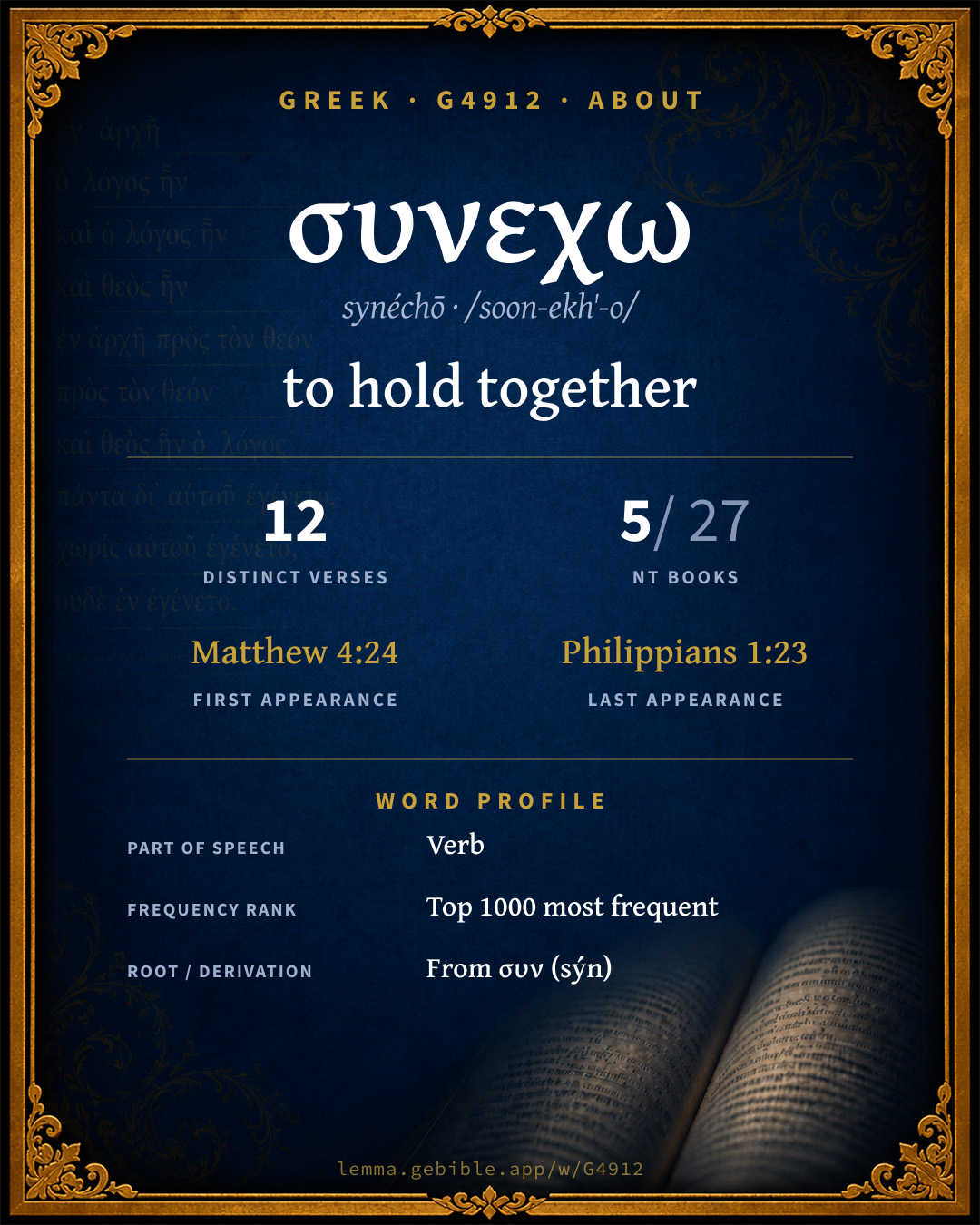
συνέχω
to hold together
‘to hold together’ is one of 5 main senses fuller range ↓
Full lexicon entry — Thayer's Greek Lexicon
From Thayer's Greek Lexicon
Where this word appears
See every Present-tense verb in the Greek New Testament →
Grammar key — what these labels mean
Part of speech
- Verb
- An action or state-of-being word.
Tense
- Present
- Ongoing or general action in present time (imperfective aspect).
- Aorist
- Action viewed as a simple whole, without regard to duration — often past (perfective aspect).
- Future
- Action expected in future time.
- Imperfect
- Continuous or repeated action in past time (“was writing”).
Voice
- Passive
- The subject receives the action.
- Active
- The subject performs the action.
Mood
- Indicative
- States a fact or asks a factual question (the mood of reality).
- Participle
- A verbal adjective (“writing,” “having written”).
Case
- Nominative
- The case of the subject (and the predicate nominative).
- Accusative
- The case of the direct object and of extent.
Person
- 1st person
- The speaker (“I / we”).
- 3rd person
- The one spoken about (“he / she / it / they”).
Gender
- Masculine
- Grammatically masculine.
- Feminine
- Grammatically feminine.
Number
- Singular
- One.
- Plural
- More than one.
Grammatical forms 11 distinct
- Verb, Present, Passive, Indicative, 1st person, Singular 2 times (17%)
- Verb, Aorist, Active, Indicative, 3rd person, Plural 1 time (8%)
- Verb, Future, Active, Indicative, 3rd person, Plural 1 time (8%)
- Verb, Imperfect, Passive, Indicative, 3rd person, Plural 1 time (8%)
- Verb, Imperfect, Passive, Indicative, 3rd person, Singular 1 time (8%)
- Verb, Present, Active, Indicative, 3rd person, Plural 1 time (8%)
- Verb, Present, Active, Indicative, 3rd person, Singular 1 time (8%)
- Verb, Present, Active, Participle, Nominative, Plural, Masculine 1 time (8%)
+3 more forms (3 occurrences)
Parsed forms decoded from the imported morphology (Robinson–Tischendorf, public domain), counted across 12 parsed occurrences — not distinct verses.
Every verse where G4912 appears — 12 distinct verses across 5 books. Click any verse to open its interlinear word-by-word view. Verse text shown in the World English Bible for context — . Each verse’s Greek form is shown with its reference; the English is not keyword-highlighted, since the data carries no word-level English alignment. Use “Compare translations” on any verse to read it across multiple English versions. This concordance covers the Greek New Testament; Septuagint (Greek Old Testament) occurrences of this word are not indexed here.
Matthew 1 verse
Luke 6 verses
- Luke 4:38 συνεχομένη pres pass ptcp nom sg fem He rose up from the synagogue, and entered into Simon's house. Simon's mother-in-law was afflicted with a great fever, and they begged him for her.
- Luke 8:37 συνείχοντο impf pass ind 3pl All the people of the surrounding country of the Gadarenes asked him to depart from them, for they were very much afraid. He entered into the boat, and returned.
- Luke 8:45 συνέχουσίν pres act ind 3pl Jesus said, "Who touched me?" When all denied it, Peter and those with him said, "Master, the multitudes press and jostle you, and you say, 'Who touched me?'"
- Luke 12:50 συνέχομαι pres pass ind 1sg But I have a baptism to be baptized with, and how distressed I am until it is accomplished!
- Luke 19:43 συνέξουσίν fut act ind 3pl For the days will come on you, when your enemies will throw up a barricade against you, surround you, hem you in on every side,
- Luke 22:63 συνέχοντες pres act ptcp nom pl masc The men who held Jesus mocked him and beat him.
Acts 3 verses
- Acts 7:57 συνέσχον aor act ind 3pl But they cried out with a loud voice, and stopped their ears, and rushed at him with one accord.
- Acts 18:5 συνείχετο impf pass ind 3sg But when Silas and Timothy came down from Macedonia, Paul was compelled by the Spirit, testifying to the Jews that Jesus was the Christ.
- Acts 28:8 συνεχόμενον pres pass ptcp acc sg masc It happened that the father of Publius lay sick of fever and dysentery. Paul entered in to him, prayed, and laying his hands on him, healed him.
2 Corinthians 1 verse
Philippians 1 verse
About this entry
At a glance — auto-summarized from this page’s data, not written by a person. Every figure links to its source below. This summary describes the numbers; it doesn’t interpret them.
At its core, συνεχω (synéchō) means “to hold together.” Its uses cluster heavily in Luke (50% of all occurrences). With 12 verses in 5 books, it is an uncommon word in the Greek New Testament. First canonically at Matthew 4:24, it enters the text early. Catalogued under 5 senses, its meaning is not single-sense. Each statement above links to its evidence; the full detail follows below.
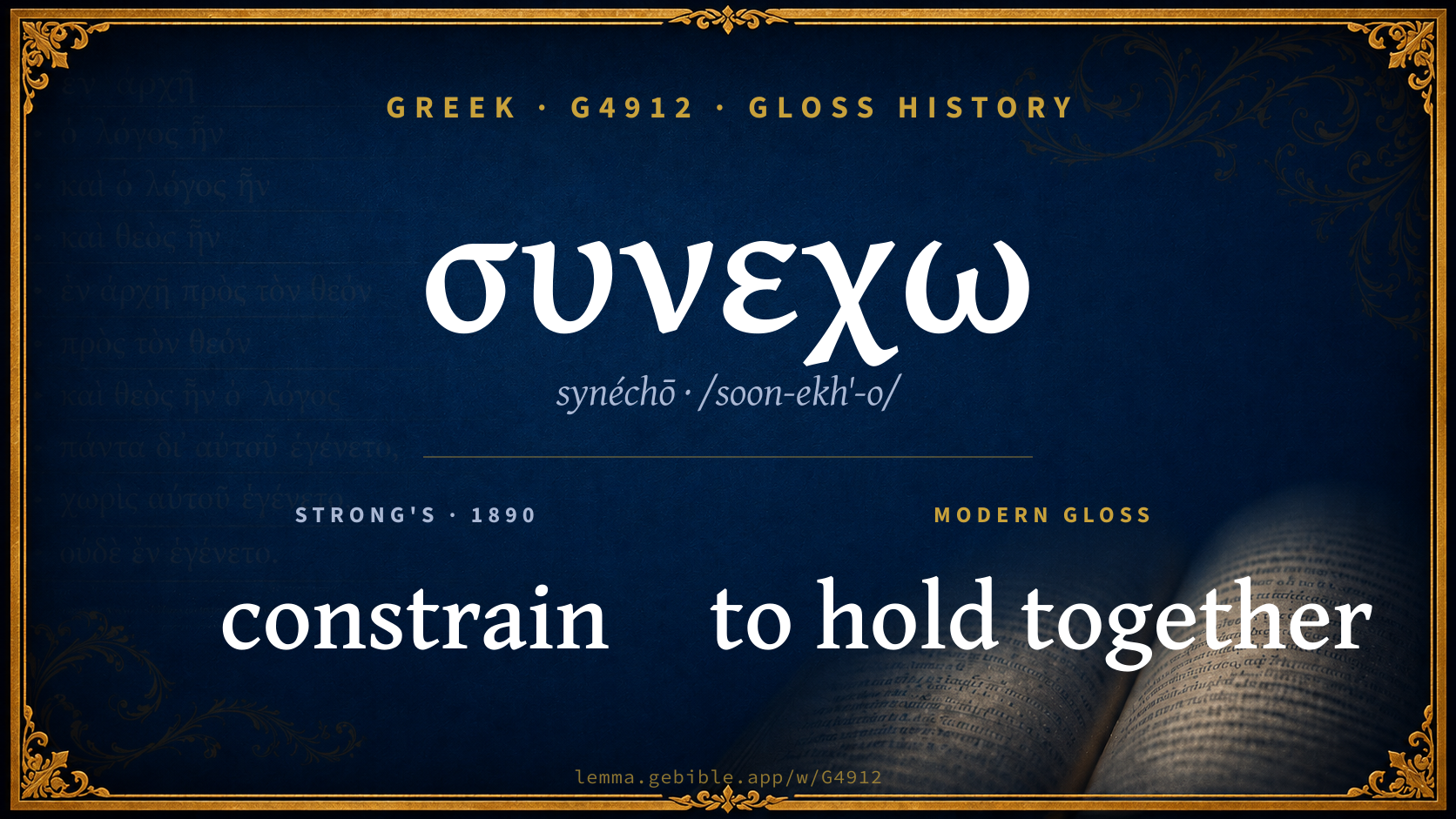
Gloss history
Strong's 1890 vs modern scholarship
About this word
Strong's G4912 catalogs a Greek word from the Greek New Testament.
These counts are not copied from any lexicon or concordance. They are computed here, from the morphology-tagged Greek New Testament. What Lemma adds →
- 12
- distinct verses
- The word appears in 12 distinct verses.
- 5 / 27
- NT books
- The word appears in 5 of 27 New Testament books.
- #904
- by frequency
- Top 1000 most frequent Greek words (rank 904 of 5,347 Greek words by occurrence).
View all 12 occurrences in the concordance →
By section of the New Testament
By traditional corpus
Conventional, traditional groupings — biblical authorship is debated, so this is a traditional corpus grouping, not an authorship claim. Some books belong to more than one corpus (Luke is in both the Gospels and the Lukan corpus, and so on), so these shares overlap and need not total 100%. Each figure is a share of the word’s 12 distinct verses.
- Lukan (Luke–Acts) 9 verses · 75%
- Gospels 7 verses · 58%
- Pauline corpus 2 verses · 17%
How translations render this word
Counts come from each version’s own published word-to-Strong’s tagging or interlinear alignment — an approximate guide to how each version renders this word, not a word-level alignment the data otherwise carries. Because each total is that version’s own tagged count, the per-version totals vary from one another and need not match the appearance or distinct-verse counts above. These counts may also differ from a printed concordance because Lemma counts each distinctly tagged rendering and does not collapse phrase taggings into a single head-word total. This is a fixed set of word-tagged versions (KJV, ASV, BSB, ULT) and does not change with the reading translation you choose elsewhere. Each version’s license is shown beside its name below (and on Sources).
- King James Version: Am i straitened 1×, Constraineth 1×, Held 1×
- American Standard Version: Am i straitened 1×, Constraineth 1×, Crush 1×
- Berean Standard Bible: Suffering from 2×
- unfoldingWord Literal Text: Are crowding around 1×, Being afflicted by 1×, Being afflicted with 1×
King James Version Public Domain
Renders G4912 across 13 tagged occurrences — most commonly:
Plus other, less common renderings.
American Standard Version Public Domain
Renders G4912 across 13 tagged occurrences — most commonly:
Plus other, less common renderings.
Berean Standard Bible Public Domain
Renders G4912 across 12 tagged occurrences — most commonly:
Plus 10 renderings that appear only once — usually multi-word phrases or single function words the recovered tagging swept in, not distinct renderings.
unfoldingWord Literal Text CC BY-SA 4.0
Renders G4912 across 12 tagged occurrences — most commonly:
Senses in Thayer's
The 5 senses Thayer's distinguishes for this word, in lexicon order (not ranked by frequency or importance). The full entry — with sub-senses — is in the Lexicon Entry tab.
- any whole, lest it fall to pieces or something fall away from it
- to hold together with constraint, to compress
- to hold fast
- metaph.
- of the soul
Word origin
Derived from συν (sýn) (G4862) — with.
From G4862 and G2192 ; to hold together that is to compress (the ears with a crowd or siege) or arrest (a prisoner); figuratively to compel perplex afflict preoccupy : - constrain hold keep in press lie sick of stop be in a strait straiten be taken with throng.
— Strong’s Exhaustive Concordance (1890), public domain.
Forms in the corpus
The 11 distinct written forms G4912 takes in the Greek New Testament, most frequent first — each parse links to that tense’s occurrences in the concordance.
Same root — word family
Other Thayer's entries built from the same root as G4912, grouped by Strong’s listed origin. These share a root / origin per the lexicon — not necessarily a shared meaning. Each links to that word’s own entry.
Derives from
Shares the same root
- κοινος koinós G2839 common
- συγγενης syngenḗs G4773 related by blood
- συγγνωμη syngnṓmē G4774 pardon
- συγκαθημαι synkáthēmai G4775 to sit together
- συγκαθιζω synkathízō G4776 to sit together
- συγκακοπαθεω synkakopathéō G4777 to suffer together
- συγκακουχεω synkakouchéō G4778 to be ill-treated together
- συγκαλεω synkaléō G4779 to call together
- συγκαλυπτω synkalýptō G4780 to cover completely
- συγκαμπτω synkámptō G4781 to bend together
- συγκαταβαινω synkatabaínō G4782 to go down with
- συγκατατιθεμαι synkatatíthemai G4784 to deposit together
- συγκαταψηφιζω synkatapsēphízō G4785 to vote against
- συγκεραννυμι synkeránnymi G4786 to mix together
- συγκλειω synkleíō G4788 to shut up
- συγκληρονομος synklēronómos G4789 joint heir
- συγκοινωνεω synkoinōnéō G4790 to share together
- συγκοινωνος synkoinōnós G4791 joint partner
- συγκομιζω synkomízō G4792 to collect together
- συγκρινω synkrínō G4793 to join together
- συγκυπτω synkýptō G4794 to bend together
- συγκυρια synkyría G4795 by chance
- συγχαιρω synchaírō G4796 to rejoice with
- συγχεω synchéō G4797 to disturb
+125 more words share this root (not shown).
Derived from this word
Compare all same-root words → Showing 4 of 152 — not the complete family. They share a root, not necessarily a meaning.
Septuagint usage
The same Greek word συνεχω appears 42 times in the Greek Old Testament (Septuagint), across 42 verses in 17 books.
- 42
- LXX occurrences
- Tagged occurrences of this Greek word in the Septuagint.
- 42
- verses
- Distinct Septuagint verses containing this word.
- 17 / 39
- OT books
- The word appears in 17 of the 39 Old Testament books.
Sample Septuagint occurrences
- Genesis 1:9 συνἔχω
- Exodus 26:3 συνἔχω
- Deuteronomy 11:17 συνἔχω
- 1 Samuel 14:6 συνἔχω
- 2 Samuel 20:3 συνἔχω
- 1 Kings 6:10 συνἔχω
- 2 Kings 9:8 συνἔχω
- 1 Chronicles 12:1 συνἔχω
- 2 Chronicles 6:26 συνἔχω
- Ezra 16:10 συνἔχω
- Job 2:9 συνἔχω
- Psalms 68:16 συνἔχω
Septuagint occurrences (same lexeme)
Every verse where the same Strong’s number (G4912) appears in the Greek Septuagint. Verse text shown in the World English Bible for context; the Greek form is the matched word — the English is not keyword-highlighted.
- Genesis 1:9 συνἔχω God said, "Let the waters under the sky be gathered together to one place, and let the dry land appear," and it was so.
- Genesis 8:2 συνἔχω The deep's fountains and the sky's windows were also stopped, and the rain from the sky was restrained.
- Exodus 26:3 συνἔχω Five curtains shall be coupled together one to another; and the other five curtains shall be coupled one to another.
- Exodus 28:7 συνἔχω It shall have two shoulder-pieces joined to the two ends of it, that it may be joined together.
- Exodus 36:11 συνἔχω He made loops of blue on the edge of the one curtain from the edge in the coupling. Likewise he made in the edge of the curtain that was outmost in the second coupling.
- Exodus 36:28 συνἔχω He made two boards for the corners of the tent in the far part.
- Deuteronomy 11:17 συνἔχω and the anger of Yahweh be kindled against you, and he shut up the sky, so that there shall be no rain, and the land shall not yield its fruit; and you perish quickly from off the good land which Yahweh gives you.
- 1 Samuel 14:6 συνἔχω Jonathan said to the young man who bore his armor, Come, and let us go over to the garrison of these uncircumcised: it may be that Yahweh will work for us; for there is no restraint to Yahweh to save by many or by few.
- 1 Samuel 21:8 συνἔχω David said to Ahimelech, Isn't there here under your hand spear or sword? for I have neither brought my sword nor my weapons with me, because the king's business required haste.
- 1 Samuel 23:8 συνἔχω Saul summoned all the people to war, to go down to Keilah, to besiege David and his men.
- 2 Samuel 20:3 συνἔχω David came to his house at Jerusalem; and the king took the ten women his concubines, whom he had left to keep the house, and put them in custody, and provided them with sustenance, but didn't go in to them. So they were shut up to the day of their death, living in widowhood.
- 2 Samuel 24:21 συνἔχω Araunah said, Why is my lord the king come to his servant? David said, To buy the threshing floor of you, to build an altar to Yahweh, that the plague may be stayed from the people.
- 2 Samuel 24:25 συνἔχω David built there an altar to Yahweh, and offered burnt offerings and peace-offerings. So Yahweh was entreated for the land, and the plague was stayed from Israel.
- 1 Kings 6:10 συνἔχω He built the stories against all the house, each five cubits high: and they rested on the house with timber of cedar.
- 1 Kings 6:15 συνἔχω He built the walls of the house within with boards of cedar: from the floor of the house to the walls of the ceiling, he covered them on the inside with wood; and he covered the floor of the house with boards of fir.
- 1 Kings 8:35 συνἔχω When the sky is shut up, and there is no rain, because they have sinned against you; if they pray toward this place, and confess your name, and turn from their sin, when you do afflict them:
- 1 Kings 20:21 συνἔχω The king of Israel went out, and struck the horses and chariots, and killed the Syrians with a great slaughter.
- 2 Kings 9:8 συνἔχω For the whole house of Ahab shall perish; and I will cut off from Ahab every man-child, and him who is shut up and him who is left at large in Israel.
- 2 Kings 14:26 συνἔχω For Yahweh saw the affliction of Israel, that it was very bitter; for there was none shut up nor left at large, neither was there any helper for Israel.
- 1 Chronicles 12:1 συνἔχω Now these are those who came to David to Ziklag, while he yet kept himself close because of Saul the son of Kish; and they were among the mighty men, his helpers in war.
- 2 Chronicles 6:26 συνἔχω When the sky is shut up, and there is no rain, because they have sinned against you; if they pray toward this place, and confess your name, and turn from their sin, when you do afflict them:
- 2 Chronicles 7:13 συνἔχω If I shut up the sky so that there is no rain, or if I command the locust to devour the land, or if I send pestilence among my people;
- Ezra 16:10 συνἔχω
- Job 2:9 συνἔχω Then his wife said to him, "Do you still maintain your integrity? Renounce God, and die."
- Job 3:24 συνἔχω For my sighing comes before I eat, My groanings are poured out like water.
- Job 7:11 συνἔχω "Therefore I will not keep silent. I will speak in the anguish of my spirit. I will complain in the bitterness of my soul.
- Job 10:1 συνἔχω "My soul is weary of my life; I will give free course to my complaint. I will speak in the bitterness of my soul.
- Job 20:13 συνἔχω Though he spare it, and will not let it go, But keep it still within his mouth;
- Job 31:23 συνἔχω For calamity from God is a terror to me, By reason of his majesty I can do nothing.
- Job 34:14 συνἔχω If he set his heart on himself, If he gathered to himself his spirit and his breath;
- Job 36:8 συνἔχω If they are bound in fetters, And are taken in the cords of afflictions,
- Job 38:2 συνἔχω "Who is this who darkens counsel By words without knowledge?
- Job 41:9 συνἐχω Behold, the hope of him is in vain. Will not one be cast down even at the sight of him?
- Psalms 68:16 συνἔχω Why do you look in envy, you rugged mountains, At the mountain where God chooses to reign? Yes, Yahweh will dwell there forever.
- Psalms 76:10 συνἔχω Surely the wrath of man praises you. The survivors of your wrath are restrained.
- Proverbs 5:20 συνἔχω For why should you, my son, be captivated with an adulteress? Why embrace the bosom of another?
- Isaiah 52:15 συνἔχω so shall he sprinkle many nations; kings shall shut their mouths at him: for that which had not been told them shall they see; and that which they had not heard shall they understand.
- Jeremiah 2:13 συνἔχω For my people have committed two evils: they have forsaken me, the spring of living waters, and hewed them out cisterns, broken cisterns, that can hold no water.
- Jeremiah 23:9 συνἔχω Concerning the prophets. My heart within me is broken, all my bones shake; I am like a drunken man, and like a man whom wine has overcome, because of Yahweh, and because of his holy words.
- Ezekiel 33:22 συνἔχω Now the hand of Yahweh had been on me in the evening, before he who was escaped came; and he had opened my mouth, until he came to me in the morning; and my mouth was opened, and I was no more mute.
- Ezekiel 43:8 συνἔχω in their setting of their threshold by my threshold, and their door-post beside my door-post, and there was [but] the wall between me and them; and they have defiled my holy name by their abominations which they have committed: therefore I have consumed them in my anger.
- Micah 7:18 συνἔχω Who is a God like you, who pardons iniquity, And passes over the disobedience of the remnant of his heritage? He doesn't retain his anger forever, Because he delights in loving kindness.
These are occurrences of the same Greek lexeme (G4912) in the Septuagint — not a translation of any one Hebrew word. The store carries no word-level Hebrew↔Greek alignment, so no Hebrew original is asserted here. Counts come from the recovered LXX Strong's tagging — high-frequency vocabulary is well covered, while rare or late forms may be untagged — so they reflect tagged occurrences and may slightly undercount.