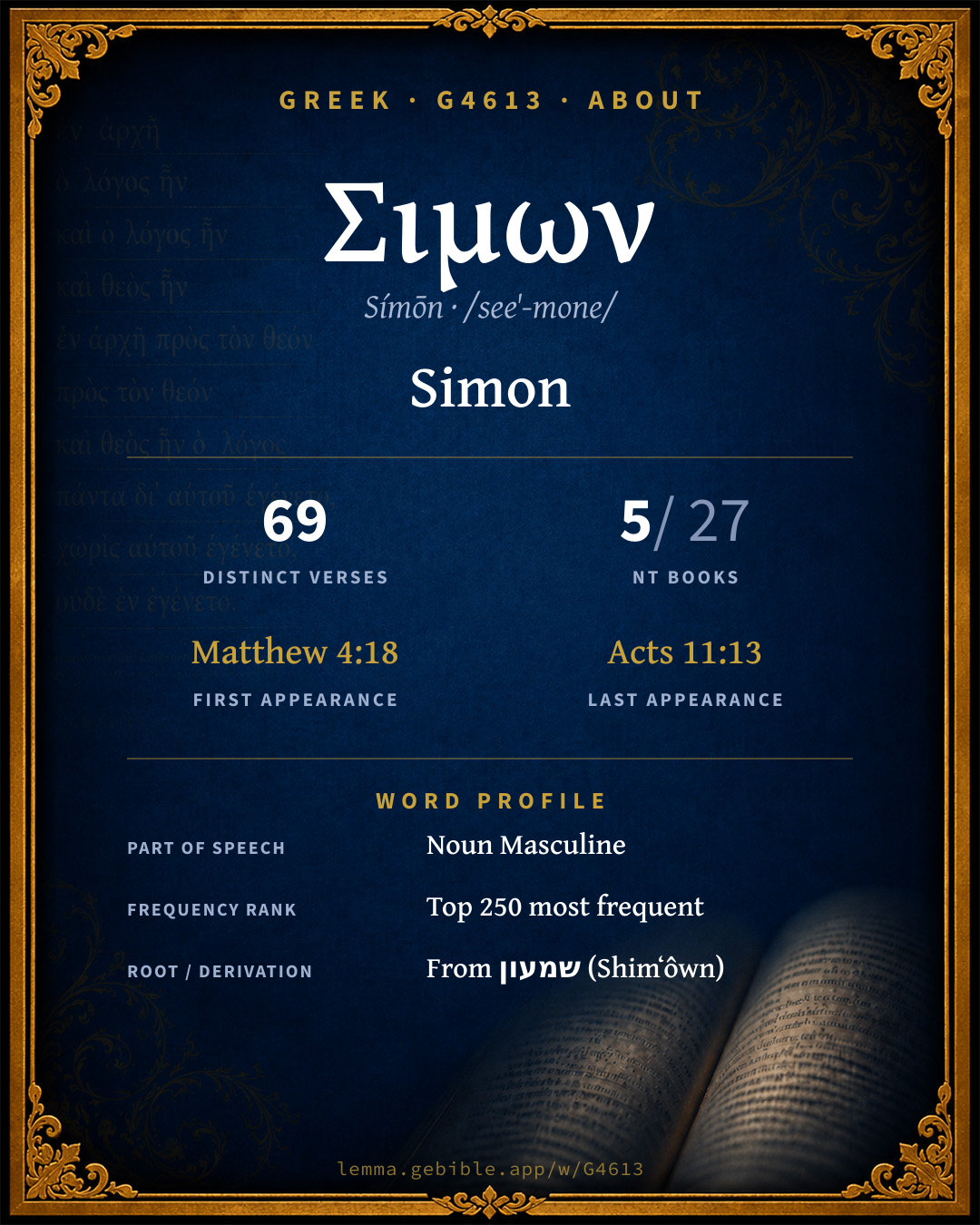
Σίμων
Simon
Thayer's lists 10 entries for ‘Simon’ fuller range ↓
Full lexicon entry — Thayer's Greek Lexicon
From Thayer's Greek Lexicon
Where this word appears
See every Nominative-case word in the Greek New Testament →
Grammar key — what these labels mean
Part of speech
- Noun
- A naming word — a person, place, thing, or idea.
Case
- Nominative
- The case of the subject (and the predicate nominative).
- Accusative
- The case of the direct object and of extent.
- Genitive
- The case of source, possession, or “of” — answers “whose / from what.”
- Vocative
- The case of direct address (“O Lord”).
- Dative
- The case of the indirect object, means, or location — “to / for / with / in.”
Gender
- Masculine
- Grammatically masculine.
Number
- Singular
- One.
Grammatical forms
- Noun, Nominative, Singular, Masculine 27 times (36%)
- Noun, Accusative, Singular, Masculine 16 times (21%)
- Noun, Genitive, Singular, Masculine 16 times (21%)
- Noun, Vocative, Singular, Masculine 9 times (12%)
- Noun, Dative, Singular, Masculine 7 times (9%)
Parsed forms decoded from the imported morphology (Robinson–Tischendorf, public domain), counted across 75 parsed occurrences — not distinct verses.
Every verse where G4613 appears — 69 distinct verses across 5 books. Click any verse to open its interlinear word-by-word view. Verse text shown in the World English Bible for context — . Each verse’s Greek form is shown with its reference; the English is not keyword-highlighted, since the data carries no word-level English alignment. Use “Compare translations” on any verse to read it across multiple English versions. This concordance covers the Greek New Testament; Septuagint (Greek Old Testament) occurrences of this word are not indexed here.
Matthew 9 verses
- Matthew 4:18 Σίμωνα n acc sg masc Walking by the sea of Galilee, he saw two brothers: Simon, who is called Peter, and Andrew, his brother, casting a net into the sea; for they were fishermen.
- Matthew 10:2 Σίμων n nom sg masc Now the names of the twelve apostles are these. The first, Simon, who is called Peter; Andrew, his brother; James the son of Zebedee; John, his brother;
- Matthew 10:4 Σίμων n nom sg masc Simon the Canaanite; and Judas Iscariot, who also betrayed him.
- Matthew 13:55 Σίμων n nom sg masc Isn't this the carpenter's son? Isn't his mother called Mary, and his brothers, James, Joses, Simon, and Judas?
- Matthew 16:16 Σίμων n nom sg masc Simon Peter answered, "You are the Christ, the Son of the living God."
- Matthew 16:17 Σίμων n voc sg masc Jesus answered him, "Blessed are you, Simon Bar Jonah, for flesh and blood has not revealed this to you, but my Father who is in heaven.
- Matthew 17:25 Σίμων n voc sg masc He said, "Yes." When he came into the house, Jesus anticipated him, saying, "What do you think, Simon? From whom do the kings of the earth receive toll or tribute? From their children, or from strangers?"
- Matthew 26:6 Σίμωνος n gen sg masc Now when Jesus was in Bethany, in the house of Simon the leper,
- Matthew 27:32 Σίμωνα n acc sg masc As they came out, they found a man of Cyrene, Simon by name, and they compelled him to go with them, that he might carry his cross.
Mark 10 verses
- Mark 1:16 Σίμωνα Σίμωνος n acc sg masc n gen sg masc Passing along by the sea of Galilee, he saw Simon and Andrew the brother of Simon casting a net in the sea, for they were fishermen.
- Mark 1:29 Σίμωνος n gen sg masc Immediately, when they had come out of the synagogue, they came into the house of Simon and Andrew, with James and John.
- Mark 1:30 Σίμωνος n gen sg masc Now Simon's wife's mother lay sick with a fever, and immediately they told him about her.
- Mark 1:36 Σίμων n nom sg masc Simon and those who were with him followed after him;
- Mark 3:16 Σίμωνι n dat sg masc Simon, to whom he gave the name Peter;
- Mark 3:18 Σίμωνα n acc sg masc Andrew; Philip; Bartholomew; Matthew; Thomas; James, the son of Alphaeus; Thaddaeus; Simon the Zealot;
- Mark 6:3 Σίμωνος n gen sg masc Isn't this the carpenter, the son of Mary, and brother of James, Joses, Judas, and Simon? Aren't his sisters here with us?" They were offended at him.
- Mark 14:3 Σίμωνος n gen sg masc While he was at Bethany, in the house of Simon the leper, as he sat at the table, a woman came having an alabaster jar of ointment of pure nard-- very costly. She broke the jar, and poured it over his head.
- Mark 14:37 Σίμων n voc sg masc He came and found them sleeping, and said to Peter, "Simon, are you sleeping? Couldn't you watch one hour?
- Mark 15:21 Σίμωνα n acc sg masc They compelled one passing by, coming from the country, Simon of Cyrene, the father of Alexander and Rufus, to go with them, that he might bear his cross.
Luke 14 verses
- Luke 4:38 Σίμωνος Σίμωνος n gen sg masc n gen sg masc He rose up from the synagogue, and entered into Simon's house. Simon's mother-in-law was afflicted with a great fever, and they begged him for her.
- Luke 5:3 Σίμωνος n gen sg masc He entered into one of the boats, which was Simon's, and asked him to put out a little from the land. He sat down and taught the multitudes from the boat.
- Luke 5:4 Σίμωνα n acc sg masc When he had finished speaking, he said to Simon, "Put out into the deep, and let down your nets for a catch."
- Luke 5:5 Σίμων n nom sg masc Simon answered him, "Master, we worked all night, and took nothing; but at your word I will let down the net."
- Luke 5:8 Σίμων n nom sg masc But Simon Peter, when he saw it, fell down at Jesus' knees, saying, "Depart from me, for I am a sinful man, Lord."
- Luke 5:10 Σίμωνι Σίμωνα n dat sg masc n acc sg masc and so also were James and John, sons of Zebedee, who were partners with Simon. Jesus said to Simon, "Don't be afraid. From now on you will be catching people alive."
- Luke 6:14 Σίμωνα n acc sg masc Simon, whom he also named Peter; Andrew, his brother; James; John; Philip; Bartholomew;
- Luke 6:15 Σίμωνα n acc sg masc Matthew; Thomas; James, the son of Alphaeus; Simon, who was called the Zealot;
- Luke 7:40 Σίμων n voc sg masc Jesus answered him, "Simon, I have something to tell you." He said, "Teacher, say on."
- Luke 7:43 Σίμων n nom sg masc Simon answered, "He, I suppose, to whom he forgave the most." He said to him, "You have judged correctly."
- Luke 7:44 Σίμωνι n dat sg masc Turning to the woman, he said to Simon, "Do you see this woman? I entered into your house, and you gave me no water for my feet, but she has wet my feet with her tears, and wiped them with the hair of her head.
- Luke 22:31 Σίμων Σίμων n voc sg masc n voc sg masc The Lord said, "Simon, Simon, behold, Satan asked to have you, that he might sift you as wheat,
- Luke 23:26 Σίμωνά n acc sg masc When they led him away, they grabbed one Simon of Cyrene, coming from the country, and laid on him the cross, to carry it after Jesus.
- Luke 24:34 Σίμωνι n dat sg masc saying, "The Lord is risen indeed, and has appeared to Simon!"
John 24 verses
- John 1:41 Σίμωνος n gen sg masc He first found his own brother, Simon, and said to him, "We have found the Messiah!" (which is, being interpreted, Christ).
- John 1:42 Σίμωνα n acc sg masc He brought him to Jesus. Jesus looked at him, and said, "You are Simon the son of Jonah. You shall be called Cephas" (which is by interpretation, Peter).
- John 1:43 Σίμων n nom sg masc On the next day, he was determined to go out into Galilee, and he found Philip. Jesus said to him, "Follow me."
- John 6:8 Σίμωνος n gen sg masc One of his disciples, Andrew, Simon Peter's brother, said to him,
- John 6:68 Σίμων n nom sg masc Simon Peter answered him, "Lord, to whom would we go? You have the words of eternal life.
- John 6:71 Σίμωνος n gen sg masc Now he spoke of Judas, the son of Simon Iscariot, for it was he who would betray him, being one of the twelve.
- John 13:2 Σίμωνος n gen sg masc After supper, the devil having already put into the heart of Judas Iscariot, Simon's son, to betray him,
- John 13:6 Σίμωνα n acc sg masc Then he came to Simon Peter. He said to him, "Lord, do you wash my feet?"
- John 13:9 Σίμων n nom sg masc Simon Peter said to him, "Lord, not my feet only, but also my hands and my head!"
- John 13:24 Σίμων n nom sg masc Simon Peter therefore beckoned to him, and said to him, "Tell us who it is of whom he speaks."
- John 13:26 Σίμωνος n gen sg masc Jesus therefore answered, "It is he to whom I will give this piece of bread when I have dipped it." So when he had dipped the piece of bread, he gave it to Judas, the son of Simon Iscariot.
- John 13:36 Σίμων n nom sg masc Simon Peter said to him, "Lord, where are you going?" Jesus answered, "Where I am going, you can't follow now, but you will follow afterwards."
- John 18:10 Σίμων n nom sg masc Simon Peter therefore, having a sword, drew it, and struck the high priest's servant, and cut off his right ear. The servant's name was Malchus.
- John 18:15 Σίμων n nom sg masc Simon Peter followed Jesus, as did another disciple. Now that disciple was known to the high priest, and entered in with Jesus into the court of the high priest;
- John 18:25 Σίμων n nom sg masc Now Simon Peter was standing and warming himself. They said therefore to him, "You aren't also one of his disciples, are you?" He denied it, and said, "I am not."
- John 20:2 Σίμωνα n acc sg masc Therefore she ran and came to Simon Peter, and to the other disciple whom Jesus loved, and said to them, "They have taken away the Lord out of the tomb, and we don't know where they have laid him!"
- John 20:6 Σίμων n nom sg masc Then Simon Peter came, following him, and entered into the tomb. He saw the linen cloths lying,
- John 21:2 Σίμων n nom sg masc Simon Peter, Thomas called Didymus, Nathanael of Cana in Galilee, and the sons of Zebedee, and two others of his disciples were together.
- John 21:3 Σίμων n nom sg masc Simon Peter said to them, "I'm going fishing." They told him, "We are also coming with you." They immediately went out, and entered into the boat. That night, they caught nothing.
- John 21:7 Σίμων n nom sg masc That disciple therefore whom Jesus loved said to Peter, "It's the Lord!" So when Simon Peter heard that it was the Lord, he wrapped his coat around him (for he was naked), and threw himself into the sea.
- John 21:11 Σίμων n nom sg masc Simon Peter went up, and drew the net to land, full of great fish, one hundred fifty-three; and even though there were so many, the net wasn't torn.
- John 21:15 Σίμωνι Σίμων n dat sg masc n voc sg masc So when they had eaten their breakfast, Jesus said to Simon Peter, "Simon, son of Jonah, do you love me more than these?" He said to him, "Yes, Lord; you know that I have affection for you." He said to him, "Feed my lambs."
- John 21:16 Σίμων n voc sg masc He said to him again a second time, "Simon, son of Jonah, do you love me?" He said to him, "Yes, Lord; you know that I have affection for you." He said to him, "Tend my sheep."
- John 21:17 Σίμων n voc sg masc He said to him the third time, "Simon, son of Jonah, do you have affection for me?" Peter was grieved because he asked him the third time, "Do you have affection for me?" He said to him, "Lord, you know everything. You know that I have affection for you." Jesus said to him, "Feed my sheep.
Acts 12 verses
- Acts 1:13 Σίμων n nom sg masc When they had come in, they went up into the upper room, where they were staying; that is Peter, John, James, Andrew, Philip, Thomas, Bartholomew, Matthew, James the son of Alphaeus, Simon the Zealot, and Judas the son of James.
- Acts 8:9 Σίμων n nom sg masc But there was a certain man, Simon by name, who used to practice sorcery in the city, and amazed the people of Samaria, making himself out to be some great one,
- Acts 8:13 Σίμων n nom sg masc Simon himself also believed. Being baptized, he continued with Philip. Seeing signs and great miracles occuring, he was amazed.
- Acts 8:18 Σίμων n nom sg masc Now when Simon saw that the Holy Spirit was given through the laying on of the apostles' hands, he offered them money,
- Acts 8:24 Σίμων n nom sg masc Simon answered, "Pray for me to the Lord, that none of the things which you have spoken happen to me."
- Acts 9:43 Σίμωνι n dat sg masc It happened, that he stayed many days in Joppa with one Simon, a tanner.
- Acts 10:5 Σίμωνά n acc sg masc Now send men to Joppa, and get Simon, who is surnamed Peter.
- Acts 10:6 Σίμωνι n dat sg masc He lodges with one Simon, a tanner, whose house is by the seaside."
- Acts 10:17 Σίμωνος n gen sg masc Now while Peter was very perplexed in himself what the vision which he had seen might mean, behold, the men who were sent by Cornelius, having made inquiry for Simon's house, stood before the gate,
- Acts 10:18 Σίμων n nom sg masc and called and asked whether Simon, who was surnamed Peter, was lodging there.
- Acts 10:32 Σίμωνα Σίμωνος n acc sg masc n gen sg masc Send therefore to Joppa, and summon Simon, who is surnamed Peter. He lodges in the house of Simon a tanner, by the seaside. When he comes, he will speak to you.'
- Acts 11:13 Σίμωνα n acc sg masc He told us how he had seen the angel standing in his house, and saying to him, 'Send to Joppa, and get Simon, whose surname is Peter,
About this entry
At a glance — auto-summarized from this page’s data, not written by a person. Every figure links to its source below. This summary describes the numbers; it doesn’t interpret them.
The Greek name Σιμων centers on the idea of “Simon.” Its earliest occurrence is Matthew 4:18. Spanning 69 verses in 5 books, it ranks among the moderately common words of the Greek New Testament. John dominates its distribution — 24 of 69 verses. Dig into 69-verse concordance and the renderings breakdown below.
Gloss history
Strong's 1890 vs modern scholarship
About this word
Strong's G4613 catalogs a Greek word from the Greek New Testament.
These counts are not copied from any lexicon or concordance. They are computed here, from the morphology-tagged Greek New Testament. What Lemma adds →
- 69
- distinct verses
- The word appears in 69 distinct verses.
- 5 / 27
- NT books
- The word appears in 5 of 27 New Testament books.
- #228
- by frequency
- Top 250 most frequent Greek words (rank 228 of 5,347 Greek words by occurrence).
View all 69 occurrences in the concordance →
By section of the New Testament
By traditional corpus
Conventional, traditional groupings — biblical authorship is debated, so this is a traditional corpus grouping, not an authorship claim. Some books belong to more than one corpus (Luke is in both the Gospels and the Lukan corpus, and so on), so these shares overlap and need not total 100%. Each figure is a share of the word’s 69 distinct verses.
- Gospels 57 verses · 83%
- Lukan (Luke–Acts) 26 verses · 38%
- Johannine 24 verses · 35%
How translations render this word
Counts come from each version’s own published word-to-Strong’s tagging or interlinear alignment — an approximate guide to how each version renders this word, not a word-level alignment the data otherwise carries. Because each total is that version’s own tagged count, the per-version totals vary from one another and need not match the appearance or distinct-verse counts above. These counts may also differ from a printed concordance because Lemma counts each distinctly tagged rendering and does not collapse phrase taggings into a single head-word total. This is a fixed set of word-tagged versions (KJV, ASV, BSB, ULT) and does not change with the reading translation you choose elsewhere. Each version’s license is shown beside its name below (and on Sources).
- King James Version: Simon 63×, Simon's 7×, One simon 2×
- American Standard Version: Simon 69×, Son of simon 2×
- Berean Standard Bible: Simon 70×, Simon’s 2×
- unfoldingWord Literal Text: Simon 71×, A 3×, Son of simon 3×
King James Version Public Domain
Renders G4613 across 75 tagged occurrences — most commonly:
Plus 1 rendering that appears only once — usually multi-word phrases or single function words the recovered tagging swept in, not distinct renderings.
American Standard Version Public Domain
Renders G4613 across 74 tagged occurrences — most commonly:
Plus 3 renderings that appear only once — usually multi-word phrases or single function words the recovered tagging swept in, not distinct renderings. Not rendered by a distinct English word in 1 further occurrence.
Berean Standard Bible Public Domain
Renders G4613 across 72 tagged occurrences — most commonly:
Not rendered by a distinct English word in 3 further occurrences.
unfoldingWord Literal Text CC BY-SA 4.0
Renders G4613 across 79 tagged occurrences — most commonly:
10 senses in Thayer's, in lexicon order
The 10 senses Thayer's distinguishes for this word, in lexicon order (not ranked by frequency or importance). The full entry — with sub-senses — is in the Lexicon Entry tab.
- Peter = "a rock or stone"
- Peter was one of the apostles
- Simon called Zelotes or the Kanaites
- Simon, father of Judas who betrayed Jesus.
- Simon Magus, the Samaritan wizard
- Simon the tanner, Ac.
- Simon the Pharisee, Luke 7:40
- Simon of Cyrene who carried the cross of Christ
- Simon the cousin of Jesus, the son of Cleophas
- Simon the leper, so called to distinguish him from others of the same name
Word origin
Derived from שמעון (Shimʻôwn) (H8095) — Simeon.
Forms in the corpus
The 5 distinct written forms G4613 takes in the Greek New Testament, most frequent first — each parse links to that case’s occurrences in the concordance.
| Form | Parsing | Example | Uses |
|---|---|---|---|
| Σίμων Símōn | Noun, Nominative, Singular, Masculine | Matthew 10:2 | 36 |
| Σίμωνος Símōnos | Noun, Genitive, Singular, Masculine | Matthew 26:6 | 16 |
| Σίμωνα Símōna | Noun, Accusative, Singular, Masculine | Matthew 4:18 | 14 |
| Σίμωνι Símōni | Noun, Dative, Singular, Masculine | Mark 3:16 | 7 |
| Σίμωνά Símōná | Noun, Accusative, Singular, Masculine | Luke 23:26 | 2 |
Same root — word family
Other Thayer's entries built from the same root as G4613, grouped by Strong’s listed origin. These share a root / origin per the lexicon — not necessarily a shared meaning. Each links to that word’s own entry.
Derives from
Proper names from this root
People and places named from this root — a name, not an additional meaning of the word.
Compare all same-root words → 3 of the same-root words are proper names (people or places). They share a root, not necessarily a meaning.
Bible dictionary
Public-domain dictionary articles matched to this entry by name (Simon). A biblical name can be shared by more than one person or place, so an article may treat several.
Easton's Bible Dictionary · M. G. Easton, 1897
The abbreviated form of Simeon. (1.) One of the twelve apostles, called the Canaanite (Matt. 10:4; Mark 3:18). This word "Canaanite" does not mean a native of Canaan, but is derived from the Syriac word Kanean or Kaneniah, which was the name of a Jewish sect. The Revised Version has "Cananaean;" marg., "or Zealot" He is also called "Zelotes" (Luke 6:15; Acts 1:13; R.V., "the Zealot"), because previous to his call to the apostleship he had been a member of the fanatical sect of the Zealots. There is no record regarding him.
(2.) The father of Judas Iscariot (John 6:71; 13:2, 26).
(3.) One of the brothers of our Lord (Matt. 13:55; Mark 6:3).
(4.) A Pharisee in whose house "a woman of the city which was a sinner" anointed our Lord's feet with ointment (Luke 7:36-38).
(5.) A leper of Bethany, in whose house Mary anointed our Lord's head with ointment "as he sat at meat" (Matt. 26:6-13; Mark 14:3-9).
(6.) A Jew of Cyrene, in North Africa, then a province of Libya. A hundred thousand Jews from Palestine had been settled in this province by Ptolemy Soter (B.C. 323-285), where by this time they had greatly increased in number. They had a synagogue in Jerusalem for such of their number as went thither to the annual feasts. Simon was seized by the soldiers as the procession wended its way to the place of crucifixion as he was passing by, and the heavy cross which Christ from failing strength could no longer bear was laid on his shoulders. Perhaps they seized him because he showed sympathy with Jesus. He was the "father of Alexander and Rufus" (Matt. 27:32). Possibly this Simon may have been one of the "men of Cyrene" who preached the word to the Greeks (Acts 11:20).
(7.) A sorcerer of great repute for his magical arts among the Samaritans (Acts 8:9-11). He afterwards became a professed convert to the faith under the preaching of Philip the deacon and evangelist (12, 13). His profession was, however, soon found to be hollow. His conduct called forth from Peter a stern rebuke (8:18-23). From this moment he disappears from the Church's history. The term "Simony," as denoting the purchase for money of spiritual offices, is derived from him.
(8.) A Christian at Joppa, a tanner by trade, with whom Peter on one occasion lodged (Acts 9:43).
(9.) Simon Peter (Matt. 4:18). See PETER.
Smith's Bible Dictionary · William Smith, 1863
(contracted form of Simeon, a hearing).
+ Son of Mattathias. [Maccabees] + Son of Onias the high priest, whose eulogy closes the "praise of famous men" in the book of Ecclesiasticus, ch. 4. (B.C. 302-293.) + A "governor of the temple" in the time of Seleucus Philopator, whose information as to the treasures of the temple led to the sacrilegious attach of Heliordorus. 2 Macc. 3:4, etc. (B.C. 175.) + Simon the brother of Jesus. The only undoubted notice of this Simon occurs in (Matthew 13:55; Mark 6:3) He has been identified by some writers with Simon the Canaanite, and still more generally with Symeon who became bishop of Jerusalem after the death of James, A.D. 62. The former of these opinions rests on no evidence whatever, nor is the later without its difficulties. + Simon the Canaanite, one of the twelve apostles, (Matthew 10:4; Mark 3:18) otherwise described as Simon Zelotes, (Luke 6:15; Acts 1:13) (A.D. 28.) The latter term, which is peculiar to Luke, is the Greek equivalent for the Chaldee term preserved by Matthew and Mark. [Canaanite, The] Each of these equally points out Simon as belonging to the faction of the Zealots, who were conspicuous for their fierce advocacy of the Mosaic ritual. + Simon of Cyrene, a Hellenistic Jew, born at Cyrene, on the north coast of Africa, who was present at Jerusalem at the time of the crucifixion of Jesus, either as an attendant at the feast, (Acts 2:10) or as one of the numerous settlers at Jerusalem from that place. (Acts 6:9) (A.D. 30.) Meeting the procession that conducted Jesus to Golgotha, as he was returning from the country, he was pressed into the service to bear the cross, (Matthew 27:32; Mark 15:21; Luke 23:26) when Jesus himself was unable to carry it any longer. Comp. (John 19:17) Mark describes him as the father of Alexander and Rufus, perhaps because this was the Rufus known to the Roman Christians, (Romans 16:13) for whom he more especially wrote. + Simon, a resident at Bethany, distinguished as "the leper." It is not improbable that he had been miraculously cured by Jesus. In his house Mary anointed Jesus preparatory to his death and burial. (Matthew 26:6) etc.; Mark 14:3 etc.; John 12:1 etc. + Simon Magus, a Samaritan living in the apostolic age, distinguished as a sorcerer or "magician," from his practice of magical arts. (Acts 8:9) According to ecclesiastical writers he was born at Gitton, a village of Samaria, and was probably educated at Alexandria in the tenets of the Gnostic school. He is first introduced to us as practicing magical arts in a city of Samaria, perhaps Sychar, (Acts 8:5) comp. John 4:5 And with such success that he was pronounced to be "the power of God which is called great." (Acts 8:10) The preaching and miracles of Philip having excited his observation, he became one of his disciples, and received baptism at his hands, A.D. 36,37. Subsequently he witnessed the effect produced by the imposition of hands, as practiced by the apostles Peter and John, and, being desirous of acquiring a similar power for himself, he offered a sum of money for it. His object evidently was to apply the power to the prosecution of magical arts. The motive and the means were equally to be reprobated; and his proposition met with a severe denunciation from Peter, followed by a petition on the part of Simon, the tenor of which bespeaks terror, but not penitence. (Acts 8:9-24) The memory of his peculiar guilt has been perpetuated in the word simony, as applied to all traffic in spiritual offices. Simon's history, subsequent to his meeting with Peter, is involved in difficulties. Early Church historians depict him as the pertinacious foe of the apostle Peter, whose movements he followed for the purpose of seeking encounters, in which he was signally defeated. He is said to have followed the apostle to Rome. His death is associated with this meeting. According to Hippolytus, the earliest authority on the subject, Simon was buried alive at his own request, in the confident assurance that he would rise on the third day. + Simon Peter. [Peter] + Simon, a Pharisee, in whose house a penitent woman anointed the head and feet of Jesus. (Luke 7:40) + Simon the tanner, a Christian convert living at Joppa, at whose house Peter lodged. (Acts 9:43) The house was near the seaside, (Acts 10:6,32) for the convenience of the water. (A.D. 37.) + Simon the father of Judas Iscariot. (John 6:71; 13:2,26)
Hitchcock's Bible Names Dictionary · Roswell D. Hitchcock, 1869
that hears; that obeys
Classic public-domain reference works; full attribution on Sources.