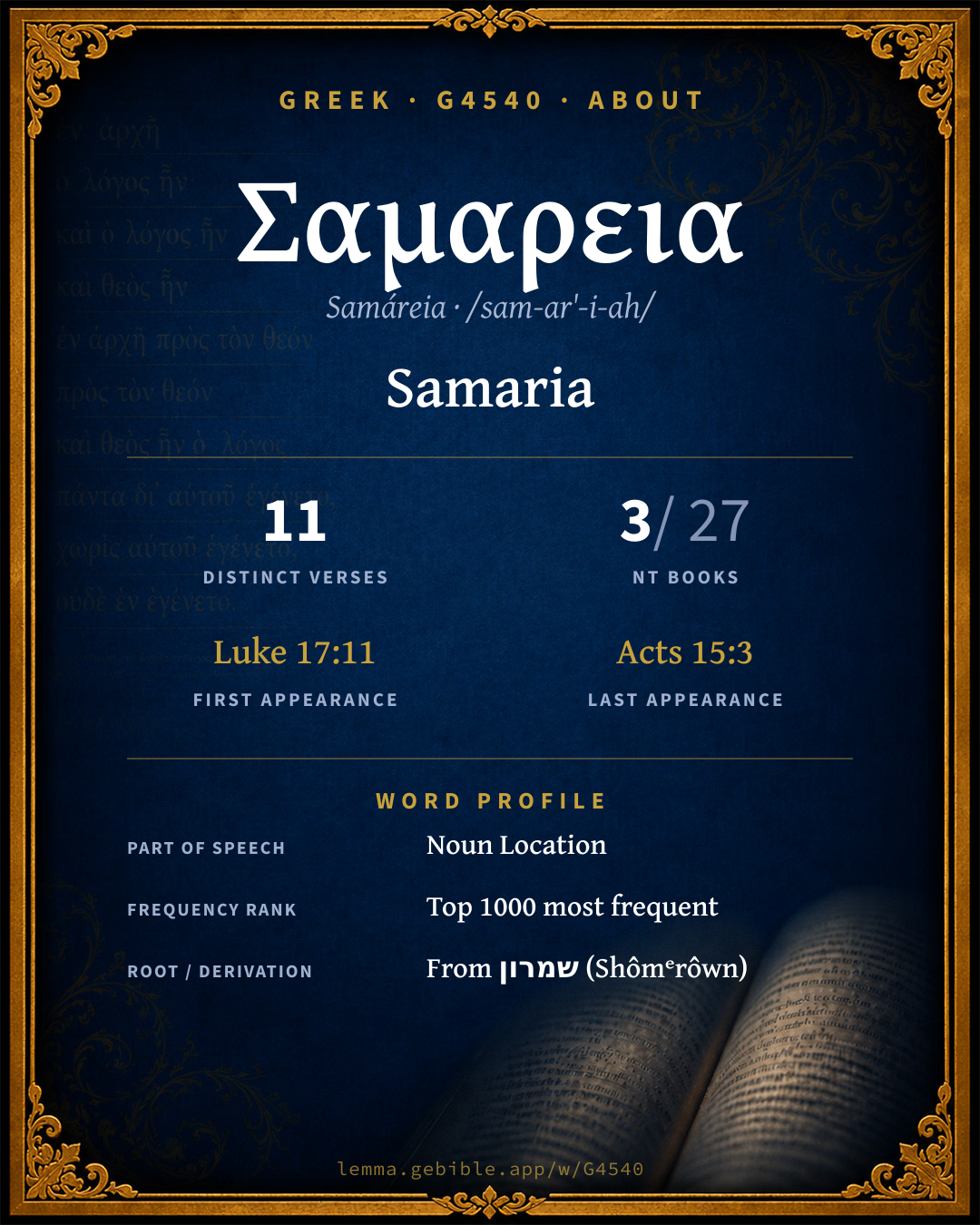
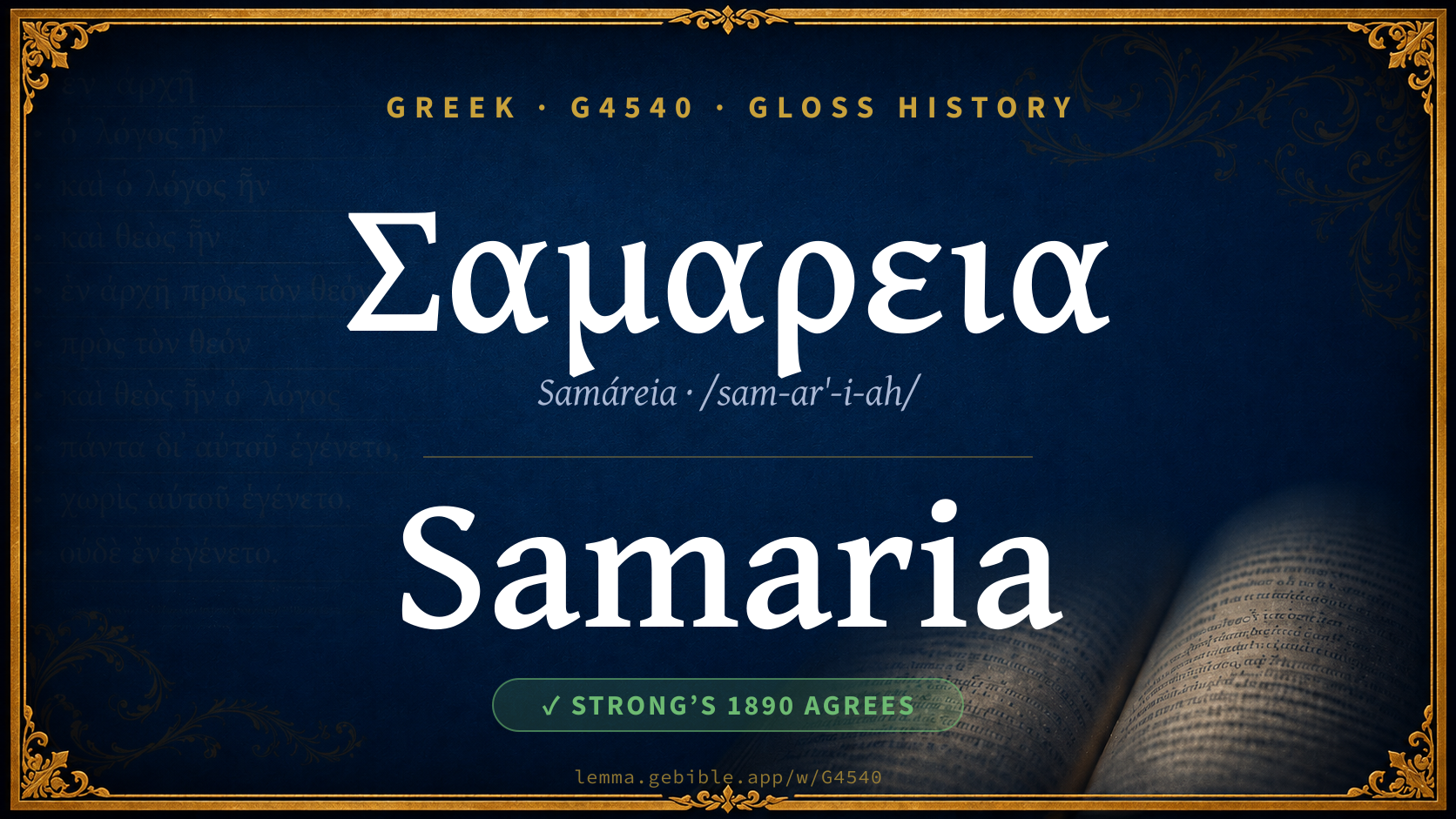
Σαμάρεια
Samaria
Thayer's lists 2 entries for ‘Samaria’ fuller range ↓
Full lexicon entry — Thayer's Greek Lexicon
From Thayer's Greek Lexicon
Where this word appears
See every Genitive-case word in the Greek New Testament →
Grammar key — what these labels mean
Part of speech
- Noun
- A naming word — a person, place, thing, or idea.
Case
- Genitive
- The case of source, possession, or “of” — answers “whose / from what.”
- Accusative
- The case of the direct object and of extent.
- Dative
- The case of the indirect object, means, or location — “to / for / with / in.”
- Nominative
- The case of the subject (and the predicate nominative).
Gender
- Feminine
- Grammatically feminine.
Number
- Singular
- One.
1 distinct verse where G4540 appears in the Dative case, across 1 book. Filtered view — show all forms. Click any verse to open its interlinear word-by-word view. Verse text shown in the World English Bible for context — . Each verse’s Greek form is shown with its reference; the English is not keyword-highlighted, since the data carries no word-level English alignment. Use “Compare translations” on any verse to read it across multiple English versions. This concordance covers the Greek New Testament; Septuagint (Greek Old Testament) occurrences of this word are not indexed here.
Acts 1 verse
About this entry
At a glance — auto-summarized from this page’s data, not written by a person. Every figure links to its source below. This summary describes the numbers; it doesn’t interpret them.
Σαμαρεια (Samáreia) is a Greek name most often rendered “Samaria.” Acts dominates its distribution — 7 of 11 verses. The Greek New Testament uses it across 11 verses — uncommon. First canonically at Luke 17:11, it enters the text early. Dig into 11-verse concordance and the renderings breakdown below.
Gloss history
Strong's 1890 vs modern scholarship
About this word
Strong's G4540 catalogs a Greek word from the Greek New Testament.
These counts are not copied from any lexicon or concordance. They are computed here, from the morphology-tagged Greek New Testament. What Lemma adds →
- 11
- distinct verses
- The word appears in 11 distinct verses.
- 3 / 27
- NT books
- The word appears in 3 of 27 New Testament books.
- #978
- by frequency
- Top 1000 most frequent Greek words (rank 978 of 5,347 Greek words by occurrence).
View all 11 occurrences in the concordance →
By section of the New Testament
By traditional corpus
Conventional, traditional groupings — biblical authorship is debated, so this is a traditional corpus grouping, not an authorship claim. Some books belong to more than one corpus (Luke is in both the Gospels and the Lukan corpus, and so on), so these shares overlap and need not total 100%. Each figure is a share of the word’s 11 distinct verses.
- Lukan (Luke–Acts) 8 verses · 73%
- Gospels 4 verses · 36%
- Johannine 3 verses · 27%
How translations render this word
Counts come from each version’s own published word-to-Strong’s tagging or interlinear alignment — an approximate guide to how each version renders this word, not a word-level alignment the data otherwise carries. Because each total is that version’s own tagged count, the per-version totals vary from one another and need not match the appearance or distinct-verse counts above. These counts may also differ from a printed concordance because Lemma counts each distinctly tagged rendering and does not collapse phrase taggings into a single head-word total. This is a fixed set of word-tagged versions (KJV, ASV, BSB, ULT) and does not change with the reading translation you choose elsewhere. Each version’s license is shown beside its name below (and on Sources).
- King James Version: Samaria 11×
- American Standard Version: Samaria 11×
- Berean Standard Bible: Samaria 10×
- unfoldingWord Literal Text: Samaria 11×
King James Version Public Domain
Renders G4540 across 11 tagged occurrences — most commonly:
American Standard Version Public Domain
Renders G4540 across 11 tagged occurrences — most commonly:
Berean Standard Bible Public Domain
Renders G4540 across 11 tagged occurrences — most commonly:
Plus 1 rendering that appears only once — usually multi-word phrases or single function words the recovered tagging swept in, not distinct renderings.
unfoldingWord Literal Text CC BY-SA 4.0
Renders G4540 across 11 tagged occurrences — most commonly:
Senses in Thayer's
The 2 senses Thayer's distinguishes for this word, in lexicon order (not ranked by frequency or importance). The full entry — with sub-senses — is in the Lexicon Entry tab.
- Samaria = "guardianship"
- a territory in Palestine, which had Samaria as its capital
Word origin
Derived from שמרון (Shômᵉrôwn) (H8111) — Samaria.
Of hebrew origin [ H8111 ]; Samaria (that is Shomeron ) a city and region of Palestine : - Samaria.
— Strong’s Exhaustive Concordance (1890), public domain.
Forms in the corpus
The 4 distinct written forms G4540 takes in the Greek New Testament, most frequent first — each parse links to that case’s occurrences in the concordance.
| Form | Parsing | Example | Uses |
|---|---|---|---|
| Σαμαρίας Samarías | Noun, Genitive, Singular, Feminine | Luke 17:11 | 8 |
| Σαμάρια Samária | Noun, Nominative, Singular, Feminine | Acts 8:14 | 1 |
| Σαμάριαν Samárian | Noun, Accusative, Singular, Feminine | Acts 15:3 | 1 |
| Σαμαρίᾳ Samaría | Noun, Dative, Singular, Feminine | Acts 1:8 | 1 |
Same root — word family
Other Thayer's entries built from the same root as G4540, grouped by Strong’s listed origin. These share a root / origin per the lexicon — not necessarily a shared meaning. Each links to that word’s own entry.
Derives from
Proper names from this root
People and places named from this root — a name, not an additional meaning of the word.
- שמרין Shomrayin H8115 Samaria
- שמרני Shômrônîy H8118 Samaritans
- Σαμαρειτης Samareítēs G4541 Samaritan
Compare all same-root words → Showing 4 of 5 — not the complete family. 4 of the same-root words are proper names (people or places). They share a root, not necessarily a meaning.
Bible dictionary
Public-domain dictionary articles matched to this entry by name (Samaria). A biblical name can be shared by more than one person or place, so an article may treat several.
Easton's Bible Dictionary · M. G. Easton, 1897
A watch-mountain or a watch-tower. In the heart of the mountains of Israel, a few miles north-west of Shechem, stands the "hill of Shomeron," a solitary mountain, a great "mamelon." It is an oblong hill, with steep but not inaccessible sides, and a long flat top. Omri, the king of Israel, purchased this hill from Shemer its owner for two talents of silver, and built on its broad summit the city to which he gave the name of "Shomeron", i.e., Samaria, as the new capital of his kingdom instead of Tirzah (1 Kings 16:24). As such it possessed many advantages. Here Omri resided during the last six years of his reign. As the result of an unsuccessful war with Syria, he appears to have been obliged to grant to the Syrians the right to "make streets in Samaria", i.e., probably permission to the Syrian merchants to carry on their trade in the Israelite capital. This would imply the existence of a considerable Syrian population. "It was the only great city of Palestine created by the sovereign. All the others had been already consecrated by patriarchal tradition or previous possession. But Samaria was the choice of Omri alone. He, indeed, gave to the city which he had built the name of its former owner, but its especial connection with himself as its founder is proved by the designation which it seems Samaria bears in Assyrian inscriptions, Beth-khumri (the house or palace of Omri').", Stanley.
Samaria was frequently besieged. In the days of Ahab, Benhadad II. came up against it with thirty-two vassal kings, but was defeated with a great slaughter (1 Kings 20:1-21). A second time, next year, he assailed it; but was again utterly routed, and was compelled to surrender to Ahab (20:28-34), whose army, as compared with that of Benhadad, was no more than "two little flocks of kids."
In the days of Jehoram this Benhadad again laid siege to Samaria, during which the city was reduced to the direst extremities. But just when success seemed to be within their reach, they suddenly broke up the seige, alarmed by a mysterious noise of chariots and horses and a great army, and fled, leaving their camp with all its contents behind them. The famishing inhabitants of the city were soon relieved with the abundance of the spoil of the Syrian camp; and it came to pass, according to the word of Elisha, that "a measure of fine flour was sold for a shekel, and two measures of barely for a shekel, in the gates of Samaria" (2 Kings 7:1-20).
Shalmaneser invaded Israel in the days of Hoshea, and reduced it to vassalage. He laid siege to Samaria (B.C. 723), which held out for three years, and was at length captured by Sargon, who completed the conquest Shalmaneser had begun (2 Kings 18:9-12; 17:3), and removed vast numbers of the tribes into captivity. (See SARGON.)
This city, after passing through various vicissitudes, was given by the emperor Augustus to Herod the Great, who rebuilt it, and called it Sebaste (Gr. form of Augustus) in honour of the emperor. In the New Testament the only mention of it is in Acts 8:5-14, where it is recorded that Philip went down to the city of Samaria and preached there.
It is now represented by the hamlet of Sebustieh, containing about three hundred inhabitants. The ruins of the ancient town are all scattered over the hill, down the sides of which they have rolled. The shafts of about one hundred of what must have been grand Corinthian columns are still standing, and attract much attention, although nothing definite is known regarding them. (Comp. Micah 1:6.)
In the time of Christ, Western Palestine was divided into three provinces, Judea, Samaria, and Galilee. Samaria occupied the centre of Palestine (John 4:4). It is called in the Talmud the "land of the Cuthim," and is not regarded as a part of the Holy Land at all.
It may be noticed that the distance between Samaria and Jerusalem, the respective capitals of the two kingdoms, is only 35 miles in a direct line.
Smith's Bible Dictionary · William Smith, 1863
(watch mountain). This city is situated 30 miles north of Jerusalem and about six miles to the northwest of Shechem, in a wide basin-shaped valley, six miles in diameter, encircled with high hills, almost on the edge of the great plain which borders upon the Mediterranean. In the centre of this basin, which is on a lower level than the valley of Shechem, rises a less elevated hill, with steep yet accessible sides and a long fiat top. This hill was chosen by Omri as the site of the capital of the kingdom of Israel. He "bought the hill of Samaria of Shemer for two talents of silver, and built on the hill, and called the name of the city which he built, after the name of the owner of the hill, Samaria." (1 Kings 16:23,24) From the that of Omri's purchase, B.C. 925, Samaria retained its dignity as the capital of the ten tribes, and the name is given to the northern kingdom as well as to the city. Ahab built a temple to Baal there. (1 Kings 16:32,33) It was twice besieged by the Syrians, in B.C. 901, (1 Kings 20:1) and in B.C. 892, (2 Kings 6:24-7; 2 Kings 6:20) but on both occasions the siege was ineffectual. The possessor of Samaria was considered Deuteronomy facto king of Israel. (2 Kings 15:13,14) In B.C. 721 Samaria was taken, after a siege of three years, by Shalmaneser king of Assyria, (2 Kings 18:9,10) and the kingdom of the ten tribes was put an end to. Some years afterward the district of which Samaria was the centre was repeopled by Esarhaddon. Alexander the Great took the city, killed a large portion of the inhabitants, and suffered the remainder to set it at Shechem. He replaced them by a colony of Syro-Macedonians who occupied the city until the time of John Hyrcanus, who took it after a year's siege, and did his best to demolish it entirely. (B.C. 109.) It was rebuilt and greatly embellished by Herod the Great. He called it Sebaste=Augusta, after the name of his patron, Augustus Caesar. The wall around it was 2 1/2 miles long, and in the centre of the city was a park 900 feet square containing a magnificent temple dedicated to Caesar. In the New Testament the city itself does not appear to be mentioned; but rather a portion of the district to which, even in older times it had extended its name. (Matthew 10:5; John 4:4,5) At this clay the city is represented by a small village retaining few vestiges of the past except its name, Sebustiyeh, an Arabic corruption of Sebaste. Some architectural remains it has, partly of Christian construction or adaptation, as the ruined church of St. John the Baptist, partly, perhaps, traces of Idumaean magnificence, St. Jerome, whose acquaintance with Palestine imparts a sort of probability to the tradition which prevailed so strongly in later days, asserts that Sebaste, which he invariably identifies with Samaria was the place in which St. John the Baptist was imprisoned and suffered death. He also makes it the burial-place of the prophets Elisha and Obadiah.
Hitchcock's Bible Names Dictionary · Roswell D. Hitchcock, 1869
watch-mountain
Classic public-domain reference works; full attribution on Sources.
Septuagint usage
The same Greek word Σαμαρεια appears 104 times in the Greek Old Testament (Septuagint), across 96 verses in 10 books.
- 104
- LXX occurrences
- Tagged occurrences of this Greek word in the Septuagint.
- 96
- verses
- Distinct Septuagint verses containing this word.
- 10 / 39
- OT books
- The word appears in 10 of the 39 Old Testament books.
Sample Septuagint occurrences
- 1 Kings 13:32 σαμαρεία
- 2 Kings 1:2 σαμαρεία
- 2 Chronicles 18:2 σαμαρεία
- Ezra 4:17 σαμαρεία
- Isaiah 8:4 σαμαρεία
- Jeremiah 23:13 σαμαρεία
- Ezekiel 16:46 σαμαρεία
- Amos 3:9 σαμαρεία
- Obadiah 1:19 σαμαρεία
- Micah 1:1 σαμαρεία
Septuagint occurrences (same lexeme)
Every verse where the same Strong’s number (G4540) appears in the Greek Septuagint — showing the first 50 of 96. Verse text shown in the World English Bible for context; the Greek form is the matched word — the English is not keyword-highlighted.
- 1 Kings 13:32 σαμαρεία For the saying which he cried by the word of Yahweh against the altar in Bethel, and against all the houses of the high places which are in the cities of Samaria, shall surely happen.
- 1 Kings 16:28 σαμαρεία So Omri slept with his fathers, and was buried in Samaria; and Ahab his son reigned in his place.
- 1 Kings 16:29 σαμαρεία In the thirty-eighth year of Asa king of Judah began Ahab the son of Omri to reign over Israel: and Ahab the son of Omri reigned over Israel in Samaria twenty-two years.
- 1 Kings 16:32 σαμαρεία He reared up an altar for Baal in the house of Baal, which he had built in Samaria.
- 1 Kings 18:2 σαμαρεία Elijah went to show himself to Ahab. The famine was sore in Samaria.
- 1 Kings 20:1 σαμαρεία Ben Hadad the king of Syria gathered all his host together; and there were thirty-two kings with him, and horses and chariots: and he went up and besieged Samaria, and fought against it.
- 1 Kings 20:18 σαμαρεία He said, Whether they are come out for peace, take them alive, or whether they are come out for war, taken them alive.
- 1 Kings 21:1 σαμαρεία It happened after these things, that Naboth the Jezreelite had a vineyard, which was in Jezreel, hard by the palace of Ahab king of Samaria.
- 1 Kings 21:10 σαμαρεία and set two men, base fellows, before him, and let them testify against him, saying, You did curse God and the king. Then carry him out, and stone him to death.
- 1 Kings 21:17 σαμαρεία The word of Yahweh came to Elijah the Tishbite, saying,
- 1 Kings 21:34 σαμαρεία
- 1 Kings 21:43 σαμαρεία
- 1 Kings 22:10 σαμαρεία Now the king of Israel and Jehoshaphat the king of Judah were sitting each on his throne, arrayed in their robes, in an open place at the entrance of the gate of Samaria; and all the prophets were prophesying before them.
- 1 Kings 22:37 σαμαρεία So the king died, and was brought to Samaria; and they buried the king in Samaria.
- 1 Kings 22:38 σαμαρεία They washed the chariot by the pool of Samaria; and the dogs licked up his blood (now the prostitutes washed themselves [there]); according to the word of Yahweh which he spoke.
- 1 Kings 22:52 σαμαρεία He did that which was evil in the sight of Yahweh, and walked in the way of his father, and in the way of his mother, and in the way of Jeroboam the son of Nebat, in which he made Israel to sin.
- 2 Kings 1:2 σαμαρεία Ahaziah fell down through the lattice in his upper chamber that was in Samaria, and was sick: and he sent messengers, and said to them, Go, inquire of Baal Zebub, the god of Ekron, whether I shall recover of this sickness.
- 2 Kings 1:3 σαμαρεία But the angel of Yahweh said to Elijah the Tishbite, Arise, go up to meet the messengers of the king of Samaria, and tell them, Is it because there is no God in Israel, that you go to inquire of Baal Zebub, the god of Ekron?
- 2 Kings 1:18 σαμαρεία Now the rest of the acts of Ahaziah which he did, aren't they written in the book of the chronicles of the kings of Israel?
- 2 Kings 2:25 σαμαρεία He went from there to Mount Carmel, and from there he returned to Samaria.
- 2 Kings 3:6 σαμαρεία King Jehoram went out of Samaria at that time, and mustered all Israel.
- 2 Kings 5:3 σαμαρεία She said to her mistress, Would that my lord were with the prophet who is in Samaria! then would he recover him of his leprosy.
- 2 Kings 6:19 σαμαρεία Elisha said to them, This is not the way, neither is this the city: follow me, and I will bring you to the man whom you seek. He led them to Samaria.
- 2 Kings 6:20 σαμαρεία It happened, when they were come into Samaria, that Elisha said, Yahweh, open the eyes of these men, that they may see. Yahweh opened their eyes, and they saw; and, behold, they were in the midst of Samaria.
- 2 Kings 6:24 σαμαρεία It happened after this, that Benhadad king of Syria gathered all his host, and went up, and besieged Samaria.
- 2 Kings 6:25 σαμαρεία There was a great famine in Samaria: and, behold, they besieged it, until a donkey's head was sold for eighty [pieces] of silver, and the fourth part of a kab of dove's dung for five [pieces] of silver.
- 2 Kings 7:1 σαμαρεία Elisha said, Hear you the word of Yahweh: thus says Yahweh, Tomorrow about this time shall a measure of fine flour be [sold] for a shekel, and two measures of barley for a shekel, in the gate of Samaria.
- 2 Kings 7:18 σαμαρεία It happened, as the man of God had spoken to the king, saying, Two measures of barley for a shekel, and a measure of fine flour for a shekel, shall be tomorrow about this time in the gate of Samaria;
- 2 Kings 10:1 σαμαρεία Now Ahab had seventy sons in Samaria. Jehu wrote letters, and sent to Samaria, to the rulers of Jezreel, even the elders, and to those who brought up [the sons of] Ahab, saying,
- 2 Kings 10:12 σαμαρεία He arose and departed, and went to Samaria. As he was at the shearing-house of the shepherds in the way,
- 2 Kings 10:17 σαμαρεία When he came to Samaria, he struck all who remained to Ahab in Samaria, until he had destroyed him, according to the word of Yahweh, which he spoke to Elijah.
- 2 Kings 10:35 σαμαρεία Jehu slept with his fathers; and they buried him in Samaria. Jehoahaz his son reigned in his place.
- 2 Kings 10:36 σαμαρεία The time that Jehu reigned over Israel in Samaria was twenty-eight years.
- 2 Kings 13:1 σαμαρεία In the three and twentieth year of Joash the son of Ahaziah, king of Judah, Jehoahaz the son of Jehu began to reign over Israel in Samaria, [and reigned] seventeen years.
- 2 Kings 13:6 σαμαρεία Nevertheless they didn't depart from the sins of the house of Jeroboam, with which he made Israel to sin, but walked therein: and there remained the Asherah also in Samaria.)
- 2 Kings 13:9 σαμαρεία Jehoahaz slept with his fathers; and they buried him in Samaria: and Joash his son reigned in his place.
- 2 Kings 13:10 σαμαρεία In the thirty-seventh year of Joash king of Judah began Jehoash the son of Jehoahaz to reign over Israel in Samaria, [and reigned] sixteen years.
- 2 Kings 13:13 σαμαρεία Joash slept with his fathers; and Jeroboam sat on his throne: and Joash was buried in Samaria with the kings of Israel.
- 2 Kings 14:14 σαμαρεία He took all the gold and silver, and all the vessels that were found in the house of Yahweh, and in the treasures of the king's house, the hostages also, and returned to Samaria.
- 2 Kings 14:16 σαμαρεία Jehoash slept with his fathers, and was buried in Samaria with the kings of Israel; and Jeroboam his son reigned in his place.
- 2 Kings 14:23 σαμαρεία In the fifteenth year of Amaziah the son of Joash king of Judah Jeroboam the son of Joash king of Israel began to reign in Samaria, [and reigned] forty-one years.
- 2 Kings 15:8 σαμαρεία In the thirty-eighth year of Azariah king of Judah did Zechariah the son of Jeroboam reign over Israel in Samaria six months.
- 2 Kings 15:13 σαμαρεία Shallum the son of Jabesh began to reign in the nine and thirtieth year of Uzziah king of Judah; and he reigned the space of a month in Samaria.
- 2 Kings 15:14 σαμαρεία Menahem the son of Gadi went up from Tirzah, and came to Samaria, and struck Shallum the son of Jabesh in Samaria, and killed him, and reigned in his place.
- 2 Kings 15:17 σαμαρεία In the nine and thirtieth year of Azariah king of Judah began Menahem the son of Gadi to reign over Israel, [and reigned] ten years in Samaria.
- 2 Kings 15:23 σαμαρεία In the fiftieth year of Azariah king of Judah Pekahiah the son of Menahem began to reign over Israel in Samaria, [and reigned] two years.
- 2 Kings 15:25 σαμαρεία Pekah the son of Remaliah, his captain, conspired against him, and struck him in Samaria, in the castle of the king's house, with Argob and Arieh; and with him were fifty men of the Gileadites: and he killed him, and reigned in his place.
- 2 Kings 15:27 σαμαρεία In the two and fiftieth year of Azariah king of Judah Pekah the son of Remaliah began to reign over Israel in Samaria, [and reigned] twenty years.
- 2 Kings 17:1 σαμαρεία In the twelfth year of Ahaz king of Judah began Hoshea the son of Elah to reign in Samaria over Israel, [and reigned] nine years.
- 2 Kings 17:5 σαμαρεία Then the king of Assyria came up throughout all the land, and went up to Samaria, and besieged it three years.
These are occurrences of the same Greek lexeme (G4540) in the Septuagint — not a translation of any one Hebrew word. The store carries no word-level Hebrew↔Greek alignment, so no Hebrew original is asserted here. Counts come from the recovered LXX Strong's tagging — high-frequency vocabulary is well covered, while rare or late forms may be untagged — so they reflect tagged occurrences and may slightly undercount.