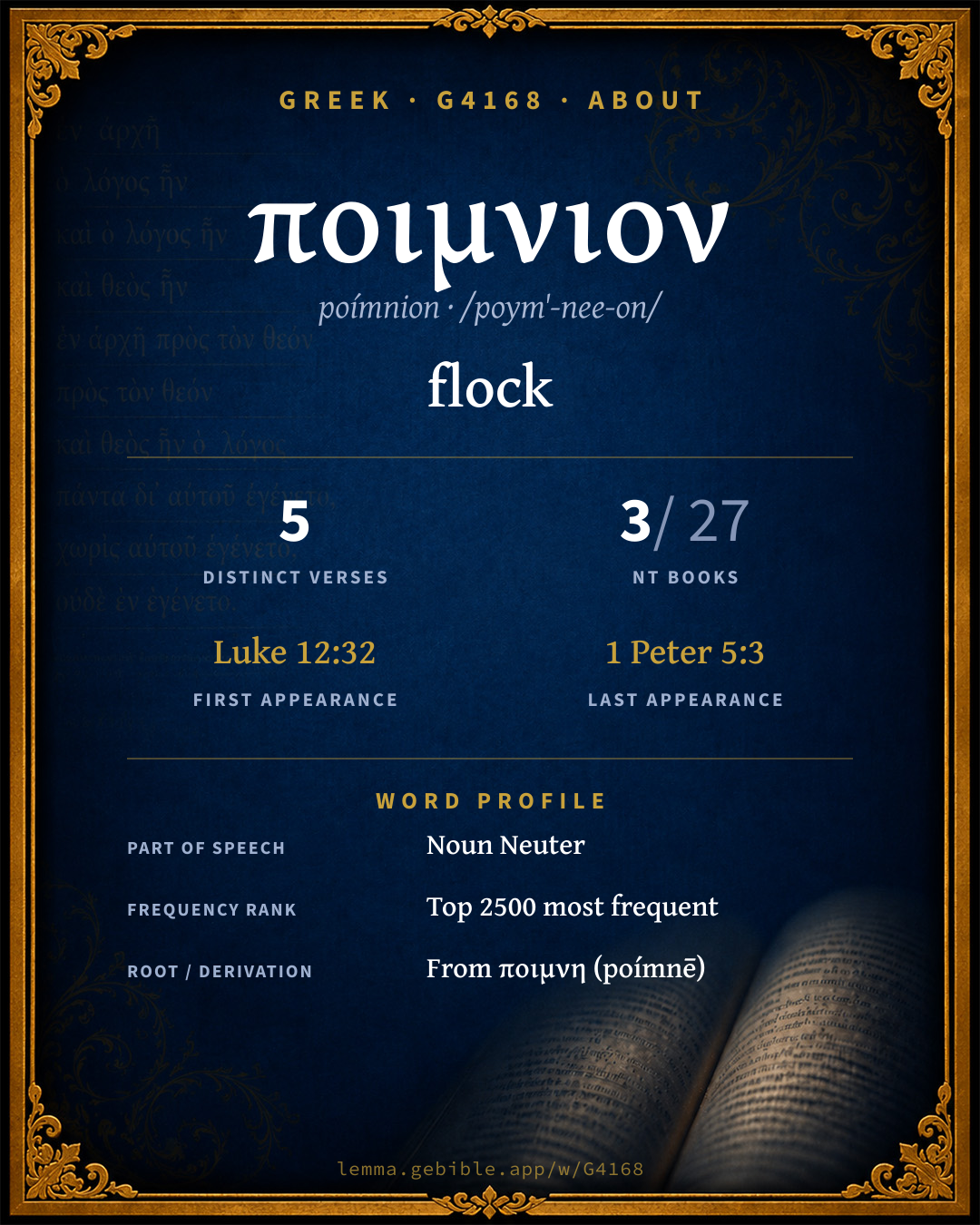
ποίμνιον
flock
‘flock’ is one of 3 main senses fuller range ↓
Full lexicon entry — Thayer's Greek Lexicon
From Thayer's Greek Lexicon
Where this word appears
See every Genitive-case word in the Greek New Testament →
Grammar key — what these labels mean
Part of speech
- Noun
- A naming word — a person, place, thing, or idea.
Case
- Genitive
- The case of source, possession, or “of” — answers “whose / from what.”
- Accusative
- The case of the direct object and of extent.
- Dative
- The case of the indirect object, means, or location — “to / for / with / in.”
- Nominative
- The case of the subject (and the predicate nominative).
Gender
- Neuter
- Grammatically neuter.
Number
- Singular
- One.
1 distinct verse where G4168 appears in the Dative case, across 1 book. Filtered view — show all forms. Click any verse to open its interlinear word-by-word view. Verse text shown in the World English Bible for context — . Each verse’s Greek form is shown with its reference; the English is not keyword-highlighted, since the data carries no word-level English alignment. Use “Compare translations” on any verse to read it across multiple English versions. This concordance covers the Greek New Testament; Septuagint (Greek Old Testament) occurrences of this word are not indexed here.
Acts 1 verse
About this entry
At a glance — auto-summarized from this page’s data, not written by a person. Every figure links to its source below. This summary describes the numbers; it doesn’t interpret them.
At its core, ποιμνιον (poímnion) means “flock.” It is rare — just 5 verses in the entire Greek New Testament. The word gravitates to Acts (40%), then 1 Peter and Luke. Scripture first uses it in Luke 12:32. Catalogued under 3 senses, its meaning is not single-sense. Each statement above links to its evidence; the full detail follows below.
Gloss history
Strong's 1890 vs modern scholarship
About this word
Strong's G4168 catalogs a Greek word from the Greek New Testament.
These counts are not copied from any lexicon or concordance. They are computed here, from the morphology-tagged Greek New Testament. What Lemma adds →
- 5
- distinct verses
- The word appears in 5 distinct verses.
- 3 / 27
- NT books
- The word appears in 3 of 27 New Testament books.
- #1,648
- by frequency
- Top 2500 most frequent Greek words (rank 1,648 of 5,347 Greek words by occurrence).
View all 5 occurrences in the concordance →
By section of the New Testament
By traditional corpus
Conventional, traditional groupings — biblical authorship is debated, so this is a traditional corpus grouping, not an authorship claim. Some books belong to more than one corpus (Luke is in both the Gospels and the Lukan corpus, and so on), so these shares overlap and need not total 100%. Each figure is a share of the word’s 5 distinct verses.
- Lukan (Luke–Acts) 3 verses · 60%
- General (Catholic) Epistles 2 verses · 40%
- Gospels 1 verse · 20%
How translations render this word
Counts come from each version’s own published word-to-Strong’s tagging or interlinear alignment — an approximate guide to how each version renders this word, not a word-level alignment the data otherwise carries. Because each total is that version’s own tagged count, the per-version totals vary from one another and need not match the appearance or distinct-verse counts above. These counts may also differ from a printed concordance because Lemma counts each distinctly tagged rendering and does not collapse phrase taggings into a single head-word total. This is a fixed set of word-tagged versions (KJV, ASV, BSB, ULT) and does not change with the reading translation you choose elsewhere. Each version’s license is shown beside its name below (and on Sources).
- King James Version: Flock 5×
- American Standard Version: Flock 5×
- Berean Standard Bible: Flock 5×
- unfoldingWord Literal Text: Flock 5×
King James Version Public Domain
Renders G4168 across 5 tagged occurrences — most commonly:
American Standard Version Public Domain
Renders G4168 across 5 tagged occurrences — most commonly:
Berean Standard Bible Public Domain
Renders G4168 across 5 tagged occurrences — most commonly:
unfoldingWord Literal Text CC BY-SA 4.0
Renders G4168 across 5 tagged occurrences — most commonly:
Senses in Thayer's
The 3 senses Thayer's distinguishes for this word, in lexicon order (not ranked by frequency or importance). The full entry — with sub-senses — is in the Lexicon Entry tab.
- a flock (esp.) of sheep
- a group of Christ's disciples
- bodies of Christian (churches) presided over by elders
Word origin
Derived from ποιμνη (poímnē) (G4167) — flock.
Neuter of a presumed derivative of G4167 ; a flock that is (figuratively) group (of believers): - flock.
— Strong’s Exhaustive Concordance (1890), public domain.
Forms in the corpus
The 3 distinct written forms G4168 takes in the Greek New Testament, most frequent first — each parse links to that case’s occurrences in the concordance.
| Form | Parsing | Example | Uses |
|---|---|---|---|
| ποίμνιον poímnion | Noun, Accusative, Singular, Neuter | 1 Peter 5:2 | 2 |
| ποιμνίου poimníou | Noun, Genitive, Singular, Neuter | Acts 20:29 | 2 |
| ποιμνίῳ poimníō | Noun, Dative, Singular, Neuter | Acts 20:28 | 1 |
Septuagint usage
The same Greek word ποιμνιον appears 68 times in the Greek Old Testament (Septuagint), across 64 verses in 23 books.
- 68
- LXX occurrences
- Tagged occurrences of this Greek word in the Septuagint.
- 64
- verses
- Distinct Septuagint verses containing this word.
- 23 / 39
- OT books
- The word appears in 23 of the 39 Old Testament books.
Sample Septuagint occurrences
- Genesis 29:2 ποίμνιον
- Deuteronomy 7:13 ποίμνιον
- Judges 6:4 ποίμνιον
- 1 Samuel 8:17 ποίμνιον
- 2 Samuel 12:2 ποίμνιον
- 1 Kings 21:27 ποίμνιον
- 1 Chronicles 17:7 ποίμνιον
- 2 Chronicles 32:28 ποίμνιον
- Ezra 20:37 ποίμνιον
- Job 24:2 ποίμνιον
- Psalms 49:9 ποίμνιον
- Proverbs 27:23 ποίμνιον
Septuagint occurrences (same lexeme)
Every verse where the same Strong’s number (G4168) appears in the Greek Septuagint — showing the first 50 of 64. Verse text shown in the World English Bible for context; the Greek form is the matched word — the English is not keyword-highlighted.
- Genesis 29:2 ποίμνιον He looked, and behold, a well in the field, and, behold, three flocks of sheep lying there by it. For out of that well they watered the flocks. The stone on the well's mouth was great.
- Genesis 29:3 ποίμνιον There all the flocks were gathered. They rolled the stone from the well's mouth, and watered the sheep, and put the stone again on the well's mouth in its place.
- Genesis 30:40 ποίμνιον Jacob separated the lambs, and set the faces of the flocks toward the streaked and all the black in the flock of Laban: and he put his own droves apart, and didn't put them into Laban's flock.
- Genesis 31:4 ποίμνιον Jacob sent and called Rachel and Leah to the field to his flock,
- Genesis 32:17 ποίμνιον He commanded the foremost, saying, "When Esau, my brother, meets you, and asks you, saying, 'Whose are you? Where are you going? Whose are these before you?'
- Genesis 32:20 ποίμνιον You shall say, 'Not only that, but behold, your servant, Jacob, is behind us.'" For, he said, "I will appease him with the present that goes before me, and afterward I will see his face. Perhaps he will accept me."
- Deuteronomy 7:13 ποίμνιον and he will love you, and bless you, and multiply you; he will also bless the fruit of your body and the fruit of your ground, your grain and your new wine and your oil, the increase of your cattle and the young of your flock, in the land which he swore to your fathers to give you.
- Deuteronomy 28:4 ποίμνιον Blessed shall be the fruit of your body, and the fruit of your ground, and the fruit of your animals, the increase of your cattle, and the young of your flock.
- Deuteronomy 28:18 ποίμνιον Cursed shall be the fruit of your body, and the fruit of your ground, the increase of your cattle, and the young of your flock.
- Deuteronomy 28:51 ποίμνιον and shall eat the fruit of your cattle, and the fruit of your ground, until you are destroyed; that also shall not leave you grain, new wine, or oil, the increase of your cattle, or the young of your flock, until they have caused you to perish.
- Judges 6:4 ποίμνιον and they encamped against them, and destroyed the increase of the earth, until you come to Gaza, and left no sustenance in Israel, neither sheep, nor ox, nor donkey.
- 1 Samuel 8:17 ποίμνιον He will take the tenth of your flocks: and you shall be his servants.
- 1 Samuel 14:32 ποίμνιον and the people flew on the spoil, and took sheep, and oxen, and calves, and killed them on the ground; and the people ate them with the blood.
- 1 Samuel 15:9 ποίμνιον But Saul and the people spared Agag, and the best of the sheep, and of the oxen, and of the fatlings, and the lambs, and all that was good, and wouldn't utterly destroy them: but everything that was vile and refuse, that they destroyed utterly.
- 1 Samuel 15:14 ποίμνιον Samuel said, What means then this bleating of the sheep in my ears, and the lowing of the oxen which I hear?
- 1 Samuel 15:15 ποίμνιον Saul said, They have brought them from the Amalekites: for the people spared the best of the sheep and of the oxen, to sacrifice to Yahweh your God; and the rest we have utterly destroyed.
- 1 Samuel 15:21 ποίμνιον But the people took of the spoil, sheep and oxen, the chief of the devoted things, to sacrifice to Yahweh your God in Gilgal.
- 1 Samuel 16:11 ποίμνιον Samuel said to Jesse, Are here all your children? He said, There remains yet the youngest, and, behold, he is keeping the sheep. Samuel said to Jesse, Send and get him; for we will not sit down until he come here.
- 1 Samuel 16:19 ποίμνιον Therefore Saul sent messengers to Jesse, and said, Send me David your son, who is with the sheep.
- 1 Samuel 17:14 ποίμνιον David was the youngest; and the three eldest followed Saul.
- 1 Samuel 24:4 ποίμνιον The men of David said to him, Behold, the day of which Yahweh said to you, Behold, I will deliver your enemy into your hand, and you shall do to him as it shall seem good to you. Then David arose, and cut off the skirt of Saul's robe secretly.
- 1 Samuel 25:2 ποίμνιον There was a man in Maon, whose possessions were in Carmel; and the man was very great, and he had three thousand sheep, and a thousand goats: and he was shearing his sheep in Carmel.
- 1 Samuel 25:4 ποίμνιον David heard in the wilderness that Nabal was shearing his sheep.
- 1 Samuel 25:16 ποίμνιον they were a wall to us both by night and by day, all the while we were with them keeping the sheep.
- 1 Samuel 27:9 ποίμνιον David struck the land, and saved neither man nor woman alive, and took away the sheep, and the oxen, and the donkeys, and the camels, and the clothing; and he returned, and came to Achish.
- 1 Samuel 30:20 ποίμνιον David took all the flocks and the herds, [which] they drove before those [other] cattle, and said, This is David's spoil.
- 2 Samuel 12:2 ποίμνιον The rich man had very many flocks and herds,
- 2 Samuel 12:4 ποίμνιον A traveler came to the rich man, and he spared to take of his own flock and of his own herd, to dress for the wayfaring man who had come to him, but took the poor man's lamb, and dressed it for the man who had come to him."
- 1 Kings 21:27 ποίμνιον It happened, when Ahab heard those words, that he tore his clothes, and put sackcloth on his flesh, and fasted, and lay in sackcloth, and went softly.
- 1 Kings 22:17 ποίμνιον He said, I saw all Israel scattered on the mountains, as sheep that have no shepherd: and Yahweh said, These have no master; let them return every man to his house in peace.
- 1 Chronicles 17:7 ποίμνιον Now therefore thus shall you tell my servant David, Thus says Yahweh of Hosts, I took you from the sheep pen, from following the sheep, that you should be prince over my people Israel:
- 2 Chronicles 32:28 ποίμνιον store-houses also for the increase of grain and new wine and oil; and stalls for all manner of animals, and flocks in folds.
- Ezra 20:37 ποίμνιον
- Job 24:2 ποίμνιον There are people who remove the landmarks. They violently take away flocks, and feed them.
- Psalms 49:9 ποίμνιον That he should live on forever, That he should not see corruption.
- Psalms 77:52 ποίμνιον
- Psalms 77:70 ποίμνιον
- Proverbs 27:23 ποίμνιον Know well the state of your flocks, And pay attention to your herds:
- Ecclesiastes 2:7 ποίμνιον I bought men-servants and maid-servants, and had servants born in my house. I also had great possessions of herds and flocks, above all who were before me in Jerusalem;
- Song of Solomon 1:8 ποίμνιον If you don't know, most beautiful among women, Follow the tracks of the sheep. Graze your young goats beside the shepherds' tents.
- Isaiah 17:2 ποίμνιον The cities of Aroer are forsaken; they shall be for flocks, which shall lie down, and none shall make them afraid.
- Isaiah 27:10 ποίμνιον For the fortified city is solitary, a habitation deserted and forsaken, like the wilderness: there shall the calf feed, and there shall he lie down, and consume the branches of it.
- Isaiah 40:11 ποίμνιον He will feed his flock like a shepherd, he will gather the lambs in his arm, and carry them in his bosom, [and] will gently lead those who have their young.
- Isaiah 65:10 ποίμνιον Sharon shall be a fold of flocks, and the valley of Achor a place for herds to lie down in, for my people who have sought me.
- Jeremiah 6:3 ποίμνιον Shepherds with their flocks shall come to her; they shall pitch their tents against her round about; they shall feed everyone in his place.
- Jeremiah 6:18 ποίμνιον Therefore hear, you nations, and know, congregation, what is among them.
- Jeremiah 13:17 ποίμνιον But if you will not hear it, my soul shall weep in secret for [your] pride; and my eye shall weep sore, and run down with tears, because Yahweh's flock is taken captive.
- Jeremiah 13:20 ποίμνιον Lift up your eyes, and see those who come from the north: where is the flock that was given you, your beautiful flock?
- Jeremiah 28:23 ποίμνιον
- Jeremiah 38:10 ποίμνιον Then the king commanded Ebedmelech the Ethiopian, saying, Take from hence thirty men with you, and take up Jeremiah the prophet out of the dungeon, before he die.
These are occurrences of the same Greek lexeme (G4168) in the Septuagint — not a translation of any one Hebrew word. The store carries no word-level Hebrew↔Greek alignment, so no Hebrew original is asserted here. Counts come from the recovered LXX Strong's tagging — high-frequency vocabulary is well covered, while rare or late forms may be untagged — so they reflect tagged occurrences and may slightly undercount.