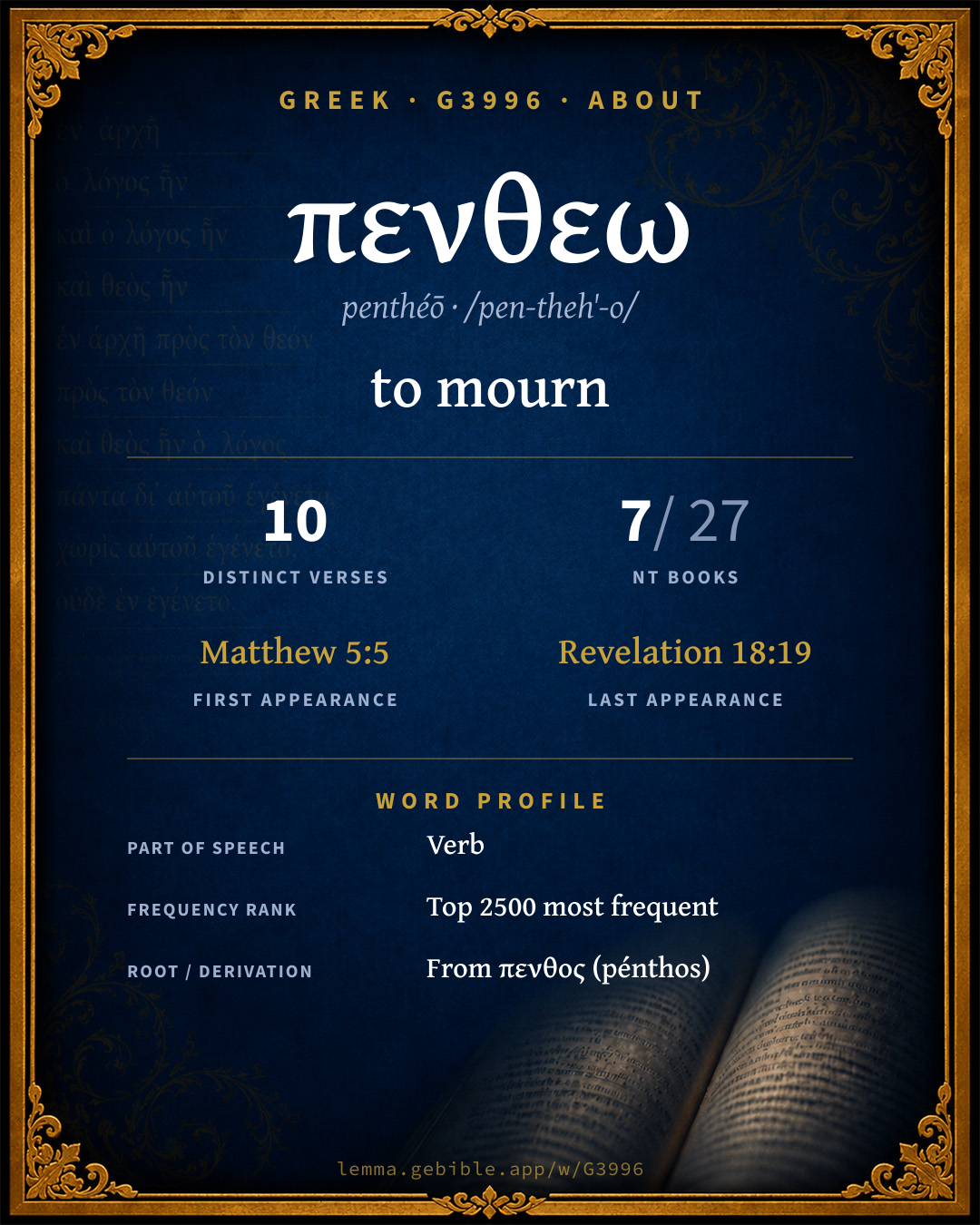
πενθέω
to mourn
‘to mourn’ is one of 2 main senses fuller range ↓
Full lexicon entry — Thayer's Greek Lexicon
From Thayer's Greek Lexicon
Where this word appears
See every Present-tense verb in the Greek New Testament →
Grammar key — what these labels mean
Part of speech
- Verb
- An action or state-of-being word.
Tense
- Present
- Ongoing or general action in present time (imperfective aspect).
- Aorist
- Action viewed as a simple whole, without regard to duration — often past (perfective aspect).
- Future
- Action expected in future time.
Voice
- Active
- The subject performs the action.
Mood
- Participle
- A verbal adjective (“writing,” “having written”).
- Indicative
- States a fact or asks a factual question (the mood of reality).
- Imperative
- Expresses a command or request.
- Subjunctive
- Expresses probability, purpose, or possibility (the mood of contingency).
- Infinitive
- A verbal noun (“to write”), unmarked for person or number.
Case
- Nominative
- The case of the subject (and the predicate nominative).
- Dative
- The case of the indirect object, means, or location — “to / for / with / in.”
Person
- 2nd person
- The one addressed (“you”).
- 1st person
- The speaker (“I / we”).
- 3rd person
- The one spoken about (“he / she / it / they”).
Gender
- Masculine
- Grammatically masculine.
Number
- Plural
- More than one.
- Singular
- One.
1 distinct verse where G3996 appears in the Future tense, across 1 book. Filtered view — show all forms. Click any verse to open its interlinear word-by-word view. Verse text shown in the World English Bible for context — . Each verse’s Greek form is shown with its reference; the English is not keyword-highlighted, since the data carries no word-level English alignment. Use “Compare translations” on any verse to read it across multiple English versions. This concordance covers the Greek New Testament; Septuagint (Greek Old Testament) occurrences of this word are not indexed here.
Luke 1 verse
About this entry
At a glance — auto-summarized from this page’s data, not written by a person. Every figure links to its source below. This summary describes the numbers; it doesn’t interpret them.
πενθεω — transliterated penthéō — is a Greek verb carrying the sense “to mourn.” Its earliest occurrence is Matthew 5:5. It appears 10 verses across 7 books of the Greek New Testament, among its uncommon vocabulary. More than a quarter of its appearances fall in Revelation. Thayer's distinguishes 2 senses for it. See the sense tree, 10-verse concordance, and the renderings breakdown below.
Gloss history
Strong's 1890 vs modern scholarship
About this word
Strong's G3996 catalogs a Greek word from the Greek New Testament.
These counts are not copied from any lexicon or concordance. They are computed here, from the morphology-tagged Greek New Testament. What Lemma adds →
- 10
- distinct verses
- The word appears in 10 distinct verses.
- 7 / 27
- NT books
- The word appears in 7 of 27 New Testament books.
- #1,056
- by frequency
- Top 2500 most frequent Greek words (rank 1,056 of 5,347 Greek words by occurrence).
View all 10 occurrences in the concordance →
Most concentrated in
- Revelation 3 verses 30%
- Matthew 2 verses 20%
- Mark 1 verse 10%
By section of the New Testament
By traditional corpus
Conventional, traditional groupings — biblical authorship is debated, so this is a traditional corpus grouping, not an authorship claim. Some books belong to more than one corpus (Luke is in both the Gospels and the Lukan corpus, and so on), so these shares overlap and need not total 100%. Each figure is a share of the word’s 10 distinct verses.
- Gospels 4 verses · 40%
- Johannine 3 verses · 30%
- Revelation 3 verses · 30%
- Pauline corpus 2 verses · 20%
- Lukan (Luke–Acts) 1 verse · 10%
- General (Catholic) Epistles 1 verse · 10%
How translations render this word
Counts come from each version’s own published word-to-Strong’s tagging or interlinear alignment — an approximate guide to how each version renders this word, not a word-level alignment the data otherwise carries. Because each total is that version’s own tagged count, the per-version totals vary from one another and need not match the appearance or distinct-verse counts above. These counts may also differ from a printed concordance because Lemma counts each distinctly tagged rendering and does not collapse phrase taggings into a single head-word total. This is a fixed set of word-tagged versions (KJV, ASV, BSB, ULT) and does not change with the reading translation you choose elsewhere. Each version’s license is shown beside its name below (and on Sources).
- King James Version: Mourn 3×, Wailing 2×
- American Standard Version: Mourn 4×, Mourning 2×
- Berean Standard Bible: Mourn 6×
- unfoldingWord Literal Text: Mourn 4×, Mourning 4×
King James Version Public Domain
Renders G3996 across 11 tagged occurrences — most commonly:
Plus 6 renderings that appear only once — usually multi-word phrases or single function words the recovered tagging swept in, not distinct renderings.
American Standard Version Public Domain
Renders G3996 across 11 tagged occurrences — most commonly:
Plus 5 renderings that appear only once — usually multi-word phrases or single function words the recovered tagging swept in, not distinct renderings.
Berean Standard Bible Public Domain
Renders G3996 across 10 tagged occurrences — most commonly:
Plus 4 renderings that appear only once — usually multi-word phrases or single function words the recovered tagging swept in, not distinct renderings.
unfoldingWord Literal Text CC BY-SA 4.0
Renders G3996 across 11 tagged occurrences — most commonly:
Plus 3 renderings that appear only once — usually multi-word phrases or single function words the recovered tagging swept in, not distinct renderings.
Senses in Thayer's
The 2 senses Thayer's distinguishes for this word, in lexicon order (not ranked by frequency or importance). The full entry — with sub-senses — is in the Lexicon Entry tab.
- to mourn
- to mourn for, lament one
Word origin
Derived from πενθος (pénthos) (G3997) — mourning.
From G3997 ; to grieve ( the feeling or the act ): - mourn (be-) wail.
— Strong’s Exhaustive Concordance (1890), public domain.
Forms in the corpus
The 7 distinct written forms G3996 takes in the Greek New Testament, most frequent first — each parse links to that tense’s occurrences in the concordance.
| Form | Parsing | Example | Uses |
|---|---|---|---|
| πενθοῦντες penthoûntes | Verb, Present, Active, Participle, Nominative, Plural, Masculine | Matthew 5:5 | 3 |
| πενθοῦσιν penthoûsin | Verb, Present, Active, Indicative, 3rd person, Plural | Revelation 18:11 | 2 |
| πενθήσατε penthḗsate | Verb, Aorist, Active, Imperative, 2nd person, Plural | James 4:9 | 1 |
| πενθήσετε penthḗsete | Verb, Future, Active, Indicative, 2nd person, Plural | Luke 6:25 | 1 |
| πενθήσω penthḗsō | Verb, Aorist, Active, Subjunctive, 1st person, Singular | 2 Corinthians 12:21 | 1 |
| πενθεῖν pentheîn | Verb, Present, Active, Infinitive | Matthew 9:15 | 1 |
| ἐπενθήσατε epenthḗsate | Verb, Aorist, Active, Indicative, 2nd person, Plural | 1 Corinthians 5:2 | 1 |
Septuagint usage
The same Greek word πενθεω appears 48 times in the Greek Old Testament (Septuagint), across 44 verses in 17 books.
- 48
- LXX occurrences
- Tagged occurrences of this Greek word in the Septuagint.
- 44
- verses
- Distinct Septuagint verses containing this word.
- 17 / 39
- OT books
- The word appears in 17 of the 39 Old Testament books.
Sample Septuagint occurrences
- Genesis 23:2 πενθέω
- Numbers 14:39 πενθέω
- 1 Samuel 6:19 πενθέω
- 2 Samuel 13:37 πενθέω
- 1 Chronicles 7:22 πενθέω
- 2 Chronicles 35:24 πενθέω
- Ezra 11:4 πενθέω
- Job 14:22 πενθέω
- Psalms 34:14 πενθέω
- Isaiah 3:26 πενθέω
- Jeremiah 4:28 πενθέω
- Lamentations 1:4 πενθέω
Septuagint occurrences (same lexeme)
Every verse where the same Strong’s number (G3996) appears in the Greek Septuagint. Verse text shown in the World English Bible for context; the Greek form is the matched word — the English is not keyword-highlighted.
- Genesis 23:2 πενθέω Sarah died in Kiriath Arba (the same is Hebron), in the land of Canaan. Abraham came to mourn for Sarah, and to weep for her.
- Genesis 37:34 πενθέω Jacob tore his clothes, and put sackcloth on his loins, and mourned for his son many days.
- Genesis 37:35 πενθέω All his sons and all his daughters rose up to comfort him; but he refused to be comforted. He said, "For I will go down to Sheol to my son mourning." His father wept for him.
- Genesis 50:3 πενθέω Forty days were fulfilled for him, for that is how many the days it takes to embalm. The Egyptians wept for him for seventy days.
- Numbers 14:39 πενθέω Moses told these words to all the children of Israel: and the people mourned greatly.
- 1 Samuel 6:19 πενθέω He struck of the men of Beth-shemesh, because they had looked into the ark of Yahweh, he struck of the people fifty thousand seventy men; and the people mourned, because Yahweh had struck the people with a great slaughter.
- 1 Samuel 15:35 πενθέω Samuel came no more to see Saul until the day of his death; for Samuel mourned for Saul: and Yahweh repented that he had made Saul king over Israel.
- 1 Samuel 16:1 πενθέω Yahweh said to Samuel, How long will you mourn for Saul, seeing I have rejected him from being king over Israel? fill your horn with oil, and go: I will send you to Jesse the Bethlehemite; for I have provided me a king among his sons.
- 2 Samuel 13:37 πενθέω But Absalom fled, and went to Talmai the son of Ammihur, king of Geshur. [David] mourned for his son every day.
- 2 Samuel 14:2 πενθέω Joab sent to Tekoa, and fetched there a wise woman, and said to her, please act like a mourner, and put on mourning clothing, Please, and don't anoint yourself with oil, but be as a woman who has a long time mourned for the dead:
- 2 Samuel 19:2 πενθέω The victory that day was turned into mourning to all the people; for the people heard say that day, The king grieves for his son.
- 1 Chronicles 7:22 πενθέω Ephraim their father mourned many days, and his brothers came to comfort him.
- 2 Chronicles 35:24 πενθέω So his servants took him out of the chariot, and put him in the second chariot that he had, and brought him to Jerusalem; and he died, and was buried in the tombs of his fathers. All Judah and Jerusalem mourned for Josiah.
- Ezra 11:4 πενθέω
- Ezra 18:9 πενθέω
- Job 14:22 πενθέω But his flesh on him has pain; His soul within him mourns."
- Psalms 34:14 πενθέω Depart from evil, and do good. Seek peace, and pursue it.
- Psalms 77:63 πενθέω
- Isaiah 3:26 πενθέω Her gates shall lament and mourn; And she shall be desolate and sit on the ground.
- Isaiah 16:8 πενθέω For the fields of Heshbon languish, [and] the vine of Sibmah; the lords of the nations have broken down the choice branches of it, which reached even to Jazer, which wandered into the wilderness; its shoots were spread abroad, they passed over the sea.
- Isaiah 19:8 πενθέω The fishermen shall lament, and all those who cast angle into the Nile shall mourn, and those who spread nets on the waters shall languish.
- Isaiah 24:4 πενθέω The earth mourns and fades away, the world languishes and fades away, the lofty people of the earth do languish.
- Isaiah 24:7 πενθέω The new wine mourns, the vine languishes, all the merry-hearted do sigh.
- Isaiah 33:9 πενθέω The land mourns and languishes; Lebanon is confounded and withers away; Sharon is like a desert; and Bashan and Carmel shake off [their leaves].
- Isaiah 61:2 πενθέω to proclaim the year of Yahweh's favor, and the day of vengeance of our God; to comfort all who mourn;
- Isaiah 61:3 πενθέω to appoint to those who mourn in Zion, to give to them a garland for ashes, the oil of joy for mourning, the garment of praise for the spirit of heaviness; that they may be called trees of righteousness, the planting of Yahweh, that he may be glorified.
- Isaiah 66:10 πενθέω Rejoice you with Jerusalem, and be glad for her, all you who love her: rejoice for joy with her, all you who mourn over her;
- Jeremiah 4:28 πενθέω For this shall the earth mourn, and the heavens above be black; because I have spoken it, I have purposed it, and I have not repented, neither will I turn back from it.
- Jeremiah 12:4 πενθέω How long shall the land mourn, and the herbs of the whole country wither? for the wickedness of those who dwell therein, the animals are consumed, and the birds; because they said, He shall not see our latter end.
- Jeremiah 14:2 πενθέω Judah mourns, and the gates of it languish, they sit in black on the ground; and the cry of Jerusalem is gone up.
- Jeremiah 16:5 πενθέω For thus says Yahweh, Don't enter into the house of mourning, neither go to lament, neither bemoan them; for I have taken away my peace from this people, says Yahweh, even loving kindness and tender mercies.
- Jeremiah 23:10 πενθέω For the land is full of adulterers; for because of swearing the land mourns; the pastures of the wilderness are dried up. Their course is evil, and their might is not right;
- Jeremiah 38:21 πενθέω But if you refuse to go forth, this is the word that Yahweh has shown me:
- Lamentations 1:4 πενθέω The ways of Zion do mourn, because none come to the solemn assembly; All her gates are desolate, her priests do sigh: Her virgins are afflicted, and she herself is in bitterness.
- Lamentations 2:8 πενθέω Yahweh has purposed to destroy the wall of the daughter of Zion; He has stretched out the line, he has not withdrawn his hand from destroying; He has made the rampart and wall to lament; they languish together.
- Ezekiel 31:15 πενθέω Thus says the Lord Yahweh: In the day when he went down to Sheol I caused a mourning: I covered the deep for him, and I restrained the rivers of it; and the great waters were stayed; and I caused Lebanon to mourn for him, and all the trees of the field fainted for him.
- Daniel 10:2 πενθέω In those days I, Daniel, was mourning three whole weeks.
- Hosea 4:3 πενθέω Therefore the land will mourn, And everyone who dwells therein will waste away. All living things in her, Even the animals of the field and the birds of the sky; Yes, the fish of the sea also die.
- Hosea 10:5 πενθέω The inhabitants of Samaria will be in terror for the calves of Beth Aven; For its people will mourn over it, Along with its priests who rejoiced over it, For its glory, because it has departed from it.
- Joel 1:9 πενθέω The meal offering and the drink offering are cut off from Yahweh's house. The priests, Yahweh's ministers, mourn.
- Joel 1:10 πενθέω The field is laid waste. The land mourns, for the grain is destroyed, The new wine has dried up, And the oil languishes.
- Amos 1:2 πενθέω He said: "Yahweh will roar from Zion, And utter his voice from Jerusalem; And the pastures of the shepherds will mourn, And the top of Carmel will wither."
- Amos 8:8 πενθέω Won't the land tremble for this, And everyone mourn who dwells in it? Yes, it will rise up wholly like the River; And it will be stirred up and sink again, like the River of Egypt.
- Amos 9:5 πενθέω For the Lord, Yahweh of Hosts, is he who touches the land and it melts, and all who dwell in it will mourn; and it will rise up wholly like the River, and will sink again, like the River of Egypt.
These are occurrences of the same Greek lexeme (G3996) in the Septuagint — not a translation of any one Hebrew word. The store carries no word-level Hebrew↔Greek alignment, so no Hebrew original is asserted here. Counts come from the recovered LXX Strong's tagging — high-frequency vocabulary is well covered, while rare or late forms may be untagged — so they reflect tagged occurrences and may slightly undercount.