Isaiah 24:4

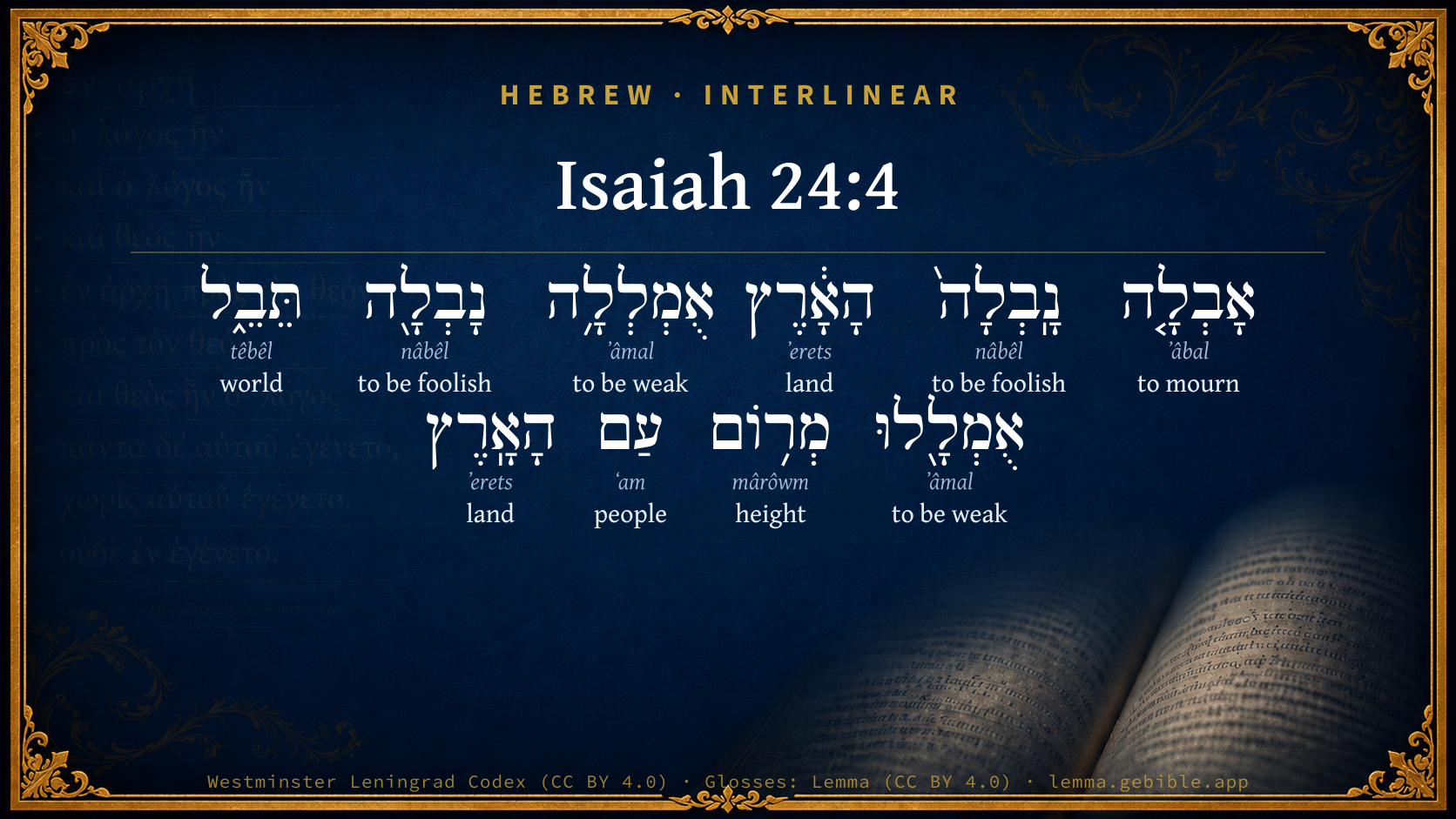
Hebrew (Westminster Leningrad Codex) Isaiah 24:4 appears in the Hebrew Old Testament. The text above is from the Westminster Leningrad Codex. Each word links to its Strong’s number, a concise gloss, and parsing drawn from the Open Scriptures Hebrew Bible morphology. Click any word for its full Brown-Driver-Briggs (BDB) entry.
Download image
Cite this verse

Isaiah 24:4 (World English Bible). Public Domain. Lemma interlinear Bible study tool, https://lemma.gebible.app/v/isaiah/24/4.

Show BibTeX & RIS
BibTeX
RIS
English Translation
The earth mourns and fades away, the world languishes and fades away, the lofty people of the earth do languish.
World English Bible · Public Domain
Download a study sheet

One document with this verse’s original text, its word-by-word gloss line, the meaning frame, cross-references with their text, attributed commentary, and full source and license credits — printable, and it pastes into notes with its structure intact.

This verse Autodidact and up

Study sheet (.html) Plain text (.txt)

A passage Seminary Student

Up to 50 verses in one chapter. A passage sheet keeps up to 6 commentary sources and 12 cross-references per verse, in the order this page ranks them, and says so on the sheet whenever that leaves anything out. Ask for a single verse and you get the Autodidact verse sheet above.

Everything on this page stays free to read, with no account — the sheet is a download of what is already on screen, not access to it.

Want to remove ads? Support Godless Engineer
Compare translations 3

The same verse in 3 English versions, stacked beneath the original-language interlinear above. Click any original word for its lexicon entry.

Each is an independent rendering of the whole verse — the interlinear is not word-aligned to these translations.

Highlighted words mark where these versions differ — a whole-verse word diff, not a word-by-word alignment.

  • World English Bible Public Domain
    The earth mourns and fades away, the world languishes and fades away, the lofty people of the earth do languish.
  • King James Version Public Domain
    The earth mourneth and fadeth away, the world languisheth and fadeth away, the haughty people of the earth do languish.
  • unfoldingWord Literal Text CC BY-SA 4.0
    The earth mourns; it withers. The world is enfeebled; it withers. They are enfeebled, the height of the people of the earth.

unfoldingWord Literal Text — © unfoldingWord, licensed CC BY-SA 4.0. Word-aligned USFM3 via Door43 (git.door43.org/unfoldingWord/en_ult).

Versions to compare (up to 4)

3 of 4 selected

Show all 18 translations

Every available English version of this verse, each an independent rendering of the whole verse.

  • World English Bible Public Domain
    The earth mourns and fades away, the world languishes and fades away, the lofty people of the earth do languish.
  • Berean Standard Bible Public Domain
    The earth mourns and withers; the world languishes and fades; the exalted of the earth waste away.
  • Majority Standard Bible Public Domain
    The earth mourns and withers; the world languishes and fades; the exalted of the earth waste away.
  • King James Version Public Domain
    The earth mourneth and fadeth away, the world languisheth and fadeth away, the haughty people of the earth do languish.
  • American Standard Version (1901) Public Domain
    The earth mourneth and fadeth away, the world languisheth and fadeth away, the lofty people of the earth do languish.
  • Revised Version (1885) Public Domain
    The earth mourneth and fadeth away, the world languisheth and fadeth away, the lofty people of the earth do languish.
  • Geneva Bible (1599) Public Domain
    The earth lamenteth and fadeth away: the world is feeble and decaied: the proude people of the earth are weakened.
  • Douay-Rheims (1899) Public Domain
    The earth mourned, and faded away, and is weakened: the world faded away, the height of the people of the earth is weakened.
  • Young's Literal Translation Public Domain
    Mourned, faded hath the land, Languished, faded hath the world, Languished have they -- the high place of the people of the land.
  • Literal Standard Version CC BY-SA 4.0
    The earth has mourned, faded, || The world has languished, faded, || They have languished—the high place of the people of the earth.
  • Unlocked Literal Bible CC BY-SA 4.0
    The earth dries up and withers, the world shrivels up and fades away, the prominent people of the earth waste away.
  • unfoldingWord Literal Text CC BY-SA 4.0
    The earth mourns; it withers. The world is enfeebled; it withers. They are enfeebled, the height of the people of the earth.
  • Darby Bible Public Domain
    The land mourneth, it fadeth away; the world languisheth, it fadeth away: the haughty people of the land do languish.
  • World Messianic Bible Public Domain
    The earth mourns and fades away. The world languishes and fades away. The lofty people of the earth languish.
  • Webster's Bible Public Domain
    The earth mourneth and fadeth away, the world languisheth and fadeth away, the haughty people of the earth do languish.
  • Free Bible Version CC BY-SA 4.0
    The earth dries up and withers away; the world shrivels up and withers away, the high and mighty people shrivel up along with the earth.
  • Bible in Basic English Public Domain
    The earth is sorrowing and wasting away, the world is full of grief and wasting away, the high ones of the earth come to nothing.
  • JPS Tanakh (1917) Public Domain
    The earth fainteth and fadeth away, the world faileth and fadeth away, the lofty people of the earth do fail.

Literal Standard Version (2020), Covenant Press — licensed CC BY-SA 4.0. Text via the HelloAO Bible API (eBible.org). Unlocked Literal Bible (unfoldingWord) — licensed CC BY-SA 4.0. Text via the HelloAO Bible API (eBible.org). unfoldingWord Literal Text — © unfoldingWord, licensed CC BY-SA 4.0. Word-aligned USFM3 via Door43 (git.door43.org/unfoldingWord/en_ult). Free Bible Version, Dr. Jonathan Gallagher — licensed CC BY-SA 4.0. Text via the HelloAO Bible API (eBible.org).

Word by word

More ways to search: Search by grammar → Find every occurrence → Compare this word →

Practice this passage: Drill this verse → Learn its vocabulary →

אֻמְלְלָ֥ה
ʼâmal
H535
“to be weak”
Verb, Pulal, Perfect, 3rd Person, Feminine, Singular
Part of Speech
Verb
Stem
Pulal
Form
Perfect
Person
3rd Person
Gender
Feminine
Number
Singular
Full BDB Definition

Origin: a primitive root

TWOT: 114

to be weak, to droop, to languish, to be exhausted - (Qal) passive participle (of the heart) - to be weak - to droop - (Pulal) - to be or grow feeble - to languish
  1. אָבְלָ֤ה ʼâbal H56 “to mourn” Verb, Qal, Perfect, 3rd Person, Feminine, Singular
  2. נָֽבְלָה֙ nâbêl H5034 “to be foolish” Verb, Qal, Perfect, 3rd Person, Feminine, Singular
  3. הָאָ֔רֶץ ʼerets H776 “the · land” Particle, Definite Article + Noun, Common, Both, Singular, Absolute
  4. נָבְלָ֖ה nâbêl H5034 “to be foolish” Verb, Qal, Perfect, 3rd Person, Feminine, Singular
  5. תֵּבֵ֑ל têbêl H8398 “world” Noun, Common, Feminine, Singular, Absolute
  6. אֻמְלָ֖לוּ ʼâmal H535 “to be weak” Verb, Pulal, Perfect, 3rd Person, Common, Plural
  7. מְר֥וֹם mârôwm H4791 “height of” Noun, Common, Masculine, Singular, Construct
  8. עַם ʻam H5971 “people of” Noun, Common, Masculine, Singular, Construct
  9. הָאָֽרֶץ ʼerets H776 “the · land” Particle, Definite Article + Noun, Common, Both, Singular, Absolute

About this verse

These counts appear in no published source. They are computed here, from the morphology-tagged text and Lemma’s own curated glosses. What Lemma adds →

10
words
7
distinct lemmas
Prophets
section

Notable vocabulary

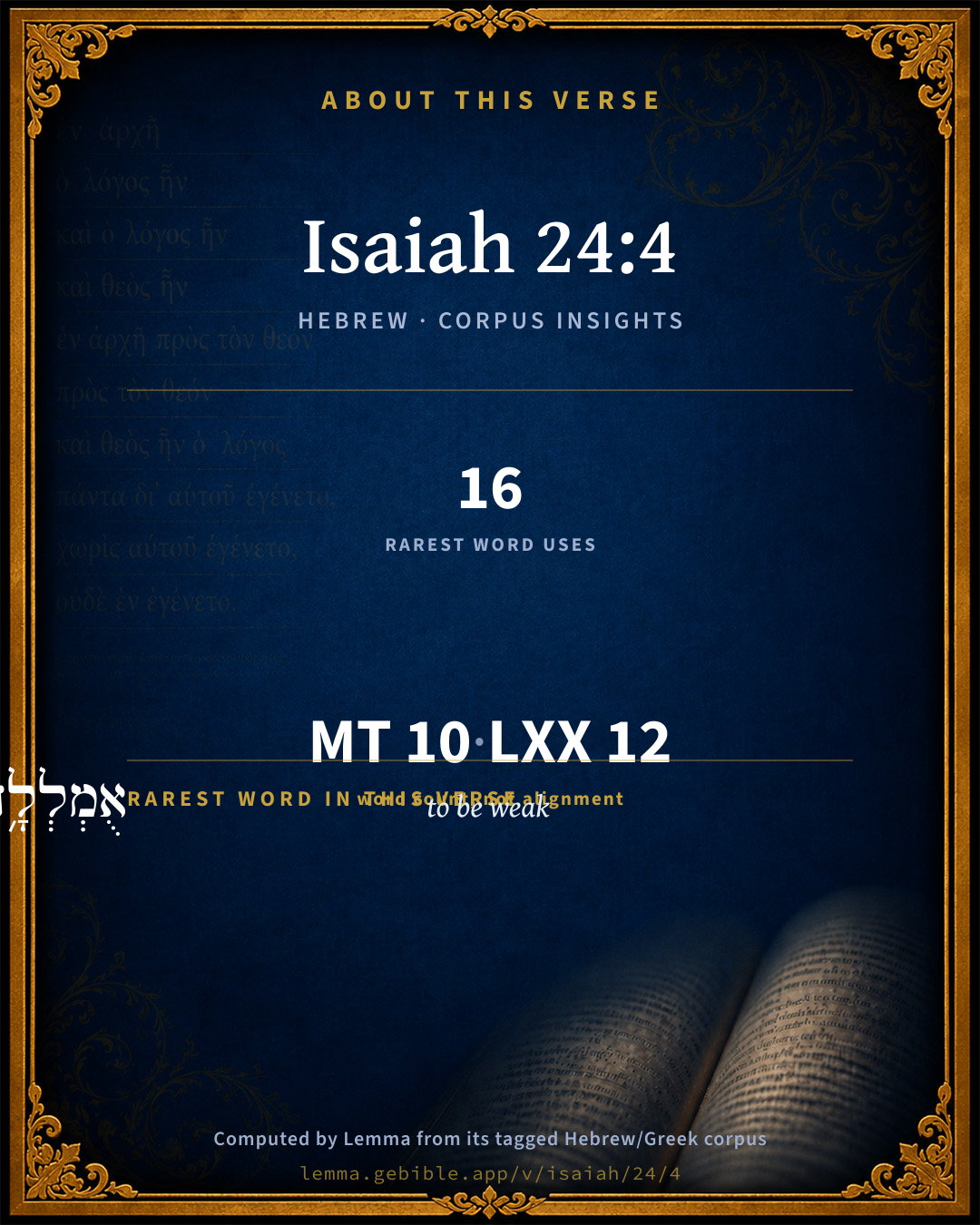
The rarest word here is אֻמְלְלָ֥ה to be weak H535 — appearing just 16 times in the whole Hebrew Bible.

Shared distinctive vocabulary

אֻמְלְלָ֥ה to be weak H535 occurs in 14 verses of the Hebrew Bible. Also found in:

Grammatical profile

  • 5 verbs
  • 5 nouns

Verb forms

  • אָבְלָ֤ה Qal · Perfect
  • נָֽבְלָה֙ Qal · Perfect
  • אֻמְלְלָ֥ה Pulal · Perfect
  • נָבְלָ֖ה Qal · Perfect
  • אֻמְלָ֖לוּ Pulal · Perfect

Repetition

Words recur within this verse — often emphatic in Hebrew:

  • נָֽבְלָה֙ to be foolish H5034 ×2
  • הָאָ֔רֶץ land H776 ×2
  • אֻמְלְלָ֥ה to be weak H535 ×2

Hebrew & Septuagint length

In English translation the verse runs 20 words from the Hebrew and 16 from the Septuagint (LXX English) — closely comparable.

A rough comparison of the two English renderings, which tokenize alike — not a word-level alignment.

Word counts can differ between the Hebrew and the Greek without any difference in meaning — e.g. the Hebrew direct-object marker אֵת has no separate Greek word, and Greek often adds the article ὁ.

In the original languages it is 10 Hebrew tokens and 12 Greek tokens — but the two are counted differently (Hebrew bundles its prefixes and suffixes into one token; the Greek is in lemma form), so that isn’t a like-for-like length.

Cross-references

8

Topical passages linked to Isaiah 24:4 in the Treasury of Scripture Knowledge — connected by theme and wording, ordered by reader-vote popularity; previews shown in the World English Bible.

  • Hosea 4:3 Therefore the land will mourn, And everyone who dwells therein will waste away. All living things in her, Even the animals of the field and the birds of the sky; Yes, the fish of the sea also die.
  • Isaiah 2:11–12 The lofty looks of man will be brought low, The haughtiness of men will be bowed down, And Yahweh alone will be exalted in that day.
  • Isaiah 3:26 Her gates shall lament and mourn; And she shall be desolate and sit on the ground.
  • Isaiah 33:9 The land mourns and languishes; Lebanon is confounded and withers away; Sharon is like a desert; and Bashan and Carmel shake off [their leaves].
  • Isaiah 28:1 Woe to the crown of pride of the drunkards of Ephraim, and to the fading flower of his glorious beauty, which is on the head of the fat valley of those who are overcome with wine!
  • Isaiah 64:6 For we are all become as one who is unclean, and all our righteousness are as a polluted garment: and we all do fade as a leaf; and our iniquities, like the wind, take us away.
  • Jeremiah 4:28 For this shall the earth mourn, and the heavens above be black; because I have spoken it, I have purposed it, and I have not repented, neither will I turn back from it.
  • Jeremiah 12:4 How long shall the land mourn, and the herbs of the whole country wither? for the wickedness of those who dwell therein, the animals are consumed, and the birds; because they said, He shall not see our latter end.

Cross-references courtesy of OpenBible.info (CC BY 4.0).

Hebrew and Greek witnesses Masoretic Hebrew ↔ Greek Septuagint

The same verse in the two great witnesses to the Old Testament, shown verse-for-verse.

These are two independent witnesses, not word-aligned to each other, and the Septuagint is shown in lemma (dictionary) form.

Hebrew Isaiah 24:4 Masoretic · Westminster Leningrad Codex

אָבְלָ֤ה נָֽבְלָה֙ הָאָ֔רֶץ אֻמְלְלָ֥ה נָבְלָ֖ה תֵּבֵ֑ל אֻמְלָ֖לוּ מְר֥וֹם עַם הָאָֽרֶץ

The earth mourns and fades away, the world languishes and fades away, the lofty people of the earth do languish.

World English Bible · Public Domain

Greek LXX Isaiah 24:4 Septuagint · lemma form

πενθέω ὁ γῆ καί φθείρω ὁ οἰκέω πενθέω ὁ ὑψηλός ὁ γῆ

The earth mourns, and the world is ruined, the lofty ones of the earth are mourning.

LXX2012 (modern English Septuagint) · Public Domain

Hebrew: Westminster Leningrad Codex (CC BY 4.0). Greek: Septuagint (public domain); English from LXX2012 (modern English Septuagint) (Public Domain). How the Septuagint differs from the Hebrew →

Targum (Aramaic paraphrase)

1

The Targum is the ancient Jewish Aramaic paraphrase of the Hebrew Scriptures — an interpretive translation, not the Hebrew text itself. Onkelos (literal) and Pseudo-Jonathan (expansive) render the Torah, and Jonathan the Prophets. Coverage is partial: where no permissively-licensed English translation exists for a verse, only the Aramaic is shown. This is verse-level text, not a word-by-word alignment to the Hebrew.

  1. Targum Jonathan Prophets (Joshua–Malachi)
    אִתְאַבְּדַת חֲרוֹבַת אַרְעָא צְדִיאַת חֲרוֹבַת תֵּבֵל סְפוּ תְקוֹף עַמָא דְאַרְעָא:

    The land mourneth, it is laid desolate; the world is laid waste, it is laid desolate: the strength of the people of the land hath come to an end.

    Targum Jonathan — Aramaic: “Mikraot Gedolot” (public domain). English: “Sefaria Community Translation” (CC0 1.0 (public-domain dedication)); “London "Chaldee Paraphrase," 1871” (public domain). Text via Sefaria.

Commentary

Notes on Isaiah 24:4 from classic Christian and Jewish commentators (each source and its license shown beneath its notes). The classic Christian expositions comment on the surrounding passage and are grouped to its opening verse, so a note may address several verses; the Jewish commentaries on the Tanakh (Rashi and others) are per-verse, so they appear only where the commentator wrote on this verse.

Lemma curates 59 commentaries, every one of them public domain or Creative Commons licensed, each selected and text-cleaned for this edition rather than reprinted as found. About our sources →

Trapp's Complete Commentary

John Trapp

Isa 24:4 The earth mourneth [and] fadeth away, the world languisheth [and] fadeth away, the haughty people of the earth do languish.

Ver. 4. The earth mourneth and fadeth away.] Luxit et diffiuxit, waileth and faileth; gallant rhetoric in the original, as this is a stately chapter all along: all the rollings of Demosthenes are but dull stuff compared to it.

The world languisheth.] As a sick man, so enfeebled that he cannot stand high alone.

John Trapp, A Commentary or Exposition upon All the Books of the Old and New Testament (1647–1656) — public domain. Text from a community e-Sword module.

Joseph Benson's Commentary

Isa 24:4. The earth, the land, mourneth and fadeth away — Hebrew, אבלה נבלה, abelah nabelah, lamenteth, falleth. The world languisheth, &c. — “The world,” says Bishop Lowth, “is the same with the land; that is, the kingdoms of Israel and Judah; orbis Iraeliticus,” the Israelitish world. Heathen authors frequently speak of particular provinces and countries under the name of orbis, orbis habitabilis, and orbis terrarum, the world, the habitable world, the whole world, &c. And the same mode of speaking is often used in the Scriptures, where we not only find the Roman empire termed the world, (even all the world,) as Luk 2:1; Act 11:28; but also Babylon, (Isa 13:11,) and this very land of Judea, Joh 12:19; and Joh 18:20. The haughty people of the land — Hebrew, מרום עם, the height of the people, those of the highest dignity in it; or the lofty people, as Bishop Lowth renders it. Not only common people are depressed and stink in sorrow, but the magistrates and rulers, the rich and powerful, the haughty and high-minded. Indeed, these are wont to suffer most under such calamities, either as having most to lose, or as not being used to hardships.

Joseph Benson's Commentary on the Old and New Testaments (1811–1818) — public domain. Text from a community e-Sword module.

Keil & Delitzsch

C. F. Keil & F. Delitzsch

That this is the case is evident from Isa 24:4-9, where the accursed state into which the earth is brought is more fully described, and the cause thereof is given. "Smitten down, withered up is the earth; pined away, wasted away is the world; pined away have they, the foremost of the people of the earth. And the earth has become wicked among its inhabitants; for they transgressed revelations, set at nought the ordinance, broke the everlasting covenant. Therefore hath the curse devoured the earth, and they who dwelt in it make expiation: therefore are the inhabitants of the earth withered up, and there are very few mortals left. New wine mourneth, vine is parched, all the merry-hearted groan. The joyous playing of tabrets is silent; the noise of them that rejoice hath ceased; the joyous playing of the guitar is silent. They drink no wine with a song; meth tastes bitter to them that drink it." "The world" (tēbēl) is used here in Isa 24:4, as in Isa 26:9 (always in the form of a proper name, and without the article), as a parallel to "the earth" (hâ'âretz), with which it alternates throughout this cycle of prophecies. It is used poetically to signify the globe, and that without limitation (even in Isa 13:11 and Isa 18:3); and therefore "the earth" is also to be understood here in its most comprehensive sense (in a different sense, therefore, from Isa 33:9, which contains the same play upon sounds). The earth is sunk in mourning, and has become like a faded plant, withered up with heat; the high ones of the people of the earth (merōm; abstr. pro concr., like câbōd in Isa 5:13; Isa 22:24) are included (עם is used, as in Isa 42:5; Isa 40:7, to signify humanity, i.e., man generally). אמללוּ (for the form, see Comm. on Job, at Job 18:16-19) stands in half pause, which throws the subjective notion that follows into greater prominence. It is the punishment of the inhabitants of the earth, which the earth has to share, because it has shared in the wickedness of those who live upon it: chânaph (not related to tânaph) signifies to be degenerate, to have decided for what is evil (Isa 9:16), to be wicked; and in this intransitive sense it is applied to the land, which is said to be affected with the guilt of wicked, reckless conduct, more especially of blood-guiltiness (Psa 106:38; Num 35:33; compare the transitive use in Jer 3:9). The wicked conduct of men, which has caused the earth also to become chanēphâh, is described in three short, rapid, involuntarily excited sentences (compare Isa 15:6; Isa 16:4; Isa 29:20; Isa 33:8; also Isa 24:5; Isa 1:4, Isa 1:6, Isa 1:8; out of the book of Isaiah, however, we only meet with this in Joe 1:10, and possibly Jos 7:11). Understanding "the earth" as we do in a general sense, "the law" cannot signify merely the positive law of Israel. The Gentile world had also a torâh or divine teaching within, which contained an abundance of divine directions (tōrōth). They also had a law written in their hearts; and it was with the whole human race that God concluded a covenant in the person of Noah, at a time when the nations had none of them come into existence at all. This is the explanation given by even Jewish commentators; nevertheless, we must not forget that Israel was included among the transgressors, and the choice of expression was determined by this. With the expression "therefore" the prophecy moves on from sin to punishment, just as in Isa 5:25 (cf., Isa 5:24). אלה is the curse of God denounced against the transgressors of His law (Dan 9:11; compare Jer 23:10, which is founded upon this, and from which אבלה has been introduced into this passage in some codices and editions). The curse of God devours, for it is fire, and that from within outwards (see Isa 1:31; Isa 5:24; Isa 9:18; Isa 10:16-17; Isa 29:6; Isa 30:27., Isa 33:11-14): chârū (milel, since pashta is an acc. postpos.),

(Note: In correct texts châr has two pashtas, the former indicating the place of the tone.)

from chârar, they are burnt up, exusti. With regard to ויּאשׁמוּ, it is hardly necessary to observe that it cannot be traced back to אשׁם = ישׁם, שׁמם; and that of the two meanings, culpam contrahere and culpam sustinere, it has the latter meaning here. We must not overlook the genuine mark of Isaiah here in the description of the vanishing away of men down to a small remnant: נשׁאר (שׁאר) is the standing word used to denote this; מזער (used with regard to number both here and in Isa 16:14; and with regard to time in Isa 10:25 and Isa 29:17) is exclusively Isaiah's; and אנושׁ is used in the same sense as in Isa 33:8 (cf., Isa 13:12). In Isa 24:7 we are reminded of Joel 1 (on the short sentences, see Isa 29:20; Isa 16:8-10); in Isa 24:8, Isa 24:9 any one acquainted with Isaiah's style will recall to mind not only Isa 5:12, Isa 5:14, but a multitude of other parallels. We content ourselves with pointing to עלּיז (which belongs exclusively to Isaiah, and is taken from Isa 22:2 and Isa 32:13 in Zep 2:15, and from Isa 13:3 in Zep 3:11); and for basshir (with joyous song) to Isa 30:32 (with the beating of drums and playing of guitars), together with Isa 28:7. The picture is elegiac, and dwells so long upon the wine (cf., Isa 16:1-14), just because wine, both as a natural production and in the form of drink, is the most exhilarating to the heart of all the natural gifts of God (Psa 104:15; Jdg 9:13). All the sources of joy and gladness are destroyed; and even if there is much still left of that which ought to give enjoyment, the taste of the men themselves turns it into bitterness.

Keil & Delitzsch — Biblical Commentary on the Old Testament (1861–1891) — public domain (CC PDM 1.0). Text via the HelloAO Bible API. (Old Testament only.)

Tyndale Open Study Notes

Tyndale Open Resources

24:4-13 All humanity is guilty (Rom 3:23) and under condemnation (see Isa 59:1-15). Judgment is likened to a failed grape harvest that brings drinking and feasting to a halt.

24:4 earth . . . dries up . . . land wastes away and withers: The prophets often used the imagery of a drought to get the attention of people who live off the land (see also Jer 23:10; Joel 1:12; Amos 1:2).

Tyndale Open Study Notes — © Tyndale Open Resources, licensed CC BY-SA 4.0. Text via the HelloAO Bible API.

Jamieson, Fausset & Brown

Robert Jamieson, A. R. Fausset & David Brown

world--the kingdom of Israel; as in Isa 13:11, Babylon.

haughty--literally, "the height" of the people: abstract for concrete, that is, the high people; even the nobles share the general distress.

Jamieson, Fausset & Brown — Commentary Critical and Explanatory on the Whole Bible (1871) — public domain (CC PDM 1.0). Text via the HelloAO Bible API.

Adam Clarke's Commentary

Verse 4. The world languisheth] The world is the same with the land; that is, the kingdoms of Judah and Israel, orbis Israeliticus. See Clarke on Isa 13:11.

Adam Clarke's Commentary on the Bible (1810–1826) — public domain. Text from a community e-Sword/MySword module.

Ellicott's Commentary for English Readers

(4) The haughty people of the earth.—Literally, the heights, or, to use an English term with a like history, “the highnesses of the people.”

A Bible Commentary for English Readers, edited by Charles John Ellicott (1878–1897) — public domain. Text from a community e-Sword module.

The Cambridge Bible for Schools and Colleges

gen. ed. J. J. S. Perowne

4. mourneth … languisheth … fadeth away] Another instance of paronomasia in the original. Cf. ch. Isa_33:9; Hos_4:3; Joe_1:10.

the haughty people] Lit. “the height of the people,” i.e. the noblest of the people. It is the only case where the word is so used (though cf. Ecc_10:6).

4–6. The earth lies under a curse on account of the wickedness of its inhabitants.

The Cambridge Bible for Schools and Colleges (gen. ed. J. J. S. Perowne; Cambridge University Press, 1878–1918) — public domain. Text from a community e-Sword module.

John Gill's Exposition

The earth mourneth, and fadeth away,.... It mourns, because of its inhabitants being destroyed; and it fades away, because stripped of its wealth and riches: so the kings of the earth, and merchants of it are represented as weeping and mourning at the destruction of Rome, because of its judgments, and the loss of its trade and riches, Rev 18:9,

the world languisheth, and fadeth away: the inhabitants of it are like a sick man, that is so faint and feeble that he cannot stand, but totters and falls; and like the leaves of trees and flowers of the fields, whose strength and beauty are gone, and fade and fall:

the haughty people of the earth do languish: the kings and merchants of the earth before mentioned, who grow sick and faint through fear of what is coming upon them.

John Gill's Exposition of the Whole Bible (1746–1763) — public domain (CC PDM 1.0). Text via the HelloAO Bible API.

Albert Barnes' Notes on the Bible

The earth mourneth - The word ‘earth’ here, as in Isa 24:1, means the land of Judea, or that and so much of the adjacent countries as would be subject to the desolation described. The figure here is taken from flowers when they lose their beauty and languish; or when the plant that lacks moisture, or is cut down, loses its vigor and its vitality, and soon withers (compare the note at Isa 1:30; Isa 34:4; Psa 1:3).

The world - (תבל têbêl). Literally, the inhabitable world, but used here as synonymous with the ‘land,’ and denoting the kingdoms of Judah and Israel (compare the note at Isa 13:11)

The haughty people - Margin, as in the Hebrew, ‘Height of the people.’ It denotes the great, the nobles, the princes of the land. The phrase is expressive of rank, not of their moral character.

Albert Barnes' Notes on the Bible (1834–1885) — public domain. Text from a community e-Sword/MySword module.

Haydock's Catholic Bible Commentary

Weakened: Joakim, &c., are made prisoners. The greatest monarchs must come before God’s tribunal.

George Leo Haydock (1774–1849), Haydock's Catholic Family Bible and Commentary, 1859 edition — public domain. Excludes Psalms (Douay-Rheims chapter numbering differs from Protestant) and Deuterocanonical books (Catholic canon only).

Matthew Poole's English Annotations

The world: from this word some infer that this prophecy concerns not only the land of Judea, but also the neighbouring countries. But if the proper signification of that word be urged, this prophecy must be extended to all the parts of the world, which these learned men will not allow. And the world, both in Scripture and other authors, is often used synecdochically for that which in truth is but a small part of it, at least in comparison with the whole; as it is not only of the Roman empire, as Luk 2:1; Act 11:28, but also of Babylon, Isa 13:11, and, which cometh nearer to the point, of this very land of Judea, as Joh 12:19; 18:20, and elsewhere. And therefore it may well be so understood here, especially when this word world is explained by those other words the earth and the land, which the very next verse showeth to be meant of Israel or Judea, as we shall there discover.

The haughty people; not only common people, who use to be of low spirits; but the high and lofty ones, who use to be stout in their words and carriages towards me, and to deride my threatenings.

Matthew Poole's English Annotations on the Holy Bible (1683–1685) — public domain. Text from a community e-Sword/MySword module.

The Pulpit Commentary

The earth... fadeth away. As a flower that fades and withers up. (comp. Isa_1:30 Isa_28:1, 4 34:4, etc.; Psa_1:3 Psa_37:2) The world. Tabel has never any narrower sense than the entire "world," and must be regarded as fixing the meaning of arets in passages where (as here) the two are used as synonymous. The haughty people; or, the high ones. All the great are brought down, and laid low, that "the Lord alone may be exalted in that day". (cf. Isa_2:11-17)

The future for haughty folk.

"The haughty people of the earth do languish." The proud are an offence unto God. It is not the rich who find it so difficult to enter the kingdom of God; it is they who "trust in riches," who boast of their riches, who make their riches the occasion for despising others.

I THE FUTURE IS AGAINST THE HAUGHTY NATURALLY. Fortune tells upon precisely those things in which they pride themselves. The picture of trembling, suffering old age, given in the Book of Ecclesiastes, is designed as a warning to the proud. See what you are certainly coming to who admired your fine persons, made so much of your independence, and pampered your appetites and passions. The picture of old age is not that of the ordinary man, but of the haughty, masterful sensualist, the sinner of the high places of society, whose iniquity comes back upon him. It is enough for haughty folk to live; life becomes their humbling and their chastisement.

II THE FUTURE IS AGAINST THE HAUGHTY PROVIDENTIALLY. For they cannot win love. Everybody serves them in fear or for pay; and so, oftentimes, their very grandeur is undermined by those about them, their riches takes wings and fly away, their dependents take advantage of their times of weakness, and all are glad to see the haughty humbled. Striking illustration may be found in the career of Squire Beckford, of Fonthill. An insufferably austere and haughty man, the providences were against him. His mansion fell with a crash. His projects failed. He was humbled to the dust, and died almost a beggar.

III THE FUTURE IS AGAINST THE HAUGHTY JUDICIALLY. For God must punish pride. It cannot be allowed to lift up its bead. The Lord hath a controversy with it. Nebuchadnezzar eats grass like an ox. "Babylon is fallen, is fallen Babylon, the type of the haughty. Belshazzar sees the recording finger write the judgment of the proud. God will bring into contempt all the proud of the earth. "God resisteth the proud, and giveth grace to the humble." Time is on the side of the meek. Time is against the haughty. The judgments of God gather, like black thunder-clouds, against those whose hearts are lifted up. The storm will burst in the ever-nearing future. The haughty man"s prosperity may blossom as a garden of delights; but God will breathe his blight upon it, and behold, as in our text, "the haughty people of the earth do languish." Then, with a true fear, let us "humble ourselves under the mighty hand of God. R.T.

The Pulpit Commentary (1880–1919), ed. H.D.M. Spence-Jones & Joseph S. Exell — public domain. Text from a community e-Sword module.

John Wesley's Explanatory Notes

The world - The land of Judea. The majesty - Not only common people, but the high and lofty ones.

John Wesley, Explanatory Notes Upon the Whole Bible (1754–1765) — public domain. Text via the GEBible commentary corpus.

J. A. Alexander on Isaiah

Joseph Addison Alexander

“The earth mourneth, fadeth; the world languisheth, fadeth; the highest of the people of the earth languish.” Earth and world are not to be taken in their widest sense, but as poetical descriptions of the country.

Joseph Addison Alexander, The Prophecies of Isaiah (1846–1847; New York: Scribner, 1870–1878) — public domain. Text from a community e-Sword module.

Rashi

Rabbi Shlomo Yitzchaki (Rashi)

it has withered (נָבְלָה) Comp. (Jeremiah 8:13) “And the leaf has withered (נָבֵל).” An expression of withering and languishing.

has been humbled (אֻמְלְלָה), an expression of humility. Comp. (Neh. 3: 34) “humble Jews (אֻמְלָלִים).”

The land (תֵּבֵל) This is the land of Israel, which is spiced (מְתֻבֶּלֶת) with many commandments.

the highest of the people of the land the pride of the people of the land.

Rashi on the Tanakh — English translations: “The Judaica Press complete Tanach with Rashi, translated by A. J. Rosenberg” (CC BY 4.0); “Pentateuch with Rashi's commentary by M. Rosenbaum and A.M. Silbermann, 1929-1934” (public domain); “The Metsudah Tanach series, Lakewood, N.J” (CC BY 4.0); and “The Book of Joshua, Metsudah Publications, 1997” (CC BY 4.0). Text via Sefaria.

Ibn Ezra

Rabbi Abraham ibn Ezra

The earth mourneth, because the King of Assyria has destroyed many countries.

נבלה Fadeth away. Niphal of בלל, to confound; comp. ונבקה, and it will be emptied (19:3); ונסבה and it will be surrounded (Ez. 41:7); the second נבלה might, however, be the Kal of נבל, to fade; comp. נבול תבול, thou wilt surely wear away (Ex. 18:18).

יושבי מרום═מרום they that sit on high, the chiefs of the land.

Ibn Ezra on the Tanakh — English translations: “Sefaria Community Translation” (CC0 1.0 (public-domain dedication)); “Yalkut, Sifsei Chachomim Chumash, Metsudah Publications, 2009” (CC BY 4.0); and “Commentary of Ibn Ezra on Isaiah - trans. by M. Friedlander, 1873” (public domain). Text via Sefaria.

Lesson kit

Teaching starters — assembled from the data on this page, not authored interpretation. Every prompt links to the verse data it draws on. Edit before teaching.

Isaiah, in the Prophets, opens this verse with 10 words (7 distinct Hebrew lemmas). Its most distinctive word is ʼâmal (“to be weak”). A historical commentator’s framing appears above. Read the whole chapter for the surrounding context.

Discussion questions

  1. What does “to be weak” (ʼâmal) contribute to the verse as a whole?
  2. How does 1 Samuel 2:5, which shares the word «to be weak», read alongside this verse?
  3. What does the repetition of “to be foolish” (2× in this one verse) do in this verse?
  4. These translations render this verse differently; the difference is in the English rendering, not the original. What questions does that raise?
  5. «אָבְלָ֤ה» is a Qal Perfect verb. How does that grammatical form shape the action described?
  6. Compare how Trapp's Complete Commentary and Joseph Benson's Commentary read this verse. Where do they agree or differ?

Things to notice

Reading settings

Reading text

Shown beneath each verse's original-language words.

Old Testament
Old Testament edition

Read the OT as the Masoretic Hebrew (MT) or the Greek Septuagint (LXX).

English shown for the Greek Septuagint (in the Hebrew ↔ Greek comparison).

Comparing translations? Open the Compare panel on any verse page to stack up to four side by side.