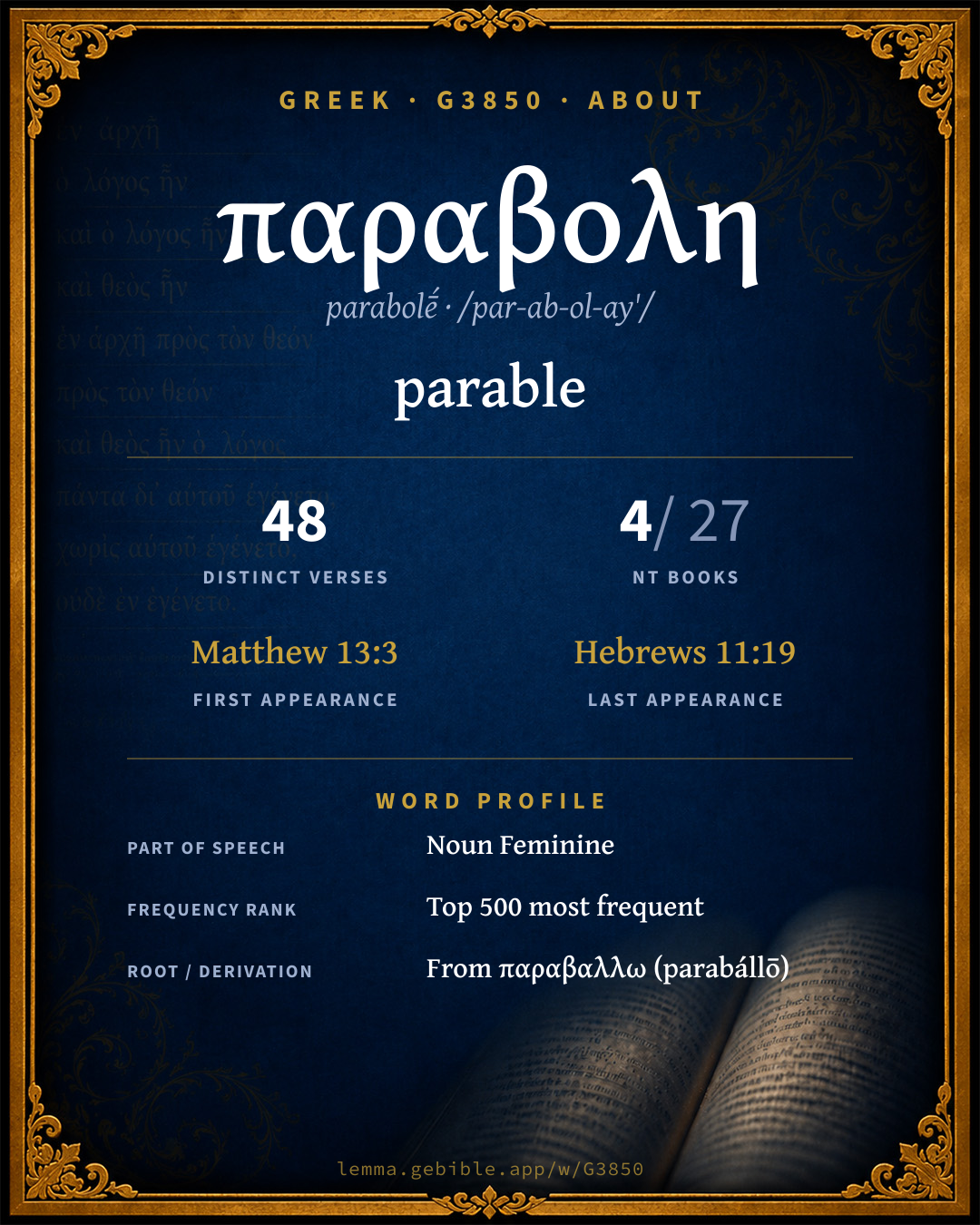
παραβολή
parable
‘parable’ is one of 5 main senses fuller range ↓
Full lexicon entry — Thayer's Greek Lexicon
From Thayer's Greek Lexicon
Where this word appears
See every Accusative-case word in the Greek New Testament →
Grammar key — what these labels mean
Part of speech
- Noun
- A naming word — a person, place, thing, or idea.
Case
- Accusative
- The case of the direct object and of extent.
- Dative
- The case of the indirect object, means, or location — “to / for / with / in.”
- Genitive
- The case of source, possession, or “of” — answers “whose / from what.”
- Nominative
- The case of the subject (and the predicate nominative).
Gender
- Feminine
- Grammatically feminine.
Number
- Singular
- One.
- Plural
- More than one.
Every verse where G3850 appears in the Book of Luke — 18 distinct verses. Click any verse to open its interlinear word-by-word view. Verse text shown in the World English Bible for context — . Each verse’s Greek form is shown with its reference; the English is not keyword-highlighted, since the data carries no word-level English alignment. Use “Compare translations” on any verse to read it across multiple English versions. This concordance covers the Greek New Testament; Septuagint (Greek Old Testament) occurrences of this word are not indexed here.
Luke
- Luke 4:23 παραβολὴν n acc sg fem He said to them, "Doubtless you will tell me this parable, 'Physician, heal yourself! Whatever we have heard done at Capernaum, do also here in your hometown.'"
- Luke 5:36 παραβολὴν n acc sg fem He also told a parable to them. "No one puts a piece from a new garment on an old garment, or else he will tear the new, and also the piece from the new will not match the old.
- Luke 6:39 παραβολὴν n acc sg fem He spoke a parable to them. "Can the blind guide the blind? Won't they both fall into a pit?
- Luke 8:4 παραβολῆς n gen sg fem When a great multitude came together, and people from every city were coming to him, he spoke by a parable.
- Luke 8:9 παραβολή n nom sg fem Then his disciples asked him, "What does this parable mean?"
- Luke 8:10 παραβολαῖς n dat pl fem He said, "To you it is given to know the mysteries of the Kingdom of God, but to the rest in parables; that 'seeing they may not see, and hearing they may not understand.'
- Luke 8:11 παραβολή n nom sg fem Now the parable is this: The seed is the word of God.
- Luke 12:16 παραβολὴν n acc sg fem He spoke a parable to them, saying, "The ground of a certain rich man brought forth abundantly.
- Luke 12:41 παραβολὴν n acc sg fem Peter said to him, "Lord, are you telling this parable to us, or to everybody?"
- Luke 13:6 παραβολήν n acc sg fem He spoke this parable. "A certain man had a fig tree planted in his vineyard, and he came seeking fruit on it, and found none.
- Luke 14:7 παραβολήν n acc sg fem He spoke a parable to those who were invited, when he noticed how they chose the best seats, and said to them,
- Luke 15:3 παραβολὴν n acc sg fem He told them this parable.
- Luke 18:1 παραβολὴν n acc sg fem He also spoke a parable to them that they must always pray, and not give up,
- Luke 18:9 παραβολὴν n acc sg fem He spoke also this parable to certain people who were convinced of their own righteousness, and who despised all others.
- Luke 19:11 παραβολήν n acc sg fem As they heard these things, he went on and told a parable, because he was near Jerusalem, and they supposed that the Kingdom of God would be revealed immediately.
- Luke 20:9 παραβολὴν n acc sg fem He began to tell the people this parable. "A man planted a vineyard, and rented it out to some farmers, and went into another country for a long time.
- Luke 20:19 παραβολὴν n acc sg fem The chief priests and the scribes sought to lay hands on Him that very hour, but they feared the people--for they knew He had spoken this parable against them.
- Luke 21:29 παραβολὴν n acc sg fem He told them a parable. "See the fig tree, and all the trees.
About this entry
At a glance — auto-summarized from this page’s data, not written by a person. Every figure links to its source below. This summary describes the numbers; it doesn’t interpret them.
παραβολη (parabolḗ) is a Greek noun most often rendered “parable.” Its lexical range runs to 5 senses. It turns up in 48 verses across 4 books, a moderately common footprint. It concentrates in Luke, which alone accounts for 38% of its uses. It first appears in Matthew 13:3. For the data behind this summary, explore the sense tree and the renderings breakdown below.
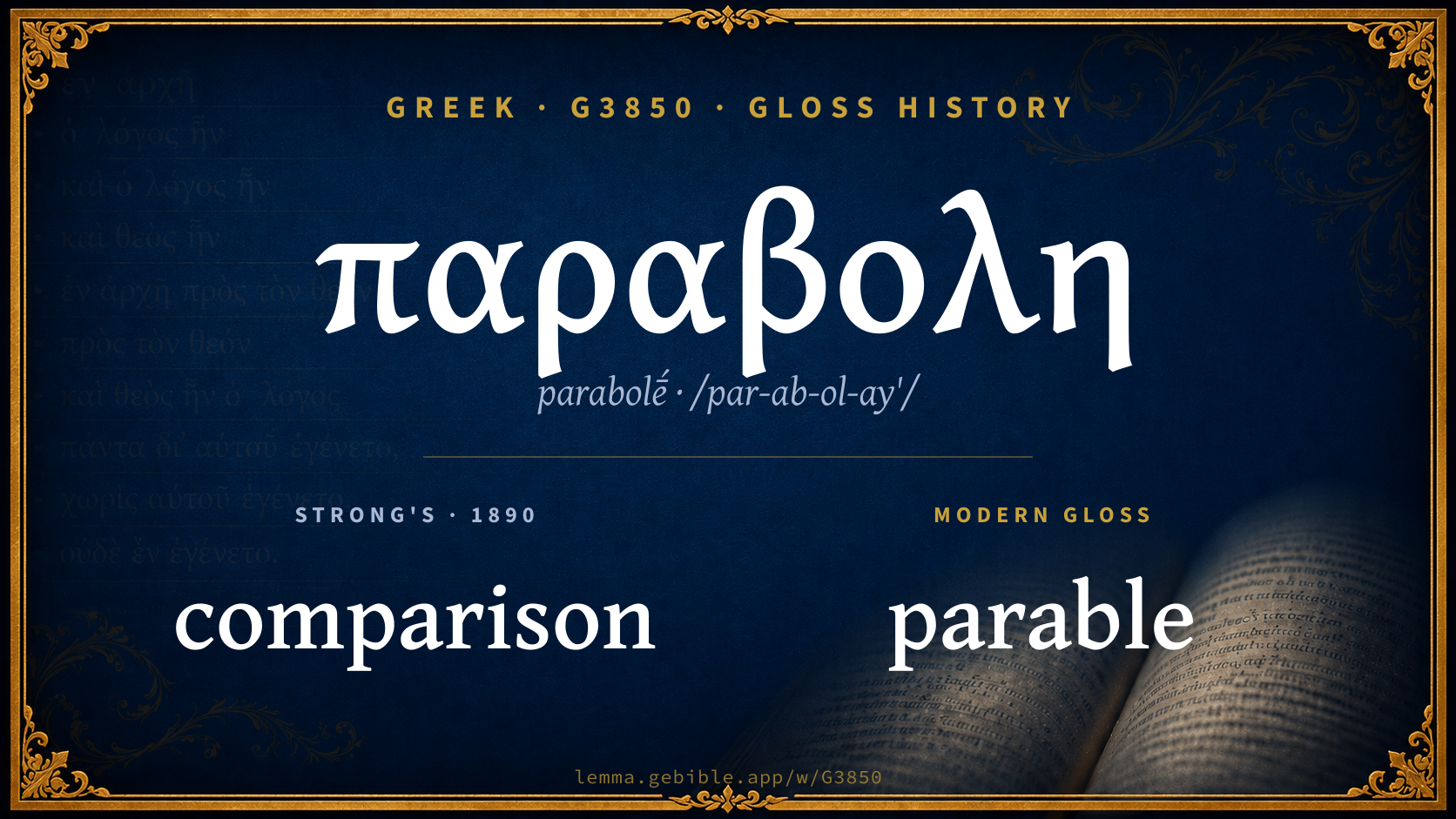
Gloss history
Strong's 1890 vs modern scholarship
About this word
Strong's G3850 catalogs a Greek word from the Greek New Testament.
These counts are not copied from any lexicon or concordance. They are computed here, from the morphology-tagged Greek New Testament. What Lemma adds →
- 48
- distinct verses
- The word appears in 48 distinct verses.
- 4 / 27
- NT books
- The word appears in 4 of 27 New Testament books.
- #310
- by frequency
- Top 500 most frequent Greek words (rank 310 of 5,347 Greek words by occurrence).
View all 48 occurrences in the concordance →
By section of the New Testament
By traditional corpus
Conventional, traditional groupings — biblical authorship is debated, so this is a traditional corpus grouping, not an authorship claim. Some books belong to more than one corpus (Luke is in both the Gospels and the Lukan corpus, and so on), so these shares overlap and need not total 100%. Each figure is a share of the word’s 48 distinct verses.
- Gospels 46 verses · 96%
- Lukan (Luke–Acts) 18 verses · 38%
- Hebrews 2 verses · 4%
How translations render this word
Counts come from each version’s own published word-to-Strong’s tagging or interlinear alignment — an approximate guide to how each version renders this word, not a word-level alignment the data otherwise carries. Because each total is that version’s own tagged count, the per-version totals vary from one another and need not match the appearance or distinct-verse counts above. These counts may also differ from a printed concordance because Lemma counts each distinctly tagged rendering and does not collapse phrase taggings into a single head-word total. This is a fixed set of word-tagged versions (KJV, ASV, BSB, ULT) and does not change with the reading translation you choose elsewhere. Each version’s license is shown beside its name below (and on Sources).
- King James Version: Parable 31×, Parables 15×
- American Standard Version: Parable 31×, Parables 16×
- Berean Standard Bible: Parable 30×, Parables 15×, Lesson 2×
- unfoldingWord Literal Text: Parable 33×, Parables 16×
King James Version Public Domain
Renders G3850 across 50 tagged occurrences — most commonly:
Plus 4 renderings that appear only once — usually multi-word phrases or single function words the recovered tagging swept in, not distinct renderings.
American Standard Version Public Domain
Renders G3850 across 49 tagged occurrences — most commonly:
Plus 2 renderings that appear only once — usually multi-word phrases or single function words the recovered tagging swept in, not distinct renderings.
Berean Standard Bible Public Domain
Renders G3850 across 50 tagged occurrences — most commonly:
Plus 3 renderings that appear only once — usually multi-word phrases or single function words the recovered tagging swept in, not distinct renderings.
unfoldingWord Literal Text CC BY-SA 4.0
Renders G3850 across 51 tagged occurrences — most commonly:
Plus 2 renderings that appear only once — usually multi-word phrases or single function words the recovered tagging swept in, not distinct renderings.
Senses in Thayer's
The 5 senses Thayer's distinguishes for this word, in lexicon order (not ranked by frequency or importance). The full entry — with sub-senses — is in the Lexicon Entry tab.
- a placing of one thing by the side of another, juxtaposition, as of ships in battle
- metaph.
- a pithy and instructive saying, involving some likeness or comparison and having preceptive or admonitory force
- a proverb
- an act by which one exposes himself or his possessions to danger, a venture, a risk
Word origin
Derived from παραβαλλω (parabállō) (G3846) — to place beside.
From G3846 ; a similitude (parable) that is (symbolically) fictitious narrative (of common life conveying a moral) apoth gm or adage : - comparison figure parable proverb.
— Strong’s Exhaustive Concordance (1890), public domain.
Forms in the corpus
The 9 distinct written forms G3850 takes in the Greek New Testament, most frequent first — each parse links to that case’s occurrences in the concordance.
| Form | Parsing | Example | Uses |
|---|---|---|---|
| παραβολὴν parabolḕn | Noun, Accusative, Singular, Feminine | Matthew 13:18 | 19 |
| παραβολαῖς parabolaîs | Noun, Dative, Plural, Feminine | Matthew 13:3 | 12 |
| παραβολήν parabolḗn | Noun, Accusative, Singular, Feminine | Matthew 15:15 | 7 |
| παραβολὰς parabolàs | Noun, Accusative, Plural, Feminine | Matthew 13:53 | 3 |
| παραβολῆς parabolē̂s | Noun, Genitive, Singular, Feminine | Matthew 13:34 | 3 |
| παραβολή parabolḗ | Noun, Nominative, Singular, Feminine | Luke 8:9 | 2 |
| παραβολῇ parabolē̂ | Noun, Dative, Singular, Feminine | Mark 4:30 | 2 |
| παραβολάς parabolás | Noun, Accusative, Plural, Feminine | Mark 4:10 | 1 |
| παραβολὴ parabolḕ | Noun, Nominative, Singular, Feminine | Hebrews 9:9 | 1 |
Septuagint usage
The same Greek word παραβολη appears 34 times in the Greek Old Testament (Septuagint), across 33 verses in 14 books.
- 34
- LXX occurrences
- Tagged occurrences of this Greek word in the Septuagint.
- 33
- verses
- Distinct Septuagint verses containing this word.
- 14 / 39
- OT books
- The word appears in 14 of the 39 Old Testament books.
Sample Septuagint occurrences
- Numbers 23:7 παραβολή
- Deuteronomy 28:37 παραβολή
- 1 Samuel 10:12 παραβολή
- 2 Samuel 23:3 παραβολή
- 1 Kings 5:12 παραβολή
- 2 Chronicles 7:20 παραβολή
- Psalms 43:15 παραβολή
- Proverbs 1:6 παραβολή
- Ecclesiastes 1:17 παραβολή
- Jeremiah 24:9 παραβολή
- Ezekiel 12:22 παραβολή
- Daniel 12:8 παραβολή
Septuagint occurrences (same lexeme)
Every verse where the same Strong’s number (G3850) appears in the Greek Septuagint. Verse text shown in the World English Bible for context; the Greek form is the matched word — the English is not keyword-highlighted.
- Numbers 23:7 παραβολή He took up his parable, and said, From Aram has Balak brought me, The king of Moab from the mountains of the East: Come, curse me Jacob, Come, defy Israel.
- Numbers 23:18 παραβολή He took up his parable, and said, Rise up, Balak, and hear; Listen to me, you son of Zippor:
- Numbers 24:3 παραβολή He took up his parable, and said, Balaam the son of Beor says, The man whose eye was closed says;
- Numbers 24:15 παραβολή He took up his parable, and said, Balaam the son of Beor says, The man whose eye was closed says;
- Numbers 24:20 παραβολή He looked at Amalek, and took up his parable, and said, Amalek was the first of the nations; But his latter end shall come to destruction.
- Numbers 24:21 παραβολή He looked at the Kenite, and took up his parable, and said, Strong is your dwelling-place, Your nest is set in the rock.
- Numbers 24:23 παραβολή He took up his parable, and said, Alas, who shall live when God does this?
- Deuteronomy 28:37 παραβολή You shall become an astonishment, a proverb, and a byword, among all the peoples where Yahweh shall lead you away.
- 1 Samuel 10:12 παραβολή One of the same place answered, Who is their father? Therefore it became a proverb, Is Saul also among the prophets?
- 1 Samuel 24:14 παραβολή After whom is the king of Israel come out? after whom do you pursue? after a dead dog, after a flea.
- 2 Samuel 23:3 παραβολή The God of Israel said, The Rock of Israel spoke to me: One who rules over men righteously, Who rules in the fear of God,
- 1 Kings 5:12 παραβολή Yahweh gave Solomon wisdom, as he promised him; and there was peace between Hiram and Solomon; and they two made a league together.
- 2 Chronicles 7:20 παραβολή then will I pluck them up by the roots out of my land which I have given them; and this house, which I have made holy for my name, will I cast out of my sight, and I will make it a proverb and a byword among all peoples.
- Psalms 43:15 παραβολή
- Psalms 48:5 παραβολή They saw it, then they were amazed. They were dismayed, They hurried away.
- Psalms 68:12 παραβολή "Kings of armies flee! They flee!" She who waits at home divides the spoil,
- Psalms 77:2 παραβολή In the day of my trouble I sought the Lord. My hand was stretched out in the night, and didn't get tired. My soul refused to be comforted.
- Proverbs 1:6 παραβολή To understand a proverb, and parables, The words and riddles of the wise.
- Ecclesiastes 1:17 παραβολή I applied my heart to know wisdom, and to know madness and folly. I perceived that this also was a chasing after wind.
- Ecclesiastes 12:9 παραβολή Further, because the Preacher was wise, he still taught the people knowledge. Yes, he pondered, sought out, and set in order many proverbs.
- Jeremiah 24:9 παραβολή I will even give them up to be tossed back and forth among all the kingdoms of the earth for evil; to be a reproach and a proverb, a taunt and a curse, in all places where I shall drive them.
- Ezekiel 12:22 παραβολή Son of man, what is this proverb that you have in the land of Israel, saying, The days are prolonged, and every vision fails?
- Ezekiel 12:23 παραβολή Tell them therefore, Thus says the Lord Yahweh: I will make this proverb to cease, and they shall no more use it as a proverb in Israel; but tell them, The days are at hand, and the fulfillment of every vision.
- Ezekiel 16:44 παραβολή Behold, everyone who uses proverbs shall use [this] proverb against you, saying, As is the mother, so is her daughter.
- Ezekiel 17:2 παραβολή Son of man, put forth a riddle, and speak a parable to the house of Israel;
- Ezekiel 18:2 παραβολή What do you mean, that you use this proverb concerning the land of Israel, saying, The fathers have eaten sour grapes, and the children's teeth are set on edge?
- Ezekiel 18:3 παραβολή As I live, says the Lord Yahweh, you shall not have [occasion] any more to use this proverb in Israel.
- Ezekiel 19:14 παραβολή Fire is gone out of the rods of its branches, it has devoured its fruit, so that there is in it no strong rod to be a scepter to rule. This is a lamentation, and shall be for a lamentation.
- Ezekiel 21:5 παραβολή and all flesh shall know that I, Yahweh, have drawn forth my sword out of its sheath; it shall not return any more.
- Ezekiel 24:3 παραβολή Utter a parable to the rebellious house, and tell them, Thus says the Lord Yahweh, Set on the caldron, set it on, and also pour water into it:
- Daniel 12:8 παραβολή I heard, but I didn't understand: then said I, my lord, what shall be the issue of these things?
- Micah 2:4 παραβολή In that day they will take up a parable against you, And lament with a doleful lamentation, saying, 'We are utterly ruined! My people's possession is divided up. Indeed he takes it from me and assigns our fields to traitors!'"
- Habakkuk 2:6 παραβολή Won't all these take up a parable against him, and a taunting proverb against him, and say, 'Woe to him who increases that which is not his, and who enriches himself by extortion! How long?'
These are occurrences of the same Greek lexeme (G3850) in the Septuagint — not a translation of any one Hebrew word. The store carries no word-level Hebrew↔Greek alignment, so no Hebrew original is asserted here. Counts come from the recovered LXX Strong's tagging — high-frequency vocabulary is well covered, while rare or late forms may be untagged — so they reflect tagged occurrences and may slightly undercount.